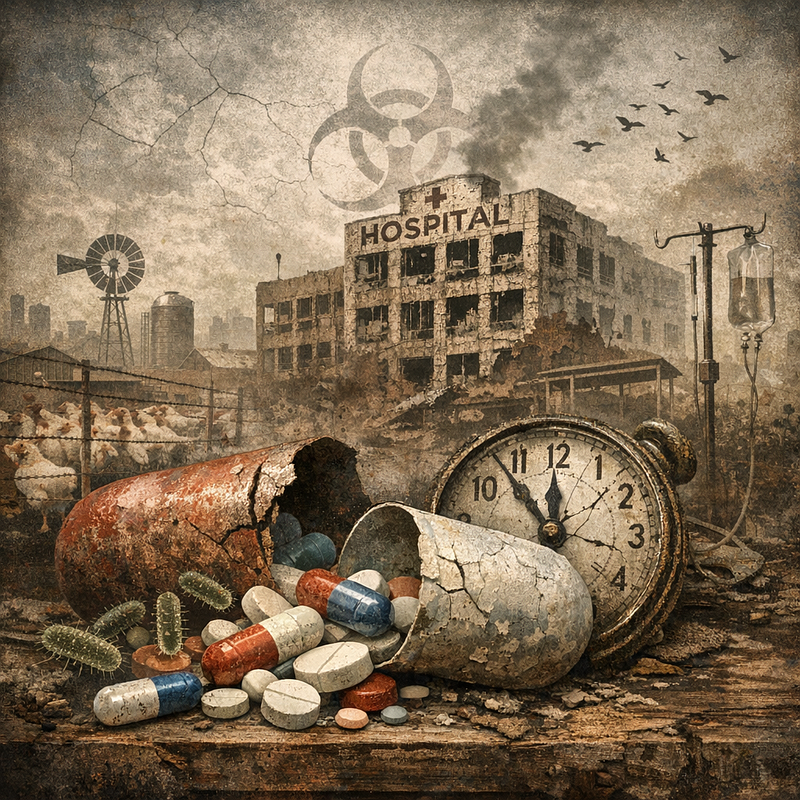
For most of the twentieth century, modern life made a quiet assumption.
Not spoken.
Not defended.
Simply lived.
You could cut into a body and close it again.
You could concentrate animals by the thousands and still eat them safely.
You could cross continents with an infection and expect it to stop at a pharmacy.
You could grow old in a dense city and survive the small injuries that once ended lives.
Nothing about this felt extraordinary.
It felt stable.
Repeatable.
Permanent enough to forget.
Antibiotics did not arrive as a revelation.
They arrived as confirmation.
They reassured a world already moving faster than biology that it could continue without renegotiation. They settled questions without announcing that they were temporary answers.
They did not claim attention.
They occupied the background, where assumptions live.
From there, systems learned to lean.
Hospitals expanded without rethinking their margins.
Agriculture scaled without revisiting biological limits.
Cities densified without recalculating exposure.
Each decision was rational.
Together, they formed a dependency that did not look like one.
Antibiotics shortened recovery.
They narrowed uncertainty.
They smoothed variation.
They made time legible.
Schedules held.
Forecasts worked.
Plans closed.
Life reorganized itself around the expectation that infection would no longer decide outcomes.
This expectation was never stated.
It did not need to be.
It functioned.
Only later did it become clear that what functioned was not control, but delay.
A system that pushes consequence forward in time does not describe itself as provisional. It presents itself as reliable.
Antibiotics were not a cure.
They were a delay.
By the time resistance appeared as data rather than anomaly, the delay had already been built into architecture. Into training. Into logistics. Into the mathematics of survival.
Resistance did not interrupt progress.
It revealed what progress had been leaning on.
The Temporary Miracle
The discovery of antibiotics is often told as a clean turning point.
A moment when humanity crossed an invisible line and left an older world behind.
Before, infection ruled.
After, medicine intervened.
The story is tidy because it flatters intention.
In reality, antibiotics entered medicine not as philosophy, but as workaround.
Surgery existed before them.
So did chemotherapy, intensive care, and invasive diagnostics.
What antibiotics changed was not possibility, but survivability.
They made risk tolerable.
A surgeon could cut deeper because infection no longer guaranteed failure.
An oncologist could suppress immunity because bacterial complications could be contained.
Hospitals could fill with vulnerable bodies because outbreaks could be managed rather than feared.
What looked like progress was, in practice, a recalibration of acceptable loss.
The miracle was not that antibiotics eliminated infection.
It was that they made infection predictable enough to ignore.
Once predictability entered the system, ambition followed.
Medicine layered procedures on top of procedures.
Devices on top of bodies.
Timelines on top of recovery.
Each layer assumed the one beneath it would hold.
The same logic spread outward.
Food production adopted antibiotics not as medicine, but as insurance.
Animals grew faster.
Density stopped being a biological risk and became an economic advantage.
Cities followed.
Millions of bodies moved through shared air, shared transport, shared spaces with quiet confidence that microbial chaos had been tamed.
Antibiotics made this confidence feel earned.
But confidence is not permanence.
The miracle was conditional.
It worked because bacteria had not yet adapted at scale.
Because time had not yet closed the gap between intervention and response.
That gap is what antibiotics bought.
They did not stop evolution.
They postponed its consequences.
And delays, when successful, are mistaken for resolution.
Evolution Never Signed the Contract
Evolution never agreed to this arrangement.
Bacteria did not need to become smarter.
They only needed to continue.
Long before humans named them, they were already exchanging genetic material, iterating across generations measured in minutes, adapting to hostility as a condition of existence.
Antibiotics changed the environment everywhere at once.
Every dose became a lesson.
Most organisms died.
A few survived.
Those survivors reproduced, exchanged advantages, and passed them sideways as easily as forward.
What had been rare became common.
What had been local became mobile.
Some of these organisms now circulate quietly through hospitals under technical names that carry no drama.
Carbapenem-resistant Enterobacteriaceae.
ESBL-producing strains.
Multi-drug resistant tuberculosis.
They are not exotic.
They are not unexpected.
They are the logical outcome of pressure applied at scale.
Evolution does not negotiate.
It does not pause for regulation or intent.
It accumulates.
Hospitals became concentrated fields of selection.
Farms accelerated the process.
Wastewater carried it outward.
Rivers and coastlines learned the lesson too.
What humans treated as a consumable, biology archived as information.
The Industrial Shortcut
If hospitals were laboratories of selection, industrial agriculture was its accelerator.
Antibiotics entered farming not to cure disease, but to prevent interruption.
Density amplifies infection.
Stress suppresses immunity.
Uniform genetics narrow resilience.
Antibiotics stabilized output.
Used continuously at low doses, they reduced mortality and increased growth.
Meat became cheaper.
Scale became profitable.
Here, antibiotics were not medicine.
They were infrastructure.
Low-dose exposure did not eliminate bacteria.
It trained them.
Manure spread resistance into soil.
Runoff carried it into waterways.
Dust lifted it into air.
None of this required negligence.
It followed directly from design.
Scale, once achieved, is difficult to surrender.
The Hospital Without a Net
Modern hospitals are designed around redundancy.
Backup power.
Backup oxygen.
Backup staffing.
They do not have backup biology.
Antibiotics sit beneath nearly every invasive act.
When they weaken, the net does not tear.
It thins.
Procedures remain possible.
Margins shrink.
Care becomes cautious.
Decisions shift.
What was routine becomes conditional.
Medicine does not fail loudly.
It narrows quietly.
The Moment That Does Not Make the News
There is no announcement when antibiotics stop being reliable.
No emergency declaration.
No singular failure.
No date to remember.
What appears instead is hesitation.
A procedure postponed.
A drug withheld.
A patient classified as too complex.
Nothing dramatic happens.
Something fundamental shifts.
From this point on, medicine no longer asks can this be done.
It asks should this still be done.
That question does not leave again.
When antibiotics fail, medicine does not collapse.
It recalibrates.
What Actually Changes
When antibiotics lose their reliability, the world does not collapse.
It contracts.
Medicine continues.
But under narrower conditions.
Surgeries still take place.
Fewer qualify as reasonable.
Treatments remain available.
Thresholds rise.
Infections are addressed.
Outcomes spread wider than before.
Small events regain weight.
A cut no longer resolves itself by default.
A post-operative fever lingers longer in decision-making.
Recovery timelines loosen.
Back to normal becomes a conditional phrase.
Hospitals adapt without spectacle.
Selection replaces routine.
Age, resilience, and context begin to matter more than protocol.
What was once offered must now be justified.
Medicine grows less universal without ever saying so.
Outside clinical walls, consequences accumulate quietly.
Illness stretches into weeks instead of days.
Absence from work becomes harder to absorb.
Insurance systems recalibrate.
Coverage tightens.
A form gains an extra checkbox.
Risk migrates outward.
Food systems feel it too.
Without antibiotics as insurance, scale loses its buffer.
Outbreaks disrupt supply.
Prices fluctuate.
Efficiency gives way to exposure.
In crises, margins disappear first.
War wounds infect more often.
Disaster zones lose medical slack.
Humanitarian care moves quickly from treatment to triage.
And then something deeper changes.
Expectations lower.
Societies stop assuming that illness resolves cleanly.
That intervention guarantees recovery.
That medicine restores continuity.
Care remains.
Promise thins.
The consequence is not mass death.
It is the end of certainty.
Life continues under new conditions.
Slower.
More selective.
Less forgiving of error.
This is what a post-antibiotic world looks like.
Not collapsed.
Constrained.
The Collapse of Short Time
Modern systems are built on short time.
Budgets assume resolution.
Calendars assume recovery.
Institutions assume disruption can be absorbed and closed.
Antibiotics made this viable.
Resistance stretches time.
Not indefinitely.
Just enough to break coordination.
Healing still happens.
It just stops arriving on schedule.
Civilizations do not fail when resources disappear.
They fail when timing does.
Planning shifts.
Institutions hedge instead of expand.
Preservation replaces ambition without being named.
Living With Deferred Consequence
Human psychology is well suited to sudden danger.
It is poorly suited to slow erosion.
Antibiotic resistance inconveniences rather than alarms.
Each effect is manageable.
Together, they reshape behavior without triggering mobilization.
Adaptation masks loss.
What we learn to live with stops looking like decline.
The Return of the Careful Body
Antibiotics allowed societies to forget the body.
Minor injuries became trivial.
Exposure acceptable.
Risk externalized.
Resistance brings the body back into awareness.
Not as fragile.
As unbuffered.
Antibiotics allowed societies to forget the body.
Resistance forces it back into consideration.
Density Reconsidered
Modern cities were built on biological optimism.
Crowded air.
Shared surfaces.
Constant contact.
As resistance grows, cities do not empty.
They recalibrate.
Innocence fades.
Proximity regains consequence.
Systems That Remember Without Thinking
Systems do not think.
They remember.
Antibiotics were encoded everywhere.
Once encoded, they stopped being questioned.
Memory resists revision.
What is remembered as normal is defended as necessary.
The Knowledge That Circulates Quietly
Resistance is taught.
Studied.
Modeled.
But it is rarely narrated.
Knowledge without narrative does not travel far.
From Right to Chance
Antibiotics supported the moral architecture of entitlement.
Without them, care becomes probabilistic.
Care without effective antibiotics cannot be promised.
It can only be attempted.
This is an ethical rupture.
The Absence of Motive
All of this is known.
What is missing is motive.
There is no profit in restraint.
No prestige in limits.
No breakthrough in acceptance.
Systems designed to reward progress
have no instinct for funding boundaries.
Resistance is managed.
Not solved.
Closing Reflection
Antibiotics allowed civilization to behave as if biology were negotiable.
For a time, it was.
What ends now is not medicine.
It is the illusion that time itself could be postponed indefinitely.
Not all collapses are loud.
Some arrive as boundaries we learn to inhabit.
Related from The Manifest Archive