Rome is easiest to misread when the city is full. By midmorning the square is spectacle, the façades are backdrop, and the names cut above the doors vanish behind movement and cameras and guided voices. But before dawn, when the delivery vans echo through the Borgo and priests pass through side gates with keys in their hands, the city looks less like a monument to the past than like a system still quietly reporting for duty. In most cities the old names belong to history. In Rome they behave like infrastructure.
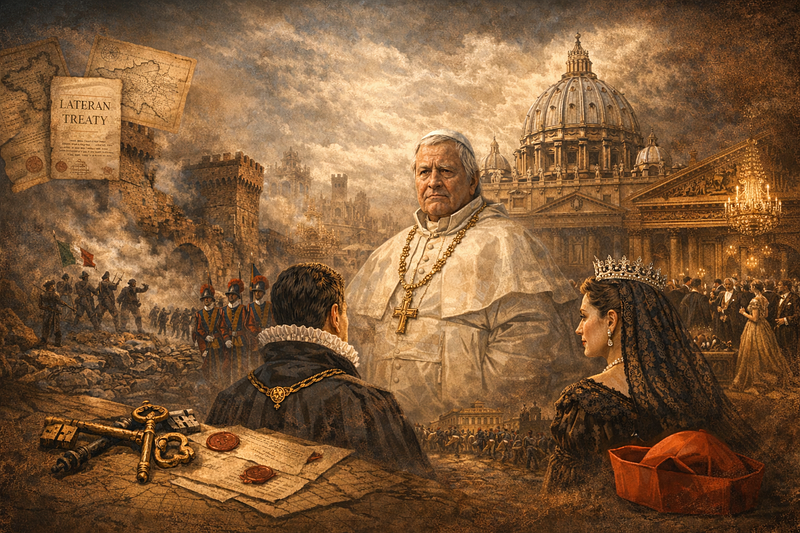
This is not the story of those families, which is told elsewhere in this archive. It is the story of the fifty-nine years in which the institution they surrounded performed the strangest feat in modern European statecraft. From 1870 to 1929 the papacy had no country. The Papal States were gone, annexed by the new Kingdom of Italy, and the pope governed no territory at all beyond the walls of a palace he refused to leave. And across those six decades the Holy See went on functioning as a sovereign: refusing the conqueror's terms, withholding millions of citizens from the new state's politics, exchanging ambassadors with the great powers, and being treated, by most of the world, as a continuing actor in international affairs. It was a state without a state, and the way it managed that is the clearest case in modern history of a power surviving the loss of the one thing every textbook says a power cannot do without, which is ground.
The breach, and the question underneath it
On the 20th of September 1870 the troops of the Kingdom of Italy breached the Aurelian Walls at Porta Pia. The military phase lasted a morning; the political meaning was enormous. The Papal States, which had given the pope direct temporal rule over a broad swathe of central Italy for more than a thousand years, came to an end. Rome was annexed and made the capital of a united Italy, and the long arc of the Risorgimento reached its symbolic completion.
The conventional account stops there, and it is the account winners prefer, because it is linear and clean. An outdated clerical sovereignty gave way to the modern nation state. The pope lost his kingdom and retreated into religion. The future belonged to Italy. All of that is true, and all of it is only half the story, because it answers the easy question, what did the papacy lose, and never asks the hard one. What did it keep, and how did it keep it without the territory that had supposedly held everything together.
The hard question is the interesting one, because the papacy's answer to it ran against the deepest assumption of the age it was living in. The nineteenth century was the century of the territorial nation state, the century in which sovereignty and soil became, in the European mind, the same thing. A power without land was, by definition, a power that had ended. The Holy See spent the next fifty-nine years quietly demonstrating that the definition was wrong.
The law it refused
The first move was a refusal, and it is the move that reveals the whole strategy.
In May 1871 the Italian parliament passed the Law of Guarantees, a statute meant to settle the pope's position inside the new order. It was, on its face, generous. It declared the pope's person sacred and inviolable, granted him royal honours and the right to send and receive ambassadors, guaranteed him the free use of the Vatican, the Lateran, and the villa at Castel Gandolfo, and offered him a large annual income from the Italian treasury. A defeated sovereign might have taken the deal. Pius IX rejected it within two days, in the encyclical Ubi Nos, and refused the money, and no pope touched the allowance for the next fifty-eight years while it sat accumulating in the Italian books.
The refusal looks, at first, like pride, and it was something far more calculated than pride. The Law of Guarantees was a unilateral act of the Italian state, a domestic law, not a treaty between equals. What one parliament grants, another parliament can revoke. To accept the law would have been to accept that the pope's status was now a concession of Italy, held at Italy's pleasure, defined by the very power that had taken his kingdom. Refusing it was the assertion that the Holy See's sovereignty did not come from Italy and could not be defined by it, that it was older than the Kingdom of Italy and did not depend on the Kingdom's permission to exist. A power that lets its conqueror write the terms of its survival has already surrendered the thing that matters. The papacy declined to let the conqueror hold the pen.
The allowance the law offered was no token, either. It was a large yearly sum, commonly given as over three million lire a year, meant to replace the revenues of the lost Papal States, and the popes left every lira of it untouched for fifty-eight years. The unclaimed money simply accumulated on the Italian books, a standing reminder that the Holy See had never accepted the settlement, and when the Roman Question was finally resolved in 1929 the long-refused compensation reappeared, transformed, in the financial terms of the treaty. The papacy had refused to be paid off by a law it had not agreed to, and waited, across three generations, until it could be paid by an agreement it had.
The prisoner who was making a point
The second move was the posture that gave the whole period its name. From 1870 onward the popes refused to leave the Vatican, declaring themselves prisoners there, and five of them in succession, Pius IX, Leo XIII, Pius X, Benedict XV, and Pius XI, held to the refusal for fifty-nine years. None of them set foot in the Rome that now belonged to the Italian king.
It is easy to read this as sulking, an old man's grievance dressed up as principle, and that reading misses the function entirely. To step out of the Vatican and walk in Rome would have been to move, as an ordinary subject, through territory now governed by Italy, and so to perform, in the most public way available, acceptance of the seizure. Staying inside was a doctrine of non-recognition made physical. As long as the pope was a prisoner, the annexation was not settled; it was an open wound, a thing still being contested rather than a transfer already complete. The confinement kept the Roman Question alive precisely by refusing to let it close. A prisoner is, by definition, someone who has not consented, and a power that has not consented has not, in the deepest sense, been defeated. It has only been, for the moment, overpowered, which is a different and a more temporary thing.
The surest sign that this was policy and not temperament is that it survived the men who practised it. The prisoner posture was held by five very different popes across fifty-nine years, the embittered Pius IX, the diplomatic Leo XIII, the pastoral Pius X, the wartime Benedict XV, the negotiating Pius XI, men of sharply different character and circumstance, and not one of them broke it. A grievance belongs to a person and dies with him. A stance that five successive personalities all maintain, against the daily temptation simply to walk out into the most beautiful city in the world, is not a mood. It is an institutional decision, taken once and renewed by each office-holder because the office, not the man, required it. That is the difference between a sulk and a strategy, and the proof is the consistency across temperaments. The Vatican was not nursing a wound for sixty years. It was running a position.
The night the mob came for the body
How raw the conflict really was can be measured by a single night in the summer of 1881. Pius IX had died in 1878, and his remains had rested temporarily in Saint Peter's; his wish was to be buried in the basilica of San Lorenzo fuori le Mura, across the city. When the time came to move the coffin, the transfer was done after dark, to avoid trouble, and the trouble came anyway. As the funeral procession crossed Rome in the night, an anti-clerical crowd set on it, shouting against the dead pope, jostling the cortege along the river, and at the height of it a part of the mob tried to seize the coffin and throw the body of Pius IX into the Tiber. The police barely held the line, and the remains reached San Lorenzo only under guard.
It is worth holding that scene against the dignified abstraction of the Roman Question, because it shows what was actually at stake in the streets. This was not a polite constitutional disagreement over the pope's legal status. It was a city in which a mob would try to drown a dead pope in the river, eleven years after the walls fell, which means the contest over Rome's meaning was still live, still bitter, and very far from the settled transfer the textbooks describe. A power that still provokes that kind of hatred is a power that has not been disposed of. You do not riot against a relic. You riot against a rival that refuses to die.
The generation it kept out of politics
The third move was the most aggressive, and it is the one that proves the papacy was not merely preserving its dignity but actively wielding power it supposedly no longer had.
Through the policy known as the Non Expedit, the Latin for it is not expedient, the Holy See declared that it was inadmissible for Italian Catholics to vote or stand in the national elections of the Kingdom of Italy. It began as a directive in 1868, was formalized in 1874, and in 1886 was declared a grave precept, a binding obligation rather than a suggestion. For roughly a generation, the Church instructed the Catholics of Italy to abstain from the political life of the state that had taken Rome, and they largely obeyed. The result was a documented gap between what Italians of the period called the legal country, the small enfranchised electorate that actually voted, and the real country, the abstaining Catholic mass that the Church held back from the polls.
The scale needs to be stated carefully, because the franchise of the era was already narrow, restricted by property and literacy, and broad male suffrage came only in 1912. The Non Expedit did not bar Catholics from local and municipal politics, where they stayed active. What it did was withhold practising Catholics from the national arena of the new state for decades, and that is a remarkable thing for a power with no army and no territory to be able to do. A defeated institution does not get to keep a fifth of a country out of the conqueror's parliament.
The relaxation, when it came, was as instructive as the ban, because the Church let the policy go only on its own terms and only when it served. Pius X began loosening it after 1905, permitting bishops to suspend the prohibition where a Catholic vote could block a candidate the Church regarded as subversive. By 1913, under the arrangement remembered as the Gentiloni Pact, Catholic voters were quietly delivered to liberal candidates who pledged to defend Catholic positions on divorce and education, so that the abstaining bloc became, in a single move, a kingmaking one. The directive was finally and formally revoked by Benedict XV in 1919, just as Don Luigi Sturzo founded the Italian People's Party and the Catholic mass entered national politics as an organized force at last. Read the whole arc and the point is unmistakable. The Holy See had treated participation in the Italian state as a thing it could switch off and on, withholding the Catholic electorate for a generation and then releasing it on conditions of its own choosing. The state had taken the territory. The Church still controlled who would consent to live inside the politics built on it, and on what terms they would arrive.
A sovereign without a country
The fourth move is the one that settles the matter, because it shows the rest of the world treating the territory-less papacy as a sovereign in the plainest practical terms.
Through the entire period of the Roman Question, the Holy See continued to send and receive ambassadors. It exchanged diplomatic representatives with the great powers, Russia, Germany, Austria-Hungary, and others, maintained its nuncios in foreign capitals, and signed agreements with foreign states, all while governing not one square mile of its own. The count of diplomatic missions accredited to the Holy See, which had dipped after 1870, climbed again, from around sixteen in 1870 to roughly twenty-seven by 1929, and it grew most after the First World War, when Benedict XV's wartime neutrality and his attempts at mediation made the Holy See look, to a war-exhausted Europe, like one of the few actors above the fight. In 1917, from a palace that governed no soldiers and no border, Benedict XV issued a peace note to the warring powers calling the conflict a useless slaughter and proposing terms to end it. The note went nowhere, rejected by combatants who still believed they could win, but the fact of it is the point. A power with no army, no territory, and no stake in the trenches addressed the heads of every belligerent state as a peer entitled to propose the terms of peace, and they received the proposal as exactly that, even as they declined it. Territory would have added nothing to the gesture. The Holy See was already being treated as one of the moral sovereigns of Europe, and it had no ground at all.
This is the load-bearing fact, and it is best stated as a tension rather than a tidy conclusion, because the tension is itself the evidence. In practice the Holy See plainly functioned as a sovereign: it made treaties, it kept legations, it was received as an equal in the chanceries of Europe. In legal theory the jurists argued. Some, following Oppenheim, held that the international personality of the old Papal States had died in 1870 and that the Holy See between 1870 and 1929 possessed only a kind of quasi-sovereignty by custom. Others held that the Holy See had never lost its international personality at all. What is striking is that the practice ran ahead of the doctrine. The diplomats treated the pope as a sovereign while the lawyers were still debating whether he was one, and the practice is what governed the actual conduct of states. The Holy See proved, in the most concrete way there is, by being received, that territory was not a precondition for acting as a sovereign. It was an attribute a sovereign could lose and continue without.
A power is not defined by the ground it stands on. It is defined by whether others still have to deal with it. The Holy See lost the ground and kept the dealing, and the dealing is what sovereignty actually is.
The apparatus that never stopped
Behind the diplomacy sat the part that is least visible and most decisive, the working machine of the institution, which never paused. The loss of the Papal States did not interrupt the Roman Curia. The congregations went on meeting, the Secretariat of State went on running a foreign policy, and the pope went on doing the thing that no Italian law could touch, appointing and disciplining the bishops of a Church spread across every continent. Whatever happened to the territory around the Vatican, the institution continued to govern its real domain, which was never a patch of central Italy but a worldwide hierarchy of clergy that took its orders from Rome. The map that mattered to the papacy had never been the map of the Papal States. It was the map of the dioceses, and that map the Kingdom of Italy could not redraw.
The clearest proof that the machine was not merely surviving but legislating came in 1917, when the Holy See, still landless, still in the middle of the prisoner years, promulgated the first complete modern codification of canon law, the Pio-Benedictine Code, a single ordered body of law for the entire Latin Church. Consider what that means. A power that the nineteenth century had declared finished, that governed no country and sat behind the walls of a borrowed palace, produced in those very decades the most comprehensive legal code its global institution had ever possessed, binding on hundreds of millions of people in every nation on earth. You do not write a worldwide legal code from a deathbed. The territory was gone and the legislation went out anyway, which tells you where the institution's power had actually been living the whole time. Not in the soil. In the apparatus, and the apparatus had not lost a day.
The social shell that held
None of this happened in a vacuum, and this is where the families return to the story, not as its subject but as its setting. An institution survives the loss of its state only if enough people keep behaving as though it still matters, and in Rome that behaviour had a social home. The old aristocratic houses that had shut their doors in mourning in 1870, the families this archive examines in detail elsewhere, kept the papal court alive as a living social world rather than a museum. They held the hereditary court offices, performed the precedence, attended the ceremonies, and oriented their marriages and their loyalty toward a pope the Italian state would have preferred to see as a mere local bishop. The point was never that these families governed anything. It was that their continued deference helped keep the papacy looking like the centre of a surviving order rather than the relic of a finished one. A court cannot exist without courtiers, and a sovereign without subjects nearby to treat him as sovereign is only a private man. The families supplied the social proof that the institution's own claims required, and they supplied it across the exact decades when the claim was hardest to sustain.
For most of the fifty-nine years the city held two courts at once, and the doubling is the clearest social register of the standoff. There was the court of the king at the Quirinal, the palace that had been the pope's own residence until 1870 and was now the seat of the House of Savoy, attended by the families who had accommodated the new Italy, the white nobility. And there was the court of the pope inside the Vatican, attended by the families who had refused, the black nobility, who would not be received at the Quirinal and would not receive those who were. Two aristocracies, two courts, two sovereigns, in one city, for nearly sixty years, the visible social proof that Rome had never agreed on who its rightful centre was. A society that maintains a rival court to the official one has not settled the question of legitimacy. It has institutionalized the dispute, and the existence of the pope's court, kept alive by the families who attended it, was the daily evidence that the institution at its centre still considered itself sovereign, and was still treated as such by people who mattered.
The treaty that recognized what already existed
The fifty-nine years ended in a palace, on the 11th of February 1929, when Cardinal Pietro Gasparri signed for Pius XI and Benito Mussolini signed for the Italian king, and the Lateran Pacts resolved the Roman Question at last. The settlement had three parts: a treaty that created the State of Vatican City, a tiny sovereign territory of about forty-four hectares, the smallest state on earth; a concordat governing the Church's position inside Italy; and a financial convention under which Italy paid the Holy See seven hundred and fifty million lire in cash and a further billion in state bonds, compensation, at last, for the kingdom seized in 1870. It is one of the quiet ironies of European history that it took a fascist dictator to hand the papacy back a state.
There is a detail in the territory that makes the point sharper than any argument. The state the treaty created was the smallest on earth, about forty-four hectares, a walled enclave with some gardens, a basilica, and a few palaces, deliberately tiny. The Holy See did not bargain for the return of the Papal States or anything like them. It accepted the bare minimum of ground required to satisfy the legal theory that a sovereign needs some territory, and not an acre more. That is not the behaviour of an institution that had spent sixty years desperate for land. It is the behaviour of one that had learned it could do without land almost entirely, and took back only the symbolic minimum the lawyers said it needed to close the file. The forty-four hectares were not a restoration of the old territorial power. They were a footnote, a legal formality appended to a sovereignty that had been functioning, unfootnoted, the whole time.
The treaty is usually told as the moment the papacy was saved, restored, brought back from sixty years in the wilderness. The structure of the thing says something almost the reverse, and it is the heart of this whole account. The Holy See did not crawl back to relevance in 1929 after decades of irrelevance. It had spent those decades being treated as a sovereign by the governments of the world, withholding a generation of Catholics from Italian politics, refusing the conqueror's terms, and conducting a foreign policy from a palace that controlled no land. The Lateran Treaty did not create that survival. It ratified it. Mussolini did not rescue a dying institution; he came to terms with a power that had never actually stopped being one, and gave a legal form to a sovereignty that had been operating, in fact, the whole time. The treaty was not the cause of the papacy's endurance. It was the world's admission that the endurance had already happened.
The settlement of 1929 looked like a restoration. It was closer to a confession: that the thing everyone had pronounced finished in 1870 had been functioning, in plain sight, for fifty-nine years.
Why the fifty-nine years matter beyond Rome
Strip the specifics away and the period teaches a rule that reaches far past the Vatican, and it should be marked as a reading of the case rather than a further fact. Institutions rarely survive a catastrophic shock by holding their old form rigid against it. They survive by converting the visible, takeable kind of power into the less visible kind faster than the conqueror understands what is happening. Territory becomes network. Rule becomes recognition. Administration becomes influence. Government becomes environment. The thing that can be seized loses its primacy, and the things that cannot be seized, the loyalty, the diplomacy, the memory, the social world, the sheer habit of being treated as central, turn out to carry the institution across the gap.
Rome is the clearest place to study this because the layers stay visible. The papacy lost the most concrete attribute a power can have, its land, and kept the most abstract ones, and the abstract ones proved to be the durable ones. That is the inversion the nineteenth century could not see and the reason the Roman Question looks, in hindsight, so unlike the clean ending it was reported to be. The map said the papacy had fallen. The map was measuring the wrong thing. Old power becomes hardest to see at exactly the moment it stops looking like a government and starts looking like an environment, and an environment is much harder to conquer than a state, because there is no capital to take and no army to defeat. There is only a way of behaving, distributed across a whole society, that the new power can outlaw but cannot quite end.
The same shape recurs wherever an apparatus outlives the regime that seemed to be the whole of it. A state collapses and its institutions, its administrators, its archives, its working machinery, are quietly inherited by whatever comes next, so that the visible rupture sits on top of a deep continuity almost no one reports. The personnel that ran one order staff the next. The files change letterhead and stay in the same drawers. The papacy is the purest version of the pattern because it ran the experiment in the open and across an unusually long span: fifty-nine years is long enough that the survival cannot be dismissed as the brief afterglow of a fallen power. It is long enough to be a demonstration. The determining variable in the survival of an institution is not whether it holds its territory. It is whether its apparatus keeps running while the territory changes hands, and the papacy kept its apparatus running through six decades in which it held no territory at all. The land was the part that could be taken, which is exactly why it was the part that mattered least.
What ended, and what did not
Return, at the close, to the city before dawn, and to the names above the doors that behave like infrastructure rather than history. The fall of the Papal States in 1870 ended a territory. It did not end a centre. For fifty-nine years the Holy See held the distinction open, refusing to let the loss of the one become the loss of the other, and in 1929 the world signed a paper conceding that the distinction had held.
In Rome, defeat rarely arrives as disappearance. It arrives as reduction, as concealment, as translation, the conversion of a power that could be seen and taken into a power that could only be recognized and dealt with. What looked like an ending in 1870 was the beginning of the longest and most instructive interregnum in modern European history, the decades in which an institution proved that it could lose its country and keep its sovereignty, and that the throne is the most visible part of a power and very far from the most important. The throne was taken in a morning. What sat behind it took fifty-nine years to fail to die, and then stopped trying, and signed.
Frequently Asked Questions: The Roman Question
What was the Roman Question?
The Roman Question was the dispute between the papacy and the Kingdom of Italy from 1870 to 1929 over Italy's seizure of Rome and the end of the pope's temporal rule. The pope refused to recognize the loss; Italy refused to give Rome back. It was settled only by the Lateran Treaty of 1929.
Why did the pope call himself a prisoner in the Vatican?
After Italian troops took Rome in 1870, Pius IX refused to accept the new state, withdrew behind the walls of the Vatican, and declared himself a prisoner. His successors held that posture for nearly sixty years, until 1929.
What was the Lateran Treaty of 1929?
It was the agreement between Italy and the Holy See that created the sovereign Vatican City State and formally ended the Roman Question. In effect it recognized a sovereignty the papacy had continued to exercise, by diplomacy, all along.
How did the Vatican stay sovereign without any territory?
Through continuity of function rather than ground: it kept exchanging ambassadors with the great powers, withheld Catholics from Italian politics through the Non Expedit, and ran an administrative apparatus that never stopped, so the world kept treating it as a sovereign actor.
Evidence Map
Facts, interpretations, forecasts, and disconfirming signals.
Core claim. Between 1870 and 1929 the Holy See functioned as a sovereign without territory, refusing the conqueror's settlement, withholding Italian Catholics from national politics, and conducting recognized diplomacy from a palace it governed alone, so that the Lateran Treaty of 1929 recognized a survival already achieved rather than creating it.
Evidence level. Facts (high): the breach at Porta Pia and the end of the Papal States, 20 September 1870; the Law of Guarantees of May 1871 and the papacy's refusal of it and of its allowance (Ubi Nos); the "prisoner in the Vatican" posture held by five popes to 1929; the Non Expedit, issued 1868, formalized 1874, made a grave precept 1886, relaxed under Pius X after 1905, revoked by Benedict XV in 1919; the continued exchange of ambassadors and the growth of diplomatic missions to the Holy See (roughly sixteen in 1870 to twenty-seven by 1929, the count imprecise across sources); the Lateran Pacts of 11 February 1929 (Gasparri and Mussolini), the creation of Vatican City at about forty-four hectares, and the financial settlement of 750 million lire in cash plus a billion in bonds. Interpretation (medium, marked): the reading that the treaty recognized rather than created the survival; the "territory becomes network" generalization. Contested in the source, marked as such: whether the territory-less Holy See held full international legal personality (Oppenheim's dissent versus the continuity view); the essay rests on the practice (legation and treaty-making), which is not contested, not on the legal theory, which is. Rejected: any reading that the Black Nobility families governed during this period; they are the social setting, not the actors.
What would confirm this. Documented continuity of Holy See diplomacy and treaty-making across 1870 to 1929; the Non Expedit's measurable effect on Catholic electoral abstention; the refusal of the Law of Guarantees allowance across the whole period.
What would disprove this. Evidence that the Holy See was in practice treated as a non-sovereign during the period (its legations refused, its agreements disregarded); or that the 1929 settlement created rather than recognized its standing, which the prior decades of recognized diplomacy contradict.
Watchlist. Scholarship on the legal status of the Holy See; comparative cases of sovereignty asserted without territory; the historiography of the Non Expedit and its real electoral weight.