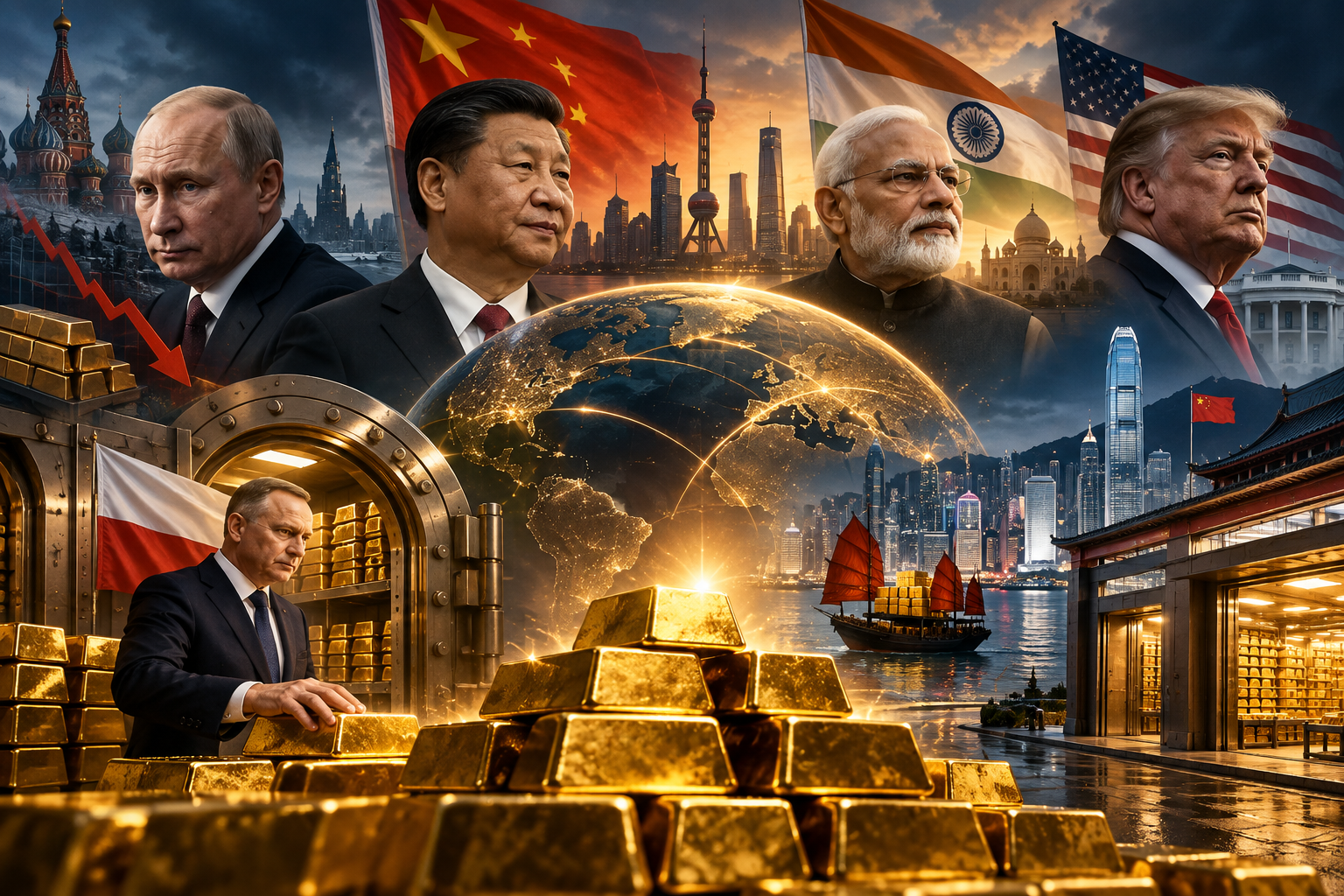
The closest the New Delhi Declaration comes to gold is paragraph 88. In a document of roughly 140 paragraphs, adopted on 12 September 2026 at a summit that brought Xi Jinping, Vladimir Putin and Narendra Modi into the same hall, the paragraph is mostly about rough diamonds and the Kimberley Process. Its last line commits the leaders of BRICS to "continue to examine viable mechanisms to promote trade in diamond and precious metals." That is the whole of it. There is no gold-backed currency in the text, no common reserve unit, no joint vault, no pooled bullion. Paragraph 90 acknowledges discussions on settling trade in local currencies and asks for payment systems that are "fast, low-cost." The language is careful, procedural, and almost entirely about plumbing that does not yet exist.
Outside the hall, the story being told about BRICS and gold was far louder. Across the past three years, the claim that the bloc is quietly building a gold-backed alternative to the dollar has become a staple of financial commentary. It has a plausible shape. Central banks have bought gold at roughly twice their historical pace since 2022. Gold ran above $5,500 an ounce in late January 2026. BRICS summits produce communiqués about de-dollarization. Put those three facts next to each other and the conclusion seems to write itself: the bloc is buying its way out.
The conclusion does not survive the country-by-country record. When you stop reading the bloc as a unit and read the ledger of who actually bought and sold, a different picture appears, and it is stranger than the one in the headlines. The second-largest gold holder inside BRICS is selling. The bloc's chair says it has no interest in undermining the dollar. The largest reported buyer in the world this year is a NATO member on the eastern edge of the European Union. And in 2025 more gold entered central-bank hands without a public name attached than any single country reported buying.
This piece asks a narrow question: if the flight into gold is not a BRICS project, what is it, and where does the real contest sit?
Paragraph 88 and the currency that isn't
Start with what BRICS has actually committed to, because the gap between that and the public story is the first finding.
The idea most often attached to BRICS and gold is "the Unit," a proposed settlement instrument backed forty percent by gold and sixty percent by a basket of member currencies. It is a real proposal. It comes from IRIAS, a research institute in Moscow, which ran a pilot in October 2025 and built a prototype on a blockchain platform in December of that year. No BRICS central bank has adopted it. It does not appear in the New Delhi Declaration. The headlines that described it as a BRICS launch were describing a think tank's prototype as if it were a treaty.
India has said so in plain words. In December 2024 its foreign minister, S. Jaishankar, stated there was "no proposal" for a BRICS currency, and in March 2025 he went further: "We have no interest in undermining the dollar." India chaired the bloc in 2026. The declaration its officials drafted respects "national priorities" and insists there is "no one-size-fits-all approach," which is diplomatic language for the fact that governments with very different relationships to Washington could not agree to more.
Washington has also made the cost of agreeing to more explicit. On 30 November 2024, Donald Trump threatened 100 percent tariffs on BRICS members if they created a currency to replace the dollar. In July 2025 he added a threatened extra ten percent for countries aligning with what he called the bloc's "anti-American policies." A bloc whose members sell heavily into the American market has every reason to keep its monetary ambitions in the future tense.
Even the bloc's own bank stays inside the system it is supposed to offer an alternative to. After Russia's invasion of Ukraine in 2022, the New Development Bank, which BRICS founded, stopped considering new projects in Russia, one of its five founders. In July 2023 its president, Dilma Rousseff, confirmed that the bank complies with international sanctions. The reason appears structural rather than political: the bank raises much of its money in dollar markets and carries ratings from Western agencies, and lending against the sanctions regime would put at risk the funding that keeps it alive. I found no public reversal of that position since.
None of this makes BRICS irrelevant to the monetary order, but the bloc, as a bloc, has not done the thing it is most often credited with. Whatever is driving the gold, it is not coming out of paragraph 88.
The ledger since 2023: Warsaw above Beijing
The numbers that matter here come from the World Gold Council, which compiles central-bank purchases from IMF data and its own estimates. They describe a genuine break with the past. From 2010 to 2021, central banks added an average of 473 tonnes of gold a year. In 2022 they added 1,082 tonnes. In 2023, 1,037. In 2024, 1,092. In 2025 the pace eased to 863 tonnes, still close to double the old average. In the first half of 2026, 345 tonnes.
Now read the same years by country, and the bloc begins to dissolve.
China is by far the largest reported BRICS buyer. By its own reporting, the People's Bank of China added 225 tonnes in 2023, 44 in 2024, 27 in 2025 and about 80 in the first eight months of 2026, for a total of roughly 376 tonnes since the start of 2023. Over the same period, Narodowy Bank Polski, the central bank of Poland, reported 130 tonnes in 2023, 90 in 2024, 102 in 2025 and about 98 so far in 2026: roughly 420 tonnes. On the official record, a single NATO member has added more gold to its reserves since 2023 than the People's Republic of China.
The flight into gold is real. The bloc behind it is not.
The rest of the leading buyers confirm the pattern. Kazakhstan added 57 tonnes in 2025, Uzbekistan and the Czech Republic buy steadily, Turkey was a heavy buyer in 2024, and Azerbaijan's state oil fund appeared on the list. Brazil, a BRICS founder, bought 43 tonnes in 2025, its first purchases since 2021, which is a real BRICS contribution and worth counting honestly. India added 73 tonnes in 2024 and has bought little since. Russia, as the next section shows, has moved in the other direction. By my own rough count from the World Gold Council's country data, the members of BRICS account for something like one tonne in eight of the gold that central banks have reported buying since 2022. The figure is approximate, it depends on how you treat members whose holdings are not reported, and it could rise sharply if the unreported buying described below belongs mostly to BRICS states. It does not describe a bloc leading a monetary revolution.
What it describes is a large number of separate governments, several of them firmly inside the Western alliance, reaching the same conclusion about the same risk at roughly the same time. That is a different mechanism from coordination, and it has a different cause.
Glapiński's 700 tonnes
The cause is easiest to see in Warsaw, because Poland has been unusually willing to say out loud why it buys.
When the board of Narodowy Bank Polski approved a plan in January 2026 to buy another 150 tonnes, taking Poland's reserves toward 700 tonnes and into the world's top ten holders, its president, Adam Glapiński, did not present the decision as a bet on the price. He presented it as a matter of state security. Gold, he said, is "free of credit risk, independent of the monetary policy decisions of other countries." He called it "a strategic asset for the state's security." By the end of 2025 gold made up about 28 percent of Poland's reserves, up from under 17 percent a year earlier, and Poland held more gold than the European Central Bank. By August 2026 Glapiński was reporting 648 tonnes, with 52 still to go. Even here the metal is not untouchable: in March 2026 he reportedly proposed channelling central-bank profits, including revaluation gains on gold, into a defence fund, and the option of selling some gold was debated in public. None has been sold.
Poland's reasoning has nothing to do with escaping the dollar. It is a country that borders Russia, Belarus and Ukraine, that has watched a neighbor's central bank lose access to most of its foreign reserves overnight, and that wants a store of value no foreign court, clearing house or government can switch off. In 2019 it brought 100 tonnes of its gold home from the Bank of England. Hungary brought all of its gold home the same year. Germany had finished moving bullion back from New York and Paris by 2017. India has repatriated so aggressively that more than three quarters of its 880 tonnes now sits inside the country.
A useful name for what these states are protecting is reserve sovereignty, which is a different thing from a reserve currency. A central bank can keep pricing, trading and saving in dollars while trying to control where its reserves physically sit and under whose law. What connects these states is not membership of any bloc but a lesson they drew from 2022: reserves held in another jurisdiction can become inaccessible. Their politics differed, but the practical conclusion did not. The lesson is about custody: a reserve held in someone else's system is a claim that can be suspended, while metal in your own vault stays in your hands.
The trigger has a date and a number. In February and March 2022, Western governments froze the Russian central bank's foreign reserves held in their jurisdictions, roughly $280 billion by one official count, with about $200 billion of it sitting at Euroclear in Brussels. A working paper published by the International Monetary Fund in January 2023, by Serkan Arslanalp, Barry Eichengreen and Chima Simpson-Bell, found that central banks facing Western financial sanctions tend to raise their gold holdings, and that sanctions imposed by several countries together have a stronger effect than sanctions imposed by one. After 2022, that tendency became a much broader precaution. The World Gold Council's 2026 survey of central banks found a record 45 percent planning to raise their own gold reserves in the coming year, and 74 percent expecting the dollar's share of global reserves to be lower in five years. The reasons they give are crisis performance, diversification and geopolitical risk.
Poland is the clean case because its motive leaves no room for the de-dollarization story. It is hedging against Russia, not against America, and it bought more gold than China to do it.
Moscow's 43.5 tonnes
If gold is the reserve that cannot be frozen, Russia should be the one country still buying it. It is doing the opposite.
The Bank of Russia held about 2,282 tonnes of gold on 1 July 2026, around 40 percent of its reserves, which makes it the second-largest holder inside BRICS after China. In the first half of 2026 those holdings fell by 43.5 tonnes, the sixth monthly decline in a row and, by one count, the sharpest drop in a quarter of a century. The World Gold Council listed Russia as the largest central-bank seller of the second quarter. The sales have been reported in connection with covering the federal budget deficit and with operations of the National Wealth Fund, the sovereign reserve the finance ministry draws on when revenues fall short. Those are different institutions with different balance sheets. The published figure is the Bank of Russia's reserve holding; how much of the decline reflects finance-ministry sales from the fund, swaps, or the central bank's own decisions is not broken out in public data, and I would not treat them as one seller. The question of who legally sells which gold, from which account, is itself a custody question.
The gold could not be frozen. It could be spent.
That is the part of the 2022 lesson the headlines skip. Gold protects a state from having its reserves seized by others, but not from needing to sell them itself. A country fighting a long war under sanctions, with oil revenues squeezed and its foreign-currency reserves immobilized abroad, has a limited set of liquid assets it can still use, and gold is prominent among them. The metal did exactly what it was bought to do: it stayed available when the rest of the reserve did not. Being available meant it could be consumed.
This matters for the BRICS story in a direct way. The member most often cast as the engine of a gold-backed alternative to the dollar is drawing down its bullion to pay its bills, while the member most often cast as its ally, China, buys cautiously and publishes little. What those two behaviors show is two states using the same asset for two different purposes, one as a fortress and the other as a war chest, with no joint strategy visible in either.
Russia is not alone in treating gold as money to be used rather than a monument to be kept. Turkey, one of the heaviest buyers of 2024, became the largest net seller in the first seven months of 2026, at around 85 tonnes, much of it, according to the World Gold Council, through gold swaps and tactical transactions. Azerbaijan's state oil fund sold 22 tonnes in the first quarter. The same asset that looks like a long-term hedge in one year becomes the most usable cash a central bank owns in the next. Liquidity under pressure is part of what makes gold valuable to a government in trouble, and it is why reading every purchase as a vote against the dollar misreads what reserves are for.
Whatever else Russia's gold is, it is being used in a way a coordinated accumulation thesis does not predict.
Where de-dollarization is real: 99 percent, and bilateral
None of this means the dollar's reach has not shrunk anywhere. It has, sharply, in one place: the trade of countries that no longer have a choice.
In November 2025 Russia's finance minister, Anton Siluanov, said that more than 99 percent of trade between Russia and China was now settled in rubles and yuan. Russian officials have put the figure for trade with India above 90 percent. These are Russian government claims, not independently audited numbers, but the direction is not in dispute. Sanctions cut Russian banks off from dollar clearing, and the trade found other channels because it had to. That is de-dollarization in its real form: bilateral, forced, and limited to the relationships where the dollar route was closed from outside. Indian refiners paying for Russian crude illustrate how partial it remains. Some cargoes have been paid in yuan or dirhams, but the oil is still priced in dollars, and payments have switched back and forth with the sanctions weather.
The multilateral version has moved much less. The most advanced project for settling cross-border payments between central banks outside the dollar system, mBridge, was built with the Bank for International Settlements. The BIS withdrew in October 2024. Saudi Arabia's central bank completed a proof of concept in May 2025 and has since confirmed it is no longer a participating member. The remaining members are China, Hong Kong, Thailand, the United Arab Emirates and, more recently, Macau.
The bloc's own development bank shows the same limit from the inside. The New Development Bank had approved 141 projects worth about $44 billion by June 2026, and it has set a target of lending 30 percent of its portfolio in local currencies, which means the plan itself assumes most lending stays in dollars. It still issues benchmark dollar bonds and depends on ratings of AA+ from S&P and AA from Fitch. When Fitch downgraded it after the Russia suspension in 2022, the cost of its dollar borrowing rose above that of comparable development banks. Its chief financial officer, Leslie Maasdorp, put the constraint in one sentence in 2023: "You cannot step outside of the dollar universe and operate in a parallel universe."
In the cases examined here, the pattern is consistent: states abandon the dollar where they have been shut out of it, and elsewhere they stay and hedge. Gold belongs to the hedging. It is what a country buys when it wants to remain inside the system while preparing for the day it might be pushed out.
The 57 percent nobody signs for
Here the record thins out, and the honest thing is to say where.
Of the 863 tonnes that central banks were estimated to have bought in 2025, about 57 percent was not reflected in publicly reported purchases. The World Gold Council describes it as the gap between its data provider's estimate of official demand and what central banks have reported, a sign of substantial "opaque" activity. More than half of the most important monetary buying of the year has no public name attached to it. The Council does not say whose it is. In the second quarter of 2026 it described unreported buying as "elevated" again.
Most analysts assume a large share of it is Chinese, and there are reasons for that assumption. In November 2025, Société Générale estimated that China had bought around 250 tonnes that year against 25 reported, and that its true holdings might be close to 5,000 tonnes, more than double the official figure. The method leans on UK gold export flows to China and other trade data, and treats the gap between what arrives and what is declared as probable state buying. A Goldman Sachs nowcast reported on 23 September 2026, built from London over-the-counter trading flows, suggested China bought about 35 tonnes in July against the 20 it reported.
I do not know who bought the unreported half of 2025's gold, and I am wary of anyone who claims to. Both estimates are residuals. They measure what is left over after everything identifiable has been subtracted, and a residual can contain state buyers, state-owned banks, sovereign funds, private investors routing through offshore accounts, and simple measurement error. As Adrian Ash of BullionVault put it when the SocGen estimate appeared, the true figure is "ultimately impossible" to verify. Neither estimate traces a single bar to the People's Bank of China.
Beijing has also widened the channels through which gold enters the country, which makes the residual even harder to attribute. In February 2025 it allowed ten insurance companies to put up to one percent of their assets into gold, a pilot Bloomberg estimated could free around 200 billion yuan. In April 2025 the central bank granted commercial banks extra import quotas. By one industry count, Chinese gold imports passed 1,100 tonnes in the first eight months of 2026, more than in all of 2025. Every one of those channels is legal and every one is private or semi-private, so a tonne arriving in Shanghai can sit on an insurer's balance sheet, in a bank's vault or in state reserves, and the trade data alone cannot tell which.
What can be said is narrower and still significant. China's official purchases follow a pattern that looks deliberate: small, steady additions, a six-month pause from May to October 2024 when the price was at records, a return in November 2024, and an acceleration through 2026 as the price fell from its January peak, reaching 20.2 tonnes in August, the largest monthly addition since October 2023. The last official explanation of why China holds gold dates from 2019, when a spokesperson for the State Administration of Foreign Exchange said gold was "conducive to adjusting and optimizing the overall risk and return characteristics" of reserves. Since then, nothing on the record names the dollar or sanctions.
This is the passage where a comfortable conclusion is available, and it would be easy to take it. The evidence could be arranged into a story of a secret Chinese gold hoard, deliberately hidden, building toward a day when Beijing reveals 5,000 tonnes and reprices the world. That story has everything a reader wants: a villain, a hidden treasure, a coming reveal. It is also more than the documents can carry. What the documents show is a buyer that reports selectively, prices carefully, and prefers not to be read. That is ordinary behavior for any large buyer in a thin market that does not want to move the price against itself, and it is ordinary behavior for a state that holds a large pile of assets in the currency it might be seen to be leaving. This is not to claim that China's reported figures are complete; it is only to say that nobody outside Beijing can yet show how incomplete they are. Silence can be strategy without being conspiracy.
A vault in Hong Kong, a plan in Shenzhen
The more revealing Chinese move concerns where other people's gold is kept.
On the other side of China's balance sheet, the shift away from American debt is visible and documented. China held $1.317 trillion of US Treasury securities at its peak in November 2013. In July 2026 the figure in the Treasury's own TIC data was $618 billion, the lowest since August 2008. In February 2026 Chinese regulators reportedly advised state banks to limit their Treasury holdings, citing volatility. The picture is less clean than those numbers suggest. Brad Setser of the Council on Foreign Relations has argued that a large share of Chinese dollar assets sits in custodial accounts in Belgium and in US agency bonds rather than Treasuries, and that dollar assets have stayed close to half of China's reserves once those are counted. Gold, for its part, is only about 9 percent of China's reserves, against more than 80 percent for the United States, Germany, France and Italy, and around 40 percent for Russia. China has reduced its visible exposure to Washington without leaving the dollar, and its gold position is small relative to what it holds.
The newer development is institutional. In 2025 the Shanghai Gold Exchange opened a vault in Hong Kong, operated by Bank of China (Hong Kong), and the People's Bank of China began inviting foreign central banks to store gold inside China. In November 2025, Bloomberg reported that Cambodia planned to store part of its reserves in a vault registered with the Shanghai Gold Exchange in Shenzhen's bonded zone. Cambodia's central bank said it was weighing several locations and has not confirmed China as one of them, and I found no report that any gold has actually moved. Reports in 2026 describe Chinese interest in extending the network to Singapore, Dubai, Riyadh and Moscow; those plans are not confirmed.
For most of the past century, the world's most important gold vault has been in London. The Bank of England holds about 400,000 bars on behalf of clients, most of them central banks, none of it on its own balance sheet. That custody role is a quiet form of power. It is why Venezuela, from 2019 onward, could not retrieve its own gold from Threadneedle Street: the Bank declined to release it, and the question of who was entitled to give the instruction ended up in the British courts. It is also why Poland, Hungary and India brought their metal home: repatriation is the decision that the location of a reserve is part of its value.
The move has a precedent, and the difference from it is instructive. In February 1965 Charles de Gaulle publicly called for a return to the gold standard, and over the following years the Banque de France converted a large part of its dollar holdings into American gold and brought much of it back to Paris. That was a run on a promise: France was testing whether the United States would honor dollar convertibility, a test the system failed in 1971. Today's repatriations test something else: nobody is asking Washington to redeem anything, only where their own metal sits and whose court could stop them from reaching it.
A reserve is only as sovereign as the vault it sits in.
China's vault offer is the other side of the same decision. A state that has watched reserves frozen in Brussels and gold stranded in London now offers other states an alternative jurisdiction to hold their metal, one outside the reach of Western courts and sanctions. States once sent their gold to where power was. Power is now beginning to follow where gold is kept.
This is the layer the BRICS debate misses, and here I am offering an interpretation rather than a documented intent: no Chinese official has said the vaults are meant as an alternative to London. A new currency needs agreement among governments that do not agree. A vault needs only a building, a legal regime, and one client willing to move a few tonnes. Nothing of the first kind happened in New Delhi, while the building for the second already stands in Hong Kong, with a first prospective client, and none of it required a communiqué.
The consequence is practical. The freeze of 2022 worked because roughly half of Russia's reserves sat where Western authorities could reach them. Every tonne that moves into a home vault, or into one outside Western jurisdiction, reduces what a future freeze could catch. Rather than being challenged head-on, the most powerful financial sanction of the decade is having its future reach narrowed one transfer at a time, by states that include some of its authors' allies.
What the IMF table cannot see
Part of the reason this shift is hard to see is that the most quoted measure of the dollar's position does not include gold at all.
The IMF's COFER database, the standard source for reserve currency shares, reported on 1 July 2026 that the dollar made up 57.13 percent of allocated foreign-exchange reserves in the first quarter of the year, up from 56.42 percent the quarter before. The euro held about 20 percent and the renminbi about 2 percent. Those figures are routinely cited as proof that de-dollarization is a myth, and on their own terms they are correct: the dollar's share of currency reserves is stable, and the renminbi's is tiny. The IMF itself notes that about half of the dollar's quarterly gain came from exchange-rate movements rather than new buying.
But COFER counts currencies, and gold is left out of the table by design.
The European Central Bank's annual report on the international role of the euro, published on 2 June 2026, measures the whole reserve stock at market prices, gold included. By that measure, gold made up about 27 percent of global official reserves at the end of 2025, ahead of US Treasury securities at around 22 percent and the euro at about 15 percent. Gold had already passed the euro in 2024. The two measures do not contradict each other, because they count different things: the first shows the dollar holding its ground among currencies, while the second shows that the largest single change in the world's reserves over the past four years happened in an asset that is not a currency, and therefore does not register in the table most commentators read.
The ECB is careful about why, and the reason cuts against the dramatic reading. Most of gold's rising share comes from its price, which rose by around 60 percent in 2025 alone, rather than from the tonnes bought. Central banks added about 4,070 tonnes between 2022 and 2025, roughly a ninth of their existing stock; over the same period the price more than doubled. And the price is not a one-way line. After peaking above $5,500 in late January 2026, gold was trading near $4,300 in September, roughly a fifth lower. Even the buying data moves: the World Gold Council's first estimate of central-bank purchases in the first quarter of 2026 was 244 tonnes, later revised to 57. A reserve share driven mainly by price can shrink the same way it grew.
That is the right size for the finding. Rather than abandoning the dollar for gold, the world's central banks have added a second, non-currency layer to their reserves, one that the standard dollar measure does not see, that is concentrated in countries worried about sanctions and war, and whose value moves with a volatile price. The measure most people quote was built for a reserve system made of currencies, and the most significant recent change in that system has happened outside it.
The strongest objection
The strongest counterargument to this reading does not dispute the country data. It accepts that Poland outbought China, that Russia is selling, and that BRICS has no gold plan. It says that all of this proves the opposite of what the gold story implies. The dollar remains on one side of 89 percent of all foreign-exchange trades, according to the Bank for International Settlements' 2025 survey, of a market turning over $9.6 trillion a day. It carries about half of all payments on SWIFT and more than 80 percent of trade finance. Its share of currency reserves rose this year. Gold's rise is mostly a price effect, the largest buyers are a mixture of allies and rivals of the United States, and the bloc supposedly leading the challenge cannot agree on a sentence. On this view, there is no structural shift at all, only a precautionary trade that will fade when geopolitical tension does.
That objection is serious, and most of it is correct. If the claim here were that gold is displacing the dollar, or that BRICS is organizing a monetary alternative, the objection would win. The claim is narrower. It is that a growing number of central banks, including several inside the Western alliance, now treat the location and legal character of their reserves as a risk in its own right, and have responded by holding more of an asset no one can freeze and by moving it to vaults they control. That behavior coexists with dollar dominance in transactions, and it does not require any bloc to organize it. The objection explains why the dollar still runs the system, but it leaves open why so many of the system's users are building a way to survive a quarrel with its custodians.
Back to New Delhi
Return to paragraph 88. Read against the ledger, its modesty makes sense. The leaders in New Delhi could not promise a gold-backed currency because the countries in the room were doing different things with their gold: China buying quietly and offering vaults, Russia selling as its budget came under strain, India bringing its bars home and disclaiming any interest in hurting the dollar, Brazil making a first purchase in four years. There was nothing to coordinate, because the underlying decisions had already been made separately, in national central banks, for national reasons.
The largest reported buyer, in 2025 and again in the first half of 2026, was in Warsaw. The largest seller of the second quarter of 2026 was in Moscow. The largest share of 2025's official buying, 57 percent by the World Gold Council's estimate, carried no public name at all. And the most consequential institutional move, a Chinese vault network opening its doors to other countries' reserves, began without a summit, a declaration, or a vote.
No one in this story is accountable for the whole of it, because no one designed the whole of it. The IMF measures currencies. The ECB measures reserves. The World Gold Council estimates what it cannot see. Central banks disclose what they choose. The bloc publishes paragraphs. Each of those actors has a defined role and a defined instrument, and each of them is doing its job.
None of them needed to agree for the result to appear. Enough central banks reached versions of the same conclusion for the result to become structural: hold more of the asset whose access does not depend on someone else's permission. Parallel rationality, with no coordinator in the room.
On the day paragraph 88 was adopted, the delegations in New Delhi were still examining mechanisms. In Warsaw, Moscow and Hong Kong, the vaults were already being filled, emptied and built.
Evidence Map
Facts, interpretations, forecasts, and disconfirming signals.
Core claim. The post-2022 surge in central-bank gold buying is a set of separate national hedges against custody and sanctions risk, not a coordinated BRICS strategy. BRICS has no gold policy; its second-largest holder (Russia) is selling; its 2026 chair (India) disclaims de-dollarization; the largest reported buyer since 2023 is Poland; more than half of 2025 buying is unreported. The live contest is over custody, which the IMF's reserve-currency measure does not capture because it excludes gold.
Evidence level. Facts (high): New Delhi Declaration paragraphs 88 and 90; WGC annual and quarterly central-bank data (2010-21 average 473t; 2022-2025 annual totals; H1 2026 345t; 57% of 2025 unreported; Q1 2026 revision from 244t to 57t); PBOC holdings (about 2,387t, August 2026, +20.2t); NBP holdings (648t) and Glapiński's statements; Bank of Russia holdings and H1 2026 decline of 43.5t; IMF COFER Q1 2026 (57.13%); ECB IRE June 2026 (gold 27%, Treasuries 22%, euro 15% at end-2025); US TIC data on Chinese Treasury holdings; Jaishankar statements; Trump tariff threats; NDB compliance with sanctions; Cambodia's reported plan to store gold in an SGE-registered vault in Shenzhen (not confirmed as executed); BIS 2025 triennial survey; de Gaulle's February 1965 call for a return to gold and the Banque de France conversions; NDB portfolio (141 projects, about $44bn) and 30% local-currency target; Turkey's 2026 net sales. Official claims (reported as such): Siluanov's 99% Russia-China settlement figure. Single-source (flagged in text): Chinese import total for 2026; reported Polish debate on routing gold revaluation gains to defence. Interpretation (medium, marked): that the buying pattern reflects custody risk rather than bloc coordination; that China's vault network is the more consequential Chinese move; the approximate BRICS share of reported buying (author's calculation). Estimates (marked): Société Générale and Goldman Sachs figures on unreported Chinese buying.
What would confirm this.
Further growth of central-bank gold held domestically or in non-Western vaults; additional foreign central banks storing gold in China; WGC surveys continuing to cite sanctions and geopolitical risk; BRICS continuing to issue declarations without a common reserve instrument.
What would disprove this.
A binding BRICS agreement on a gold-linked settlement unit adopted by member central banks; documentary evidence that the unreported buying is centrally coordinated across BRICS states; a sustained return of central-bank buying to pre-2022 levels once geopolitical tension eases; Poland and other Western-aligned buyers stopping while BRICS buyers accelerate.
Watchlist.
IMF COFER Q2 2026 (late September); WGC Q3 2026 data (late October), including Russia's sales and the unreported share; whether any foreign central bank actually moves gold into China's vault network, starting with Cambodia; Poland's progress to 700 tonnes; the 2027 BRICS chair's agenda on payments.
Jerry van der Laan writes The Manifest Archive, forensic journalism on the systems beneath power, money, and history. He traces the structures beneath them.