How power stopped hiding the truth and started replacing it with a more usable version of the world
A man stands in a supermarket staring at a shelf that looks full and still feels empty. The products are there, the lights are on, the music is soft. Nothing dramatic has happened, and yet he knows, with the kind of knowledge that lands in the body before it reaches language, that something has shifted. The package is smaller. The price is higher. The explanation on the news is smoother than the experience in his hands. He hears words like adjustment, transition, pressure, resilience. He does not hear the word that fits the feeling. Loss. Later that evening he opens his phone, and a war is called deterrence, censorship is called safety, dependency is called support, surveillance is described as trust. The words move past him with polished surfaces and professional calm, as if language itself had been hired to keep reality from arriving too sharply. He is not uninformed. He is surrounded by information. That is the problem.
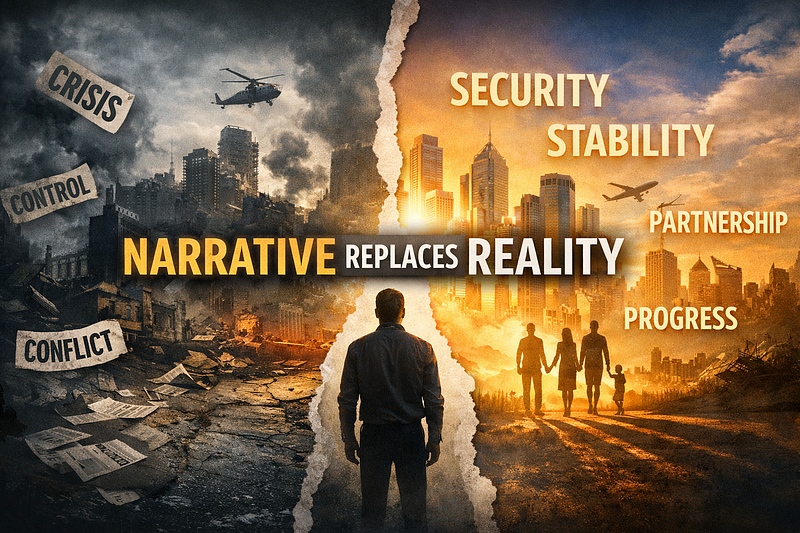
The visible story of information control is the old one, the censor who hides a fact. But reality is rarely hidden from the public anymore. More often it is delivered in a language designed to keep it from fully arriving. The old model of propaganda tried to convince people that something false was true. The newer model is more sophisticated, and it does not always deny what is happening. It builds a parallel interpretive environment around events, one that is socially safer, emotionally smoother, and institutionally easier to repeat, and by the time the public begins debating what is happening, the decisive shift has usually already taken place. The public is no longer responding to reality. It is responding to the version that reached it first. The determining variable is no longer whether the fact is available. It is which interpretation the event arrives wearing. Power no longer needs to defeat the truth. It only needs to make the truth feel less usable than the narrative that replaces it.
The pictures in our heads
This is not a new discovery, and the master should say so plainly, because the mechanism has been named and refined across a full century, which is what lifts it from suspicion to documentation. In 1922 Walter Lippmann observed that people do not respond to the world directly but to a pseudo-environment, the picture of the world they carry in their heads, and that whoever shapes that picture shapes the behavior that follows from it. The world outside and the pictures inside were already, he saw, two different things, and politics operated on the second.
A generation later, in 1946, George Orwell narrowed the focus from the picture to the sentence. Political language, he wrote in Politics and the English Language, is designed to make lies sound truthful and to give an appearance of solidity to pure wind, and the specific instrument he identified was the soft abstraction that lets a brutal fact be stated without anyone having to picture it. Villages bombed, populations expelled, prisoners shot become pacification, transfer of population, elimination of unreliable elements. Orwell's point was not that the words were false. It was that the words were built so that the reader would not see the thing. That is the mechanism in miniature, and it is the Manifest's own first foundation: the demand that language let reality arrive intact.
Sixteen years on, Daniel Boorstin named the next stage. In 1962 he described the pseudo-event, the press conference, the staged announcement, the manufactured occasion that exists for no reason except to be reported, an event that is real in that it happens and unreal in that it was created only to generate its own coverage. Five years after that, Guy Debord pushed the idea to its limit in The Society of the Spectacle, arguing that in a media-saturated order what was once directly lived recedes into representation, and the image of a thing comes to dominate the thing. And in 1981 Jean Baudrillard gave the endpoint its name, hyperreality, the condition in which the model precedes and replaces the real, until the copy no longer refers to any original and the distinction between the event and its representation stops being available at all. Lippmann to Orwell to Boorstin to Debord to Baudrillard is not a fringe lineage. It is a documented intellectual tradition describing, decade by decade, the same migration: from hiding reality, to softening it, to staging it, to representing it, to replacing it. The substitution of narrative for reality is not a theory of the present. It is the oldest mechanism in modern media, finally industrialized.
When language arrives before meaning
The first instrument is rarely a law, a sanction, or a platform ban. It is a word. Human beings do not live by data, they live by description, and the name given to an event becomes part of the event. A society that hears coercion called management absorbs coercion differently. A society that hears extraction called reform endures extraction longer. A society that hears surveillance called protection surrenders privacy in a calmer emotional state than one forced to call it by its original name. The softening is not cosmetic, it is structural, and the same operation runs across every domain. Civilian deaths become collateral. Financial dispossession becomes reform. Platform throttling becomes integrity. Welfare reduction becomes modernization. Information control becomes trust and safety. External dependency becomes partnership.
The wording performs a transfer. It moves the emotional weight off the system and onto an abstraction, so that people are handed a processed version of an event before they ever meet the raw one. The aim is not to make a falsehood believable. The aim is to make reality, stated plainly, sound unreasonable, so that the person who insists on the original word seems shrill while the person who repeats the softened one sounds responsible. A mother notices the groceries shrinking while experts discuss volatility. A worker watches purchasing power fall while hearing stabilization. A citizen feels speech narrowing while being told he is being protected. The words do not only describe the world. They regulate how much of it can still be felt.
The emotional field is shaped first
Most people believe they think first and feel second. In practice it usually runs the other way. Before a population understands an event, it absorbs an atmosphere around it: tone arrives before analysis, and emotional permission arrives before evidence. People learn what they are allowed to feel before they understand why. A system that shapes that emotional field decides in advance where fear will be amplified, where empathy will be licensed, and where doubt will be treated as suspect, which is why two structurally similar events can produce opposite public reactions, one prepared and one neutralized. The most advanced form of this does not tell people what to believe. It trains them in what it is safe to feel, and it is why public language at moments of real consequence increasingly sounds therapeutic and managerial, because bureaucratic softness has become one of the most effective anesthetics of the age. A crisis that sounds responsible does not provoke. That is the point.
A worked example
The mechanism is easiest to see where the vocabulary is most institutional. For four decades the standard package of cuts to public spending, currency devaluation, privatization, and removal of subsidies that the International Monetary Fund and World Bank attached to their loans was called structural adjustment. The phrase is a machine. Structural points away from any actor and toward a neutral feature of the system, as if the economy were a building settling on its foundations. Adjustment implies a small correction toward a correct position, not a transfer. A citizen in a country undergoing the program experienced rising bread prices, shrinking clinics, and vanishing jobs, and read, in the same week, that his government was implementing structural adjustment to restore stability. The two did not connect, because the language had been built so they would not. When the term itself began to attract criticism, the same content tended to reappear under gentler names, reform, consolidation, modernization, each doing similar work of moving the weight off the institution and onto an abstraction. Nothing in the policy was hidden. Every figure was published. The reports were public. What was governed was not the availability of the facts but the word through which they could be felt, and the plain word, dispossession, was simply never the one on offer. This is the entire mechanism in a single documented case: the fact fully visible, the accurate description structurally absent, and the citizen left feeling something for which the system has supplied no usable name. Nothing was concealed. Everything was renamed. That is the modern form, and it is more durable than any secret.
Fragmentation, not concealment
Here the mechanism meets its sibling, the one traced in the foundation of this axis. Older systems hid facts. Modern systems often let the facts circulate freely and prevent them from assembling into a picture. Scandals appear and vanish. Contradictions are visible but inert. Evidence exists but never reorganizes perception, because the real threat is no longer visibility, it is coherence. When information becomes abundant, the working instrument of power is not censorship but fragmentation plus replacement: reality is allowed to arrive in pieces, and the system simply ensures the pieces never become a map. The narrative is what fills the space where the map would be. War dissolves into a story about leaders, debt into a story about responsibility, censorship into a debate about moderation, extraction into a story about efficiency. Structure becomes anecdote, pattern becomes episode, and the public argues vigorously over the personalities while the architecture stands untouched. Narrative works best when it keeps attention moving so that understanding never deepens.
The word that is never offered
The most complete version of the mechanism is not the wrong word supplied but the right word withheld, and this is the layer that leaves no trace. The man in the supermarket is never told the false thing that prices are falling. He is simply never offered the accurate word, Loss, that would let his experience cohere into a grievance. The substitution works by absence as much as by replacement. There is a plain word for what is happening, and the narrative environment is arranged so that the word is available everywhere except in the places that matter, so that a citizen can feel the thing precisely and still have no sanctioned language in which to name it. A grievance that cannot be named cannot be organized, and a loss that has no accepted word is, politically, a loss that did not officially occur. This is why the recovery of reality begins not with more facts but with the restoration of a single missing word, because the missing word is the gap through which the whole structure was made unspeakable. The most effective censorship in an open society is not the banned sentence. It is the unoffered word.
When people carry it themselves
A narrative reaches its most powerful form when it stops feeling imposed and starts feeling normal. People repeat its language without being asked, adopt its tone, internalize its boundaries, until censorship is spoken of as responsibility and dependency as partnership in ordinary conversation, by people describing what they take to be their own thoughts. This is not weakness. The replacement offers genuine relief: it reduces friction, it makes a deteriorating reality easier to carry, and a tired population will reliably choose a manageable explanation over an accurate one. Crisis accelerates all of it, because fear narrows interpretation, fatigue weakens pattern recognition, and the first narrative to arrive in an emergency tends to define the entire frame before a slower, truer account can form. And the platforms did not invent this, they automated it. Every feed is a ranking system, every ranking system is a visibility system, and every visibility system shapes which version of an event travels and which dies unseen. The user experiences free access. The system delivers a governed sequence. A narrative becomes sovereign at the moment people repeat it as their own thought.
Recovering reality
The answer is not blind distrust, which is only another way of being managed, this time by reflex. The answer is precision. Ask what the words are doing, not just whether they are true. Ask who is relieved of weight by a given phrasing and who is asked to carry it. Ask which plain word has gone missing, and say it. Security for whom. Stability for what. Support at what cost. The moment those questions return, the narrative loses its smoothness and the structure underneath becomes visible again, not louder, only clearer. The first act of resistance is not protest. It is restoring the original weight of words, because once the accurate word is back in circulation, the softened one can no longer do its work.
Modern power does not need to hide reality. It needs only to replace it, to ask people to accept its language before they examine its function, to inherit its tone and repeat its softened vocabulary until reality itself begins to sound excessive. The substitution arrives quietly, through headlines and institutions and platforms and everyday speech, and it feels reasonable, and it spreads without force. But reality does not disappear. It waits, and sooner or later every softened word meets the structure it was built to hide. The most dangerous lie is not the one that sounds false. It is the one that sounds reasonable while reality is being quietly removed behind it. People do not lose reality all at once. They inherit its replacement, phrase by phrase.
Evidence Map
Facts, interpretations, forecasts, and disconfirming signals.
Core claim. Where facts circulate freely, control has moved from hiding the fact to governing the frame: power supplies the softened description before the event arrives and withholds the plain word that would let experience cohere into a grievance.
Evidence level. Facts: high (the documented lineage, Lippmann's pseudo-environment in 1922, Boorstin's pseudo-events in 1962, Debord's spectacle in 1967, Baudrillard's hyperreality in 1981). Interpretation: medium (contemporary institutional, platform, and policy language as the industrialized form of the same mechanism). No single coordinating author is claimed.
What would confirm this. Official and institutional language migrating toward the therapeutic and managerial exactly when plain description would be most damaging; the same renaming pattern (coercion as management, dependency as support, throttling as safety) recurring across unrelated domains; the hardest stories to circulate remaining those that restore a plain word to a softened event.
What would disprove this. Plain, structural description circulating as freely and traveling as far as the softened version; the renaming pattern proving domain-specific rather than general; or the dominant mechanism of control in open societies turning out to be the removal of facts rather than the governance of their frame.
Watchlist. Evergreen and structural, with live attention to institutional and platform language during crises, where the substitution is most visible.
Jerry van der Laan writes The Manifest Archive, a continuous investigation into how institutions, language, and systems shape what people are permitted to see as reality. He does not report events. He traces the structures beneath them.
Related from The Manifest Archive