How the oldest continuous archive on earth governs not the past, but the terms on which the past may be seen
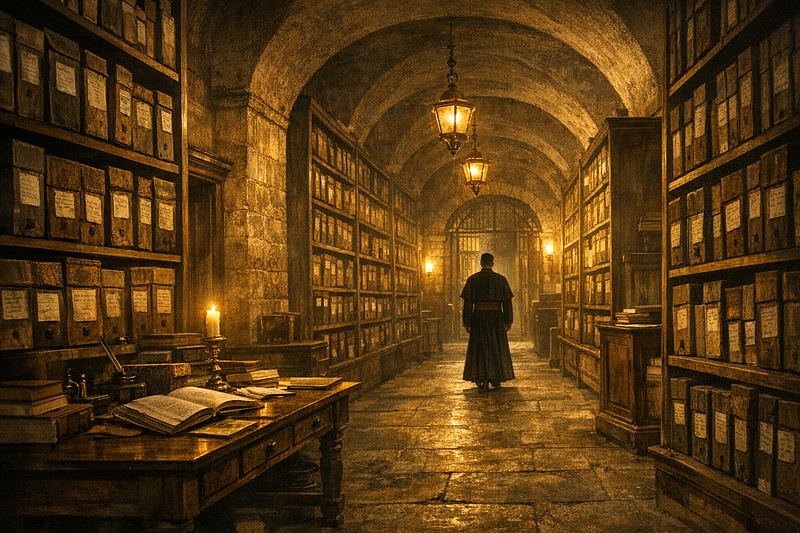
The scholar did not enter a vault first. He entered a corridor. Stone under soft light. Air held at the kind of steady temperature that suggests not comfort but control. A faint scent of paper, polish, linen, and age, not the age of decay but the age of retention. Doors with labels. Desks with nothing unnecessary on them. Silence, though even that word is too loose. It was not silence as absence. It was silence as discipline. Nothing in the corridor asked to impress him, and that was the first signal. Real continuity rarely performs itself. It has already survived the centuries that taught other powers to shout.
He would be allowed to see a fragment. A folder, perhaps. A box. A narrow aperture cut into the body of time. Never the whole architecture. Only the portion that had become safe enough to survive his gaze. That is how mature power reveals itself, not by refusing visibility but by governing sequence, not by erasing memory but by deciding when memory has become harmless. The strongest institutions do not destroy the past. They decide the hour at which the past may finally be seen without danger.
The visible story of the Vatican archive is that it is a vast and venerable library, a treasure of scholarship behind a famously closed door. That story is true and beside the point. The determining variable is not what the archive contains. It is who decides the sequence in which it may be opened. The Vatican did not survive two thousand years of collapse by standing outside history. It survived by learning how to hold history still, and the instrument it learned to hold it with was the archive. An archive does not have to lie. It only has to decide when truth may enter the room.
What the Vatican's secret archive actually is
Begin with the documented physical fact, because it is more revealing than the legend. The institution now called the Vatican Apostolic Archive holds an estimated eighty-five kilometres of shelving. It is organized into roughly six hundred fonds, the coherent record-collections of distinct administrative bodies, and its selective public catalogue describes about thirty-five thousand volumes. Its continuous documentary stream runs from the eighth century to the present, twelve centuries of the correspondence, judgments, property claims, and diplomatic traffic of an institution that sat at the crossing point of Europe's doctrinal, dynastic, colonial, and moral disputes. Much of it lies in a two-storey reinforced bunker beneath the Cortile della Pigna, completed in 1980, climate-controlled, fireproofed, seismically braced. Above the ground sits the reading room. The architecture itself separates the user from the source.
Read the structure as an instrument and one detail becomes the whole argument. Access is granted not to the archive but to a fonds. A researcher approved to consult the records of one nunciature cannot, on that approval, open the files of the Secretariat of State. The internal logic of the archive reproduces the administrative structure of the apparatus, which means that reading the index of fonds is already a form of reading the organizational chart of the Curia. And it means something more consequential, rarely stated: no single scholar can ever reconstruct the whole by reading, because every inquiry is pre-segmented. The fragmentation is not a rule that could be waived. It is built into the architecture of access. The catalogue does not hide the past. It decides who is allowed to see which part of it, and in what order.
The renaming that changed the name and nothing else
In October 2019 the institution stopped being called the Vatican Secret Archive. By a motu proprio, the pope restored the older title, the Vatican Apostolic Archive, and the official explanation was a correction of a misunderstanding. The Latin word in the old name, secretum, never meant secret in the modern sense of hidden or concealed. It meant private, the personal archive of the pope, separate from the public library. The word had simply aged badly in translation. So the name was changed to remove the unfortunate connotation.
Read that act in forensic mode and it inverts. A mistranslation that had stood for centuries could have been corrected at any time with a sentence of explanation. It was not corrected with an explanation. It was corrected with a renaming, and the renaming arrived in a season when the Vatican was under sustained pressure to demonstrate transparency, in the same period as the McCarrick and Becciu affairs. The change altered nothing operational. Not one access rule, not the hierarchy of fonds, not the timetable by which any decade of material would be released. It was a communication, performed at the moment a material act was expected, and substituting a word for a structural change is a recognizable pattern in the management of visibility. The institution did not become more open. It became better named. The change altered perception, not procedure. The sign on the door was rewritten; the door was not.
How the past is released: the Pius XII files
The clearest demonstration of the archive as an instrument is the way it opens. In March 2019 the pope announced that the records of the pontificate of Pius XII, who led the Church through the Second World War and the Holocaust, would be opened to researchers. Under the standard seventy-year rule the material would not have been due until 2028. The eight-year acceleration was presented as a gift.
The gift had taken fourteen years to wrap. Since 2006 a team under the archive's prefect had been ordering, describing, and partially publishing the Pius XII material, some hundred and twenty series, roughly twenty thousand archival units, drawn from the Secretariat of State and the Roman congregations. The opening, when it came on 2 March 2020, was not an act of spontaneous candor. The external pressure had been building for two decades, from Jewish historical organizations, from Israeli diplomats, from established academic historians. The question had never been whether the files would open, only when. By choosing the moment itself, the institution kept control of the one thing that mattered, the framing. The records were released with accompanying interpretation, press conferences, official context. When the first major scholarship emerged from them, it confirmed what critics had long suspected, that the wartime silence had been an institutional choice debated inside the Curia rather than mere diplomatic caution. The revelation was real. It was also managed, dated, and narrated by the institution it exposed. A truth released too early can rupture. A truth released after its danger has cooled becomes texture. The Vatican did not hide the Pius XII record. It decided the year in which the record would be released, and presented the decision as generosity.
What the Vatican still keeps closed
The opening of one pontificate is legible only against everything that stays shut, and the closures fall into three kinds. The first is the clock. Material from the pontificates after Pius XII remains largely closed under the same seventy-year rule, which places John XXIII years away and the recent popes generations away. Early release is possible under pressure, but it is the exception that proves the institution sets the timetable.
The second closure is jurisdictional. The archive of the former Holy Office, the body that was once the Roman Inquisition and is now the doctrinal authority of the Church, is not part of the Apostolic Archive at all. It is a separate archive in its own palazzo, opened in 1998 only as far as 1903, with no commitment that the twentieth century will ever follow. And the files concerning what canon law calls offences against morals, the central dossiers of clerical sexual abuse gathered under the doctrinal authority since 2001, are closed regardless of date, because they sit inside the living administrative structure rather than the historical one. The third closure is operational. The Holy See maintains diplomatic relations with well over a hundred and eighty states, and a nunciature cannot release the advice it gave last year while the same nunciature is still working this year. The boundary between archive and operation is not a date. It is a function, and a political one. What is open is what has been disarmed by time. What is closed is what can still act.
What the archive lost, and what it destroyed
An archive that decides what survives must also be read by its absences, and the Vatican's are documented. When Napoleon occupied Rome he had the archives shipped to Paris, around three thousand crates beginning in 1810. In transit and in storage, crates were lost or stolen, and when the surviving material was returned after 1817, a portion was sold or destroyed to reduce the weight and cost of the return. A measurable part of the pre-1810 record was scattered in those years. Earlier, fires in the Lateran complex in the fourteenth century had already fragmented the medieval record.
Loss by catastrophe is one thing. The harder fact is loss by decision. Parts of the Holy Office archive were burned during the twentieth century, a destruction known to some Curia historians, justified at the time as housekeeping and effective as the erasure of evidence. And nunciatures routinely destroy material before it ever travels to Rome, under destruction protocols codified within the Secretariat of State in 1991, the contents of which are not public. What we know is that the protocols exist, and that they guarantee a quantity of diplomatic correspondence with foreign governments never reaches the archive to begin with. The collection a scholar is eventually permitted to see is therefore twice filtered, once by what was destroyed before it arrived and once by what is released after its danger has passed. An institution that governs both what enters the record and when the record may be read does not need to forge the past. It only needs to edit the set of what was ever allowed to survive.
What can no longer be asked
The deeper consequence of selective destruction and segmented access is not that documents are missing. It is that specific questions can no longer be answered, and the institution chose which ones. An absence here is not a gap left by accident. It is a decision about what the future is permitted to know.
Because parts of the twentieth-century Holy Office record were burned and the rest is sealed, the internal reasoning behind modern doctrinal enforcement, who was investigated, on what evidence, against what dissent, cannot be reconstructed from the primary sources. A historian can describe the outcomes. The deliberations are unreadable. Because nunciatures destroy material before it reaches Rome under protocols codified in 1991, the full primary record of the Vatican's diplomacy with the regimes of the last century is structurally incomplete, which means certain diplomatic histories cannot be written from Vatican sources because the sources were never allowed to become sources. Because the abuse dossiers sit inside the living administration and are closed regardless of date, the institutional pattern, how cases were routed, who knew, how decisions travelled across decades, cannot be independently established from the record; the scale can be estimated, but the mechanism cannot be read. And because access is granted per fonds rather than to the whole, the questions that would matter most, the ones that require connecting the Secretariat of State to a nunciature to the doctrinal authority on a single affair, are not merely difficult. They are architecturally unanswerable, because no scholar is ever permitted to hold all three files at once.
This is the layer beneath the missing document. The power on display is not the power to hide a fact. It is the power to determine which forms of knowledge can ever be assembled, and which are dissolved at the source so that no future inquiry can recover them. The archive does not only decide when a question may be answered. It decides which questions may be asked of it at all.
1870, when defeat became refinement
This is why the Vatican's survival cannot be read as the persistence of a relic. Go to 1870, the year the Papal States fell to Italian unification. On paper it was humiliation. Territory vanished, the political form broke, the pope was described as a prisoner in the Vatican. For ordinary analysis this is decline. For mature analysis it is concentration. Large visible systems are expensive to defend and constant to expose. Compress one without destroying its legitimacy and it becomes smaller in geography and stronger in symbolism, less cumbersome as empire and more durable as authority.
The Lateran Treaty of 1929 completed the refinement. It gave the Holy See a sovereign shell in miniature, a tiny territory carrying immense implication, and solved the strategic problem with almost surgical economy. The papacy no longer needed broad possession to remain a geopolitical presence. It needed sovereignty, an archive, a diplomatic service, and symbolic continuity, and nothing more. What looked like reduction was closer to purification. The shell contracted and the continuity remained, perhaps even sharpened. In the hands of an institution that thinks in centuries, defeat can become design.
The hinge where memory becomes rule
Here the argument turns on its hinge. Many institutions preserve memory. Libraries do, universities do, ministries do. The Vatican is different because its memory was fused to legitimacy. It did not merely record kings, it crowned them. It did not merely preserve doctrine, it declared orthodoxy. It did not merely store disputes, it judged them. Once memory is attached to a body that can certify legitimacy, memory stops being passive and becomes active structure, part of the machinery through which a civilization sorts the lawful from the unlawful, the orthodox from the deviant, the serious from the dismissible.
That is the deeper architecture. The Vatican is not best understood as a secretive repository with political side effects. It is better understood as a legitimacy engine with a vast memory attached, and because legitimacy travels farther across time than force usually does, the engine outlived the orders that believed themselves more modern than Rome. The families that cluster near it, the Jesuit networks that carried Catholic continuity into new elites, the finance that gave the sacred its years of duration through bodies like the Vatican bank, the concordats that let the Holy See sign with monarchies and republics and dictatorships alike without binding itself to the lifespan of any, all of these are real, and each is its own study. But none is the core. They are the limbs. The archive is the nervous system, the place where the institution's memory is kept, sorted, and timed. The deepest power is not the power that defeats every regime. It is the power every new regime still finds itself forced to address.
Why Rome matters more now, not less
The skeptical reader feels the tug of dismissal. Stone corridors, papal archives, shrinking sovereignty, interesting as atmosphere but surely secondary in an age of satellites, platforms, and algorithmic governance. That reaction is exactly backward. The reason to study the Vatican archive now is that it shows, in unusually concentrated form, the long grammar of power beneath changing technology.
Today's dominant institutions also survive through retention. They store behavioral memory, they govern access, they time disclosure, they present custody as service and classification as necessity. The technology firm stores behavior. The state stores permissions. The intelligence system stores truth in compartments and releases it, when it releases it at all, after its danger has cooled. The old throne built of paper has not vanished. It has multiplied into databases, compliance structures, knowledge hierarchies, and managed recall. The Vatican is not identical to these systems, but it remains the clearest historical example of how power evolves when it no longer wishes to appear as command. It becomes administration. It becomes memory. It becomes certification. It becomes the neutral background against which reality is sorted. The most durable empire is the one history mistakes for an institution, and the public mistakes for a caretaker.
The safest throne in history
When the scholar finally entered the room, nothing inside looked like dominion. No crown, no procession, no visible command. Only boxes, shelves, bindings, controlled air, labels, the modest furniture of historical authority. That was enough. The mature forms of power no longer need to stand above history in order to direct its afterlife. They only need to remain present where legitimacy, memory, and sequence are still being decided. The loud empires prefer fire. The durable ones prefer folders, stamps, delays, and rooms where even the air is trained not to react.
Behind the page a visitor is permitted to see, behind the document released after its danger has cooled, behind the courteous vocabulary of preservation and access, the real achievement stayed intact. Rome had learned to survive every visible ending by moving underneath the idea of ending itself. The safest throne in history was never the one placed in the open. It was the one the modern world learned to call an archive.
Evidence Map
Facts, interpretations, forecasts, and disconfirming signals.
Core claim. The Vatican's endurance rests not on its contents but on a small administrative mechanism that governs both what enters the record and the sequence in which it may be read, which lets the institution decide when each part of its past becomes safe to see.
Evidence level. Facts: high (the archive's scale and per-fonds access regime, the 2019 renaming and its timing, the Pius XII announcement and the 2020 opening after fourteen years of preparation, the separate time-capped Holy Office archive, the abuse-file closure, the Napoleonic dispersal and documented destructions). Interpretation: medium (the archive as an active instrument of governance rather than a passive repository). A single coordinating intention is held open at Level 3 and not asserted.
What would confirm this. Future releases continuing to arrive pre-framed and timed to institutional rather than scholarly convenience; the Holy Office and abuse files staying closed well past the point the time-rule alone would explain; each opening paired with official interpretation rather than left to independent reconstruction.
What would disprove this. The Vatican moving to whole-archive rather than per-fonds access, publishing its nunciature destruction protocols, opening the twentieth-century Holy Office records on the ordinary timetable, or releasing sensitive material without accompanying institutional framing.
Watchlist. Evergreen and structural, with live tracking of Apostolic Archive release schedules, Holy Office archive policy, and scholarship emerging from the Pius XII files.
Jerry van der Laan writes The Manifest Archive, a continuous investigation into how institutions, language, and systems shape what people are permitted to see as reality. He does not report events. He traces the structures beneath them.
Related from The Manifest Archive