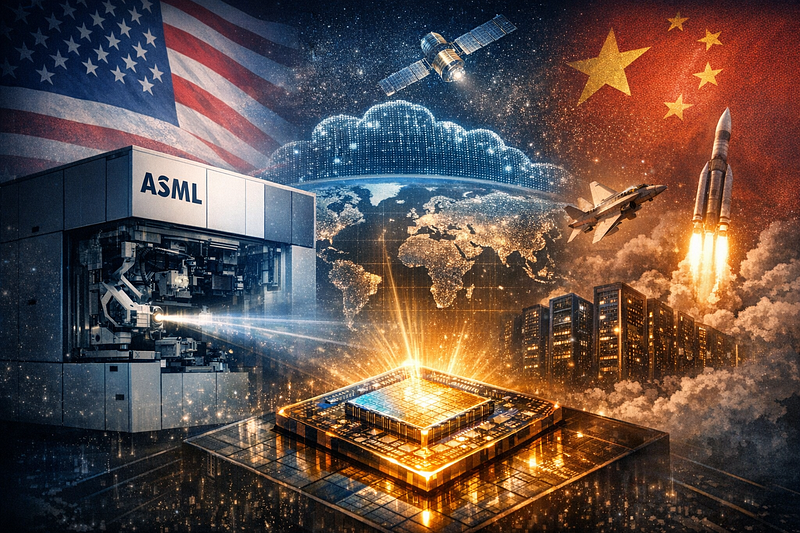
Fifty thousand times a second, inside a machine in a small Dutch town, a laser strikes a falling droplet of molten tin and flashes it into a plasma hotter than the surface of the sun. The light this produces is invisible, useless to almost everything, and found in nature mainly in stars: extreme ultraviolet, a wavelength so short and so easily swallowed that glass absorbs it, air absorbs it, and it can be steered only by mirrors so smooth that, by the company's own illustration, if one were enlarged to the size of Germany its largest bump would stand about a millimeter high. The whole apparatus runs in a vacuum, weighs as much as two airliners, draws on roughly a hundred thousand parts from some five thousand suppliers, and arrives at a customer in about two hundred and fifty freight crates. There is exactly one company on earth that can build it.
Its name is ASML, and almost no one outside the semiconductor industry can tell you what it does. Yet nearly everything that gets called the future of technology, every most-advanced chip, every frontier artificial-intelligence model, every cutting-edge weapon, depends on that one machine, and therefore on that one company, in a small town called Veldhoven, that the rest of the world rarely thinks about and could not replace if it tried.
This essay is about what it means for so much power to rest on so narrow a point, and about why the narrowness, not the power, is the thing worth understanding.
The bottleneck is not where the value is
Begin by correcting the instinct almost everyone brings to the chip industry, because the instinct points at the wrong place.
Ask who holds power in advanced semiconductors and most people will name the giants: the chip designers like Nvidia whose products are worth trillions, or the great manufacturer, TSMC in Taiwan, whose fabrication plants turn designs into silicon and whose importance is now a matter of open geopolitical anxiety. These are not wrong answers. They are simply not the deepest one. Because TSMC, for all its scale and all its strategic weight, cannot make an advanced chip without a tool it does not make and cannot make, and there is only one supplier of that tool, and it is not in Taiwan or California or anywhere people are looking. The most consequential company in the entire chain is not the one at the top of it, where the money and the attention are, but the one at its narrowest point, where the substitution is impossible.
This is the determining variable, and it inverts the usual map of power. We are trained to locate power at the summit of a value chain, with the famous brand and the enormous market capitalization. But in a chain where every link depends on the one before it, the real leverage sits not at the top but at the chokepoint, the single link that has no parallel, the one component for which there is no second source. TSMC has rivals, in a sense; Samsung and Intel also run frontier fabs. Nvidia has would-be challengers. But ASML has no rival at all in the machine that all of them require, and that absence of an alternative, rather than any amount of revenue, is what makes it the hinge. Power in a complex industry concentrates not where the value is greatest but where the substitution is hardest, and there is no harder substitution in modern technology than the one the world has, so far, entirely failed to make for the machine in Veldhoven.
Why it cannot simply be copied
The natural next thought is that a monopoly this critical must be temporary, that a determined company or a determined country will build its own version and break it. To see why that has not happened, and why it is so much harder than it sounds, you have to understand that ASML's monopoly is not protected by a patent or a law. It is protected by physics and by time.
Consider only the light. To etch the almost unimaginably small features of an advanced chip, you need light with a very short wavelength, and the wavelength chosen, 13.5 nanometers, is so short that it behaves less like the light from a lamp than like a soft X-ray. Ordinary lenses cannot focus it, because the glass simply absorbs it; the entire optical path has to be built from mirrors instead, and not ordinary mirrors but special stacks of dozens of alternating atomic layers, figured and polished by the German optics firm Zeiss to a smoothness that has few rivals among manufactured objects. The light itself has to be manufactured, since nothing convenient emits it, which is why the machine fires a laser at a tin droplet fifty thousand times a second, a feat of timing and power that took decades to make reliable and that newer systems are now pushing toward a hundred thousand droplets a second. And all of this happens in a vacuum, because the EUV light would be absorbed by air before it reached the wafer.
Now notice what that means for anyone hoping to copy it. ASML does not really manufacture the machine in the way a car company manufactures a car. It integrates, at the apex of a supply chain assembled over forty years, the specialized outputs of thousands of firms that each spent those decades solving one impossible piece: Zeiss and its mirrors, the American firm Cymer and its light source, the German firm Trumpf and its lasers, and thousands more. To build a rival is therefore not to build one machine. It is to rebuild the entire forty-year ecosystem of suppliers, each of which is itself a small monopoly of accumulated, often unwritten, know-how, and to do it fast enough to matter while the leader keeps moving. The monopoly is not a fortress someone could storm. It is a depth of accumulated specialization so great that even a wealthy and motivated state, pouring in money, finds itself years behind and discovering that money is not the binding constraint. The binding constraint is time that has already passed, and the experience of five thousand suppliers that cannot be hired all at once.
You can measure the depth of that accumulation in something as mundane as delivery. When ASML ships its newest machine, the High-NA system that costs around three hundred and eighty million dollars, it does not arrive as a crate but as a convoy: roughly two hundred and fifty freight containers carrying a machine that weighs as much as two airliners, followed by a team of some two hundred and fifty engineers who spend around six months assembling and calibrating it on the customer's floor before it can etch a single wafer. Intel's first one, installed in Oregon in 2024, was a delivery measured in months. A thing that takes two hundred and fifty specialists half a year merely to install, after four decades to invent, is not a thing a competitor reverse-engineers from a purchased sample, because there is no sample that helps. The knowledge is not in the object. It is in the five thousand companies and the forty years that made the object possible, and none of that can be unpacked from a crate.
No one designed this
Here the discipline matters, because a chokepoint this complete invites the suspicion that someone built it on purpose, and the truth is both less sinister and more unsettling.
No one set out to create a single global bottleneck for the most important industry on earth. ASML did not conquer its competitors so much as outlast them at a task most of them concluded was not worth the agony. For years EUV was a money pit, a technology that swallowed billions and decades and repeatedly seemed as if it might never work, and the Japanese firms that had once led lithography, Nikon and Canon, looked at the cost and the risk and walked away from the frontier, leaving the field to the one company stubborn enough, and backed by enough of the industry's own money, to keep going. The result is what economists call a natural monopoly, an outcome in which the market is simply too small and too hard to support more than one supplier, so that the one supplier who survives the brutal economics ends up alone not by conquest but by attrition. The chokepoint is the residue of a problem so difficult that only one solver remained.
That is the part the conspiratorial reading gets backward, and getting it backward matters, because it points the worry in the wrong direction. The danger here is not that a Dutch company plotted to hold the world's technology hostage. The danger is structural and arrived without anyone willing it: an industry on which everything now depends has, through the ordinary economics of extreme difficulty, narrowed to a single point of failure, and a single point of failure is dangerous regardless of the intentions of whoever happens to occupy it. ASML could be the most benign company in the world, and the structural fact would be identical. A system that runs through one machine, made by one firm, dependent on one fragile and irreplaceable supply chain, is fragile in a way that has nothing to do with anyone's character and everything to do with the shape of the thing.
The customers who built their own cage
There is a deeper irony in how the monopoly formed, one that complicates even the natural-monopoly story, because the chokepoint was not merely tolerated by the industry that now depends on it. It was financed by it.
ASML began in 1984 as a modest joint venture between the Dutch electronics giant Philips and a smaller equipment maker, working at first out of a shed beside a Philips building near Eindhoven, an unlikely birthplace for what would become the most critical company in technology. For most of its life it was one lithography firm among several, smaller than its Japanese rivals. What changed everything was EUV, and EUV was so expensive and so uncertain that ASML could not fund it alone. So in 2012 it made an extraordinary arrangement. Its three largest customers, Intel, TSMC, and Samsung, the very companies whose fabs would one day depend on the machine, together bought roughly a quarter of ASML and poured billions into its research, so that the tool they all needed would come to exist.
Sit with what that means. The chipmakers did not have a chokepoint imposed on them by an outside power. They built it, deliberately, with their own money, because each of them needed the machine and none of them could develop it alone, and the rational move for every one of them was to fund the single shared supplier rather than attempt the impossible separately. Every step was sensible. Intel's investment was sensible, TSMC's was sensible, Samsung's was sensible, and the sum of all that sensible behavior was the creation of a single point of failure that now sits above all three of them and above everyone downstream. This is how the most dangerous dependencies are usually made. Not imposed by a schemer, but co-produced by everyone who needed the thing and could not build it alone, each contributing to a concentration that none of them would have chosen as an outcome and all of them helped to cause. The cage was not built around the industry. The industry built it, together, because in the moment each bar of it was the reasonable thing to add.
Every chokepoint sits on another
Follow the dependency in the other direction, downward, and the single point of failure turns out not to be a point at all. It is the top of a stack of them.
ASML is the chokepoint for the chip industry, but ASML is no more self-sufficient than its customers are. Its machine cannot see without the mirrors, and the mirrors come from one place, the German optics firm Zeiss, whose EUV components are themselves without a real alternative, the product of their own decades of accumulated, uncopyable craft. ASML knew this, and did to Zeiss exactly what Intel and TSMC and Samsung had done to ASML. In 2016 it bought roughly a quarter of Zeiss's relevant division and poured money into its research, securing the supplier it could not do without, the same defensive move repeating one layer down the chain. And Zeiss in turn rests on its own narrow base: the exotic low-expansion ceramics for the mirror blanks, the multilayer coatings laid down almost atom by atom, the handful of specialized firms and rare materials without which the optics cannot exist. Below them sit suppliers narrower still.
So the real structure is not a bottleneck but a tower of them, each resting on the one beneath, each a single point with no substitute, each holding up everything above it. The chip world depends on the fab; the fab on ASML; ASML on Zeiss; Zeiss on a few makers of materials most people have never heard of; and at no level is there a second source to fall back on. Pull out any one of them and the whole tower above it stops, because the danger in a stack of monopolies is that the fragility does not average out across the levels. It compounds. A system resting on one machine sounds fragile enough. The truth is worse: it rests on one machine that rests on one optics maker that rests on a handful of suppliers, and the further down you go the smaller and quieter and less defended the companies become, until the most advanced technology on earth is found to be standing, at its base, on firms almost no one could name and no fleet would ever sail to protect.
Every chokepoint, it turns out, sits on another. The determining variable is not a point. It is the narrowest link in a chain that is narrow all the way down.
The machine the chipmakers cannot make
State the inversion plainly, because it is the heart of the matter and it is easy to lose in the awe at the engineering.
ASML cannot make a chip. It does not design processors, does not run fabrication plants, does not sell silicon to anyone. And the companies that do make the world's chips cannot make an ASML, cannot build the one tool without which their billion-dollar fabs are expensive buildings full of machines that cannot reach the frontier. The chipmakers cannot make the machine, and the machine's maker cannot make the chips, and that mutual incapacity is the entire structure of dependence. It means that TSMC, the company the whole world now frets about losing, is itself downstream of a dependency most of that worrying never reaches, because the anxiety stops at Taiwan and the actual irreplaceable link is one step further back, in a country no one is preparing to defend with a fleet.
This is why the determining variable is the bottleneck and not the famous firm. The conversation about chips is dominated by the visible giant, TSMC, and by the geopolitics of the island it sits on, and that conversation is not wrong, only shallow, because it stops at the most visible chokepoint instead of the deepest one. The fab is a chokepoint. The tool the fab cannot operate without is a deeper chokepoint. And the machine the world watches, the one whose loss is gamed out in war colleges, sits atop a machine the world barely watches at all, whose loss would be just as total and whose maker has no aircraft carriers anywhere near it. To find the real determining variable in any dependency, you do not stop at the link everyone is guarding. You keep going back until you reach the link that has no substitute, and in the chip war that link is not the island. It is the machine.
A Dutch company on an American leash
And now the structure turns from an industrial fact into an instrument of state power, because a chokepoint this total does not stay merely commercial. Someone, sooner or later, picks it up.
ASML sits in the Netherlands, a sovereign country, and sells, in principle, to whoever can pay. In practice it has never once been allowed to sell its most advanced machine, the EUV system, to a customer in China, and it has never been allowed because, since around 2019, the Dutch government has withheld the export licenses, and the Dutch government has withheld them under sustained pressure from the United States. In 2023 and again in 2024 the restrictions widened to cover some of the older but still advanced machines as well, again moving in step with Washington. The result is one of the cleanest examples in the modern economy of a chokepoint converted into a lever: the United States, unable to make China's chips worse directly, reached instead for the one tool China could not do without, and pulled it out of reach, using a Dutch company's export licenses as the mechanism. China's share of ASML's sales, which had spiked toward half of the total by the middle of 2024 as Chinese firms rushed to buy what they still could, was guided back toward roughly a fifth as the controls bit.
Read that as a fact about sovereignty and it is sharper than it first appears. The Netherlands owns ASML in every formal sense; it is a Dutch company, headquartered on Dutch soil, employing Dutch and international workers, answerable to Dutch and European law. And the single most consequential decision the company makes, who may and may not buy the machine that determines the technological future of nations, is one the Dutch state does not make alone, because the machine depends on enough American technology, and the Netherlands depends on enough of the American alliance, that Washington's preferences pass through the licensing decision as surely as if they were written into Dutch law. Legal ownership sits in The Hague. Operational control over the chokepoint is shared, quietly, with another capital. The country that holds the world's most important industrial monopoly does not fully hold the lever the monopoly creates, and that gap, between owning the asset and controlling what it does, is the same gap that runs under every modern dependency, here made unusually visible because the asset is a single machine and the lever is a single license.
What it does to the country on the wrong side
To see the chokepoint working, look at the country it is being used against, because its response reveals exactly how binding the constraint is.
Denied the machine, China has not been able to conjure a substitute, and the effort to do so is the clearest measure of how hard the substitution is. Its leading manufacturer reached a respectable seven-nanometer chip without EUV at all, using older machines and a laborious technique of patterning the same wafer several times over, a real achievement that also ran into exactly the wall the technique implies: lower yields, higher costs, and a ceiling that the older method cannot climb past into the most advanced nodes. Reports through 2025 and into 2026 describe Chinese programs racing to build a domestic EUV machine by alternative routes, and at least one prototype, using a different method of generating the light, is reported to be working in a laboratory, producing EUV at a fraction of ASML's power. But making a flash of the right light in a lab is a long way from making chips at the frontier at scale, and on that, the part that actually decides anything, the sober assessments still put a homegrown Chinese capability years off, with China's own targets pointing toward the end of the decade. As of this writing, no one on earth has broken ASML's monopoly in production. A state with effectively unlimited resources, treating this as a first-order national priority, has spent years and vast sums and still cannot buy or build its way around a single machine.
That is the most eloquent proof of the determining variable that one could ask for. When the second-largest economy in the world, fully mobilized, cannot substitute for a thing, the thing is not merely important; it is, for now, decisive. Everything China can still do at the older nodes it can do. Everything that requires the frontier, the most advanced AI accelerators, the densest and most efficient processors, it cannot do at scale, not because it lacks designers or money or fabs but because it lacks one machine, and the lack of that one machine sets a ceiling on an entire national ambition. Sovereignty, in the place where it now matters most, is not what Beijing can legislate or fund. It is what Beijing can build, and there is one thing it cannot build, and so there is one ceiling it cannot raise.
The race that runs through one machine
Lift the frame from the chip war to the thing the chip war is increasingly about, because it makes the stakes of the bottleneck current and concrete.
The contest that now consumes governments and trillions of dollars of investment is the race to build artificial intelligence, and that race is, in its physical substance, a race for compute, for ever larger arrays of the most advanced processors training ever larger models. Those processors, the accelerators the leading AI companies cannot buy fast enough, are made at the frontier nodes, and the frontier nodes are made on EUV. The line runs straight and short: there is no frontier AI chip without an advanced fab, no advanced fab without the machine, and no machine without ASML. The most consequential technological competition of the age, the one nations now treat as a matter of survival, funnels at its base through the same single point as everything else, a point most of the people staking their futures on the race have never had cause to think about.
This is what makes the determining variable a live lever rather than a historical curiosity. A government that wants to lead in artificial intelligence cannot simply will the compute into being; it needs the chips, which need the fab, which needs the machine it cannot make. And a government that wants to deny a rival's lead reaches, as the United States has, not for the AI models, which are software and travel freely, but for the one part of the stack that is physical, scarce, and gated: the machine, and the license that controls where it goes. The whole frantic, world-historic AI competition rests, in the end, on whether and where a few hundred of these machines are allowed to travel, which means the future everyone is racing toward is shaped, quietly and decisively, in a licensing office and a Dutch factory, by a constraint almost none of the racers control.
The case that this is simply a great company
The strongest objection has to be put now, and put fairly, because it is largely true and an argument that ignored it would deserve to lose.
The defense runs like this. ASML's position is earned, not seized. It is the product of forty years of genuine, extraordinary engineering and tens of billions of dollars in research that for long stretches returned nothing, a bet on a technology so hard that the only companies prudent enough to avoid it are the ones that are no longer at the frontier. The monopoly is not a trick or a conspiracy; it is what happens when a problem is so difficult that the market can support exactly one solver, and calling that a chokepoint, with the word's faint suggestion of menace, risks slandering what is in truth one of the most impressive sustained feats of industrial cooperation in human history. The export controls, similarly, are not arbitrary coercion but a defensible response, within an allied framework, to a genuinely dual-use technology with obvious military significance. And no monopoly in deep technology has ever been permanent; the history of these tools is a history of supposedly uncopyable leads that eventually narrowed, which means the bottleneck, however total it looks now, is probably eroding on some timescale, even if not a short one.
Every clause of that is true, and the honest form of this essay depends on granting it. ASML did not cheat its way to the top; it climbed there by doing something almost impossibly hard better and longer than anyone else, and its engineers deserve admiration rather than suspicion. But notice, as ever, what the defense does not touch. The case for ASML is a case about its conduct and its merit, and the finding here was never about either. It is about the shape of the dependence, which is the same whether the company at its center is admirable or not. An earned monopoly and a stolen one create the identical single point of failure. A benign chokepoint and a malign one offer the identical lever to whoever can reach the license that controls it. The determining variable is the existence of the bottleneck, not the virtue of the firm that occupies it, and the world is exactly as exposed to a fragile, irreplaceable, politically-leveraged dependency when that dependency was built by heroes as when it was built by villains. The engineering is a triumph. The structure is still a vulnerability, and the two facts are not in tension, because they are answers to different questions.
The narrowest point
So return, at the end, to the machine, and to the strange disproportion between its obscurity and its importance.
A device most people will never see or hear of, made by a company most people cannot name, in a town most people cannot place, sets the outer limit of what every advanced economy can compute, and therefore of what it can secure, model, and build. The whole towering edifice of modern technology, the trillion-dollar chip designers, the world-historic anxiety over Taiwan, the race for artificial intelligence on which nations now stake their futures, rests on a base far narrower than any of the structures above it, narrow enough to run through one fragile machine and one fragile supply chain and one set of export licenses signed in two capitals. The visible drama is all at the top, where the money and the headlines are. The thing that actually determines the outcome is at the bottom, at the narrowest point, where almost no one looks.
That is the lesson the machine in Veldhoven teaches, and it reaches far past chips. The most decisive position in any system on which the world depends is rarely the famous one at the summit. It is the quiet one at the point of no substitution, the single link with no parallel, the part that cannot be bought past or sanctioned around or built in a hurry. Find that link and you have found where the power really sits, which is almost never where the attention is. The chip war is fought, in the headlines, over an island. It is decided, in fact, by a machine that fires a laser at a falling drop of tin fifty thousand times a second, in a country no fleet is sailing to defend, because the world has not yet noticed that the narrowest point in the most important industry on earth is not where it has been told to look.
Evidence Map
Facts, interpretations, forecasts, and disconfirming signals.
Core claim. The determining variable in the advanced-chip industry is not the famous producer (TSMC) or designer (Nvidia) but the single irreplaceable TOOL the producers cannot make themselves: ASML's EUV lithography machine, of which ASML is the only maker on earth. Power in a complex chain concentrates at the point of no substitution, not at the point of greatest value. The monopoly is protected by physics and forty years of accumulated supply-chain depth, not by patent, which is why even a fully mobilized state cannot copy it quickly. It is an emergent natural monopoly (a by-product of a problem so hard only one solver remained), not a designed weapon, and that structural single-point-of-failure is dangerous regardless of the firm's intent. The chokepoint became a geopolitical lever: a Dutch company's EUV machines have never been sold to China, withheld via Dutch export licenses under US pressure.
Evidence level. Facts (high, documented): ASML (Veldhoven) is the sole maker of EUV lithography (~100% EUV; dominant in DUV, roughly four-fifths of total lithography); the EUV mechanism (a CO2 laser vaporizing tin droplets ~50,000/sec, next-gen toward ~100,000, to make 13.5nm light, focused by Zeiss multilayer mirrors, in vacuum); ~100,000 parts from ~5,000 suppliers, ~250 crates; EUV price ~$200M, High-NA ~$380M; cumulative 300+ EUV shipped; High-NA delivered to Intel first (2024); customers TSMC/Samsung/Intel; Nikon and Canon exited EUV; the EUV-to-China ban since ~2019 and the 2023-2024 DUV restrictions, with China's share of ASML sales spiking (~half in early 2024) then guided toward ~a fifth; China's DUV-multipatterning 7nm (2023) with its yield/cost ceiling. Interpretation (medium, marked): the "bottleneck not the famous firm" determining-variable reading; the natural-monopoly / no-one-designed-it account; the legal-vs-operational-sovereignty (Dutch ownership, shared control) reading. Contested / fast-moving (marked): Chinese domestic-EUV progress in 2025-2026 is prototype/pilot-stage and trade-press-sourced (Level 2.5-3); the monopoly is unbroken as of mid-2026 but this is the item most likely to shift. Attributed illustration: the Zeiss "mirror scaled to Germany, bump under a millimeter" smoothness analogy (company illustration; cited values vary ~0.1-1mm).
What would confirm this. Continued inability of any state or firm to field a production EUV alternative despite maximal effort; continued use of EUV/DUV licenses as the primary lever in the chip-control regime; the frontier remaining gated by tool access rather than capital or talent.
What would disprove this. A working, production-grade non-ASML EUV machine (Chinese or other) reaching the frontier, which would dissolve the single-point monopoly; or evidence that advanced chips can reach the frontier at scale without EUV (breaking the tool-dependence), which would relocate the determining variable away from the machine.
Watchlist. Chinese domestic-EUV efforts (LDP and alternative light sources, SMEE/SiCarrier) and any move from prototype to production; High-NA EUV adoption and its costs; further tightening or loosening of Dutch/US export licensing; any single-point-of-failure shock (a Zeiss or supply-chain disruption) revealing the fragility directly.
Related from The Manifest Archive
- Taiwan: The Chokepoint That Breaks Everything
- Microsoft and the Digital Veto
- Everyone Is Watching the Cloud. Nobody Is Watching the Cables on the Seabed.
- Everyone Is Watching Food Prices. Nobody Is Watching the Gas That Feeds Half the World.
Jerry van der Laan writes The Manifest Archive, daily forensic essays on power, language, and the systems that shape what we are allowed to see as reality. He traces the structures beneath them.