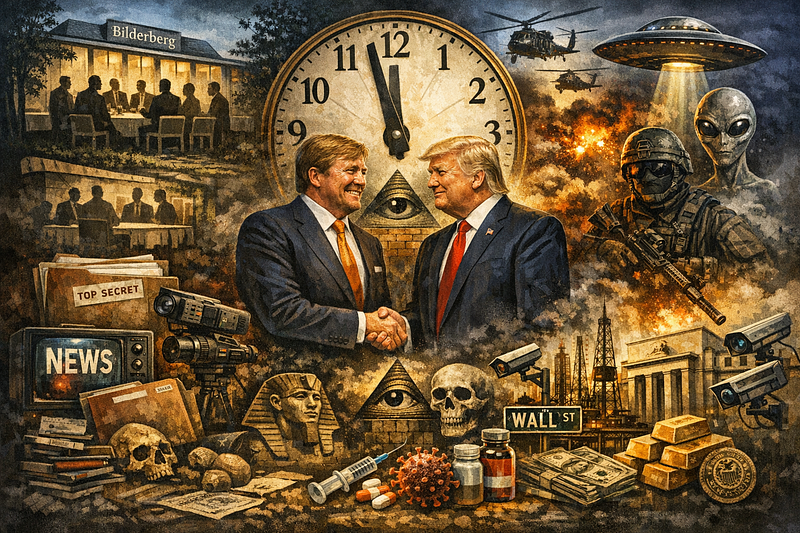
You have read about the visit. You saw the photographs from the White House. You read that the Dutch king made clear "that we disagree on fundamental points." What the official programme did not say is that the King and Queen, and the Prime Minister who went with them to the White House, had spent the preceding days at a private conference with the people who shape Western policy. The Royal House did not announce it. Much of the reporting on the visit did not mention it. That gap is what this article is about.
April 9, 2026. Washington, D.C. The Salamander hotel is a short drive from the White House. For four days, 128 participants from 23 countries met there in private. A list of topics was published. What anyone said was not. The meeting was the 72nd Bilderberg Conference, and the rule governing it guarantees that nothing discussed can ever be attributed to anyone who said it.
On the evening of April 13, the day after Bilderberg ended, King Willem-Alexander and Queen Máxima of the Netherlands arrived at the White House for dinner with President Trump, and stayed the night. It was part of a three-day working visit to the United States. Prime Minister Rob Jetten accompanied them to Washington and to the dinner. All three names were on the published participant list of the Bilderberg meeting that had closed the day before.
The Royal House published the programme of the visit on April 3. It began on April 13, in Philadelphia. It did not mention the conference. One outlet that did, the royalty pages of the Dutch broadcaster EO, reported that the King and Queen had attended Bilderberg that weekend and that the Government Information Service had not announced it. The other reports on the visit that I checked, among them NL Times, said nothing about it.
Four days. Same city. Same delegation. Different rooms.
What Bilderberg Is
Bilderberg is an annual private conference, held since 1954, that brings together roughly 130 senior figures from Western governments, finance, technology, defense, and media. The participant list is published. The agenda is published in outline. What is not published, and structurally cannot be published, is what anyone says. The Chatham House Rule prohibits attribution. Participants may use what they learn. They may not reveal who said what.
The result is a room where a central bank governor, a defense minister, a technology CEO, and an intelligence official can discuss the same policy question without any public record of who argued what. This is not secrecy in the ordinary sense. The names are public. What is missing is accountability for what was said, and secrecy can be breached in a way this arrangement cannot.
A forum for off-the-record dialogue, the official description reads. Off-the-record means not attributable. It does not mean uninfluential, and it does not prove influence either.
Note what this costs: nothing. No suppression required. No orders given.
The architecture produces its own silence.
The Founding Chairman Had Been a Nazi Party Member
Prince Bernhard of the Netherlands chaired Bilderberg from its founding in 1954 until 1976. In the early 1930s he had been a member of the Nazi Party, and in 1996 he admitted having belonged to an SS unit as a student. He denied the party membership until his death in 2004; his membership card was found in his own archive in 2023. In 1976 a government commission of inquiry found that he had accepted payments from the Lockheed Corporation, put at $1.1 million, and he gave up his public functions, including the chair of Bilderberg. Queen Juliana is widely reported to have threatened to abdicate if he were prosecuted. He was not prosecuted.
His daughter, Beatrix, also appears on Bilderberg's historical participant lists. His grandson, King Willem-Alexander, was on the participant list in Washington in 2022, and again in 2026.
Seventy-two years. The chair has changed hands many times. The family's place on the list has not disappeared.
The Dutch Delegation
Six Dutch participants are named on the 2026 list: the King and the Queen; Prime Minister Rob Jetten; Sigrid Kaag, former Minister of Foreign Affairs and of Finance, now co-chair of the board of the United Nations Foundation; Roy Jakobs, chief executive of Royal Philips; and Rolly van Rappard, co-founder and chair of CVC Capital Partners. For a country of eighteen million people, that is the head of state, the head of government, a former deputy prime minister and two business leaders, in one room, at a moment when the Hormuz blockade had restructured global energy flows and the published agenda included energy diversification, the Middle East, AI and the future of warfare.
What the King and the President discussed the next evening is not on record either. Afterwards the King said only that he had made clear "that we disagree on fundamental points," and declined to say which: "That's not up to me."
Then there is ASML. Peter Wennink, then chief executive of ASML, is on the participant lists for 2022 and 2023. ASML makes the only extreme ultraviolet lithography machines in existence, and every advanced semiconductor depends on them. During those two years the United States pressed the Netherlands to restrict ASML's exports to China, and in January 2023 the Dutch government was reported to have agreed.
Whether anything said at Bilderberg shaped that decision cannot be known, and that is the point. The Chatham House Rule does not prevent coordination. It prevents documentation of whether there was any. That is the limit of what can be said here: not that the meeting decided anything, but that no one outside it can show whether it did.
The Man Not on the List
Donald Trump does not appear on any published Bilderberg participant list, as a developer, a candidate, a president or a former president. People around him do. Jared Kushner and Mike Pompeo attended in 2019; H.R. McMaster and Wilbur Ross in 2017.
On April 13 the King, the Queen and the Prime Minister went from a weekend in that room to a dinner with a president who has never been listed in it. Whether anything from the weekend carried into the dinner is not on any record. What can be said is narrower: the Dutch side arrived from a forum where the American president's policies were on the agenda, and the President had not been part of it.
What the Silence Tells Us
A more charitable reading would be simpler. State and working visits are scripted events. Journalists focus on what is said in the room, not on what may have been discussed elsewhere. Bilderberg, in that reading, is treated as background rather than news. That explanation is plausible. It is also incomplete, because the overlap here was not subtle. It required no leak, no source, no speculation. It required only two public facts: a participant list, and a visit. The EO connected them. The official programme did not, and much of the coverage followed the programme.
This is not a conspiracy. The meeting was publicly listed. The participants were named. The dates were known. The proximity was arithmetically obvious. The story was there, and it was largely not told.
Propaganda does not require a propagandist. It requires a structure that makes certain information feel peripheral.
Consider what that silence required. Not a single editor had to be instructed. Not a single journalist had to be pressured. The convention that Bilderberg is background noise was sufficient. It was enough that the professional culture of political journalism had, over decades, filed this kind of proximity under coincidence and this kind of meeting under fringe. No one made that decision. It accumulated. That is what makes it durable.
The grandfather who chaired the conference for twenty-two years had been a member of the Nazi Party and left the chair over Lockheed's payments. The grandson who attended its 72nd edition sat down with the American president the next evening, accompanied by the Prime Minister who had been at the same conference. None of that is hidden. It is simply not put side by side.
You read about the visit. You saw the photographs. You read that differences were made clear. The only actor the arrangement did not design a role for is the one reading this now.
Correction, 10 October 2026: an earlier version of this article was titled "No One Mentioned Bilderberg" and said that no outlet had reported the connection; the EO did. It also described the trip as a state visit (it was a working visit), described Rob Jetten as climate and energy minister (he attended as Prime Minister), said four Dutch participants attended (six are listed), said no agenda was published (topics were), and said Sigrid Kaag accompanied the King to the White House (she did not). Unsupported statements about a Shell stake of the House of Orange, a letter on royal stationery, and an Iran discussion at the dinner have been removed. Details: themanifestarchive.com/standards.
Jerry van der Laan is an independent analyst and the author of The Manifest Archive.