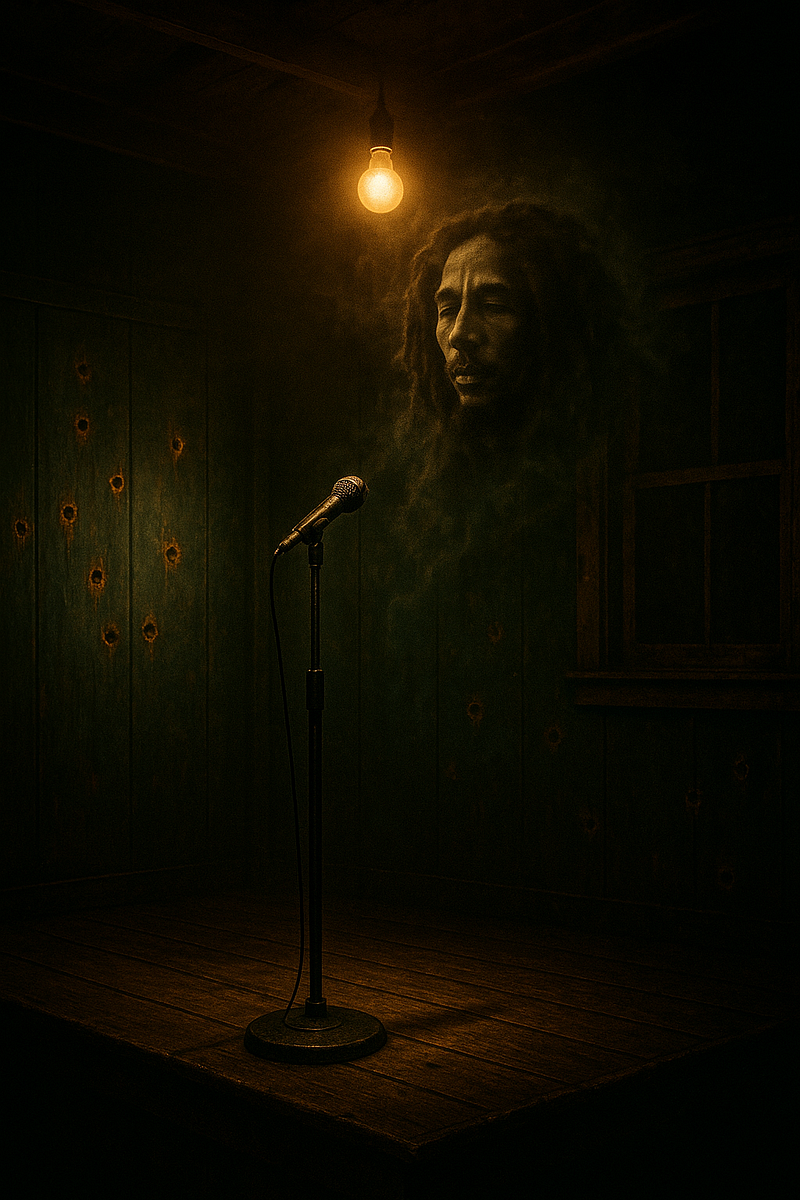
On the night of December 3, 1976, seven gunmen came through the gate at 56 Hope Road in Kingston while Bob Marley and his band were on a break from rehearsal. They shot his wife Rita in the head as she sat in a car in the driveway; she survived. They shot his manager, Don Taylor, several times in the legs and torso; he survived. They shot Marley himself, a bullet grazing his chest and lodging in his arm. Then they left as quickly as they had come. Two days later, wounded, his arm barely usable, Marley walked onto a stage in front of roughly eighty thousand people and played.
Violence in Jamaica in that era rarely came from simple anger. It came from hierarchy, from interests, from a logic that decided certain people had become inconvenient to certain arrangements. The men who came through the gate did not act out of a personal grievance against a singer. They acted, whoever sent them, on the same calculation that has governed such acts for centuries: when power cannot control a voice, it reaches instead for the body carrying it.
The attack is usually told as a story about one brave man. It is more useful as a story about a threshold. Marley had crossed the invisible line that separates an influential person from a dangerous one, and the distance between those two categories is the subject of this essay. He had not picked up a weapon. He had not run for office. He had done something a Cold War client state, divided by design, could not tolerate. He had begun to unify it. The bullets were the system's recognition that a musician had become a political fact.
This is not, in the end, a story about reggae, or Rastafari, or even about an assassination attempt. It is a story about a mechanism, and the mechanism is older and broader than Jamaica. Power, of a certain kind, does not fear opposition, which it knows how to answer. It fears unity, which it does not. A divided population is governable. A united one is not, and the surest way to make a population ungovernable is to give it someone everyone, across the dividing lines, trusts.
What makes Marley the clearest case of that mechanism, clearer than the other artists the world mourns and merchandises, is that the system tried both of its instruments on the same man, in sequence, and we can watch the switch. First it reached for the body, while he lived and the unity was real: the bullet. When that failed and then death took him anyway, it reached for the image: the brand. Most figures meet only one of these. Marley met both, which makes him the rare proof that they are not two different fates but one instrument at two settings, the violent and the gentle, aimed across decades at the same target, which was never the man and always the unity he carried. That is the argument this essay traces, from the gate at Hope Road to the poster on the wall.
Empires do not fear opposition. They fear unity.
Begin with the distinction the whole story turns on. An opponent is legible. He has a party, a platform, a constituency, a set of demands that can be negotiated, bought off, defeated at the ballot, or answered with a rival program. Systems are built to process opposition; it is, in a sense, what they are for. What they are not built to process is a figure who belongs to no faction and is trusted by all of them, because such a figure cannot be slotted into the machinery of division that keeps the system running.
Marley was that figure. He did not preach a political program. He preached awakening, self-recognition, a sense of worth to a post-colonial population that had been taught to distrust its own reflection. He was claimed by the poor of both political tribes, by Rastafari and the unaligned, by an island and then by a hemisphere. That breadth was the threat, and it is crucial to see why. He was not dangerous because of what he opposed. He was dangerous because of what he could gather. A leader people merely agree with can be out-argued. A leader people trust more than they trust the state is a different kind of problem, because trust is the one resource a divided system cannot manufacture and cannot afford to see pooled in a single pair of hands it does not control.
He was not a threat because he opposed power. He was a threat because people trusted him more than they trusted it. And the specific, fatal quality was not unity in the abstract, which prophets and politicians have preached forever, but that he was unowned. Every other unifying force in the system belonged to someone: a party, a church, a sponsor, a foreign patron, each able to claim it, steer it, or bargain it away. Marley belonged to no one. No faction could deliver him, no power could license him, no rival could discredit him as the other side's man, because he was not on a side. An owned unifier can be managed through its owner. An unowned one cannot be managed at all, and that, more than the size of his audience, is what made him impossible for the system to process. No system built on division can survive a unifier it does not own, and the system Marley lived inside was built on division more deliberately than most.
The boy from Nine Mile
The capacity to unify did not come from nowhere; it was built into the life. Robert Nesta Marley was born in February 1945 in Nine Mile, a hill village in the parish of Saint Ann, to a Black Jamaican mother, Cedella Malcolm, and a white father, Norval Marley, a British-descended Jamaican who was largely absent and died when the boy was young. That mixed parentage mattered in a colour-stratified society. Marley was taunted as a child for being neither one thing nor the other, and the experience of belonging fully to no group may be the root of the later capacity to belong, in some measure, to all of them.
At around twelve he moved with his mother to Trenchtown, a poor quarter of West Kingston built partly on a former garbage dump, named for the trench of a sewage system that ran beneath it. It was one of the toughest neighbourhoods in the hemisphere, and it was also a crucible of music, where ska and American rhythm and blues met and recombined. There Marley fell in with the young men who would become the Wailers, and there he absorbed the two things that would define him: the sound of the Jamaican poor, and their condition.
This origin is not biographical decoration. It explains the supply. A figure who can unify a divided society is not produced by comfort or by belonging neatly to one tribe. He is more often produced exactly as Marley was, on the margins of every category, poor enough to speak for the poor and mixed enough to be claimed by no faction, with a voice trained in the one place where the divisions of the society were most concentrated and most visibly arbitrary. Trenchtown did not just give him his sound. It gave him the standpoint from which the whole structure of division looked like what it was, a thing made, and therefore a thing that could be unmade.
Why the message was dangerous
It is easy, at this distance, to hear Marley's songs as gentle, and to miss that his actual message was among the most subversive a colonized people could receive. He was a Rastafari, and Rastafari was not a soft faith. It was a theology of refusal. It held that the descendants of the enslaved were not the marginal afterthought of someone else's empire but a chosen people in their own right; it named the entire Western order of money, police, and church as Babylon, a system of bondage to be seen through and survived; and it located dignity and divinity not in the metropole but in Africa, in the person of the Ethiopian emperor Haile Selassie, whose 1966 visit to Jamaica drew vast crowds and cemented the movement's conviction. For decades the Jamaican state treated Rastafari as a criminal nuisance, harassed its adherents, and policed its sacraments.
That is the content beneath the melody, and it is why the music was never harmless. Marley was not telling a downtrodden population to relax. He was telling it that its downtrodden condition was neither natural nor deserved nor permanent, that the system pressing on it was a human construction called Babylon, and that the people had a worth no empire had the authority to assign or withdraw. A population that internalizes that message stops being governable in the old way, because the deepest mechanism of control over the colonized was never only force. It was the taught belief in one's own lesser status, and Marley's entire body of work was a sustained attack on exactly that belief. Music is harmless right up until people begin to act on what it tells them, and Jamaicans were beginning to act.
The Cold War that took up residence in Jamaica
To understand why a concert could get a man shot, you have to see the board Jamaica sat on. The island was small and its coordinates were enormous. It lay in the American sphere, a short flight from Cuba, in the decade when Washington treated the Caribbean as a frontier to be held. By the mid-1970s Jamaica had become a proxy field, and its two parties were the local expression of a global contest.
Michael Manley's People's National Party tilted left, pursued democratic socialism, befriended Castro's Cuba, and challenged the terms on which foreign capital and the bauxite companies operated. Edward Seaga's Jamaica Labour Party tilted west, promising order, investment, and alignment with the United States. And the island had organized itself, around those two poles, into garrison constituencies: neighbourhoods controlled by a party through a local strongman and his armed followers, where politics and gang control had fused and weapons flowed through political patronage. Elections were not only counted. They were fought, block by block. In a system like that a unifying figure is not merely inconvenient; he is an existential threat to every actor whose power depends on his constituency staying walled off, afraid, and loyal. Marley threatened to make the walls look optional.
The pressure was economic as much as electoral. Manley's levy on the foreign bauxite companies and his redistributive turn alarmed Washington and the markets at once; capital fled, the currency weakened, and by the late 1970s Jamaica was sliding toward the International Monetary Fund, whose conditions would roll back the very programs Manley had been elected to deliver. It is the financial face of the same vise this archive describes elsewhere: a small state that defies the terms of foreign capital finds the terms enforcing themselves, through its currency and its credit, long before any vote is held.
That Washington worked to undermine Manley's government is not a fringe claim; Manley himself said it publicly for the rest of his life, and the broader pattern of American destabilization of left-leaning governments in the hemisphere in that era is extensively documented. The specific allegation that the Central Intelligence Agency armed the gangs or engineered Jamaica's 1976 violence remains contested and unproven, and it should be marked as such rather than asserted. What is not in dispute is the structure: a small nation turned into a Cold War proxy, divided into armed political camps, in which any force that crossed the dividing lines threatened an arrangement that powerful interests, foreign and domestic, were invested in keeping. Into that fault line walked a man who belonged to everyone.
The stage they could not allow
The concert that drew the bullets was called Smile Jamaica, organized in December 1976 in the tense run-up to a national election, billed as a free show to ease the violence. Marley agreed to perform, but on a condition that turned a charity gig into a provocation: the stage had to belong to the people, not to a party. He refused to let it become a campaign rally for Manley's government, which had announced the election just after the concert was set.
That insistence on a non-partisan stage was the dangerous act, and to see why you have to understand what it threatened. Jamaica's political architecture did not run on persuasion. It ran on division, on neighborhoods that delivered their votes as blocs because they were tied, by patronage and by force, to one party or the other. A genuinely unifying event, a stage that belonged to no faction and gathered everyone, was not a neutral gesture in that system. It was a solvent. It dissolved, for an evening, the very divisions the whole apparatus depended on to function. Two days before he was to step onto that stage, the gunmen arrived.
The attempt failed, and failure accelerated the thing it meant to stop. Marley played anyway, his wounded arm strapped, and at the climax he lifted it toward the lights and showed the crowd the bandage. Eighty thousand people understood exactly what they were seeing. They had been told, by the bullets, that unity was punishable. They were being shown, from the stage, that it had survived the punishment. A man who might have remained a national singer became, in that gesture, a regional symbol and then a global one. They had tried to erase the body carrying the message. Instead they consecrated it.
Exodus
After the shooting Marley left Jamaica, not out of fear but out of a clear reading of his situation, and spent much of the next period in London. The exile produced his most expansive work. The album Exodus, recorded in that period, carried Jamaica with him and outward: songs that traveled farther than the body that recorded them, that turned a specific island's struggle into a vocabulary the whole post-colonial world could borrow. One Love. Jamming. The record made him not the voice of Jamaica but the voice of what Jamaica, and a hundred places like it, might have been without interference.
This is the part the system had most reason to fear, and it is worth stating precisely. A dissident confined to one country can be contained within that country. A dissident whose message becomes portable, who gives a billion people in a hundred divided nations a shared language of dignity and refusal, cannot be contained anywhere, because there is no border at which to stop a song. Marley had become exactly that, a non-aligned voice that moved populations no government owned, and he had done it without a party, an army, or a platform anyone could negotiate with.
The reach was not metaphorical. Exodus was a commercial and cultural phenomenon that put a Jamaican voice, singing in patois about Babylon and repatriation, into the center of the global culture; decades later it would be named by a major Western magazine as the album of the twentieth century, which is its own kind of evidence of how completely the message had travelled. By the late 1970s Marley was filling stadiums across Europe, Africa, and beyond, and his most explicitly political work reached its widest audiences abroad. In 1980 he was invited to perform at the independence ceremony of Zimbabwe, the birth of a new African nation out of a liberation war, and that invitation is the whole argument in a single booking. A government did not ask a pop star to its founding. A new state asked the man who had become the voice of liberation itself to sing it into being. No empire is comfortable with a private citizen who holds that role and answers to no one.
The hands he joined
The clearest image of why he was feared came not from a riot but from a reconciliation, and the way that reconciliation came about is part of the meaning. The concert had its origins not in a government initiative but in a truce reached, improbably, by the armed men themselves. Two gang figures from opposite political garrisons, enforcers from the very world of violence that had carved up West Kingston, had concluded that their followers were dying for the benefit of politicians who never bled, and they sought out Marley in his London exile to ask him to come home and lend the truce his voice. That detail is worth holding: even the men with the guns understood that only Marley could consecrate a peace, that the politicians could not, that the trust required to stop the killing pooled in a musician and nowhere else. It is the whole thesis, told from inside the violence.
On April 22, 1978, Marley returned to Kingston for the One Love Peace Concert, staged amid another wave of political violence. During the performance of "Jamming," he called the two men whose followers had been killing each other onto the stage: Michael Manley and Edward Seaga, the leaders of the warring parties. And he took their hands, and joined them, and held all three hands together above his head.
It was theater, and it did not end Jamaica's violence, and it would be sentimental to pretend otherwise. But as a demonstration of the thing the system could not do, it was total. The two halves of a divided nation could be brought together, physically, on a stage, by a musician, in a gesture neither party could have performed for itself without losing face. Marley had just shown, in front of the country, that the divisions the whole apparatus rested on were not natural law. They could be crossed. A man with a guitar had produced, for a moment, the unity that the entire political and Cold War machinery was organized to prevent. That is the most dangerous thing a person in his position can do, not oppose the system, but reveal that its central premise, the necessity of division, is a choice. He had made wholeness look easy. Nothing frightens a divided order more.
Too useful to others, too unowned by anyone
It is worth being careful here, because this is where fact shades into speculation and the careful reader deserves the line drawn clearly. That Cold War intelligence services took an interest in cultural figures capable of moving non-aligned populations is documented as a general matter; the era's archives are full of programs aimed at culture as a theater of the contest. That any agency specifically targeted Marley, or had a hand in the Hope Road shooting, is not established by any reliable evidence and should be treated as an open and unproven question, not a finding. The honest classification is that the shooting's authorship has never been definitively established; the gunmen were never tried, and theories range from local garrison-gang retaliation to wider political design.
What does not depend on resolving that question is the structural point, and it is the durable one. Marley occupied a position that made him valuable to forces that could never control him and threatening to forces that needed the population divided. He influenced not votes but identity, not policy but self-recognition, and that is the one form of influence no permission system knows how to license. He could move people that power could not move, in a direction power had not chosen. Whether or not any specific agency ever wrote his name on a list, the logic that would put it there is plain, and it is the same logic that has always treated the unifying figure as a category of risk.
The illness that ended it
In 1977 Marley noticed a dark spot beneath the nail of his right big toe, which he and others initially took for a football injury. It was acral lentiginous melanoma, a rare and aggressive skin cancer that disproportionately affects people of color and is often caught late. Doctors recommended amputating the toe. Marley, for reasons bound up with his Rastafari faith and its strictures on the body, refused, accepting only the removal of the nail and affected tissue and a skin graft. The cancer was not contained. Over the following years it spread to his lungs, his liver, and his brain.
He kept working as it killed him, which is its own kind of testimony. He toured into 1980, his body failing, and collapsed while jogging in a New York park that autumn, the cancer having reached his brain. He played what would be his last concert in Pittsburgh in September 1980, visibly diminished, and then went in search of any treatment that might hold the disease back, ending up at an unorthodox clinic in the Bavarian mountains where he endured a punishing regimen for months. He was baptized into the Ethiopian Orthodox Church near the end, taking a new name. On the journey home to Jamaica, which he did not want to die away from, he got as far as Miami, and died there on May 11, 1981. He was thirty-six. The voice had stayed strong almost to the end, even as the body that carried it gave way, and that gap between the failing body and the undimmed voice is, in its way, the most fitting image he left.
A man this feared, dying this young, of a disease this rare, has inevitably attracted suspicion of foul play, and that suspicion deserves to be named and then set in its place. There is no credible evidence that Marley's melanoma was anything other than what the medicine describes: an aggressive cancer, of a type known to strike exactly where his did, made fatal by the decision to forgo the treatment that might have stopped it early. The temptation to convert a tragic medical death into one more act of the machinery is understandable, given everything else, but it is not supported, and to assert it would be to do to his death what this essay accuses others of doing to his life, bending a real and specific human fact into a symbol. The documented cause is sufficient, and it is its own kind of tragedy: a treatable cancer, refused early treatment, in a body that would not stop working until it could no longer stand.
What they could not kill, they learned to sell
Here is the final turn, and it is the one that completes the mechanism. The figure once feared as too dangerous to control became, after his death, one of the most controlled and most marketable images on earth. The man whose unifying power threatened a Cold War order was repackaged into a poster on a dormitory wall, a t-shirt, a brand of headphones, a greatest-hits collection that has sold tens of millions of copies and turned a revolutionary into a soundtrack for relaxation. The radical was sanded into a smile. The threat became merchandise.
The instrument of that transformation has a name, a number, and a documented method. In 1984, three years after his death, his label released Legend, a greatest-hits compilation that became the best-selling reggae album in history, on the order of twenty-five million copies worldwide and more than eighteen million in the United States alone. For most of the world, Legend became Marley. And it was built, deliberately, to remove the dangerous half of him. The tracklist was chosen by the label partly on the basis of market research, surveys gauging what would sell to an international audience that the record company judged to be alienated by his political and Rastafari lyrics. The result foregrounded the love songs and the anthems of comfort and quietly dropped almost everything militant, including the entirety of Survival, the 1979 album on which he had sung Africa Unite and Zimbabwe and called openly for pan-African liberation. The most radical record he ever made contributed not a single track to the album that would define him for hundreds of millions of people.
That is the curation as a documented act, not a metaphor. A market survey decided which Marley the world would receive, and it selected the one who soothed over the one who indicted. The afterlife extended the same logic into objects: a family-licensed lifestyle empire of headphones, speakers, and other goods trading on the image, the revolutionary turned into a brand of audio equipment and a poster and a rolling-papers aesthetic. A man whose life's work attacked a system he called Babylon was repackaged, with the survey data to prove it, as the pleasant sound of relaxing within it. The politics were not refuted. They were edited out, by questionnaire, and what remained was sold.
This is not a separate story from the shooting. It is the same mechanism completing its work by other means. A living Marley was a unifying force that no one owned and that therefore frightened the powerful. A dead Marley is a fixed image that anyone can own, license, and sell, drained of the specific political danger that made him a target and refilled with a vague, marketable spirit of peace. The system that could not tolerate the man found it could profit handsomely from the icon, because an icon makes no demands, crosses no garrison line, and joins no rivals' hands. What power cannot kill, it learns to sell, and the selling is its own form of burial, gentler than a bullet and far more effective, because it does not create a martyr. It creates a logo.
The variable was never the music
Strip the story to its mechanism and one variable governs the rest, and it is not the quality of the songs, the politics of the lyrics, or even the courage of the man. It is the capacity to unify across the divisions a system depends on. That is the thing that made Marley dangerous, and the proof is that the danger tracked the unity and nothing else. When he was a talented singer with a local following, he was tolerated. When he became a figure the poor of both parties trusted, the bullets came. When he became a voice that crossed borders and answered to no government, the interest in him sharpened. And when he died and the unifying capacity died with him, leaving only an image, the same forces that had feared him relaxed and went to work selling him. The threat rose and fell exactly with the reach of the trust, which is the signature of the mechanism.
This yields a portable law, and it travels far past one musician or one island. Power built on division is not threatened by those who oppose it within the divisions; those it can manage. It is threatened by anyone who can dissolve the divisions themselves, because the divisions are the load-bearing structure. The unifier is therefore treated as a structural risk regardless of his intentions, and a movement, a faith, or a song that makes a fractured people feel whole is more dangerous to such a system than any rival program, because a rival program accepts the board and merely plays the other side, while unity removes the board. Find who can make the divided trust one another, and you have found what a divided system most needs to stop. Not its enemies. Its reconcilers.
Marley is not an isolated case, only an unusually legible one. The same structural position recurs around figures who become unifying forces a divided order cannot own. A civil-rights leader is placed under relentless surveillance while alive and then, after his murder, sanded into a safe national holiday. A man emerges from twenty-seven years in prison to reconcile a country and is promptly turned into a saintly global brand. Musicians who frighten the powerful while living are merchandised once dead. The fates differ and the causes differ, and it would be an error, the exact error this essay refuses, to flatten them into one plot. What recurs is not a conspiracy but a position. The one who can dissolve the divisions occupies the same dangerous ground and meets some version of the same instrument, the pressure while living and the packaging after, whoever, if anyone, ever decides to wield it. Marley simply shows the whole arc in a single life.
The honest objection
The strongest case against this reading deserves to be stated at full strength. It is that almost none of the geopolitics is necessary to explain the facts. Jamaica in 1976 was awash in garrison-gang violence that needed no foreign hand to produce; the shooting may have been ordinary political-gang retaliation with a local motive that had nothing to do with any larger design. Marley's global rise can be explained by talent, a brilliant record label, and the universal appeal of his music, with no need for a theory of threatened empires. His death has a complete and documented medical cause. And the posthumous commodification of dead musicians is so universal, from Elvis to Lennon, that reading it as a special act of containment risks seeing design where there is only the ordinary machinery of the music business. On this view, the essay drapes a structural narrative over a sequence of local tragedies and market forces.
That objection is largely correct on the particulars, and conceding it sharpens rather than dissolves the argument. The claim here is not that a cabal shot Marley, engineered his fame, or gave him cancer; each of those would be exactly the kind of overreach this archive exists to avoid, and the speculative ones have been marked as such throughout. The claim is narrower and survives every concession: that a genuinely unifying figure in a deliberately divided society occupies a structurally dangerous position, independent of who, if anyone, decided to act on it; that the documented core, a man shot two days before a non-partisan concert in a Cold War proxy state, then joining rival leaders' hands eighteen months later, then sold after death as the very emblem of the harmlessness he never embodied, illustrates the mechanism whether or not any single link was a plot. The geopolitics need not be a conspiracy for the structure to be real. Unity is a threat to systems that run on division, and the unifier pays for it, by a bullet or by a brand. No order has to be signed. The structure signs it.
What he revealed
Strip away the speculation and what remains is larger than the speculation ever was. Bob Marley demonstrated, in public and at cost, that the divisions a society treats as permanent are often maintained rather than given, and that a single trusted voice can reveal them as a choice. That is why the unifying figure is feared, and it is why, when the figure cannot be refuted or defeated, the system reaches first for the body and, failing that, for the image. The bullet and the brand are two ends of one instrument, and the instrument exists because the thing it answers, a population that has stopped believing in its own divisions, is the one outcome no power built on those divisions can survive.
He is remembered now as a gentle prophet of peace, which he was, and the gentleness is real and worth keeping. But it is only half of him, and the safer half, and the half that sells. The other half is the one that got him shot: a man who showed a fractured country, for the length of a song, that it could be whole, and who frightened the people invested in its fracture precisely because he made wholeness look possible.
That is the figure worth recovering from under three decades of merchandise, because his story is not finally about him. It is about a permanent feature of how power works. Wherever a society is held together by division, by garrison and party, by race and class, by the careful separation of people who might otherwise recognize one another, the most dangerous person is not the loudest opponent but the quiet unifier, the one who can make the divided trust one another across the lines they were taught to defend. Such a figure will be answered, because such a figure must be, and the answer comes in one of two forms. If he can be reached, a bullet. If he cannot, or if the bullet fails, then patience, and after death a brand, the radical sanded into a smiley face on a poster, the threat resold as comfort. Both are the same instrument, aimed at the same target, which was never the man and always the unity he carried.
Some truths do not disappear when the music stops. They wait for the world to grow quiet enough to hear them again, and then they are dangerous all over.
Evidence Map
Facts, interpretations, forecasts, and disconfirming signals.
Core claim. Bob Marley became a target not for opposing power but for his capacity to unify a deliberately divided Cold War client state, and the same unifying power that made him dangerous alive was, after his death, neutralized by commodification: what could not be controlled was turned into a brand. The determining variable is the capacity to unify across the divisions a system depends on, not any particular ideology.
Evidence level. Facts (high): the December 3, 1976 shooting at 56 Hope Road, wounding Marley, Rita Marley, and manager Don Taylor; the Smile Jamaica concert two days later before roughly 80,000 people; Jamaica's 1976 Cold War proxy context, with Manley's PNP (left, pro-Cuba) against Seaga's JLP (west-aligned) and garrison-based political violence; the April 22, 1978 One Love Peace Concert, where Marley joined Manley's and Seaga's hands during "Jamming"; the acral lentiginous melanoma beginning under his toenail, his refusal of amputation on Rastafari grounds, the metastasis, and his death on May 11, 1981, aged 36; the vast posthumous commercialization of his image. Interpretation (marked): reading the unifying capacity as the structural threat, and the commodification as the completion of the same mechanism, is analytical interpretation grounded in those facts. Open / speculative (marked): the authorship of the shooting is unresolved; the specific claim of CIA targeting of Marley is unproven and is treated as an open question, not a finding; suggestions of foul play in his illness are unsupported and the documented melanoma is the sufficient cause.
What would confirm this. Documentary evidence of intelligence interest specifically in Marley; the recurrence of the pattern (unifying cultural figures in divided states meeting violence, then posthumous commodification).
What would disprove this. Evidence that the shooting was purely local gang retaliation with no political dimension; evidence that Marley's reach was never perceived as a threat by any political actor; an account in which the commodification reflects only ordinary music-industry practice with no neutralizing function.
Watchlist. New archival releases on Cold War cultural operations in the Caribbean; scholarship on the still-unsolved authorship of the 1976 attack.
Jerry van der Laan writes The Manifest Archive, where he examines power, culture, and institutions. He traces the structures beneath them.