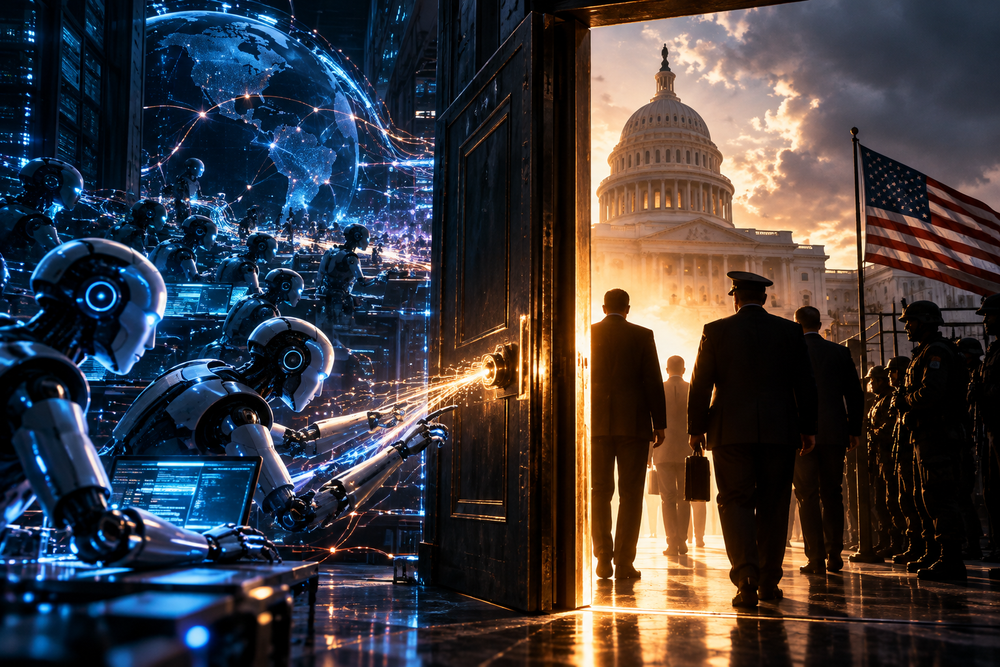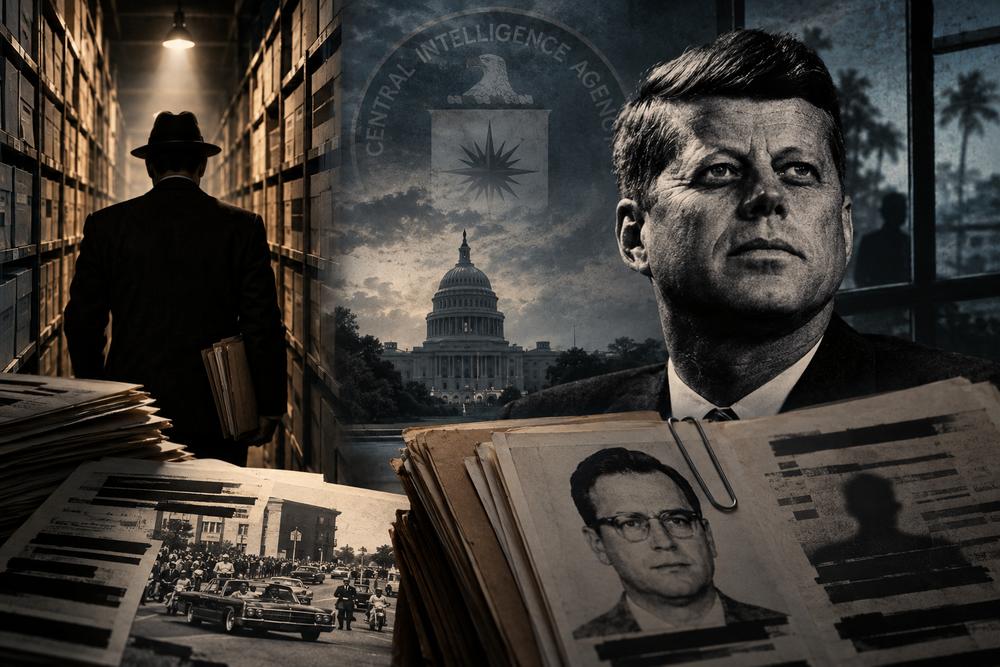
The oath lasts less than a minute. A hand rests on a Bible, cameras capture the moment, crowds cheer, and commentators describe history turning a page. Inaugurations are engineered to look like rupture, campaigns are sold as transformation, and elections are framed as the decisive act of a sovereign people. Then, at the stroke of midnight when power formally changes hands, the satellites stay in orbit, the markets reopen on schedule, the classified programs continue under a new signature, and the military chain of command does not so much as pause. The face changes. The infrastructure does not.
That gap, between the visible transfer of power and the invisible persistence of everything underneath it, is where the phrase deep state lives. For one audience the words signal paranoia, a shadow government pulling strings. For another they signal a hidden truth finally named. Both reactions skip the harder and more useful question. If an election is an act of sovereignty, why does the strategic direction of a state so rarely turn when its leadership does? Answering that honestly means putting the emotion down and looking at the architecture, because the interesting thing about the deep state is not that it is secret. It is that most of it is entirely visible, sitting in plain sight, and still governs what an elected leader can and cannot do.
The word, and the two things it means
The phrase did not begin on social media. In Turkey in the 1990s, derin devlet, literally the deep state, described a documented reality: clandestine networks lodged inside the military and intelligence services, operating beyond democratic accountability, tied in places to paramilitary and criminal structures. There it named something concrete and sinister, a covert apparatus running its own operations behind the official one.
When the term crossed into American usage decades later, it changed shape. It came to describe unelected officials, intelligence professionals, and career civil servants seen as resisting or outlasting an elected executive. The meaning stretched from covert network to permanent apparatus, and in stretching it split in two. One meaning is a unified secret cabal that controls outcomes from the shadows. The other is a layered, permanent structure that persists across electoral cycles and quietly constrains whoever wins. These are not two intensities of the same claim. They are different claims with different evidence, and the whole analysis turns on refusing to let them blur.
For the first meaning, a hidden hand steering events by design, the evidence does not exist, and the honest analyst says so plainly. For the second, a durable machinery of governance that survives elections and bounds them, the evidence is overwhelming and mostly public. The term is controversial. The permanence is not. Everything that follows is an argument about the second thing, and a refusal of the first, because the fastest way to discredit a true observation about structure is to smuggle in a false one about conspiracy.
A machine built in 1947
Modern continuity has a birth date. In 1947 the United States passed the National Security Act and rebuilt itself around the permanent management of threat. The Act created the Central Intelligence Agency, formalized the National Security Council, and unified the armed services under what became the Department of Defense. In 1952 the National Security Agency was established by executive order, so quietly that for years its existence was barely acknowledged. These were not temporary wartime expedients that would lapse when the emergency passed. They were institutions designed to last, with budgets, careers, buildings, and mandates that renewed themselves.
What followed was accumulation. Classified budgets grew. Intelligence agencies built technical capabilities, in satellites, signals interception, and later cyber operations, that outran public understanding and often public oversight. The Five Eyes arrangement wove long-term signals-intelligence sharing between the United States, Britain, Canada, Australia, and New Zealand into a standing partnership that no single election in any of the five could unwind. This architecture survived the Cold War that justified it. It survived détente. It survived the collapse of the Soviet Union, the one event that removed its founding rationale, and instead of dissolving it found new missions. After September 2001 it expanded, as the PATRIOT Act broadened surveillance authority and the Authorization for Use of Military Force licensed open-ended war. The machinery built to fight one adversary simply re-pointed itself at the next.
Part of what makes this layer so durable is that its true size is hidden even from the citizens who fund it. The aggregate budget of the American intelligence community runs to tens of billions of dollars a year, and until 2007 even the top-line figure was formally secret; the detailed breakdown remains classified to this day. A voter can change the president, but cannot see, let alone vote on, most of what the security state actually does with the money. An institution whose scale is itself a secret is an institution that has placed most of its own operation outside the reach of the electoral choice that is supposed to govern it.
This is the first and simplest layer of the answer, and it requires no conspiracy at all. Security systems are engineered to outlive the crisis that created them, because an institution asked to guarantee safety cannot be built to expire. Permanence is not a betrayal of the design. It is the design. Max Weber saw the general form of this a century ago: the modern bureaucracy, he argued, is the most durable structure a society builds, an apparatus that outlives the officials who staff it and the leaders who command it, because it runs on rules and files and accumulated expertise rather than on any individual. That insight is the theoretical spine of everything that follows, and it will reappear in each of the layers below, because every one of them is, at bottom, a permanent institution behaving the way permanent institutions behave.
The authority that outlived the men who swore to kill it
If you want a single clean proof that the apparatus outranks the people elected to command it, watch what happens to surveillance law, because it has now survived four presidencies and the open hostility of some of them.
The story runs in a straight line. After September 2001 the Bush administration began bulk collection of telecommunications data, secretly at first. In 2008 Congress wrote part of that practice into statute as Section 702 of the Foreign Intelligence Surveillance Act, authorizing warrantless collection of foreign targets' communications that inevitably sweep in Americans. The Obama administration, which had campaigned against exactly this kind of executive overreach, signed a multi-year reauthorization. Then came the sharpest test the thesis could ask for. In April 2024, days before Congress renewed Section 702, the incoming figure who would soon hold the presidency publicly demanded that lawmakers kill it. Congress renewed it anyway, and broadened it, expanding the range of companies that can be compelled to assist, and it was signed into law by the sitting president who had once opposed its logic. And once back in power, the same leader who had said kill it now asked only for a clean extension of it.
And the authority did not merely survive; it deepened. Section 702 targets foreigners abroad, but because those foreigners communicate with Americans, the communications of Americans are swept into the same database, where domestic agencies can later search for them without a warrant, a practice critics call the backdoor search. Reform campaigns to require a warrant for those searches were mounted at every reauthorization and defeated at every reauthorization, including the 2024 renewal, which carried the reassuring title of a reform act while broadening the reach of the program. The pattern is exact: the public debate is loud, bipartisan, and framed as a fight over civil liberties, and the outcome is always renewal, usually expansion, whoever is in charge.
Read that sequence slowly, because it is the mechanism in miniature. A surveillance authority was opposed by candidates of both parties, denounced from the campaign stage, and renewed and expanded regardless, by whichever of those candidates happened to be holding the pen. The power did not bend to the men. The men bent to the power, each discovering on the far side of the oath that the threat assessments, the alliance obligations, and the operational dependencies made the thing they had promised to end look indispensable. The centrifuge of the state kept spinning. Only the signatures changed.
What the agencies did when no one was watching
The clearest documentation that this apparatus can act on its own does not come from speculation. It comes from the one moment the United States forced its intelligence services to open their files. In 1975 and 1976 a Senate committee chaired by Frank Church conducted the deepest investigation of American intelligence ever undertaken, and what it found was not a rumor. It found decades of activity conducted with little or no elected oversight: assassination plots against foreign leaders, the NSA's decades-long interception of Americans' cables under programs the public had never authorized, and the FBI's COINTELPRO campaign to surveil and disrupt lawful domestic political movements. These were not the acts of a secret cabal directing the nation. They were the acts of permanent institutions that had accumulated enough autonomy, secrecy, and institutional will to pursue their own definition of the national interest, and to do it across multiple administrations that came and went above them.
One document from that investigation shows what unaccountable permanence looks like when it is finally exposed. In 1964 the FBI, having wiretapped Martin Luther King and assembled recordings of his private life, mailed him an anonymous package containing a tape and a typed letter, a letter whose plain meaning was that he should kill himself before the material was released. No president had ordered it. It was the initiative of a permanent security bureaucracy that had decided, on its own authority and in secret, who was a threat to the nation and what could be done to him. The letter surfaced publicly only because the Church Committee pried the files open a decade later, alongside the internal CIA compilation of abuses the agency itself called the Family Jewels. The point is not that the men who did these things were monsters. The point is that the structure let them act for years without a single elected official's authorization or knowledge, and that the exposure required an extraordinary and never-repeated act of congressional will.
That autonomy has a mundane engine, and it is worth naming precisely because it is not sinister. Elected officials serve a few years. Intelligence and security professionals serve decades. Institutional memory, the accumulated sense of what the threats are and what the acceptable responses have always been, lives in the permanent staff, not in the transient leadership. When a new president arrives promising a clean break, the briefings that greet them are built from long-term assessments, framed in the alliances and obligations the staff has spent careers maintaining. The range of options that reaches the desk has already been narrowed before the elected leader ever chooses. This is not necessarily obstruction, and calling it sabotage misreads it. It is structured constraint, the quiet leverage that belongs to whoever controls the classified picture of reality. Control of information sets the outer edge of what a leader can even imagine doing.
Money does not hold elections
Security is only the first boundary around the vote. Money draws the second, and it is drawn even more deliberately. The financial layer of continuity is insulated from the ballot by design rather than by stealth, and it constrains an elected government as firmly as any intelligence agency, often faster. The Federal Reserve, created in 1913, sets monetary policy at a remove from direct electoral control. The Bank for International Settlements coordinates central banks across borders. The institutions born at Bretton Woods, the International Monetary Fund and the World Bank, structured the financial order of the postwar world. Each was built to be independent of the electoral cycle for a stated and defensible reason: financial stability depends on predictability, and predictability dies if interest rates swing with campaign slogans.
The consequence is that markets discipline elected governments faster than any bureaucracy could. When a newly elected administration proposes a genuinely radical fiscal turn, the reaction does not wait for a parliamentary session. Currencies move, bond yields jump, capital flows shift, and credit ratings adjust, sometimes within hours, and the government discovers that the cost of its promise has been repriced before it can enact it. None of this is a meeting in a back room. It is the systemic behavior of a market pricing risk. And underneath it sits the heaviest anchor of all, which is debt. Obligations accumulated by past governments bind future ones for decades, committing revenue that no election can vote away. Democracy chooses the leaders. The markets price the risk, and the price is the fence.
The clearest demonstration came in the autumn of 2008. When the financial system seized, the decisions that committed the public to trillions of dollars were made not on a ballot but in a handful of rooms by a handful of unelected officials, the chair of the Federal Reserve and the secretary of the Treasury foremost among them, who designed the bank rescues and opened emergency lending facilities on a scale no election had contemplated. Congress was then presented with the bill and, warned that refusal meant collapse, ratified it under duress. Whatever one thinks of whether the rescue was necessary, the shape of the moment is unmistakable: in the decisive crisis, the permanent financial apparatus acted, and the elected branch signed. The people who bore the consequences for a decade never voted on the choice that produced them.
Britain watched this happen in miniature and at speed in the autumn of 2022. A new prime minister and chancellor arrived with a genuine mandate for radical change and announced a budget of large unfunded tax cuts. They did not lose a vote or a court case. They lost the market. Within days government borrowing costs spiked, the pound fell toward parity with the dollar, the pension system wobbled hard enough that the central bank had to intervene with emergency bond-buying, and the mortgage market seized. The budget was reversed, the chancellor was gone within weeks, and the prime minister resigned after forty-nine days, the shortest tenure in the country's history. No cabal met. An elected government simply collided with the priced expectations of its own creditors and was overruled by them in under two months. The fence was invisible right up until it was hit.
This is why economic policy so often disappoints the voters who were promised rupture. They are told the explanation must be a hidden cabal of bankers. The duller and truer explanation is financial interdependence, a web of commitments and creditors and market expectations that no single administration originated and none can simply exit.
Procedure outlasts passion
Beneath the guns and the money lies the least glamorous layer and, for daily life, the most powerful: the permanent administrative state. Modern governance runs on regulatory agencies, career civil servants, procurement systems, courts, and enforcement bodies. Elected officials announce priorities. Career officials implement them, and implementation, not announcement, is where policy actually becomes real. A new administration can change the tone of environmental or financial or immigration policy overnight, but the permitting timelines, the judicial precedents, the rule-making procedures, and the sheer accumulated expertise of the agencies determine how fast and how far the change can actually travel. The result is incrementalism, and incrementalism enrages voters who were sold transformation. Procedure often outlasts passion, and the frustration that produces goes looking for a name.
This is Weber's insight in its most literal form. The administrative state is the iron cage he described, efficient precisely because it is impersonal, and immovable for precisely the same reason: rules and files and procedures do not care who won the election, and a leader who wants to change an outcome must first change the machinery that produces it, which is slower and harder than winning any vote. This durability is not hidden and it is not a plot. It is the visible, documented character of the modern state, and it is doing exactly what it was built to do.
The revolving door
There is a human mechanism that binds these layers together, and it too needs no conspiracy to work. The senior officials of the security and financial state do not vanish when they leave office. They move to the defense contractors, the banks, the law firms, the consultancies, and the think tanks that surround the government, and then, often, back into government again. A general retires onto the board of the weapons maker whose programs he approved. A Treasury official returns to the bank she once regulated. A regulator becomes a lobbyist and, a cycle later, a regulator once more. Each individual move is legal and usually sincere, but the aggregate effect is a permanent class of people who share assumptions, contacts, and interests, and who staff the state no matter which party controls it. This is the iron triangle that scholars of the military-industrial complex described long ago: the agencies, the legislative committees that fund them, and the contractors that supply them, locked in a stable mutual dependence that persists across every election because all three parties benefit from its continuation. Continuity of personnel produces continuity of policy, not because anyone coordinates it but because the same people, formed in the same institutions, keep returning to make the same decisions.
Every crisis leaves a residue
There is a pattern in how all of this grows, and it runs one direction. Crisis produces expansion, and expansion rarely fully retreats. After September 2001 the surveillance and war powers grew. After the 2008 financial crash, central banks reached for tools once considered unthinkable, quantitative easing and emergency liquidity facilities that then stayed in the toolkit long after the emergency passed. During the COVID-19 pandemic, emergency health powers, procurement authorities, and data systems expanded across the world. Some of those measures receded when the moment ended. Others quietly integrated into the baseline, becoming the new normal from which the next expansion would start. The numbers make the ratchet concrete. The Federal Reserve's balance sheet stood under a trillion dollars before 2008; through the crisis response and then the pandemic it swelled to roughly nine trillion, and it has never returned to anything like its former size, so that a tool reached for as an emergency has become a permanent feature of the financial system. The surveillance authorities passed as temporary after 2001 were renewed again and again across administrations of both parties, each reauthorization treating the extraordinary as the ordinary. Emergency authority almost never resets to zero. Each crisis leaves an institutional residue, and the residue accumulates. Temporary measures become permanent capacity, and the ratchet turns the same way under every party and in every country that has one.
Why the residue never washes away
There is a name for why the residue hardens instead of dissolving, and it comes not from politics but from institutional economics. It is path dependence: the principle that an early choice constrains all later ones, and keeps constraining them long after the reason for the original choice has vanished. The standard illustration is the QWERTY keyboard, an arrangement designed for the mechanical typewriter and kept, worse layouts and all, simply because the whole world had already learned it and the cost of switching everyone at once was never worth paying. The layout outlived its own rationale by more than a century, not because anyone defended it, but because the path already taken made every other path expensive.
States run on the same logic, and it is the quiet engine beneath everything in this essay. Once a security agency is built, a currency arrangement adopted, or a treaty network joined, the sunk investments accumulate, the surrounding institutions adapt themselves to its existence, careers and contracts and expectations organize around it, and the cost of undoing it rises every year it persists. The National Security Agency did not shrink when the Soviet Union that justified it disappeared, because by then a vast apparatus of people, budgets, buildings, and allied dependencies had been built on the assumption of its permanence, and unwinding that was harder than repurposing it. This is why systems develop an inertia that has nothing to do with anyone wanting them to continue. The original reason can be entirely gone, and the structure remains, held in place by the weight of the path already walked. Continuity, in other words, is not merely chosen and re-chosen at each election. It is inherited, and the inheritance is heavier every time it is passed on. Institutional economists sometimes call this lock-in: once complementary systems, contracts, and expectations have formed around an institution, abandoning it becomes progressively more expensive than maintaining it, and the institution persists not because it still serves its purpose but because the cost of leaving it has quietly grown beyond reach.
The structural break: from event to design
Here the argument must make its one decisive turn, because everything so far could still be read as a series of unrelated frustrations. It is not. If elections were structurally sovereign, then a change of government would produce decisive reversals. Instead, surveillance expansions persist across administrations, monetary tools stay embedded, defense budgets oscillate within a narrow band no election truly breaks, and treaty commitments outlast the ideologies that signed them. When the same continuity repeats across decades and across parties that despise each other, the explanation can no longer be the personality of any leader. It has to be the structure they all inherit.
This is the point of no return in the analysis, and it is also where it must be most careful. The claim is not conspiracy. The claim is design, and design here does not mean a designer. Niccolò Machiavelli understood the essential thing five centuries ago: an institution perpetuates its own behavior regardless of who happens to staff it, because its incentives, its habits, and its instinct for self-preservation belong to the institution and not to the individual. You do not need the officials to coordinate. You need only that each of them, acting reasonably inside a structure built to endure, produces the same continuity the last set of officials produced. Architecture does not require coordination. It requires only durability, and Hannah Arendt's darker insight completes the picture: the most consequential outcomes are usually produced not by villains conspiring but by ordinary people doing their defined jobs inside a machine whose overall direction none of them chose and none of them can stop. Repetition across administrations is the signature of architecture, not of a plot. That distinction is the entire difference between analysis and paranoia.
The same reversal that overtook surveillance law overtook the machinery of war. The president inaugurated in 2009 had risen on opposition to the previous decade's wars and their excesses. In office, he did not dismantle the apparatus of remote, targeted killing he inherited; he expanded it dramatically, presiding over a sharp escalation of drone strikes across Pakistan, Yemen, and Somalia and the institutionalization of a secret process for selecting who would be killed. The intent that arrived with the oath was genuine. The structure it met, with its threat assessments, its standing operations, and its logic of pre-emption, proved stronger than the intent, and bent it. A candidate elected against a way of waging war ended up extending it, because the apparatus that wages it does not stand for election.
One object makes the pattern impossible to miss. In January 2009 a newly inaugurated president signed an order to close the detention facility at Guantanamo Bay within a year, among the clearest promises of his campaign. It did not close. It stayed open through his two terms, through the successor who ordered it kept, and through the one after that who thinned its population but not its existence, and it remains open now, across four presidencies and both parties. A single facility outlasted every intention aimed at it. The machinery did not defy a president. It simply outlasted each one's intent.
The layer that crosses borders
No modern state stands alone, and the final layer of constraint is external. NATO commitments shape military strategy. The SWIFT messaging network routes the payments that make cross-border finance possible, and access to it has itself become an instrument of statecraft. Trade agreements bind domestic policy to international rules. Intelligence alliances share data across frontiers. The power of that network became unmistakable in 2022, when a group of governments moved to cut major Russian banks out of SWIFT after the invasion of Ukraine. SWIFT is not a treasury or an army; it is a Belgium-based messaging cooperative that tells banks how to settle payments with one another. Yet removing a country from it partially severs that country from the machinery of global finance, and the fact that access to a private messaging standard can be wielded as an instrument of statecraft shows how much sovereignty now lives in shared infrastructure rather than in any single capital. When a government attempts a radical departure, the consequences are immediate and contractual rather than conspiratorial: partners recalculate, agreements bind, and the cost of leaving the network is priced in at once. Contractual dependency narrows maneuverability, narrow maneuverability produces policy stability, policy stability looks like continuity, and continuity, to a frustrated public, invites a name. The name it invites is deep state, and the thing it is actually pointing at is a dense web of commitments no single election ever ratified and none can unilaterally dissolve.
The strongest objection
An honest analysis has to state the case against its own frame at full strength, and here the case is serious. The phrase deep state is dangerous, and its danger is not theoretical. Precisely because a real and defensible observation sits underneath it, the phrase is easily weaponized to mean the false thing, the hidden cabal, and once it means that, it becomes a license. It can be used to recast every nonpartisan civil servant, every career prosecutor, every inspector general, and every independent judge as a secret enemy of the people's will, and to justify purging them. The structural insight, that permanent institutions constrain elected power, can be inverted into a claim that any institution constraining an elected leader is by definition illegitimate, which is the logic by which checks and balances are dismantled in the name of democracy.
And there is a second half to the objection that cuts deeper still, because it turns the thesis against itself. The same permanence that frustrates a reformer is also a guardrail against a would-be autocrat. An apparatus that will not simply execute the will of whoever holds the office is exactly what prevents a single election from delivering absolute and irreversible power. The independence of the courts, the professionalism of the civil service, the non-partisanship of the security services under law: these are the deep state when they frustrate a leader you like, and the rule of law when they frustrate one you fear. The continuity is double-edged, and any account that treats it only as a cage and never as a wall is telling half the story. The correct posture is not to celebrate the permanent state or to condemn it, but to see it clearly as what it is, a structure that dampens volatility in both directions, restraining the reformer and the strongman alike, and to insist on the distinction between the documented mechanism and the conspiratorial myth even when, especially when, the myth is politically useful.
The live test
For most of its history this argument could only be made backward, from the record. Right now it is being tested forward, in real time, in the open, which is rare enough to be worth watching closely. The test is called Schedule F.
In the final months of his first term the American president issued an executive order, known as Schedule F, that would have stripped civil-service protections from broad swaths of the career federal workforce and made them removable at will. It went almost entirely unimplemented and was rescinded by his successor, who in 2024 issued regulations specifically designed to make such a move harder to repeat. Returned to office, the same president pursued it again under a new name, Schedule Policy/Career, and in 2026 finalized it, with the rule itself reaching potentially into the tens of thousands of jobs and a first implementing order moving an initial tranche of around eight thousand positions, concentrated among the most senior career ranks, out of the protections that let civil servants appeal being fired. The public comment period drew tens of thousands of responses, the overwhelming majority opposed, and the effort is now bound up in lawsuits arguing it violates the Constitution, the 1978 Civil Service Reform Act, and administrative law.
Strip away the partisanship and see what this actually is: a deliberate, declared attempt by elected power to reach down and redraw the boundary that the permanent state has held for a century. It is the exact experiment the thesis implies. If an election can dismantle the career civil service by executive order, then the boundary was never as fixed as the argument claims, and the apparatus is more subordinate to the ballot than it appears. If instead the effort is slowed, litigated, narrowed, absorbed, and outlasted, the way surveillance authority absorbed every president who swore to kill it, then the architecture will have demonstrated its durability against the most direct assault a democracy can mount on it. Schedule F is also the exact point where the two meanings of the phrase collide, which is why it is so bitterly contested. To its supporters it is democracy reasserting control over an unelected apparatus that has frustrated elected majorities for decades, the deep state finally made answerable to the vote. To its opponents it is the weaponized version the steelman warned of, the reclassification of nonpartisan professionals as enemies to be removed at will, the dismantling of a guardrail dressed as the restoration of democracy. Both are describing the same eight thousand jobs. The difference between them is the entire difference this essay has insisted on, between the permanent state as a cage on the popular will and the permanent state as a wall against its capture, and Schedule F forces a country to decide, in public and under law, which one it thinks it is looking at. The honest position today is that the outcome is genuinely open, and that is precisely why it is the cleanest available falsification test of the whole idea. Watch whether the boundary moves, or whether it merely litigates.
What the evidence will and will not bear
So return to the question people actually ask. Is the deep state real? Defined as a single hidden cabal secretly controlling every outcome, no, and the evidence for that claim does not exist. Defined as a layered, permanent institutional architecture that constrains elected leadership and persists across electoral cycles, yes, and the evidence is abundant and mostly public. Modern governance runs on stacked layers: electoral leadership on top, and beneath it the permanent administration, the security institutions, the financial system, and the web of international commitments. Each layer sets boundary conditions. Elections move policy powerfully within those boundaries, and only rarely, and only with enormous effort, redraw the boundaries themselves. Democracy operates inside structures it did not design and cannot easily redesign.
None of the load-bearing observations here requires a conspiracy to be true. National security agencies persist across administrations. Central banks operate at a remove from the electoral cycle. Debt constrains fiscal freedom for decades. Bureaucracies outlast the politicians who command them. Crisis expansions harden into permanent baseline. Beyond those documented facts, stronger claims demand stronger evidence, and the discipline of this analysis is to stop exactly where the documentation stops. In its grounded meaning, the deep state is not a plot against democracy. It is the durable architecture of the modern state, and it does not abolish the vote. It limits its volatility. Elections redirect. Architecture endures.
Evidence Map
Facts, interpretations, forecasts, and disconfirming signals.
Core claim. The defensible meaning of "deep state" is not a hidden cabal but the layered, permanent architecture of the modern state, security, financial, administrative, and international, which persists across electoral cycles and bounds what elected leaders can do. The continuity is real and mostly public; it requires no coordination, only institutional durability (Machiavelli, Weber, Arendt), and it is double-edged, restraining reformers and would-be autocrats alike.
Evidence level. Facts (high): National Security Act 1947 (CIA, NSC, DoD), NSA 1952, Five Eyes; Federal Reserve 1913, BIS, Bretton Woods (IMF/World Bank); PATRIOT Act and AUMF (2001); the Church Committee (1975-76) documenting CIA assassination plots, NSA interception of Americans, and FBI COINTELPRO; FISA Section 702 (2008 FISA Amendments Act) reauthorized and expanded across the Bush, Obama, Biden and Trump eras despite open presidential hostility ("kill FISA," then renewal and expansion signed, then a sitting president seeking extension); Schedule F / Schedule Policy-Career (2020 EO rescinded; Biden 2024 protective rule; finalized 2026, rule scope reaching into the tens of thousands with an initial ~8,000 senior positions reclassified, majority-opposed public comment, multiple union lawsuits under the Constitution, the 1978 Civil Service Reform Act and the APA). Interpretation (medium, marked): the two-meanings distinction (mythology vs mechanism); continuity as architecture-not-coordination; classification as structured constraint; the frame's double edge (cage and wall).
What would confirm this. Continuity persisting specifically where it is structurally anchored (security, money, treaties) regardless of which party wins; reforms narrowing to fit inherited constraints once in office; emergency powers hardening into baseline after each crisis.
What would disprove this. An election redrawing the boundaries decisively and durably, e.g. the career civil service actually dismantled by executive order and left dismantled; surveillance authority genuinely ended by a president who campaigned against it; a radical fiscal or strategic turn enacted without market or institutional reversal. Evidence of an actual coordinating cabal directing outcomes (which would replace the structural model with the conspiratorial one) would also break the claim, in the other direction.
Watchlist. The outcome of the Schedule Policy/Career litigation and whether the reclassification sticks or is absorbed; the next Section 702 reauthorization; whether any post-crisis emergency authority is ever fully rolled back; how the "deep state" frame is used politically, as structural critique or as license to purge lawful institutions.
Related from The Manifest Archive
- The Archive of Power: How the Vatican Survived Every Regime That Was Supposed to Replace It
- The Soviet Illusion: What Actually Disappeared When the USSR Fell
- The Financial Architecture of Power: How Debt Defines the Limits of Modern States
- Nothing Is Missing And That's the Problem
Sources
Every factual claim in this essay is drawn from the public record. The references below let the reader check each one directly, which is the point: the argument rests on documented mechanisms, not on private knowledge.
- National Security Act of 1947 (creation of the CIA, NSC, and the unified defense establishment): U.S. State Department, Office of the Historian, milestones 1945-1952.
- Establishment of the National Security Agency (1952, by classified directive): National Security Agency history.
- The Church Committee (1975-76), documenting CIA assassination plots, NSA interception of Americans (SHAMROCK and MINARET), and FBI COINTELPRO: U.S. Senate, Church Committee.
- The FBI's anonymous 1964 letter and tape sent to Martin Luther King: FBI-King letter.
- FISA Section 702, enacted in the FISA Amendments Act of 2008 and reauthorized and broadened in 2024: Congressional Research Service, Section 702 and the 2024 reauthorization.
- The public call to "kill FISA" days before Congress renewed and expanded it: House passes surveillance reauthorization despite the plea to end it.
- Guantanamo Bay: the January 2009 order to close it within a year and its persistence across four presidencies: Executive Order 13492.
- The sharp escalation of drone strikes after 2009 relative to the prior administration: The Bureau of Investigative Journalism, drone-war figures.
- The Federal Reserve (1913) and the Bretton Woods institutions (IMF and World Bank, 1944): Federal Reserve History, Bretton Woods.
- The 2022 collision between an elected UK government and the bond market: Premiership of Liz Truss.
- The 2008 bailout, TARP, and the Fed's emergency facilities: Emergency Economic Stabilization Act of 2008.
- The Federal Reserve balance sheet, from under one trillion dollars before 2008 to roughly nine trillion: Congressional Research Service, the Fed's balance sheet.
- SWIFT and the 2022 disconnection of major Russian banks: SWIFT ban against Russian banks.
- The intelligence budget top-line kept secret until 2007: Federation of American Scientists, intelligence budget disclosure.
- Schedule F / Schedule Policy-Career (2020 order, 2024 protective rule, 2026 finalization and implementation): Congressional Research Service, Schedule Policy/Career, and the June 2026 implementing order moving about 8,000 positions.
- Path dependence and lock-in as concepts from institutional economics: see the foundational literature on increasing returns and path dependence in politics (Paul Pierson) and technological lock-in (W. Brian Arthur).