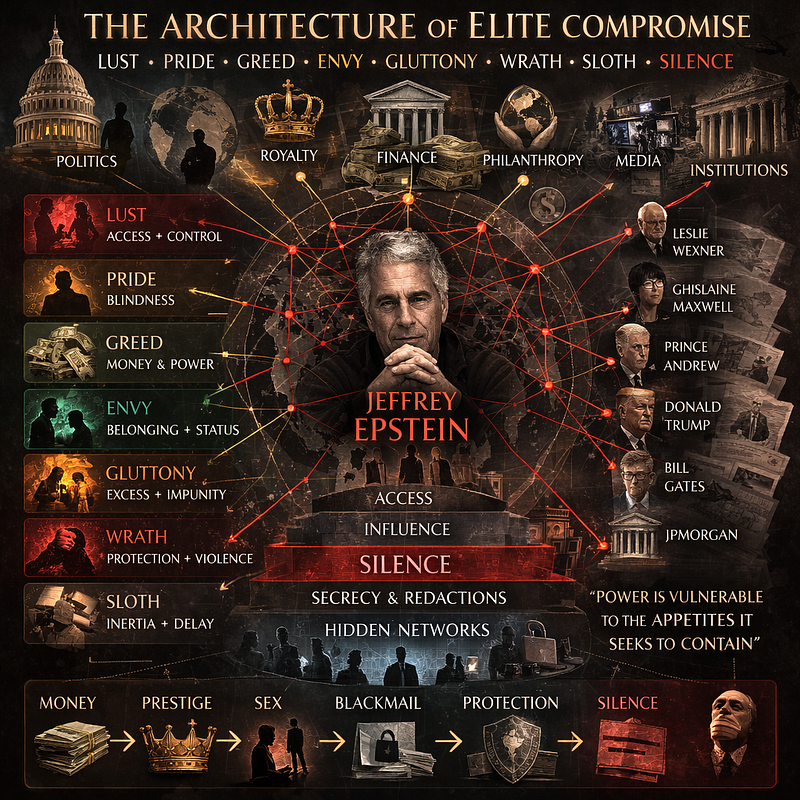
There are scandals that expose a man, and scandals that expose an environment.
Jeffrey Epstein belongs to the second category.
The easiest way to read him is as an aberration, a singular predator who somehow climbed too high, knew too many people, and moved too long without consequence. That version is morally convenient. It isolates the corruption in one body and leaves the wider world intact. One monster. One circle. One fall.
But Jeffrey Epstein was never important only because of what he did. He was important because of what his success revealed about the worlds that received him.
What stands out is not only the man, but the system of access around him. Not only the crimes, but the tolerance. Not only the depravity, but the strange elasticity of institutions that should have shut him down far earlier. Jeffrey Epstein moved through elite networks spanning finance, politics, royalty, philanthropy, media-adjacent circles, banking, and institutional power. His 2007 Florida non-prosecution agreement was later criticized by the DOJ Inspector General as unusually favorable, his relationship with Leslie Wexner extended far beyond a normal advisory role, and JPMorgan kept him as a client from 1998 to 2013 before later settling Epstein-related suits for $290 million and $75 million without admitting wrongdoing.
That does not automatically prove a single hidden command.
It does reveal something more enduring.
It reveals a world in which appetite, prestige, money, weakness, access, and institutional caution can combine into a structure of astonishing tolerance.
The old moral vocabulary still describes that world better than much of modern sociology does.
Lust. Pride. Greed. Silence.
Call them sins if you want the older frame. Call them recurring elite vulnerabilities if you prefer modern language. The point remains the same. Epstein’s real talent may not have been secrecy alone. It may have been his ability to identify which weakness governed which person, then build environments in which that weakness could be indulged, normalized, protected, and eventually weaponized.
That is why this story matters inside The Manifest.
Because the deepest continuity in history is not just institutions.
It is methods.
Epstein’s real talent may not have been secrecy alone. It may have been his ability to identify which weakness governed which person.
What Rome Already Knew About Power
The modern world flatters itself by imagining that sophisticated manipulation belongs mainly to intelligence agencies, surveillance platforms, modern blackmail structures, and digital archives.
Ancient systems understood more than we admit.
Old Rome knew that men in power rarely collapse first through doctrine. They collapse through appetite, vanity, rivalry, dependency, debt, humiliation, and fear of exposure. Patronage was never merely a social courtesy. It was a mechanism of binding. Banquets were never simply celebrations. They were spaces where rank softened, boundaries blurred, secrets circulated, and obligations thickened. Reputation had political value. Sexual conduct had political value. Gossip had political value. Public shame had political value.
That is what makes the Epstein story feel older than itself.
He did not need to invent a new method if he understood an old one.
A powerful person does not have to be physically overpowered when he can be morally absorbed. He does not have to be dragged down if he can be enticed downward by his own desires. He does not have to be conquered if he can be induced to compromise himself.
That is not medieval fantasy.
It is one of the oldest political truths in the world.
The powerful are rarely captured by force first. They are captured through appetite, vanity, dependency, and fear.
What made Epstein dangerous was not simply that he had access to elites. Many wealthy people have access. What made him dangerous was the apparent convergence of three capacities. He could read weakness, build permissive settings, and maintain enough status to make those settings feel protected.
That is more than criminal opportunism.
That is a social method.
Jeffrey Epstein and Cross-Domain Access
One of the clearest signs that Epstein was more than an ordinary predator or social climber was the range of worlds he moved through.
Not one world. Several.
Finance. Politics. Royalty. High society. Prestige academia. Banking. Philanthropy. Media. Celebrity culture. Institutional environments that normally do not overlap so easily in the hands of one man.
That matters because most influence remains trapped inside its own category. A financier may dominate finance and remain socially provincial. A politician may know power but not prestige. A media figure may shape visibility without entering the deeper rooms where continuity is guarded. A royal may carry symbolic capital without controlling the harder mechanics of money, information, and institutional protection.
A figure who can move between these worlds acquires something different.
He does not simply collect names. He learns where forms of status intersect, where systems of protection meet, and where the weaknesses of one elite environment can be translated into leverage inside another.
That appears to have been one of Epstein’s rarest abilities.
He did not merely circulate among the powerful. He moved through the seams between different power systems. That is a far more dangerous form of access. It allows a person to become not only a guest, but a broker. A carrier of introductions. A manager of atmospheres. A translator of appetite, prestige, reputation, and silence across domains that prefer to imagine themselves separate.
And that is where the deeper question begins.
Because Epstein’s success says something not only about him, but about the environments that accepted him, protected him, and continued to treat him as useful long after alarm should have replaced convenience.
A man does not move for years through finance, royalty, media, philanthropy, and elite institutions on cunning alone. He moves because those environments contain their own vulnerabilities. Vanity. Moral laziness. Reputational fear. Mutual protection. The quiet belief that discretion matters more than exposure.
That is not incidental.
It is structural.
The public often looks at Epstein and asks how one man gained so much access.
A harder question is why so many elite worlds proved so permeable to him in the first place.
That is why names matter here, but only when read as markers of environment rather than proof by association. Leslie Wexner matters because he helps explain Epstein’s extraordinary financial and social ascent. Ghislaine Maxwell matters because she belonged to the inner operational architecture of the world he built. Prince Andrew matters because royalty was not outside that environment. Donald Trump matters because the overlap reached into political and celebrity-adjacent power; Trump later said he broke with Epstein after Epstein “stole people that worked for me.” Bill Gates matters because the same permeability extended into philanthropy, technology, and establishment respectability. Jes Staley and JPMorgan matter because institutional banking did not stand at a safe distance from the network, but remained entangled with it for years.
Being present in Epstein’s orbit does not by itself prove guilt, coercion, or criminal knowledge. What it does reveal is the breadth of the environment through which he moved, and the unusual permeability of elite worlds around him.
The point is not that every name proves the same thing.
It is that figures from politics, royalty, finance, philanthropy, media-adjacent prestige, and institutional power kept appearing around the same environment, suggesting a level of cross-domain permeability that would be remarkable even without a single grand explanation.
Publicly visible evidence points clearly to access across elite domains, including royalty, banking, and older prestige environments. What it does not publicly establish with certainty is every deeper historical layer people may suspect behind that access. That distinction matters. But even without the harder claims, the pattern remains striking.
He appears to have understood how to move inside both old and modern elite structures with unusual fluency.
What made Epstein dangerous was not only who he knew, but the worlds he could move between.
If that is correct, then his influence did not come only from money, sex, or secrecy. It came from a rarer skill: knowing where prestige, weakness, protection, and silence intersected.
The revelation is not only that Epstein gained access to power, but that power proved structurally vulnerable to the appetites it believed it could privately contain.
And that is why the case still matters.
Epstein is gone.
The environments that enabled him are not.
Lust as an Entry Point
Lust is the most obvious instrument in the Epstein story, which is one reason it is also the easiest to oversimplify.
Most people hear that word and think only of sex. But in elite settings lust is broader than bodily desire. It is appetite enlarged by insulation. It is the thrill of the forbidden combined with the confidence that status will neutralize consequence. It is the conviction that rules are for the outer world, not the protected room. It is the intoxication of access itself.
In that sense, lust is not merely personal.
It is structural.
It allows a room to become more than a room. It becomes a sorting device. A test of who believes he is untouchable. A chamber in which ordinary moral boundaries are softened by status, luxury, secrecy, and mutual implication.
The room mattered as much as the act.
Privacy, luxury, youth, status, and the absence of ordinary restraint combined to create an atmosphere in which powerful people could mistake transgression for insulation.
This is why sexual compromise has been such a durable instrument in systems of power across centuries. It is intimate, deniable, and deeply human. It binds the participant to his own shame more effectively than many external chains ever could.
What made Epstein’s environment especially revealing was that it appeared to convert desire into atmosphere. Not one act, but a climate. Not one weakness, but an ecosystem of indulgence.
The more powerful the guest, the more dangerous the illusion.
Because elites often mistake privacy for immunity.
Pride as Blindness
If lust opened doors, pride helped keep them open.
Pride is not only arrogance. It is the belief that one is too powerful, too intelligent, too sophisticated, too connected, too culturally elevated, or too historically insulated to be manipulated by a lesser figure. It is the weakness most likely to disguise itself as strength.
This may be one reason Epstein could circulate for so long among people of extraordinary status. Men and institutions at the top of social pyramids often underestimate the possibility that they themselves can become instruments in someone else’s design. They assume they are using the room, when the room may already be using them.
Pride also creates another useful condition.
It discourages confession.
The proud do not merely fear scandal. They fear reduction. They fear being seen as gullible, weak, compromised, ridiculous, ordinary, or morally flimsy. That fear breeds concealment.
And concealment is the oxygen of compromise.
A man ruled by pride will often prefer deeper compromise to open admission.
That is when manipulation becomes durable.
Because the compromised person begins helping maintain the structure that compromised him.
Greed as a Social Solvent
Greed in elite systems is rarely vulgar. It does not always appear as cash in an envelope or a primitive transaction. More often it arrives as access, advantage, exclusivity, investment opportunity, social elevation, reputational gain, private leverage, or proximity to other valuable people.
That matters because the Epstein world appears to have functioned not merely as a vice theater, but as a zone where wealth, prestige, introductions, and permissiveness intersected.
This is how greed works at upper levels.
It dissolves moral distance.
Once a person begins to see a compromised environment as useful, profitable, strategically valuable, or too socially costly to lose, his internal calculus changes. He no longer judges the environment primarily by principle. He judges it by yield.
At elite levels, greed often appears less as cash than as access to rare rooms, powerful introductions, reputational elevation, and the quiet protection that comes with remaining close to useful people.
A bank can do something similar. A wealthy client generates profit, prestige, and access to other wealthy relationships. Red flags appear, but the institution begins narrating itself a story about complexity, discretion, importance, legal caution, or procedural ambiguity. That broader pattern is visible in the later litigation around Epstein’s long JPMorgan relationship.
Greed does not need to desire the crime itself.
It only needs to desire the benefits strongly enough to delay interruption.
Silence as the Final Shield
The most underestimated sin in systems of power is silence.
Not because silence is dramatic, but because it is administrative. It is what allows all the other weaknesses to accumulate into structure. Lust compromises. Pride conceals. Greed rationalizes. Silence preserves.
Silence does not always mean active conspiracy. More often it means delayed action, strategic vagueness, procedural retreat, reputational caution, legal softening, institutional self-protection, and the quiet hope that the problem will relocate before anyone is forced to speak clearly.
This is what makes the Epstein case reveal more than individual depravity. It reveals how many respectable systems are built to metabolize discomfort instead of confront it. A legal office grants an unusually favorable arrangement. A bank keeps a client too long. A network of prestigious acquaintances drifts around the obvious.
The machine functions anyway.
Silence is what turns individual weakness into systemic endurance.
Where appetite creates the breach, silence builds the fortress around it.
In that sense silence is not the absence of action.
It is a social technology.
By the time a structure depends on silence, it is no longer protecting only a person. It is protecting the self-image of the environment that allowed him to thrive.
That is why elite environments can become so difficult to penetrate from the outside.
Their greatest defense is often not force.
It is mutual embarrassment.
Why No One Stopped Him
One of the most disturbing questions in the entire Epstein story is also one of the simplest.
Why did so few people stop him sooner.
Not why they understood everything. Not why they possessed the full map. But why so many people, institutions, and elite environments appear to have tolerated, minimized, delayed, softened, or absorbed what should have triggered decisive rupture.
Part of the answer lies in fear.
Not always fear of criminal implication. Often something more socially powerful. Fear of scandal. Fear of association. Fear of losing access. Fear of exposing one’s own bad judgment. Fear of harming an institution by admitting what it had allowed near itself.
In elite systems, these fears rarely arrive dramatically. They arrive as hesitation. As caution. As advice to wait. As legal narrowing. As internal handling. As quiet distancing without open exposure.
Because elites rarely punish one of their own in the way ordinary people imagine. They first calculate fallout. Who else will be touched. Which names will surface. Which institutions will be embarrassed. Which reputations will become unstable.
This is why men like Epstein can survive inside powerful environments longer than reason should allow.
He did not only benefit from appetite.
He benefited from interdependence.
A compromised room is rarely composed of one guilty person and many innocent observers. More often it contains gradients of weakness. Some desire. Some suspect. Some profit. Some rationalize. Some remain silent because silence feels less dangerous than disclosure.
Once enough people occupy those positions at once, the environment begins defending itself automatically.
This does not require a single mastermind or a formally coordinated conspiracy. Closed environments develop protective reflexes on their own. Once access, prestige, and mutual exposure accumulate in the same space, self-protection can begin to function automatically.
Elite systems do not need universal loyalty to protect themselves. They only need enough people to fear the cost of honesty.
A predator can be monstrous. An environment that repeatedly absorbs him is something worse.
That may be the real scandal beneath the scandal.
Not only that Epstein existed.
But that so many circles appear to have been structured in ways that made stopping him institutionally difficult, socially costly, and morally late.
Envy, Gluttony, Wrath, and Sloth
The four most obvious sins in the Epstein story are lust, pride, greed, and silence. But the older map becomes even stronger when the remaining sins are allowed to breathe inside it.
Envy pulls outsiders toward inner circles they do not understand. Many elite systems are held together by the desire to belong to rooms one has not yet entered.
Gluttony appears not only as consumption, but as excess without limit. More luxury. More privacy. More stimulation. More invitation. More immunity.
Wrath enters less visibly, but it is there in the management of threat. In the anger triggered by potential exposure. In the defensive aggression of institutions protecting themselves.
Sloth may be the least glamorous of the seven, but perhaps the most modern. It appears as institutional fatigue, ethical passivity, bureaucratic delay, procedural laziness, and the refusal to act when action would be costly.
Seen this way, the seven sins are not merely religious categories.
They are operational vulnerabilities.
Lust opens. Pride blinds. Greed softens. Envy lures. Gluttony normalizes excess. Wrath protects the structure when threatened. Sloth allows the whole system to continue because decisive interruption never quite arrives.
That is a serious architecture of compromise.
The Epstein Files That Never Fully Opened
One detail continues to hover over the entire affair.
Even now, the full documentary record has never completely entered the public domain. Large parts of the Epstein files remain withheld, partially released, or heavily redacted. Legal explanations exist for this. Privacy protections for victims. The danger of falsely implicating uninvolved people. Investigative complexity.
Those explanations are not absurd.
But the result remains striking.
One of the most consequential elite scandals of the modern era still exists in partial light. The public has seen fragments, flight logs, court documents, testimonies, and glimpses of relationships. Yet the fuller architecture remains only partially visible. Exposure comes in controlled waves. Critics and lawmakers have argued that the federal government identified millions of potentially responsive pages while planning to release only part of that universe after review and redaction.
The sheer size of the archive says enough on its own. It suggests that the environments Epstein moved through did not disappear with him. They remain active in the filtering, delaying, and management of what the public is permitted to see. Whatever the legal reasons for redactions and delayed release may be, the public is clearly not looking at the full structure, only at selected fragments.
The archive does not only preserve evidence.
It preserves the scale of what the public still has not been allowed to fully see.
Sometimes the management of information becomes part of the story itself.
In that sense, the Epstein case continues to occupy an unusual place. It is simultaneously one of the most discussed scandals of the century and one whose full documentary landscape remains incomplete.
For a story about appetite, compromise, influence, and silence, that fact alone is remarkable.
More Than a Scandal
This is why the Epstein story should not be read merely as scandal literature. It belongs to the larger history of how power environments become vulnerable to infection.
An infection does not create a body from nothing.
It enters a body already susceptible. It exploits existing weakness, existing exposure, existing habits.
Epstein feels, in that sense, less like the total explanation than the revealing infection. He exposed the susceptibility of elite worlds built on discretion, appetite, vanity, prestige, compartmentalization, and reputational insulation.
He did not invent those conditions.
He appears to have understood them.
The real scandal is not only what one man did, but what elite worlds were willing to normalize before calling it intolerable.
That is what makes the case larger than the man.
It is not only a story about predation.
It is a story about the moral structure of closed power.
The Method That Outlived the Man
The public still circles around the same outer questions.
Who exactly was Epstein.
Who exactly knew what.
Which names belonged to which circle.
Those questions matter.
But they remain the outer skin of the subject.
The deeper question is what kind of environment allowed a man like Epstein to operate for so long without decisive interruption. What kind of system becomes so accustomed to prestige, appetite, discretion, and mutual protection that manipulation can grow inside it almost invisibly.
Because Epstein’s true significance may not lie in the crimes alone.
It may lie in the structure he revealed.
Across finance, politics, royalty, prestige institutions, and elite social life, he moved through worlds that normally imagine themselves separate. That kind of movement is rare. It requires not only access, but an instinct for human weakness and the patience to build environments where that weakness can quietly become leverage.
Lust opened doors.
Pride blinded those inside the rooms.
Greed made the rooms worth protecting.
Silence ensured that the doors stayed closed from the outside.
Those mechanisms are not modern inventions.
Rome understood them already. Its political culture was built around patronage, obligation, compromise, status management, appetite, and the careful protection of reputation.
In that sense, the Epstein story feels less like a modern anomaly and more like an ancient method resurfacing inside contemporary elites.
The most enduring instruments of power are rarely technological. They are human.
The man at the center of the case is gone.
But the pattern remains.
The environments that enabled him remain.
Epstein did not merely expose a crime.
He exposed a habitat.
And that may be the most revealing fact of all.
Because the scandal did not end with his death.
It survived in the silences, the redactions, and the structures that still prefer management over truth.
Related Chapters of The Manifest
- The Age of Managed Crisis
- The Architecture of Aid: How Help Becomes Control
- How the ECB, Brussels and NATO Decide Your Life Without a Vote
- What Possesses Mark Rutte to Call War Inevitable?
- Architecture of Power: How Modern Empires Hide in Plain Sight
The Manifest is an ongoing investigation into power, history, finance, and the structures that continue beneath the surface of modern events.
If this chapter spoke to you, you can follow the publication here.
Related from The Manifest Archive