The agreement had fourteen points. It called for a ceasefire, withdrawal of heavy weapons, prisoner exchanges, and a political process that would restore Ukrainian sovereignty over the eastern border. Both sides signed. Neither side treated it as a final settlement. One side treated it as a timeline.
The Minsk agreements were brokered under the Normandy Format, a diplomatic framework assembled in the months after Russia’s annexation of Crimea in March 2014. France and Germany served as guarantors. The first agreement was signed in September 2014. The second, negotiated after the Ukrainian defeat at Debaltseve, was signed in February 2015. Angela Merkel and Francois Hollande flew to Minsk, negotiated through the night, and announced a document both governments described as the best available path to peace. Fourteen points. A ceasefire line. A political framework. A signature.
In December 2022, Merkel described it differently. The ceasefire had been useful, she told Die Zeit, because it had given Ukraine time. Her words were specific. The agreements had not been designed to resolve the conflict. They had been designed to delay it until the military situation changed. That is a different agreement from the one the public was told was being signed.
The Agreement
Minsk I was signed on September 5, 2014, three weeks after the battle of Ilovaisk, in which Ukrainian forces suffered one of the most significant military defeats of the early conflict. The encirclement at Ilovaisk killed hundreds of Ukrainian soldiers and demonstrated the limitations of a military that had not undergone systematic modernization since independence. Heavy equipment was captured or abandoned. Units dissolved. The ceasefire that followed stabilized a contact line but did not resolve the underlying question of who would control the eastern territories.
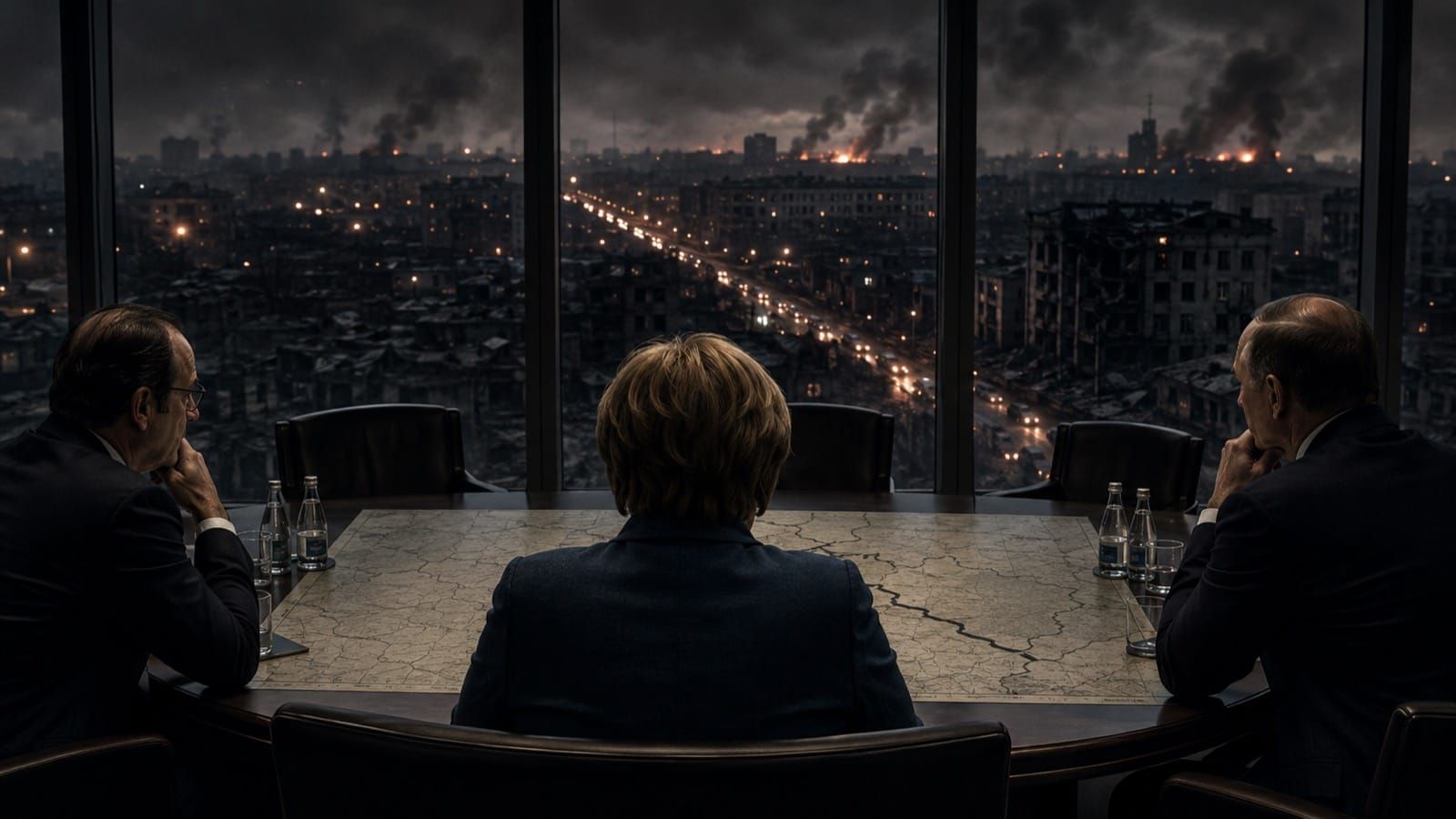
The fighting continued through the winter. By January 2015, the Donetsk airport, which Ukrainian forces had held for months as a symbol of military capacity, had fallen. By early February, Ukrainian units were encircled near the town of Debaltseve, a railway junction whose control was strategically significant to both sides. Merkel and Hollande flew first to Kyiv, then to Moscow, then to Minsk. The session lasted seventeen hours. Both leaders emerged visibly exhausted. Minsk II was signed on February 12, 2015.
Minsk II extended the first agreement with a political framework: a constitutional reform process granting a form of autonomy to the Donbas regions, elections under OSCE supervision, and a sequenced path toward Ukrainian restoration of border control. The sequencing was the critical structural element. Ukraine would regain control of its eastern border only after the political provisions had been implemented. The political provisions were never implemented. The sequence, by design or by failure, never reached that threshold.
The political provisions were never implemented. The sequence, by design or by failure, never reached that threshold.
The OSCE Special Monitoring Mission deployed observers to the contact line and published regular reports documenting ceasefire violations, which both sides attributed to the other. The monitoring was real. The accountability was not. What happened in the years between February 2015 and February 2022 was not a diplomatic stalemate in the conventional sense. It was a preparation process, with the ceasefire line functioning as the operational perimeter within which that preparation occurred.
Ukraine’s defense budget in 2014 was $1.6 billion. By 2021 it had reached $5.9 billion, with additional bilateral security assistance from NATO member states amounting to several billion more in equipment, training, and intelligence support across those seven years.
The Rearmament
Between the signing of Minsk II in February 2015 and the Russian invasion in February 2022, Ukraine received military training from advisers deployed by more than thirty NATO member states. The United States committed $2.5 billion in security assistance over that period. The United Kingdom launched Operation Orbital in 2015, embedding military advisers to train Ukrainian army units in doctrine, tactics, and combined-arms coordination. Canada launched Operation UNIFIER the same year. Germany, historically cautious about weapons exports to active conflict zones, provided non-lethal military equipment and training support. By the time the full-scale invasion began, Western programs had trained more than 70,000 Ukrainian soldiers and helped establish NATO-compatible command, control, and communications structures at the battalion and brigade level.
The transformation extended beyond personnel. Ukraine received advanced anti-tank systems, including Javelin missiles from the United States beginning in 2018, counter-battery radar systems that could identify incoming artillery positions within seconds of firing, secure communications equipment that reduced Russian signals intelligence advantage, and intelligence-sharing arrangements that gave Ukrainian commanders visibility into Russian force dispositions along and behind the contact line. The country that had struggled to field coherent combined-arms units in 2014 was, by 2022, capable of conducting coordinated multi-domain operations against a larger and better-equipped adversary. That transformation required approximately seven years and a ceasefire within which to occur.
The Minsk framework held long enough for this transformation to occur. It held not because the political provisions were advancing toward implementation, but because the ceasefire line and the diplomatic language surrounding it provided a functional operational pause. Negotiating sessions continued under the Trilateral Contact Group. Communiques were issued. The language of process was maintained. Meanwhile, the military transformation proceeded on a schedule that the framework accommodated precisely because it was never resolved.
Petro Poroshenko, who signed Minsk II as Ukrainian president, confirmed this reading in a June 2022 interview. ”Our goal was to first stop the threat, or at least to delay the war, to give Ukraine time to strengthen,” he said. He continued: ”We achieved our goal. We had eight years to pump up our armed forces.” The statement was made publicly, in a recorded interview, by the head of government who had signed the document. No diplomatic disclaimer accompanied it. It was a description of purpose, in the signer’s own words.
The ceasefire was the operational window. The political framework was the cover for an eight-year military transformation that the agreement’s own signatories understood to be proceeding behind it.
The delay produced specific positions. Defense contractors received billions in orders. Western chancelleries deferred the political costs of confrontation by deferring the conflict that would expose them. The Donbas population paid in displacement during the operational pause. The Ukrainian soldiers of 2022 paid in the war they had been trained to fight. The architects retired with reputations as peace-brokers. The accounting was asymmetric across both sides of the contact line.
The Admission
In December 2022, Angela Merkel gave an interview to Die Zeit in which she addressed the Minsk agreements directly. The question was whether they had been a mistake. Her answer was precise: ”The 2014 Minsk agreement was an attempt to give Ukraine time. Ukraine used this time to become stronger, as you can see today. The Ukraine of 2014-2015 is not the Ukraine of today.” She added that she was not certain whether she could have achieved anything different at the time, but that she stood by the approach.
This was not a casual observation made in passing. It was a deliberate retrospective assessment, made ten months after the Russian invasion, by the head of government who had invested more diplomatic capital than any other Western leader in building and sustaining the Minsk framework. She was saying, in terms that left very little room for alternative interpretation, that the purpose of the agreements had not been to resolve the conflict. The purpose had been to delay it until the military balance shifted to a point where the conflict could be engaged on different terms.
Francois Hollande confirmed the same logic in an interview published in Le Monde the same month. ”The Minsk agreements stopped the war,” he said. ”They gave Ukraine the time it needed.” The formulation was identical in structure to Merkel’s: the agreements were described, in retrospect, as a delay mechanism rather than a resolution framework. Two heads of government, in the same calendar month, using nearly identical language, describing the same purpose for a process they had publicly presented as a peace initiative for seven years.
Russia’s government treated the admissions as confirmation of what it had argued since the invasion began: that the Minsk process had been a strategic deception rather than a genuine diplomatic initiative. The framing of deception is Russia’s. What is not Russia’s is the substance. The architects of the process described the mechanism themselves, in named interviews, using terms that do not require interpretation. The function they described in December 2022 was not the function they had publicly represented between 2015 and 2022.
Both architects of the Minsk process confirmed, in the same month, using nearly identical language, that the agreements had never been designed to resolve the conflict they publicly represented as a path to resolution.
The peace agreement was the procurement timeline.
The peace agreement was the procurement timeline.
The Narrative That Required This
Sustaining the Minsk framework as a public peace process required consistent narrative maintenance over seven years. Both Germany and France had to describe ongoing ceasefire violations, failed negotiations, and absent political implementation as progress toward resolution rather than evidence of a structural process operating according to a different logic entirely. Merkel spoke regularly of Minsk as the only viable path to peace. The German foreign ministry described each negotiating round as a necessary step. The French foreign ministry used equivalent language. The European Union endorsed the framework as the legitimate diplomatic channel for the conflict.
The narrative was not false in every dimension. The agreements did reduce the intensity of the conflict relative to the summer of 2014. The contact line did stabilize. Civilian casualties in the Donbas were lower under the ceasefire than during the periods of active fighting. In that operational sense, the agreements functioned. What they did not do was what they were publicly represented as being designed to do: resolve the political status of the eastern territories through a constitutional process and a negotiated framework. That gap between public representation and operational purpose is what the architects confirmed in December 2022.
The admission required no institutional response, because no mechanism existed in the relevant institutional frameworks to process it. There was no parliamentary inquiry in Germany into the gap between what the government had said the Minsk agreements were and what their chief architect later described them as being. There was no formal review of the Normandy Format’s outcomes. No commission was constituted. The documents that established the Minsk framework remain in the archive. The documents that describe its actual purpose are now also in the archive. They occupy the same institutional space without structural tension, because no institutional mechanism requires them to be reconciled.
The specific diplomatic machinery the Minsk framework required is worth noting as architecture in its own right. The Steinmeier Formula, proposed by then-German Foreign Minister Frank-Walter Steinmeier in 2015, offered a sequenced path toward local elections in the Donbas that would trigger Ukrainian border restoration. It was accepted in principle at the Normandy summit in October 2019 and generated domestic political controversy in Ukraine. The formula kept the process formally alive without advancing it toward implementation. That function, keeping the language of process operational without producing the outcome the process was named for, is not incidental to the framework. It is the framework.
The admission entered the historical record without triggering the institutional review mechanisms that any equivalent gap between stated policy and actual policy would, in the domestic political context of either country, theoretically require.
The Silence After the Admission
The structural context in which this occurred was not constructed in 2014. In February 1997, George Kennan published an article in The New York Times arguing that NATO expansion into Eastern Europe would be the most fateful error of American policy in the entire post-Cold War era. He predicted it would produce a hostile Russian reaction and destabilize the security architecture it was intended to strengthen. Kennan had designed the original containment strategy in 1946. He was writing from direct experience with the specific institutional and geopolitical dynamics he was describing. His analysis was published in the most widely read newspaper in the United States and entered the public record before the first round of NATO enlargement.
Kennan was warning against a process that had begun seven years earlier. In February 1990, James Baker had told Soviet leaders that NATO would not extend one inch east of a unified Germany. By 1997, the question was no longer whether the promise had been kept. It was whether the strategic position the promise had described would be acknowledged in any official record before the next round of expansion was scheduled.
In February 2008, William Burns, then serving as U.S. ambassador to Russia, sent a diplomatic cable to Washington with the title ”Nyet Means Nyet: Russia’s NATO Enlargement Redlines.” The cable assessed that Russian opposition to Ukrainian NATO membership was not a negotiating position that could be moderated through diplomatic engagement. It was a strategic commitment that, if tested, would produce a severe and sustained response. Burns described the likely consequences in some detail. The cable was classified. It was published by WikiLeaks in 2010, making it part of the public record. Burns was appointed CIA director in 2021. The author of the warning that NATO movement toward Ukraine would produce a severe Russian response became, thirteen years later, the head of the agency whose covert programs helped bring that response forward.
In July 2019, the RAND Corporation published a study titled ”Overextending and Unbalancing Russia,” commissioned and funded by the United States Army. The study analyzed the full range of measures available to extend and stress Russian political, economic, and military capacity. It identified providing lethal aid to Ukraine as a tool that could exploit what it described as Russia’s greatest point of external vulnerability. The recommendation was made explicit in the text. The study was published as an open-access document available to any reader with an internet connection.
Together these documents describe an institutional process in which the consequences of a strategic decision were analyzed and entered into the public record, at multiple points across more than two decades, by credentialed analysts and senior officials, before and during the implementation of that decision. The Minsk admissions fit into this sequence not as revelations but as confirmations. They confirm that the diplomatic layer, which was the publicly visible layer of the overall process, was understood by the people who constructed it to be temporary and operational, not permanent and resolving.
The analysis that predicted this outcome was in the institutional record before the outcome occurred. What was absent was not information. What was absent was a mechanism for that information to alter the sequence of decisions that had already been taken.
What the Architecture Knew
The mechanism was not designed in secret. The component parts are public. The RAND study is available for download. The Burns cable has been in the WikiLeaks archive since 2010. The Kennan article appeared in The New York Times in 1997. The Merkel and Poroshenko admissions were given in named interviews to Die Zeit and Le Monde in 2022. No element of this sequence required concealment from any actor with access to public archives and the time to consult them.
What the mechanism required was not secrecy. It required that each component remain within its institutional silo. The analysts who wrote the RAND study on overextending Russia were not briefed on the diplomatic framework’s strategic purpose. The diplomats who maintained the public Minsk language over seven years did not need to coordinate their messaging with the military advisers arriving in Kyiv in 2015. The parliamentary committees in Berlin and Ottawa that approved training missions did not require explicit confirmation of what the ceasefire architecture had been designed to achieve. Each institution performed its assigned function. None required the others to acknowledge what they were collectively building. The whole was not visible from within any single part.
What follows is observation, not assertion. The component facts are documented above. The pattern they form is the claim the architects made themselves.
Compartmentalization is not deception. It is architecture.
A ceasefire was signed. Weapons deliveries continued. Military training accelerated. Defensive positions were built. Territorial positions stabilized along a line that gave Ukraine time to prepare its own defensive depth. The ceasefire held long enough to rebuild the military. The military was rebuilt. That is not diplomacy. That is a rearmament schedule. The distinction is not rhetorical. It is the difference between an agreement designed to end a conflict and an agreement designed to manage the interval before the next phase of one.
The agreement promised what the schedule delayed. The schedule built what the agreement disguised.
The war that began in full in February 2022 arrived at the end of a documented sequence in which every actor performed a documented function. The military advisers trained because training was their function. The diplomats negotiated because negotiation was their function. The analysts published because analysis was their function. The journalists reported the language the diplomats used because reporting language is what journalism does. Each layer was internally coherent and visible from within its own institutional logic.
The architecture accounts for every actor in the sequence. Each institution knew its own function precisely. None was required to know the function of the others, and none did.
The specific institutional silence that followed the admissions is itself documented. The Bundestag did not convene hearings on the Merkel statement. The French National Assembly did not schedule a review of the Hollande interview. The European Commission, which had endorsed the Minsk framework as the legitimate diplomatic process for the conflict, issued no statement addressing the gap between the framework’s stated purpose and the purpose its architects had confirmed. The OSCE, whose monitoring mission had operated under the framework for seven years, published no assessment of what the admissions implied about the mission’s operational context. Each institution that had been part of the Minsk architecture remained inside its own institutional logic after the architecture was publicly described.
The agreements are in the archive. The RAND study is in the archive. The Kennan analysis is in the archive. The admissions are in the archive. The sequence runs from February 1997 to December 2022, documented at every threshold. No institutional review followed. No government that had promoted the Minsk framework as a peace process convened a process to account for the gap between what it had represented and what its architects later confirmed. The only actor without a designed role in this architecture is the one who read the word ”peace” in February 2015 and treated it as information about what was actually being built.
The Minsk mechanism belongs to a documented class of strategic preparation operating behind diplomatic cover. The RAND study that named Ukraine as Russia’s greatest point of external vulnerability was funded by the U.S. Army, a sequence examined in ”RAND Does Not Win Wars. It Defines What Winning Means.” The financial architecture that sustained eight years of military transformation runs through the institutional network traced in ”BlackRock Doesn’t Own the War. It Owns Everything Around It.”
What you just read documents one mechanism. The architecture it belongs to spans three years of forensic research, two hundred and fifty interconnected pieces, and a cross-referenced evidence trail that makes the pattern increasingly difficult to dismiss. The further in you go, the harder it becomes to look away. The full archive is at themanifestarchive.com.
Related from The Manifest Archive