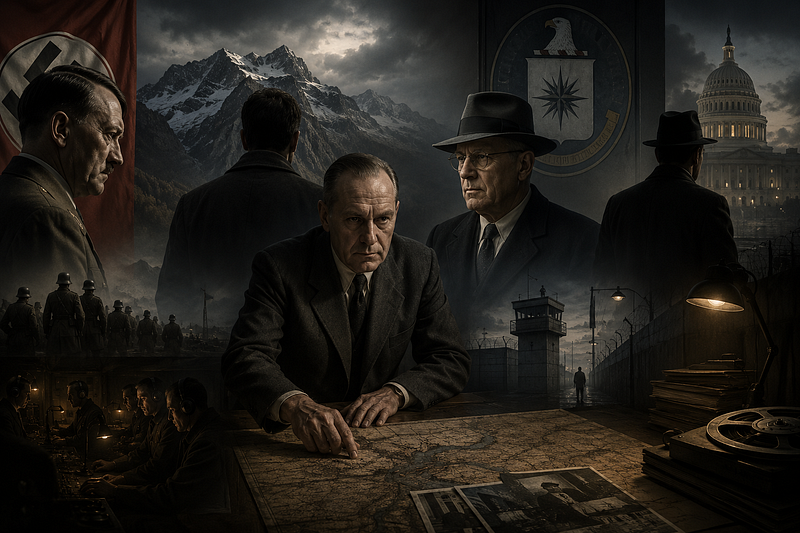
The man who briefed Adolf Hitler on Soviet armour in February 1945 briefed Allen Dulles's people on Soviet armour in October 1946. Same officer. Same files. Same maps. Same analytical templates. The employer changed. The work did not.
Reinhard Gehlen had been chief of Fremde Heere Ost, the Wehrmacht intelligence directorate for the Eastern Front, since April 1942. By the spring of 1945 he held two assets that no one else in Europe held. The first was a complete order-of-battle archive on the Red Army, built up over three years of operations against it. The second was the network of agents and analysts who had built the archive and who could update it. He understood, in the weeks before the German surrender, that these assets had a market.
He surrendered to the United States Counter Intelligence Corps on the 22nd of May 1945, in Bavaria, near the end of a war his side had lost completely. He brought no troops. He brought the knowledge of where, six weeks earlier, he had buried the photographic duplicates of his most important files, sealed in roughly fifty steel containers in the Alps. Within eleven months he was back near Munich, running the same intelligence operation under American patronage. The arrangement had no public name and no public authorization. It was funded first by Army intelligence, then by the newly created Central Intelligence Agency. It produced, by the early 1950s, the bulk of the United States government's human intelligence on the Soviet armed forces. In 1956 it was given a German legal identity. The Federal Republic of Germany still operates it today.
This is the story of how a defeated intelligence service was bought rather than dissolved, and of what the purchase made permanent.
The barn in Bavaria and the cases in the Alps
Gehlen's preparation for surrender began in March 1945, ten weeks before the surrender itself. He ordered the photographic duplication of his Eastern Front files. The originals were too bulky to move and too compromising to retain. The duplicates were packaged in sealed steel containers and buried in the Alps under the supervision of officers he trusted. He kept the knowledge of where they lay.
When he walked into American custody, he was forty-three years old, in good health, and carrying a transferable inventory. Consider the cold competence of the act. A general of a regime that had just lost the most catastrophic war in history did not present himself as a defeated man hoping for mercy. He presented himself as a vendor. He had read the shape of the coming world weeks before the surrender, seen that the wartime alliance between the Western powers and the Soviet Union would not survive victory, and concluded that his archive on the Red Army, worthless to a Germany that no longer existed, would be the single most valuable commodity on the continent to whichever Western power grasped first that the next adversary was the current ally. So he did not destroy his files. He photographed them, buried them, and kept the location in his head as the one thing he would have to sell. The Counter Intelligence Corps interrogator who took his statement, Captain John Boker, recorded that he proposed a specific arrangement. He would surrender his files. He would retrieve his agents from American captivity. He would continue running both, against the Soviet Union, on American payroll. It was less a surrender than a job interview, conducted by a man who had correctly guessed the next two decades of geopolitics while the rubble of the last twelve years was still smoking around him.
Boker was a junior officer. He passed the proposal upward. It reached Brigadier General Edwin Sibert, the senior intelligence officer of the U.S. Twelfth Army Group, who endorsed it. By the late summer of 1945 Gehlen and six of his senior staff were on a flight to Washington in plain civilian clothes, on US Army orders, to be debriefed at Fort Hunt in Virginia, the facility that had handled high-value German prisoners during the war. The fact of their presence was held closely. Gehlen was allowed his family. The cost was paid out of military intelligence budgets that did not yet have a Cold War line item.
The arrangement preceded the doctrine that would justify it. The doctrine grew up around the arrangement.
What Boker had encountered was not a defeated officer seeking lenient treatment. It was a senior intelligence executive offering to sell a functioning analytical service to a buyer who did not yet realize that he needed it. Sibert recognized the offer. Allen Dulles, then winding down his Office of Strategic Services station in Switzerland, recognized it within weeks and fought an inter-agency battle to bring Gehlen under his eventual command. Dulles won. His associate Frank Wisner, who from 1948 would run the Office of Policy Coordination, the covert-action service housed in the CIA, became the operational interface as the network was stood up. There was no signed treaty, whatever the later legends say. There was an understanding, made by men who knew exactly what they were buying and from whom.
Pullach and the firm with American capital
By July 1946 Gehlen and his staff were back in Germany, settled in a former Waffen-SS housing complex at Pullach on the southern edge of Munich. The complex was given a cover name and a cover story of business consulting. Its actual function was running ex-Wehrmacht and ex-SS intelligence officers against the Soviet zone, the Soviet armed forces, and the new Soviet-aligned governments of Eastern Europe.
The funding was straightforward. The United States Army paid the bills, initially through its own intelligence channels and from 1949 through the Central Intelligence Agency, created by the National Security Act of 1947. The annual budget ran around one and a half million dollars in the late 1940s, a sum that bought very large operational scale in occupied Germany, and the organization grew from a few hundred staff to roughly four thousand by the time it was handed to West German control in 1956.
The personnel composition was the political problem, and it was not incidental. The declassified CIA records held in the United States National Archives, in Record Group 263, document that the organization employed numerous former Nazis and known war criminals, including more than a hundred former Gestapo or SS officers. Among them was Alois Brunner, Adolf Eichmann's deputy in the Office of Jewish Affairs, who had organized the deportation of more than a hundred and twenty thousand Jews from Slovakia, Greece, and France to Auschwitz. He was never tried. He spent his postwar decades in Damascus as a security adviser to the Syrian government and died there, most likely in 2001, though for years his death was reported as around 2010, an old man in a cellar in a city at war, having outlived nearly everyone who had hunted him.
Klaus Barbie, the Gestapo chief of Lyon who had personally tortured the Resistance leader Jean Moulin to death in 1943, was recruited as an American Counter Intelligence Corps informant in 1947 and, when his past became inconvenient, exfiltrated in 1951 along the Vatican-linked escape routes, the so-called ratlines, that also took Eichmann to Argentina. The Catholic infrastructure of those routes was organized above all by Bishop Alois Hudal in Rome and the Croatian priest Krunoslav Draganović, who ran the line Barbie used. The Gehlen Organization did not operate the ratlines. It ran in parallel with them, and the two operations recruited from the same labor pool, which is the point that matters. The escape network and the intelligence network were drawing from a single supply of men whom no Western legal system could afford to prosecute.
That supply was large, and the way it was distributed tells you how the postwar order actually treated the perpetrators it had publicly condemned. The same population of SS and Gestapo veterans who could not be tried fed three streams at once: the escape routes that spirited the most exposed of them to Argentina, Bolivia, Syria, and beyond; the intelligence services of the West that hired the most useful of them to work against the new enemy; and, in time, the security apparatuses of the East as well, which made their own quieter accommodations. Nuremberg had hanged a dozen men and announced a standard for the rest, and the standard collided almost at once with the strategic value of the men it was meant to judge. Where a war criminal held something a Cold War antagonist wanted, an archive, a network, a skill, a willingness to operate without scruple against the new adversary, the standard bent, every time, and the bending was not the failure of the system but its working logic. The prosecutions were the exception. The recruitments were the rule. The Gehlen Organization was simply the largest and most institutionalized instance of the rule, the place where the absorption of the unprosecutable stopped being a series of furtive individual deals and became a permanent agency of state.
The asset was the unprosecutability
This was not a hiring problem to be regretted and reformed. It was the design.
The men whose archives the Americans wanted were the men whose careers were unprosecutable in any system that took the Nuremberg standards seriously. To buy the archive was to retain the men who had built it, and to retain them was to guarantee that the archive could not be opened to the light without opening their files too. Gehlen made this explicit in his memoirs. He had told his American counterparts from the first interrogation that the value of the network was indivisible from the personnel who had built it, and they had agreed.
Read that arrangement closely, because it inverts the usual moral story. In the ordinary account, the Americans hired Nazis despite their crimes, a shameful compromise made for the sake of intelligence. The structure says something colder. The crimes were not a cost the Americans paid to get the intelligence. The crimes were part of what made the personnel reliable, because a man who can be hanged the moment he is exposed is a man who will never defect, never talk, never break the arrangement that is the only thing standing between him and a war-crimes tribunal. Unprosecutability cut both ways. It protected the men, and it bound them. Their guilt was not a flaw in the asset. It was a feature of it, the thing that made the network both retainable and silent, and the buyer understood this perfectly. You do not accidentally employ a hundred SS officers. You employ them because the same fact that makes them monstrous makes them controllable.
The seventy per cent
Between 1947 and the mid-1950s, Gehlen's organization supplied the bulk of American human intelligence on the Soviet Union. The figure most often cited in the declassified literature is more than seventy per cent of United States military intelligence on Soviet armed forces in the early Cold War, with a comparable share of NATO's raw intelligence on the Warsaw Pact. These are widely repeated estimates rather than audited metrics, and they should be carried as estimates, but the order of magnitude is not in dispute.
The figure has a boundary, and the boundary matters. It describes human intelligence on Soviet conventional ground forces. It does not describe signals intelligence, where the American-built effort, the Venona decryptions of Soviet traffic and the continuing work on Soviet ciphers, ran in parallel and was owned outright by Washington. The dominance of the Gehlen product over the human-intelligence channel was real. It was never the whole of American intelligence, and the careful version of this story keeps the two streams apart.
This dominance was not an accident. It reflected three structural facts. No other Western service had a comparable archive on the Soviet east; the British effort had been smaller and the French preoccupied with their own occupation, and the Americans had built almost no Soviet-facing capability of their own. Gehlen's network of agents across Eastern Europe, assembled since 1942, was the only live network of its kind in existence in 1947. And the CIA in its first three years was small, contested in Washington, and desperate for assets that would justify its existence. Gehlen offered a turnkey product to a buyer who needed one immediately. The procurement was over before anyone with the authority to refuse it understood what had been acquired.
The threat that justified the buildup
Here is where the architecture stops being a curiosity of espionage history and becomes something that shaped the world the alliance built, and it has to be stated with precision, because the temptation to overstate it is exactly the trap the subject sets.
The intelligence that Gehlen's network fed into the Western picture of the Soviet Union was part of a body of estimates that ran, across the early Cold War, systematically high. The most consequential overestimate concerned the Soviet ground army. The West worked with a figure of roughly a hundred and seventy-five Soviet divisions, and the raw count was probably sound. The error was not in the number of divisions. It was in how they were read. Western analysis, for more than a decade, counted cadre and low-strength divisions, skeleton formations that would have needed weeks of mobilization to become combat-ready, as though they were full-strength fighting units poised to roll west. The distinction between a division on paper and a division ready for war was not, on the standard historical reading, systematically built into the American estimate until the early 1960s. The Soviet army was large, and it was far less immediately dangerous than the image of a hundred and seventy-five divisions implied, and the gap between those two facts was the engine of a great deal of Western policy.
That inflated reading of Soviet conventional readiness fed directly into the document that set the terms of the Cold War, NSC-68, completed in 1950, which called for a vast and sustained military buildup on the premise of an aggressive, war-ready Soviet adversary. The number is worth holding in the mind. American defense spending, which had fallen sharply after 1945, was tripled across the early 1950s, and the permanent national-security state, the standing army in peacetime, the global network of bases, the institutionalized intelligence apparatus, was built on the foundation of a Soviet threat estimated as imminent and overwhelming. The Korean War of 1950 supplied the political shock that got NSC-68 funded, but the threat picture it rested on had been assembled in the preceding years, in the order-of-battle estimates of an adversary whose readiness was being read at the high end of every plausible range. A peacetime democracy does not triple its arms budget for a danger it believes is modest. It does so for a danger it believes is about to march, and the intelligence that built that belief was, at its human core, substantially the product of the service that had once worked for the enemy the buildup was meant to deter. The honest forensic statement of Gehlen's role here is the bounded one, and the bounded one is damning enough. His network was a principal source for the Eastern-bloc order of battle that the United States then read as more combat-ready than it was. He did not single-handedly cause the overestimate; the core error was analytical, a method that counted cadre divisions as combat divisions, and it cannot be pinned on any one source. But his organization's institutional survival depended on the Soviet threat being existential, and its product flowed, year after year, into the channel where that threat was being sized. An intelligence service whose budget, whose protection, and whose very reason to exist all rested on the danger being maximal was the dominant human source on the danger. That is not a configuration that produces conservative estimates.
The two most famous threat scares of the period, the bomber gap of the mid-1950s and the missile gap that followed Sputnik, belonged to the same climate of inflation but ran through a different stream, and it would be wrong to lay them at Gehlen's door. Those were products of American air-force and agency estimates of Soviet bomber and missile production, sharpened by a Soviet deception at a 1955 air show where the same handful of heavy bombers circled the field to look like a fleet, and they were corrected not by human agents but by cameras, the U-2 overflights from 1956 and the CORONA reconnaissance satellites from 1960, which photographed the Soviet interior and found that the feared armadas did not exist. The bomber gap and the missile gap were imagery failures, not Gehlen failures. But they completed the picture, because they show what kind of intelligence environment Gehlen's product lived inside: one in which every estimate of Soviet power bent, reliably, in the direction of more. He was the largest human source feeding a system that was already disposed to overcount, and a biased source pouring into a biased system does not cancel out. It compounds.
The penetration
The product also carried a more specific compromise, and it is the sharpest irony in the whole history. Heinz Felfe, a former SS officer who rose to run the organization's counter-espionage against the Soviet Union, had been working for the KGB since around 1951. For roughly a decade, the man responsible for protecting the Pullach apparatus against Soviet penetration was himself the principal channel through which Soviet intelligence shaped, and read, the Western estimate of the Soviet Union. When he was finally arrested in November 1961, the damage assessment ran to something like fifteen thousand photographed documents passed to Moscow and the identities of close to a hundred West German agents in the Soviet bloc, many of whom did not survive the exposure.
What unmasked Felfe was not his own service. It was the CIA, working from fragments mailed anonymously out of Poland beginning in 1959 by a senior officer of the Polish security service, who pointed to a high-level Soviet penetration of the West German service and later defected. The Americans assembled the picture and, to protect their source, did not hand it to the West Germans for nearly two years. The man at the center of West German intelligence had belonged to the adversary for ten years before anyone in Bonn was told, and the telling came from outside the Federal Republic entirely.
Sit with the full shape of that, because it is the architecture turned back on itself. The organization had been bought for the unique value of its intelligence on the Soviet Union. The man it had put in charge of counter-espionage against the Soviet Union, the officer charged above all others with keeping Soviet intelligence out, was a Soviet agent, and had been for a decade. Which means that for ten years the Soviet Union held a hand on the very instrument through which the West measured the Soviet Union, able to confirm the West's fears where it suited Moscow and to blind it where it did not. The turnkey product the Americans had bought to see the enemy clearly came with the enemy already inside the lens. And the service that had been sold partly on its impregnability could not detect its own deepest penetration; that took the patient work of a foreign agency reading anonymous letters out of Warsaw. For the whole of that decade the West German government received the organization's product as authoritative. The alliance was built, in part, on intelligence supplied by the regime the alliance had defeated, filtered through an officer the alliance's principal adversary had partially controlled.
1956 and what West Germany inherited
The transfer of the Gehlen Organization from American intelligence ownership to West German state ownership took place on the 1st of April 1956. The new agency was named the Bundesnachrichtendienst, the Federal Intelligence Service. Reinhard Gehlen became its first president, and held the post until 1968, having served four chancellors. Konrad Adenauer, whose government inherited the agency, knew the personnel composition in detail. He had been briefed. He authorized the transfer anyway.
The transfer changed the legal form of the operation. It did not change the personnel, the buildings, the files, or the operational doctrine. The same officers who had worked for the Wehrmacht, then for Gehlen on American payroll, now worked for Gehlen on West German payroll. Among the personnel who carried over was Karl Silberbauer, the SS officer who had led the raid that arrested Anne Frank and her family at the Prinsengracht in Amsterdam on the 4th of August 1944. He drew a West German state salary until Simon Wiesenthal identified him in 1963 and forced his departure. He was not prosecuted. He returned to ordinary life in Vienna and died there in 1972.
Gehlen's twelve years as president overlapped with the construction of the Federal Republic's entire national-security apparatus. The service helped shape NATO's intelligence-sharing arrangements, helped train other Western European services, and supplied the analytical templates on which West German foreign and defense policy substantially rested for over a decade. The continuity from Pullach in 1946 to Pullach in 1956 to Pullach in 1968 was unbroken in personnel and in doctrine. The legal forms had cycled three times. The men had not.
The Federal Republic has never disowned the lineage. The service's official history acknowledges Gehlen as its founder and treats his career as a story of pragmatic anti-communism rather than of unprosecuted continuity. The distinction is not accidental. The agency cannot disown its origin without disowning the doctrine that built it.
The same architecture, the other Germans
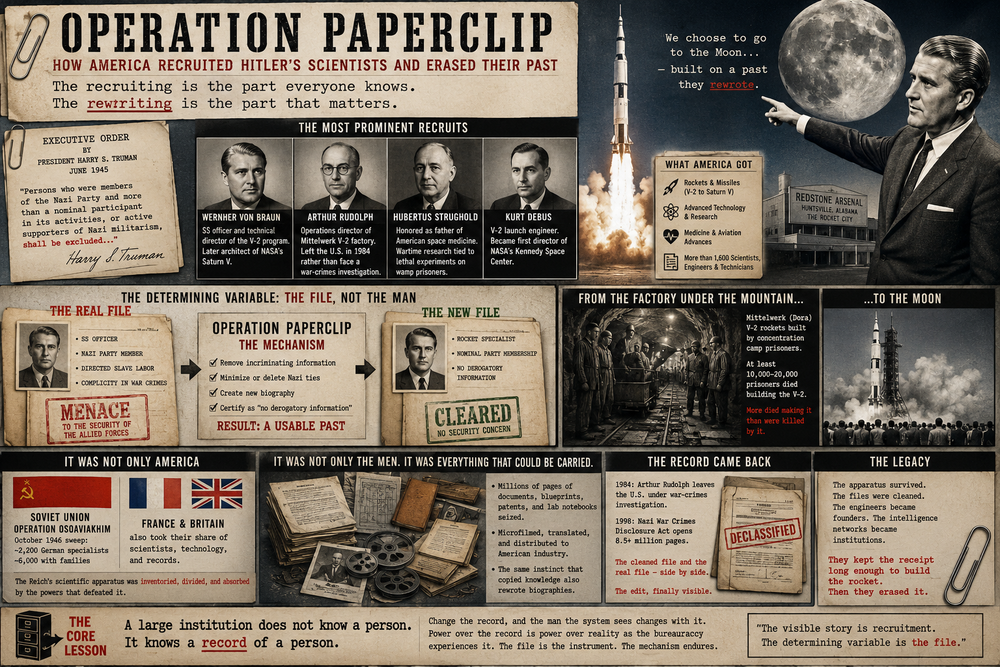
Gehlen was not the only defeated German asset the victor bought intact, and the parallel is the proof that what happened at Pullach was a structure and not an accident. While American intelligence was absorbing Gehlen's network, a different arm of the same government was absorbing Nazi Germany's rocket scientists. Through the program eventually known as Operation Paperclip, more than a thousand German scientists and engineers, Wernher von Braun and the V-2 team chief among them, were brought to the United States, their wartime records sanitized so that men who had drawn on the slave labor of concentration-camp prisoners to build their rockets could be issued security clearances and put to work. Von Braun, who had been an SS officer and whose rockets had been assembled by dying prisoners at the Mittelwerk, ended his American career as a national hero, the architect of the Saturn V that carried Americans to the Moon. The full account of that absorption is told elsewhere in this archive. What matters here is the identical shape of it.
Two arms of the United States government, working the same years, ran the same operation in two domains. One bought the intelligence apparatus of the defeated regime, the other bought its technological apparatus, and both bought the personnel along with the capability because the capability was inseparable from the people who embodied it, and both protected those personnel from the prosecution their records invited, because protection was the price of acquisition. The defeat of Nazi Germany did not destroy its most valuable apparatus. It transferred it, in two parallel streams, to the power that had defeated it, which inherited the machine and erased the receipt. That is not a coincidence of two scandals. It is one architecture, applied twice, by the same buyer, in the same years, to the same supply of unprosecutable men.
The mechanism
Strip the names away and the structure is clean enough to state as a rule. A senior officer of a defeated intelligence service offers his archive and his network to the victor. The victor accepts, because building a comparable capability from scratch is slower than the strategic timetable allows. The victor pays in cash and in protection from prosecution. The personnel who staff the operation are the personnel whose own files the new alliance cannot afford to open, and their unprosecutability is not an embarrassment to be managed but the very thing that makes them retainable and silent. The operation then produces intelligence that justifies the strategic posture that requires the operation, and the intelligence is structurally biased toward the conclusions the operation needs it to reach. The bias is hard to see because the alternative source, an independent capability owned outright by the buyer, was never developed, having been rendered unnecessary by the turnkey product on offer. That is not a sequence of errors. It is a procurement architecture, and it is coherent at every step.
What survived
Reinhard Gehlen died in his Bavarian retirement in 1979, at seventy-seven. He had been a Wehrmacht major general, the founding chief of an American-financed shadow service, and the first president of a major NATO intelligence agency. He was never charged with any crime. His pension was honored by the Federal Republic until his death, and his memoirs, sanitized for publication, sold widely.
Most Americans have never heard of him. Most Germans have not heard of him either. The service he founded moved in 2019 from Pullach into a vast new headquarters in central Berlin, reportedly the largest intelligence building in the world, where some thousands of its officers now work. Its director reports to the Federal Chancellery. Its budget is classified. Its founding doctrine is the doctrine Gehlen wrote. He was forgotten by name. The architecture he built was not.
There is a general law in this, and it reaches well past one German service. When a regime falls, the part of it that the victor most wants to destroy in public is often the part the victor most wants to keep in private, because the apparatus that made the old regime dangerous is the same apparatus that would make the new order powerful. So the regime is condemned and its machine is inherited, the criminals are denounced and the most useful of them are hired, and the public ceremony of rupture, the trials, the denazification, the liberation, runs on the surface while underneath, in the buildings and the files and the payrolls, the continuity holds. The victor inherits the machine and erases the receipt. That is how an apparatus survives the death of the regime that built it, and the Gehlen story is the cleanest documented instance of the pattern, because here the receipt was not even fully erased. It was photographed, buried in the Alps, and slowly, across half a century, dug back up by the declassification of the very records the architecture had relied on staying sealed.
That architecture accounts for every actor in this history. The buyer who needed the asset. The seller who had it. The personnel whose unprosecutability made the deal possible and kept it quiet. The agency that institutionalized the deal. The state that inherited the agency. Every one of those positions has a name and a paper trail. There is one position the architecture does not account for, and it is the only one that was never represented in any room where the deal was made. That is the position of the European publics in whose name the alliance was built, and who were told they had been liberated from exactly the apparatus that was, in fact, quietly being kept on. The deal still runs. Its descendants still draw salaries. The receipt was buried in the Alps, and most of it has never been dug up.
Evidence Map
Facts, interpretations, forecasts, and disconfirming signals.
Core claim. After 1945 the United States did not dissolve Nazi Germany's Eastern Front intelligence service but bought it intact, personnel and archive together, because its files on the Soviet Union were the only ones of their kind; the unprosecutability of its war-criminal staff made them both retainable and silent; and the operation was institutionalized as the West German Bundesnachrichtendienst, which still exists. This is a procurement architecture, not a series of isolated compromises.
Evidence level. Facts (high, documented in declassified CIA records, National Archives Record Group 263): Gehlen as chief of Fremde Heere Ost from 1942; his surrender on 22 May 1945 and the buried photographic files; the Fort Hunt debriefing; the Pullach operation funded by US Army intelligence and then the CIA; the employment of more than a hundred former Gestapo/SS officers, including Alois Brunner and, adjacent to the network, Klaus Barbie; the transfer to West German control as the BND on 1 April 1956 with Gehlen as first president to 1968; Heinz Felfe's exposure as a KGB agent in November 1961 (the case cracked by the CIA via a Polish source, not by the BND); Karl Silberbauer's carry-over employment; the BND's 2019 move to Berlin. Interpretation (medium, marked): the "procurement architecture" reading; the claim that unprosecutability functioned as a binding asset; the reading of Gehlen's product as a structurally biased input. Bounded, not overstated: Gehlen's contribution to the Soviet-threat overestimate is framed as a principal HUMINT input into an order-of-battle picture misread as combat-ready, with the core error analytical (cadre divisions counted as combat-ready) and not attributable to any single source; the bomber and missile gaps are explicitly assigned to a separate imagery/air-production stream, not to Gehlen.
What would confirm this. Further declassification showing the deliberate linkage of archive-acquisition to personnel-retention; documentation that independent US Soviet-facing HUMINT was deprioritized because the Gehlen product was available; continuity of doctrine and personnel across the 1956 transfer (well attested).
What would disprove this. Evidence that the war-criminal personnel were retained reluctantly and pruned as soon as feasible rather than retained by design; that an independent American capability was built in parallel and the Gehlen product was marginal; or that the BND made a documented institutional break with the Gehlen doctrine rather than treating him as its founder.
Watchlist. Continuing releases from Record Group 263 and the Army intelligence dossiers; BND historians' commission work on the agency's Nazi-era continuities; comparative cases of victors absorbing a defeated adversary's apparatus intact.
Related from The Manifest Archive
- Hitler Lost the War. Von Braun, Gehlen and Dulles Won the Peace
- Operation Ajax: How the CIA, BP and MI6 Took Iran's Oil
- The Reich After the Reich
- Inside Europe's Secret War, 1945-1990
- Operation Paperclip: How America Recruited Hitler's Scientists
- Did Wernher von Braun Predict the Alien Card?
- Allen Dulles: CIA Director, Nazi Financier, and the Man Who Investigated JFK's Murder