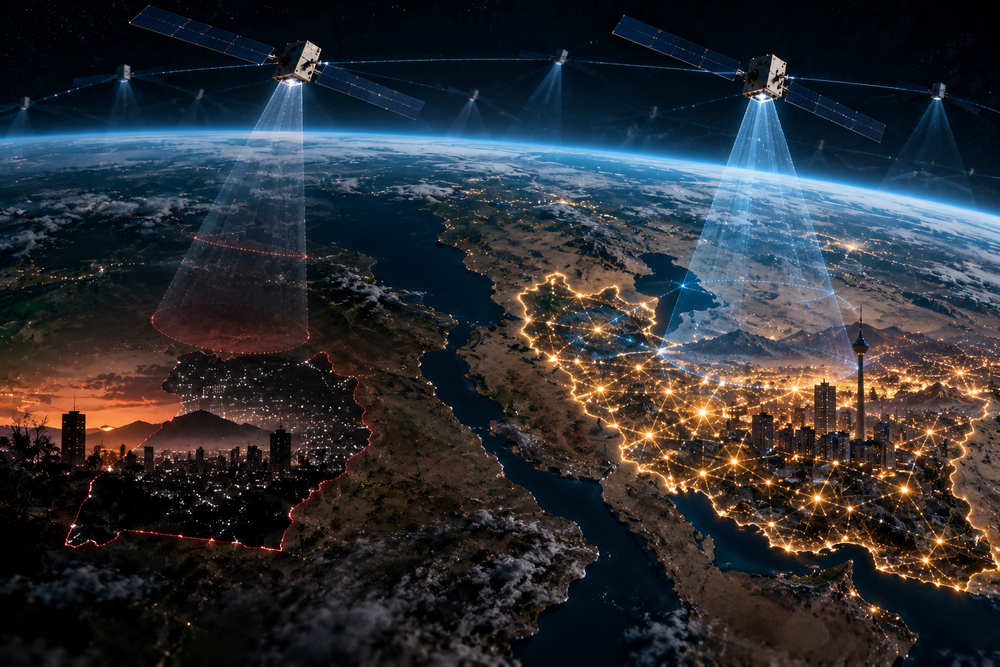
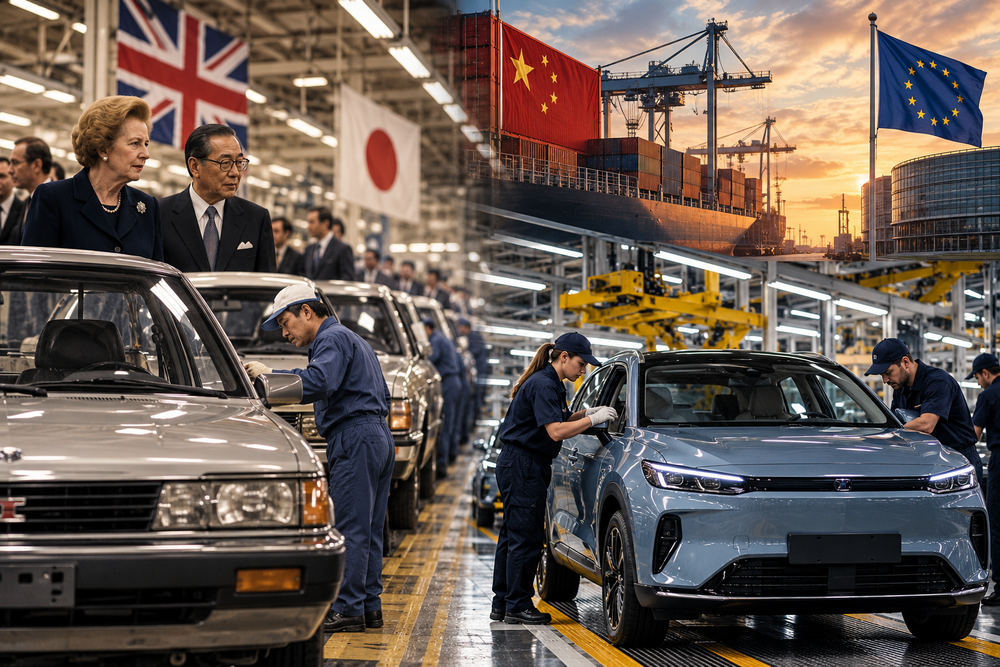
August 24, 2026. Washington. In the Cash Room at the Treasury Department, Scott Bessent announced that the United States Treasury was launching Operation Economic Outcast. The objective, in his own words, was to sever every economic lifeline sustaining the Islamic Republic of Iran until Iran stood alone. The framing invoked the Second World War: D-Day, Normandy, the campaign that ended Hitler's regime. "In the Second World War, D-Day marked the historic beginning of a campaign with our allies to target and drive the enemy from its positions, including those in third countries. Today, in that same spirit, we are launching an economic onslaught against Iran's financial connections around the globe."
Bessent's phrase is new. The strategy is not. For more than a century, major powers have tried variations of the same proposition: impose enough economic pain on an adversary state and political resistance will eventually become more expensive than compliance. The proposition has been tested, on Germany, on Japan, on Iraq, on Russia. Each time it was tested under conditions of maximum pressure. Across the four cases, the same structural pattern repeatedly appears. That recurring dynamic has a name. Robert Pape, professor of political science at the University of Chicago and author of thirty years of research on economic coercion, calls it the escalation trap.
Four cases span the documented record. Each was framed, at the moment of application, as the version of maximum economic pressure that would finally work. Each produced the same structural sequence.
The Design of Economic Coercion
Before the cases, the theory.
Economic coercion campaigns are built on a structural assumption: that an adversary regime, faced with severe enough economic pain, will eventually calculate that the costs of maintaining its current behavior exceed the costs of changing it. This assumption has intuitive logic. Regimes require resources. Resources come from economic activity. Disrupt the economic activity severely enough and the regime faces a resource constraint that forces a choice.
The theory has two versions. The weaker version holds that economic pressure, sustained over time, gradually degrades an adversary's capacity to resist while building internal political pressure for change. The stronger version holds that maximum pressure, sanctions applied at once, to maximum severity, forces an immediate crisis the regime cannot outlast.
Operation Economic Outcast is the stronger version. "Sever every economic lifeline" is not a gradual pressure campaign. It is a campaign designed to create an immediate resource crisis severe enough that the Islamic Republic faces a choice between capitulating and watching its population suffer.
The operational architecture is extensive. Secondary sanctions target third-country entities that maintain any financial relationship with Iranian institutions. The "economic outcast" framing is itself an operational concept: not merely restricting Iran's access to the dollar system but systematically disconnecting it from every financial network through which it currently operates, crypto exchanges, stablecoin rails, the correspondent banking networks of partner countries in Asia, the Gulf, and Europe. The campaign targets IRGC financing channels, oil export revenues, and the network of front companies through which Iranian entities have historically accessed international capital.
What is documentable is the historical record of the tool Bessent was deploying.
The theory is clean. The record is not.
Case One: The Naval Blockade of Germany, 1914–1919
The first documented Economic D-Day of the modern era was Winston Churchill's naval blockade of Germany during the First World War. Churchill, First Lord of the Admiralty until May 1915, championed a systematic campaign to cut off German supply lines by sea. The blockade was not incidental to Allied strategy; it was central to it. The premise was that Germany, deprived of imported food and raw materials, would face a resource crisis that would shorten the war.
The blockade worked as designed, in the sense that it inflicted severe damage. It killed hundreds of thousands of people, between roughly 424,000 by a 1928 academic estimate and the 763,000 claimed by German health authorities in December 1918, deaths attributed primarily to blockade-related deprivation, predominantly among the very young, the very old, and those already weakened by malnutrition. It created food shortages, fuel shortages, and material shortages throughout the German economy. German industrial output declined. The civilian population experienced genuine deprivation.
What the blockade did not do was break the German regime or end the war through economic pressure alone. Germany fought until November 1918, four years into the blockade. The blockade inflicted genuine damage: it was a real contributor to German exhaustion. But it was not the decisive mechanism. The regime held. The civilian population did not mobilize politically against the war in the way the theory predicted. Economic deprivation at massive scale produced endurance, adaptation, and intensified nationalism, not the compliance the theory expected.
Germany endured years of blockade and surrendered only after military defeat, internal political collapse, and cumulative wartime exhaustion converged in November 1918. What the blockade did produce was economic suffering that contributed to Germany's domestic collapse, the strikes, the mutinies, the revolution. What it did not produce, independently, was compliance with Allied demands. Economic suffering contributed to the internal conditions for collapse. It was not a sufficient cause of behavioral change in the absence of military defeat. That distinction matters: the blockade mattered, but not through the mechanism the theory specified.
What the four subsequent applications of the same theory share is a feature the German case established structurally: in every case, economic pressure was combined with, or followed by, military pressure. Whether Allied planners explicitly drew that lesson from 1914-1919 is a transmission question that the historical record does not cleanly answer. What the record does show is that the theory survived its own first application intact. The blockade inflicted real damage. The war ended. The damage was credited to the blockade. The mechanism by which Germany actually collapsed, military defeat and domestic revolution, was assigned less explanatory weight than the economic instrument that had preceded it. A theory that is credited for outcomes it did not produce is insulated from the outcomes it does produce.
Case Two: The Oil Embargo Against Japan, 1939–1941
The second case is the United States oil embargo against Imperial Japan, culminating in the comprehensive embargo of July 1941. The strategic logic was cleaner than the German blockade. Japan was an island nation with almost no domestic oil production. Its military machine, the navy, the air force, the mechanized army, was entirely dependent on imported petroleum, the overwhelming majority of which came from the United States. Cut off the oil and Japan could not fight.
By July 1941, the embargo was total. The American assessment was that Japan, confronted with a choice between military operations that would exhaust its reserves within months and a negotiated settlement, would eventually choose settlement.
The Japanese calculation was different, and more structurally significant than it first appears. The historical record, on which Pape draws directly, shows that the oil embargo of July 1941 was a central trigger in the Japanese decision to plan for war, a decision that culminated in the Pearl Harbor attack. What the embargo had done was not merely reduce Japanese resources. It had changed Japan's time horizon. Before the sanctions, Japan could wait. After the July 1941 embargo, with reserves sufficient for perhaps eighteen months of military operations, Japan could not wait. Delay had become strategically more dangerous than attack. Japan calculated that initiating war while it still had fuel reserves gave it a better chance of survival than submitting to slow strangulation.
Sanctions do not merely reduce an adversary's resources. They can compress the adversary's decision time, and compressed decision time makes high-risk military action rational in ways that a slower trajectory would not.
This is the finding that matters most for Iran. If Iran calculates that oil revenues available today will be lower in six months; that financial channels accessible now will be fewer in six months; that proxy capacity operational today may face further degradation; and that Hormuz leverage substantial now may be operationally constrained, then the relevant strategic question is not "can we survive Economic Outcast?" It is: "Are we stronger acting now than we will be six months from now?"
The escalation trap produces a dual-clock structure. As pressure intensifies, both sides face compressed timelines that make earlier action more rational. Iran's clock says acting sooner preserves leverage not available later. The United States' clock says if sanctions are not producing compliance and the costs are reaching consumers and markets, waiting becomes politically harder. The instrument of coercion changes the temporal calculation of both parties simultaneously, accelerating the confrontation it was deployed to prevent.
Japan attacked Pearl Harbor on December 7, 1941.
What followed was four more years of the most destructive naval and land campaign in the Pacific theater, ending only with the atomic bombing of Hiroshima and Nagasaki in August 1945.
Pape notes a dimension of this case that is rarely foregrounded in conventional histories. Whether or not the Roosevelt administration anticipated that the oil embargo would produce precisely this escalatory response is genuinely uncertain, there is documented debate among historians, and the mechanism does not require intention to operate. What Pearl Harbor provided, regardless of what was or was not anticipated, was a political event that resolved the administration's domestic mobilization problem. The American public, deeply reluctant to enter another European war, rallied immediately after the attack. It does not matter to the mechanism whether Roosevelt intended that political consequence. Pearl Harbor produced it.
What is documentable is the structural pattern: maximum economic pressure compressed Japan's decision time, produced escalation, and that escalation produced the domestic political conditions in the United States for military force.
The oil did not end the war. The war ended the oil.
Case Three: The Sanctions Regime Against Iraq, 1990–2003
The third case spans twelve years. After the liberation of Kuwait in 1991, the United States and its coalition partners kept in place the draconian UN sanctions first imposed on Iraq in August 1990, now designed to force Saddam Hussein to comply with UN weapons inspection requirements and to prevent reconstruction of its military capacity. The sanctions included oil sanctions, financial sanctions, and a blockade that cut off nearly all imports.
The sanctions imposed severe damage. Iraq's GDP fell by approximately fifty percent during the sanctions period. The sanctions coincided with severe deterioration in Iraqi public health infrastructure, child nutrition, and access to medicine. UNICEF and multiple UN agencies documented the humanitarian decline extensively. Excess mortality estimates vary widely and remain subject to genuine demographic dispute; what is documented and not seriously contested is the direction and severity of the deterioration. The sanctions produced a public health crisis at scale.
Saddam Hussein's regime did not collapse. For twelve years, it maintained internal control, continued military activities at a reduced level, and used the humanitarian crisis as a political tool, framing civilian deaths as American aggression rather than as consequences of the regime's own choices. The regime's political survival was not despite the humanitarian catastrophe. The humanitarian catastrophe was, in part, a political resource the regime deployed to maintain legitimacy with its constituency and to build international sympathy.
In March 2003, the United States resolved the situation by invading Iraq with 150,000 ground forces. The economic campaign that had run for twelve years, after twelve years of extraordinary civilian deprivation, had not produced the degree of compliance Washington ultimately demanded. Military force produced the regime change.
The economic D-Day was the prelude to the military campaign, not the alternative to it.
Case Four: The Sanctions Against Russia, 2022–Present
The fourth case is the most recent complete example. Following Russia's full-scale invasion of Ukraine in February 2022, the United States and its European allies applied what is widely described as the most extensive sanctions regime ever imposed on a major economy. The measures included the exclusion of selected Russian banks from SWIFT, the freezing of approximately $300 billion in Russian central bank assets held in Western jurisdictions, export controls on advanced technology and components, the seizure of oligarch assets, and the systematic disconnection of Russian entities from Western financial markets.
The ruble initially collapsed. Russian GDP contracted. The Russian economy faced genuine stress.
Vladimir Putin readjusted. The Russian economy reoriented toward non-Western trading partners: China, India, Turkey, the Gulf states. Energy exports continued through alternative channels. The sanctions imposed real costs on the Russian economy and on Russian consumers. They did not produce the rapid regime collapse that some Western analysts predicted in the weeks after they were applied.
Russia is the least clean comparison in this set, because Western sanctions served multiple simultaneous objectives: punishment, degradation of military capacity, deterrence, and signaling to other potential aggressors. Not all of those objectives require Russian capitulation to be achieved. But on the narrow coercive question relevant here, whether extraordinary economic pressure forced Moscow to abandon its central war aims, the answer, four years in, is no. Four years later, as of August 2026, Russia and Ukraine are fighting the largest war of attrition in Europe since the Second World War. The sanctions are still running. The war is still running.
The Escalation Trap
These four cases are not an arbitrary sample. They form an unusually close historical reference class for evaluating Operation Economic Outcast: major adversary states pursuing core security objectives they considered non-negotiable; sustained high-intensity economic pressure applied over a significant time period; explicit behavioral demands that the imposing country communicated publicly; and target states with credible military retaliation capacity that they demonstrated. Selection bias runs in the other direction: if you study sanctions only where targets complied, you systematically study cases where the target's calculus was different from Iran's, smaller states, peripheral interests, or adversaries without the structural capacity to retaliate in ways that imposed costs on the imposing country. The base rate from these four cases is not a ceiling on what sanctions can do. It is the best available evidence about what sanctions produce when the structural conditions match.
These four cases establish a pattern. Pape, who has spent thirty years studying economic coercion in its various forms, has a structural explanation for why the pattern recurs. Pape describes this mechanism as an "escalation trap." The three-stage sequence below is my reconstruction of the recurring mechanism across Pape's cases, not a formal taxonomy proposed by Pape himself. The terminology is mine; the underlying pattern is his.
The first stage requires the target population to attribute its suffering to the regime's choices rather than to the external power imposing the pressure. This is the stage that consistently fails. In each of these four cases, Germany, Japan, Iraq, Russia, the regime successfully framed civilian suffering as externally imposed aggression rather than as a consequence of its own decisions. The population under pressure does not, in the historical record, reliably mobilize politically against the regime as a result of economic pain. It more commonly mobilizes around the regime against the external threat.
The second stage requires the regime to calculate that changing its behavior is less costly than continuing its current path. But for a regime facing an adversary that has publicly committed to maximum compliance demands, the calculus is asymmetric. Capitulating does not eliminate the threat; it confirms that pressure works and creates the expectation of further demands. Defiance, even at severe economic cost, preserves the regime's strategic position and maintains internal legitimacy. Iran has operated under some form of sanctions for more than four decades. Its institutional memory is not "sanctions eventually end if we cooperate." Its institutional memory is "sanctions are permanent regardless of behavior."
The third stage is where the trap closes. As economic pressure accumulates without producing capitulation, the target regime faces increasing incentive to demonstrate that it has not been broken, to show its domestic constituency and its international partners that it remains viable. Across these cases, mounting economic pressure coincided with, and in some cases directly intensified incentives for, escalatory action. Germany intensified submarine warfare. Japan attacked Pearl Harbor. Iraq continued military activities as long as fuel permitted. Russia intensified and sustained its military campaign despite extraordinary economic pressure. Whether these actions were primarily driven by pressure-induced desperation, strategic calculation, or prior military momentum varies by case. What is consistent is the pattern: escalation accompanied by failure to comply, producing a dynamic that changed the political conditions in the imposing country.
The escalatory action then creates a feedback loop in the imposing country. Escalation by the target produces higher energy prices, security costs, or political crises that generate domestic pressure for resolution. As coercion visibly fails, force can begin to present itself politically not as the first option, but as the remaining one. The economic D-Day has, by this point in its structural sequence, altered the domestic political conditions in the imposing country in ways that make military action easier to justify.
The campaign applies pressure. The regime calculates that compliance, at the terms demanded, signals a weakness from which it cannot recover. Defiance produces escalation. The escalation reaches consumers through energy prices before it reaches diplomats through channels that could resolve it. Consumer costs generate domestic pressure. Domestic pressure seeks resolution. The resolution the structure makes available is not the economic campaign. The economic campaign has failed at coercion. But its failure has already changed the political environment in which the next decision will be made.
Against major adversary states pursuing a core security objective under conditions of maximum external pressure and credible military retaliation capacity, sanctions do not end conflicts. They schedule them.
Why Iran Is Not Japan
Before the mechanism runs, there is a prior question that the four-case reference class cannot answer on its own: why would Iran respond differently than a state that had no institutional memory of American economic coercion?
Iran's relationship with American economic pressure did not begin in 2006, when the first wave of nuclear-related sanctions was imposed, or in 2015, when JCPOA negotiations reached their conclusion, or in 2018, when the United States withdrew. It began in 1953. The CIA-MI6 operation that removed Mohammad Mosaddegh, Iran's democratically elected Prime Minister, who had nationalized Iranian oil, installed a client regime that governed Iran for the next twenty-six years. When that regime fell in 1979, the new government's founding institutional experience of the United States was a coup organized to protect Western oil interests. The hostage crisis did not emerge from nothing.
The forty-seven years since 1979 have produced a continuous sequence: hostage crisis, US support for Iraq during the Iran-Iraq War, sanctions regimes of varying intensity, JCPOA signed and abandoned, maximum pressure campaigns, targeted assassinations, and now Operation Economic Outcast. Iran's leadership has watched Libya abandon its nuclear program and lose Muammar Gaddafi. It has watched Iraq face invasion after a decade of sanctions. It has watched the arc from compliance to vulnerability across multiple cases.
What Operation Economic Outcast is attempting to achieve, behavioral change through economic pain, is being applied to a state whose entire institutional memory is organized around the proposition that compliance with American demands does not produce security. That memory is not irrational. It is a conclusion an Iranian strategic actor could reasonably draw from seventy years of observable experience.
This is why there are structural reasons to expect the escalation trap, if it operates in Iran, to compress faster than in several of the preceding cases. The calculation about acting now versus later is not being made by a state encountering American economic coercion for the first time. It is being made by a state that has been waiting, in one form or another, since 1953.
The Hormuz Difference
Operation Economic Outcast differs from the four preceding Economic D-Days in one structural way that makes the feedback loop faster and more direct.
None of the four previous cases targeted a state that sat astride a chokepoint carrying about a fifth of the world's oil consumption. Germany's blockade affected German imports but did not threaten global energy supply lines. Japan's oil was supplied by America itself, so the embargo was a supply cutoff, not a chokepoint threat. Iraq's oil exports were significant, but Iraq did not control Persian Gulf shipping lanes. Russia's energy leverage is substantial, but Russia does not control the maritime infrastructure through which European gas historically flowed.
Iran possesses the military capacity to threaten commercial transit through the Strait of Hormuz. Every Iranian escalatory response to Operation Economic Outcast, every attack on Gulf state infrastructure, every signal of intent to constrain Hormuz traffic, every missile or drone strike on energy facilities, can produce an immediate response in energy markets that subsequently reaches American consumers through fuel prices.
In the weeks before Bessent's announcement, Iran had already been conducting attacks on UAE infrastructure and Kuwaiti positions with increasing frequency. These were systematic signals, not isolated events. They produced gas price signals in global markets. As those signals accumulate, the consumer experience of economic pressure is diffuse and personal: not "Iran has responded to American sanctions" but "gas is more expensive." That diffuse personal experience, aggregated across the American electorate, is precisely the domestic pressure that historically moves political systems toward military action.
A chokepoint does not have to close to function as a weapon. It only has to become expensive enough to cross. Every Iranian escalatory action travels through an intermediary layer that amplifies it. Every attack on Gulf energy infrastructure, every signal of intent toward Hormuz, passes through Lloyd's Joint War Committee redesignations, war-risk premium adjustments, reinsurance appetite constraints, charter rate increases. Iran does not need to sink a tanker. It needs only to raise the probability that a tanker might be sunk. The shipping market prices that probability daily. American gas prices price it within days. The consumer never sees the JWC risk matrix. They see the number at the pump.
The secondary sanctions architecture compounds this dynamic further. Operation Economic Outcast targets third-country enablers, meaning it applies pressure to China, India, Turkey, and Gulf states that maintain commercial relationships with Iranian entities. Those states have their own leverage over American interests. The campaign creates friction with exactly the states the United States needs for any negotiated resolution of the broader Iran situation. The economic coercion campaign structurally undermines the diplomatic conditions that would be required to resolve the situation without military force.
There is a second structural tension that distinguishes this Economic D-Day from its predecessors. Every time Washington uses access to dollar clearing infrastructure as a coercive tool, it strengthens the structural incentive for third countries to build alternatives, RMB settlement architecture, BRICS-linked payment initiatives, bilateral local-currency settlement, non-Western correspondent banking networks. The more effectively the dollar weapon is used, the stronger the case for building around it. Operation Economic Outcast deploys the dollar weapon at maximum pressure against a network of states, including Iran, China, and Russia, with overlapping incentives to reduce dependence on Western financial infrastructure, states that have been building alternative settlement infrastructure for a decade. The tool and the incentive to retire it are running in parallel. This tension does not neutralize Operation Economic Outcast in the short term, but it shapes the longer-term architecture of the campaign in ways that previous economic D-Days did not face.
The Persuasion Function
There is a dimension of the escalation trap pattern that Pape names explicitly and that is rarely discussed in conventional foreign policy analysis.
Economic D-Days serve a domestic political function in democratic countries that is distinct from, and sometimes in tension with, their stated strategic purpose. That function is to demonstrate, publicly and visibly, that all non-military options have been exhausted. Democratic publics are difficult to mobilize for military action without a prior demonstration that alternatives were tried and found insufficient. Economic maximum pressure campaigns provide that demonstration.
The sequence is visible in the cases where democratic publics were the relevant audience for the coercion campaign, Japan, Iraq, and the current Iran case most directly. The democratic government applies severe economic pressure. The pressure fails to produce the desired behavioral change. The failure is documented in press conferences, intelligence briefings, and political discourse. The public is told that sanctions are biting, that the adversary is suffering, but that the adversary is not changing its behavior. The conclusion this sequence points toward, that if economic pressure cannot resolve the situation, something else must, is left implicit. It does not need to be stated. The structure of the situation states it.
Pape describes the mechanism in direct terms. Campaigns of this kind, he told Breaking Points in August 2026, are "effectively the Western way of war because they persuade liberal audiences [we've] done everything you could do, so force is a last resort."
This is not a claim about any particular administration's intentions. It is a structural observation about how democratic political systems process the failure of economic coercion. The Pearl Harbor case is the clearest documented instance: whether or not FDR anticipated that the oil embargo would trigger a Japanese attack, the attack produced the domestic political conditions for entering the war that had previously been absent. The structural pattern does not require intention to operate.
The structure does not require intention to produce these dynamics. It also does not require that everyone loses. Lockheed Martin shares traded just under $50 when the Afghanistan campaign began in October 2001. They were around $360 when the last American aircraft left Kabul in August 2021. Vitol told its banks it made about $2 billion in profit in the first quarter of 2026, despite trading losses early in the Iran war. These are incidental observations, not causal claims. The mechanism does not require beneficiaries to operate. The point is narrower: the political structure that maximum economic pressure creates tends to produce escalation as its downstream consequence, and that escalation produces its own set of winners independently of how the coercion campaign was designed.
The campaign that is designed to prevent war is the campaign that makes war politically viable.
The Strongest Counterargument
The strongest counterargument to this reading is that Iran in August 2026 is structurally different from Germany in 1918, Japan in 1941, Iraq in 2003, and Russia in 2022.
The argument runs as follows. Iran is not a unified command structure capable of indefinitely absorbing economic pressure through political will. The Islamic Republic in 2026 has a new Supreme Leader, Mojtaba Khamenei, who assumed power on March 8, 2026, after his father Ali Khamenei was killed in the US-Israeli strikes that opened the war on February 28. Mojtaba was reportedly injured in the same strike and had not been seen publicly as of August 2026; Iranian officials insisted he was healthy, but the few images released could not be dated or independently verified. A Supreme Leader who is physically compromised, who has governed for less than six months, and who inherited power under conditions of active war, has not yet consolidated the coalition his father held together for three decades. The IRGC, the pragmatic-technocratic faction around President Pezeshkian, and reformist currents are operating with competing institutional interests under a leadership that remains unproven. Economic pressure severe enough to destabilize that coalition might produce a regime dynamic that has not occurred in any of the preceding four cases, not because the theory of economic coercion is suddenly correct, but because the internal conditions are specifically different in ways that make the threshold for internal political disruption lower.
The supporting evidence is not negligible. The IRGC's financial exposure to sanctions is documented. Key factions within the regime have historically sought accommodation with Western economic integration, particularly around the 2015 nuclear deal, and have been marginalized by hardliners. Economic pressure that makes the hardliner position visibly unaffordable might, at the right moment of internal contestation, shift coalition dynamics in ways that produce behavioral change.
This counterargument deserves to be taken seriously. It is not refuted by the historical pattern; it is a claim that Iran's case is outside the pattern's range.
The reading offered here does not claim that outcome is impossible. It makes a narrower claim: the four-case historical record establishes the base rate for economic maximum pressure campaigns, and there is no documented transmission mechanism, in any of those cases or in the available evidence about Iran's internal politics in 2026, that shows how internal factional division translates into regime compliance under external economic pressure. Internal political contestation existed in Germany, Japan, Iraq, and Russia during their respective pressure campaigns. It did not produce behavioral change in any of them. The claim that Iran's internal fractures will produce a different outcome rests on a structural premise the historical record does not support.
That is not a prediction. It is a statement about confidence levels and the limits of what can be inferred from what is documented. The base rate is four cases. The base rate shows one pattern.
Scott Bessent announced Operation Economic Outcast on August 24, 2026. He called it Economic D-Day. The comparison to June 6, 1944, carried historical weight that he presumably intended.
What the comparison also carries is the history of maximum economic coercion that came before it. Four campaigns spanning a century. Four episodes of maximum economic pressure applied to adversary states. Four instances of genuine economic damage imposed on civilian populations. And four documented outcomes that were not the ones the campaigns were designed to achieve. Germany endured four years of blockade before collapsing through military defeat and domestic revolution. Japan attacked Pearl Harbor. Iraq maintained its regime for twelve years until ground forces ended it. Russia absorbed the most extreme sanctions in modern history and is still fighting.
The fifth case is now running. Iran will feel the pressure of Operation Economic Outcast. The Iranian population will experience the economic consequences of an administration determined to sever every lifeline. And as that pressure accumulates, the Islamic Republic will face the same structural choice that Germany, Japan, Iraq, and Russia each faced: capitulate or demonstrate that you have not been broken.
The four-case record shows what that choice produced in each of those four cases.
Economic D-Day does not need to be designed for war. It only needs to fail.
Evidence Map
Core claim: Operation Economic Outcast follows the documented structural pattern of four previous economic maximum pressure campaigns, each of which produced escalation rather than behavioral change, and will likely produce the same structural sequence with Iran.
Observed conditions (high confidence, directly documented):
- Bessent's August 24, 2026, public announcement naming "Operation Economic Outcast" and explicitly invoking D-Day framing (Treasury announcement, publicly stated)
- WWI German naval blockade: civilian deaths estimated between about 424,000 (1928 academic study) and 763,000 (German health authorities, December 1918); Germany did not capitulate due to economic pressure; war ended through military defeat November 1918
- Japan oil embargo July 1941: the historical record shows the oil embargo as a central trigger of Japanese war planning; Japan attacked Pearl Harbor December 7, 1941; four more years of war followed
- Iraq sanctions 1990-2003: GDP decline approximately 50%; UNICEF and multiple humanitarian agencies documented catastrophic increases in child mortality during the sanctions period, with estimates ranging into the hundreds of thousands, figures that remain demographically contested but whose direction is not; regime survived until US military invasion March 2003 with 150,000 ground forces
- Russia sanctions 2022-present: SWIFT exclusion, $300B asset freeze; documented as most extreme sanctions ever applied to a major state; Russia did not collapse; Ukraine war continues as of August 2026
- Iran conducting attacks on UAE infrastructure and Kuwait positions in weeks preceding August 24, 2026, announcement (multiple verified reports)
Documented structural dependencies (medium-high confidence):
- Robert Pape: University of Chicago political scientist, 30 years of academic research on economic coercion; describes mechanism as "escalation trap"; across his four cases, maximum economic pressure has not independently forced capitulation of a major adversary state on maximal political demands
- Mojtaba Khamenei confirmed as Supreme Leader since March 8, 2026 (Al Jazeera, multiple sources); suffered injuries in the same strike that killed his father; not seen publicly since March as of August 2026 per Iranian state media reports
- Hormuz carries about 20% of global oil consumption (EIA); war-risk premium and Lloyd's JWC redesignation mechanisms create energy market feedback without requiring physical chokepoint closure
- Dollar settlement as coercive tool: documented incentive effect on alternative settlement architecture (BRICS-linked payment initiatives, RMB settlement, bilateral local-currency trade networks, non-Western correspondent banking) strengthens with each high-profile deployment
Analytical inferences (medium confidence):
- The three-stage escalation trap mechanism (pressure fails to translate to compliance → regime demonstrates resilience through escalation → domestic political conditions shift toward force) is inferred from the four-case pattern, not from documented Iranian decision-making
- The "persuasion function", Economic D-Days as political prelude making military escalation domestically viable, is a structural inference from pattern, not a documented intention of the current administration
- The dollar-weakening tension with maximum-pressure financial coercion is a structural contradiction inferred from public statements; the operational interaction is not yet documentable
What would confirm this:
- Iran conducting new escalatory actions within 30-60 days of Operation Economic Outcast launch
- US energy prices rising in response to Iranian escalatory responses
- Third-country entities (China, India, Gulf states) circumventing secondary sanctions at scale, reducing practical effect
- US military posture in the Gulf increasing rather than decreasing over the next 6 months
- The political discourse in the US shifting from "sanctions are working" to "something more is needed"
What would disprove the Iran projection:
- Iran announcing substantive behavioral change on nuclear program or proxy operations within 90 days of Operation Economic Outcast launch, specifically citing economic pressure as the cause
- Documented internal Iranian political reorganization, factional realignment producing compliance behavior, directly attributable to Operation Economic Outcast pressure
What would weaken the historical mechanism:
- A systematic review of the four-case reference class finding that economic pressure was the primary cause of behavioral change in any of them, rather than military defeat, regime collapse under military conditions, or factors independent of the economic campaign
- Evidence that the four cases are not structurally comparable to the current case in ways that make the base rate non-applicable
Watchlist:
- Mojtaba Khamenei: any verified public appearance; health status updates; evidence of coalition consolidation or fracture within the new leadership structure
- IRGC factional developments: documented signs of internal coalition stress attributable to economic pressure
- Third-country compliance with secondary sanctions: China, India, Turkey, Gulf state responses
- Hormuz traffic data: AIS vessel tracking, charter rate signals, Lloyd's Joint War Committee risk ratings
- US military posture in Gulf region: carrier strike group positioning, force deployments
- US domestic energy price trajectory: correlation with Iranian escalatory actions following August 24 announcement
Confidence assessment:
- Four-case historical pattern: HIGH, documented historical record across multiple independent archives and scholarly sources
- Escalation trap mechanism for Iran specifically: MEDIUM, structural inference from pattern applied to Iran's documented institutional context
- Timeline of escalation: LOW, pattern establishes direction and structural sequence, not speed or specific triggering events
- Internal Iranian political dynamics as differentiating factor: LOW, limited verified information on current factional balance; insufficient to override base rate from four-case pattern
The chokepoint dimension of Operation Economic Outcast has a documented infrastructure context. The Iran War Triggered the Largest IEA Reserve Release in History. The Buffer Runs Out in July. established the IEA depletion arithmetic as the binding constraint the market was not pricing. Hormuz Closed. Houthis Closed Yanbu. The Backups Ran Out. documented the simultaneous disruption of both major Middle Eastern maritime corridors. Everyone Is Watching Two Separate Wars. Nobody Is Watching Where Ukraine Just Hit Iran. tracks the Caspian corridor and the three open predictions on rerouting capacity against real-time data.