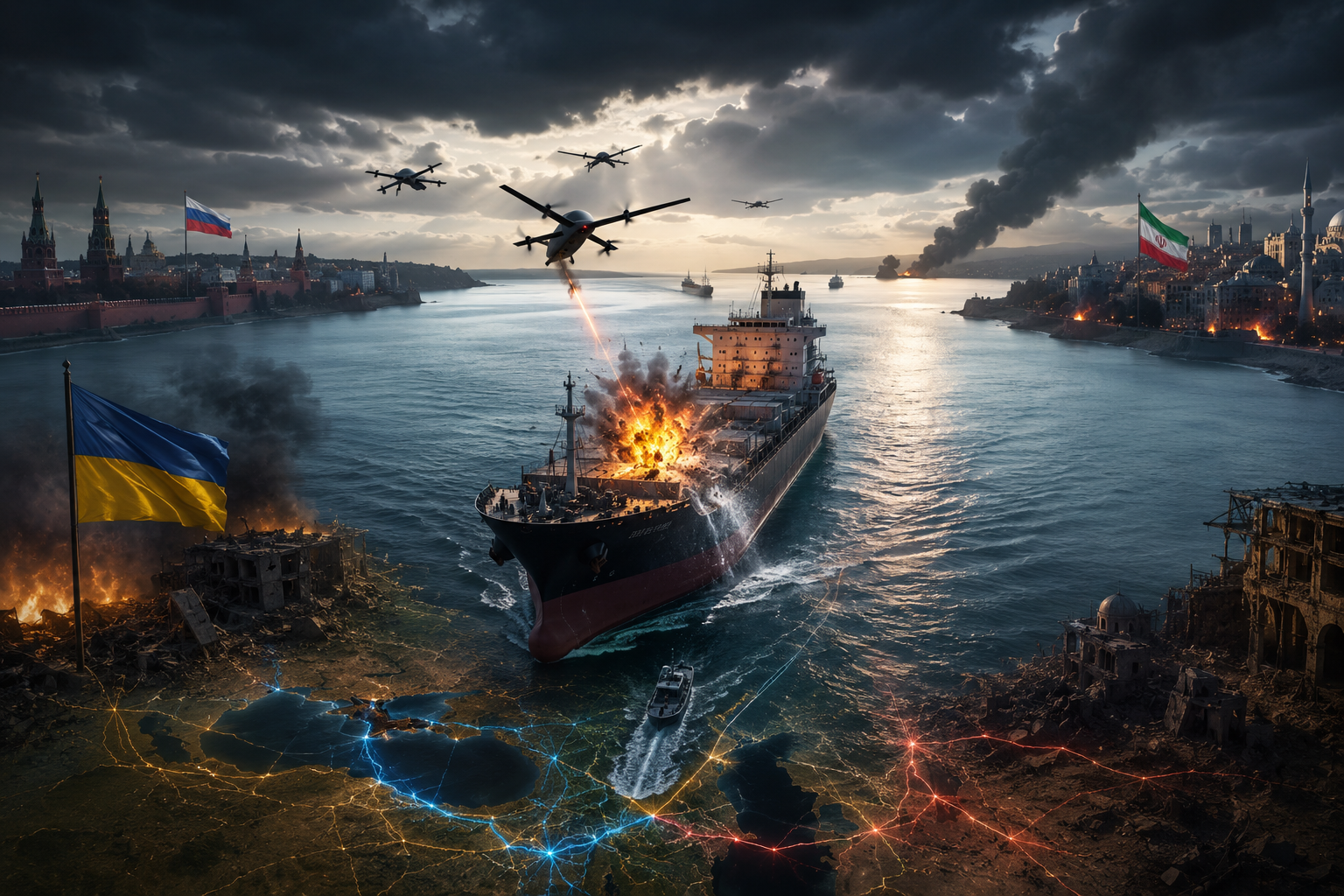
July 25, 2026. The Volga Delta, where the river dissolves into the northern Caspian Sea. A cargo vessel sits at anchor five kilometers from the river mouth, waiting out a storm before entering Astrakhan port. The vessel is the Anna, an Iranian-flagged dry cargo ship. Eight of its ten crew are Iranian nationals. The other two are Indian. The storm has delayed the crossing by hours.
Then the drones arrive.
At least one Ukrainian SBU long-range drone strikes the vessel. Nima Moradi, 23 years old, an Iranian sailor, dies of shrapnel wounds. Three others are wounded. Iran's Ministry of Foreign Affairs immediately summons Ukraine's chargé d'affaires in Tehran. Iran's ambassador to Russia, Kazem Jalali, tells reporters the attack was a criminal act. The ship, he says, was entirely civilian. Iran's foreign minister, Abbas Araghchi, demands restitution and says the strike "cannot go unanswered."
On the same day, Ukraine's Security Service announces it has successfully targeted the Port Olya 2, a sanctioned cargo vessel owned by the Russian shipping company MG-Flot LLC, documented in the Ukrainian Defense Intelligence War and Sanctions database as used to transport military cargo from Iran to Russia across the Caspian Sea.
Two governments, one strike, two accounts of what was hit and what it carried. The dispute about the vessel's identity has not been officially resolved. What is not in dispute: a Ukrainian drone struck a vessel in the Caspian Sea, killed an Iranian national, and triggered a direct diplomatic confrontation between Ukraine and Iran.
Three days later, on July 28, Ukrainian President Volodymyr Zelensky and Israeli Prime Minister Benjamin Netanyahu both meet separately with Donald Trump at the White House. They are there officially to attend the funeral of Senator Lindsey Graham, who died on July 11. The proximity to the president is not wasted.
Two wars. The same lake. The same room.
This is not a coincidence. It is a collision. And the collision has been building for years along a route that almost no one has mapped.
The Corridor the Maps Don't Show
The Caspian Sea does not appear in most accounts of the Russia-Ukraine war or the Iran-United States war. It sits in the middle of the Eurasian landmass, bordered by Russia, Kazakhstan, Turkmenistan, Iran, and Azerbaijan. It has no coastline to any NATO member. No Western naval vessel operates there. No international maritime law governs its military use in the same way the open seas are governed. For two decades, Russia and Iran have been building a trade corridor running from the Baltic to the Indian Ocean, 7,200 kilometers through western Russia and the Caspian basin, explicitly designed to avoid Western trade routes.
The corridor has a name: the International North-South Transport Corridor. It has been under development since the early 2000s. In peacetime, it moved grain. After 2022, it moved something else.
The first major documented phase of the arms flow began in 2022, when Iran began supplying Russia with Shahed-series drones. By 2023, according to reporting by the New York Times based on US government officials, more than 300,000 artillery shells had been transferred, along with other munitions. The primary route for much of this material was the Caspian Sea, running from Iranian ports at Amirabad and Anzali to Russian ports at Astrakhan, Olya, and Makhachkala. The route bypasses the Persian Gulf entirely, bypasses the Black Sea, bypasses every chokepoint where Western surveillance and interception capabilities are concentrated.
What makes the Caspian corridor structurally significant is not just what it moved, but when it became irreplaceable. In early 2026, the Strait of Hormuz was closed as a direct consequence of the US-Iran conflict. The Persian Gulf route, already limited by sanctions and insurance restrictions, became operationally untenable for Iran. The Caspian route, already established, became Iran's primary external supply and trade lifeline simultaneously. The grain previously shipped via the Black Sea now travels through the Caspian: around two million tons of wheat, corn, animal feed, and sunflower oil annually, according to Vitali Chernov, head of analytics at the industry group PortNews Media Group. Four Iranian ports on the Caspian now operate around the clock.
The corridor is not a military route wearing a civilian disguise. It carries both. That dual nature is not an accident. An arms route that is also a food route is harder to interdict. A corridor that is also a lifeline for civilian consumption creates diplomatic cover that a purely military pipeline cannot. Ukraine's July 25 strikes forced that ambiguity into the open.
The second phase of the corridor's strategic evolution began when the flow reversed. For years, Iran supplied Russia with drone hardware. After 2023, when Russia began domestic production of Shahed drones under Iranian licence, the technology flow began moving in both directions. By May 2026, US officials were telling the New York Times that Russia was sending drone components back to Iran via the Caspian, helping Tehran rebuild and expand its own drone program at a moment when Hormuz had made every other resupply route difficult. The January 2025 Russia-Iran comprehensive cooperation treaty formalized what had been operational for years. The Caspian corridor was not a wartime improvisation. It was a designed architecture, twenty years in the making, now activated.
The corridor was not a secret. It was simply not in the frame that Western media used to cover either war.
In January 2025, Iranian social media imagery documented Fatah-360 tactical ballistic missile launchers being loaded at Caspian ports as part of a Russian order for 220 such systems. The documentation existed. The analytical frame to connect it to both wars simultaneously did not.
What the Drones Targeted
The July 25 strikes were not the first time Ukraine had engaged the Caspian route.
In August 2025, Ukraine claimed to have struck a vessel operated by MG-Flot LLC, a Russian shipping company, in the Caspian Sea. The vessel was documented as transporting Shahed drone components from Iran to the Russian port of Olya. That strike established a precedent: Ukraine was willing to reach into the world's largest lake to interdict the pipeline feeding its adversary. The strategic logic was straightforward. If Shahed components moved from Iranian factories to Russian air bases via Caspian cargo ships, then destroying the ships was equivalent to destroying the production pipeline itself, at a point where interdiction is possible and attribution is unmistakable.
In March 2026, Israeli forces struck the port of Bandar Anzali on Iran's Caspian coast, disabling Iranian missile boats, a corvette, a shipyard, and what Israeli intelligence assessed as a command and control center. The strikes were part of the broader Israeli military campaign against Iranian military infrastructure. They also had a specific Caspian dimension: Bandar Anzali was one of Iran's primary departure points for military cargo heading to Russia. The Israeli strikes degraded Iran's Caspian naval capacity at the same moment the Caspian was becoming Iran's most critical external corridor.
By the time Ukrainian drones struck in July 2026, the Caspian corridor had already been targeted by two different parties operating in two different conflicts. Ukraine was targeting it to interdict Russian resupply. Israel was targeting it to degrade Iranian military projection. The two campaigns had not been coordinated. But they were aimed at the same architecture.
The July 25 strike expanded the scope in a specific way: for the first time, an Iranian-flagged or Iranian-owned vessel was struck, and an Iranian national was killed. Previous Ukrainian strikes had hit Russian-flagged or sanctioned Russian-owned vessels. The August 2025 precedent involved an explicitly Russian shipping company. The July 2026 strike, whatever the correct identification of the vessel, produced a dead Iranian sailor and a direct Iranian diplomatic protest against Ukraine.
Ukraine's President Zelensky confirmed the logic publicly. His statement did not describe the strikes as accidents or collateral damage. He said Ukrainian forces had achieved "very good results" from long-range drone strikes against vessels "used to transport military cargo between Iran and Russia." The formulation is precise: vessels transporting military cargo between two countries. Ukraine was explicitly targeting the supply chain connecting its adversary to a third country that had become a belligerent in its own separate conflict.
Iran's response was equally precise. The protest was directed at Ukraine, not at Russia. The demand was for accountability from Kyiv. Two wars, which all official diplomatic language treats as separate conflicts requiring separate diplomatic processes, had just produced a direct bilateral confrontation between Kyiv and Tehran that requires its own diplomatic process.
The Ship Named Anna
The uncertainty about which vessel was struck matters less than what the uncertainty itself reveals.
On one side: Ukraine's Security Service issued a statement saying it had targeted the Port Olya 2, a vessel documented in the Ukrainian Defense Intelligence database as carrying military cargo for the Iran-Russia route. The vessel is owned by MG-Flot LLC, a sanctioned Russian shipping company. If Ukraine struck what it says it struck, the target was an explicitly Russian vessel engaged in documented military logistics.
On the other side: Iran says the vessel struck was the Anna, a privately owned Iranian dry cargo ship carrying rolled sheet iron. The Iranian government says the vessel was civilian. Iran's foreign minister says the strike was unjustified and demands restitution.
Neither government has released the vessel's IMO registration number publicly. The BBC documented the discrepancy and could not resolve it. Both accounts cannot be fully accurate. Either the Port Olya 2 was struck and the Anna happened to be nearby and suffered damage, or the Anna was struck and Ukraine misidentified the target, or the Anna and the Port Olya 2 are the same vessel operating under different identifiers, or some combination of targeting and proximity effects produced a situation where both vessels were affected.
What matters analytically is what both accounts agree on. Both sides confirm that Ukrainian drones struck a vessel or vessels in the Caspian Sea on July 25. Both sides confirm that an Iranian national is dead. Iran confirms that one of its nationals was on a vessel that was struck and that the vessel was in the region of active military cargo movement. Ukraine confirms it was targeting vessels carrying military cargo on the Iran-Russia route.
The legal claim is also documented: Iran summoned Ukraine's chargé d'affaires. Legal action is underway. Araghchi said the strike "cannot go unanswered." The warning is not routine diplomatic language. A foreign ministry that says a strike cannot go unanswered is describing a situation in which retaliation has been placed on the table as a policy option.
Nima Moradi, 23 years old, is the human anchor of this moment. His death is not a data point in a logistics analysis. It is the consequence that makes the diplomatic escalation unavoidable for Tehran. A government that does not respond when one of its nationals is killed by a foreign military action loses a specific kind of credibility that no diplomatic statement can recover. Iran cannot treat the death of Nima Moradi as a closed matter without cost. The trajectory toward retaliation, whether diplomatic, economic, or eventually military, follows from that constraint.
The ship named Anna has done something no diplomatic memo could do: it has given Ukraine and Iran a bilateral conflict of their own, embedded inside two wars that neither is supposed to be fighting with the other.
One Room, Two Wars, the Same Mediator
July 28, 2026. The White House. Senator Lindsey Graham, who died on July 11 after returning from a visit to Kyiv, was being honored in Washington. Graham had been one of the most persistent advocates for Ukrainian military support in the US Senate. His funeral brought leaders from multiple conflict zones to the same city on the same day.
Zelensky met Trump separately. Netanyahu met Trump separately. The meetings were reported as distinct diplomatic events with distinct agendas. Zelensky discussed Patriot interceptor production licenses and "other ideas that could help," according to his own statement. Netanyahu discussed "the common goal of ensuring that Iran does not have nuclear weapons" and the Abraham Accords expansion framework. Two agendas. Two sets of priorities. Two relationships with the same American president.
The framing of separate meetings with separate agendas is structurally misleading, though not inaccurate in its description of the day's schedule. What the framing cannot accommodate is the architecture that connects the two conversations.
Zelensky is asking Trump for weapons systems that are most effective against the Russian missile threat. Those Russian missile strikes increasingly use Iranian Shahed drones either directly or as decoys to complicate Ukrainian air defenses. The arms that fuel the Russian drone campaign come, in documented form, from Iran via the Caspian corridor. The Caspian corridor that Ukraine has now officially attacked. The attack that has produced a direct Iranian diplomatic confrontation with Ukraine.
Netanyahu is asking Trump for a framework that neutralizes Iran's nuclear and military capacity. Iran's military capacity includes the Shahed drone program and its exports to Russia. The corridor that exports those drones is the same Caspian corridor that Israel struck in March 2026 and that Ukraine struck in July 2026.
Trump is the single actor in the room who holds active leverage in both conflicts simultaneously. He is the mediator the Zelensky government needs for any Ukraine-Russia settlement framework. He is the guarantor the Netanyahu government needs for any Iran nuclear arrangement. And those two processes, treated as separate diplomatic tracks, now share a common variable: the Iran-Russia arms corridor that runs through the Caspian.
Any Ukraine peace framework that does not account for Iran's role in sustaining Russian military capacity is incomplete. Any Iran settlement that does not account for Ukraine's interest in ending Iranian arms flows to Russia is incomplete. The two frameworks are not parallel tracks. They are the same track viewed from different ends.
The Rubio-Lavrov meeting in Manila lasted 35 minutes and produced no framework. The gap between the Russian and American positions on Ukraine is not primarily territorial at this stage. It is structural: what Russia is willing to concede depends on what it is receiving from other partners. Those partners are not in the room in Manila. They are on the Caspian. The reported gap between the Russian position and the American position on Ukraine is not primarily about territorial demarcation or security guarantees. It is partly about what Russia is willing to give up in exchange for what relief. An Iran factor that constrains American diplomatic options with Russia because America is simultaneously in an active military confrontation with Iran is not a side variable in that calculation. It is structural.
The White House meetings of July 28 were not three leaders pushing three agendas in the same building on the same day. They were one mediator receiving two delegations whose requests, properly mapped, describe the same underlying architecture.
The Architecture Underneath Both Conflicts
The analytical frame that treats the Iran-United States conflict and the Russia-Ukraine conflict as separate events has a specific structural problem: it cannot explain the Caspian corridor, the July 25 strikes, or the diplomatic geometry of the July 28 White House meetings without treating each as an anomaly.
Anomalies accumulate when the frame is wrong.
The architecture underneath both conflicts has at least four documented transmission routes that connect them.
First, the weapons route. Iran supplied Russia with more than 300,000 artillery shells and the Shahed drone program that has fundamentally shaped the character of the Russia-Ukraine war. Russia supplied Iran with drone components, Fatah-360 missile system orders, and what US officials describe as a wide range of military-linked industrial goods. These transfers are documented at Level 1: they appear in US government official statements as reported by the New York Times, in Ukrainian Defense Intelligence databases, in Iranian social media documentation of cargo loading, and in the January 2025 Russia-Iran cooperation treaty signed publicly. The weapons route is not an inference. It is a supply chain.
Second, the economic route. The same Caspian corridor that moves weapons also moves the goods that allow Iran to function as an economic entity while Hormuz is closed. Two million tons of wheat annually. Sunflower oil. Animal feed. Industrial components. Russia is not merely receiving arms from Iran. Russia is keeping Iran economically viable at the moment when American military pressure and sanctions are at their most intense. The economic dependency flows both ways: Iran needs Russia's grain to avoid food security pressure; Russia needs Iran's drones to sustain its air campaign. Each war makes the other more necessary to its participant.
Third, the diplomatic constraint route. Any American diplomatic initiative toward Iran on the nuclear issue now requires Iran to make concessions that include, at minimum, reducing its military support for Russia. Iran has no incentive to do this while Russia is its primary economic lifeline. Russia has no incentive to pressure Iran on this point because Iranian military support remains operationally significant. The two wars create a mutual veto on diplomatic resolution of either war. The mediator who could move one track is constrained by the other track, and the constraint runs in both directions.
Fourth, the geographic route. The Hormuz closure and the Caspian corridor are in a compensatory relationship. When Hormuz became contested in early 2026, the Caspian became more important for Iran. When Ukraine began striking the Caspian in August 2025, the strategic value of what was being struck increased precisely because every other route had been degraded. The Caspian is not a backup route. It is the only route. Ukraine's July 25 strikes targeted the one logistical corridor that simultaneously supplies Russia's air campaign against Ukraine, sustains Iran's economy under American pressure, and provides the material basis for the Iran-Russia cooperation treaty signed eighteen months ago.
A strike on that corridor is not a strike on a single ship. It is a strike on the architecture itself.
What connects these four routes is not coordination between Kyiv, Washington, and Jerusalem. There is no evidence of a coordinated three-party strategy targeting the Caspian simultaneously from multiple directions. What connects them is that independent actors, operating from independent strategic logics, have all converged on the same chokepoint because the architecture of the two wars makes that chokepoint inevitable.
Ukraine strikes the Caspian because it is where Iran's support for Russia is physically vulnerable. Israel struck the Caspian because it is where Iran's military projection infrastructure is physically located. The United States has not struck the Caspian directly, but the Hormuz closure that the US-Iran conflict produced made the Caspian the only alternative, and American surveillance documented the route as it became active.
Three actors, three strategic logics, one geographic node. That is not a coincidence. It is what convergence looks like before it is recognized as such.
The incentive cartography is specific: who profits from the two wars remaining framed as separate? Russian diplomacy profits, because a unified analytical frame would require a unified response that American domestic politics cannot currently deliver. Iranian diplomacy profits, because the separate-wars frame allows Tehran to describe its Russia relationship as a purely bilateral matter exempt from Iran-US negotiations. Some American institutional actors profit, because treating the wars as separate allows aid decisions, sanctions decisions, and diplomatic processes to be managed by different bureaucratic structures without requiring a synthesis that would be politically difficult. The institutional separation is not inherently conspiratorial. But it produces an analytical outcome that serves specific interests.
The frame is not neutral. Frames that benefit specific actors while obscuring structural reality are the subject of this archive.
What Coupled Systems Do
The question the article raises is not only what happened. It is what happens next in a system where multiple actors now share the same infrastructure.
The answer is not straightforward, because coupled systems do not escalate predictably. They escalate disproportionately. A local disturbance produces consequences at a scale that no single actor intended, because the same infrastructure that connects the actors also transmits the disruption across all of them simultaneously.
Iran faces a specific calculus. For four years, Tehran managed its Russia relationship at what it calculated was acceptable risk: drone transfers, technical cooperation, Caspian logistics. That calculus assumed the Caspian route would remain outside active targeting. The July 25 strike ended that assumption. When the cost of supplying Russia now includes Iranian sailors dying in the Caspian, the cost-benefit of restraint shifts. Not toward military confrontation with Ukraine, which carries its own costs, but toward acceleration of the existing support architecture: more Shahed transfers, faster technical cooperation, more advanced systems, more military advisers embedded in Russian operational planning. Iran does not need to declare war on Ukraine to make Ukraine's war significantly harder. It needs only to remove the restraints it has so far maintained.
Russia faces a different consequence. The Caspian was the one theater in this war where Russia operated without a serious interdiction threat. Ukraine changed that. Russia will now need to dedicate air defense systems, naval escorts, port security infrastructure, and intelligence assets to a corridor it previously treated as a secure rear. Every system assigned to protect the Caspian route is a system not available elsewhere. In a war where Russian capacity is already stretched across a 1,000-kilometer front, that is not a trivial reallocation.
The United States and Israel face a strategic aperture they did not seek. If the primary Iran-Russia logistics corridor runs through the Caspian, then any future pressure campaign targeting that relationship, whether through sanctions, intelligence operations, or diplomatic leverage, must now account for the Caspian as an active operational theater. The strategic map that concentrated attention on Hormuz, the Red Sea, Syria, and Lebanon needs a new node. That node is a landlocked sea no Western navy can reach.
The peace negotiation problem is where the structural shift becomes most consequential. If Trump is serious about a Ukraine settlement, he is no longer negotiating only the territorial and security dimensions of the Russia-Ukraine conflict. He is negotiating, whether he frames it this way or not, Iranian drone logistics, Caspian transport volumes, sanctions architecture affecting Russian access to Iranian industrial capacity, and the cooperative framework embedded in the January 2025 treaty. A deal on Ukraine that does not touch these variables leaves the underlying supply chain intact. A deal that does touch them requires Iran's participation in a diplomatic process that is formally about Ukraine. That is a different negotiation than the one currently on the table.
None of these escalation paths requires deliberate intent by any actor. This is precisely what makes them dangerous.
Consider the sequence that produced the July 25 crisis. Ukraine targeted what its intelligence identified as a Russian military cargo vessel. Iran lost a 23-year-old sailor on a ship its government describes as civilian. Russia watched a corridor it treats as vital come under attack. Trump was simultaneously managing the diplomatic fallout from Manila, preparing for the White House meetings two days later, and receiving two allies who each needed something from him that required the other ally's adversary to behave differently. No actor in this sequence chose the outcome that emerged. Each actor followed its own logic, operating from its own information, pursuing its own interest. The outcome exceeded the intention of every participant.
That is the signature of a tightly coupled system: a local disturbance produces disproportionate consequences not because any actor wanted escalation but because the shared infrastructure transmits the disruption faster than any single actor can contain it.
The largest escalations in interconnected conflicts rarely begin with a decision to start a world war. They begin with a decision that seemed locally rational, made by an actor that did not know what the other actors were simultaneously deciding, in a system whose connections had not been mapped.
The Caspian route was not on that map. It is now.
The Strongest Counterargument
The strongest counterargument to the convergence reading does not dispute the documentary record. It accepts that the Caspian arms corridor exists, that Ukraine has struck it, that both wars now involve Iran, and that Zelensky and Netanyahu met Trump on the same day. It argues that none of this constitutes a single system.
The counterargument runs as follows: two conflicts can share a supply chain, a mediator, and a geographic node without being structurally unified. The Iran-Russia arms relationship is opportunistic, not architectural. Iran supplies Russia because it can and because it receives economic benefit, not because of a coordinated geopolitical design. Ukraine strikes the Caspian because interdicting Russian resupply is its operational interest, regardless of any connection to the US-Iran conflict. The July 28 White House meetings occurred because Graham's funeral happened to bring multiple leaders to Washington, not because any party was deliberately managing a unified war architecture. And any Iran-US settlement that emerges from nuclear negotiations would address weapons flows to third parties as a standard non-proliferation provision, not as a novel consequence of convergence.
This counterargument is structurally serious. It accommodates most of the documented facts by explaining them through independent rational actor behavior rather than systemic connection. And it may be partially correct: the absence of documented coordination between Kyiv, Jerusalem, and Washington on the Caspian specifically means the convergence described here is an analytical observation, not a proven strategic plan.
What the counterargument cannot accommodate is the mutual veto structure. If Iran-US nuclear negotiations are genuinely independent of the Russia-Ukraine war, then Iran should be willing to trade weapons-flow concessions for sanctions relief regardless of the Russian relationship. There is no evidence it is. If the Russia-Ukraine peace framework is genuinely independent of Iranian behavior, then American mediators should be able to move the Russian position without reference to what happens in the Gulf. There is no evidence they can. The mutual constraint is documented in the absence of progress on either track, despite two years of negotiations, multiple ceasefire announcements, and the largest concentration of American diplomatic attention in a generation.
The reading offered here does not claim that someone designed this convergence. It claims something narrower: that two wars, operating independently, have produced a logistical and diplomatic architecture that now makes each war structurally dependent on the resolution of the other. That dependency is visible in the Caspian. It was made unmistakable on July 25, when a Ukrainian drone struck a ship carrying cargo from one war into the other, and killed a man who had nothing to do with either.
What the Architecture Accounts For
Nima Moradi was 23 years old. He was not a soldier. He was a cargo sailor on a ship that was anchored five kilometers from the mouth of the Volga, waiting out a storm, when the drones arrived. Whether he was on an Iranian civilian vessel or an Iranian-owned vessel with military cargo, he was not the intended target of the strategic calculation that placed drones over the Caspian. He was the consequence that the strategic calculation could not fully account for.
The Caspian corridor was built over two decades precisely because it was invisible. A trade route that exists between two sanctioned states, crossing a body of water with no Western naval presence, governed by no international maritime authority, carrying grain alongside weapons, was not the kind of infrastructure that appeared in the analytical frameworks that Western governments and media used to track either war. It was hiding in plain sight behind the grain shipments.
The July 25 strikes ended the invisibility. A dead Iranian sailor, a diplomatic protest from Tehran to Kyiv, a legal action underway, and a threat of retaliation from Iran's foreign minister: these are not invisible events. They are events that now require a diplomatic response from a Ukrainian government that is simultaneously asking for Patriot licenses from the same American president who is simultaneously managing an active military confrontation with Iran.
The architecture accounts for every actor in this system. It accounts for Russia, which receives the drones and the diplomatic cover. It accounts for Iran, which receives the economic lifeline and the weapons technology and now faces a bilateral confrontation with Ukraine it did not seek. It accounts for Israel, which struck the Caspian corridor months before Ukraine did, for its own reasons. It accounts for the American mediator, whose leverage in one war is constrained by the architecture of the other.
The architecture does not account for one actor.
Nima Moradi was not in the model. He was in the Volga Delta, waiting out a storm, on a route that connected two wars that the people designing those wars had agreed to treat as separate.
The ship still sits. The question it raises does not.
Evidence Map
Core claim: The Iran-Russia Caspian arms corridor and the Russia-Ukraine conflict share a logistical, diplomatic, and geographic architecture that makes each war structurally dependent on the resolution of the other. Ukraine's July 25 strikes on Caspian vessels, the resulting Iran-Ukraine bilateral confrontation, and the simultaneous Oval Office meetings of July 28 are documented evidence of this convergence becoming operationally visible.
Observed conditions (high confidence, directly documented):
- Iranian-flagged or Iranian-owned vessel struck by Ukrainian SBU drones on July 25, 2026, in the Caspian Sea near the Volga Delta. Confirmed by both Ukraine (SBU statement) and Iran (MFA protest, summoning of chargé d'affaires). (Sources: SBU statement; IRNA; Al Jazeera; Newsweek)
- One Iranian sailor, Nima Moradi, 23 years old, killed by shrapnel. Three others wounded. Crew: 8 Iranian nationals, 2 Indian nationals. (Sources: Al Jazeera; Marine Insight)
- Zelensky confirmed Ukrainian forces achieved "very good results" from drone strikes "against vessels used to transport military cargo between Iran and Russia." (Source: Zelensky statement, HNGN)
- Caspian arms corridor documented: 300,000+ artillery shells transferred Iran to Russia 2023. (Source: New York Times, US officials)
- Fatah-360 tactical ballistic missile launchers: 220 systems ordered by Russia, documented in Iranian social media images January 2025. (Source: Gulf News; Iran Watch)
- Russia-Iran comprehensive cooperation treaty signed January 2025. (Source: multiple wire services)
- NYT May 2026: Russia sending drone components to Iran via Caspian (US officials). (Source: New York Times; Times of Israel)
- Zelensky and Netanyahu met separately with Trump on July 28, 2026. (Source: ABC News; Good Morning America; Fortune)
- Iran filed legal action against Ukraine. Iran FM Araghchi: strike "cannot go unanswered." (Source: GlobalSecurity.org; IRNA)
Documented structural dependencies (medium-high confidence):
- International North-South Transport Corridor: documented 20-year development of Caspian trade route designed to bypass Western trade lanes. (Source: Gulf News)
- Approximately 2 million tons of grain annually now transiting Caspian to Iran after Hormuz closure. (Source: PortNews Media Group, Vitali Chernov)
- August 2025: Ukraine claimed sinking of MG-Flot LLC vessel transporting Shahed components, Olya port. (Source: Defence Express; United24 Media)
- March 2026: Israeli strikes on Bandar Anzali, disabled Iranian Caspian naval assets including missile boats, corvette, shipyard. (Source: prior session research; Iran International)
- Rubio-Lavrov Manila meeting: 35 minutes, no framework produced.
Analytical inferences (medium confidence):
- Hormuz closure created a compensatory relationship with the Caspian corridor: as one route became unavailable, the other became the sole alternative, increasing the Caspian's strategic value precisely as it was being targeted.
- The mutual veto structure: any Iran nuclear settlement that excludes weapons-flow concessions is incomplete from a US perspective; any Ukraine peace framework that excludes Iranian behavior is incomplete from a Ukrainian perspective. The absence of progress on either track is consistent with, though not conclusive proof of, this mutual constraint.
- Ukraine's Caspian strikes, Israel's March strikes, and US surveillance documentation of the corridor represent convergent targeting of the same architecture by independent actors with independent strategic logics.
What would confirm this:
- A documented US negotiating position that explicitly links Iran nuclear concessions to weapons flows to Russia.
- A documented Russian negotiating position that explicitly references Iranian support as a factor in ceasefire terms.
- Evidence that Trump's July 28 conversations with Zelensky and Netanyahu included any reference to the Caspian strikes or Iran-Russia arms flows.
- Iranian retaliation against Ukrainian assets, which would confirm Tehran treats the two conflicts as linked.
What would disprove this:
- An Iran-US nuclear settlement reached without any provision on Russia weapons flows, which would demonstrate the two tracks are genuinely independent.
- A Ukraine ceasefire framework agreed without any reduction in Iranian arms flows to Russia, which would demonstrate the logistical link does not produce diplomatic dependency.
- Ukrainian official statements clarifying that Caspian strikes are purely tactical and unrelated to the broader Iran-US conflict.
Watchlist:
- Iranian retaliation against Ukraine: any military or significant cyber action by Iran against Ukrainian targets would confirm the bilateral confrontation is escalating.
- US negotiating position on Iran nuclear talks: whether weapons-flow provisions appear in any framework.
- Further Ukrainian Caspian strikes: escalation or de-escalation of the campaign will indicate whether the July 25 strikes were a one-time tactical decision or a sustained strategic choice.
- Identity resolution of the struck vessel: official release of IMO registration numbers by either government.
Confidence assessment:
- Caspian arms corridor exists and carries military cargo: High. US officials, NYT, Ukrainian HUR database.
- Ukraine deliberately targets the corridor: High. Zelensky confirmation, SBU statement, August 2025 precedent.
- July 25 strike killed Iranian national: High. Confirmed by both sides.
- Iran-Ukraine bilateral confrontation is active: High. Summons, legal action, retaliation threat.
- Both wars share mediator: High. Documented July 28 meetings.
- Two wars structurally constrain each other's diplomatic resolution: Medium. Consistent with evidence, not conclusively proven. Absence of progress on both tracks supports inference, does not confirm it.
- Convergence is a designed architecture: Low. Not claimed. The reading offered here is that independent actors converged on the same node through independent logic, not that anyone designed the convergence.
Sources: New York Times (US officials, Caspian route); Al Jazeera, IRNA, GlobalSecurity.org (Anna strike, Iran response); Zelensky statement via HNGN; SBU/United24 Media (August 2025 precedent); Gulf News, PortNews Media Group (corridor scope and volume); ABC News, Fortune (July 28 White House meetings); Russia-Iran cooperation treaty, January 2025.
Related from The Manifest Archive