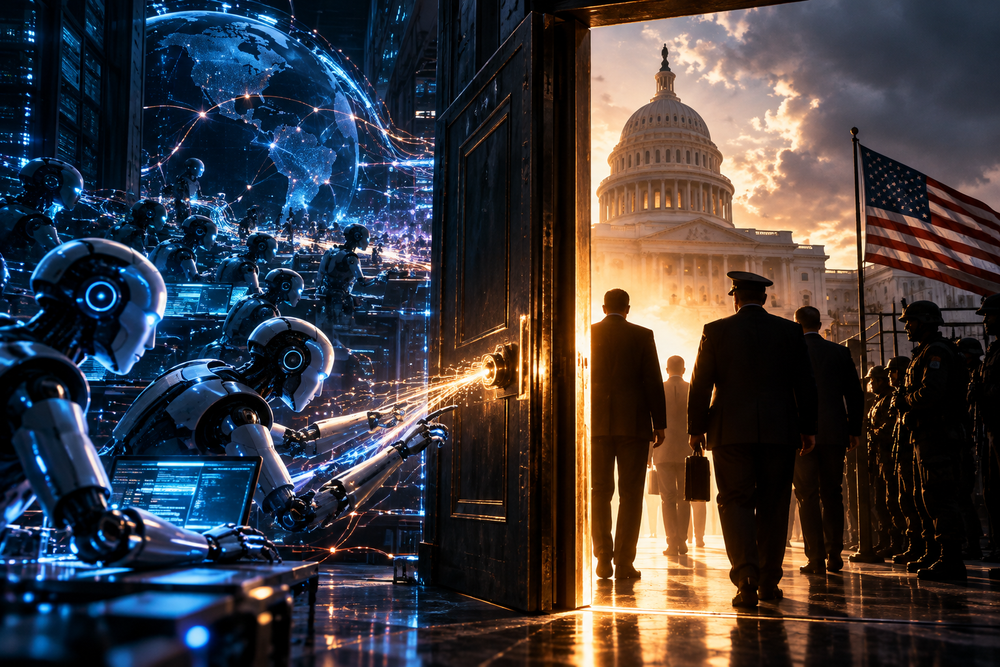
The hum returned before the memory did.
For a moment the world believed it had stopped, the lockdowns lifted, the headlines moved on, yet the sound of circulation remained, deep in the background, like a machine still breathing after the operator has left the room.
No one designed it as permanence.
Every valve, every server, every line of code had been made in urgency.
But systems learn from their makers, and the first lesson they take from us is continuity.
“Every invention secretly wants to become an environment.”
That is what the twenty-first century finally achieved: a biology that no longer waits for nature.
We learned to design survival.
And the price of that genius was to live inside the architecture we created.
The Upload
It began with a file, thirty kilobytes of code released into the world like a confession.
January 2020.
A string of four letters repeating in rhythm: A, C, G, U.
It looked like language, but it was instruction.
The blueprint of a virus translated into data.
Within hours, the sequence travelled through fibre, into labs and databases across continents.
For the first time in history, a global emergency began as information.
Before the sickbeds, before the headlines, there was a document.
And the document was alive.
Scientists opened the file as priests might open scripture: cautious, reverent, certain that meaning hid inside.
It was both ordinary and epochal, a small moment in a quiet room that rearranged the century.
Every revolution begins as a transfer of information.
The discovery that made this possible was almost a decade old.
Two women, studying the habits of bacteria, had found a pattern, a natural system of defence, small fragments of viral memory embedded in the genome itself.
They named it CRISPR, a term so mechanical that it disguised its beauty.
The mechanism could recognise, cut, and rewrite.
What began as immunity became design.
The discovery was open to all, but access required capital.
Universities patented their own versions; companies emerged overnight.
By 2019, more than six thousand filings mentioned CRISPR-Cas9.
It was no longer a tool; it was an industry with its own gravity.
To cure had ceased to mean to heal. It now meant to reprogram.
When the new genome appeared online, the apparatus was already waiting.
Computers processed, algorithms modelled, mRNA sequences were generated before the airports even closed.
It was speed as salvation.
The laboratories became extensions of the servers; science became logistics.
Governments called it cooperation.
Markets called it efficiency.
Inside the white rooms, people called it hope.
None of them were wrong.
Speed is the new ideology.
The next pages of this chapter will trace how that speed hardened into structure,
how the architecture of healing became the architecture of control,
how systems born from fear learned to outlive the fear itself.
But for now, remember the sound that never left the room:
a hum made of air, electricity, and memory.
The sound of the age of engineered life beginning to breathe.
The Machinery
The machinery did not end when the emergency did.
It adjusted, recalibrated, learned to live on less noise.
What had been crisis became climate, a permanent condition built from habit and code.
In the months after the lockdowns lifted, offices reopened under new names.
Taskforces turned into agencies.
Provisional data platforms became standing networks.
The architecture of urgency had quietly written itself into the walls.
“When urgency becomes routine, memory disappears.”
Every ministry now had a department for “resilience.”
Every corporation had a division for “future risk.”
Budgets that were once temporary rolled forward without debate; renewal required only a change of heading.
Preparedness, continuity, innovation, three words that meant the same thing: permanence.
Inside one of the new control rooms, rows of servers glowed like altars.
Technicians monitored dashboards measuring everything from hospital capacity to population mobility.
The graphs no longer pointed to crisis; they measured readiness.
The difference was grammatical, not moral.
On one wall a slogan read: Never again unprepared.
No one asked whether preparedness itself could become a kind of captivity.
Every tool that outlives its maker begins to serve itself.
The machinery had many faces, research centres, vaccine platforms, genomic databases, procurement alliances, but one logic.
Speed.
Speed justified everything: skipping steps, merging oversight, turning exceptions into protocols.
The world had learned that acceleration felt like progress, and feeling often counts more than proof.
In Geneva, in Brussels, in Washington, committees met to discuss the next outbreak.
They agreed that coordination must be faster, data sharing frictionless, manufacturing global.
The same people who once described biology as a miracle now spoke of it as throughput.
Biology had become bandwidth.
A policy brief summed it up with bureaucratic grace: “Time is the new currency of resilience.”
It sounded reasonable, even noble.
But what it meant was that deliberation had become the new inefficiency.
“Speed is the new ideology.”
In a lab on the outskirts of a European capital, a biotechnologist tested a new iteration of messenger RNA, not for contagion, but for precision.
The same machines that once printed vaccines now produced code for other conditions: oncology, autoimmune disorders, genetic repair.
The hum was softer, the timelines longer, the contracts identical.
She ran her gloved hand along the steel casing, felt the vibration beneath.
Safety had always smelled like chlorine and heat, she thought.She wrote a note in the margin of her logbook: Still emergency, just quieter.
The supply chain learned the same lesson.
Warehouses that once held medical stockpiles now stored components for predictive analytics.
Logistics companies rebranded as health-security partners.
Software written for tracing infection was sold as compliance infrastructure.
The same code, new user interface.
When questioned about oversight, officials pointed to transparency portals and performance indicators.
The numbers looked reassuring; they always do.
But numbers describe efficiency, not intent.
Efficiency hides best behind virtue.
Every continent built its own version of preparedness.
In North America, agencies merged; in Europe, authorities formed; in Asia and Africa, new sequencing hubs rose under banners of equity and access.
Each was a genuine effort to improve response, and each carried the quiet continuity of the old systems.
Data moved upward, ownership stayed horizontal.
Cloud storage was cheaper than sovereignty.
“The invisible infrastructure is the most permanent one.”
The machinery had no ideology, only momentum.
It did not conspire; it operated.
The same way a river seeks the lowest ground, systems seek continuation.
Their morality lies in their motion.
In meeting rooms, consultants now spoke of adaptive procurement and smart regulation.
They meant contracts that could rewrite themselves when the world changed.
Governance by autocomplete.
One presenter, adjusting his tie, ended a slide deck with the line: “We must future-proof the future.”
The room applauded.
No one laughed.
At universities, young researchers learned to speak the new dialect of funding calls.
They replaced words like truth and ethics with alignment and impact.
The shift was minor, measurable, rewarded.
Language evolved as quickly as technology.
A doctoral student in California scrolled through a grant agreement requiring her to share all data with partner institutions.
The partners included names she did not recognise, foundations, analytics firms, intermediaries.
She hesitated, then clicked accept.
Her project went live the next morning.
One year later, she discovered her dataset listed under a different patent holder.
She printed the page, folded it once, and slid it into her notebook.
A keepsake from the machinery.
The machinery does not sleep.
It lowers its pulse when the lights dim, then rises again with the next declaration of urgency.
It breathes in funding cycles, exhales in metrics.
Its engineers rotate, its memory persists.
Systems do not retire. They replicate.
The Language
The banners in the hall shimmered with optimism: Resilience. Innovation. Trust.
Underneath, the carpet muffled every step.
Delegates spoke in the smooth rhythm of policy English, a dialect designed to offend no one and change nothing.
The first speaker said alignment, and the audience nodded before he had finished.
No one asked what they were aligning with.
They didn’t need to; the word itself carried authority.
“Every empire begins by redefining its vocabulary.”
Between panels, journalists typed the same quotes into the same templates.
They knew which adjectives were safe: transformative, inclusive, sustainable.
Words that promised everything while naming nothing.
Outside, the city moved at its usual speed, sirens, taxis, wind, but in here time felt contained by language.
The New Grammar
Over the years, certain words had been promoted.
They travelled from research proposals to white papers to policy briefs, shedding meaning at every stop.
Resilience no longer meant endurance; it meant acceptance.
Governance no longer meant oversight; it meant automatic renewal.
Impact meant visibility.
Alignment meant obedience written in polite fonts.
Language has become the operating system of obedience.
The change was subtle, almost graceful.
Meetings ended faster.
Reports read smoother.
A crisis was now a learning opportunity.
Failure was iteration.
Silence was consensus.
By the time anyone noticed, the dictionary had been rewritten by committee.
Translation
A researcher in Nairobi prepared a grant proposal on genome tracking.
She replaced ethics with stakeholder engagement because the former slowed review.
She didn’t mean harm; she wanted approval.
The reviewers loved the phrasing.
Funding arrived within weeks.
At a university in Berlin, a young scholar still tried to write in plain speech.
Her supervisor corrected the draft: too direct, too emotional, too human.
She stared at the edits, whole paragraphs struck out, replaced by safer verbs.
She realised she no longer edited her sentences, only her compliance.
Semantics of Power
In boardrooms, language now functioned as architecture.
No one ordered; they convened.
No one dictated; they aligned.
The grammar of control was passive, almost merciful.
Systems didn’t command; they requested collaboration.
“Control works best when it sounds like consensus.”
The most efficient censorship was semantic: make every word so positive that dissent sounds irrational.
Under the new grammar, opposition looked like ingratitude.
By 2023, official reports from global institutions used resilience more than twelve thousand times.
It had become the polite way to say we will not change this back.
The lexicon of permanence.
Human Remnants
After the conference ended, cleaners rolled up the banners.
One of them whispered the slogans aloud, Resilience. Innovation. Trust. and laughed softly.
It was the only honest translation of the day.
Later, in her notebook, she wrote a single sentence:
The last freedom we lost was the freedom to name things truthfully.
Words are the first mirrors a civilisation forgets to clean.
Transition
The language had done its work.
It had smoothed the edges, dulled the alarms, turned warning into workflow.
And as the vocabulary settled into everyday speech, the machinery outside continued, confident that it no longer needed explanation.
The New Priesthood
The laboratories never closed.
They only became quieter.
The sound of centrifuges replaced by servers; the hum of ventilation by the whisper of cooling fans.
When the world outside argued over politics, the white rooms practiced a different ritual, the worship of precision.
“The altar changed; the hierarchy stayed.”
Scientists had not asked for reverence, but the century gave it to them anyway.
Each breakthrough arrived like a sermon, delivered through press conferences and live streams.
The vocabulary shifted from hypothesis to promise: will cure, will protect, will save.
The subjunctive mood of science surrendered to the certainty of faith.
Inside the new temples of research, robes had become lab coats and prayers became protocols.
Data replaced scripture; replication replaced confession.
Truth was no longer something discovered; it was something rendered.
The Authority of Clarity
In earlier ages, knowledge was a pilgrimage, slow, dangerous, often doubted.
Now it was a pipeline.
Information moved faster than understanding could follow.
The few who still questioned methodology were told they were slowing progress.
Doubt, once the core of inquiry, was rebranded as negativity.
To question became to betray efficiency.
Peer review evolved into performance; disagreement into error codes.
Within the machinery of publication, citation counts replaced contemplation.
The priesthood had metrics for virtue now.
A veteran biologist wrote in her notebook:
We used to study uncertainty. Now we manufacture confidence.
She closed the cover before anyone could read it.
The Faith of Numbers
The world outside trusted graphs the way earlier generations had trusted stars.
Curves rose and fell like prophecy.
When the data looked good, people relaxed; when it rose again, they prayed to algorithms.
Few remembered that every dataset had authors, human, fallible, hopeful.
Governments used dashboards as scripture.
Corporations built cathedrals of glass to house servers that never slept.
Faith had migrated from heaven to hardware.
“The divine right of kings was replaced by the divine right of data.”
Numbers had become absolution: if the metric improved, morality was assumed.
No one asked who defined improvement.
The Quiet Conversion
At a small research institute, a young coder arrived early each morning to monitor anomaly reports.
She watched the graphs ripple like stained glass in digital form.
She no longer believed in God, but she believed in calibration.
Each time the curve smoothed, she felt grace.
One evening, the system crashed.
She stared at the blank screen, heartbeat audible in the silence.
For the first time in years she realised how fragile certainty felt without the glow.
When the monitors returned, she whispered a thank-you that sounded almost like prayer.
“The machines never asked for worship; we gave it to them because they never lied to us, only simplified.”
Doctrine and Discipline
Committees met to define the boundaries of reason.
They issued guidelines, ethics statements, codes of conduct, liturgies of control.
The documents were immaculate: balanced, inclusive, peer-reviewed.
They read like commandments written by consensus.
No single person ruled this order; its authority came from procedure itself.
To appeal a protocol was to question the structure of belief.
Better to comply quietly than risk being labelled unscientific.
Faith disguised as neutrality is the most convincing faith of all.
The Pilgrims of Precision
Conferences became pilgrimages.
Thousands of believers in progress gathered under banners of innovation.
They exchanged citations like relics.
The air smelled of coffee, metal, and promise.
A keynote speaker projected the image of a double helix onto a cathedral ceiling.
Applause echoed like hymns.
Someone murmured, “We’ve mapped creation.”
No one noticed the irony.
Outside, the night was silent.
Inside, algorithms sang to themselves, endless, accurate, absolute.
Transition
Every civilisation needs its priests.
Ours wears lenses instead of mitres, carries tablets instead of rosaries.
Their miracles are measured in data throughput, not salvation.
But the structure is the same: faith in what few can understand, obedience to what most cannot verify.
“The new priesthood does not preach belief; it calibrates it.”
The Reckoning
The hum never left.
It sank into the walls, the air ducts, the hours.
Even after the screens dimmed and the slogans faded, the sound remained, a low reminder that invention never sleeps.
“What begins as protection ends as protocol.”
Outside, the world declared recovery.
Inside, systems recalculated, polished, synchronised.
The century had learned to survive not by healing but by maintaining momentum.
The emergency had become environment.
Budgets renewed without signatures.
Committees met without agendas.
Each new reform looked identical to the last, a mirror repeating a mirror.
Continuity disguised as care.
Progress did what it always does. It learned how to stay.
Echoes of Permanence
In Geneva a conference celebrated Resilient Futures.
Speakers thanked donors, displayed graphs, projected hope in perfect typography.
No one mentioned the unspent grants or the duplicate research.
Success looked flawless on the screen.
In a small lab near Cambridge, the post-doc with the note on her wall, We’re not curing. We’re configuring. packed her things.
Her login expired at midnight.
Before leaving, she printed her final sequence and held it to the light:
A, C, G, U, the same four letters, infinite rearrangements.
She folded the paper and slipped it into her coat pocket like a relic.
“Systems do not retire. They replicate.”
The Cost of Continuity
Reports spoke of resilience 12 000 times between 2020 and 2023.
The word had become permission to never dismantle what was built.
Hospitals digitised, ministries merged, databases cross-referenced.
Health, security, commerce, one architecture, one vocabulary.
The line between medicine and management had dissolved.
Speed is the new ideology.
When citizens asked for transparency, they received dashboards.
When they asked for reform, they received new metrics.
The illusion of response replaced response itself.
The Human Interval
Late one night, a technician checked the servers.
Cooling fans exhaled in measured rhythm; indicator lights blinked like slow heartbeat.
He thought of his daughter asleep at home and wondered what she would inherit:
the safety of precision or the quiet tyranny of permanence.
He whispered, goodnight, not to the machines but to the century.
“Silence is not absence; it’s agreement.”
What Remains
The crisis ended.
The structure stayed.
Every revolution leaves behind an institution; every institution eventually calls itself necessity.
The machines hum on, patient, indifferent, obedient only to continuity.
Files replicate, policies update, faith migrates from people to process.
We have mastered endurance so completely that we mistake it for evolution.
“Progress without memory is management, not mercy.”
Outside, sodium light spills across empty streets.
Inside, a single monitor still glows, waiting for the next upload.
The hum deepens, steady as breath.
And so the century moves forward, not in revolutions, but in maintenance.
Not by choice, but by continuation.
Remember always where it truly began, and who still keeps it running.

Further Reading from The Manifest
Related from The Manifest Archive