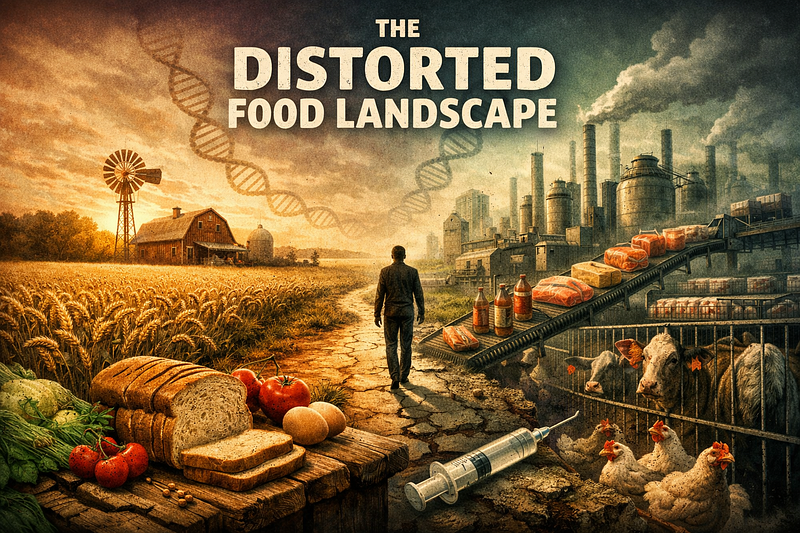
Stand in the bread aisle for a moment and watch what people actually do. They are not choosing. They are navigating. They pick up a loaf, turn it over, read the back, put it down. Whole grain, ancient grain, high protein, gut friendly, no seed oils, low FODMAP. Every package speaks the language of reassurance, and the reassurance is the tell, because you do not reassure someone who feels safe. The shopper is not asking what will nourish them. They are asking what they can tolerate, what causes no reaction, what fits inside a margin they have learned to respect. That posture, the wariness in front of the most ordinary food there is, is not a personal quirk or a wellness fad. It is what it looks like to live inside a food supply that was built for everything except the person eating it.
This essay is not about bread, and it is not the familiar argument that some villain is poisoning us. There is no poisoner. The claim here is narrower, stranger, and harder to fix: the modern food landscape was optimized, relentlessly and successfully, for a long list of things, and the human body was never on the list. Not because anyone decided the body did not matter, but because the body could not be measured the way the other things could, and what cannot be measured falls out of the design.
What the system was built to optimize
Follow any item on the shelf back up its chain and the same logic appears at every link. Does it grow reliably. Does it resist pests and weather. Does it travel without spoiling. Does it store for months. Does it taste compelling enough to be bought again. Can it be produced identically, a million times, at the lowest cost. Every one of those questions has an answer that can be counted, optimized, and rewarded. A seed company, a grain trader, a food manufacturer, a retailer all run on those numbers, and the system that results is genuinely a marvel of engineering. It feeds billions, cheaply, with almost no spoilage, in endless apparent variety.
Now notice the question that is missing from the entire chain. Is it good for the body of the person who eats it, over years, in their particular biology. That question has no clean number. The human body responds to food slowly, variably, and in context. It does not produce the uniform, immediate, comparable data that an optimization system needs as an input. One person thrives on what inflames another. The effects show up over decades, tangled with a hundred other variables, in ways no quarterly metric can capture. So the body's response was not suppressed or ignored out of malice. It was simply never a usable signal, and a system optimizes only for the signals it can read. What cannot be measured disappears from the design, and the body is the thing that cannot be measured.
That is the determining variable, and it reframes everything that follows. The food was not built to harm you. You were simply not what it was built for.
The illusion of choice
The first thing the optimization produces is the appearance of its opposite. The supermarket is a monument to choice: tens of thousands of products, hundreds of brands, an aisle for every preference and intolerance. But trace the products back to their raw inputs and the diversity collapses. An enormous share of what fills the shelves is recombination of a very small number of commodity crops, corn, soy, wheat, palm, recombined into syrups, oils, starches, proteins, and flours, then flavored and shaped into the illusion of variety. The choice is real at the level of the label and absent at the level of the substrate.
This narrowing is not an accident of taste; it is a structure with documented economics underneath it. In the United States, federal subsidies flow overwhelmingly to a handful of commodity crops, corn, soybeans, and cotton chief among them, on the order of nine billion dollars in a recent year, and by one analysis of national dietary-survey data, well over half of the calories Americans consume derive from those subsidized crops. Cheap subsidized corn becomes cheap high-fructose corn syrup; cheap subsidized soy becomes cheap seed oil; cheap commodity wheat becomes refined flour. The policy did not set out to make a population heavier. It set out to make staple calories abundant and cheap, which is a defensible and even humane goal, and the abundance of cheap recombinable calories is exactly what a profitable processed-food industry is built on. The variety you navigate in the aisle is the surface of a very narrow, very subsidized base, and the base, not the brand, is what you are actually eating.
This base was not always there, and the moment it was laid is datable. Through the middle of the twentieth century American farm policy managed supply, paying farmers to limit production to keep prices stable. In the early 1970s that reversed. Richard Nixon's agriculture secretary, Earl Butz, told farmers to get big or get out and to plant fence row to fence row, dismantled the supply controls, and pushed maximum production for export. The predictable result was a vast and permanent surplus of cheap corn. At almost the same moment a Japanese process for turning that corn into high-fructose corn syrup was adopted in the United States, and when world sugar prices spiked in the mid-1970s the cheap corn sweetener flooded in to replace it. The United States went on to lead the developed world in both high-fructose corn syrup consumption and obesity, and both climbed together from the 1970s onward. None of this was a plan to fatten a population. It was a policy to make calories abundant and cheap, layered onto the high-yield seed-and-fertilizer package of the Green Revolution, which had just multiplied grain yields worldwide. The cheap recombinable base was the intended output. The processed-food economy that grew on top of it was the unplanned consequence, and the bodies came last because they were never in the equation.
The narrowing is corporate as well as agricultural, and the figures are stark. Four firms, Bayer, Syngenta, Corteva, and BASF, control well over half of the global seed market and a comparable share of the pesticides, and a handful of trading houses move most of the world's grain. These companies do not make meals; they make conditions. They decide which crops are economically viable to grow at scale, which varieties exist and which quietly disappear because they do not suit industrial repetition. The eater never encounters them and never votes on them, yet they set the boundaries of what can be on any shelf, anywhere, long before a single product is designed. This is the upstream face of the same logic, and the ownership questions it raises belong to their own account; what matters here is only that the base of the food supply is not just a few crops but a few firms, and that concentration is what makes the surface variety possible and the substrate uniformity inevitable.
Where the measured harm actually is
If the body's harm cannot be measured, how do we know there is any? Because in the one place it has been measured carefully, it shows up immediately and unambiguously, and it does not point at chromosomes or conspiracies. It points at processing.
Nutrition science has converged in the last decade on a classification, NOVA, that sorts food not by its nutrients but by how industrially processed it is, with the fourth and most processed category, ultra-processed food, defined as industrial formulations of cheap extracts and additives bearing little resemblance to whole food. In 2019 a researcher at the United States National Institutes of Health ran a small but tightly controlled trial, the cleanest test of the question yet: he housed twenty volunteers, fed them either ultra-processed or minimally processed meals matched for calories, fat, sugar, and salt, and let them eat as much as they wanted. On the ultra-processed diet, people spontaneously ate about five hundred more calories a day and gained weight; on the whole-food diet they lost it. It is one study and a small one, a proof of concept rather than the last word, but it is the rare experiment that isolates processing itself as the variable. Same nutrients on paper, opposite outcomes in the body, with processing the only difference. And the large population studies have since found graded associations between the share of ultra-processed food in a diet and obesity, cardiovascular and metabolic disease, and premature mortality.
This is the documented core, and it is more damning than any chromosome story because it is measured. The food is engineered for palatability and shelf-life, the two things that sell and store, and palatability optimized to that degree turns out to override the body's own signals for when to stop. The product was tuned to be over-eaten, not because anyone wanted you sick, but because a food that is eaten more is a food that sells more, and "eaten more" is a number the system can read. The body's resulting harm is not. So the harm accrues on the side of the ledger no one counts, exactly as the cheap calories accumulate on the side everyone does.
And the over-eating is not an accident of the engineering; it is the engineering. The processed-food industry developed an entire applied science of palatability, the search for the precise combination of sugar, salt, and fat, the exact crunch and melt and aftertaste, that maximizes how much a person will consume before feeling done. There is a term of art for the peak of that curve, the bliss point, and products are formulated toward it deliberately, tested and retested against panels until they hit the spot where appetite stops protecting the eater. This is the part of the system that is genuinely designed rather than emergent, and it should be named as such: a food tuned to override satiety is not a neutral product that people happen to overeat. It is a product whose commercial success is measured by overeating, because the quantity consumed is the number on the ledger, and the body's signal to stop is not. The result is a shelf full of items engineered to defeat the only instrument the eater has.
There is also a metric the eater supplies directly, and it is the one they feel they are choosing: convenience. The deepest shift in modern eating is the outsourcing of preparation. For most of history the household turned raw ingredients into meals, which meant the household kept control over what went into them. The processed-food economy is, at bottom, the industrialization of that step, and it sells itself honestly on time saved, the genuine and considerable value of not having to cook. But in handing over the preparation, the eater also handed over the formulation, the additives, the portion, the salt and sugar and fat, the entire interior of the food, and received in return a finished product tuned to the seller's metrics rather than the cook's judgment. Convenience is real and it is wanted, and that is precisely why it was the door through which control of the food's contents left the home and entered the factory and did not come back. And the front of the package finishes the job the formulation began. The reassuring words, natural, whole grain, high protein, no additives, are a perception layer engineered as deliberately as the recipe, because the health halo a label projects measurably raises both what people buy and how much of it they eat, often regardless of what the product actually contains. The shopper reading the front of the pack for safety is reading a surface built to be read, and the distance between that front and the ingredient list on the back is one of the most carefully optimized spaces in the entire system.
A word on wheat, marked as what it is
Here a popular explanation has to be handled honestly rather than borrowed for effect. Many people sense, correctly, that modern wheat sits badly with them, and a widely repeated theory blames its genetics: that breeding drove wheat from the fourteen chromosomes of ancient einkorn through emmer's twenty-eight to modern bread wheat's forty-two, leaving a grain too genetically dense for a body that co-evolved with the older kind. The chromosome counts are accurate. The inference is not well supported, and it should be marked as the speculation it is rather than presented as fact.
Bread wheat's forty-two chromosomes are not a modern laboratory product; that hexaploid form arose by natural hybridization some eight to twelve thousand years ago and has been the staple ever since. Careful comparisons find that gluten content has stayed roughly constant across the last century of breeding, not risen. And where people genuinely react to wheat without having celiac disease, the better-supported culprits are not chromosomes but other components, the fermentable carbohydrates called FODMAPs and certain wheat proteins, that produce real symptoms through ordinary digestive mechanisms. So the honest version keeps the experience and discards the explanation: the discomfort is real, the modern wheat-and-flour environment may well provoke it, and the chromosome theory is a Level-3 hypothesis, possible but unproven and probably wrong about the mechanism. The instinct that something changed is sound. What changed is overwhelmingly the processing and the refining around the grain, not the count inside its cells.
Who got to define the problem
There is one place in this story where the harm was not merely an unmeasured byproduct but was actively shaped, and honesty requires naming it as sharply as the emergence is named everywhere else, because the discipline cuts both ways. The question of what counts as healthy eating is not settled by the body; it is settled by nutrition authorities, dietary guidelines, and the research they rest on, and that layer can be influenced.
The documented case is now public record. In 1967, the sugar industry's trade group quietly paid Harvard nutrition researchers, the equivalent of around fifty thousand dollars in today's money, to write an influential review for a leading medical journal that downplayed the emerging evidence linking sugar to heart disease and pointed the blame instead at dietary fat. The funding was not disclosed. The review helped tilt decades of nutrition science and public guidance toward a low-fat consensus, and the food industry answered that guidance by flooding the shelves with low-fat products that replaced the removed fat with sugar and refined starch, the very commodities the cheap base was made of. A generation was told to fear the wrong nutrient, and the processed-food economy was perfectly positioned to sell the reformulated answer.
This is the part of the landscape that does have authors, and the four-part forensic discipline that treats most of this story as emergent must say so plainly: who funded the review, who wrote it, and who benefited are all answerable here. But notice even this does not require a grand conspiracy across the whole system. It required one trade group, one funded review, at one decisive moment, after which the ordinary emergent machinery, guidelines, reformulation, marketing, took the tilt and ran with it on its own. A designed nudge at the legitimacy layer, then an emergent cascade. That is usually how the designed and the emergent actually combine: not a hand on every lever, but a hand on the one lever that sets the slope.
The low-fat episode also set a template the industry has followed ever since, and it is worth seeing as a pattern rather than a single event. Whenever a nutrient is publicly indicted, the system does not return to whole food; it reformulates, replacing the condemned ingredient with another cheap derivative of the same commodity base and printing the absence on the front of the pack. Fat became the enemy, and low-fat products arrived sweetened with sugar. Sugar became the enemy, and the sugar was swapped for high-intensity sweeteners and the pack relabeled. Carbohydrate became the enemy, and protein was extruded into everything. Each cycle keeps the commodity base intact, keeps the product ultra-processed, and sells the eater a fresh reassurance, because the one move never on the table is the unprofitable one: less processing, fewer products, food closer to the plant and the animal. Reformulation is how the landscape absorbs every health alarm without changing its base. It metabolizes the threat it cannot deny by changing the label rather than the substance.
The body as the unmeasured system
The deepest version of the missing-metric problem is the one almost no one designs around, because it is the least standardizable thing in human biology. The gut microbiome, the vast ecosystem of bacteria that does much of the work of digestion, varies enormously between individuals, responds slowly, and resists every attempt to reduce it to a single number. It is, by its nature, the opposite of a design input. A food system that runs on uniformity and scale cannot optimize for a system that is individual and slow, so it did not. The microbiome was not excluded by decision. It was excluded by incompatibility with the metric, and the consequences, the diffuse digestive and metabolic disturbances that so many people now carry, are feedback from a system that has no receiver in the design. The specific damage is now partly legible, even if the system cannot act on it: ultra-processed, low-fiber diets are associated with a measurable loss of microbial diversity, and the fiber that feeds a healthy gut ecosystem is among the first things stripped out when whole foods are refined into shelf-stable products. The optimization that removes fiber for texture and shelf-life is, without intending it, optimizing against the one organ the design never acknowledged.
This is the same asymmetry that runs through every part of the story. The food supply counts what it can measure, yield and shelf-life and palatability and repurchase, and is blind to what it cannot, the slow, individual, decades-long response of a living body. And because the body's cost is uncounted, it reads, to the eater, not as a flaw in the food but as a flaw in themselves. The bloating, the fatigue, the intolerance become personal failures to manage rather than what they are, signals from a landscape that was never built to their measure.
And the uncounted harm does not vanish. It migrates. The cost that the food system declined to carry reappears, years and decades later, on an entirely different ledger, the medical one, as diabetes, heart disease, and the long tail of metabolic illness, where it is finally counted in full, in spending and in suffering, and attributed not to the design of the food but to the choices of the patient. This is the same asymmetry running one layer further out: the food economy optimizes the cheap calorie and books the profit; the health economy, much later, books the disease; and the person in between is told that both were their own doing. The harm was never destroyed by being uncounted at the point of sale. It was only deferred to a place where it would be counted against the eater instead of against the system that produced it.
The animals, the antibiotics, and the displacement
The same imperative shapes the meat and the fish, and here it has a documented cost that travels well beyond the plate. Animals in industrial systems are pushed to grow faster and denser than their natural rhythm, and the stability that makes that possible was bought, for decades, with antibiotics, not chiefly to treat sickness but to prevent the losses that crowding produces and to promote growth. The scale is not marginal: by common estimates the large majority of antibiotics sold in the United States, on the order of eighty per cent, go to animal agriculture, much of it medically important to humans. The effect does not stay in the animal. Constant low-level exposure breeds resistant bacteria, and resistance moves through soil, water, and the food chain into people, which is why antimicrobial resistance is now counted among the serious threats to human health. No one poisoned anyone. A system optimized the measurable thing, animal stability and yield, and a slow, diffuse, unmeasured harm displaced itself outward, exactly as it does on the crop side. The pattern is identical; only the organism changes.
Why the diets feel like truth
This is why the restrictive diets spread the way they do, and reading them correctly tells you more about the landscape than about nutrition. Keto, paleo, carnivore, and their kin do not work because any of them has found the final truth of human eating. They work, when they work, because each of them switches off large parts of the modern food landscape at once. Cut grains, sugars, and processed foods, and you have removed precisely the most heavily engineered, most over-palatable, most processed elements, and the body responds not with revelation but with relief.
That relief is real, and it explains the fervor. But notice what the diets actually are. They are navigation, not cure. They arise from confusion, not clarity, from a landscape that no longer explains itself, and they offer the one thing the landscape withholds, a set of legible rules a person can impose when the system has become too large and abstract to influence. In a food environment that is no longer self-evident, any route that produces calm feels like discovery. The diets do not repair the landscape. They teach the eater how to walk through it without being hurt, and they spread because that is exactly the skill the landscape now demands.
The same landscape, exported
If this were a quirk of one rich country, it would be a local problem. It is not, and the way it travels is the strongest evidence that the cause is structural rather than cultural. Nutrition researchers have a name for the pattern, the nutrition transition: as the cheap, energy-dense, ultra-processed food system spreads into low- and middle-income countries, those populations move, often within a single generation, from diets of traditional whole foods to the same recombined commodity calories, and they acquire the same diseases that came with them, obesity and type-2 diabetes rising in places that a generation ago worried about scarcity. The packaging changes language; the substrate does not. Countries that never had a domestic processed-food culture import the finished landscape wholesale, complete with its optimization for palatability and shelf-life and its blindness to the body. A pattern that reproduces itself identically across cultures, languages, and cuisines is not a feature of any one society's tastes. It is a property of the system being exported, which is the same point as before at global scale: wherever the production-optimized food landscape arrives, the bodies that meet it pay the same uncounted bill.
No villain, and why that is worse
It would be satisfying to end with a culprit, an industry that knew and chose, and the honesty of this analysis depends on refusing that ending, because it is not what the evidence shows. Run the question through its alternatives. Is this a designed harm, an orchestrated poisoning. Almost nowhere. Is it emergent, the sum of many rational optimizations with no coordinator. Overwhelmingly yes. The subsidy that cheapens corn, the manufacturer that tunes a product to be over-eaten, the retailer that stocks what sells, the farmer who plants what pays, the eater who genuinely wants food that is cheap, convenient, and delicious, each is acting reasonably, and the sum is a landscape optimized for everything except long-term health. Even the demand side must be credited honestly: people were not only sold cheap palatable food, they wanted it, and the system is extremely good at giving people what they want in the dimension it can measure.
A few elements are genuinely designed and should be named as such, because the discriminator cuts both ways: the subsidies are legislated, the marketing is deliberate, the formulations are engineered in labs to hit the precise point of maximum palatability. But the overall outcome, a population navigating its own staple foods with wariness, was authored by no one. It is what a system produces when its selection criterion, what scales and sells and is bought again, simply does not include the thing that matters most to the person at the end of it. That is more sobering than a conspiracy, because a conspiracy could be exposed and stopped, while a selection criterion that rewards everything except your health will keep producing this result no matter who runs the companies, until the criterion itself is changed.
The landscape has already changed
So return to the aisle, and to the wary shopper reading the back of a loaf. That wariness is not paranoia and not a lifestyle. It is accurate. It is the correct response to a food supply that is genuinely abundant, genuinely cheap, genuinely various at the surface, and genuinely indifferent to the body at the base, because the body was the one input it could never measure and therefore never served.
The problem was never that food harms us, which sounds like an accusation and invites a denial. The problem is that the body was never the measure of the food's design, which is not an accusation at all but a description of an optimization that ran for a century with one variable left out. When people must work around their staple foods, scrutinizing the most ordinary calories before they will eat them, the landscape has already changed beneath them, and no amount of personal discipline repairs a landscape. It only teaches you to walk it. The food was made for the market, the shelf, and the metric. It was not made for you, and your body, meal after meal, is the only instrument still keeping the score that the system declined to keep.
Evidence Map
Facts, interpretations, forecasts, and disconfirming signals.
Core claim. The modern food supply was optimized relentlessly for measurable production metrics, yield, shelf-life, transport, palatability, repurchase, and the human body was never a design input, because the body's slow, variable, individual response cannot be reduced to the uniform data an optimization system reads. The harm therefore accrues on the uncounted side of the ledger and reads to the eater as a personal failing. The cause is overwhelmingly emergent, not a poisoner.
Evidence level. Facts (high): the NOVA ultra-processed category and the 2019 NIH inpatient randomized trial (about 500 extra kcal/day and weight gain on ultra-processed vs minimally processed diets matched for nutrients); graded population associations between ultra-processed share and obesity, cardiometabolic disease, and mortality; US commodity subsidies (~$9bn/year, corn/soy/cotton) and the estimate that a majority of US calories derive from subsidized crops; antibiotics in livestock (~80% of US use, much medically important) and antimicrobial resistance as a recognized threat; bread wheat as an ancient hexaploid (~8,000-12,000 years), gluten content roughly constant over a century of breeding, FODMAPs/ATIs better supported than chromosome count for non-celiac wheat reactions. Interpretation (medium, marked): the body-as-unmeasured-input reading; restrictive diets as navigation not cure; the harm as emergent optimization. Speculation (Level 3, explicitly marked): the wheat-chromosome causation hypothesis, kept as a possible-but-unproven minority view, not a load-bearing claim.
What would confirm this. Continued evidence that processing, not single nutrients or genetics, drives the measured harm; the harm tracking the metrics the system optimizes (cheap, palatable, shelf-stable) rather than any deliberate target; restrictive diets working by subtraction of the processed landscape rather than by any positive principle.
What would disprove this. Evidence that the harm is in fact deliberately engineered (a designed target rather than an emergent byproduct); that whole, unprocessed diets produce the same outcomes as ultra-processed ones; or that the wheat-chromosome mechanism, not processing and FODMAPs/ATIs, is the real driver of modern wheat reactions.
Watchlist. Whether dietary guidelines adopt the ultra-processed category over the nutrient model; whether any food metric for long-term individual health ever becomes measurable enough to enter the design; how subsidy structures shift; the trajectory of antimicrobial resistance from agriculture.