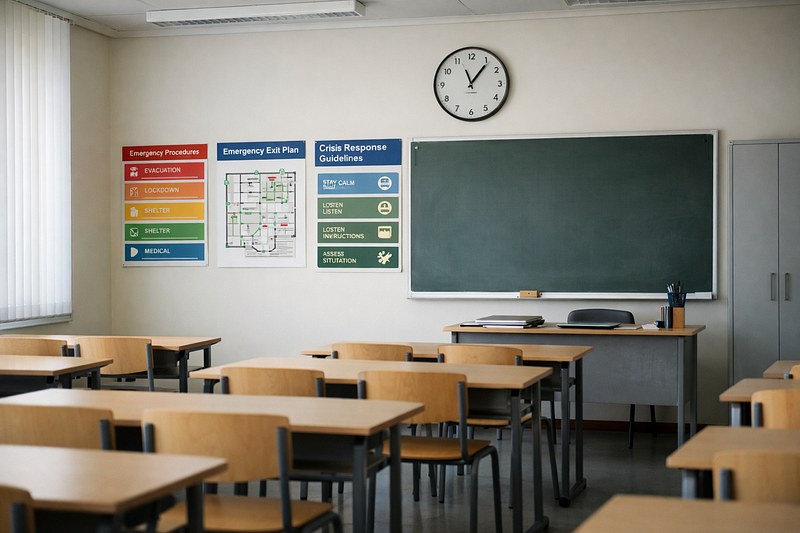
The classroom is quiet in a way that feels rehearsed.
Not the quiet of attention, but the quiet of procedure.
Posters line the walls. Emergency flows. Communication ladders. Color-coded responses to unnamed events. The paper is thick, laminated, designed to last longer than the lesson itself. The teacher does not raise her voice. She does not need to.
This is not a military class.
That is stated clearly.
It is about resilience.
About preparedness.
About civic responsibility.
The students are sixteen.
No one mentions war.
Yet nothing in the room assumes peace.
The Language That Makes Action Possible
Across Europe, something old is returning without being announced.
Not conscription.
Not mobilization.
Not the draft.
Those words carry weight. History. Resistance. Blood. They require explanation, debate, memory. They invite refusal.
What replaces them is lighter. Administrative. Responsible.
Maatschappelijke service.
Civil protection.
Resilience training.
Hybrid threat awareness.
Whole-of-society preparedness.
The effect does not change.
Only the friction disappears.
When a system stops naming what it prepares for, preparation becomes frictionless.
No Decision, Only Movement
There was no vote.
No emergency session marking a break with the past.
No public moment in which Europe acknowledged it had crossed a threshold.
The shift arrived through documents. Through pilot programs. Through language embedded in policy papers that few citizens read and even fewer contest.
Education ministries coordinate with defense departments.
Civil protection agencies redesign curricula.
Resilience task forces issue guidelines that sound optional but feel inevitable.
Each step is reasonable.
Each step is reversible.
Each step denies responsibility.
Together, they are not reversible at all.
No one is asked.
Why the Young Come First
The focus is deliberate.
Not the old, who remember.
Not the elected, who might hesitate.
Not the policymakers, who already live inside abstraction.
The focus is youth.
Students. Teenagers. Young adults still inside systems that shape behavior long before they teach choice.
They are told this is about skills. Cooperation. Mental strength. Employability.
They are not told that every system preparing for conflict begins with those least able to refuse it.
“They call it readiness. But readiness for what?”
A Necessary Preparation?
Here the analysis becomes less comfortable.
Because it is possible, even reasonable, to argue that preparation is prudent. That in a world of cascading crises, training civilians to respond is not militarization but care. That ignoring risk is itself irresponsible.
I cannot fully dismiss that argument.
And that is precisely the problem.
The most effective systems of control are those that do not require bad intentions to function.
War Without Declaration
Officially, Europe is not at war.
Structurally, it behaves as if war is no longer an exception.
Budgets migrate steadily from welfare to defense.
Factories reopen for ammunition production.
Infrastructure is mapped for civilian and military dual use.
Media adopts crisis language without crisis declaration.
Now the population is trained.
Not to fight.
To respond.
To adapt.
To function under pressure.
To accept disruption as normal without asking who produced it.
A society does not need to declare war if it can normalize readiness.
Voluntary, Then Expected
Every program begins as voluntary.
Participation is encouraged. Certificates are offered. Credits accumulate. Résumés improve.
Refusal carries no punishment.
At first.
But absence becomes visible.
Non-participation becomes a mark.
Marks become questions.
Why didn’t you join?
Why aren’t you trained?
Why are you unprepared?
At some point, refusal stops looking like choice and starts looking like irresponsibility.
Obedience is most effective when it feels like self-improvement.
The Silence That Matters
What defines this shift is not propaganda.
It is omission.
There is no serious public discussion about alternatives.
No sustained debate about de-escalation.
No space for asking whether preparation itself accelerates the outcome it claims to prevent.
The assumption is complete.
Conflict is coming.
Adaptation is required.
Consent is inefficient.
This is not taught as ideology.
It is embedded as environment.
“They are not instructed what to believe. They are trained how to behave.”
Democracy, Intact in Form
Elections still take place.
Parliaments still debate.
Speech remains formally free.
Yet the most consequential transformation of the decade is proceeding without collective deliberation.
Not because democracy collapsed.
Because democracy was bypassed by coordination.
Preparedness does not require permission.
Only alignment.
A Familiar Pattern
History rarely returns with speeches.
It returns through administration.
Every major conflict of the last century was preceded by civilian conditioning. Training. Messaging. Normalization. Always framed as responsibility. Never introduced as war.
The structure does not change.
Only the vocabulary does.
The Students Leave
The lesson ends.
The students gather their materials. Infographics folded. Checklists memorized. Seriousness acquired without clarity.
They cannot oppose what was never stated.
They cannot refuse what was framed as care.
They are prepared for something they are not allowed to name.
“A population trained without being asked has already been partially conscripted.”
Closing Reflection
Europe insists it is not preparing for war.
Nothing in the language suggests urgency.
Nothing in the procedures requires agreement.
There are no announcements.
No votes.
No moment that can be pointed to later.
Only classrooms that grow quieter.
Only preparations that no longer need to explain themselves.
Remember always where it truly began, and who set it in motion.
By the time it has a name,
it no longer needs consent.
Related from The Manifest Archive