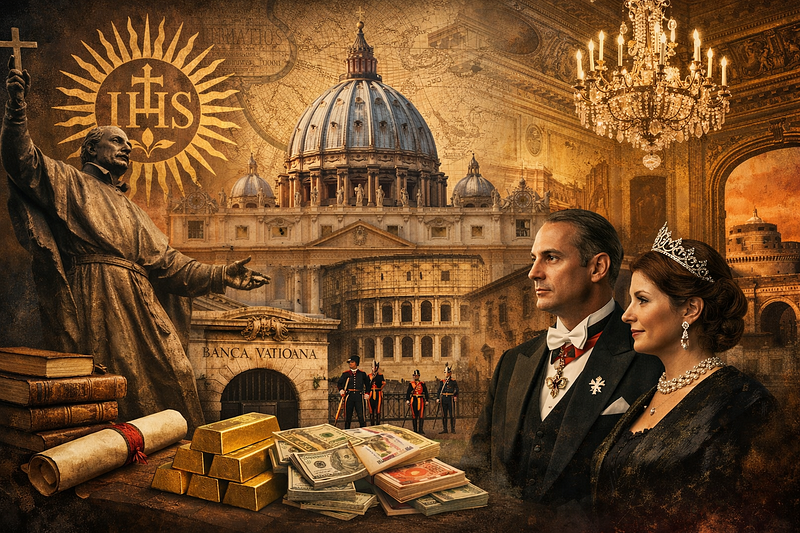
The order received its death sentence in a single paragraph of Latin. On a July day in 1773, a papal brief signed by Clement XIV dissolved the Society of Jesus across the entire Catholic world. At that moment the Jesuits ran the largest education network on earth: somewhere near eight hundred colleges and seminaries, well over a thousand houses and residences once you counted them all, staffed by roughly twenty-two thousand men on every inhabited continent. By decree, all of it ceased to exist. Property was seized. Schools were handed to other orders or to the state. The most powerful teaching institution in Europe was abolished with a stroke of a pen.
And it did not work.
Forty-one years later the order was restored, intact in its method, recognizable in its discipline, and within a few generations larger than it had ever been. The interesting question is not how the Jesuits were suppressed. Powers are suppressed all the time. The interesting question is why the suppression failed. The answer is the subject of this chapter, and it is not the answer most people reach for.
Most accounts of Jesuit power look for it in the obvious places. They look for money, and find the Vatican Bank. They look for bloodlines, and find the Roman aristocracy. They look for a hidden hand, and invent one. All of this misses the actual mechanism, which was stranger and more durable than any treasury or any dynasty. The Jesuits' instrument of influence was a syllabus. The determining variable was not what they owned or whom they knew. It was how they formed minds, and the fact that they had standardized that formation into something that could be copied anywhere and could not be confiscated anywhere.
This is the difference between a power built on assets and a power built on method. You can seize an asset. You cannot seize a method that already lives inside thousands of trained heads.
What the Order Actually Manufactured
In 1599, after more than a decade of drafts and field reports, the Society of Jesus issued a document with a dry administrative title: the Ratio atque Institutio Studiorum, the Method and System of the Studies of the Society of Jesus. Historians of education call it the only comprehensive, official, and universal plan for Jesuit education ever issued. That phrase deserves to be read slowly. Not a regional guideline. Not a recommendation. A single curriculum, binding on every Jesuit college from Lisbon to Lima to the edge of the Mughal empire, specifying what was taught, in what order, by what method, and to what end.
This was a genuinely radical act, and its radicalism is easy to miss because schooling now feels standardized by default. In the sixteenth century it was not. Education was local, idiosyncratic, tied to a particular master and a particular town. The Jesuits did something closer to what a modern corporation does when it writes an operations manual. They studied what worked across their scattered colleges, convened schoolmen of different nationalities in Rome to compare notes, and then issued one uniform system that any new college could implement and any trained Jesuit could deliver. A boy entering a Jesuit school in one country would move through the same sequence of grammar, rhetoric, philosophy, and disputation as a boy five thousand miles away.
The effect of this is subtle and enormous. When you standardize the formation of minds, you stop needing to command the people those minds eventually become. You have already shaped the categories through which they will think. You decided, years before they entered any office, what counts as a good argument, what counts as evidence, what a well-formed question looks like, which authorities deserve deference. The school sets the terms of thought before anyone reaches the point of making a decision. By the time a graduate becomes a magistrate or a diplomat or a professor, the most important work has already been done, and it does not look like influence at all. It looks like an educated man simply thinking for himself.
This is the layer that the conspiracy theories cannot see, because it is not hidden. It is structural. Influence becomes most durable at the exact moment it stops appearing as command and starts looking like ordinary intellectual life. A man who has been formed does not feel formed. He feels free. That feeling is the proof that the mechanism worked.
The Jesuits understood something that crude power never grasps. The way to shape a society is not to capture its institutions one by one. It is to form the people who will fill those institutions, and to standardize that formation so completely that it reproduces itself without further instruction. The Ratio Studiorum was not a school rulebook. It was a template for manufacturing a recognizable kind of mind, at scale, across the planet, for two centuries.
Why a School Outlasts a Government
There is a reason the most patient forms of power gravitate toward education, and it has nothing to do with idealism. A government governs for a generation. A school shapes the assumptions of the generations that govern next.
Consider the asymmetry. A treaty can be broken within a year of its signing. A government can fall in an afternoon. A financial structure can collapse in a single panicked week. These are the events that fill the news, and they feel like where power lives. But each of them is downstream of something slower. Behind the magistrate is the education that taught him what justice means. Behind the diplomat is the formation that gave him his sense of what is negotiable. Behind the reformer is the schooling that defined for him what counts as progress. The visible decision is loud and brief. The formation behind it is quiet and long.
The Jesuits built their entire architecture on this asymmetry. Their colleges were never meant only to train priests. From the beginning they taught rhetoric, philosophy, languages, logic, and administration to the sons of the laity, to the future officials and lawyers and scholars of civil society. The Roman College, founded by Ignatius of Loyola in 1551 and known today as the Pontifical Gregorian University, sat at the center of a web that reached across Europe and the Americas. Georgetown, founded in 1789, became the oldest Catholic and Jesuit university in the United States and educated generations of American officials. These institutions did not produce clergymen and stop. They produced a governing class.
And here the mechanism turns recursive, which is what makes it self-sustaining. The students formed by the system did not merely carry its assumptions into the world. The most capable of them returned to teach. The formed became the formers. A curriculum that reproduces not only its content but its teachers no longer needs a central command to keep running. It runs on its own graduates. This is why the Jesuit system could survive the death of any individual, the loss of any single college, the hostility of any single monarch. The thing being transmitted was not stored in one place. It was distributed across everyone the system had ever shaped.
A government writes laws for a generation. A school writes the generation that will write the laws.
This is the longue durée of power, the slow layer beneath the fast events. Wars and elections and scandals occupy the surface. Underneath them, almost invisibly, the formation of each new cohort of decision-makers proceeds on a schedule measured in decades. Whoever controls that formation controls something far more durable than any office, because offices turn over and formations do not. The Jesuits did not need to win the argument in any particular century. They needed only to keep teaching, and to let the graduates carry the rest.
The Experiment No One Designed
History rarely runs a clean experiment. The suppression of the Jesuits is the closest thing the history of institutional power offers to one, because it took a single mechanism and tried to destroy it completely, then waited to see what remained.
The pressure did not come first from Rome. It came from the Catholic monarchies. Portugal expelled the Jesuits in 1759. France followed in 1764. Spain in 1767. These were not theological disputes. They were the actions of absolutist states that had come to see a transnational, disciplined, independently financed order, answerable to a general in Rome rather than to any king, as a rival inside their own borders. The order had become too independent, too mobile, too embedded in the formation of elites the crown wished to control. Under sustained pressure from the Bourbon courts, Clement XIV finally issued the brief Dominus ac Redemptor in 1773 and dissolved the Society everywhere.
Everywhere, that is, that the brief was promulgated. And this is where the experiment reveals its result. In the Russian Empire, Catherine the Great refused to allow the brief to be published. She had recently absorbed territory with functioning Jesuit colleges, and she valued the teachers too much to lose them over a Roman decree. So in Russia, the order did not die. It continued, legally, teaching. A novitiate operated at Polotsk, in what is now Belarus, admitting new candidates through the very years the order was supposed not to exist. Between 1803 and 1805 alone, more than a hundred candidates entered there. Picture the strangeness of it. In a town on the western edge of the Russian Empire, young men were walking through the doors of a Jesuit novitiate to begin their training, taking up a formation whose order had been abolished by the pope three decades earlier and had, in the eyes of most of Catholic Europe, simply ceased to exist. They were joining something that was not supposed to be there. The schoolroom had not been told it was dissolved. In Prussia, Frederick the Great protected the Jesuits as teachers for a time as well, though only briefly. The order survived in the cracks, on the edges of empires whose rulers cared more about good schools than about papal politics.
Think about what this means. The institution was abolished by the highest authority in its own church. Its property was gone, its hierarchy formally dissolved, its name legally erased across most of the world. And yet the thing that mattered, the method, survived, because the method was not a building or a bank account. It was a way of forming minds that already lived inside the men who had been formed. You cannot confiscate that. You cannot read a brief aloud and remove a pedagogy from the heads of the people who carry it. When Pius VII restored the order in 1814 with the bull Sollicitudo omnium ecclesiarum, he was not rebuilding from nothing. He was reactivating something that had never fully stopped, because its essential capital had never been in a form that could be seized.
It would be too neat to credit the survival to portability alone, and the honest version of the argument refuses the shortcut. The order persisted physically in Russia for a reason that had little to do with pedagogy. Catherine declined to publish the brief because she wanted to keep the teachers and the schools she had just inherited, a calculation of statecraft, not of curriculum. The college at Polotsk was itself an asset, a building in a place, and it survived because a sovereign chose to shield it. So two different things were necessary here, and they should not be folded into one. The sovereign's veto is what kept a living instance of the order physically in existence through the suppression. The portable method is what allowed that single sheltered instance to reconstitute the whole order, intact and recognizable, the moment Rome permitted it, and what had let the order replicate across the planet in the first place. Take away the protection and the institution dies in body. Take away the method and it cannot be rebuilt from the survivors. The suppression proves the second claim, not the first, and the distinction is worth keeping sharp.
This is the deepest lesson of the suppression, and it is a lesson about the architecture of survival, not about the Jesuits in particular. A power concentrated in assets can be destroyed by taking the assets. A power distributed as a method survives the destruction of any particular instance, because it is stored everywhere a trained mind exists. The order could be dissolved. The formation could not. That is why it came back.
The Communities That Could Not Travel
The colleges were not the only thing the Jesuits built, and the fate of the other thing they built is the sharpest test of the argument. In the borderlands of South America, beginning around 1610, the order constructed something close to unprecedented: the reductions, mission-communities of the Guaraní people, eventually some thirty settlements spread across what are now Paraguay, Argentina, and Brazil. These were not schools. They were entire towns, organized around the Jesuit method and the Jesuit calendar, with workshops, churches, farms, and at their height a combined population of more than one hundred forty thousand people. By the standards of the age they were astonishing, and they have been romanticized as a utopia and condemned as a paternalistic enclosure ever since, sometimes in the same sentence.
For the present argument, what matters is what happened to them when the suppression came. The reductions did not survive. They could not. They were the part of the Jesuit enterprise that was bound to a place. They were land, buildings, populations, harvests, the accumulated physical infrastructure of a society fixed in geography. All of that could be seized, and all of it was. The communities scattered, the towns emptied, and within a generation the reductions were ruins in the forest, which is what they remain.
Set this beside the survival of the colleges and the contrast is almost diagrammatic. The same order, in the same decades, under the same suppression, lost the part of itself that was an asset and kept the part of itself that was a method. The reductions were rooted, embodied, located, and so they died when the location was taken. The curriculum was portable, distributed, carried in trained minds, and so it lived because there was nothing to take. The Jesuits did not theorize this distinction. They experienced both outcomes at once, and history recorded the result. What was held as property was lost as property. What was held as formation could not be lost at all.
This is the thesis stated by negative example. Every account that reaches for the Jesuits' wealth, their lands, their settlements, is reaching for the part of them that proved fragile. The durable part was never the part you could photograph. The ruins in the forest are visible to this day. The formation that outlasted them left no ruins, because it was never the kind of thing that could fall.
The Method Turned Outward
The same instrument that formed elites at home made the Jesuits unusually effective abroad, and for the same reason. Their training was, at bottom, a discipline of entering other minds. Learn the categories of the person in front of you, master the language in which those categories live, and only then teach. Applied to a classroom, this produced the Ratio Studiorum. Applied to a foreign court, it produced a distinctive kind of diplomacy.
Matteo Ricci entered China in the 1580s and did not arrive as a conqueror of souls. He learned Chinese, studied the Confucian classics, dressed first as a Buddhist monk and later as a Confucian scholar, and presented Western mathematics and astronomy as gifts worth the attention of the educated. Roberto de Nobili did something parallel in southern India from 1606, living as a sannyasi, learning Tamil and Sanskrit, translating Christian ideas into the conceptual world of those he hoped to reach. This approach, called accommodation, was not improvised. It flowed directly from the order's understanding that you reach a mind by first inhabiting its framework.
This made the Jesuits valuable to the wider diplomatic apparatus of the Holy See in a way that ordinary envoys could not match. They went where formal diplomacy could not reach, learned what embassies could not learn, and built relationships that treaties could not produce. They mapped territories, recorded customs, studied the heavens. Jesuit astronomers were so prominent that more than thirty craters on the Moon now carry their names, and Christopher Clavius stood at the center of the reform that produced the Gregorian calendar in 1582. None of this made the order an intelligence service in the modern sense. But it made it a knowledge network of extraordinary reach, and knowledge, gathered patiently and interpreted well, is its own form of quiet power.
The point worth holding is that the missions abroad and the colleges at home were not two different enterprises. They were the same method pointed in two directions. Both rested on the conviction that the way to lasting influence runs through formation, through the patient shaping of how people understand the world, rather than through the seizure of what they happen to own.
What the Conspiracy Theories Get Wrong
No subject attracts invented architecture like the Jesuits. The Superior General is nicknamed the Black Pope, a phrase that comes from nothing more than the color of the cassock, yet a whole literature treats him as the hidden ruler of the world, the secret hand behind banks, governments, assassinations, and wars. It is worth saying clearly that this literature is folklore, not history. Scholarship on the office is explicit that the Superior General's authority is administrative and spiritual, confined to the internal governance of the order. There is no documentary basis for the claim that the Jesuits control global finance or direct the affairs of states from the shadows.
It is tempting to treat the secret-cabal story as the bold version of the truth, the version that takes Jesuit power seriously while polite history looks away. It is in fact the opposite. The cabal story is the comfortable version, because a hidden hand is something you can imagine exposing, fighting, defeating. Name the conspirators, break the cabal, and the spell is lifted. The real mechanism offers no such satisfaction. There is no room to raid, no ledger to seize, no roster of secret masters to publish. There is only a curriculum, taught openly, for centuries, that shaped how a recognizable kind of educated person thinks. You cannot expose a syllabus. It was never hidden. And you cannot defeat it by revelation, because revealing it changes nothing about its operation.
This is also where the Vatican Bank belongs in the story, which is to say, mostly outside it. The Institute for the Works of Religion is a Vatican institution, and the scandals that surround it, the collapse of Banco Ambrosiano in 1982, the death of Roberto Calvi beneath a London bridge, belong to the history of Vatican finance and its opacity. They are not Jesuit operations, and folding them into a story about Jesuit power is precisely the error that the cabal framing encourages. It conflates the Church's money with the order's influence, when the entire point about the order is that its capital was never primarily monetary. The Jesuits' resource was human. It was formation. Confusing the two does not make the analysis bolder. It makes it wrong, and it obscures the genuinely interesting thing, which is that an institution can accumulate immense durable influence with no secret treasury at all.
The honest objection runs the other way, and it deserves its strongest form. A skeptic could grant everything above and still deny that there is any mechanism here at all. Every school shapes minds, the objection goes, because that is what schools do. Aristocratic and ambitious families sent their sons to Jesuit colleges for the same reason families chase elite schooling now, because those colleges were simply the best available, rigorous and well connected. The later prominence of their graduates would then reflect nothing more than the ordinary fact that capable, well-placed young men, given a good education, tend to end up in positions of authority. On this reading the Jesuits did not engineer anything. They ran good schools, and good schools attract people already headed for prominence. To call that a mechanism of power is to mistake a correlation for an architecture.
The objection has real force, and the argument here does not defeat it so much as narrow it. The claim is not that Jesuit formation manufactured elites who would otherwise have been nobodies. It is that a standardized formation, delivered in nearly identical form across countries and centuries, propagated a recognizable and consistent cast of mind among the people who did reach authority, and that this consistency is precisely what ordinary good schooling does not produce. A hundred excellent but independent schools shape minds in a hundred different directions. One deliberately unified curriculum, exported worldwide and held stable for two centuries, shapes them in the same direction, and does so reproducibly enough to survive the destruction of the institution that wrote it. The reductions and the colleges drew on the same world; only one of the two left a transmissible method behind. That is the line between a good school and a mechanism. It is narrow. It is also real.
The architecture is real. The hidden hand is not. Holding both of those at once is the whole discipline.
The Order and the Bloodline
Rome contains two different machines for carrying power across time, and the Jesuits are only one of them. The other is the Roman aristocracy, the families historically aligned with papal authority that are sometimes called the Black Nobility. Setting the two side by side is the clearest way to see what is distinctive about each, because they solve the same problem by opposite means.
The aristocratic families reproduce influence through inheritance. Power passes down a bloodline, secured by marriage, patronage, property, and proximity to the papal center. The mechanism is biological and dynastic. It requires descendants. Its continuity is the continuity of a name carried forward through generations of the same blood, and its vulnerability is the vulnerability of any dynasty: it depends on the family surviving, marrying well, and keeping its position. The families endure because they are embedded, anchored, rooted in a specific city and a specific set of inherited relationships.
The order reproduces influence through formation. Power passes not down a bloodline but through a curriculum, from teacher to student, regardless of who the student's parents were. The mechanism is pedagogical, not biological. It requires no descendants, only new students, and there is an inexhaustible supply of those. This is why the two structures are complementary rather than redundant. The families provide permanence and embeddedness, the deep rootedness of inherited legitimacy. The order provides mobility and reach, the capacity to form minds anywhere, in any country, across any political boundary. One anchors the center through blood. The other extends outward through method.
The difference in vulnerability is the difference that matters. A bloodline can be ended. A family can fail to produce an heir, can marry badly, can be stripped of its property and dispersed. But a method has no bloodline to end. As long as anyone remembers how to teach it, it can be transmitted to a stranger. The dynastic families needed their children. The order needed only its students. That is why, when the absolutist states moved against the order in the eighteenth century, they could expel it and seize its colleges but could not actually destroy it, while a noble family that lost its position and its heirs would simply have ceased to exist. Blood is fragile in a way that method is not. The families bet on descendants. The order bet on formation. The order's bet was the safer one.
The Method That Became Invisible
There is a final reason the mechanism is hard to see, and it is the most interesting one. The Jesuit way of organizing education did not merely survive. It won so completely that it vanished into the ordinary.
Consider what a school looks like. Students are divided into graded classes by level of advancement. They move through a structured, sequential curriculum, each stage building on the last. A trained teacher delivers a planned lesson and then tests whether it was absorbed. This arrangement feels eternal, the natural shape of education itself. It is not. It was, to a significant degree, systematized by the Jesuits, who took the ordered approach of the University of Paris, the modus parisiensis, and built it into a replicable institutional model that the Ratio Studiorum then standardized and exported across the world. Historians of education credit the Jesuit colleges with doing more than almost any other institution to establish the graded, sequential, teacher-led classroom as the default form of Western schooling.
Notice what this does to the question of influence. The deepest form of formation is not to shape what people think. It is to shape the structure within which they think it, so thoroughly that the structure stops being noticeable and starts feeling like nature. A modern secular student, in a modern secular school, sitting in a graded class and moving through a sequential syllabus delivered by a trained teacher, is moving through an architecture the Jesuits did as much as anyone to standardize. The content has changed beyond recognition. The form persists. And because the form is invisible, no one experiences it as influence at all.
This is the endpoint of the logic that began with the Ratio Studiorum. A method that is merely adopted can be abandoned. A method that becomes the unexamined default has achieved something stronger than loyalty. It has achieved invisibility, and invisible structures are the hardest of all to dislodge, because no one can argue against a thing they cannot see. The Jesuits' curriculum stopped being theirs precisely by succeeding. It became everyone's, which is to say it became no one's, which is to say it became simply the way things are done.
The loudest powers shape what a society believes. The quietest shape the form in which it believes anything at all.
Formation in the Present
The Society of Jesus today is, by the measure of its own membership, a shrunken thing. At its peak around 1965 it numbered roughly thirty-six thousand members. Today it is closer to fourteen thousand, a decline of well over half in two generations. If membership were the measure of the mechanism, this would be a story of decline.
But membership was never the mechanism. The reach of the formation system has not contracted in proportion to the order's numbers, because the system was built precisely so that it would not depend on them. Jesuit higher education today spans something on the order of a hundred and thirty institutions across more than thirty countries. In the United States alone there are twenty-seven to twenty-eight Jesuit colleges and universities and more than sixty Jesuit high schools. Worldwide, the network of schools at all levels runs into the thousands and educates millions of students who will never enter the order and most of whom will never become Catholic. The formation continues, delivered now largely by laypeople, reaching far beyond the dwindling roster of professed Jesuits. In 2013 the order gained its first pope, Francis, the first Jesuit ever elected to the office, which gave the Society a global visibility its numbers alone could never have produced.
There is a real question buried here, and honesty requires naming it rather than smoothing it over. Does the mechanism still operate the way it once did? The Ratio Studiorum produced a distinctive kind of mind precisely because it was distinctive, a particular formation that set its graduates apart. A Jesuit university today operates inside a globalized higher-education system whose assumptions, methods, and credentials are largely shared across thousands of secular institutions. To the degree that Jesuit formation has been absorbed into generic higher education, it no longer reproduces a distinctive way of thinking, and the mechanism that made it a vehicle of durable influence weakens accordingly. This is the condition under which the analysis in this chapter would stop applying. If the formation is no longer distinctive, then it is no longer formation in the sense that mattered. It is simply schooling, and schooling that resembles everyone else's confers no particular continuity on anyone.
That boundary is worth stating plainly, because it is what separates an argument from a belief. The claim is not that the Jesuits secretly run the world, now or ever. The claim is narrower and more defensible: that for roughly two centuries, a standardized system of elite formation functioned as one of the most durable mechanisms of influence ever built, and that its durability came from being a method rather than an asset. Whether that mechanism still operates at full strength in an age of homogenized global education is genuinely open. The history is settled. The present is a question.
What Survives a Decree
Return to the brief of 1773, and to the thing it could not accomplish. A pope dissolved the order. Monarchs seized its colleges. Its name was erased across most of the Catholic world. By every visible measure, the most powerful teaching institution in Europe had been destroyed. And four decades later it stood again, because the destruction had reached only the visible measures, and the actual mechanism had never been visible at all.
This is the portable lesson, the one that travels far beyond the Jesuits or the Church. An institution that standardizes a method outlives an institution that accumulates assets, because a method, once distributed across trained minds, cannot be confiscated. It is the logic that lets an open body of knowledge survive the firms that hold it, a military doctrine survive the defeat of the army that wrote it, a discipline survive the closing of any particular department. Whatever can be seized will eventually be seized. What cannot be seized is what endures. The Jesuits grasped this four hundred years before the language of networks and distributed systems existed to describe it, and they built the longest-running proof of it that the modern world contains.
The crude powers of history tried to rule by holding things: territory, treasure, the levers of the state. They held them for a while and then lost them, as holders always do. The Society of Jesus did something different and quieter. It did not seize the institutions that hold power. It formed the people who fill them, and it wrote down how to do that so exactly that the formation could continue without it.
The most enduring systems do not conquer the world once. They teach the world how to reproduce them.
Evidence Map
Facts, interpretations, forecasts, and disconfirming signals.
Core claim. Jesuit influence survived the order's total suppression because it rested on a method rather than on assets. The standardized curriculum of the Ratio Studiorum was a transferable system for forming minds that could be copied anywhere and confiscated nowhere, unlike money, property, or bloodline.
Evidence level. Facts: high. Documented: the suppression of the Society of Jesus by Clement XIV in 1773, when it ran on the order of eight hundred colleges and roughly twenty-two thousand members; the seizure of its property; the restoration of the order in 1814; the Ratio atque Institutio Studiorum of 1599 as a single universal teaching plan. Interpretation: low to medium. The reading of method-over-assets as the determining variable is an analytical conclusion drawn from the documented survival.
What would confirm this. Evidence that the order's rapid recovery after 1814 rested on its preserved educational method and trained personnel rather than on restored wealth; the persistence of the Ratio's structure in later Jesuit education.
What would disprove this. Evidence that Jesuit influence after restoration depended primarily on recovered assets, finance, or aristocratic patronage rather than on its method, which would undercut the asset-versus-method distinction.
Watchlist. Whether the method-over-assets pattern generalizes to other institutions that survived confiscation, or is specific to education.