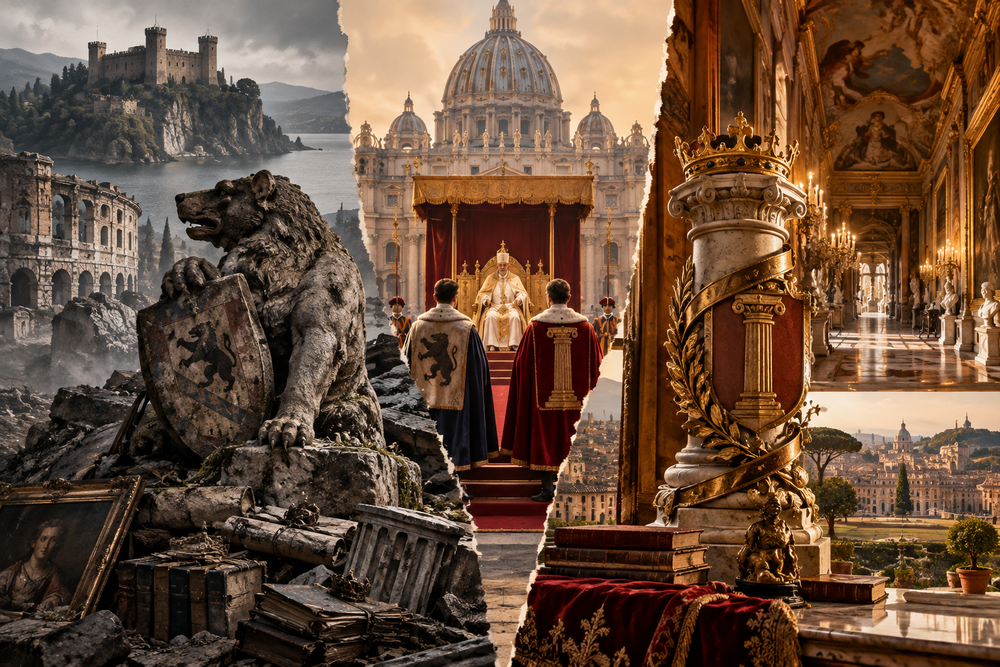
Rome does not give up its power in public.
It hides it in stone, in names, in coats of arms set above gates so old they have become part of the street. Walk far enough behind the ceremonial city, past the palazzi the tour groups never reach, and a different Rome begins to surface. Not the Rome of postcards. Not even the Rome of emperors. A quieter Rome. A city of surnames.
Colonna. Orsini. Chigi. Borghese. Massimo.
In most capitals such names feel like history. In Rome they feel like an address still in use.
This is a story about how an institution can lose its state and keep its hierarchy, and about the families who were the means by which that happened. It is not the story the term Black Nobility usually attracts, the one about a secret aristocracy that rules the world from behind the curtain. That version is a fantasy, and the documented reality is smaller, stranger, and far more instructive. It is about what actually survives when a power loses everything the map can show, and who carries it through.
In this chapter: the circle, not the throne · the houses that made the popes · the word Rome gave the world · the family that bought its way in · the office that was abolished · what remains today. New to the subject? Start with What Is the Black Nobility? For the family-by-family reference: The Black Nobility Explained.
The doors closed in mourning
The name is precise, and the precision is the first clue.
On the 20th of September, 1870, the army of the new Kingdom of Italy breached the walls of Rome and ended the Papal States, and within weeks the Quirinal Palace, until then a papal residence, was taken for the king. Pope Pius IX withdrew behind the walls of the Vatican and declared himself a prisoner there, a posture every pope would maintain for the next fifty-nine years rather than appear to bless the secular state that had stripped him of his kingdom.
The Roman aristocracy split. Some families made their peace with the new Italy and took their place at the king's court. Others did not. The families that stayed loyal to the deposed pope kept the great front doors of their palaces shut, in mourning for the temporal power that had fallen and in refusal to normalize what had replaced it. From those closed doors came the name. Nobiltà nera. The Black Nobility. Black for mourning, black for refusal.
The label was new in 1870. The thing it described was very old. These were not parvenu loyalists; they were the families who had stood beside the papacy for centuries, who had governed the Papal States, staffed the Holy See, married into and out of the Curia, and produced, again and again, the popes themselves. The mourning of 1870 simply revealed, in a single gesture, a class that had been bound to the institution for six hundred years.
The circle, not the throne
Here is the determining variable, and it is worth stating with care, because this is exactly the subject where careless statement turns insight into nonsense.
When people look for the power of Rome, they look at the throne: the pope, the office, the visible sovereign. The more durable thing was never the throne. It was the circle around it. A pope reigns for a decade or two and dies. The office can lose its army, its territory, its place on the map, as it did in 1870. What carried the institution across that loss was not the office but the surrounding social world that held its memory, its rank, its law, and its personnel intact while the territorial shell fell away.
The claim is not that these families secretly governed, then or now. It is narrower and harder to dismiss: that an institution which loses everything visible can survive through a class positioned close enough to carry it, and that the papacy is the clearest case in European history of exactly that. The state fell. The circle remained. And because the circle remained, the institution had somewhere to live during the decades when, on paper, it had been reduced to a few acres and a grievance.
That is the mechanism, and it has nothing to do with conspiracy. It is the oldest survival strategy there is: when you cannot hold the ground, hold the people who remember how the ground was held.
The houses that made the popes
To see how deep the binding went, follow the families into the office itself, because for centuries the surest route to the top of the Church ran through a Roman name.
The Colonna and the Orsini were the two great poles of medieval and Renaissance Rome, rivals so fixed that the city's politics for generations was essentially the quarrel between them. They were not outsiders pressing on the Church from below. They were inside it. The Colonna produced Pope Martin V in 1417, whose election ended the great schism and whose pontificate poured wealth and land back into his family. The Orsini produced popes of their own and held, for generations, hereditary standing at the papal court.
The pattern repeated with a regularity that stops looking like coincidence. The Farnese had built a strong position in Roman nobility before Alessandro Farnese became Pope Paul III in 1534, and once he held the office he used it to lift the family further still. The Borghese rose with the election of Camillo Borghese as Paul V. The Chigi, who had climbed through banking and papal finance as much as through blood, produced Alexander VII. House after house followed the same arc: accumulate standing in Rome, place a son on the throne of Peter, and use the pontificate to enrich and entrench the family that had supplied him.
In Rome it was the house that made the pope, and the pope that made that house. The office and the family fed each other across the generations, each renewing the other, until it became impossible to say where the institution ended and the dynasty began. This is what people are reaching for, clumsily, when they say the families controlled the Church. The truth is more interesting than control. The families and the Church were not two separate powers, one steering the other from outside. For long stretches the distinction between a family's interest and the institution's became almost impossible to draw. They fought constantly, the houses against each other, the popes against the houses, the Curia against them all, and yet the fighting itself unfolded inside a single braided world, one in which family and Church had grown into each other past the point where the two could be cleanly pulled apart.
The word Rome gave the world
There is a single word that proves how deep the fusion ran, and you use it without thinking about where it came from.
The word is nepotism, and it is Roman to its root. It descends from the Latin nepos, nephew, and it was coined in the seventeenth century to name a specific papal habit: the elevation of a pope's relatives, above all his nephews, to power within the Church. The habit had a formal shape. For nearly four centuries, from the Avignon papacy onward, almost every pope appointed a cardinal-nephew, a young male relative raised to the cardinalate and handed the real executive running of the papacy, its diplomacy, its finances, its appointments. Contemporaries had a name for this figure, the cardinale padrone, the cardinal-master, a role historians have since likened to a prime minister, even to a "vice-pope." A pope who did not have a cardinal-nephew was the rare exception. The office was not corruption sneaking in at the edges. It was the standard operating system, the mechanism by which a pope, who could not pass his throne to a son, bound the institution to his bloodline for as long as he could.
And then, in 1692, the institution abolished it. Pope Innocent XII issued a bull whose title was itself a rebuke, Romanum decet Pontificem, "it befits the Roman Pontiff," the point being that what had become ordinary did not befit the office at all. The document banned the cardinal-nephew outright, limited any pope to elevating a single relative to the cardinalate, and capped what a papal nephew could receive at a fixed sum. The most entrenched family mechanism in the Church, four centuries deep, was ended from the inside, in writing, by the institution's own hand.
Hold onto that, because it will happen again. The papacy is not, and has never been, a fortress of permanent family power. It is something stranger: an institution that repeatedly fused itself to families and then, when the fusion threatened the institution itself, cut the formal tie and survived the cut. The families were the means of continuity. They were never permitted, in the end, to become the master of it.
Proximity was the currency
Old Rome did not run on the instruments a modern citizen looks for. It had no ministries answerable to a parliament, no constitution, no electorate. It ran on proximity, and proximity was a thing you could hold, inherit, and lose.
The clearest token of it was an actual office, and the office is worth knowing because it makes the whole abstract argument concrete. The Prince Assistant to the Papal Throne was a real position in the papal court, held, by hereditary right, by the heads of exactly two families: the Orsini and the Colonna. From the sixteenth century onward, when the pope appeared in full ceremony, these two Roman princes stood beside the throne, the living proof that certain families did not merely serve the institution but were woven into its very staging. Proximity was not a metaphor in that room. It was a place you stood, marked out for your bloodline, next to the most sacred chair in the Catholic world.
Around that visible apex spread a much wider papal nobility, families who supplied officeholders, lawyers, diplomats, and administrators to the Holy See, generation after generation. The Pacelli were one such family, bound to the papacy through generations of legal and administrative service, and in 1939 they gave the Church a pope of their own when Eugenio Pacelli became Pius XII. They were not an ancient warrior dynasty like the Orsini. They were something the modern reader recognizes more easily: a family of high functionaries who had made service to the institution their hereditary profession, and who rose through it accordingly.
This is the texture the conspiracy version misses entirely. The power was not a hidden hand issuing commands. It was a thousand quiet positions of nearness, held across centuries, that placed certain families permanently within reach of the institution that outlived every regime around it.
The family that bought its way in
The circle was not sealed by blood, and the proof is the family that walked in through the counting house.
The Torlonia were not an ancient warrior dynasty. They began as French cloth merchants who Italianized their name on settling in Rome, and they rose, within two generations, to be spoken of as a byword for limitless wealth. The route they took is the one the conspiracy story cannot accommodate, because it was completely open: they made themselves indispensable to the Vatican's money. Giovanni Torlonia built his father's lending business into a private bank and administered the papal finances through the chaos of the Napoleonic wars, rescuing a treasury that war had emptied. His son Alessandro became one of the most important financial partners the Holy See had, the man who restructured its debts and arranged its loans, at times in partnership with the Rothschilds, including a loan of four hundred thousand pounds arranged in the early 1830s to keep the papacy solvent.
The papacy paid in the only currency that mattered in Rome. It made them nobles. In return for managing the Vatican's finances, the Torlonia were created dukes, marquesses, and princes by a succession of popes across a few short decades, lifted from the merchant class into the highest Roman aristocracy by the institution they served. And the arc closes exactly where this story is heading: a Torlonia would be one of the last two men ever to hold the hereditary office of Prince Assistant to the Papal Throne, the title that placed him beside the pope in ceremony, before that office lost its hereditary status in 1968.
This is what a structure looks like, as opposed to a cabal. A cabal is closed; you are born into it or you are out. The Roman circle was a structure, and a structure has a door. Serve the institution's deepest needs, its continuity, its diplomacy, its solvency, and the institution would draw you in and ennoble you, whatever you had been before. The families were not a bloodline that owned the Church. They were the changing set of houses that, in each era, made themselves necessary to it.
What the continuity was made of
Continuity is an abstraction until you can name what it was built from, and in Rome it was built from four concrete things you can still follow in the records: office, land, marriage, and the law that locked all three in place.
Office came first, because it was the most direct. The papal Curia was, for long stretches, partly a market. The popes raised a substantial share of their revenue by selling offices, the vacabili, lifetime positions in the Chancery and the financial apparatus that an investor bought outright and held for an annual return. To purchase such an office was to acquire a stipend, a standing, and a place inside the machine of the Holy See all at once. Families and their clients held these positions across generations, and the German historian Wolfgang Reinhard, one of the leading scholars of the papacy's patronage networks, who reconstructed the papal administration of the sixteenth and seventeenth centuries house by house, argued that the Curia and family strategy were not two systems but one: a pope used office, nepotism, and patronage to build his family, and the family in turn supplied the personnel that ran the Church.
None of this was hidden at the time. The Venetian ambassadors to the papal court, whose dispatches back to their Republic remain among the sharpest eyewitness records of how Rome actually worked, reported the machinery of papal favour in plain detail, cataloguing how each new pope settled offices, revenues, and titles on his own house. The nineteenth-century historian Leopold von Ranke would later build much of his history of the popes on exactly these reports. The nepotism was never a secret waiting to be exposed. It was observed, recorded, and filed by the working diplomats of the day as simply the way the institution ran.
Land was the second thing, and the route to it ran straight through the papacy. A house that placed a son on the throne harvested estates. When Oddone Colonna became Martin V in 1417, his family gathered fiefs and enriched its holdings across the papal territory, at Frascati, Paliano, and Genazzano, names that still run through Colonna history. When Camillo Borghese became Paul V in 1605, the Borghese rose from Sienese gentry into one of the great landed houses of Rome within a single generation. The office made the land, and the land outlived the office.
Marriage was the third, and it is where the families stop being a list and become a single fabric. The houses married into one another with strategic care, and the marriages moved property. In 1619 a Borghese married Camilla Orsini, daughter of the Duke of Bracciano; in the next generation a Borghese married Olimpia Aldobrandini, opening the claim to the Aldobrandini inheritance, and a later Borghese marriage folded in the wealth of the Salviati. Title wed title, land wed land, and over generations the separate houses thickened into a dense web of cousins, heirs, and merged inheritances, harder to unpick with every wedding.
And the fourth thing held the other three still. The entail, the fedecommesso, bound a family's estates to pass intact to a single heir, generation after generation, so that land and office could not be sold off or scattered among children. It was a legal machine built to defeat time, to make a fortune permanent. Office, land, and marriage assembled the position; the entail made it inheritable; and inheritance, repeated across centuries, is only another name for the thing this whole essay is about.
The fifty-nine years
The test of any survival mechanism is what it does during the catastrophe, and the papacy's catastrophe lasted fifty-nine years.
From 1870 to 1929, the popes refused to leave the Vatican. They held to the fiction, and the dignity, of imprisonment rather than walk out into a Rome that now belonged to the Italian king. It was not only a posture. Through the policy known as the Non Expedit, the bare Latin formula meaning "it is not expedient," the Holy See declared it inadmissible for Italian Catholics to vote or stand in the national elections of the state that had despoiled it, a stance enforced through the clergy that worked, for decades, as an effective ban, withholding its enormous flock from the political life of the new country as a standing refusal of the whole arrangement. A defeated power that can keep millions of citizens from fully participating in their own state has not been defeated in any simple sense.
And through those decades the institution went on being itself. The Holy See kept sending and receiving ambassadors as though it were still a sovereign, which diplomatically it remained, conducting a foreign policy from a palace that controlled no territory at all. The Curia kept functioning. The Roman families kept their place around it, the unbroken social world in which the papacy was still treated as what it claimed to be. The state was gone from the map, and the institution behaved, for nearly sixty years, as if the map were simply wrong.
It turned out the map was the thing that bent. In 1929 Mussolini's government and the Holy See, negotiating through Cardinal Gasparri, signed the Lateran Treaty, which resolved the long standoff by creating the sovereign state of Vatican City and compensating the Church for what it had lost in 1870. It is one of the quiet ironies of European history that it took a fascist dictator to hand the papacy back a state. But the deeper point is the one the families embody. The Church did not claw its way back to relevance in 1929 after sixty years in the wilderness. It had never left. It had spent the entire interval being preserved, inside its loyal circle, as a fully operating institution that simply lacked a country, until a country could be arranged.
Hold the objection
Stop here, because by now a fair and deflating objection is taking shape, and it deserves its strongest form rather than a quiet burial.
Maybe this is just old aristocracy being old: faded families, decorative titles, ceremony mistaken for mechanism. That objection is half correct, and it gets its fullest hearing at the end of this chapter. Hold it until then, because what happens next in the documented record is the strongest evidence on both sides at once: the institution itself reached in and dissolved the formal apparatus of family power. A thing that can be abolished by a memo was real enough to need abolishing, and weak enough to be ended with a stroke of a pen. The honest version of this story lives in the tension between those two facts.
The office that was abolished
The deflating objection and the serious one meet at a specific date, and the date is the discipline of the whole subject.
First, a smaller scene. In January 1958, by contemporary accounts, the Orsini Prince Assistant, Filippo Orsini, was quietly stripped of the hereditary office his family had held since 1735, after his affair with the English actress Belinda Lee became a public scandal. A bloodline's six-hundred-year nearness to the throne, ended over a tabloid romance. The office was real enough that losing it was a humiliation, and human enough that a love affair could cost it.
Then the larger reckoning. In 1968, carrying out the modernizing spirit of the Second Vatican Council, Pope Paul VI issued the document Pontificalis Domus and reformed the entire papal court out of existence, replacing it with a streamlined Papal Household. Nearly all the old hereditary court titles were suppressed in a single stroke. The Prince Assistant to the Papal Throne ceased to be hereditary. The two men who held it at that moment, a Colonna and a Torlonia, were permitted to keep the title personally until they died, and then it was gone, and it has never returned.
Sit with what that means, because it is the heart of the disciplined reading. The formal machinery by which Roman families were embedded in the Vatican was not overthrown by a revolution or exposed by a leak. It was ended by the institution itself, from the inside, with a document. And it was not the first time. The cardinal-nephew had gone the same way in 1692, abolished by the same kind of papal stroke. Twice across three centuries, the Church reached in and severed the formal tie binding it to its families, and twice it survived the severing without difficulty. That is the opposite of how a secret world-governing cabal behaves. You cannot abolish the people who really run everything by reforming a court. The Church abolished its noble court because the noble court was a survivable thing to lose, a ceremonial inheritance, not a hidden government. The families that mourned in 1870 watched their last formal foothold inside the institution dissolve in 1968, and the world did not change, because the world had never been theirs to command.
And yet. The thing that the 1968 reform abolished was the formal office, not the social fact beneath it. You can suppress a title by decree. You cannot decree away six hundred years of marriages, memory, property, and proximity, the dense web of a class that has lived beside an institution since the Middle Ages. What ended was the visible apparatus. What persisted was the quieter inheritance: the names, the palaces, the family histories braided into the Church's own, the social capital that does not appear in any ledger and cannot be cancelled by any motu proprio.
Not the cabal
This is the point to name the fantasy directly and set it aside, because it has attached itself to this subject like a barnacle and it actively obscures the more interesting truth.
There is a whole literature, from the cruder conspiracy theorists to the pseudo-scholarly registers of supposed secret committees, that takes the Black Nobility to be a hidden directorate steering wars, banks, and governments across the centuries. It is a fantasy, and a lazy one. It survives because it offers the comfort of a hand on the wheel, a someone to blame, a hidden author behind the chaos of events. The documented record offers no such author. It offers something less dramatic and far more unsettling: not a cabal that controls, but a class that endures; not a plan, but a structure; not power exercised, but power preserved.
The economist Friedrich Hayek spent his life on the difference between an order that is consciously designed and one that merely emerges and persists without any designer, and he warned that we constantly mistake the second for the first, seeing intention where there is only structure. The Black Nobility is a textbook case. No one designed the survival of papal Rome through its aristocratic circle. It emerged, family by family, marriage by marriage, office by office, over centuries, because proximity to a durable institution is itself a heritable asset, and assets accumulate. There was never a meeting. There was only a slope, and time.
What remains
So what is actually left, in the present tense, once the fantasy and the formal apparatus are both gone? Less than the conspiracy theorists claim, and more than nothing, and the gap between those two is the whole honest answer.
The names persist. The Colonna, the Orsini, the Massimo, the Borghese, the Odescalchi, the Boncompagni-Ludovisi are still living families, and some still hold the palaces their ancestors built, a few of them now opened for tours and receptions, the marble paying its own upkeep. The Black Nobility survives today mainly as a social category rather than a political one, a set of families with honorary and ceremonial standing in Catholic Rome, occasionally present at papal occasions, carrying a prestige that is real and a power that is not. This is the afterglow of a structure, not the structure itself.
What they keep, more than property, is a sense of time. There is a story long told about the Massimo family, possibly embroidered in the retelling, in which Napoleon asks a Massimo prince whether his house truly descends from the Roman general Fabius Maximus, two thousand years back. The prince is said to have answered that he could not prove it, it was merely a tradition the family had preserved for some twelve hundred years. Whether or not the exchange ever happened, the answer is the point. To belong to one of these houses is to measure your existence against the rise and fall of states, to treat the loss of a kingdom as one event among many in a chronicle your family has been keeping since before the nation around it was born. That sense of time is the last and most intangible inheritance, and it is the one no reform can suppress, because it lives in self-understanding rather than in any office.
It is also, precisely, the measure of how modest their present significance is. The honest reckoning is not that these families run anything. It is that they remember, and that their remembering is the faint final trace of the mechanism by which, long ago, an institution used them to cross a catastrophe.
The slow clock
The reason the pattern is so easy to miss is that it runs on a clock most observers cannot read.
Modern power keeps fast time. It moves on election cycles, news cycles, quarterly results, the four-year and the ninety-day horizons that organize contemporary life. A party can be born and die in a decade. A fortune can evaporate in a season. Against that tempo, a family network assembled over six centuries is almost invisible, because it barely seems to move at all. It does not win news cycles. It does not need to. It keeps generational time, and on the generational clock, surviving is winning.
The historian Fernand Braudel taught that beneath the fast surface of events sits a slow layer that hardly appears to change and yet sets the terms for everything above it. The Roman aristocratic circle is that slow layer for the history of the papacy. While popes reigned and died, while the Papal States rose and fell, while Italy unified and fascism came and went and the Republic was born, the families persisted underneath, not ruling the events but outlasting them, the institutional memory of a power that had learned, better than any other in the West, how to survive its own defeats.
That is the durable lesson, and it reaches well past Rome. A political order announces the death of an old power and believes the announcement. The map is redrawn. The titles are abolished. The court is reformed. And underneath, the class that knew the old institution from the inside persists into the new world, less visible than before, attached now to memory rather than sovereignty, but not gone. Not ruling. Just remaining, which over a long enough horizon is the rarer and the stronger thing.
The strongest case against this reading
The fair-minded skeptic deserves the last and fullest hearing, because the honest counter-case is strong and the discipline of this whole subject depends on conceding it.
It runs like this. The formal power is simply gone, and saying so plainly is more honest than any talk of enduring circles. The Prince Assistant was abolished in 1968. The Papal States ended in 1870. The Vatican today is run by a clerical bureaucracy of cardinals and curial officials drawn from across the entire world, overwhelmingly not from the old Roman houses, and its finances and governance are matters of appointment and office, not bloodline. Many of the famous families are diminished, their palaces sold or opened to ticketed tours, their fortunes spent. To dwell on their former centrality is to write an elegy and dress it as an analysis, to find a mechanism in what is really just the long, slow fading of an aristocracy, the same fading that overtook noble houses everywhere.
Most of that is true, and it must be held without flinching. The formal apparatus is gone. The modern Church is a global clerical institution, not a Roman family business. The present-tense claim that these houses control the Vatican is false, and the title this archive once gave this very piece overstated it.
What survives the objection is narrower and real. It is not a claim about who runs the Vatican today. It is a claim about how the institution crossed the catastrophe of 1870 at all, and the most economical reading of the record is that it crossed, in large part, through the families who refused to let its hierarchy die when its state did. That reading is interpretation, not proof, but it is the interpretation the documented facts most readily support. The enduring lesson is not that the Black Nobility rules. It is that institutions outlive their own destruction by living, for a time, inside a loyal class, and that this is how the most resilient power in European history bought the decades it needed until the Lateran Treaty of 1929 gave it a state again. The families were the bridge. The bridge is documented. What people build on top of it, the secret directorate, the hidden hand, is the part that is not.
What is harder to break than the throne
Return, at the end, to the closed doors of 1870, and to what they were really mourning.
They were not only mourning a lost kingdom. They were performing, without quite knowing it, the oldest Roman competence there is: the knowledge of where power goes when it can no longer be held in the open. It does not simply die when the public is told it has died. It retreats. It narrows. It becomes less territorial and more concentrated, passing from sovereignty into institution, from institution into circle, from circle into memory, each form smaller and harder to see than the last, and each more difficult to destroy.
Power does not survive because it wins every confrontation. It survives because it knows where to retreat: into office, into ritual, into law, into family, into the long memory of a class that has watched empires come for it before. The Roman houses around the papal court did not need to dominate the modern world, and they do not. Their function was quieter and, on the long clock, more enduring. They kept alive the social world in which a defeated institution could remain itself until history turned again.
That is why the Black Nobility still repays attention, once the fantasy is stripped away. Not because a secret aristocracy rules from the shadows, but because the real story is the one the fantasy hides.
Thrones can be taken. Maps can be redrawn. The harder thing to destroy is the circle that remembers where the throne once stood.
Frequently Asked Questions About the Black Nobility Families
Which families are the Black Nobility?
The best-known Black Nobility families are the Colonna, Orsini, Chigi, Borghese, Massimo and Torlonia, among others. The term is not a fixed bloodline but a political category from 1870: the Roman aristocratic families who stayed loyal to the pope after the Kingdom of Italy took Rome. Some, such as the Torlonia, were recent arrivals (eighteenth-century financiers), which is one reason the "ancient unified bloodline" story does not hold.
Are the Orsini and Colonna families still around?
Yes. The Orsini and Colonna are among Rome's oldest houses, with a rivalry stretching back centuries; Sciarra Colonna assaulted Pope Boniface VIII at Anagni in 1303. Both later shared the hereditary office of Prince Assistant to the Papal Throne, instituted in 1511, until the papal court was reformed in 1968.
Did the Black Nobility families control the Vatican?
Not in the way the conspiracy literature claims. There is no documentary evidence of a secret organization running the Church. What the record shows is proximity: families holding hereditary court offices and marrying into influence around the papacy. That is closeness to power, not hidden control of it.
What happened to the Black Nobility after 1870?
They held a public posture of mourning, their palaces draped in black and withdrawn from the royal court, for nearly sixty years, until the Lateran Treaty of 1929 settled the dispute between the pope and Italy. The hereditary papal-court offices that defined their status were largely abolished in the 1968 reform.
Evidence Map
Facts, interpretations, forecasts, and disconfirming signals.
Core claim. The papacy survived the loss of its state in 1870 not through its office but through the surrounding class of Roman aristocratic families, the "Black Nobility," who carried its hierarchy, memory, and personnel across the territorial collapse. This is a documented account of institutional survival through a loyal class, explicitly not a claim that these families secretly control the Vatican or the world today.
Evidence level. Facts (high): the term nobiltà nera for families loyal to Pius IX after 20 September 1870; the pope as self-described "prisoner in the Vatican" 1870 to 1929; the closed mourning doors as the origin of the name; centuries-old families (Colonna, Orsini, Borghese, Chigi, Massimo, and others) that produced popes (Martin V, Paul III, Paul V, Alexander VII) and held hereditary court office; the Prince Assistant to the Papal Throne, held by the Orsini and Colonna; Filippo Orsini stripped of it in 1958; Paul VI's 1968 Pontificalis Domus suppressing the hereditary court offices; the Lateran Treaty of 1929. Interpretation (medium, marked): the "circle, not the throne" reading of how the institution survived; the Braudel/slow-clock framing; the Hayek emergent-not-designed account. Rejected (marked): the conspiracy reading that the Black Nobility is a hidden directorate governing world events, and the present-tense claim that these families "control" the Vatican.
What would confirm this. Historical documentation of Black Nobility families staffing and financing the Holy See across the 1870 to 1929 period; continuity of specific family offices and roles into the twentieth century (the Prince Assistantship, curial and legal dynasties such as the Pacelli).
What would disprove this. Evidence that the papacy's survival after 1870 owed nothing material to its aristocratic circle; that the loyal families were ceremonial only and supplied no functional continuity; or, on the other side, any credible documentation that the families exercise coordinated control over Vatican governance today (which would convert the rejected conspiracy reading into fact and is not found in the record).
Watchlist. Scholarship on Vatican finances and personnel networks; the residual social role of the surviving papal-nobility families; how the modern global Curia continues to displace the old Roman aristocratic layer.