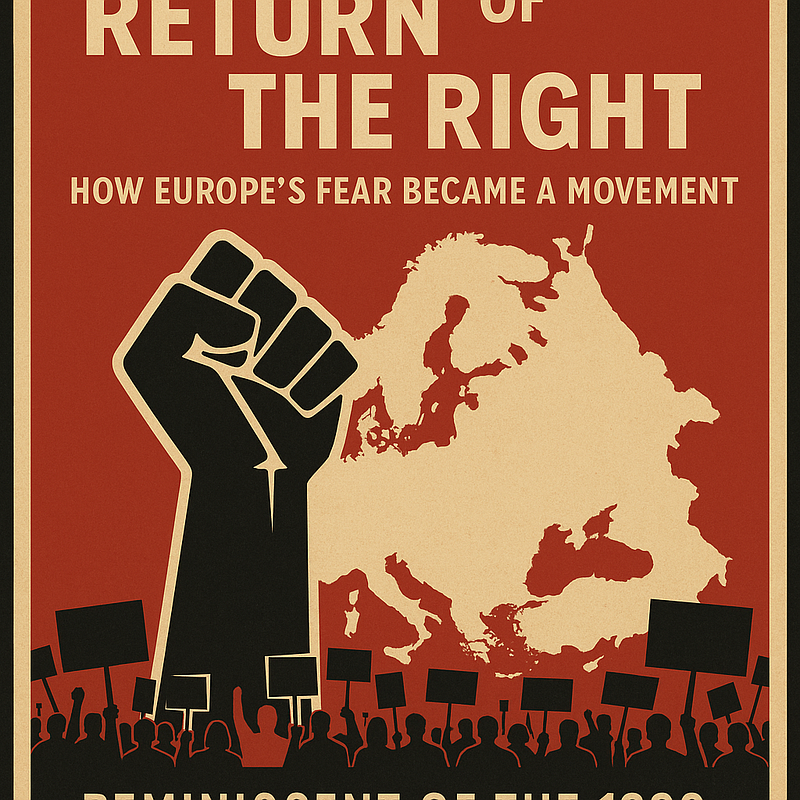
Across the continent, anger once dismissed as fringe has turned mainstream, protests, elections and silence all speaking the same language.
The Unnoticed Return
The tram turns past Schuman in the wet blue of morning. Shoes squeak on stone; a cyclist exhales a small white cloud and disappears.
Something is shifting across Europe.
What looked like noise, a protest here, a ballot there, a road blocked by tired hands, has become a pattern you can feel beneath your feet.
History isn’t back. Its rhythm is.
From Rome to Rotterdam, the map tilts the same way.
Parties once dismissed as fringe are now the furniture of government.
The grand words remain, sovereignty, security, values, transition, but their cadence is older than their spelling.
The tone is managerial. The instinct, defensive.
Beneath the calm, a simpler pulse: the fear of losing control.
Across the capitals, the balance that defined the post-war compact thins quietly.
The right calls itself the people.
The centre calls itself democracy.
The left no longer knows who it speaks for.
What makes this moment extraordinary isn’t the turn itself, it’s the refusal to feel it.
Politicians repeat that the system is stable.
Analysts call every shock an exception.
Commentators label unrest “populism,” as if the word could neutralise the feeling.
Meanwhile, in cafés and supermarkets, in factories and forgotten towns, people describe the same sensation in different languages: they no longer recognise the world they built.
It isn’t extremism that grows in silence.
It’s distance.
The Politics of Blindness
Power no longer argues; it explains.
Every explanation sounds like reassurance, every reassurance like noise.
Citizens are told that moderation is strength, that progress is management, that Europe’s story is stable.
But stories grow brittle when they stop evolving.
The old ideological lines blur into grammar wars, who owns words like freedom, progress, belonging.
The right reclaims nation; the centre insists on values; the left defends hope without conviction.
Language itself has become contested ground.
And yet, few notice the erosion, because erosion feels like routine.
Each press conference, each communique, carries the same undertone:
the adults are in the room; the people should wait.
Democracy becomes most fragile when it sounds most professional.
The Age of Management
A farmer in the Ardennes folds the flag he hung last winter. The fabric still smells of rain and diesel. He scrolls the news on his phone, sees the word “resilience” again, and laughs without sound.
For fifteen years Europe has lived inside the language of crisis, debt, migration, pandemic, war, inflation.
Each emergency produced new slogans: reform, recovery, resilience.
Every word meant the same thing. Wait.
Waiting turned to weariness. Weariness to withdrawal.
When citizens stop believing that participation matters, democracy turns into administration.
The continent’s new right feeds on that fatigue.
It offers belonging instead of vision, certainty instead of complexity.
It promises to restore what modernity erased, work with pride, faith without irony, borders that still mean something.
Its success lies not in deception, but in recognition.
People don’t vote for it because they’re misled.
They vote because they feel unseen.
They call it ideology.
It’s memory dressed as resistance.
When power stops listening, it starts managing.
They don’t ask for blueprints. They ask to be seen, to be spoken to in a grammar they can remember.
Between rulers and ruled stretches a silence filled by algorithms and anger.
Policy arrives as notification; empathy as design.
The new Europe doesn’t debate; it optimises.
And each optimisation leaves another human frequency behind.
A Language the People Understand
The causes are visible to anyone willing to look.
An economy hollowed by outsourcing.
Energy dependence exposed by war.
Demographic decline, technological acceleration, cultural exhaustion.
Yet what most citizens experience is simpler: power now speaks a dialect they no longer understand.
Policy arrives through screens; leadership as notifications.
The distance between rulers and ruled is no longer measured in class or geography, but in bandwidth.
The more governments tighten their grip, the more they reveal how little trust remains.
Europe’s leaders respond with regulation: misinformation laws, surveillance disguised as safety, censorship renamed as care.
They call it protection.
Citizens feel it as suspicion.
And suspicion is the seed of retreat.
When people stop trusting language, they start trusting tone.
And tone, once infected by fear, spreads faster than any policy.
The Return of Fear
The shift is not only political.
It is emotional.
Where optimism once held Europe together, fear now does.
Fear of loss, of strangers, of tomorrow.
And fear, when ignored, always finds a voice.
The night Public Enemy took the stage in 1989, the air itself turned electric.
That same energy hums again across the continent, not in rhythm, but in restlessness.
What began as local protests over fuel, lockdowns or farms has become a continental mood: the sense that democracy no longer negotiates but instructs.
The words are gentler now transition, reform, resilience yet their structure is command.
The sentence always ends with obedience.
History doesn’t return as spectacle. It returns as habit.
In the 1930s, fatigue paved the road to obedience.
Then it was inflation, humiliation, unemployment.
Now it is stagnation, disinformation, and the quiet despair of managed societies.
The danger isn’t the rise of the right.
It’s the loss of recognition.
People don’t see themselves in the institutions that claim to represent them.
They see the reflection of management, efficient, polite, detached.
The Quiet Retreat
Europe’s governments believe they are defending stability.
In truth, they are defending a story that no longer convinces.
Each new election, each protest, each tightening of control makes that fragility visible.
The continent isn’t marching to the right; it’s retreating toward the certainty that fear once promised.
The mood is everywhere and nowhere at once,
in the slogans of new parties,
in the silence of old ones,
in the careful tone of newsrooms,
in the exhaustion that fills every conversation about the future.
Europe has been here before.
It doesn’t recognise the landscape because this time, the danger comes not with boots, but with policies.
It arrives as security, as consensus, as care.
The more Europe tries to control dissent, the more it reveals how fragile its consensus has become.
The Mirror Awaits
Brussels counts the protests.
Rome counts the votes.
Berlin counts the laws.
Yet beneath the numbers moves an older rhythm, the quiet return of a story Europe once believed it had ended.
The next reflection lies not in ideology, but in memory itself how a civilisation can feel the ground shifting beneath its feet and still call it stability.
Europe’s strength was never its wealth, but its remembrance.
And memory, when neglected, becomes nostalgia disguised as certainty.
The Mirror of the 1930s
Europe has seen this landscape before.
Not in the details, but in the rhythm, the slow alignment of fear, fatigue and faith in authority.
The 1930s did not begin with violence.
They began with exhaustion.
People were not angry yet; they were tired.
They had survived one crisis after another, war, inflation, unemployment, and believed that stability was the final stage of progress.
Collapse always disguises itself as normal life.
In the cafés of Weimar Berlin, the conversations were not about ideology but about rent.
In the newspapers of Vienna, the editorials spoke of reform and recovery.
Each decree, each emergency law, was justified by the same word Europe now repeats: stability.
And when that word becomes sacred, politics turns from debate into management.
Patterns in the Dust
Today, the same vocabulary returns.
Resilience. Transition. Green recovery.
Noble phrases concealing fatigue.
Citizens hear promises of renewal, but feel the slow tightening of control.
Governments reassure; markets fluctuate; and somewhere between reassurance and reality, trust evaporates.
Europe’s strength once came from contradiction, debate, dissent, diversity.
Now it comes from procedure.
The theatre remains democratic, but the script has been automated.
Every empire falls the moment it mistakes order for understanding.
The Architecture of Fear
The 1930s were not defined by ideology alone.
They were defined by the technology of their time, radio, film, the mass rally.
Each invention became a conductor of emotion.
The human voice carried further than ever before, and the crowd became a single listener.
Today the medium has changed, not the mechanism.
The algorithm is the new orator.
It listens, calculates, amplifies.
Where loudspeakers once echoed through the squares, timelines now hum in living rooms.
The tone is softer.
The reach, infinite.
Propaganda no longer shouts.
It curates.
It doesn’t persuade.
It personalises.
Then, fear was broadcast. Now, it’s customised.
The old propagandists made citizens feel part of a mission.
The new ones make them feel part of a conversation.
Both achieve the same result, obedience disguised as participation.
Economic Memory
In the early 1930s, Europe lived inside an illusion of inevitability.
The Great Depression was treated as a passing storm, the rise of autocracy as a local malfunction.
By the time leaders recognised the pattern, it had already hardened into structure.
Nearly a century later, the pattern reappears, slower, quieter, digital.
Decades of deindustrialisation hollowed out the towns that once defined the European middle class.
Energy crises revealed the fragility of global supply chains.
Inflation returns like a ghost the experts swore was exorcised.
The numbers differ.
The emotion does not.
When people lose faith in the currency, they begin to trade in certainty.
In the 1930s, that certainty came as nationalism. Today, it arrives as autonomy.
Protectionism, sovereignty, strategic independence, the same instinct wrapped in bureaucratic language.
Every policy paper that speaks of self-reliance carries a hidden clause of fear: the fear of dependence that once tore the continent apart.
The Psychological Equation
Every collapse begins with the same formula: insecurity plus humiliation equals radical hope.
The citizens of the 1930s did not worship power because they were cruel.
They worshipped it because it promised to end chaos.
They did not choose tyranny; they chose relief, and only later discovered they had chosen both.
The modern voter repeats that choice with different words.
He doesn’t say leader.
He says strong government.
She doesn’t say obedience.
She says security.
People rarely choose oppression.
They choose relief.
The architecture of fear is built from reasonable acts repeated too long.
The architects of Europe’s interwar decline believed they were protecting civilisation.
They censored to prevent panic.
They regulated to preserve order.
They intervened for the common good.
Each action was rational in isolation, disastrous in sequence.
Today’s leaders inherit that logic, benevolent, data-driven, efficient and still fail to see that excess control is the engine of rebellion.
The Culture of Forgetting
Europe’s greatest defence after 1945 was memory.
The ruins were left standing as warnings, the lessons printed in every textbook.
But memory fades not through denial, but through distance.
The last witnesses are gone.
The museums are quiet.
The stories have become symbols, and symbols lose their power when repeated too often.
Across the continent, the phrase Never again has become background noise, a moral reflex without reflection.
Young voters don’t feel the fear their grandparents described.
They live inside a different kind of anxiety, diffuse, digital, endless.
And when fear is abstract, it seeks a concrete shape.
That shape, once again, is the nation.
Europe forgot that peace isn’t a state. It’s a discipline.
Echoes in the Present
Walk through Berlin today and you see the contradiction in architecture: memorials beside ministries, silence beside bureaucracy.
In Paris, riot police guard the monuments of liberty.
In Rome, the statues of emperors look down on billboards promising a return to greatness.
Warsaw wraps its history in faith; Amsterdam hides it in tolerance.
Each city holds a mirror to the past, and looks away.
The comparison to the 1930s is not alarmism.
It is observation.
The same social physics apply:
when fear outweighs trust, power concentrates.
When inequality widens, democracy narrows.
When governments stop hearing criticism, they begin to fear it.
Europe’s crisis isn’t the rise of the right. It’s the collapse of listening.
A Journey Through the Turning Continent
Rome | The Return of the Familiar
In Rome, politics still moves to the rhythm of ancient stones.
Crowds gather in the piazzas with flags that mix nostalgia and defiance.
They chant Dio, patria, famiglia the trinity that once built a nation and later broke it.
Giorgia Meloni speaks in a tone that feels both maternal and militant, promising dignity to those forgotten by Brussels.
Her success is not a surprise but a signal.
Italy has always been Europe’s emotional barometer.
What happens here soon repeats elsewhere.
The same families that once voted Christian Democrat now find comfort in a movement that speaks the same moral language but wears the costume of rebellion.
They don’t want revolution.
They want recognition.
In Rome, nationalism is not protest.
It’s memory that never left.
Posters of saints and slogans line the streets; espresso machines hiss beside campaign trucks.
At dusk, the light turns everything gold.
It looks eternal, until you realise how quickly eternity changes its script.
Berlin | The Center That Forgot Itself
Berlin hums with contradictions, progressive cafés beside cold monuments, data centres rising where the Wall once stood.
But in the east, in towns still scarred by transition, the mood feels heavier.
There, the AfD posters aren’t graffiti on democracy; they’re billboards of frustration.
People speak of lost industries, of promises that never crossed the Elbe.
The word freedom means something different here: freedom from being ignored.
In the East, democracy arrived with a manual no one could read.
At rallies in Saxony, blue flags flutter under grey skies.
The speakers talk about sovereignty, but the applause is for visibility, the relief of being heard after decades of polite neglect.
Berlin’s political class calls it extremism.
Locals call it listening.
Inside ministries, officials speak of resilience and integration.
Outside, citizens talk about heating bills and dignity.
Between those conversations stretches the same invisible border that once divided the city, not of ideology, but of experience.
Paris | The Republic in a Mirror
Paris is restless again.
Boulevards fill with smoke and sirens, cafés with arguments about liberty and order.
From the gilets jaunes to the pension strikes, the protest never ends, it only changes costume.
Marine Le Pen no longer shocks anyone.
She waits, patient, inevitable, a politician transformed into a national mood.
The government responds with policy papers and police.
President Macron speaks of reform; the streets answer with fire.
France no longer believes in revolutions. It believes in repetition.
At night, the Seine carries the reflection of flashing lights past the statues of kings and philosophers.
It’s hard to tell whether the city is defending the Republic or rehearsing its decline.
Warsaw | The Nation as Fortress
In Warsaw, church bells mix with the echo of construction cranes.
The city has rebuilt itself from ruins, and that memory of survival defines its politics.
Ruling parties speak of faith and sovereignty, words sharpened by history.
Every election feels like a referendum on identity.
The banners of God and Poland are both prayer and shield.
The border with Ukraine has turned the country into Europe’s front line, and fear here feels justified.
Yet fear, once sanctified, becomes policy, censorship, moral codes, the merger of church and state in the name of safety.
The tone isn’t hateful. It’s paternal. The promise to protect the soul of the nation from a world that no longer believes in souls.
In Poland, the Church isn’t a building.
It’s a border.
The same paradox haunts all of Europe: the wish to be open, the need to feel safe, the impossibility of being both.
Warsaw stands proud, but its pride has a shadow.
Amsterdam | The Illusion of Exception
Amsterdam still imagines itself immune.
Bicycles glide over canals, ministers speak of tolerance, and the news repeats that the Netherlands remains moderate.
Yet the posters tell another story, populist parties rising, coalitions collapsing, farmers marching with their flags upside down.
The protest here is polite but persistent.
It began with nitrogen, then with energy, then with everything at once.
People say they’re tired of rules that arrive from Brussels and experts who never visit their towns.
The Netherlands was once the pilot project of reason. Now it tests the limits of obedience.
Even in the calmest neighbourhoods, conversations drift toward loss, of trust, of control, of meaning.
Amsterdam’s beauty amplifies the unease; perfection has become a kind of pressure.
Behind façades of order, one question whispers: what if the system is no longer ours?
A Continent of Reflections
Five cities, five accents, one sentence: Europe no longer trusts itself.
Everywhere, governments tighten control and citizens tighten their grip on identity.
Everywhere, the centre speaks of stability and the people speak of survival.
The right rises not as a wave but as a climate, slow, invisible, inevitable.
The new Europe isn’t marching.
It’s drifting.
The journey ends where it began: in Brussels, under the same rain.
From above, the city glows like a circuit board, each light a signal, each silence a warning.
Inside the institutions, the speeches continue.
Outside, the streets wait.
Europe isn’t collapsing.
It’s remembering.
The Quiet Retreat
The train back to Brussels cuts through the night like a line of reflection.
Outside the window, Europe flickers past in fragments, turbines, warehouses, sleeping towns, the blue hum of screens behind curtains.
It looks peaceful from a distance.
Only up close do you see the cracks.
Everywhere, people describe the same feeling in different words:
in Italy, nostalgia; in Germany, distrust; in France, fatigue; in Poland, fear; in the Netherlands, distance.
Different languages, same temperature.
Europe isn’t consumed by rage.
It’s paralysed by unease.
And unease, when denied, becomes ideology.
The louder governments talk about stability, the less stable they sound.
The right rises not because it’s strong, but because the centre has forgotten how to feel.
When institutions speak only in data, citizens listen only to emotion.
When freedom becomes administration, belonging becomes rebellion.
People will always choose certainty over confusion.
The paradox of power is that it creates the resistance it fears.
In trying to control the noise, governments amplify it.
Each new rule, each censorship bill, each tightened budget becomes another reminder that those in charge no longer trust the people they claim to protect.
And people, sensing that distrust, return it.
When authority hides behind care, democracy begins to suffocate politely.
Across the continent, the machinery of order hums on, policies, press conferences, protocols, yet beneath that hum lies a silence that feels ancient.
It’s the same silence that filled Europe before every turning point: that moment when people still think everything can be managed, right before they remember it never could.
The Unraveling Consensus
In the post-war decades, Europe was built on an invisible promise: that material comfort would keep history at bay.
As long as prosperity flowed, memory could fade safely.
That promise has broken.
Energy is scarce, prices rise, and the belief that progress is permanent has begun to evaporate.
The right doesn’t invent this decay; it names it.
It points to the emptiness where purpose once was and calls it betrayal.
The centre answers with management.
Europe’s dialogue has become a conversation between anger and avoidance.
The system isn’t collapsing.
It’s hollowing out.
Every continent has its language of fear.
Europe’s is polite, procedural, bureaucratic.
It doesn’t shout; it circulates memos.
It doesn’t imprison dissidents; it de-platforms them.
It doesn’t ban speech; it moderates tone.
In that moderation, the old reflex returns, the wish to be safe, even from ideas.
The walls of Europe’s institutions are covered with the word values.
But values, without self-awareness, turn into mirrors.
And when a civilisation talks more about its values than it lives them, history begins to repeat itself not as farce, but as sleepwalking.
The Silence Before the Sentence
Back in Brussels, the rain returns.
The same roundabout where tractors once stood lies empty.
The marble façades of the European Quarter gleam like screens left on after the broadcast has ended.
Inside, officials prepare another summit on democracy, another communiqué on unity.
Outside, the air smells of diesel and memory.
A continent that once rebuilt itself from ruins now seems afraid to admit that the cracks have returned.
Yet the signs are everywhere, anger, apathy, nostalgia, fear.
They move through Europe like an old melody: one everyone knows but no one dares to sing.
History doesn’t repeat. It reminds.
Europe’s problem isn’t the rise of the right, but the retreat of the real.
Citizens no longer believe the words they hear; governments no longer hear the words they say.
In that echo chamber of disconnection, the past begins to whisper its instructions again.
And still, there is time.
The lesson of the 1930s is not that democracy dies quickly, but that it dies politely, through the slow replacement of conviction with convenience, through the quiet belief that someone else will take care of it.
The future of Europe depends on who notices first: those who remember, or those who repeat.
Epilogue | The Light That Remains
Dawn arrives late in Brussels.
The stones are still wet; the tram sighs through the turn at Schuman.
Inside, faces glow in the pale light of their phones, each one alone, each one connected to everything except one another.
From above, the city looks perfect again.
Files updated.
Order restored.
Nothing broken, nothing healed.
Across the continent, the hum of daily life resumes.
Farmers return to their fields, students to their screens, ministers to their meetings.
Europe performs recovery with professional grace.
It’s the one play it never stops performing.
The genius of civilisation isn’t progress. It’s forgetting.
And yet, beneath the noise, the questions remain.
Why does fear always return wearing the costume of reason?
Why do free nations trade liberty for comfort, again and again?
And why does memory, the only defence against repetition, fade fastest in the places that speak most loudly of values?
The answers aren’t written in treaties or speeches.
They live in small choices: to look, to listen, to refuse the easy lie that history has already happened.
Every generation inherits the same test, to remember that civilisation is never self-sustaining.
The lights of Europe are still on.
But they flicker for a reason.
Democracy doesn’t die from the shouting of its enemies, but from the quiet of its defenders.
The morning grows brighter.
The statues glisten.
Somewhere, in an office without windows, another report on democratic resilience is being drafted.
The sentences will sound sincere.
The graphs will rise.
And still, beneath it all, moves the oldest rhythm of the continent,
the rhythm of forgetting,
the soft pulse of a world that believes it has outgrown its past.

Further Reading from The Manifest Archive
NATO: The Façade of Peace and the Architecture of PowerHow a military alliance built for defence became the machinery of managed stability.
The Fourth Reich: Echoes of Empire in AmericaThe unbroken line of power from defeated Reich to global order, ideology reborn as management.
The Soviet Illusion: The Transition from USSR to RussiaHow collapse became design, and how yesterday’s empire learned to survive under a new name.
Why Rome Never Really Fell (Revised Edition)The myth of decline and the art of continuity, the empire that never truly ended.
The Hidden Throne: The Vatican’s Absolute PowerWhere faith meets diplomacy, and silence becomes the oldest instrument of control.
Related from The Manifest Archive