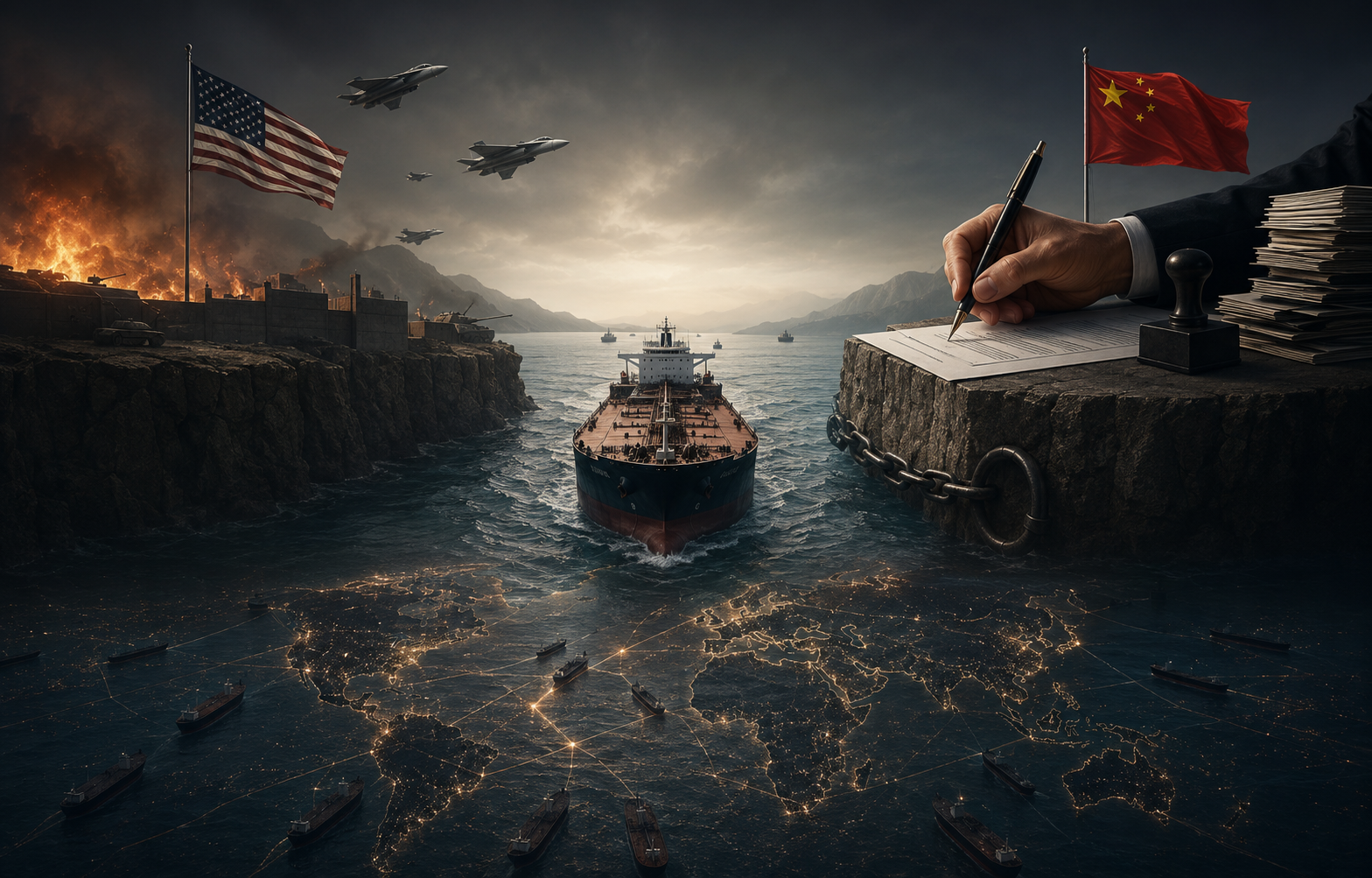
The bombs got the headlines. The pen did the damage.
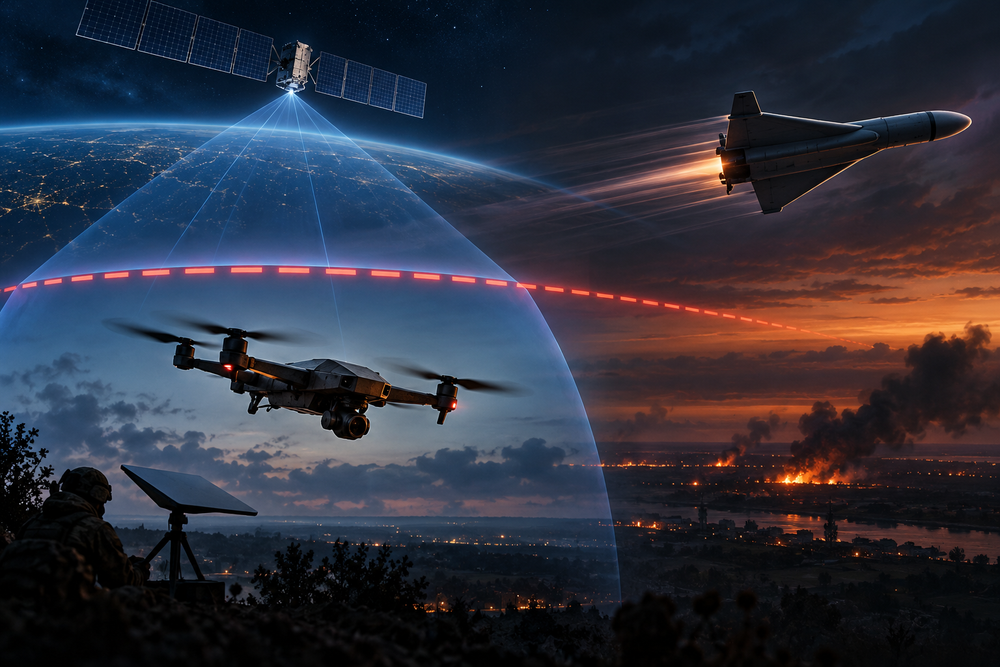
On the seventh of July, Iran attacked three commercial vessels moving through the Strait of Hormuz, and the United States answered with what its own Central Command called strikes on more than eighty targets, launched off the deck of the USS Abraham Lincoln. That was the war everyone saw: the tankers, the jets, the coastal radar sites turned to smoke. But the same day, in a document with no flames in it at all, Washington revoked the waiver that had quietly allowed Iran to keep selling its crude. Brent crude, which had spent the spring falling, jumped about five percent to near seventy-eight dollars within hours. The missiles were the spectacle. The revoked waiver was the blow that will still be landing in six months.
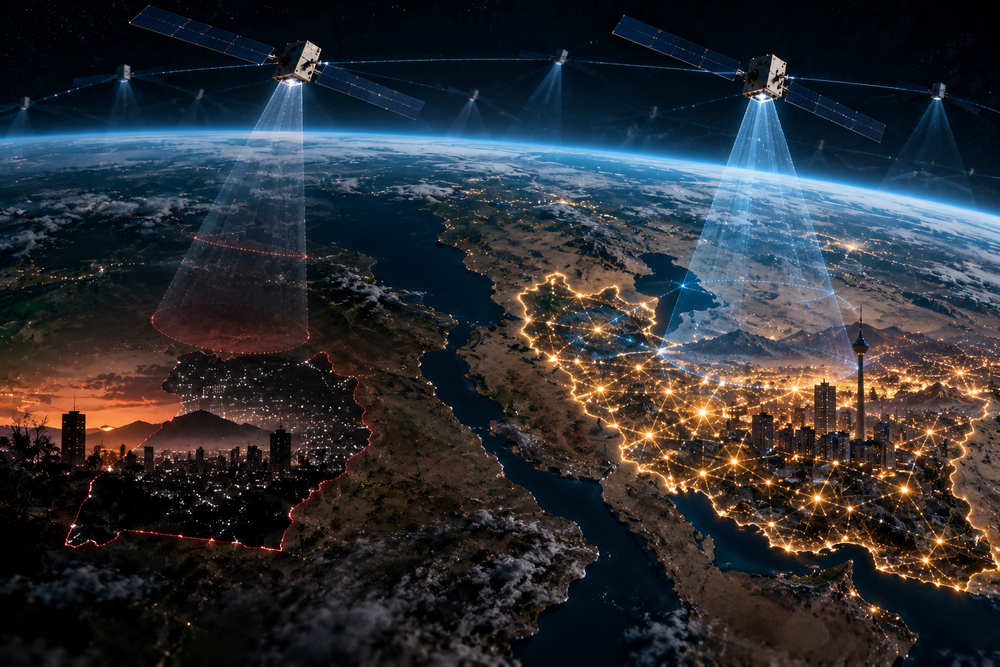
That gap, between the war on the water and the war over the paperwork, is the thing almost every account of Hormuz misses. The story is told as a chokepoint drama: will Iran close the strait, will the oil price explode, will America force it open. It is a real drama, and it has been running since late February, when a joint American and Israeli campaign aimed openly at regime change killed Iran's Supreme Leader and Iran responded by shutting the strait. But underneath the visible siege of the water, a second and quieter siege has been fought the whole time, and it is the one that actually decides who wins and what it costs the world. It is not a war over the strait. It is a war over the tanker.
Two blockades, not one
Begin by naming what is actually happening, because the single word closure hides half of it.
Iran closed the Strait of Hormuz on the twenty-eighth of February 2026, and by any measure it has stayed closed. The World Trade Organization's shipping tracker recorded a collapse of roughly ninety-five percent in crude-carrying vessels and close to ninety-nine percent in liquefied natural gas ships moving to and from Persian Gulf ports. A waterway that carried around three thousand vessels a month emptied out. The United Arab Emirates' state oil company has said flatly that full flows will not resume before 2027, even if a deal were signed tomorrow. This is not the rhetorical closure of past crises, the parliamentary threat that never arrives. The strait genuinely shut, and it has been shut for months.
That is the blockade everyone can see. Here is the one they cannot. Since the thirteenth of April, the United States has been running a naval blockade of Iran's own ports, turning back or redirecting well over a hundred commercial ships by Central Command's own count, choking the outbound flow of the one commodity that funds the Iranian state. Iran closed the water to the world. America closed the world to Iran. What looks like one country strangling a strait is in fact two countries strangling each other, and the second strangulation is the one aimed at a decision rather than a headline.
The American blockade works nothing like Iran's. It needs no mines and no missiles, because it operates on the layer where modern oil actually moves: the ledger. A tanker approaching an Iranian terminal can be intercepted and turned back, and Central Command says well over a hundred already have been. But the sharper instrument is the one with no ship at all. By sanctioning the specific vessels that lift Iranian crude, the insurers that cover them, the terminals that receive them, and, with the revoked waiver, the buyers that pay for them, Washington makes each barrel of Iranian oil radioactive to the financial system that every legitimate cargo must pass through. Iran holds the water. America holds the paperwork that turns oil into money, and in a modern economy the paperwork is the harder wall.
The two blockades are not the same kind of weapon. Iran's closure of Hormuz is indiscriminate: it raises the cost of everyone's oil, hurts every importer, and hurts Iran too, since Iran ships its own crude through those same waters. Indiscriminate pressure tends to generate its own coalition of the injured. The American counter-blockade is aimed: it targets one thing, Iranian export revenue, the income that pays for the missiles, the drones, and the salaries. A siege inconveniences an economy; a targeted blockade, held long enough, drains a state. That is why the revoked waiver of the seventh of July matters more than the eighty targets struck the same day. Strikes destroy equipment that can be rebuilt. The blockade destroys the money that rebuilds it.
The chokepoint everyone can name
The reason the visible siege dominates the coverage is that it is easy to understand, and the numbers behind it are genuinely enormous.
Something close to a fifth of the world's oil and a fifth of its liquefied natural gas passes through the Strait of Hormuz in normal times, roughly twenty million barrels of oil a day. The navigable lanes at the narrowest point are only about two miles wide, and they run through Iranian and Omani territorial waters, which means Iran does not need a functioning navy to make the passage unbearable. It needs mines, anti-ship missiles, drones, and small boats, and the credible willingness to use them, because commercial shipping does not require a sinking to stop. It requires only that an insurer and a shipowner conclude the odds are no longer worth it. During this crisis they concluded exactly that. War-risk premiums for a Hormuz transit jumped severalfold, to the point where a single laden supertanker could face ten to fourteen million dollars of insurance for one voyage, and charter rates for the largest tankers quadrupled in a week. The telling detail is that the market did not run out of insurance. Lloyd's underwriters were clear that cover remained available. Owners simply looked at the water and stayed home. The strait was not closed by a blockade of steel. It was closed by a price.
The standard reassurance is that the oil can go around, and it is worth taking that claim seriously, because it is where the chokepoint argument is usually won or lost. There are two pipelines built precisely to bypass Hormuz: the Saudi east-west line across the peninsula, and the Emirati line to the port of Fujairah on the Gulf of Oman. Together, on the most generous reading, they can carry something like three and a half to five and a half million barrels a day. Set that against the roughly twenty million that Hormuz normally moves and the reassurance dissolves. The bypass covers well under a third of the flow, and Iran did not leave even that untouched: it struck the Saudi line in April, cutting an estimated seven hundred thousand barrels a day, and hit the Emirati line with drones. The lesson is the one the Manifest has argued before and will not belabour here: the alternatives to a chokepoint are real, and they are far too small. A back door is not a second front door.
The state that would not fall
To understand why revenue became the decisive weapon, you have to understand what the bombs failed to do.
The February campaign was not a limited strike on a nuclear site. It was aimed at bringing down a government, and it came closer to a decapitation than any attack on Iran in the republic's history: the Supreme Leader himself was killed. In most theories of how states work, that is the ending. A regime loses its founder-figure, its command is severed, its people lose their nerve, and the thing collapses. It did not collapse. Iran named a successor, the former leader's son, within days, kept its chain of command intact enough to launch sustained counter-strikes against Israel, American bases, and the Arab Gulf states, and went on fighting through months of bombardment and blockade. Whether that succession holds, and whether the state hardens or eventually fractures under the strain, is genuinely unknown and should not be pretended otherwise. But the immediate lesson of the spring was blunt: you can kill the man at the top of a modern state and the apparatus beneath him keeps running, because an apparatus is not a person.
This is why the war did not end when the headlines said it should, and it is the fact that makes the counter-blockade, rather than the air campaign, the decisive move. If bombing the leadership does not stop the war, and destroying equipment only sets it back a season, then the only pressure that actually bends the state is the one that reaches its money. A government can absorb the loss of its founder. It cannot, indefinitely, absorb the loss of the income that pays its soldiers. The strikes were an attempt to end the war by force and they failed on their own terms. The blockade is an attempt to end it by attrition of money, and it is the one with a chance, which is exactly why it is where the war has quietly moved.
The lifeline nobody photographs
Somewhere off the coast of Malaysia tonight, two ageing tankers are lying alongside each other in the dark with their tracking beacons switched off, and a hose is running crude from one hull into the other. Neither ship is where its transponder last said it was. The oil that started in an Iranian terminal will arrive in a Chinese refinery stamped as something else. No camera records it, no registry cleanly names it, and it is, quietly, the reason the world economy did not seize when a fifth of its oil supply was cut off. That transfer, repeated a few hundred times a month, is the hinge of this entire war.
So if the strait was ninety-five percent shut and the pipelines cover less than a third, and yet the world economy did not seize, something kept the oil moving. It did, and it is worth naming precisely.
The world stayed calm for a season because the largest emergency stock release in the history of the International Energy Agency, on the order of four hundred million barrels drawn substantially from the American strategic reserve, put roughly two and a half million barrels a day back into the market for a few months. That buffer is real, and it is finite, and its exhaustion has been examined elsewhere. Set it aside. The more revealing fact is that Iranian oil itself never stopped flowing, even with a shut strait and an American blockade, and the reason it did not stop is a fleet of ships that no one photographs and no registry fully names.
China buys the overwhelming majority of Iran's crude, something like nine in ten barrels Iran exports, around 1.4 million barrels a day in 2025, worth on the order of thirty billion dollars to Tehran. It does so through a shadow fleet of ageing, opaquely owned tankers that switch off their transponders, meet at sea, and pour Iranian oil into other hulls so that it arrives in Chinese ports laundered as something else. The signature of the trade is almost comic in its obviousness: Chinese customs record essentially zero Iranian oil imports, yet Chinese purchases of crude labelled Malaysian ran to roughly 1.3 million barrels a day, more than double everything Malaysia actually pumps. That gap is Iran, sailing under a flag of convenience through a war.
The mechanics are what make the fleet so hard to kill. There is no single choke point to bomb, no headquarters to sanction, only a diffuse, self-renewing swarm of a few hundred old ships, and every one that is sanctioned is replaced by another bought cheap and reflagged. This is why the counter-blockade is a slower weapon than the air campaign. You cannot destroy the shadow fleet in a night of strikes. You can only raise, ship by ship and insurer by insurer, the cost of moving Iranian oil, until the discount China demands to keep buying it swallows the revenue Iran needs to keep fighting.
The revenue itself tells the story of the squeeze in two acts. Early in the closure, Iran's oil income actually rose, because for a brief window it was almost the only exporter still getting crude out of the Gulf at all, and scarcity is a seller's friend. By June, the arithmetic had reversed: Iranian exports were reported at a six-year low as the blockade, the strikes on loading infrastructure, and the deepening Chinese discount ground the flow down. Both figures are real; they are the same weapon measured at two moments. When the strait first closed, the shadow fleet was Iran's windfall. By the seventh of July, with the waiver revoked and the fleet in the crosshairs, it had become the front line, which is why a decapitated, bombed, blockaded state could keep fighting for months, and why Washington finally moved to cut the only artery that had kept it standing.
Now the seventh of July comes into focus. Revoking the waiver that permitted some Iranian sales, and turning American attention toward the shadow fleet, is not a sideshow to the strikes. It is the strikes' purpose finally made explicit. The war on the water was always in service of the war over the tanker. Close the strait and you raise everyone's costs for a while. Close Iran's buyer, or the ghost ships that reach that buyer, and you cut off the one flow of money that a bombing campaign never could. The determining variable in this war was never the width of the water. It was whether Iranian oil could still find a hull and a port. For four months it could. The events of the seventh of July are America moving, at last, to make sure it cannot.
What it costs the rest of us
The economics of all this are where the abstraction turns into a household bill, and the pattern is stranger than either alarm or complacency allows.
Consider the price of oil across this war, because it refuses to behave the way a shut strait should make it behave. It sat in the high sixties before the fighting. It spiked above a hundred and twenty-six dollars a barrel at the end of April, at the height of the closure. And then, with the strait still ninety-five percent shut, it fell, all the way back below seventy dollars by the first of July, roughly where it started. A crisis that removed a fifth of the world's oil from its main artery ended the spring with cheaper oil than it began. That is not a sign the crisis is over. It is a sign the buffers were working and the market was betting on a fast reopening, and it is exactly the false comfort that the revoked waiver and the five percent jump of the seventh of July have begun to puncture. Cheap oil during a blockade is not resilience. It is a loan.
The bill, when it is presented, does not arrive as a single number. It arrives as an American motorist paying roughly a dollar more per gallon than a year ago. It arrives as central-bank arithmetic: a Dallas Federal Reserve and academic estimate that even a single quarter of Hormuz closure adds something like six tenths of a percentage point to American headline inflation, and a European Central Bank warning that a prolonged conflict could tip Germany and Italy into technical recession by the end of the year and leave the continent in stagflation. It arrives as fertiliser, because much of the world's urea and ammonia move through these same waters, and fertiliser is simply food with a delay: a farmer in South Asia who cannot afford to feed his soil this season sells a smaller harvest the next, and the price shows up on a table thousands of miles from any tanker. Fuel and food shortages surfaced this spring across Pakistan, Bangladesh, Nigeria, and beyond, and at least one government declared a state of emergency over fuel alone. The strait is two miles wide at its neck. The blast radius of closing it reaches the price of bread on four continents. That is the quiet cruelty of a chokepoint: the people who feel it first and worst are the ones furthest from the fight, who never chose a side and cannot read a shipping manifest, and whose only connection to a war in the Gulf is that the cost of living just moved and no one told them why.
And it arrives, above all, as a redistribution of leverage that has nothing to do with the battlefield. The single largest importer of oil through Hormuz is China, which brings in more than half its crude by sea and draws perhaps forty to fifty percent of it through this one strait. A prolonged closure threatens Beijing more than it threatens Washington, which imports almost nothing through Hormuz and sits on the reserve that steadied the market. So a war fought in the Persian Gulf quietly presses hardest on a power that fired no shot, and hands the country running the blockade a lever over the country that most needs the strait open. That is the deepest reason the tanker matters more than the strait. Every barrel of Iranian oil the shadow fleet lands in China is a barrel that funds Iran and reassures Beijing at once; every tanker Washington drives off the water tightens the same screw on both. The blockade is aimed at Tehran, but the hand it strengthens is held over Beijing, and both capitals know it. China and Russia used their Security Council seats to shield Iran diplomatically while China went on quietly buying the discounted crude, the posture of a power that wants the benefit of the strait open without the cost of guaranteeing it. Whether Beijing stays a free rider or is forced, by a serious enough squeeze on its oil, to become Iran's active protector is one of the largest open questions this war contains.
The cartel that used to absorb these shocks is meanwhile coming apart: the United Arab Emirates left OPEC in May, and Iraq is reportedly threatening to follow. And the buffer that steadied prices this spring, the record release from the American strategic reserve, is a stock, not a tap: once it is drawn down, the next release comes out of a reserve already lowered, and the cushion that made cheap oil during a blockade possible thins with every barrel. The shock absorber is failing at the exact moment the shock is worst. None of this is visible from the water. All of it is decided there.
The ceasefire that isn't
If both sides are being bled, the obvious question is why the war does not simply stop, and the answer is that it keeps trying to and cannot.
The diplomacy has been almost continuous and almost entirely fruitless. Pakistan brokered a conditional ceasefire in April and hosted talks in Islamabad; the deadlines came and went, extended and broken and extended again. In the middle of June the United States and Iran signed a memorandum of understanding to end the war and reopen Hormuz, opening a sixty-day window to negotiate a settlement. Within weeks it was fraying, and by the seventh of July it was in open violation, each side accusing the other of firing first. The pattern is the same one that runs under every stalled war: motion at the table, stillness in the substance.
What the talks keep failing to resolve is the one thing the whole war was ostensibly about. Iran will not surrender the right to enrich or ship its remaining uranium abroad, and with the international inspectors locked out since the middle of 2025, there is no way to verify any promise it makes, which means there is nothing for the other side to trust. America will not lift the blockade while the stockpile it cannot see still exists. So the negotiation is not a road toward a settlement; it is two preconditions pointed at each other, each waiting for the other's economy or nerve to give first. A ceasefire that neither side can verify and both sides are still profiting from breaking is not peace. It is the war continuing by other means, with a signing ceremony attached.
Who is the aggressor here
It is impossible to write honestly about this war without addressing the question that animates most of the suspicion around it, and the honest answer requires holding two sets of documented facts at once rather than choosing the comfortable one.
The case that the United States is the aggressor is strong and rests on the record. It was America and Israel that struck first, on the twenty-eighth of February, with a stated war aim of regime change rather than mere counter-proliferation. They struck roughly two days after Oman's mediator publicly judged a deal to be within reach, with Iran reported to have newly agreed never to build a weapon. And they struck while America's own intelligence community continued to assess that Iran was not, in fact, building a nuclear weapon. A pre-emptive war for regime change, launched against a program one's own spies say is not being weaponised, launched as diplomacy was reportedly advancing, is about as clean a case for the aggression reading as the modern record offers.
The case for the other reading is also documented, and refusing to state it would be its own dishonesty. Iran's nuclear program sat at the threshold. The International Atomic Energy Agency had verified more than four hundred kilograms of uranium enriched to sixty percent, far beyond any civilian purpose and a short technical step from weapons grade, and by the middle of 2025 the agency had lost access to Iran's enrichment sites entirely, could no longer account for that stockpile, and had declared Iran in violation of its safeguards obligations. A threshold nuclear program that has expelled the inspectors is not a status quo anyone was obliged to accept. And it was Iran, not the United States, that closed a strait belonging to the whole world's commerce, and Iran that attacked neutral commercial vessels and fired on the Arab Gulf states, wiping out a large share of Qatar's gas capacity in the process.
Read structurally, the disagreement is not really about morality, which is why it never resolves. It is about which act you treat as the baseline. Begin the clock at the American strike and Iran is defending itself against a war of choice. Begin it at the unmonitored threshold stockpile, or at the closure of the strait, and America is enforcing a red line that Iran crossed. Both clocks run on real events. Neither reading can fully swallow the other's facts, and any account that pretends one of them simply is not there has stopped doing forensics and started doing advocacy. The determining variable, even here, is not who is good. It is where you agree to start counting.
The strongest objection
The best case against the whole framing of this essay is not that any fact in it is wrong, but that the framing itself smuggles in a false symmetry, and it deserves to be put at full strength.
An intelligent critic would say this. To call the war a contest of two blockades, to weigh an American port blockade against an Iranian strait closure as if they were two moves in the same game, is to launder a war of aggression into a tidy diagram. One side launched a pre-emptive campaign for regime change and killed a head of state; describing the victim's closure of a strait and the aggressor's blockade of its ports in the same even tone grants the aggressor exactly the equivalence its own propaganda wants. The blockade frame, the critic concludes, is not neutrality. It is a way of not saying who started it.
That objection is serious, and the honest reply concedes what it correctly demands and refuses what it overreaches. It is correct that the trigger is not symmetrical, and this essay says so plainly: America and Israel struck first, for regime change, against a program their own intelligence judged non-weaponising. What the blockade frame claims is narrower and survives the objection. It does not say the two sides are morally equal. It says that once the war began, its outcome and its cost to the world stopped being decided by who was right and started being decided by a mechanism, the mutual siege, whose logic is indifferent to justice. You can hold that America began an aggressive war and still observe, clearly, that the war is now being won or lost over the tanker rather than the trench. A reader who is told only who is to blame, and never how the thing actually runs, is disarmed precisely when the next move, the strangling of the shadow fleet, is being made in plain sight.
What would falsify the reading offered here is concrete. If Hormuz reopened to something like normal traffic while Iranian exports stayed shut, the strait, not the tanker, would have been the decisive variable after all. If Iranian oil kept reaching China at volume despite the revoked waiver and the hunt for the shadow fleet, the counter-blockade would have failed and the visible siege would be the whole story. Watch which of the two blockades breaks first. That is the war.
The tanker, not the strait
Strip the crisis of its imagery and one question is left standing, and it is not the one the maps are asking.
It is not whether Iran can close the Strait of Hormuz, because Iran has already closed it and the world, for a season, absorbed it. It is not even whether America can force it open, because forcing water open is easier than making a bankrupt adversary keep fighting. The question that decides this war is whether Iranian oil can still find a buyer, and the answer to that question is being written now, not in the strait but on the manifests of a few hundred ageing tankers sailing under false flags toward Chinese ports, and in a revoked American waiver designed to sink them without a shot. The blockade you can photograph is the one that fills the news. The blockade that decides the outcome is the one conducted in insurance clauses, customs codes, and the switched-off transponder of a ship that does not want to be seen.
A strait can be reopened in an afternoon. A market, once it has learned to route around you, does not come back on command. Close the water and you stop the world's oil for a moment. Close the customer and you stop one country's revenue for good. That is the difference between the war on the water and the war over the tanker, and it is the whole of the matter.
So the next time the strait fills your screen, the narrow lanes and the massing warships and the maps with the red arrows, watch what the camera is pointed at, and then ask what it is pointed away from. The footage of the chokepoint is not coverage of the war. It is the part of the war you were meant to see.
Evidence Map
Facts, interpretations, forecasts, and disconfirming signals.
Core claim. The 2026 US-Iran war has become a mutual blockade, and its outcome and its cost to the world are decided not by the Strait of Hormuz but by whose oil can still reach a buyer. Iran closed the strait; the United States has blockaded Iran's ports and, on 7 July, revoked the waiver permitting Iranian sales and turned toward the shadow fleet that keeps Iranian revenue alive. The determining variable is the tanker, not the chokepoint.
Evidence level. Facts (high, several contested and attributed): the 28 February 2026 US-Israel campaign with a stated regime-change aim and the killing of Iran's Supreme Leader; Iran's closure of Hormuz and the ~95% collapse in crude-ship transits (WTO tracker); the US port blockade from 13 April and the 7 July strikes plus waiver revocation (CENTCOM); the oil-price path (high-60s to >$126 on 30 April to <$70 on 1 July to ~$78 on 7 July); war-risk premiums and quadrupled charter rates (Lloyd's); the ~400m-barrel IEA release; China's shadow-fleet imports of "Malaysian" crude (~1.3m bpd); the IAEA's >400 kg of 60% enriched uranium and loss of access since mid-2025. Interpretation (marked): that the counter-blockade, not the strait, is the determining variable; that the aggression question turns on which act is treated as the baseline. Forecast (speculative): the effort to strangle the shadow fleet becomes the decisive front, and oil re-prices upward as the buffers deplete and the waiver bites.
What would confirm this. Iranian export revenue falling sharply as the shadow fleet is targeted, with oil prices rising even if Hormuz traffic partially resumes.
What would disprove this. Hormuz reopening to near-normal traffic while Iranian exports stay shut (the strait was decisive), or Iranian oil continuing to reach China at volume despite the revoked waiver (the counter-blockade failed).
Watchlist. Iranian crude exports and shadow-fleet ship-to-ship transfers near Malaysia; the US strategic reserve level after the record release; war-risk insurance premiums for Hormuz; OPEC cohesion after the UAE's exit; the state of the ceasefire.