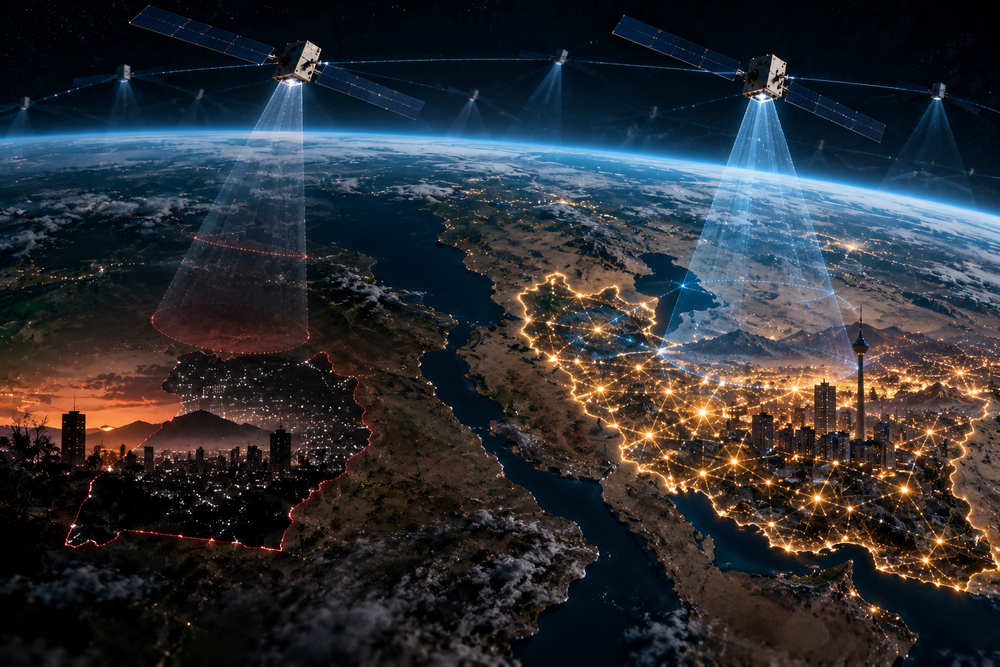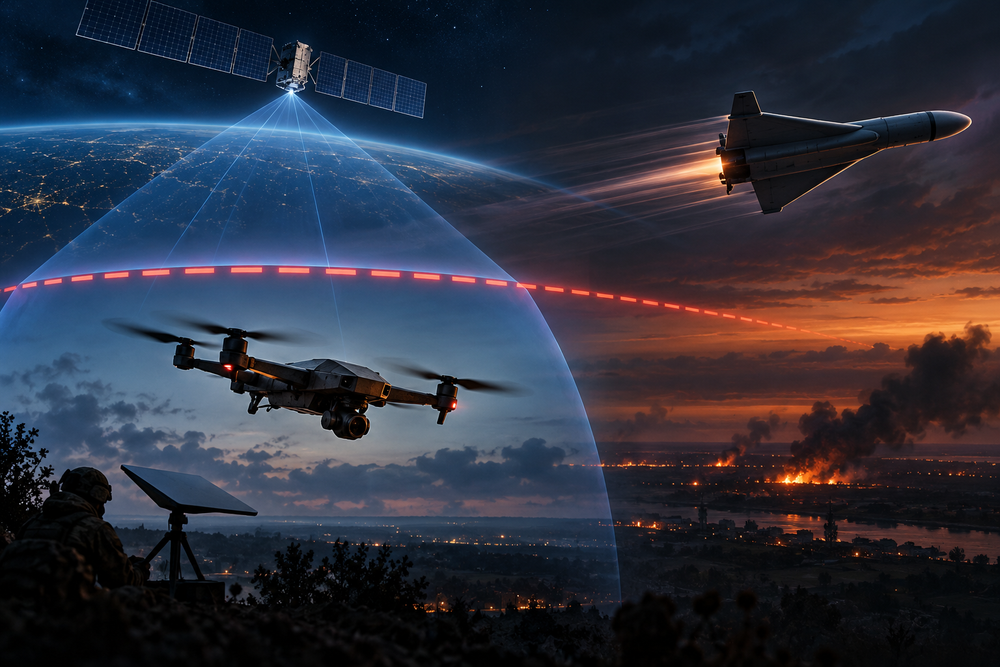
A drone crossed some 2,700 kilometres of Russian airspace and struck an oil refinery in western Siberia. It was a machine built in Ukraine, sent to hit the single largest refinery Russia operates. Nothing on the front line moved that week. The front line has barely moved in a year. And yet this was, by a wide margin, the most consequential act of the war in months.
That gap, between a frozen map and a war that is nonetheless being decided, is the thing almost every account of Ukraine gets wrong. The debate is conducted as if the question were territorial: who is advancing, who is retreating, who is winning. Read the movement of the front and you would conclude that almost nothing is happening. Read what the two sides are actually doing to each other, and you find a contest that has quietly left the map altogether. This is a war that is no longer being won. It is being outlasted, and everything that follows is an attempt to say by whom.
The map stopped moving
Begin with the territory, because it is where the false certainties live on both sides.
Russia controls somewhere around nineteen to twenty percent of Ukraine. The two most-cited independent trackers, the Ukrainian project DeepState and the American Institute for the Study of War, put the figure within a point of each other, roughly 117,000 to 118,000 square kilometres including Crimea and the parts of Donbas held since 2014. That number is not seriously disputed. What is disputed is everything the partisans build on top of it.
Here is the part that punctures the first narrative. Over the year from mid-2025 to mid-2026, Russia gained roughly three thousand square kilometres, about half of one percent of Ukraine. And the pace did not hold steady; it collapsed. Full-year 2025 saw Russia take between roughly 4,300 and 5,600 square kilometres depending on the tracker, its largest gains since the first year of the invasion. Then in June 2026 Russia advanced roughly thirty square kilometres for the entire month by ISW's count, and closer to eighty by DeepState's, the two trackers diverging by a factor of nearly three while agreeing on the only thing that matters: something on the order of one square kilometre a day, against roughly sixteen a day a year earlier. The advance on Pokrovsk moved, by the count of the Center for Strategic and International Studies, at roughly seventy metres a day, slower than the Allied advance at the Somme.
The price of that crawl is the second documented fact, and here numbers must be handled with care, because every belligerent in this war lies about the count. The firmest figure is the floor: close to 230,000 Russian dead confirmed by name by mid-2026, the toll that Mediazona and BBC Russian have verified one soldier at a time. Above that floor the estimates fan out and stop agreeing. Models push the Russian dead toward 350,000; Western services split between a quarter and half a million, a two-to-one gap over the same war. Count the wounded as well and the UK now puts total Russian casualties past 1.3 million, with one widely cited July 2026 tally placing the combined Russian and Ukrainian toll above two million. The honest reader keeps the confirmed dead, the modelled dead, and the total casualties as three different things, and distrusts anyone who quotes a single hard number with no source attached.
Even the war's boldest territorial gamble ended by proving the point. In August 2024 Ukraine did the unthinkable and drove into Russia's own Kursk region, seizing a pocket of Russian soil for the first time since the Second World War. It was meant to be leverage, a bargaining chip, a shock to a country that had thought itself safe behind its border. By the spring of 2025 Russia, with North Korean help, had pushed the Ukrainians back out, and what remained was measured in a handful of square miles. The most audacious move on the map changed the map, briefly, and changed the war not at all.
Set the confirmed advance against even the most conservative loss estimate and you get the shape of the thing: an army paying in the tens of thousands of lives for a percentage point of ground. That is not victory in any sense a general would recognise. It is also, and this is the part the other narrative refuses, not defeat.
Is Russia doing badly? Two true columns
Ask whether Russia is losing and you get an answer that depends entirely on which column of the ledger you are shown, and both columns are real.
In the first column, Russia is bleeding. The casualty-per-kilometre arithmetic is catastrophic. Neutral open-source analysts who count Russian vehicles in satellite imagery of storage depots, the same method used to track Soviet reserves for decades, record the pre-war stockpile of tanks falling from more than seven thousand to about two thousand, fewer than nine hundred of them judged restorable, with the refurbishment that fed three years of war now approaching its limit. Russia has leaned on roughly eleven thousand North Korean troops in the Kursk direction and on Iranian-designed drones built under licence. By ISW's assessment it now loses more men each day than it recruits. The economy, which for two years defied the predictions of collapse, is in 2026 showing its first real cracks: oil-and-gas revenue down close to half year-on-year in the first quarter, the liquid National Wealth Fund that once held some 113 billion dollars now under fifty, bad loans past a tenth of the banking system, and a Kremlin-linked institute warning openly of a possible banking crisis by year's end. Putin himself conceded that the economy contracted in January and February, by a combined 1.8 percent, though he blamed the weather and a shorter working calendar rather than the war.
In the second column, Russia is more durable than the collapse story ever allowed. The sanctions did not break it; defence spending roughly doubled as a share of the economy and the state kept paying. Russian factories out-produce the whole of NATO in artillery ammunition, something like seven million shells, mortar bombs and rockets in 2025 by Estonian intelligence's count, and build attack drones in the numbers it now launches by the hundreds on its heaviest nights. Russia adapted tactically faster than its enemies expected, saturating the front with glide bombs and fibre-optic drones that cannot be jammed. Sanctions were evaded almost as fast as they were written: a shadow fleet of ageing tankers still moved close to half of Russia's seaborne crude, and each new package aimed at cutting off the oil revenue was met with a new workaround, even as the United States and the European Union tightened the net around the largest producers. The most authoritative Western reference, the IISS Military Balance, judged that Russia may have rebuilt to something near its pre-2022 equipment strength even as it warned that the stockpile making this possible is nearly spent. Both halves of that sentence are the institute's own.
Hold the two columns together and the question "is Russia doing badly?" dissolves into a better one. The territorial frame cannot answer it, because territory is no longer the variable that decides. What decides is a race between exhaustions: Russia's spent Soviet inheritance and straining budget against Ukraine's manpower shortage and its dependence on a Western willingness to keep paying. The war is not being won. It is being outlasted, by whichever side runs out last.
The other exhaustion
Because most Western coverage counts Russia's problems, it is easy to miss that Ukraine is running its own clock down, and that its clock may be the shorter one.
Russia's binding constraint is material: steel, shells, the finite Soviet stockpile, a budget under strain. Ukraine's is human. A country of a fraction of Russia's population cannot trade lives at parity, and it has not tried to; it has substituted technology and Western money for manpower wherever it can, which is why a Ukrainian drone reaching Siberia is not a stunt but a strategy, a way to project force without spending the soldiers the country no longer has to spare. The mobilisation that sustains the front has grown harder and more contested with every year, the average age of the infantry has climbed, and the manpower question is now discussed in Kyiv with a candour that was unthinkable in 2022. Independent Ukrainian counts of the dead documented by name run into the tens of thousands, against Zelensky's own admission of some 55,000 killed, with the missing pushing the true figure of the lost far higher than either.
And Ukraine carries a second dependency Russia does not: it fights on someone else's willingness. Its army runs on a flow of Western weapons, intelligence, and cash that no Ukrainian vote controls. When American support stalled after the change of administration in Washington, the shortfall was real and immediate, and it fell to Europe to fill a gap it had not created. This is the asymmetry the exhaustion race actually turns on. Russia can lose men and money and still decide, alone, to continue. Ukraine can win every drone duel over Siberia and still be undone by a budget vote in a capital that is not its own. The determining variable on the Ukrainian side is not courage, which is not in question, but the stamina of its backers, which is.
It is no longer only their war
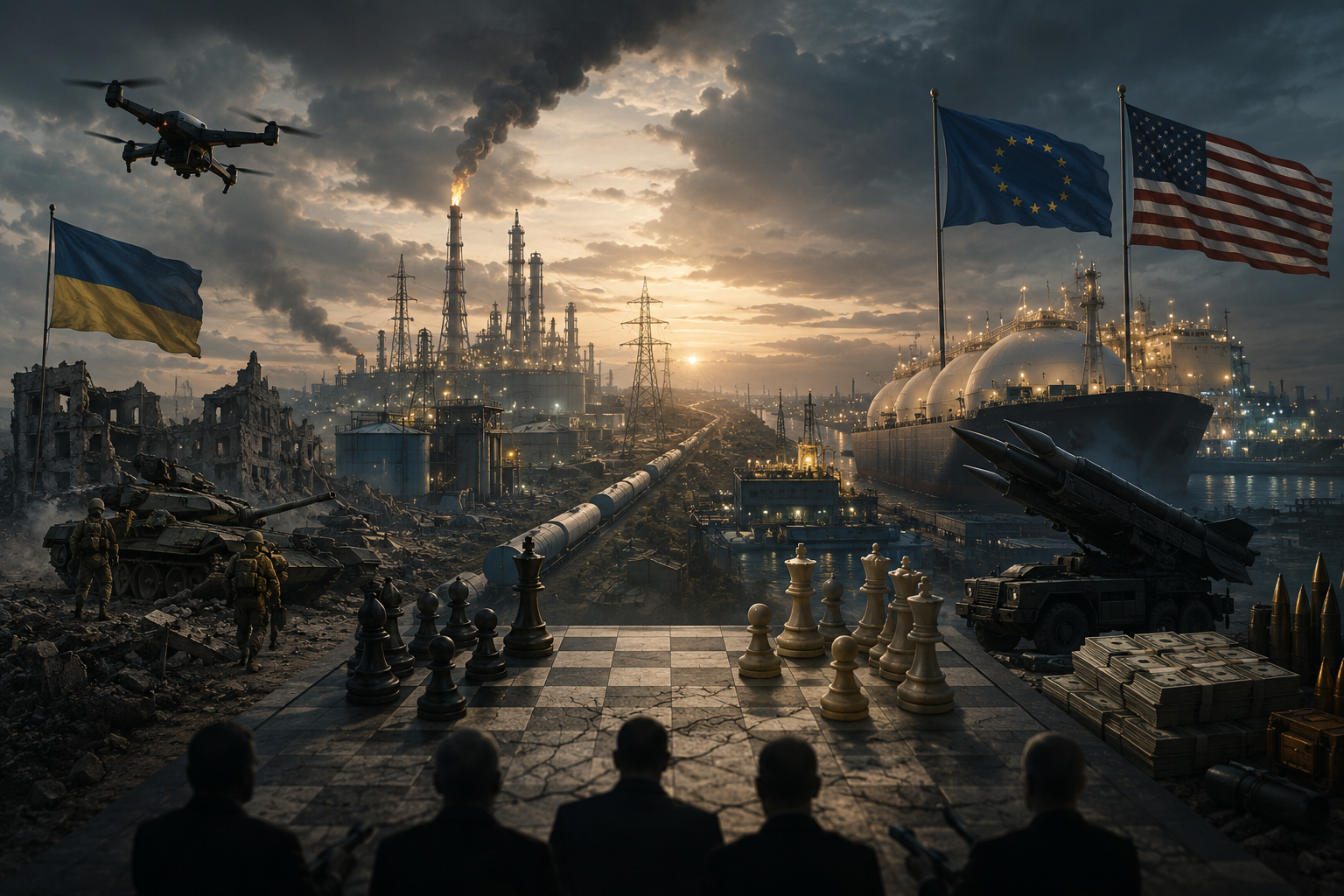
Which means the exhaustion race is not really being run by two countries at all, but by two coalitions, and this is the part that makes the war so hard to end and so dangerous to widen.
Russia does not fight alone. It leans on roughly eleven thousand North Korean troops in the Kursk direction, on Iranian-designed drones built under licence in Russian factories, and above all on a Chinese economic lifeline that buys the oil the West is trying to strand and sells the components the sanctions are meant to deny. Ukraine does not fight alone either. Its army runs on American and European weapons, on Western satellite intelligence, on money voted in capitals from Washington to Berlin. What looks on the map like Russia against Ukraine is, at the level that decides, one loose coalition draining another, each testing not only the enemy's stockpile but the patience and cohesion of the enemy's friends. This is why the war radiates outward, into the Baltic Sea and the oil market and the politics of a dozen countries with no soldier at the front. An exhaustion race between coalitions is won or lost as much in the weakest member's parliament as on the line of contact, and every backer knows it, which is exactly why Moscow works to fray Europe's resolve and the West works to prove Russia's isolation. The front is frozen. The contest for the allies is not.
The war left the map
Once you see that the contest is exhaustion rather than ground, the strange shape of 2026 makes sense. Both sides, unable to break through on the map, have moved the war onto the layer that actually feeds the fighting: each other's economic infrastructure.
Ukraine's most consequential campaign of the year is not an offensive anyone can draw on a map. It is a systematic, months-long drone assault on Russian oil refining. The strike on the Omsk refinery in western Siberia on 6 July 2026, some 2,500 to 2,700 kilometres from Ukrainian-held territory depending on the source, was among the deepest of the entire war and the first time that plant had been hit. It was part of a campaign that has at times put more than a quarter of Russia's refining capacity offline. The target is not chosen for spectacle. Refining is where crude becomes revenue, and revenue is the exact variable, oil income, that funds the Russian state's ability to keep fighting. Ukraine cannot take Omsk. It can degrade the money that Omsk represents.
Here the honesty of the account matters more than anywhere else, because the popular shorthand gets it wrong in a way that smuggles in a conclusion. These are not, whatever the phrase suggests, European drones. The long-range machines reaching Siberia are overwhelmingly Ukrainian, designed and built by Ukrainian firms such as Fire Point, with ranges its makers and President Zelensky now put beyond three thousand kilometres. Europe's contribution is money, components, and the financing club sometimes called the drone coalition, not the authorship of the strikes. The distinction is not pedantry. Western enabling of Ukraine's war is a documented fact; Western authorship of these specific attacks is not, and a piece that blurs the two has already decided the argument it claims to be examining.
Russia does the mirror image. Unable to break the Ukrainian army, it spends the winter and now the summer striking the Ukrainian electricity grid, the transformers and substations that keep the country's economy and morale alive. Each side, frozen on the ground, reaches past the front to attack the other's capacity to endure. That symmetry is the war's real front line in 2026, and it is invisible on any territorial map. The determining variable was never the trench. It was the refinery and the transformer.
The clearest proof that this war is decided off the map is at sea. Ukraine began the war with essentially no navy. It has nonetheless driven Russia's Black Sea Fleet out of its own home port. Something like a third of the fleet's combat strength has been sunk or crippled by drones and missiles, the cruiser Moskva at the bottom since the first weeks, the fleet pulled back from Sevastopol to the safer harbour of Novorossiysk, the shipping lanes for Ukrainian grain effectively reopened. No line on any map records this. A country with no ships achieved what navies exist to prevent, and it did so with unmanned boats and improvised missiles, the same logic that now sends drones to Omsk. Force has come detached from mass, and that detachment may be the deepest thing this war has revealed.
The slow siege
The refineries are only the loud version of a quieter campaign that has run since the first month, and it aims at the same organ. The West has spent three years trying to strangle the money that reaches Moscow, and Russia has spent three years slipping the grip.
The instruments are financial rather than explosive, but the target is identical: oil income. A price cap tried to force Russian crude to sell below a set figure; Russia answered with a shadow fleet of ageing, opaquely owned tankers that by 2026 moved close to half its seaborne oil outside Western insurance and Western reach. As the cap leaked, the net tightened: sanctions reaching the largest Russian producers and most of the export flow on paper, the European Union tightening its price cap below the market level, though enforcement stays partial precisely because the shadow fleet exists. The effect is real and slow, the discount on Russian crude widening, the oil-and-gas revenue down close to half in the first quarter of 2026, the budget improvising to cover the gap. It is the same logic as the drone over Omsk, carried out with paperwork instead of warheads, and it runs into the same wall of uncertainty. Nobody can yet say whether the money runs out before the willingness to keep squeezing it does. That, again, is the only real question, wearing a banker's suit this time instead of a soldier's.
Why does Europe keep confronting Russia?
Which brings us to the question that animates most of the suspicion around this war, and which deserves to be separated into its two honest halves, because collapsing them is the single most common error on every side of the argument.
There is the question of the trigger, and there is the question of the persistence, and they have different answers.
The trigger is documented, and it is not European provocation. Russia used force to redraw borders in Georgia in 2008, annexed Crimea in 2014 in a move the United Nations General Assembly rejected by a hundred votes to eleven, and launched the full-scale invasion in 2022. In December 2021 Moscow issued a formal ultimatum demanding NATO roll its forces back to the lines of 1997. Ukraine had, under the 1994 Budapest Memorandum, surrendered the world's third-largest nuclear arsenal in exchange for security assurances that carried no enforcement mechanism, assurances broken in 2014 and again in 2022. Finland and Sweden, neutral for generations, chose to join NATO after 2022, which is the behaviour of states that read Russia as a threat rather than a victim. To call the Western response a provocation is to begin the story in the middle.
There is a deeper version of the provocation argument that deserves better than dismissal, because serious people hold it. In this reading the war's true origin lies in three decades of NATO enlargement toward Russia's borders, a process the American diplomat George Kennan called, in 1997, the most fateful error of the entire post-Cold-War era, and which the scholar John Mearsheimer has argued made a collision all but inevitable. Its proponents point to a verbal assurance, documented in the archives, that NATO would not expand one inch eastward, and to the 2008 Bucharest summit that promised Ukraine eventual membership without offering it protection, the worst of both worlds. This argument is not fringe, and a forensic account has to state it at full strength. But it has to state the reply at equal strength. The assurance was never written into any treaty, and historians dispute what, if anything, it bound anyone to. Enlargement was driven as much by the demand of the states joining, sovereign nations fleeing Moscow's orbit, as by any Western design. And a cause that explains a grievance does not thereby justify an invasion; the decision to cross the border in 2022 was a choice, not a reflex. Mark this whole layer for exactly what it is, contested interpretation on which serious analysts divide, not settled fact. It belongs in the account because leaving it out would be its own kind of dishonesty.
But the trigger does not explain the scale, the direction, or the persistence of what Europe is now doing, and this is where the suspicion has something real to hold. A confrontation can start as defence and acquire, over time, its own constituencies. Europe's defence-industrial base has become one. Rheinmetall's order backlog reached nearly sixty-four billion euros at the end of 2025, up more than a third in a year; its shares rose roughly tenfold from the invasion. The NATO summit at The Hague in 2025 committed members to spending five percent of national income on defence and broader security, a level few European members reached even during the Cold War the alliance was built to fight. As American support stalled after the change in Washington, Europe overtook the United States as Ukraine's largest backer, past 235 billion dollars against roughly 135 billion, though the Kiel Institute that tracks these flows notes the overtaking is partly a matter of the American drop rather than a European surge. And European leaders have tied the Russian threat explicitly to deeper integration and rearmament: a war economy, in Macron's phrase; a Europe that must, in von der Leyen's, get ready for war in order to avoid it. Energy is the other structural driver, and it moved decisively. Russian pipeline gas, once close to forty percent of the European Union's supply, has fallen to a few percent, and the United States has become Europe's largest supplier of liquefied natural gas, its exporters profiting while European industry pays several times the American price for the same fuel. A continent that has traded a cheap adversary's pipeline for an expensive ally's tanker has acquired, whether it meant to or not, a whole architecture of interests in the new arrangement that did not exist before the war.
The forensic discipline that separates this account from the propaganda on either side is a single rule. That an industry profits, that an alliance persists, that leaders find political use in a threat, are documented facts. That these things cause the confrontation is an interpretation, and a much heavier one. Read structurally, the confrontation began as a response to force and then acquired a set of structures with an interest in its continuation. That is not a conspiracy and it needs no coordinating hand. It is what durable institutions do with a crisis: they metabolise it into a reason to continue. The determining variable in Europe's behaviour is not a hidden motive. It is that a war economy, once built, becomes its own constituency, layered on top of a security fear that is entirely real.
Nothing here is free
None of this is done without consequence, and any honest account has to carry the costs on both sides of the ledger rather than the one it prefers.
The consequences of acting are visible and mounting. Ukraine's deep strikes and Europe's rearmament invite retaliation, and Russia supplies it: the sustained assault on Ukraine's power grid, and beyond Ukraine a widening pattern of hybrid pressure across Europe, unexplained severings of undersea cables in the Baltic, GPS interference that has forced airliners to divert, arson and sabotage at logistics sites, drones drifting over airports and military bases, each incident deniable by design and calibrated to stay below the threshold of a response. Russia has revised its nuclear doctrine to widen the conditions under which it would consider use, including in response to a conventional attack that threatens the state, a signal aimed precisely at European and American decision-making and repeated whenever Western support deepens. The refinery campaign reaches into a global oil market that no European voter chose to disturb, and a serious enough disruption of Russian supply raises prices in the same European economies funding the strikes. And the rearmament itself carries a domestic price, in debt, in budgets bent toward weapons, in the slow normalisation of a continent organising itself around the expectation of war.
But the ledger has a second column that the "just stop provoking Russia" argument leaves blank, and leaving it blank is its central dishonesty. Not acting also has consequences. The whole logic of deterrence rests on the claim that a Russia which succeeds in Ukraine at acceptable cost does not stop at Ukraine, and the front-line states that know Russia best, the Balts, the Poles, the Finns, act on that reading with their own money and their own conscription. Poland now spends close to five percent of its economy on defence, more than any other member of the alliance; Finland, which shares a longer border with Russia than any other Western state, abandoned generations of neutrality to join NATO little more than a year after the invasion. These are not the reflexes of governments that read the threat as imaginary. Their fear is not manufactured in Brussels; it is read off a documented record. The honest statement is not that European action is free of consequence, because it plainly is not. It is that every available option, action and inaction alike, carries a cost, and the argument is really about which costs are visible now and which are deferred onto a later bill that someone else will pay.
The negotiation that isn't
If the war is a race of exhaustion, the obvious question is why it does not simply stop at the negotiating table, and the answer is that the table has been busy without being productive.
The eighteen months since the change of administration in Washington have been full of process. There were partial ceasefires in the spring of 2025 on energy targets and the Black Sea, agreed and never durably held. There was a prisoner exchange of a thousand for a thousand, actually carried out. There was a summit between the American and Russian presidents that produced no deal, and an American peace plan, leaked late in 2025, so tilted toward Moscow that European capitals called it capitulation and it was trimmed before it could be formally tabled. There was a trilateral meeting in the Gulf, a round in Geneva, and an American deadline set for the middle of 2026. The deadline passed. The Kremlin declined new talks.
Underneath all the motion, the positions have barely moved, and that is the finding. Russia's three demands have been constant: all of Donbas, no NATO membership for Ukraine, no Western troops on Ukrainian soil. Ukraine will not cede Donbas by signature. As long as each side believes the other will empty first, neither has a reason to accept terms it still hopes to improve by waiting. The diplomacy is not a negotiation moving toward a settlement; it is two sets of preconditions held in place by the same wager that keeps the refineries and the transformers burning. The talks fail for the same reason the front is frozen. Both sides are still waiting to see who runs out first.
The strongest objection
The strongest case against everything above is not that any fact in it is wrong, but that the framing itself is a quiet dishonesty, and it deserves to be put at full strength.
An intelligent critic would say this. To describe the war as a symmetrical contest of exhaustion, to speak of Russian and European structures each metabolising the conflict, to weigh the consequences of action against inaction as if they were commensurable, is to launder an act of aggression into a systems diagram. One country invaded another. One country is bombing apartment blocks and abducting children and annexing land by decree. To retreat from that moral asymmetry into the cool language of determining variables and constituencies is to grant the aggressor exactly the false equivalence its propaganda has sought from the first day. The map may be frozen, the critic concludes, but the moral question is not, and a forensic tone that flattens it is not neutrality but evasion.
That objection is serious, and the only honest reply is to concede what it correctly demands and refuse what it does not. It is correct that the trigger is not symmetrical, and this account says so plainly: Russia invaded, the record is documented, the provocation frame begins the story in the middle. What the account claims is narrower and survives the objection. The mechanism of the war's persistence is not the same thing as the morality of its origin. To observe that both sides now attack each other's economic infrastructure, that both have built structures with an interest in continuation, that every policy option carries a cost, is not to equate the parties morally. It is to describe how the thing actually runs, which is the only basis on which anyone can judge where it goes. A reader who is told only who is right, and never how the machine works, is disarmed precisely when understanding matters most.
What would falsify the reading offered here is concrete and worth naming. If one side achieved a genuine operational breakthrough and the front began to move at the pace of manoeuvre rather than metres, the attrition frame would be wrong and territory would again be the variable that decides. If a negotiated settlement held, the exhaustion race would have been overtaken by politics. Neither has happened. The map stays frozen, the refineries and the grid keep burning, and the contest stays what it is: a question of who runs out first.
Who runs out first
Strip the war of its slogans and a single question is left standing, the one the territorial debate is designed to obscure.
It is not who holds more ground, because the ground has stopped moving. It is not who is morally right, because that was settled at the border in 2022 and changes nothing about the machine's operation. It is who exhausts first: Russia's spent Soviet stockpile and cracking budget, or Ukraine's thinning manpower and its dependence on a Western willingness that America has already begun to withdraw and Europe has chosen, at rising cost, to sustain. Every refinery Ukraine burns is a bet that Russia's economy breaks before Ukraine's army does. Every transformer Russia destroys is the same bet in reverse. Every euro Europe commits is a wager that its own political stamina outlasts Moscow's.
There is a portable lesson in this, and it reaches well past Ukraine. When two industrial states are too evenly matched to break each other on the field, the war does not end. It migrates, to the refinery, the grid, the tanker, the budget, the alliance, and the last thing standing is not the stronger army but the more durable economy and the steadier politics behind it. The wars of this century between serious states may be decided less by who fields the better soldiers than by who holds the deeper reserves and the longer patience. Ukraine is the first large war fought openly on that principle, in full view, with drones where there were once fleets. It will not be the last.
That is the war, once you take away the map. Not a line moving east or west, but two states and their backers reaching past a frozen front to drain each other's capacity to continue, each convinced the other will empty first. The breakthrough everyone still watches for on the ground is not where the war will be decided. It will be decided in a refinery in Siberia, a substation outside Kyiv, a defence budget in Berlin, and a vote in Washington, long before it is decided in a trench.
Evidence Map
Facts, interpretations, forecasts, and disconfirming signals.
Core claim. The Ukraine war is no longer decided by territory but by attrition: with the front effectively frozen, both sides now attack each other's economic infrastructure, and the outcome turns on which side, and which side's backers, exhausts first. Europe's confrontation with Russia has a documented defensive trigger and a separate, structural set of drivers behind its scale and persistence.
Evidence level. Facts (high, but several contested and attributed): territory held (~19-20%, DeepState/ISW); the 2026 collapse in Russian advance (~1 sq km/day, ISW); the deep-strike campaign and the Omsk strike of 6 July 2026 (Reuters/Euronews); Russian oil revenue down ~40% and the National Wealth Fund near half (IMF/CBR/Reuters); European rearmament figures (NATO Hague 5%, Rheinmetall backlog, Kiel Institute aid totals). Contested estimates (attributed, ranges only): casualties on both sides (named-dead floors ~230k Russian / ~97k Ukrainian vs modelled and belligerent claims up to ~1.4-1.5M). Interpretation (marked): that the war is best read as a mutual-exhaustion contest; that European confrontation acquired structural constituencies beyond the defensive trigger; that the drone strikes are Ukrainian-authored and Western-financed rather than "European."
What would confirm this. Continued frozen front with escalating strikes on refineries and grid; the war's trajectory tracking economic and political stamina rather than territorial lines.
What would disprove this. A genuine operational breakthrough that moves the front at the pace of manoeuvre (territory would again be decisive); or a negotiated settlement that holds (politics would have overtaken attrition).
Watchlist. Russian refining capacity offline and oil-and-gas revenue; the Russian National Wealth Fund and banking-sector stress; the pace of the front (ISW monthly net change); US versus European aid flows; Russian hybrid actions inside Europe.