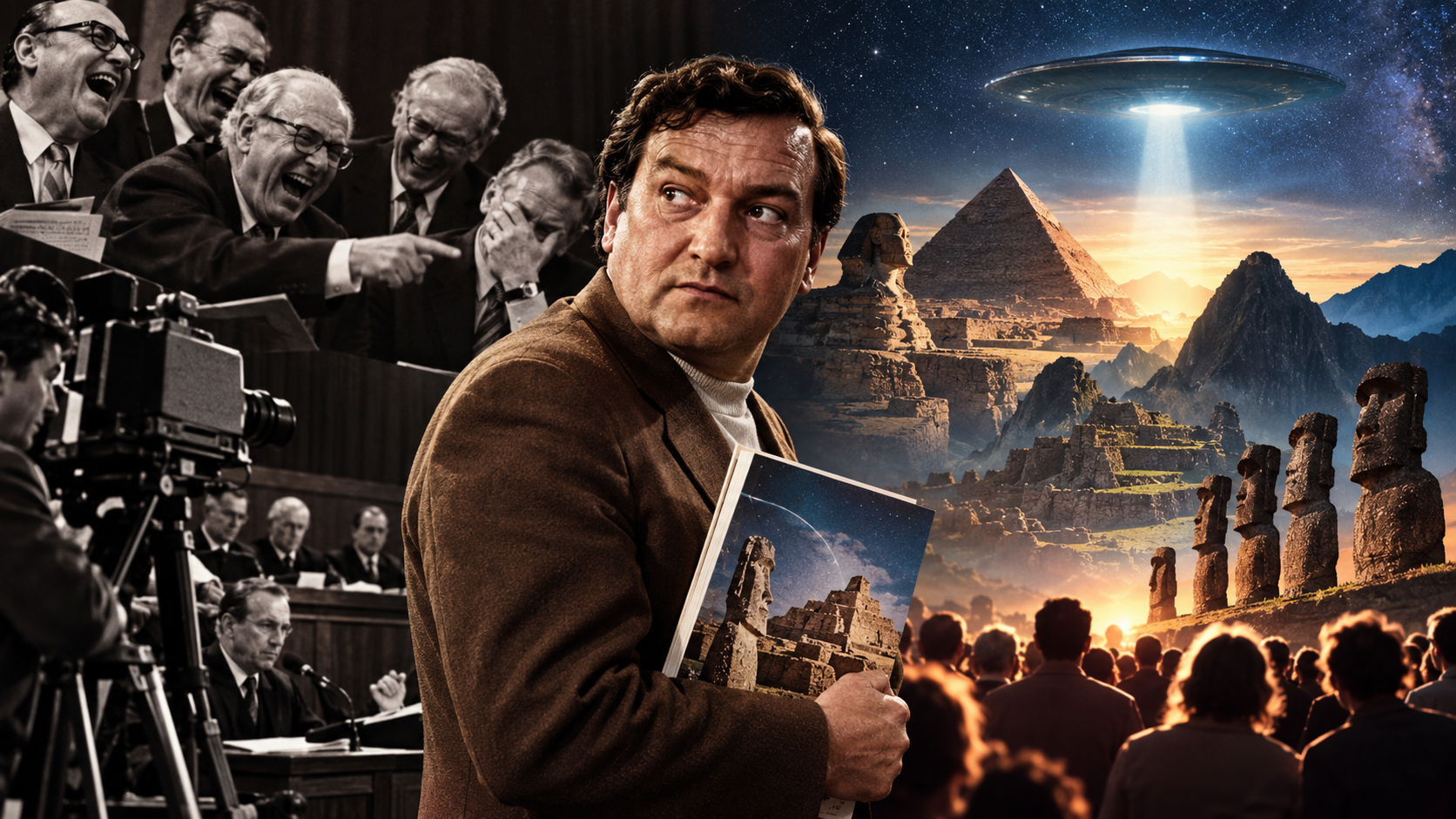
In March 1970 Erich von Däniken was gluing paper bags in Regensdorf prison, near Zurich. He described the work in a letter to his wife dated the eighth of that month, which his authorised biographer later printed. "I glue bags here," he wrote. "Real bags."
Outside, other people were selling his books. Two years earlier a publisher in Düsseldorf had printed 6,000 copies of a slim volume by an unknown Swiss hotel manager, asking whether the gods of ancient myth had been visitors from somewhere else. By the time its author was gluing bags, the 6,000 had become several hundred thousand. A second book, written in a cell while he waited for his trial, had gone to press with a first printing of 100,000, and booksellers had ordered 92,000 of them before it appeared.
None of this is how the story was supposed to go. He had been arrested at Vienna airport. A court in Chur had convicted him of embezzlement, fraud and forgery and given him three and a half years. Reviewers had taken his claims apart, scientists regarded most of his evidence as nonsense, and German television would broadcast a documentary made to expose him. The books kept moving.
It is tempting to suppose that his achievement was to plant a new idea in millions of heads. The idea had been around for half a century. Charles Fort, an American collector of anomalies, wrote in 1919, "I think we're property," though one scholar of the subject notes that Fort did not believe his own explanations. Around 1959 the Soviet mathematician Matest Agrest proposed that the destruction of Sodom and Gomorrah read like an ancient description of a nuclear explosion. In Paris in 1960 Louis Pauwels and Jacques Bergier published Le Matin des magiciens, in which ancient visitors were one theme among many; French sales are put at between 859,000 and well over a million. Robert Charroux followed in 1963 with what one scholar calls the first book devoted to the idea in the strict sense, and in Italy Peter Kolosimo won the Premio Bancarella in 1969 for another. Whatever von Däniken did, he did it with an idea that was already selling.
The ancestor I did not expect to find is a science book. In 1966 the Soviet astrophysicist Iosif Shklovskii and a young American astronomer named Carl Sagan published Intelligent Life in the Universe. Its thirty-third chapter takes up the possibility that Earth was visited in historical times, and of Agrest's proposals it says that "such hypotheses are entirely reasonable, and worthy of careful analysis."
Then come the rules. The book marks Sagan's additions with small triangles, and on page 453, in one of the passages marked as his, he set out what a real record of contact would need. It would help if the account was written down soon after the event, if the encounter changed the society that experienced it, and if the visitors made no attempt to disguise what they were. Gods who live in the sky prove nothing, he pointed out, because there are few other places for gods to live, and so "we require more of a legend than the apparition of a strange being who does extraordinary works and lives in the sky." He offered one Sumerian legend that came nearer to his conditions and said such legends should be examined carefully.
Where the evidence failed, the book threw it out. It says that "no known ancient artifacts have been unambiguously connected with a cosmic visit." A rust-resistant iron column in India was "an outstanding example of primitive powder metallurgy." A rock painting in the Sahara that had been nicknamed the Martian god showed "an ordinary human being in a ritual mask and costume."
Two years later both exhibits appeared in a bestseller, as evidence.
What changed between the science book of 1966 and the bestseller of 1968 was not the question but the person holding it. I wanted to know how he came to hold it, and why nothing thrown at him afterwards made him let go.
Düsseldorf, 1967
He wrote the manuscript at night in the Hotel Rosenhügel in Davos, which he leased and managed, after the guests had gone to bed. Der Spiegel later reported that he worked until four in the morning. An acquaintance told the magazine he was like an explosive charge and let no day pass without whispering his message into somebody's ear.
When the typescript reached Econ Verlag in 1967, the publisher's readers disliked it. Erwin Barth von Wehrenalp, who ran the house, called it "the product of an emotional non-writer." According to the magazine's report in 1969, he changed his mind only after the author told him that the rocket engineer Wernher von Braun did not rule out the possibility of ancient visitors. Wehrenalp then hired Wilhelm Utermann, a screenwriter who worked under the name Roggersdorf. A business daily close to the publisher reported that Utermann totally rewrote the text. Von Däniken told his publisher that Utermann had worked through every sentence again. The royalty was split, seven percent to the author and three to the reviser.
The finished book did two things its predecessors had not combined.
It spoke in the voice of common sense. The religious-studies scholar Jonas Richter has shown how von Däniken appeals to what any sensible person would conclude from looking at the photographs, where the French authors had dealt in secret knowledge. Von Däniken asked questions instead of making claims, by his own count more than two hundred of them, and put the largest one in the title.
It announced its own persecution on the first page. The introduction predicts that "scholars will call it nonsense and put it on the Index of those books which are better left unmentioned." The reader was told in advance that expert rejection was coming and what it would mean, so that every bad review could be read as a prediction fulfilled.
Wehrenalp did not expect any of that. He sent the book out, Der Spiegel wrote, rather listlessly, in a printing of 6,000.
From 6,000 to 600,000
The first copies were ready in the last days of February 1968. The publisher placed a few advertisements in the trade's own journal and printed two posters that Der Spiegel called meagre. By the end of the year 171,000 copies had been printed. In January 1969 alone the trade sold 37,433, six times the first printing in a single month. By September 1970, 600,000 had been sold.
The reception ran the other way. Most reviewers, the magazine wrote, treated the book with kindly mockery at best and more often panned it. Hessischer Rundfunk called it a fairy-tale book for adults. A business paper had a word for the craze, Dänikitis, as if it were an infection. The German publisher of Robert Charroux accused von Däniken of copying, and Econ quietly added the Frenchman's title to the bibliography. The first German television network broadcast a documentary made to expose the storyteller.
Then there was the arrest. In November 1968 the police took him into custody at Vienna airport on a Swiss warrant. Three weeks later the book reached first place on the bestseller list.
The book survived its reviews. It survived the documentary. It survived a plagiarism charge. It survived the arrest, the trial and the conviction of its author, and it went on to survive his own admissions. In 1974 the journalist Timothy Ferris pressed him, in a Playboy interview I have only in published transcriptions, about a cave in Ecuador he had described exploring. He conceded that he and the explorer who disputed his account were each telling half the truth, and when Ferris asked which half was his, he answered that a writer who is not writing pure science is allowed some theatrical effects.
By March 1973, when Der Spiegel put him on its cover and tried to explain him, 17,000 readers had written to the publisher. The magazine had no sympathy for his thesis. Its conclusion is worth keeping because it came from people who wanted a simpler one: the success, it wrote, owed nothing to clever management and resembled a natural event.
I would not go quite that far. By the magazine's own account the timing helped, since the first printing came out ten months before Apollo 8 circled the Moon, and in Italy Peter Kolosimo's books on the same theme were booming at the same moment without a rewrite or a film behind them. At least one scholar of the belief, Wiktor Stoczkowski, is reported to give marketing a large share of the credit. One comparison points the other way. Charroux's book had been available in German since 1966 with much the same material, and the magazine put its sales at a paltry 58,000. That is consistent with the rewrite and its framing being a determining variable, and it does not make them the only one.
America came next. A documentary film of the book had its premiere aboard a Lufthansa jumbo jet and was nominated for an Academy Award, and at the start of 1973 an edited version went out on American network television, narrated by Rod Serling. Depending on the account, Bantam took orders for 350,000 copies within a day or sold a quarter of a million in two. The accounts do not agree on the network, and the figures trace back to the author's own side. Nobody disputes the direction.
Chur, February 1970
The mockery reached its most complete form in a courtroom.
Von Däniken, by then thirty-four and the former manager of the Rosenhügel, sat with the prosecution and the defence behind him, facing five judges of the cantonal court of Graubünden. The court had allowed cameras in. The witness was Dr. Erich Weber, director of the psychiatric clinic at Beverin, and Gerhard Mauz, who covered trials for Der Spiegel, wrote that Weber was so large and so solid a man that he seemed to have stepped out of a mural by Hodler.
Weber read aloud from a letter written by the defendant's mother, and in doing so told the court something that, Mauz noted, the prosecution could not have introduced itself, that the father had once been in prison. He discussed at length, in open session, whether the defendant was homosexual or bisexual, and then observed that the sexual side was of little importance to his assessment. He summed up the defendant in a phrase, which in my translation runs: many little feelings, but no feeling. He said he could make nothing of the book's title, Memories of the Future, because he personally could not, in God's name, remember the future. He asked the court to forgive the style of his own report, since he did not have a ghostwriter at his disposal. Mauz called the testimony a verbal execution.
On 13 February the court sentenced von Däniken to three and a half years and a fine of 3,000 francs. Der Spiegel later noted that the fine was exactly what his books were earning him each day he spent in custody. By the time the sentence was read, his debts had been paid out of royalties. Five days later he was in Regensdorf.
So the simplest belief about ridicule, that it shrinks whatever it is pointed at, did not survive the record: the audience grew through every round of it I could find. Der Spiegel commissioned a poll in 1970 and found that about one German in four thought ancient visitors probable or possible, with a higher share among people who had completed academic secondary school than among those with only basic schooling. On his lecture tours the largest auditorium of the University of Hamburg, with 1,800 seats, was filled past capacity.
The ridicule was everywhere. The damage was somewhere else.
Who the laughter reached
If the ridicule did not drive the audience away, the obvious next question is whether it drove anyone away at all. The answer I found was not in von Däniken's subject but in the one next door.
On 29 July 1968 the astronomer J. Allen Hynek testified to a committee of the United States House of Representatives. Hynek had been the Air Force's scientific consultant on unidentified flying objects for two decades. "There appears to be a scientific taboo," he said, "on even the passive tabulation of UFO reports." Two years earlier he had written in Science that scientists who saw something were reluctant to report it publicly and usually asked for anonymity.
Six months after his testimony a University of Colorado study directed by the physicist Edward Condon concluded that "nothing has come from the study of UFOs in the past 21 years that has added to scientific knowledge," and by the end of 1969 the Air Force had closed its investigation. The astrophysicist Peter Sturrock later described how journals declined papers on the subject because it was not respectable, and how the lack of papers kept it that way. "This process," he wrote, "is self-reinforcing."
The public showed no such reluctance. In 1966 Gallup found that 46 percent of Americans who had heard of flying saucers thought they were something real, and across the following five decades the figure moved between 47 and 57 percent.
Mockery, it seems, has a price, and the price is not the same for everyone. A man gluing bags in Regensdorf has no university chair to lose. A hostile review cost him nothing he had, and handed him further evidence for the introduction to his own book. He said something close to it himself. "I am not a scientific man," he told Playboy, "and if I had written a scientific book, it would have been calm and sober and nobody would talk about it."
The men who could have answered the question could not afford to ask it, and the man who could afford to ask it could not answer it.
That sentence is an interpretation, and its second half is better documented than its first. Hynek was talking about flying objects, not ancient astronauts, and his testimony carries over to von Däniken's subject only by analogy. That an archaeologist or an astronomer would have paid for taking the ancient question seriously is plausible. I have none on record saying so.
At this point I assumed I was looking at an accident of professional culture, the kind of taboo that grows by itself in any field with careers in it. Then I read a memorandum from fifteen years before von Däniken's book.
January 1953
For five days in January 1953, five scientists met at the request of the Central Intelligence Agency's Office of Scientific Intelligence to review the evidence on unidentified flying objects. The chairman was H. P. Robertson, a physicist at the California Institute of Technology, and one of the four others, Luis Alvarez, would later win a Nobel Prize. A CIA officer wrote up the meetings in a memorandum classified secret.
The panel found no evidence that the objects were a direct threat and worried instead about the reports. They were, it concluded, clogging "channels of communication," and they risked "the cultivation of a morbid national psychology in which skillful hostile propaganda could induce hysterical behavior."
The remedy sits under the heading Educational Program, which "should have two major aims: training and 'debunking.'" The debunking aim "would result in reduction in public interest in 'flying saucers.'" It "could be accomplished by mass media such as television, motion pictures, and popular articles." The memo gets specific. It suggests the Jam Handy Company, which had made wartime training films, and "Walt Disney, Inc. animated cartoons." It sketches the format: "The use of true cases showing first the 'mystery' and then the 'explanation' would be forceful." And it names two civilian saucer clubs that "should be watched because of their potentially great influence on mass thinking."
The formal recommendation was that the national security agencies "take immediate steps to strip the Unidentified Flying Objects of the special status they have been given and the aura of mystery they have unfortunately acquired."
One more name is in the memo. Hynek, the same man who would complain of a taboo in 1968, sat in as an associate member and suggested that amateur astronomers might be enlisted "to spread the gospel." In a paper published that same year he wrote a sentence he would later read into the Congressional record: "Ridicule is not a part of the scientific method and the public should not be taught that it is."
For a few hours I thought I had the explanation. Here was an intelligence service, on paper, proposing to lower public interest in a subject through television and cartoons, fifteen years before a scientific taboo was on the Congressional record and a Swiss bestseller was being laughed at across two continents.
The trail that is not there
The explanation does not hold.
I went looking for the programme. The CIA's own published history of the episode, written in 1997, records that the agency dropped a directive it had been drafting on the subject, and gives no account of the proposed educational programme being carried out. The Pentagon's historical review of 2024 calls the plan a proposal: there was, it says, "at least one" government proposal "to engage in an active 'training' and 'debunking' effort." I found no budget line, no contractor and no film in the published record, and neither have the researchers who have looked hardest.
No Disney cartoon about flying saucers made for the purpose has surfaced.
What does exist is thinner and more ordinary. The Air Force tightened its rules on releasing sighting reports later that year, and the link to the panel is an inference by historians sympathetic to the subject. In 1966 a CBS documentary with Walter Cronkite treated the subject sceptically. Robertson appeared in it, and a letter from another panel member, Thornton Page, reported from the Smithsonian archives, says he helped organise the programme around the panel's conclusions. That is one letter and one broadcast.
The same CIA history also says the agency's reconnaissance aircraft, the U-2 and its successor, accounted for more than half of all sighting reports from the late 1950s through the 1960s, and that Air Force investigators, who knew, explained them away as natural phenomena. Critics dispute the figure, which rests on officials' later estimates, and I cannot settle it. Even a much smaller number means that the category being made ridiculous contained, alongside the nonsense, some reports of real objects whose explanation was secret.
And whatever was or was not done, Gallup's figures, which begin in 1966, show no fall in public belief afterwards.
On von Däniken the record is blank. I found no agency file that mentions him and nothing in any of these documents that touches ancient astronauts. Fifteen years separate the panel from his book. Automated searches cannot reach every catalogue, so absence here means only that I looked and found nothing. On the evidence available, nobody arranged his humiliation, and the memorandum proves only that the idea of managed debunking existed, not that the culture which followed was engineered.
2021: the agencies say it themselves
That left the taboo without an author, which turned out to be the more interesting result.
On 25 June 2021 the Office of the Director of National Intelligence published a preliminary assessment of what it now called unidentified aerial phenomena. It reported that military aviators and analysts "describe disparagement associated with observing UAP, reporting it, or attempting to discuss it with colleagues," and that, although the stigma had lessened as senior figures engaged with the subject in public, "reputational risk may keep many observers silent, complicating scientific pursuit of the topic." NASA's independent study team wrote in September 2023 that the stigma "almost certainly leads to data attrition at present." It added that members of the team had colleagues who "were warned to stay away from research in areas like extraterrestrial technosignatures."
Neither report found evidence of anything extraterrestrial, and their complaint was narrower: people well placed to observe were reluctant to speak, and the data suffered for it. The 1953 panel had wanted fewer reports from an excitable public, and seventy years on two government bodies were describing trained observers going quiet.
Nothing in the record requires a director for that. The political scientists Alexander Wendt and Raymond Duvall made the argument in 2008, in a paper that deserves the credit for it: what governs the subject, they wrote, is an "authoritative taboo," which they set in direct contrast to conspiracy theories, since those "assume that a decision has been made." Their explanation is structural, and mine is a plainer reading of the same thing: a taboo of this kind needs no decision behind it, only a great many separate, sensible calculations about a career.
The question changes owners
Ridicule does not kill a question. It changes its custodians.
In the case with the best documents, the unidentified objects, both halves of that claim are on paper. The public stayed, and official reports say reputational risk may have kept many pilots, analysts and scientists quiet.
In von Däniken's case I can document one half and only argue the other, and I would rather say so than blur it. What I can show is that the conditions in the 1966 book did not reach the public alongside the question. By 1974 Sagan was telling Playboy that every time von Däniken saw something he could not understand, he attributed it to extraterrestrial intelligence.
What the public got on this question was television: the Serling special and its sequels, then a syndicated series with Leonard Nimoy that ran to more than 140 episodes, then a theme park in Interlaken that closed after three and a half years, then a cable series, Ancient Aliens, which began with a pilot in March 2009 featuring von Däniken and by spring 2026 had reached 22 seasons and 283 episodes.
The other half would be that qualified people stayed away from the question because of him. I looked for a scientist who said so and did not find one. A small literature on searching for alien artifacts in the solar system continued through the 1980s and after, in journals such as Icarus and Nature, and the papers I could check do not mention him or any stigma. One physicist who works on the idea gives a practical reason for its neglect: listening to stars is easier. The NASA panel's line about technosignatures is as close as the record comes. So the claim that he made the subject untouchable for scholars is, for now, a hypothesis that fits the pattern next door and lacks a witness of its own.
What can be measured is what the public came to believe. Chapman University's annual survey asked Americans whether they agreed that aliens visited Earth in the ancient past. In 2015, 20.3 percent did. In 2018 it was 41.4 percent. The wording of the item shifted slightly in 2017, the series stops there, and an archaeologist who tied the rise to television and podcasts was offering an inference. Whatever moved that number, it was not Sagan's three conditions.
One feature of the careless version is concrete. The archaeologist Kenneth Feder, writing after von Däniken's death, pointed out that he "never questions the inherent ability of ancient Greeks to construct the Parthenon or Romans the Colosseum." The doubt fell on the builders of Giza, of Tiwanaku, of Easter Island. A question about evidence for contact, asked without rules, carried a standing suggestion that people outside Europe could not have built their own monuments.
A question does not become less important when the careless answers have the larger stage. It becomes easier to answer badly.
The strongest objection
The strongest counterargument accepts this whole record and says the explanation is simpler. Von Däniken was ridiculed because he was wrong, demonstrably and repeatedly, about the pillar, the painting and the cave. Scientists did not pursue ancient contact because there was nothing to pursue. The 1966 book itself said no artifact had ever been connected to a visit, and that remains true. Ridicule, on this view, is how a community of experts enforces its standards cheaply, without convening a tribunal for every claim. The same applies to the flying objects: the Colorado study, the National Academy of Sciences that reviewed it and the Pentagon's 2024 history all found the evidence poor. A subject with poor evidence being marginal in science is the system working as intended.
This objection is serious and most of it is correct. Poor evidence is a sufficient reason for his reception, and the claim made here concerns a side effect, not the justice of the laughter. Mockery is a blunt instrument that attaches to topics and to anyone standing near them, and cannot be aimed at a single argument. Two official bodies with no interest in vindicating believers have now said in writing that stigma may be, and in NASA's words almost certainly is, costing them data. The objection explains why von Däniken was dismissed, but not why a military pilot with a radar track would keep quiet, or why the careful version of a question should have had so small a public voice while the careless version had a television series.
There is a simpler explanation for the audience too. Spectacle may just be a better product than uncertainty. Sagan offered conditions and competing explanations, and von Däniken offered photographs and questions left hanging in the air. No professional stigma is needed to explain why one of those formats travelled further on television. I think that explanation is also correct, and it can sit beside the reputational cost documented for aerial phenomena without replacing it.
It would be comfortable to finish with a charlatan who got rich and scholars who were right, and both of those things are true. They do not account for what the audience was left with.
The mechanism would not apply if the evidence ran differently. If qualified researchers could be shown to have investigated such questions freely, in public and without penalty, while the popular versions flourished anyway, then mockery would have selected nothing and the transfer would be a matter of taste and timing. The artifact papers are a partial case of exactly that, and they count against me. If the official statements about stigma were withdrawn, or if reporting rose after they were made without any change in the reputational cost, the documented half would weaken too.
Regensdorf, again
He was released, by his biographer's account, in August 1971. He wrote dozens more books, opened and lost a theme park, and died on 10 January 2026 in a hospital near Interlaken, aged ninety. The obituaries put his sales at between sixty and seventy-five million copies, figures that come from him, his agent and his publishers. A new season of the cable series built on his book began that same month.
The letter about the bags reads differently once the rest is known. A court, a psychiatrist, the reviewers and a television network had each taken their turn with a man who had no standing to lose, and he was still a prisoner gluing bags whose royalties covered his fine every day.
The three conditions are still on page 453 of a book from 1966, and the cable series is in its twenty-second season. A reader who wants to know whether anything in the old stories deserves a second look can find the careful literature, if someone tells them it exists. The version that will find them first has had the larger stage since 1968.
Evidence Map
Facts, interpretations, forecasts, and disconfirming signals.
Core claim. Ridicule did not visibly reduce the audience for von Däniken's question or for unidentified aerial phenomena. For aerial phenomena, official reports say reputational risk reduces reporting by professionals. That the same cost moved custody of the ancient-contact question toward people with nothing to lose is argued here, not documented.
Evidence level. Fact: the Robertson Panel's debunking recommendation (Durant memorandum, Condon Report Appendix U); official statements on stigma (ODNI 2021, NASA 2023, Hynek 1968); the trial and German sales (Der Spiegel 7/1970, 12/1973); the 1966 criteria, checked against the scan (Shklovskii and Sagan, pp. 453 to 455). Reported claim: American sales after the 1973 broadcast, lifetime sales, the CBS letter, the prison letter, the U-2 share of sightings. Absence of evidence: no budget, contractor or film from the debunking programme, and no agency record of von Däniken, has been found (Haines records only a dropped directive). Absence is not proof either way. Interpretation: that mockery costs the reputable more than the disreputable. Hypothesis: that experts avoided the ancient-contact question because of von Däniken. No witness says so.
What would confirm this. A researcher's own account of dropping artifact or contact work for reputational reasons; reporting of aerial phenomena rising where stigma is formally removed.
What would disprove this (disconfirming signals). Evidence that qualified researchers pursued these questions openly and without penalty while popular versions spread; an agency document connecting debunking policy to von Däniken, which would change the story entirely.
Watchlist. NASA and AARO reporting volumes; any post-2018 polling on ancient visitors; new releases from the CIA reading room on the Robertson programme.
Sources: Der Spiegel (1968 to 1973), Peter Krassa's authorised biography, Playboy (August 1974, via published transcriptions), Jonas Richter, Wendt and Duvall, Chapman University, Gallup, the Skeptical Inquirer, and January 2026 obituaries. Translations from German are mine. Where figures diverge, this has been noted.
Jerry van der Laan writes The Manifest Archive, Forensic Narrative Intelligence Writing on the systems beneath power, money, and history. He traces the structures beneath them.