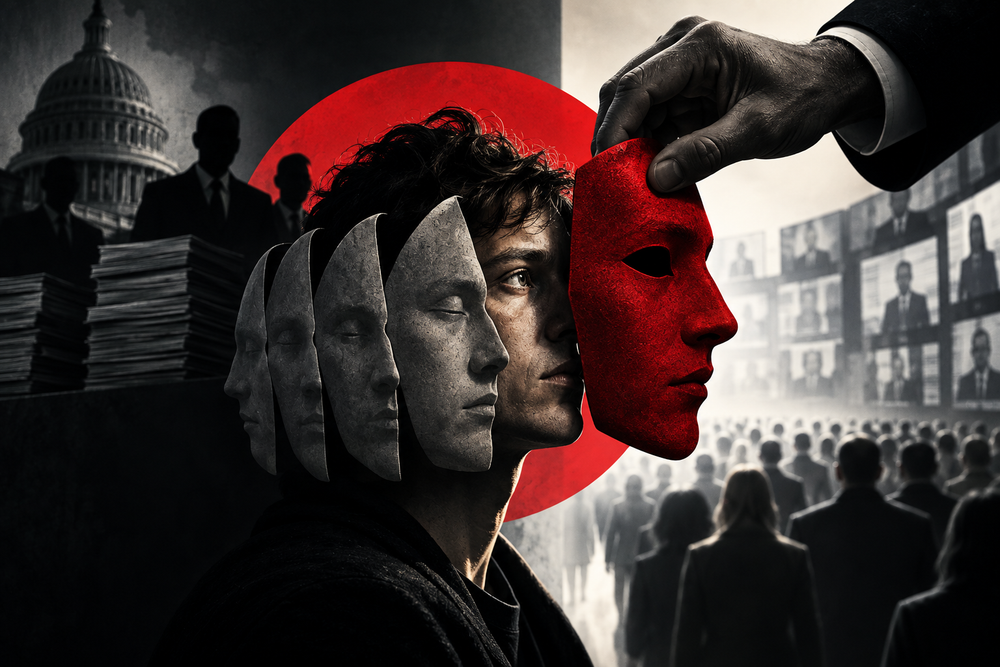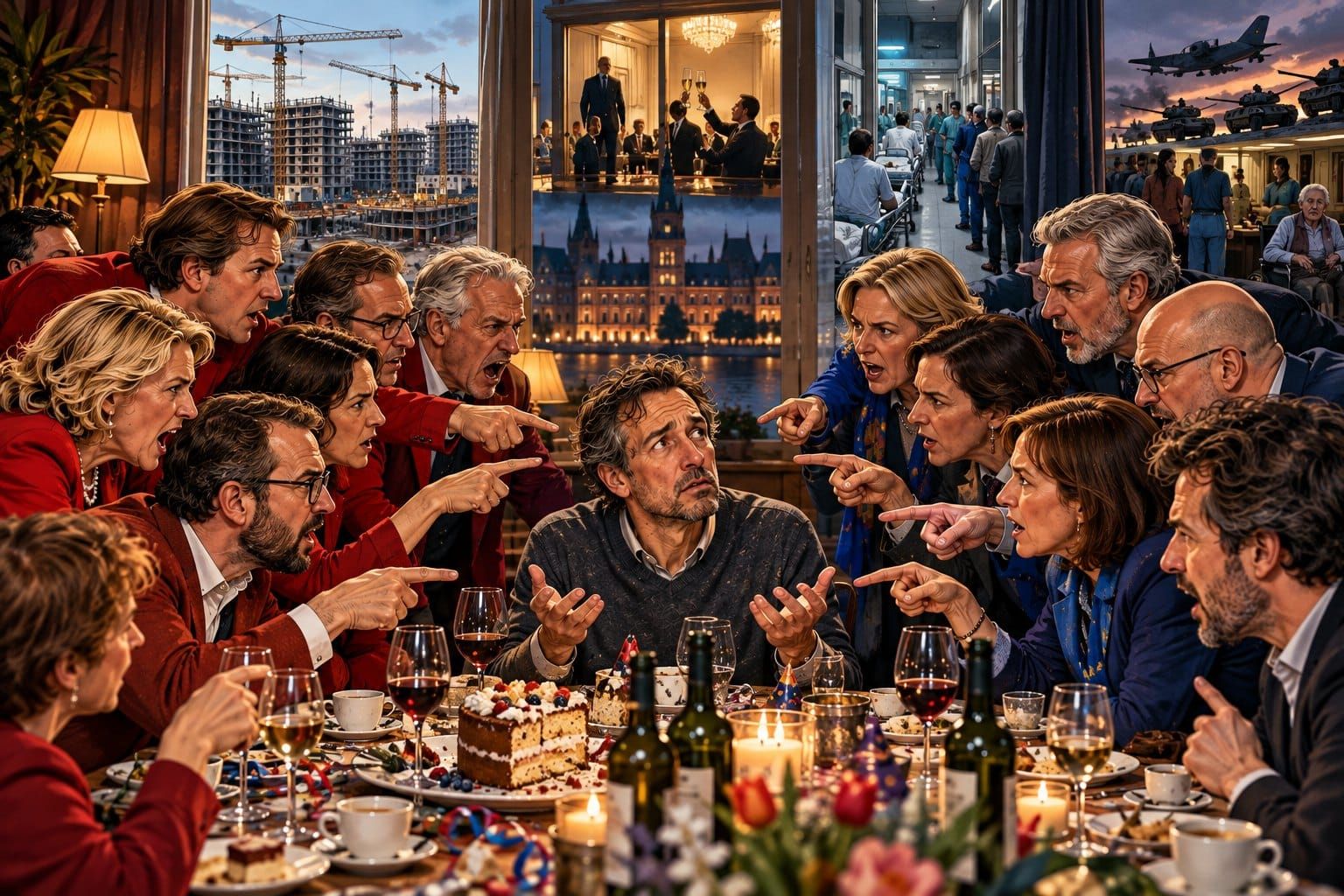
A man in his fifties notices that his son, who works full time, cannot find a home he can afford. He reads that the population keeps growing, and he asks whether construction can keep up. A woman visits her mother, who has been on a waiting list for a care home for months, and she asks how much public money goes to other things, reception of newcomers among them. A third person wonders why European governments are suddenly spending so much more on defence while hospitals and care homes run short.
None of the three needs a political programme. They are not against migration, international cooperation or defence. They are trying to understand how decisions made in The Hague and Brussels arrive at their kitchen table. Yet each of them knows how the conversation can go. Said out loud at a birthday party, at work or online, the first two questions are heard as far-right and the third as far-left. After a few times, people stop asking.
This article is about that moment: what happens to a question in the second after it is asked, why it happens, and who no longer has to answer once it has.
A birthday party, 2026: the question becomes a position
Since when did asking a question require choosing a political side? And why does the answer depend on who asks, rather than on whether the question is right?
Two different questions are being confused in that moment. One asks whether what this person says is correct; the other asks what the remark reveals about this person's politics. The second can sometimes help to understand the context of a remark. It never answers the first.
Take the question "Can the Netherlands house its current population growth?" That is a research question. It is not the same as "The Netherlands must close its borders." Yet the first can be heard as though the second had already been said. The same happens in the other direction. "What are the social consequences of cutting welfare provisions?" does not make the person asking it a radical, an opponent of enterprise or a supporter of every tax increase. In both cases the same shift takes place: the question becomes a presumed position, the position becomes an identity, and the identity becomes the answer.
That shift changes what has to be defended. Instead of examining whether the observation is correct, the conversation turns to whether the person making it belongs to an acceptable camp. A citizen who asks whether population growth is outpacing construction gets called far-right; another who questions the cost of a military programme gets called far-left.
Neither label answers the question.
The housing shortage does not disappear, and the cost of reception does not change, because the person asking about them has been assigned a political identity. The military expenditure does not become justified because its critic has been placed on the opposite side of the ideological spectrum. Both questions can be examined. Both claims can be tested. Both conclusions can be challenged. None of that happens once the argument shifts from what is being said to what kind of person is supposedly saying it.
A political label is not a factual rebuttal.
Those two questions go further than the familiar plea that critics should not be pigeonholed. They ask why a political identity should be a condition for hearing a question at all. Nobody needs to know where a citizen stands to check whether housing construction keeps up with population growth, or how much a reception budget is. The identity is not needed to examine the content, so there is no reason to demand it first. That moves the burden of proof. It is not for the citizen to explain that he is not extreme; whoever attaches a political meaning to his question has to show why that meaning follows from the question. And even when it does, even when the asker turns out to be exactly the partisan he was taken for, the original question still stands. A committed conservative can be right about a failure of migration policy, a committed progressive about a failure of defence policy, and someone with no party at all can be wrong about both. Evidence does not acquire a political identity from the person presenting it.
A question does not need a political identity. It needs an answer.
Question, claim, insinuation, proposal: four kinds of sentence
Defending the right to ask does not mean that every question is innocent. Some questions smuggle in a conclusion. "Why do all migrants refuse to adapt?" is not an open question; it contains a generalisation that would have to be established first. "Why does the government waste all our tax money on defence?" builds its verdict into the wording in the same way. An honest account has to separate four kinds of sentence.
An open question asks for investigation: can the housing supply keep up with population growth? A factual claim can be right or wrong: integration in this neighbourhood has failed, reception costs this much. A leading question carries an unproven assumption inside it. And a political proposal rests on values and interests: limit migration, build faster, move money from reception to care homes, cancel the programme or fund it.
A label is insufficient to judge any of the four, though they deserve different treatment: the open question an answer, the factual claim a check, the leading question an examination of its hidden assumption, and the proposal a debate about values. It is only at that last stage, and only by its content, that a label can sometimes carry real information: a proposal to strip people of rights because of their origin deserves to be called what it is. The political jacket, however, is often fitted much earlier, to open questions and factual observations; how often, nobody has measured. The person wearing it was describing the world, and he was answered as though he had proposed a policy.
The same distinction separates supporting a principle from checking its execution. Someone can support refugee protection and ask about housing capacity, support European cooperation and criticise its democratic control, support the energy transition and ask who pays. That is the ordinary work of a citizen.
Why, then, does the shift from question to identity happen so easily? Four explanations are supported by evidence. They reinforce each other, and none of them requires a conspiracy.
Why it happens, 1991 to 2023: the question becomes party property
The first explanation is political association. Some subjects become so strongly tied to particular parties that anyone who raises them is read as that party's supporter, whatever his own convictions.
In the Netherlands the questions about migration and integration are not minority questions. In February 2017 the current-affairs programme EenVandaag asked more than 29,000 panel members without a migration background, and 1,005 people with one, how integration was going: 78 percent of the first group and 40 percent of the second said it had not succeeded, and 85 percent and 67 percent agreed that migrants should try harder to integrate. In October 2023, 65 percent of voters told Ipsos I&O that they wanted the next cabinet to do more to reduce immigration. In November 2023 a party that campaigned on the subject won the most seats in parliament, and in 2025 a cabinet fell over asylum.
So the subject is hardly forbidden; it dominates Dutch politics. The claim has to be narrower, and it is my interpretation rather than a measured fact. Precisely because one party became so identified with the subject, the question itself came to be treated as that party's property. A citizen who asks about care-home waiting lists and reception costs is read as its voter, regardless of how he actually votes. The politics of the question is then debated, and the question is not answered. That is how a majority concern can be electorally dominant and still socially costly to raise, and why people who are not political at all feel that thinking about the subject has become a political act.
The pattern predates that party. In September 1991 Frits Bolkestein, then leader of the liberal VVD, wrote in the Volkskrant that integration had to be tackled boldly and that newcomers should accept the laws that follow from European liberal culture. The article caused a storm and he was accused of discriminating against Muslims. In March 2026, at the presentation of his biography, the VVD's parliamentary leader, Ruben Brekelmans, called him "the trailblazer for the discussion of decades later." Thirty-five years separate the accusation from the acknowledgement, and in between the question did not change.
Why it happens, Yale 2017: reasoning heard as allegiance
The second explanation is identity protection, and it goes to the heart of the experience of being put in a jacket for having used one's head.
In an experiment published in 2017, the Yale researcher Dan Kahan and colleagues gave American participants a small table of data and asked them to draw the correct conclusion from it. When the table was presented as a study of a new skin-rash treatment, the participants who were best with numbers did clearly better than the rest. When exactly the same numbers were presented as a study of a gun-control ban, answers split along political lines and accuracy fell. The split did not shrink among the most numerate participants; it grew. The participants were still reasoning, only about something else: what the conclusion would say about which side they were on. Kahan called this identity-protective cognition. The study shows that political identity can shape how people interpret numbers. It does not show that careful reasoners are therefore treated as politically suspect; that is my application of the mechanism to the experience this article describes.
Some care is needed in carrying that finding across the Atlantic and from guns to migration. But the mechanism fits the birthday party closely. A citizen sets out, step by step, why population growth, housing and care budgets might be connected. His listener processes the conclusion first as a signal of group membership and only afterwards, if at all, as a claim about the world. The logic is never refuted, because it is never evaluated as logic, and the more carefully the citizen reasons, the more clearly his conclusion seems to announce a side. A society expects its citizens to think critically, inform themselves and take part in public debate; when they do, their questions can be received as declarations of loyalty. That is the paradox at the centre of this article.
When a reflex becomes an advantage
Beneath these explanations lies a harder question. Is the shift from the question to the person asking it an unintended side effect of polarisation, or can it become a deliberate strategy for avoiding accountability?
Both are possible, and the difference matters. People can hear a question as a declaration of allegiance without ever deciding to; a listener may sincerely believe that a question about migration reveals hostility toward migrants, or that a question about military spending reveals opposition to defence. Political communication can also deliberately move attention from an argument to the credibility, motives or identity of the person making it. From the outside the two look much alike. A citizen asks why a decision produced a particular consequence; the question is associated with a camp; the conversation turns to whether he belongs to it; the decision itself receives less scrutiny. Nobody needs to have planned that diversion for it to occur, and nobody needs to have planned it to benefit from it.
It helps to separate the possible stages: a question about a problem and its cause; its interpretation as a political position; a discussion that moves to the identity of the person asking; less attention for the original question; less pressure on the responsible institution to account for its decision; and finally, perhaps, a political or administrative actor who learns to use that shift on purpose. Not every question passes through all six stages, and the model describes possible transitions rather than a law. Each transition has to be shown, case by case.
That also sets a rule for this article. Who benefits from the shift, who caused or amplified it, and whether anyone did so deliberately are three separate questions, and the first can never answer the third. Inferring intent from advantage would be committing the very error this piece criticises: attributing a motive before it has been shown. Evidence of strategy would have to show what an actor knew, what he said, whether substantive answers were available to him, and whether he repeatedly chose to discuss the critic instead.
A political label can begin as a reflex, become an advantage and, eventually, be used as a strategy. What happens when questioning the person becomes more useful than answering the question? The cases below are read with that in mind, and with the discipline of keeping effect and intent apart.
Why it happens, The Hague 2021: a cost question heard as a moral verdict
The third explanation is moral interpretation. A question about costs or feasibility is heard as a judgment about the worth of people or the legitimacy of a goal, and the person asking becomes morally suspect.
The Dutch argument about what migration costs shows this, and it also shows what an actual answer looks like. In March 2021 the researcher Jan van de Beek, with co-authors including the former CPB economist Hans Roodenburg and the emeritus economics professor Joop Hartog, published a study titled Grenzeloze verzorgingsstaat, "Borderless Welfare State." It concluded that immigration had cost the Dutch budget some 400 billion euros between 1995 and 2019. Including the second generation, it put the lifetime net cost of an average asylum migrant at nearly 475,000 euros and of a family migrant at about 275,000, while labour migrants made a net positive contribution of about 125,000. That is exactly the kind of number a woman whose mother waits for a care home wants to understand.
Three kinds of response followed, and each is on the record: a methodological critique of the calculation, a normative critique of what such figures might do to people, and remarks aimed at the researcher. They are not the same, and a moral objection is not by definition a diversion; the question is whether it is offered instead of, or alongside, an assessment of the numbers. Economists Jan Willem Gunning, Gerard de Vries and Alexander Rinnooy Kan answered with numbers: the study's annual cost estimate of 17.3 billion euros was clearly too high, its figure for public services was not based on data, and it wrongly assumed young migrants would behave at sixty as they did at twenty; their own estimate for 2016 was about 8.4 billion euros a year, under one percent of national income. That is a rival number, a named assumption and a checkable method, a debate that can be settled. Others answered with a label: critics quoted in later fact-checks argued that such statistics single out migrants from Africa and the Middle East and feed stigmatisation, and an opinion column later described the lead author as shopping selectively in the figures. And the government answered in between.
A member of parliament for JA21 asked the minister of finance, Wopke Hoekstra, whether he endorsed the 400 billion figure. In September 2021 the minister replied that he could not confirm it, raised objections about how costs had been allocated and the solidarity principle built into the budget, and added a sentence worth reading slowly: "People cannot be reduced to a simple sum of additions and subtractions along the yardstick of the euro." As a moral statement it is true. As an answer to a budget question it is beside the point. A question about what something costs was answered as though it were a proposal about what people deserve. Asked whether the government would map the costs itself, or have another institute do so, the minister said: "No, that is not for the Minister of Finance." In October 2023 the Netherlands Bureau for Economic Policy Analysis put migration on its research agenda; at the time of writing it has published no long-run fiscal estimate of its own.
Distortion runs in the other direction too. During the 2025 election campaign a political commentator claimed that every non-Western immigrant costs the treasury 600,000 euros on average, a figure that exceeds even the study's own highest per-person estimate, and that fact-checkers called an exaggeration. A label is not a rebuttal, and an inflated number is not one either. Part of the factual core of the care-home question was available all along: the 2025 budget for the admission and reception of foreign nationals was about 9.5 billion euros, according to the national budget figures cited in that fact-check, under one percent of national income. That is a different kind of number from the study's: one year's budgeted spending on admission and reception, not a long-run calculation of taxes paid and services used over lifetimes. The two cannot be compared directly, and a serious answer needs both. Whether some of that should go to care homes is a proposal about values, and reasonable people differ on it. The size of the sum is not a political position. As long as no government publishes its own long-run estimate, it is left to the most motivated people on either side.
A related mechanism works without any ideology at all. From the early 2010s the Dutch tax authority treated parents who had made administrative errors with the childcare allowance as deliberate fraudsters, often under the designation "opzet/grove schuld," intent or gross negligence. When parents asked what exactly they had done wrong, the classification was the answer. On 17 December 2020 a parliamentary committee of inquiry published Ongekend onrecht, "Unprecedented Injustice," finding that fundamental principles of the rule of law had been violated; a month later the government resigned. Tens of thousands of families had been affected. The label there was administrative rather than political, but it did the same work: it made examining the individual question unnecessary.
Why it happens, Kensington and Rotherham: who gains when the asker becomes the subject
The fourth explanation is institutional self-protection. When attention moves from the question to the person who asked it, the organisation responsible for the decision comes under less pressure to answer. This is not always demonstrable, and it should be tested case by case rather than assumed. Two official inquiries allow that test, and both show it at work, in two different forms.
Grenfell, 2016 to 2024: the messenger mattered more than the warning
On 20 November 2016, the Grenfell Action Group published a post on its blog under the title "KCTMO: Playing with fire!" The group was a handful of residents of Grenfell Tower, a council block in North Kensington, and one of its most persistent voices was Edward Daffarn, who lived on the sixteenth floor. For years they had written about fire safety, about the building's single staircase, about the way their landlord, the Kensington and Chelsea Tenant Management Organisation, handled complaints. This post went further than the others. The group, it said, firmly believed that only "a catastrophic event will expose the ineptitude and incompetence of our landlord."
Seven months later, in the early hours of 14 June 2017, a fire that started in a fridge-freezer on the fourth floor spread up the outside of the tower. Seventy-two people died. Daffarn got out.
When the public inquiry chaired by Sir Martin Moore-Bick published its final report on 4 September 2024, it described the years before the fire. Relations between the landlord and residents had become "increasingly characterised by distrust, dislike, personal antagonism and anger." The landlord regarded some residents as "militant troublemakers led on by a handful of vocal activists," and the report named Daffarn as the principal one. It had, the inquiry concluded, lost sight of the fact that the people living in the tower depended on it for a safe home.
The residents' tone was hostile, and the inquiry recorded hostility on both sides. What matters is the effect. Once some residents had been classified as troublemakers, their complaints could be read as expressions of who they were rather than as information about the building. Rather than being refuted, the question saw its askers classified, and the classification made it easier to set aside. Whether anyone at the landlord used that classification deliberately to avoid dealing with the complaints is something the inquiry's findings, as quoted here, do not establish; what they establish is the attitude and its effect.
Rotherham, 1997 to 2014: the label nobody had to say
The second inquiry shows a form of the mechanism that comes closest to the citizen's hesitation at the birthday party: the label that never has to be spoken, because the fear of it is enough.
In August 2014, Professor Alexis Jay published her independent inquiry into child sexual exploitation in Rotherham, a town in South Yorkshire. She estimated that at least 1,400 children had been sexually exploited there between 1997 and 2013, and that warnings from youth workers and earlier research had gone unheeded for years. Part of the explanation concerned the ethnicity of many of the perpetrators. Frontline staff involved in the work, Jay wrote, recalled "a general nervousness in the earlier years about discussing" the ethnic dimension, "for fear of being thought racist." Several described their nervousness about identifying the ethnic origins of perpetrators; others "remembered clear direction from their managers not to do so."
Nobody in that passage was called anything. Some staff were told by their managers to stay silent; others anticipated how a question would be classified, and so it was not asked, or was asked quietly and dropped. From the outside, the silence looked like agreement. The managers' instructions show that the reticence was not only social fear; it was also, at least in part, organisational. Whether institutional interests lay behind those instructions remains an open question on the findings quoted here. The children the system failed were among the most vulnerable people in the town.
The wider climate can be measured only imperfectly. For decades the Allensbach Institute in Germany has asked whether people feel they can freely express their political opinions or whether it is better to be careful. In its survey of September and October 2025, 46 percent said they could speak freely: about the same as in 2021, when the figure was 45 percent, and far below earlier decades, when well over two thirds said so. A survey of feelings is not proof of sanctions. But it describes the same anticipation Jay found inside a council. The closest Dutch measure is the annual National Freedom Survey of the National 4 and 5 May Committee. In February 2025, 65 percent of respondents agreed that in the Netherlands they can always speak out about their opinions, convictions and feelings, and people aged 35 to 64 more often said they do not feel free to do so than people over 65, 20 percent against 11. Feeling held back is not the same as being censored. And the survey does not ask about migration or integration, and I found no Dutch series that does; without one, the claim of a taboo and the denial of one can both be made without evidence. In Europe, questions about migration and identity also carry the memory of the 1930s, and the fear of being associated with that history often protects against real dangers. It can also stop legitimate questions before they are asked, by people with no sympathy whatsoever for that history. That last point is my interpretation, and it deserves an investigation of its own.
Lay the two inquiries side by side and the function of the label becomes visible, without assuming anyone intended it. When the conversation is about who is asking, nobody has to defend the landlord's fire safety or the council's child protection. Moving attention to the messenger can reduce or delay the pressure to account for those decisions, without anyone having to hide anything. The inquiries did eventually hold the institutions to account; what the label cost was time, and in both cases the time had victims.
A label answers the question of who is asking. It never answers the question that was asked.
Iraq and the Lancet: two comparisons
Two further cases sharpen the picture, though they carry less weight and need more care.
In January 2003, with United Nations weapons inspectors still at work in Iraq, France and Germany said they were not convinced that war was necessary. On 22 January the American defence secretary, Donald Rumsfeld, called them "a problem" and said they represented "old Europe." That remark shows political framing: doubt about the case for war was treated as a matter of alliance loyalty. On its own it cannot prove that the doubts were set aside because of the framing, and I have found no documentation that the objections were deliberately neutralised by presenting them as disloyalty; the record shows only how the doubts fared. On 6 October 2004 the Iraq Survey Group reported that Iraq had held no stockpiles of illicit weapons when the invasion began, and that its weapons programmes had largely been abandoned in the 1990s. On 6 July 2016 the British inquiry chaired by Sir John Chilcot concluded that the judgments about Iraq's weapons had been "presented with a certainty that was not justified."
On 19 February 2020, The Lancet published a statement by twenty-seven scientists that included the sentence: "We stand together to strongly condemn conspiracy theories suggesting that COVID-19 does not have a natural origin." The letter did not mention a laboratory accident by name, but it was widely read as placing the hypothesis of a research-related origin in the same category as fabrications, and from February to May 2021 Facebook removed posts claiming the virus was man-made. In 2023 the US Department of Energy concluded with low confidence that a laboratory origin was most likely, and the FBI, with moderate confidence, said the same; in January 2025 the CIA leaned the same way, also with low confidence, while stating that both a research-related and a natural origin "remain plausible." The National Intelligence Council and four other intelligence elements have leaned toward a natural origin, and most virologists still favour a natural spillover. The point is not which is true. It is that a scientific hypothesis acquired a social meaning, and discussing it became a signal of which side one was on, before the evidence existed to settle it.
What the evidence can and cannot show
I cannot say how many labelled questions turned out to be wrong, and that matters. Public inquiries are held when something has gone badly, so the cases above are a biased sample by construction. For every Grenfell blog that proved right there may be many warnings that were labelled and also mistaken, and those leave no inquiry behind. Kahan's experiment was run on Americans and about guns. Institutional self-protection is a hypothesis to be tested in each case, not a law. What the evidence establishes is narrower and still important: in each documented case, the label did not test the question. It postponed the test, and the postponement had victims.
The strongest case for labels
The best defence of labels accepts everything above and argues that in a world of overwhelming information, labels are a necessary shortcut. Nobody can investigate every claim. People reasonably rely on signals about who is making an argument, because a speaker's record predicts the reliability of what they say. Some people do use innocent-sounding questions about costs or integration as a vehicle for hostility toward groups, and naming that pattern is a legitimate act. On this view, the cases above are failures of judgment in applying labels, and the fact that inquiries eventually corrected them shows that the system works, if slowly.
Much of that is correct. Heuristics are unavoidable, and a speaker's record is real evidence about the speaker. The claim here is narrower. A label is evidence about a person; it is not evidence about a building, a child protection system, a budget or the origin of a virus. Using it as a first filter can be reasonable; using it as the final answer is the failure every one of these records describes. Even an accurate label leaves the question exactly where it was. And self-correction that arrives after seventy-two deaths and 1,400 children is correction in the record, not in time. If institutions that relied on labels had shown, case after case, that the labelled questions were in fact examined and found wrong before anyone was harmed, this reading would not hold.
A birthday party, 2026: the question still waiting
Go back to the three people at the start: the father whose son cannot find a home, the daughter whose mother waits for a care home, the citizen who wonders about defence budgets. Their questions have answers, and some are uncomfortable for one side and some for the other. Reception costs are real and measurable, and they are smaller than the loudest claims. Most people, and a large share of migrants, say integration has failed. The cabinet embraced the commission's moderate-growth scenario in 2024 and has not yet built the means to steer toward it. Defence budgets are rising, and their trade-offs can be named and weighed. None of those answers can be reached while the conversation is about what kind of person is asking.
The Grenfell Action Group's post of 20 November 2016 still exists. It was entered into the evidence of the public inquiry, where it carries a document reference that begins with the three letters of the organisation it warned about. Written off in 2016 as the work of troublemakers, it had become evidence by 2024. Nothing in the words changed; only where people looked.
That leaves the question this article cannot yet close. Who benefits when a question disappears, and who, if anyone, made it disappear? Answering that requires evidence of intent, case by case. What can already be said is simpler.
Thinking critically about the consequences of political decisions is a form of public scrutiny, and a democracy depends on it. Asking a question is not choosing a side, and choosing a side does not decide whether the question is right.
Evidence Map
Facts, interpretations, forecasts, and disconfirming signals.
Core claim. A question can be converted into a presumed position and then into a political identity, which then serves as the answer. Four explanations are supported by evidence: political association (the question becomes a party's property), identity protection (reasoning on charged subjects is heard as allegiance), moral interpretation (cost questions heard as verdicts on human worth) and, case by case, institutional self-protection. Whether the shift is ever used deliberately is treated as an open hypothesis. In the Grenfell and Rotherham cases the inquiries document that attention went to the messenger or that questions went unasked; that this reduced the pressure on the institutions is an inference, not a measurement, and intent is established in none of the cases examined here. In the Dutch migration debate this shows as majority questions answered by deflection or label and no official long-run cost estimate. In the Grenfell, Rotherham and childcare-benefits cases, official inquiries later exposed failings that had not been sufficiently examined or taken seriously when they were first raised, after harm had occurred; Iraq is a comparison, and the origin of COVID-19 remains unresolved.
Evidence level. Facts: high (EenVandaag survey 2017; Ipsos I&O 2023; Kahan et al. 2017; parliamentary answers 2021Z13767; Grenfell Tower Inquiry Phase 2 report, 2024; Jay report, 2014; Ongekend onrecht, 2020; The Lancet statement and addendum; Iraq Survey Group, 2004; Chilcot inquiry, 2016; US intelligence assessments 2023 and 2025; Allensbach 2025). Interpretation: medium (that the label treats the question as the property of a party; that the substitution protects the original decision-maker; transfer of Kahan's US findings to the Dutch context). Selection bias acknowledged in the text.
What would confirm this. Future inquiries into institutional failures record early warnings that were dismissed through a classification of the people raising them; survey measures of felt freedom of speech stay at or below their current level.
What would disprove this. A Dutch government or the CPB publishing its own long-run estimate of the fiscal effects of migration would remove part of the Dutch claim. Systematic evidence that labelled warnings were, before harm occurred, examined on their merits and found wrong at a rate comparable to unlabelled ones; or inquiries that find early warnings were dismissed for documented substantive reasons rather than because of who raised them.
Watchlist. The UK national inquiry into group-based child sexual exploitation; implementation of the Grenfell recommendations; the Dutch recovery operation for benefits parents; any further declassified assessment of COVID-19 origins. Review: October 2027.
Sources. The Grenfell Tower Inquiry Phase 2 report (2024) and the Grenfell Action Group's blog post of November 2016 in the inquiry evidence; the minister of finance's answers to parliamentary questions on Grenzeloze verzorgingsstaat (2021); EenVandaag's survey on integration (2017); Euronews' fact-check of Dutch migration costs (2025); Alexis Jay's Independent Inquiry into Child Sexual Exploitation in Rotherham 1997–2013 (2014); the Tweede Kamer on Ongekend onrecht (2020); the Lancet statement (2020); the Iraq Survey Group's findings (2004) and the Iraq Inquiry (2016); Kahan and colleagues, Motivated Numeracy and Enlightened Self-Government (2017); the National 4 and 5 May Committee's National Freedom Survey 2025; the Institut für Demoskopie Allensbach's freedom survey (2025).
Related from The Manifest Archive
- Europe Argues About Asylum. Nobody Owns the Migration Total.
- What People Feel and What They're Told
- The Return of the Right: How Europe's Fear Became a Movement
- When Power Moves Up, Accountability Disappears
Jerry van der Laan writes The Manifest Archive, Forensic Narrative Intelligence Writing on the systems beneath power, money, and history. He traces the structures beneath them.