How China controls Iran's oil revenue, payment rails, and diplomacy without deploying any of it.
May 2026. Donald Trump flew to Beijing with a war on his hands that China could help end. This is the same Donald Trump who imposed tariffs on hundreds of billions of dollars of Chinese goods, banned Huawei from US telecommunications networks, restricted semiconductor exports to China, attempted to force the sale of TikTok, and built four years of foreign policy around the doctrine of strategic decoupling from Beijing. Then Iran became a war he could not end. Then he flew to Beijing.
The summit produced one substantive agreement, by the White House account: Iran can never have a nuclear weapon. There was no framework for achieving this. No timeline. No enforcement mechanism. Xi Jinping, by Trump's account, offered to help. He attached no terms to the offer. The summit ended. Analysts described it as inconclusive.
It was not inconclusive. It was the architecture functioning exactly as designed. China spent four years watching the United States build a confrontation with Iran it could not resolve, while simultaneously building the energy relationships, financial infrastructure, and diplomatic positioning that would eventually make Chinese cooperation indispensable. Trump spent four years trying to decouple from China. Then he boarded a plane.
Trump spent four years trying to decouple from China. Then he flew to Beijing. That is not a contradiction. That is the completion of a design.
The Summit That Produced No Framework
The official accounts of the May 14-15 meetings are thin. The White House said both leaders agreed that Iran can never have a nuclear weapon and that the Strait of Hormuz must remain open. Beijing's readout said only that the Middle East had been discussed, and led with Taiwan. Trump said afterwards that Xi had promised not to supply military equipment to Tehran and had offered to help open the strait. The first round of talks, at the Great Hall of the People, lasted about two and a quarter hours; the visit ended the next day with tea at Zhongnanhai.
During the same visit in which, by Trump's account, Xi offered to help on Iran, he issued a direct warning: if the Taiwan question is mishandled, the two nations could collide or even come into conflict. The sequencing is not a coincidence of agenda management. An offer to help and a warning of consequences, delivered during the same visit by the same leader, is not diplomatic accident. It is the simultaneous presentation of a carrot and a stick, both available, neither committed.
The joint communique that failed to materialize was not a failure of draftsmanship. Every summit of this scale involves weeks of pre-meeting text work by both governments' diplomatic corps. A communique exists when both sides want one to exist. China did not want a framework at the price currently on offer. The absence of a framework is China preserving its leverage for a higher bid.
Beijing's public line on Iran has long favored broader, multilateral formats over a bilateral US-China arrangement. This positioning is deliberate. Multilateral frameworks dilute bilateral accountability. They also create additional surfaces for Chinese influence over the process. The offer to mediate is more valuable than mediation itself, because an offer can be withdrawn, repriced, or conditioned at any point before it is redeemed.
What the summit confirmed, without either side stating it plainly, is that no exit from this conflict is available without Chinese participation. That confirmation is exactly the information China needed to establish before naming a price.
Beijing offered its help. That offer is not diplomacy. That is the opening bid.
The Energy Architecture
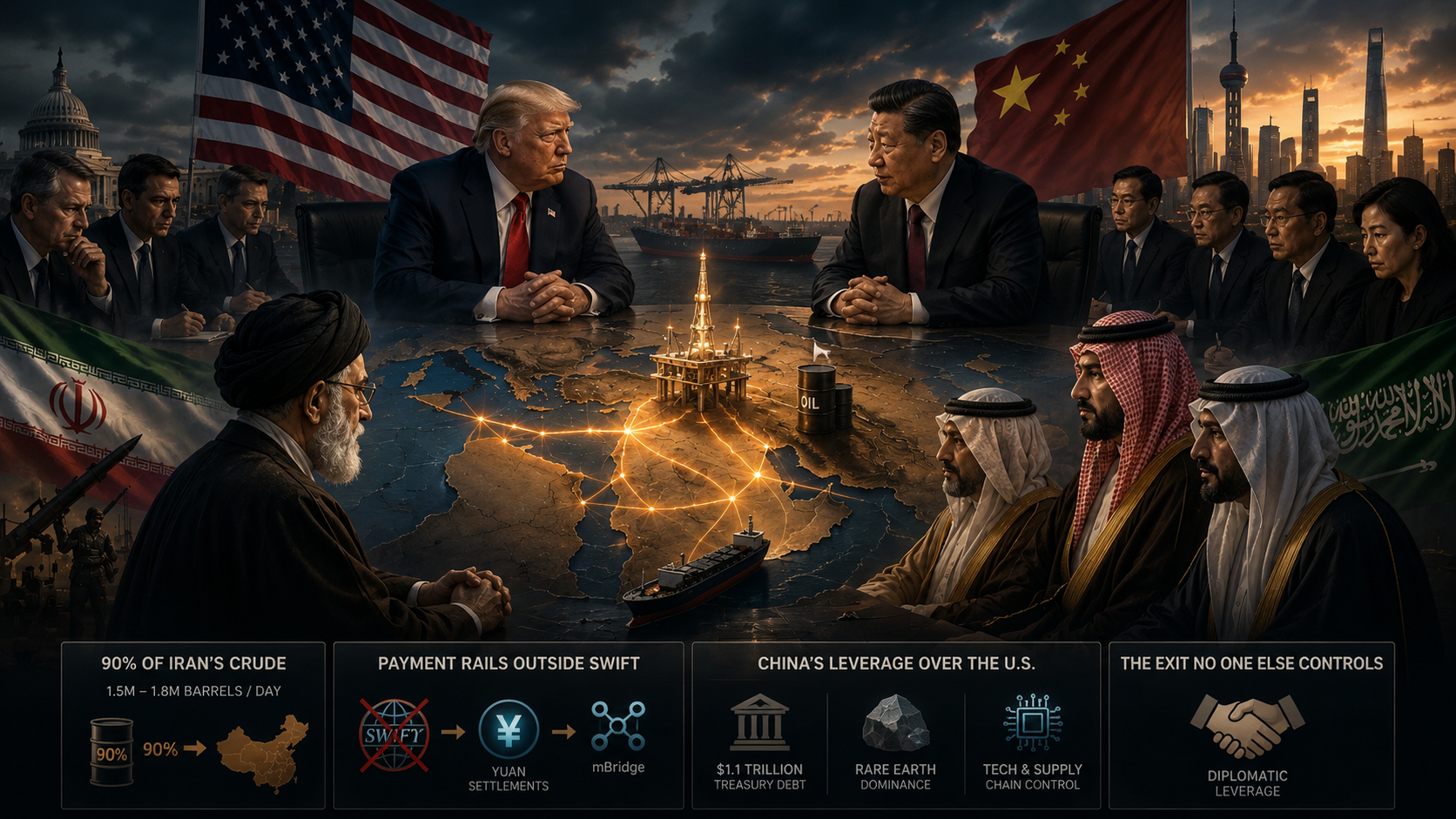
The numbers that define China's leverage over Iran are not disputed by any serious analyst. China purchases approximately 90 percent of Iran's exported crude oil. The volumes run between 1.5 and 1.8 million barrels per day depending on tanker routing and monthly fluctuation. The price is discounted significantly below Brent benchmark rates, because Iran has no alternative buyer willing to absorb this volume at international prices, so China sets the terms. Payment is denominated almost entirely in yuan, because the dollar-denominated international financial system is unavailable to Iran under the existing US sanctions architecture.
The downstream consequences of this arrangement are total. Iran's government revenue is a function of how much oil China buys and at what price. The IRGC's operational budget is downstream of government revenue. Iran's capacity to fund military operations, sustain proxy network relationships, and maintain the domestic political cohesion necessary to continue the conflict all depend on one purchasing relationship that China controls entirely, and has chosen not to use as a pressure mechanism.
The US maximum pressure campaign attempted to achieve through sanctions what China could achieve by simply reducing purchases. The campaign failed. It failed not because the sanctions were poorly designed but because they were designed for a system in which Chinese cooperation could be assumed or compelled. Neither assumption holds today. The sanctions remain on the books. Their enforcement against Iran's primary buyer has been limited to a handful of small refineries and terminal operators. The secondary sanctions that would reach Chinese financial institutions have not been deployed, because deploying them would require a financial confrontation with Beijing that Washington is not prepared to manage simultaneously with the military confrontation with Tehran.
On the Chinese side, the disruption from Hormuz instability is real but asymmetric. China imports more than 11 million barrels of crude oil per day, a significant share of it transiting Hormuz. Prolonged disruption raises Chinese energy costs, pressures industrial supply chains, and produces downstream inflationary effects that Beijing's policymakers take seriously. China has a genuine interest in reopening the strait. That interest is also precisely why China's leverage is credible: it is not a country that can ignore the costs of prolonged conflict indefinitely. It is a country that calculates when those costs are worth absorbing in exchange for structural positioning.
The US cannot reduce Iran's revenue without Chinese cooperation. That cooperation has not been requested at a price China is willing to accept.
The Financial Infrastructure
The sanctions architecture that the United States has deployed against Iran was designed for a dollar-denominated world. That world is measurably smaller than it was. The dollar's share of global central bank reserves has declined from approximately 70 percent in 2000 to about 57 percent today. The infrastructure being built around that decline is not theoretical. It is operational.
Since 2023, Saudi Arabia and China have had a currency swap line, and Riyadh has said it is open to settling trade in currencies other than the dollar. The mBridge project, a central bank digital currency platform built by China, Hong Kong, Thailand, and the UAE, which the Bank for International Settlements left in 2024, provides cross-border payment infrastructure that bypasses SWIFT entirely. By early 2026 it had processed more than $55 billion in transactions, according to the Atlantic Council. The platform is still formally a prototype, but it is moving real money.
Iran is not part of mBridge, but its own trade with China already runs outside the dollar system. Oil is paid for in yuan through small Chinese banks with little exposure to the dollar, and part of the revenue is settled in Chinese goods and projects rather than cash. The structure is not seamless. Iran faces persistent capital account constraints that Chinese infrastructure cannot fully resolve, but it is sufficient to sustain the relationship that matters most.
The mechanism runs as follows. Iran sells oil. Ninety percent goes to China. The price is yuan. Iran's earnings pile up in yuan. Iran's access to international finance runs through Chinese payment rails. Those rails sit largely beyond the reach of US sanctions enforcement. The US cannot cut Iran's revenue without Chinese cooperation. Chinese cooperation has a price. That price is not denominated in dollars. That is not a negotiating position. That is a financial architecture that was built while the world was watching something else.
The sanctions were designed for a dollar-denominated world. That world is smaller than it was.
Why China Is Not Rushing
Here is the structural question that Western analysis consistently avoids: if China holds this leverage, why hasn't it used it? The question presupposes that deploying leverage now would be optimal. It is not. Leverage deployed prematurely is leverage sold below its market price.
Every week the Iran conflict continues without Chinese mediation is a week in which China's eventual role as exit architect becomes more indispensable. The United States cannot end this war without Chinese cooperation. Iran cannot exit this war without Chinese financial support for whatever economic reconstruction follows the ceasefire. The post-war regional order, including energy pricing conventions, payment infrastructure architecture, and diplomatic alignment across Gulf states, will be shaped by whoever structures the exit terms. China intends to structure those terms. Entering the negotiation before the price is established would surrender that position.
The Taiwan warning issued during the same visit as the offer of help is the clearest available price signal. China's diplomatic engagement with the Iran conflict is not separable from its other strategic demands. It is packaged with them. Taiwan, semiconductor export control rollbacks, rare earth processing access, Belt and Road financing conditions: these are the currencies in which Chinese cooperation will ultimately be denominated. The Iran offer is the vehicle. The timing of the offer is the leverage.
This is not to say that China operates with perfect internal coherence. Beijing's foreign policy apparatus is not a single mind. The People's Bank of China faces real pressure from an energy import bill that has risen since Hormuz disruption began. The construction sector, already under significant stress from the property contraction that accelerated with Evergrande's 2021 default, absorbs further disruption from supply chain instability. There are voices within China's economic ministries, distinct from the foreign policy and security apparatus, that argue for faster resolution of the conflict. The strategic patience framing describes the dominant position at Xi Jinping's level. It does not describe the position of every institution with a stake in the outcome. The behavior at the summit level has been consistent. The pressure below that level is also real, and the distance between them is not zero. If Politburo Standing Committee deliberations reflected only reactive domestic pressure management, with no discussion of mediation timing as strategic sequencing, the architecture reading at the level of Xi's decision-making would require revision downward.
There is a secondary dimension that analysts regularly understate. Iran's oil, purchased at significant discount to international market prices, represents a structural subsidy to China's industrial base that has been running throughout the conflict. While the war continues, that discount persists. When the conflict ends and Iranian oil re-enters international markets at competitive prices, the discount disappears. China is, in a narrow fiscal sense, a beneficiary of the current arrangement, though not enough to outweigh the costs of prolonged regional instability, but enough to reduce the urgency of resolution below what Western analysts assume.
Timed patience is not restraint. It is strategy.
Three Scenarios and Their Structural Consequences
China's position is most clearly understood by examining what each possible outcome means for Chinese interests, not what it means for the conflict itself.
Scenario one: a US-Iran deal reached without Chinese mediation, probability 30 percent. The conditions required are specific: Iran accepts a verification framework the US can enforce without Chinese cooperation, or a European mechanism that excludes Beijing from the process architecture. Washington simultaneously offers sanctions relief sufficient that Tehran calculates independence from Chinese financial rails is achievable. Both conditions must hold at the same time. Neither is close to holding.
This outcome renders China's leverage irrelevant. It is the scenario China is most motivated to prevent, which is precisely why the conditions for achieving it are being made structurally difficult to assemble.
Scenario two: a Chinese-mediated settlement, probability 45 percent. This is the dominant scenario because it is the one China is actively positioning for. China provides the diplomatic channel that neither the US nor Iran can establish directly. China mediates on terms that neither side can replicate independently. China extracts its price in the process: reduced pressure on Taiwan, concessions on technology transfer restrictions, recognition of Chinese financial infrastructure as legitimate architecture in the post-conflict regional order. This outcome positions China as the indispensable architect of a new regional order designed in Beijing rather than managed from Washington.
Scenario three: protracted conflict, probability 25 percent. Iran absorbs the military and economic costs. China absorbs Iranian oil at a significant discount. The dollar's documented decline in energy pricing continues. The mBridge infrastructure matures. Yuan settlement normalizes across additional bilateral relationships in the Gulf. China pays a real cost in supply chain disruption. It also extracts a structural benefit: the acceleration of a post-dollar energy architecture that was already the strategic objective before the war began. The war has become a stress test of infrastructure China was already building. The infrastructure is passing.
Update, October 2026: the June memorandum between Washington and Tehran was brokered by Pakistan, with support from Qatar and other regional states, not by China, the outcome closest to scenario one. It did not hold: Washington declared it over on 8 July, and its sixty-day window lapsed on 17 August without extension.
The strongest counterargument to the strategic patience framing is not the supply chain exposure reading. It is more fundamental: China's foreign policy apparatus is not a coherent strategic actor that sequences leverage optimally. It is a bureaucracy with competing ministries, factional pressures within the Politburo Standing Committee, and institutional inertia that produces outcomes resembling strategy without requiring strategic intent. On this reading, China is not timing its mediation. It is simply slow. The appearance of patience is structurally indistinguishable from the appearance of calculated patience. This counterargument deserves to be taken seriously.
The architecture reading holds for observable external behavior and makes no claim about the internal process that produced it. Whether China's positioning results from deliberate sequencing or from bureaucratic inertia that happens to produce strategically advantageous outcomes, the leverage exists in either case. The price will be extracted in either case. The exit terms will reflect Chinese interests in either case. The behavioral evidence is consistent with the strategic reading: China has had the capacity to reduce purchases, condition mediation, and escalate financial pressure for months and has done none of these things. But behavior consistent with a reading does not confirm the reading. What it confirms is that the leverage is real and that it has not been deployed. The distinction between deliberate architecture and structurally identical output from slower processes is not resolvable from available evidence. It does not affect the structural conclusion.
The exit from this war will be structured. The question is whose terms structure it.
The Architecture of the Approach
May 14, 2026. Two leaders agreed, by the White House account, that Iran cannot have a nuclear weapon. The statement was accurate, unanimous, and functionally empty. It contained no mechanism for achieving what it described. No enforcement architecture. No diplomatic roadmap. No consequence for non-compliance. It was a statement of intention formatted as progress, released to audiences that needed to see movement.
The movement was in a different direction. Trump flew to Beijing because he had exhausted the alternatives. China received the US president, on a visit the war itself had forced him to postpone, at a moment when American leverage over the conflict's outcome was at its lowest point since the war began. The decoupling doctrine, the tariff architecture, the Huawei ban, the semiconductor export controls: none of these produced the strategic outcome they were designed to produce. They produced a war that required the cooperation of the country they were designed to contain.
The decoupling doctrine was designed to reduce US dependence on Chinese cooperation. The outcome increased it. That is not a policy failure. That is a design outcome.
The architecture of Chinese leverage over the Iran conflict was not built in response to this war. It was built across a decade of energy relationships, payment infrastructure development, and diplomatic positioning that treated the possibility of exactly this crisis as a planning assumption rather than an emergency. The war validated the design. The summit in Beijing was the first public evidence of that validation.
The financial architecture positions Iran as oil supplier and yuan recipient: a sanctions-testing laboratory for alternative payment infrastructure. The diplomatic architecture positions the United States as the pressure source that makes Chinese mediation necessary and therefore valuable. The energy architecture positions the Gulf states as hedges between dollar and yuan systems while both remain operational. The architecture assigns different pressure and different incentives to every actor within it.
China did not build leverage against Trump. It built leverage against whoever arrived.
The leverage architecture documented here has two deeper layers. The Iran War Triggered the Largest IEA Reserve Release in History. The Buffer Runs Out in July. Nobody Published the Date. maps the reserve arithmetic China is timing against: the buffer ends in mid-July, and every week without resolution makes Beijing’s position structurally more valuable. The diplomatic logic of a summit designed to produce no communiqué has a precedent: Angela Merkel Helped Broker a Peace Agreement in 2015. In December 2022, She Said It Was Never Designed to Bring Peace. Frameworks calibrated to expire are a documented architecture, not a diplomatic failure.
Related from The Manifest Archive
- The Iran War Triggered the Largest IEA Reserve Release in History. The Buffer Runs Out in July. Nobody Published the Date.
- 67 Days of Airstrikes Did Not Reopen the Strait of Hormuz.
- Everyone Is Watching the Iran War. Nobody Is Watching What Keeps the World Moving.
- The Five Mechanisms That Lock America Into Unwinnable Wars