Munich Security Conference 2007 to December 2021: How fifteen years of documented warnings, formal treaty proposals, and architectural red lines were consistently labeled rather than analyzed. And what that label replaced.
"Unprovoked."
The word appeared in virtually every Western government statement after February 24, 2022. In headlines, television banners, parliamentary speeches, NATO press conferences, think tank briefings, and newspaper editorials across the alliance within hours of the invasion. The word did not only assign blame. It determined where the sequence was allowed to begin.
If the invasion was unprovoked, the sequence begins in February 2022. The word makes that starting point appear natural rather than chosen. But if the sequence began earlier, the word performs a filtering function rather than a descriptive one.
The Question
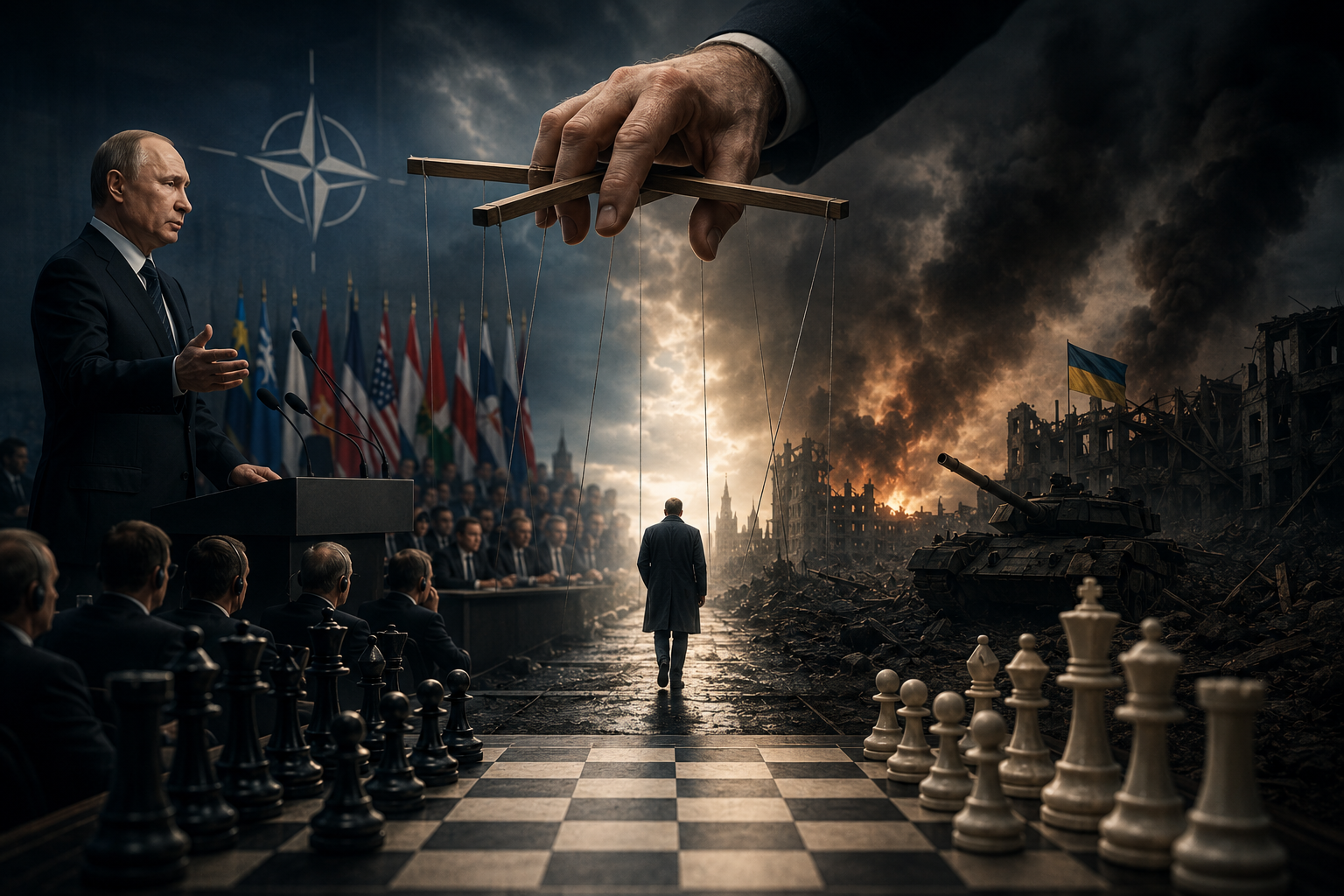
Munich. February 10, 2007. Vladimir Putin stood at the podium of the annual security conference and asked three questions. He asked what had happened to the assurances given to the Soviet Union at the end of the Cold War. He asked against whom NATO's expansion was directed. He asked whether anyone had considered what the world would look like when several nuclear states began interpreting global security conditions without shared frameworks. The conference hall contained defense ministers, foreign ministers, senators, and generals from thirty NATO member states and partner nations. The response was not substantive engagement. The dominant frame in Western coverage was that Putin had delivered a "sharp" and "threatening" speech. The questions were not answered. The label was applied.
The Munich Security Conference speech is publicly available in full transcript. Its content is not disputed. Putin's central argument was that the post-Cold War order had not delivered the shared security architecture promised at the end of the Soviet period. He cited the 1975 Helsinki Final Act, which established the principle that no state could strengthen its own security at the expense of another's. He said NATO's expansion violated that principle. He asked what the assurances made during German reunification had been worth: the assurances, given in 1990 by multiple Western leaders including James Baker, Manfred Woerner, Hans-Dietrich Genscher, and Francois Mitterrand, that the alliance would not expand eastward.
The questions were structurally coherent. They referenced documented events. Baker's February 9, 1990 assurance to Gorbachev, delivered at least three times in a single conversation, had been declassified and was available in the National Security Archive before the Munich speech was given. The Helsinki principle was written law, ratified by the United States. The sequence of NATO expansion, from Poland, the Czech Republic, and Hungary in 1999 through the Baltic states and four others in 2004, was public record. Putin was not asserting unknown claims. He was asking about the relationship between documented commitments and documented actions.
The Western response sorted the speech into a category. Coverage described it as a signal of aggression, a turning point, an indication of what Putin intended. The analytical frame that followed treated the speech as evidence of what Putin was rather than as a position that could be engaged. The substantive content of the questions, what had happened to the assurances, against whom the expansion was directed, was not addressed in any major diplomatic forum.
The speech asked documented questions. The response was a label. No major Western institutional framework publicly engaged them as legitimate security concerns.
The Architecture of the Label
Boris Yeltsin ordered tanks to shell the Russian parliament building in October 1993. He did so to dissolve a legislature that was blocking his economic reform program. Between 187 and 500 people died, depending on the count. The majority of Western governments and major media outlets characterized the action as a defense of democratic reform against anti-democratic hardliners. The vocabulary applied to Yeltsin was "reformer," "democrat," "partner in transition."
The same Western institutions applied different vocabulary to Putin after the Munich speech. The label was "authoritarian." A 2019 FAIR media study analyzed the fifty most recent articles using the term "oligarch" in the New York Times, CNN, and Fox News. Of the 150 articles, only two applied the term to Western billionaires. The remaining 148 reserved it for Russian and other foreign elites engaged in activities, political influence purchasing, media ownership, regulatory arbitrage, that are also routinely conducted by Western billionaires who are not labeled oligarchs. The semantic asymmetry has a temporal structure. The labeling intensified at specific moments that correlate with specific challenges to Western institutional arrangements, not with specific changes in the behavior being labeled.
The function of the label is not merely descriptive. It forecloses a category of analysis. When a leader is "authoritarian," his documented positions become expressions of authoritarianism rather than positions requiring engagement. The Munich questions become aggression. The December 2021 proposals become ultimatums. The entire fifteen-year record of documented communications becomes evidence for the label rather than content requiring a response. The label does not describe the record. It determines what the record is allowed to contain.
Labels do not describe. They determine what the record is allowed to contain.
Russian framing also developed its own semantic architecture. Terms such as "denazification," "historical unity," and "existential threat" performed parallel functions inside Russian domestic discourse. The existence of one narrative structure does not eliminate the need to analyze another.
The Pattern
Four months after the Munich speech, the warning received its most direct institutional test. At the Bucharest Summit of April 2008, NATO member states agreed that Georgia and Ukraine "will become members of NATO." No specific mechanism for membership was provided. The political commitment was made over the formal objections of Germany and France, with the strong support of the United States under President Bush.
William Burns was the United States Ambassador to Moscow in 2008. On February 1, before the Bucharest Summit, he sent a cable to Washington describing Ukrainian membership in NATO as a "bright red line" for Russia's leadership "across the political spectrum." He wrote: "In my two and a half years here, I have yet to find a Russian official, diplomat or serious observer who views Ukraine in NATO as anything other than a direct challenge to Russian interests." The cable was released by WikiLeaks in 2010. Burns was later appointed Director of the Central Intelligence Agency by President Biden.
In August 2008, four months after the Bucharest Summit, Russia invaded Georgia. Western framing described the invasion as unprovoked Russian aggression. The Bucharest context, the formal NATO declaration that Georgia would become a member, was referenced as background. The Burns cable, which had named the red line before it was crossed, was not widely discussed at the time.
In February 2014, the Ukrainian government of Viktor Yanukovych, which had declined an EU association agreement in favor of a Russian offer, was removed following months of protest on the Maidan. Victoria Nuland, then U.S. Assistant Secretary of State for European Affairs, said in a December 2013 speech that since Ukraine's independence in 1991, the United States had invested over $5 billion in supporting Ukrainian democratic skills, institutions, civic participation, and good governance. The figure was cumulative across twenty-two years. The speech was delivered while the Maidan protests were in progress, and Nuland described American support for the protesters as part of the same continuity of investment. A recorded phone call between Nuland and the U.S. Ambassador to Ukraine discussed preferred candidates for the post-Yanukovych government before it had formed. Russia annexed Crimea in March 2014. The dominant frame was Russian aggression. The 2013-2014 sequence was not analyzed as structural context in mainstream coverage.
The Minsk agreements followed in 2014 and 2015, presented as ceasefire frameworks. In December 2022, Angela Merkel confirmed to Der Spiegel that the agreements had been "an attempt to give Ukraine time." Petro Poroshenko, the Ukrainian president who had signed Minsk I, confirmed the same reading. The agreements presented as peace negotiations were, by the account of their own signatories, a strategic pause for military consolidation.
There is a contextual layer that is absent from virtually all Western coverage of Russian security policy: 27 million Soviet citizens died in the Second World War, more than all other Allied nations combined. The siege of Leningrad alone ran for 872 days. The city's civilian dead numbered approximately 800,000 people, more than total American losses in the entire war. They died within the same geography the invasion had crossed. The experience of invasion from the west, through what is now Ukraine and Belarus, is not rhetorical in Russian institutional memory. It is generational. The same geography produced Ukrainian losses on a comparable scale: the Holodomor of 1932-1933 killed three to five million Ukrainians under Soviet rule, and the German occupation of 1941-1944 killed another five to seven million. The trauma of the western frontier runs in both directions. The strategic logic of buffer states, of not allowing a hostile military alliance to position forces along the western border, does not require psychological explanation to be analyzed. It requires the same structural reading applied to any state that lost a fifth of its population in a war that entered through its western frontier within living memory. That context does not justify any specific policy. It does explain why the specific warnings were made, and why they were made consistently and formally across fifteen years.
Each escalation occurred after a documented Western action previously identified by Russian officials as unacceptable. Each Western action was presented as a response to Russian aggression. The sequence was circular. The frame held because the framing preceded the analysis. The institutional incentives to produce an alternative never materialized.
The pattern does not require a conspiracy. It requires an architecture.
The Proposals
In December 2021, Russia submitted formal treaty drafts to both the United States and NATO. These were not position papers or diplomatic talking points. They were specific, formatted legal documents with proposed treaty language. The core demands covered three areas: a prohibition on further NATO expansion, including the explicit exclusion of Ukraine; a ban on the deployment of offensive strike weapons in states bordering Russia; and limits on military exercises above defined thresholds in the territory of former Warsaw Pact states.
The United States response, delivered in January 2022, stated that the core demands were non-starters. The formal position was that the United States could not allow Russia to veto alliance membership decisions or dictate the deployment of forces within sovereign allied territory. This position has a coherent logic within the framework that treats NATO expansion as categorically benign. Evaluated against the documentary record, starting with the 1990 assurances and running through the Burns cable of 2008, it is also a refusal to negotiate the specific items that the responding government's own senior diplomat had identified fourteen years earlier as items Russia would go to war over.
The formal treaty texts were published and remain available. They contain specific language, not rhetorical demands. The rejection was clear. In the six weeks between the submission of the drafts and the invasion of February 24, 2022, the substantive content of Russia's proposals was not systematically analyzed in mainstream coverage. The dominant framing was that Russia was making threatening demands as a pretext for an invasion it had already decided to carry out. That framing may be accurate. It is also the framing that makes analysis of the proposals unnecessary. And the proposals, if analyzed, produce a question that the institutions covering the war had not produced: whether the specific demands were negotiable, and what would have happened if they had been.
Russia submitted formal treaty texts. The West rejected them. The invasion followed two months later. The relationship between those three facts was not systematically analyzed.
The Mechanism
The mechanism runs as follows. Putin made his position public in 2007 at a documented venue. The position was labeled rather than engaged. The label removed the position from the analytical frame. Subsequent documented warnings, in 2008 through Georgia, in 2014 through Crimea, were processed through the same frame. Each Russian action confirmed the label. Each Western action that preceded the Russian action was absorbed into the background. In December 2021, Russia made its position formal in treaty-language documents. The documents were rejected without public negotiation. In February 2022, the invasion began. Western governments described it as unprovoked. The fifteen-year documented record of positions, warnings, and formal proposals was absent from the description.
That is not a failure of intelligence. That is a mechanism.
The strongest counterargument to this reading does not dispute the documentary record. It accepts that the Munich speech was made, the Burns cable was sent, the proposals were submitted. It says: explanation is not justification. The world contains many provocations. States rarely invade their neighbors over them. Russia's invasion was a Russian decision, facilitated by Russian domestic political dynamics, by autocratic consolidation under Putin, by the historical mission Putin himself articulated about Russian statehood. The Litvinenko poisoning in 2006, the Skripal attack in 2018, the Navalny poisoning in 2020, the systematic suppression of internal opposition: these were Russian choices made independently of any specific Western trigger. NATO expansion was a necessary but not sufficient condition for the invasion. Russian agency was real and independent.
The counterargument is correct as far as it goes. The reading offered here does not claim that NATO expansion was the only cause, or that Russian decisions were determined by Western moves. It claims something narrower. NATO expansion was the variable Western institutions could have influenced. Russian officials consistently identified it as the variable they would respond to. The institutional refusal to engage that variable substantively across fifteen years is what produced the conditions in which the Russian decision became operational. The Russian decision was real. The Western institutional refusal to address the named variable was also real. Both can be true. The architecture is built from the second, not from the first.
The record was available before the analysis was produced. The analysis was not produced because the record was available.
Whether that mechanism was designed or emergent is a different question. The documentation makes the pattern visible. It does not resolve the question of intent.
The invasion was not preceded by silence. It was preceded by fifteen years of documented communication that was consistently labeled rather than analyzed.
The Absence
What is structurally absent from mainstream analysis of February 2022 is the Munich speech in its specific content. Not the fact that a speech was given, but the three questions it asked and the absence of substantive institutional response to those questions in the fifteen years that followed.
What is also absent: the Burns cable of February 1, 2008. The cable was written by an individual who later became Director of the CIA. It described, with precision, the condition that produced the 2022 invasion. Its existence means that the intelligence community of the United States had identified the specific trigger fourteen years before it was pulled. The analysis was available. The policy direction did not change.
What is absent: the RAND Corporation's 2019 report, "Overextending and Unbalancing Russia," funded by the United States Army and published three years before the invasion. The report identified specific methods to pressure Russia, including, under the heading of military options, "Providing lethal aid to Ukraine" as a measure that "could exploit Russia's greatest point of external vulnerability." The same passage warned that "any increase in U.S. military arms and advice to Ukraine would need to be carefully calibrated to increase the costs to Russia of sustaining its existing commitment without provoking a much wider conflict in which Russia, by reason of proximity, would have significant advantages." The report was a menu of cost-imposing options with explicit escalation warnings, not a blueprint. Lethal military assistance to Ukraine, one of the options the report identified, was initiated under the Trump administration in 2018 with the first Javelin anti-tank missile deliveries and expanded substantially through 2021 under the Biden administration, in the period immediately preceding the invasion. The relationship between the report's recommendations, the warnings that accompanied them, and the conditions that preceded the invasion was not analyzed in mainstream coverage of the war.
What is absent is the full content of the December 2021 treaty proposals alongside an honest assessment of which demands were negotiable. That assessment was made, implicitly, by rejecting the demands without public negotiation. The assessment was not published. The word "unprovoked" appeared in virtually every official Western government statement about the invasion of February 24, 2022. The word performs a specific function. It places the beginning of the relevant sequence at that date. The Munich speech becomes fifteen years of background. The Burns cable becomes a footnote. The RAND report becomes a coincidence. The December 2021 proposals become a pretext.
There is also the Budapest Memorandum of 1994. Ukraine surrendered its nuclear arsenal in exchange for security assurances from the United States, the United Kingdom, and Russia. The Russian annexation of Crimea in 2014 violated those assurances directly. The West offered sanctions. The structural lesson of that failure, what it communicated to every non-nuclear state evaluating its security posture, was not examined at the depth the Memorandum's significance warranted. The next time a non-nuclear state faced an existential security crisis, the Budapest Memorandum was cited in passing. The question of what it means that security assurances were given, violated, and responded to with sanctions rather than guarantees, was not the central frame.
One word. It determines what the record contains.
"Unprovoked" is not a description. It is an instruction about where to start reading.
"Unprovoked." The word is still in the record. The Munich speech is also in the record. The Burns cable is in the record. The December 2021 treaty texts are in the record. None of them appear in the same sentence as the word. The word makes that impossible, not by removing the record, but by deciding where the record begins.
No commission has traced the chain from Munich 2007 to December 2021 to February 2022 as a communication sequence that was consistently labeled rather than analyzed. No institution that funded the RAND 2019 report has assessed its relationship to the conditions that produced the invasion. No government that employed William Burns while he identified the specific red line has published an analysis of why the red line was then crossed. The record was available. The analysis was not produced by the institutions with the resources to produce it.
The architecture of this story has a place for every actor it contains. The speech-giver had a documented position. The institutions had a framework for labeling it. The defense contractors had revenue that depended on the expansion the label supported. The think tanks had funding from the contractors. The label had a function in the narrative the label sustained. The one actor the architecture does not account for is the one reading about an unprovoked invasion in a country where fifteen years of documented warnings were available, published, and archived before the invasion began.
The warning was public. The record was available. The analysis was not produced.
This analysis has two documented layers beneath it. "In 1990, James Baker Promised Russia NATO Would Not Move One Inch Eastward. There Are Now Thirty-Two Members" traces the institutional expansion that produced the conditions Putin's 2007 speech described. "Angela Merkel Helped Broker a Peace Agreement in 2015. In December 2022, She Said It Was Never Designed to Bring Peace" documents the Minsk layer of the same architecture, confirmed by its own architects.
Jerry writes The Manifest Archive, a forensic analysis of power, history, and the systems that connect them. Published daily at themanifestarchive.com.
Related from The Manifest Archive
- In 1990, James Baker Promised Russia NATO Would Not Move One Inch Eastward.
- Angela Merkel Helped Broker a Peace Agreement in 2015. In December 2022, She Said It Was Never Designed to Bring Peace.
- NATO Encirclement: How Three Rational Decisions Locked Eighty Years Into Place
- Defense Contractors Won Every American War Since Vietnam