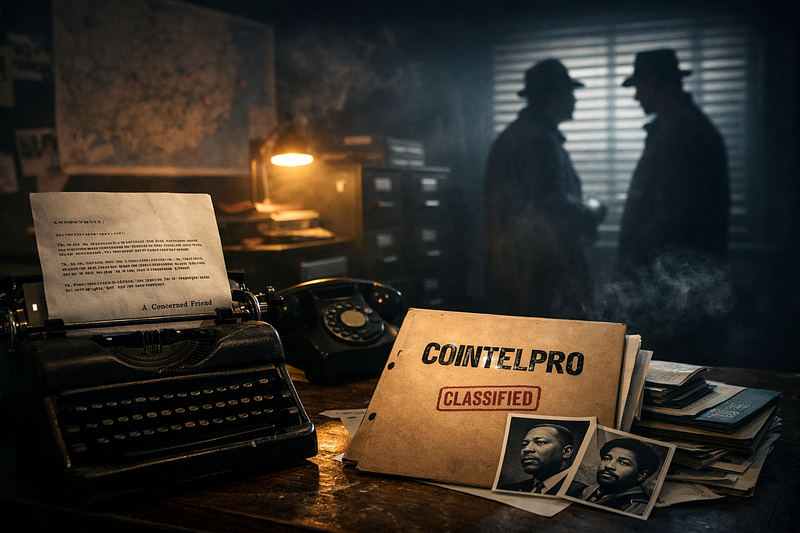
The letter does not arrive with threats. That is the first thing that stands out. No insults. No demands. No warnings. Only carefully phrased sentences, written as if someone took great care not to appear hostile.
Letters like this would later surface in FBI archives, described as preventive measures. At the time, it looked like concern set down on paper.
He reads it twice before sitting down.
The envelope had been waiting on the floor of the community center that morning. No return address. Inside, a single typed page. No handwriting. No emotion. Only details too personal to be coincidence.
It says people are worried. That he is gaining too much influence. That he may not realize the damage he is causing.
The letter does not present itself as an attack. Quite the opposite. Its tone is measured, almost caring, as if someone wants to help before things go wrong.
He knows immediately that something is off. Not because the accusations are false, but because of what the letter does. It places doubt exactly where trust used to sit. Not among opponents, but inside his own circle. What mattered was not whether the claims were true, but where they landed.
This was not accidental, and it was not isolated. It followed a pattern that had already been documented, catalogued, and quietly refined.
That evening, during the meeting, he feels the shift. Not silence. Something more precise. Looks that linger a fraction too long. Questions that trail off. Arms folded where there had once been nods. He says nothing wrong. He says less than usual. The room still responds differently. Afterward, no one stays.
In the days that follow, more signals appear. Calls that go unanswered. Meetings postponed without explanation. A local newspaper piece that mentions his name without allegation or evidence, but includes the word controversial. No one confronts him directly. They do not need to. The effect has already taken hold.
Nothing visible happens. No arrest. No raid. No courtroom. Formally, nothing occurs. That absence was the method. This scene did not unfold in one city, or around one movement. It was repeated, adjusted, and deployed according to instructions never meant for public view.
The program had a name
The method did have a name, though it was rarely spoken aloud. In internal documents it appeared as an abbreviation, as if even its authors preferred distance. COINTELPRO. Counter Intelligence Program.
In plain terms, COINTELPRO was a series of covert FBI programs, running from 1956 to 1971, that used surveillance, infiltration, forged documents, and media manipulation to disrupt and discredit American political movements the bureau considered subversive, from the Communist Party and the Ku Klux Klan to the civil rights, Black liberation, anti-war, and Native American movements. But to call it a department or a task force is to misunderstand it. It was a method. Formally initiated in 1956, it was not designed to respond to crime but to organization. Its earliest targets were communist networks, not for illegal acts, but for their ability to operate outside approved channels. The scope expanded quickly. Civil rights groups, anti-war organizations, Black self-defense movements, student collectives, feminist networks.
The documents are strikingly restrained. They avoid ideology. They avoid moral language. The concern is influence. An internal memorandum defines the goal with clinical clarity: to expose, disrupt, misdirect, discredit, or otherwise neutralize. The sequence matters. Exposure is optional. Disruption is central. Neutralization is the endpoint.
What was being managed was not crime, but coherence.
What is absent is as revealing as what is present. Legal terminology is rare. Arrests are often discouraged. Public confrontation is considered counterproductive. Visibility creates legitimacy. COINTELPRO was designed to avoid both. A recurring instruction appears across files: prevent the rise of a leader capable of unifying and electrifying a movement. This was not analysis. It was doctrine. Leadership, in this framework, was not a role but a vulnerability.
Who built it, and against whom
The program had an author, and his name was on the door. J. Edgar Hoover had run the Federal Bureau of Investigation since 1924, and would run it until his death in 1972, a tenure of nearly half a century across eight presidents, which is itself a fact worth pausing on, because it meant the bureau answered, in practice, to a single man who outlasted everyone with the authority to remove him. COINTELPRO was his instrument, and it was not a single operation but a sequence of named ones, each aimed at a category of American the bureau had decided was dangerous less for what it did than for what it might become.
The first, in 1956, targeted the Communist Party. Then, through the 1960s, the program widened into a series of fronts: one against what the bureau called white hate groups, including the Ku Klux Klan; one against the Socialist Workers Party, surveilled for decades despite never being charged with anything; one against the New Left, the student and anti-war movements; and the one that would consume the most resources and do the most damage, the program against Black nationalist groups, launched in 1967 and expanded in 1968. The overwhelming weight of that effort fell on a single organization. By the accounting of the later Senate investigation, the great majority of actions in the Black nationalist program were directed at the Black Panther Party, a group whose free breakfast programs for children alarmed the bureau as much as its rifles. The pattern is the tell. The bureau was not most frightened by violence. It was most frightened by organization that fed people and made them loyal.
The breakfast that frightened the bureau
Nothing exposes the program's true target more cleanly than what the bureau decided was its most dangerous enemy. It was not a weapon. It was a meal. The Black Panther Party ran a Free Breakfast for Children Program that, at its height, fed tens of thousands of children before school in cities across the country. In a 1969 internal memo, the bureau's own leadership identified this program, not the rifles, not the rhetoric, as the greatest single threat posed by the Panthers, because it was the activity most likely to win the Party lasting sympathy and support in the communities it served.
Read that again, because it is the whole logic in one sentence. An organization feeding hungry children was deemed the most dangerous thing the organization did, precisely because it worked, because it built the loyalty and legitimacy that no amount of surveillance could buy back once it took hold. The bureau understood, better than its targets sometimes did, that power is not most threatened by violence, which it is equipped to answer, but by competence and care, which it is not. A movement that protects its community becomes the community's, and a movement that has become the community's cannot be neutralized from outside. So the breakfast had to be stopped, and agents worked to do exactly that, spreading rumors that the food was poisoned, pressuring churches and merchants who donated space and supplies. The target was never the crime. It was the love.
Leadership as a structural threat
The logic of COINTELPRO becomes clearest when it turns toward leaders. Not officials, but figures whose authority flowed upward rather than downward. Martin Luther King Jr. was not targeted because he violated laws. He was targeted because he unified. Surveillance followed him relentlessly. Wiretaps were approved at the highest levels. Observation, however, was never the objective.
The bureau's own language gave the fear away. A notorious internal memorandum set out, among the program's aims for the Black nationalist program, the goal of preventing the rise of a messiah who could unify and electrify the movement, and named candidates for that role. The word is not rhetorical. It is classificatory. It treats charisma and unifying capacity as a category of threat, to be identified early and prevented, the way one would catalogue a structural weakness in a bridge. A leader, in this framework, is not a person with views to be answered. He is a load-bearing element to be removed before the structure can form around him.
The same logic appears in files on others described internally in that language of threat. Someone capable of uniting disparate groups posed a structural risk. Some targets were not killed. They were worn down. Followed. Discredited. Pulled into constant defense. Their time was consumed by response rather than organization, until the work of holding the movement together left no hours for the work of moving it forward. Visible repression provokes resistance. Invisible erosion produces collapse. The bureau strongly preferred the second, because the first creates martyrs and headlines, and the second creates only a slow, deniable fading that the movement itself will later be blamed for.
The letter to King
The anonymous letter described at the opening of this essay was not a literary device. It was a specific, documented object, and its most infamous instance was addressed to King himself. In late 1964 a package arrived at his home in Atlanta. Inside was a recording, assembled from bureau surveillance and meant to capture private moments, and a typed, anonymous letter. The letter was written to sound like the voice of a disillusioned supporter, someone who had believed in him and was now disgusted. It told him he was a fraud, that he was finished, and it closed with a line that has been read ever since as an instruction to take his own life, with a deadline attached, before a certain looming public moment. That moment was the Nobel Peace Prize, which King was about to receive.
The letter was written within the FBI, under the supervision of William Sullivan, one of Hoover's most senior deputies, and an agent was dispatched to Miami so the package would carry no Washington postmark. None of this is speculation. A copy of the letter was found, years later, in Sullivan's own office files, and the whole episode was laid out by the Senate committee that finally investigated the bureau. The letter did not challenge King's politics. It attacked his legitimacy and then his will to live. It sought to make him unusable as a symbol by making him hate himself, and it is the purest distillation of the program's logic ever committed to paper: do not arrest the man, do not answer his argument, simply find the most private wound and press on it until the public figure collapses from the inside.
The floor plan with an X
Where the method could not erode, it could escalate, and the clearest case is also the most chilling. Fred Hampton was twenty-one years old, the chairman of the Illinois Black Panther Party, a gifted organizer who had brokered a truce among rival Chicago gangs and built a coalition the bureau found alarming precisely because it crossed the lines that usually kept such movements apart. He was exactly the figure the files warned against, the one capable of unifying.
Inside Hampton's circle was a man named William O'Neal, his trusted head of security, who was also an FBI informant. In the days before December 4, 1969, O'Neal supplied the bureau with a hand-drawn floor plan of Hampton's apartment, with an X marking the bed where he slept. On the night of the raid Hampton did not wake, and the reason later emerged: he had been given a barbiturate, and he lay unconscious as Chicago police, acting on the bureau's intelligence, fired into the apartment. He was killed in his bed. He was twenty-one. The killing was loud and visible, the opposite of the program's usual quiet, but it came only after months of invisible preparation, of an informant placed at the very center of trust. That is the through-line. Whether the endpoint was a man hating himself or a man shot in his sleep, the instrument was the same: someone inside, turning the movement's own trust into the weapon used against it.
Infiltration as amplification
COINTELPRO did not invent infiltration. It systematized it. Informants were instructed not merely to observe, but to participate. To steer conversations. To escalate disputes. To push debates toward fracture.
In left-wing groups, infiltrators emphasized ideological purity. In Black liberation movements, generational and personal divisions were exploited. In anti-war organizations, strategic disagreements were encouraged until paralysis set in. The objective was never to win arguments. It was to prevent decisions. Internal documents repeatedly emphasize factionalism. Not chaos. Not rebellion. Division.
The techniques had a craft vocabulary. Letters were forged between rival leaders to manufacture feuds. Cartoons and poison-pen notes were planted to inflame. And there was a practice the activists came to call snitch-jacketing: spreading the rumor that a loyal, effective member was secretly an informant, so that the group would turn on its own and expel exactly the people holding it together. Suspicion alone, correctly placed, did the bureau's work for it. Once a movement turned inward, external pressure became unnecessary.
The elegance of snitch-jacketing is worth dwelling on, because it is the method's purest form. An informant who is merely discovered does limited damage; he is expelled, and the movement moves on. But a rumor that an innocent and effective organizer is an informant does far more, because it cannot be disproven. The accused cannot demonstrate the absence of a secret allegiance, and every denial sounds like exactly what a real informant would say. So the most capable people, the ones who threaten the bureau most, become the most plausible suspects precisely because of their effectiveness, and the movement does the bureau's removal for it, believing all the while that it is defending itself. The technique turns a group's healthy vigilance against infiltration into the very instrument of its infiltration. The bureau did not have to be in the room. It only had to put a question in it.
The actress who was not political
To see how far the method reached beyond famous leaders, consider someone who was not a movement at all. Jean Seberg was an American film actress, a star of French and Hollywood cinema, who gave money to civil rights causes and to the Black Panther Party. That was enough. In 1970 the bureau decided to neutralize her, and the chosen instrument was a rumor about her body.
Seberg was pregnant. In 1970 the FBI drafted a false story, that the father was not her husband but a member of the Black Panther Party, and passed it to the Los Angeles Times, which printed it in May as an anonymous gossip item. The bureau's own memo proposing the operation suggested it would, in its words, cause her embarrassment and serve to cheapen her image with the public. What followed is a matter of record. Seberg, by her husband's account, was so shaken by the very public lie that she went into premature labor in August, and her daughter died two days after birth. She buried the baby in an open coffin in her home town in Iowa so that people could see the child was white. She never recovered. Those close to her said she tried to take her own life on anniversaries of the loss, and in 1979 she died in Paris, in a death ruled a probable suicide. The bureau's goal had been to cheapen an image. The cost was counted in a child's life and, eventually, her own. No law was broken that anyone was ever charged with. A press tip had done it all.
The party that broke no law
If the program had been about crime, there is one target it would never have touched, and the fact that it pursued that target for decades is the clearest proof of what it was really for. The Socialist Workers Party was a small, legal, Trotskyist political party that ran candidates for office and never committed or seriously planned an act of violence. The bureau watched it anyway, not for years but for decades, and the scale of that watching only became public because the party sued the government and won.
In 1986 a federal judge ruled the bureau's conduct against the party unlawful and awarded damages. The court record documented what the surveillance had actually involved: more than two hundred burglaries of the party's offices and members' homes, in which agents had stolen or photographed nearly ten thousand private documents, alongside the long use of paid informants inside a lawful political organization. The party had broken no law. It had simply held the wrong ideas and organized around them, and for that it was burgled two hundred times. The judgment is one of the few moments in this entire history where the machinery met a courtroom and lost, and it stands as the legal confirmation of the thesis: the bureau was not policing crime. It was policing belief, and the act of organizing the belief was treated as the offense.
The movement that was occupied
The same method reached the newest movement of the era. The American Indian Movement rose at the end of the 1960s to confront the conditions of Native American life, and in 1973 it occupied the hamlet of Wounded Knee, on the Pine Ridge reservation, in a standoff with federal forces that lasted ten weeks and drew the nation's attention. The bureau answered as it always did, from the inside.
A man named Douglass Durham, a paid FBI operative, infiltrated the movement and rose to become its head of security, even serving as the personal bodyguard of one of its founders, a position that put a bureau asset at the very center of the movement's trust and safety. From there the familiar work could be done: feeding suspicion, shaping disputes, helping to discredit activists from within. The pattern is by now unmistakable, the same one that placed an informant beside Fred Hampton and a forged letter in front of King. Find the position of maximum trust, fill it with someone who answers elsewhere, and let the movement's own faith in its people become the channel through which it is taken apart.
Media as an indirect instrument
The program understood that media did not need to be controlled, only guided. Journalists were rarely given outright falsehoods. They were offered partial truths, anonymous tips, unverified claims. Enough to justify publication. Not enough to establish fact.
Coverage emphasized conflict over substance. Leaders were framed as divisive. Organizations as unstable. Attention shifted from demands to personalities. This required no censorship. Only selection. Media institutions did not view themselves as participating in repression. They believed they were reporting controversy. That belief enabled the process to continue unchallenged. The Seberg story is the model in miniature: the bureau never appeared in print, the columnist believed she had a scoop, and the damage was real precisely because everyone in the visible chain thought they were doing something ordinary.
The illusion of legality
One of COINTELPRO's most effective features was how rarely it relied on clear illegality. Much of its activity existed in procedural gray zones. Surveillance was justified under national security doctrines. Informants were protected. Anonymous communication was difficult to trace. When laws were broken, they were broken quietly.
This produced an illusion of legality. There were no trials, no overturned convictions, no visible legal anchor for harm. Damage occurred without a juridical event. Language was corrected. Function was not. A program that arrests no one and charges no one leaves no defendant, and a system without a defendant has no obvious place to hold a reckoning. The harm was real and the paperwork was clean, and for fifteen years those two facts coexisted because nobody outside the bureau could see both at once.
This is the deeper reason the program is so hard to teach and so easy to forget. History remembers crimes that produce a courtroom, a verdict, a name to convict. It struggles to hold a harm that produced none of these, a harm distributed across thousands of small acts, each individually deniable, none of them quite a crime on its own. The man who never got the job, the marriage that quietly failed, the organization that voted out its best member, the meeting where the trust had simply gone: each looks, from inside a single life, like ordinary misfortune. Only from above, with the files open, does the pattern resolve into a policy. That gap between the lived experience and the documented design is not a flaw in the method. It was the method's whole purpose.
The night the files walked out
The program was not ended by a court, a president, or a journalist. It was ended by burglary. On the night of March 8, 1971, while much of the country was watching the heavyweight title fight between Muhammad Ali and Joe Frazier, a small group calling itself the Citizens' Commission to Investigate the FBI broke into a small bureau field office in Media, Pennsylvania. They took no money and no weapons. They took the files, and then they mailed them to newspapers and members of Congress.
Among the documents was a routing slip bearing a word no one outside the bureau had seen: COINTELPRO. A television reporter named Carl Stern, pursuing that single word through freedom-of-information lawsuits over the following years, forced the bureau to disclose what it meant. What surfaced was not the misconduct of a few rogue agents but a structure, a standing policy, decades deep. The pressure built until the Senate convened the committee, chaired by Frank Church, that in 1975 and 1976 finally documented the program in public. The committee's findings ran to six volumes and thousands of pages, and they laid out, with the bureau's own memos as evidence, the King letter, the role of the informant in the Hampton raid, the surveillance of the lawful and the famous and the obscure alike. It is one of the most complete self-examinations a security state has ever been forced to perform, and the striking thing, reading it now, is how little needed to be alleged. The program had documented itself. The committee mostly had to read the files aloud. Hoover had in fact formally shut COINTELPRO down within weeks of the break-in, in the spring of 1971, sensing exposure. Public outrage followed the revelations. Hearings were held. Reforms were promised. Oversight mechanisms were announced. The program was officially terminated. The methods were not. What ended was attribution. What continued was practice.
From program to paradigm
After COINTELPRO disappeared as a named operation, its logic diffused. Surveillance expanded under new pretexts. Intelligence sharing deepened. Media ecosystems evolved. Neutralization no longer required coordination. Incentives replaced orders. Attention rewarded division. Funding followed compliance. Outrage became content.
What once required planning now emerged organically. Movements learned to self-moderate. Leaders learned to avoid coherence. Organizations fragmented preemptively. This was described as maturity. It was internalized control.
The reforms that followed exposure were real, and they mattered, and they were also narrower than the outrage that produced them. In 1978 a new law created a special court to oversee national-security surveillance, a genuine check that nonetheless operated in secret and approved nearly everything it was asked to approve. The deeper continuity is that each later expansion of surveillance was justified, like COINTELPRO before it, by a threat framed as too urgent for ordinary limits, and each was harder to see than the last, because it lived in data and procedure rather than in burgled offices and forged letters. The bureau's old problem, that its methods left a paper trail an activist could steal and a senator could read aloud, was solved not by abandoning the methods but by moving them into systems that produce no single document anyone can carry out a window.
In 1965 You Needed an Agent. Now You Need an Algorithm
The abstraction becomes concrete the moment you look at the movements of the last two decades, and it is important to say at the outset exactly what is and is not being claimed. There is no allegation here that any of these movements was run by a bureau, infiltrated on Hoover's model, or steered by a hidden hand. The claim is the opposite, and it is more unsettling. The patterns COINTELPRO once had to manufacture by hand now appear on their own, and they appear everywhere, because the conditions that produce them have been built into the infrastructure through which movements now live.
Run down the recent record and the old signatures are unmistakable. The movement against the Iraq war put millions into the streets on a single day in February 2003, the largest coordinated protest in human history, and within a year it had evaporated, leaving no durable organization and no leader who outlasted the moment. Occupy Wall Street made leaderlessness a principle, refused to name demands or representatives, and dissolved into procedural exhaustion and faction. The Tea Party rose as a grassroots revolt and was absorbed and broken into competing camps within a few years. Black Lives Matter built extraordinary reach and then spent much of its public life consumed by disputes over money, structure, and who was entitled to speak for it. Climate activism split along lines of tactics and purity, the disruptive wing against the institutional one. And across all of them ran the online layer, the callout, the purity test, the accusation of bad faith, the endless litigation of who is truly committed and who is secretly the enemy, the identity conflict that consumes the energy a movement needs to act. These are not the symptoms of bureau infiltration. They are, almost exactly, the symptoms COINTELPRO was designed to induce, arriving now without a designer.
This is the evolution that matters, and it can be stated as a single line. In 1965, to set a movement against itself, the bureau needed an informant in the room, a forged letter, an agent willing to spend months earning trust before betraying it. In 2026 it needs none of these, because the ranking algorithm does the work automatically, and does it at a scale no field office could dream of. An engagement-optimizing platform is not a political actor and has no interest in suppressing dissent. It has an interest in attention, and it has discovered that conflict holds attention better than agreement, that the purity test outperforms the patient coalition, that the most divisive voice in any movement will be amplified over the most unifying one, because outrage travels and nuance does not. So the platform surfaces the accusation and buries the compromise, rewards the faction and starves the synthesis, and elevates exactly the internal war the bureau once had to plant. The effect is identical to COINTELPRO and the cause is entirely different, which is what makes it so much harder to see and so much harder to resist. There is no letter to find in a senior deputy's files, no break-in that can expose it, no Church Committee that can read it into the record, because there is no author. The division is not an operation anymore. It is a business model, and it runs on the same human material the bureau exploited, the universal human readiness to suspect, to splinter, to turn on one's own.
Snitch-jacketing, the bureau's most elegant technique, now happens a thousand times a day without a single agent, as movements accuse their own most effective members of being compromised, sellouts, plants, grifters, and expel them on the strength of a rumor that cannot be disproven, exactly as the bureau intended, except that now no one had to start the rumor. The conditions start it. The architecture that COINTELPRO had to build by hand, at great cost and with a paper trail that eventually destroyed it, has been rebuilt as ambient infrastructure that costs nothing, names no one, and leaves no evidence because it requires no intent. That is not the program surviving. It is the program made unnecessary.
The disappearance of repression
As these mechanisms normalized, repression itself vanished from the language used to describe failure. Movements collapsed, and the explanations were ready. Ego. Strategy. Leadership. These accounts were not false. They were incomplete.
A society shaped by these dynamics appears stable. Dissent exists, but rarely coheres. Protest flares and fades. No movement sustains momentum long enough to threaten structure. This absence of resistance is mistaken for peace.
The shape is now so familiar it reads as natural. A cause surges, fills the squares and the feeds for a season, produces no durable organization and no leader who survives the scrutiny, and dissolves into recrimination over who betrayed it, who was too radical, who was too cautious, who was secretly working for the other side. Then the cycle repeats with a new cause, and the same explanations are offered, and no one reaches for the older word, because the older word implies an author, and there no longer appears to be one. That is the final achievement. The dynamics that the bureau once had to manufacture, the suspicion, the factionalism, the consuming internal war, now arrive on their own, accelerated by media that profit from the same division the bureau once had to plant by hand. The program does not need to run, because the conditions it created have become the weather.
What it cost
It is worth naming the cost plainly, because the program's genius for leaving no juridical trace also means it left no ledger of damage, and the absence of a ledger is part of how the harm stays abstract. The cost was a generation of American movements that did not cohere. It was leaders who spent their best years defending themselves against whispers instead of building, marriages and friendships poisoned by suspicions that turned out to be planted, organizations that expelled their most committed members on the strength of a rumor an agent had seeded. It was an actress's newborn daughter, dead two days after a premature birth. It was a twenty-one-year-old shot in his bed. It was the slow teaching of a lesson to everyone watching: that to step forward, to unify, to become effective, was to make oneself a target, and that the safest posture for a movement was to stay small, stay divided, and never produce the leader who might make it matter.
That last cost is the one still being paid, because it was internalized rather than imposed. A movement that has learned to distrust its own rising figures, to flinch at its own moments of unity, to suspect the most effective among it, carries the program forward without any agent having to lift a finger. The bureau spent fifteen years and untold resources teaching American civil society to do to itself what the bureau had once done to it. Measured against that, the formal end of the program in 1971 was almost beside the point. The lesson had already been delivered, and lessons, unlike programs, do not get terminated by a memo.
The honest objection
The strongest case against this reading deserves to be stated at full strength. It is that COINTELPRO operated in a real context, not a paranoid one. The Cold War was genuine, some of the groups the bureau targeted did contain people who advocated or committed violence, and a state does have a legitimate interest in preventing political murder and armed insurrection. To collapse all of COINTELPRO into a single story of innocent movements crushed by a malign state, a fair critic would say, flattens real distinctions, and risks excusing the genuine violence that did exist on some of the fringes the bureau watched.
That objection is right to insist on the distinctions, and conceding it sharpens the argument rather than weakening it. The case here is not that every target was innocent or that the state may never investigate a crime. It is narrower and harder to escape: that the program's own documents define its purpose not as preventing crimes but as preventing coherence, that its central instruction was to stop a unifying leader from emerging, and that its chosen methods, the forged letter, the planted rumor, the informant turning trust into a weapon, the smear that killed an actress's child, are not law enforcement by any definition. A state pursuing criminals makes arrests and brings charges. COINTELPRO specifically avoided both, because arrests confer legitimacy and trials produce evidence. The thing that distinguishes it is not that it targeted some genuinely dangerous people. It is that it treated organization itself as the danger, and chose tools designed to leave no defendant and no day in court.
Put as plainly as possible: yes, some of the groups the bureau watched contained people who advocated or committed violence. The question was never whether the FBI could investigate a crime. The question is why lawful political organization became a target alongside the crime, and the program answers it in its own files. If crime had been the point, the Socialist Workers Party, a legal party that broke no law and was eventually vindicated in federal court, would not have been burgled some two hundred times and surveilled for decades. A free breakfast for children would not have been logged as the single greatest threat a movement posed. You do not infiltrate a children's meal to prevent a bombing. You infiltrate it because it works, and because the loyalty it builds is the thing the program was actually built to stop.
The Method That Outlived Its Name
COINTELPRO was not designed to be remembered. It was designed to function. Its success was measured not in arrests or convictions, but in exhaustion, fragmentation, and silence.
What endured was not the program, but the lesson it taught power. That opposition does not need to be crushed. That dissent does not need to be banned. That movements are most effectively neutralized when they begin to mistrust themselves.
Once this lesson was absorbed, the architecture no longer required a name. It dissolved into procedure, culture, and expectation. It operated without authorship. Movements that later failed would be described as flawed, as divided, as poorly led. These explanations would feel complete because they were not wrong. They were partial.
There is a portable law underneath the whole history, and it reaches well past one bureau or one decade. The determining variable in the life of any movement is not its size, its funding, or even the justice of its cause. It is trust, the internal coherence that lets strangers act as one, and trust is the cheapest thing in the world to poison and the most expensive to rebuild. An adversary who understands this does not attack the movement. It attacks the trust, and lets the movement do the rest. To destroy an organization from outside is costly and creates martyrs; to make an organization distrust itself costs almost nothing and creates only a quiet, blameless dissolution. The lesson generalizes to anything that runs on coordinated belief, which is to say nearly every human institution: find the trust that holds it together, and you have found the thing that, removed, brings it down without a blow.
What COINTELPRO demonstrated was that power does not need to silence voices when it can shape the conditions under which voices fail to align. The system learned it did not have to speak loudly to be heard. And the deepest mark it left is the one hardest to point to: a habit of suspicion that movements now carry on their own, an internal voice that does the bureau's old work for free, asking of every emerging leader and every moment of unity whether it can be trusted. The letter on the community-center floor no longer has to be written. The doubt it carried has been installed.
COINTELPRO in Brief
What was COINTELPRO?
COINTELPRO, short for Counterintelligence Program, was a series of covert FBI operations from 1956 to 1971 that used informants, anonymous letters, forged documents and planted press stories to disrupt American political groups, from the Communist Party and the Ku Klux Klan to the civil rights movement, the Black Panther Party and the anti-war movement.
Who exposed COINTELPRO?
Eight activists calling themselves the Citizens' Commission to Investigate the FBI broke into the bureau's field office in Media, Pennsylvania, on 8 March 1971 and sent the files to the press. NBC reporter Carl Stern then forced the release of the first COINTELPRO documents in December 1973, and the Senate's Church Committee documented the programs in 1975 and 1976.
What did the FBI consider dangerous?
An FBI memo of 29 February 1968, quoted by the Church Committee, listed five long-range goals for the program against Black nationalist groups: prevent a coalition, prevent the rise of a unifying leader, prevent violence, prevent the groups from gaining respectability, and prevent their growth among young people. Only one of the five concerned violence.
Is COINTELPRO still active?
J. Edgar Hoover closed the programs on 28 April 1971, seven weeks after the Media burglary. New Justice Department guidelines followed in 1976 and the Foreign Intelligence Surveillance Act in 1978. Nothing in the public record shows a successor program of the same design.
Evidence Map
Facts, interpretations, forecasts, and disconfirming signals.
Core claim. COINTELPRO was an FBI program (1956 to 1971) whose purpose, by its own documents, was not to prevent crime but to prevent organization: to expose, disrupt, misdirect, discredit, or neutralize domestic political movements, above all by destroying the trust that holds them together and preventing the rise of a unifying leader. The determining variable was coherence, not criminality, and the program's methods, designed to leave no arrest and no trial, diffused into a lasting paradigm after the name was retired.
Evidence level. Facts (high): COINTELPRO ran from 1956 to 1971 under J. Edgar Hoover, with named sub-programs against the Communist Party, the Socialist Workers Party, white hate groups including the KKK, the New Left, and Black nationalist groups (the Black Panther Party the principal target); the 1964 anonymous "suicide" package to Martin Luther King Jr. was produced within the FBI under William Sullivan, as documented by the Church Committee; FBI informant William O'Neal supplied a floor plan before the December 4, 1969 raid that killed Fred Hampton; the FBI planted a false story about Jean Seberg's pregnancy in 1970; the March 8, 1971 Media, Pennsylvania break-in by the Citizens' Commission exposed the program, which Hoover terminated weeks later, and the Church Committee documented it in 1975 to 1976. Interpretation (marked): reading the documented operation as a single mechanism targeting coherence, and the post-1971 diffusion into an authorless paradigm, is analytical interpretation grounded in those facts.
What would confirm this. Continued documentation, in released files, of the program's emphasis on factionalism and leadership prevention; recurrence of the same techniques (informant-driven division, planted media smears) under later programs.
What would disprove this. Evidence that COINTELPRO's primary documented purpose was the prevention of specific crimes rather than the disruption of lawful organization; evidence that its methods centered on arrest and prosecution rather than on covert division.
Watchlist. Newly declassified COINTELPRO and successor-program files; the migration of these techniques into digital surveillance and information environments.
Correction, 10 October 2026: an earlier version said Jean Seberg's baby was stillborn and that she held a press conference with the infant's body. Her daughter was born prematurely and died two days later, and Seberg held an open-casket funeral. The Evidence Map previously said a copy of the 1964 letter to King was found in William Sullivan's files by the Church Committee; it now says the committee documented the letter's FBI origin.
Jerry van der Laan writes The Manifest Archive, where he examines power, institutions, and the structures beneath events. He traces the structures beneath them.