Introduction | The bomb in Bologna
The clock on the station front stopped at 10:25 a.m.
For a heartbeat the city held its breath.
Then came the noise, not just an explosion but a rupture, a sound that tore through stone, glass, and bone alike.
Bologna, August 2 1980. A summer morning of suitcases and announcements. About twenty-three kilograms of explosive, TNT and T4 mixed with gelignite, inside an abandoned suitcase.
Eighty-five dead. More than two hundred injured.
The smoke rose like a second dawn. Windows shattered three streets away. Ambulances fought through the chaos, sirens cutting through the screams.
The main hall looked less like a train station than an excavation site, layers of brick, luggage, and memory exposed to daylight.
The blast was not the beginning of a terror wave.
It was the echo of a war that Europe had never been told it was fighting.
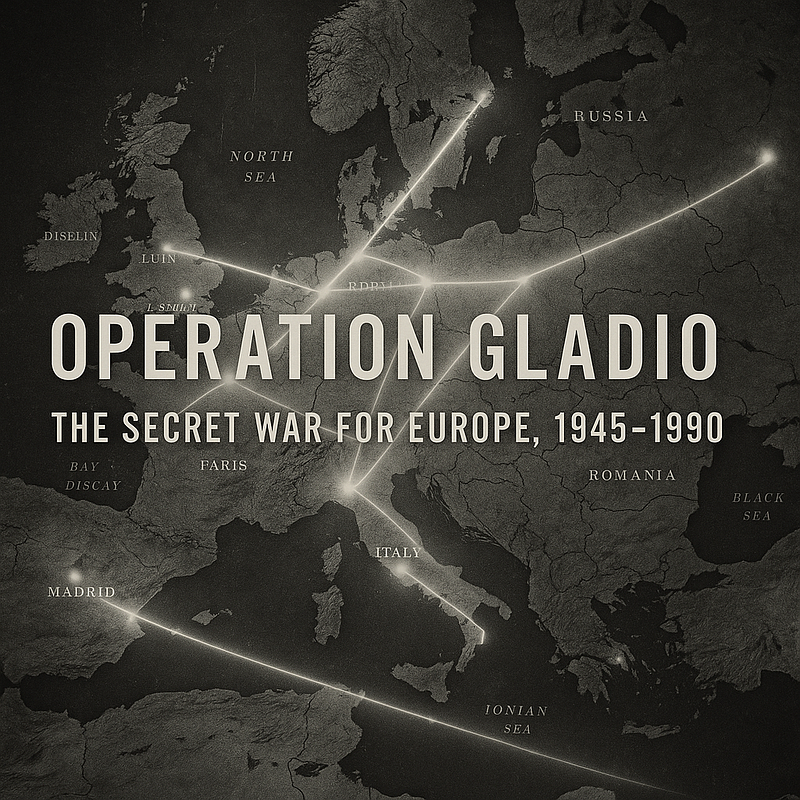
In the decades after World War II, NATO and the CIA, working with Western Europe’s own intelligence services, built a secret network across Western Europe.
Officially, it was meant to resist a Soviet invasion.
In practice, it became a parallel army, trained in sabotage, propaganda, and psychological warfare, that escaped all democratic control.
In Italy its codename was Gladio, Latin for sword.
It was the hidden weapon of the Cold War: an arrangement that merged military command and intelligence doctrine out of parliament’s sight.
While Europe rebuilt its cities and its faith in democracy, another architecture was forming beneath it, one of arms caches, secret budgets, and coded lists.
What began as defense became manipulation.
What began as protection became control.
Gladio was the invisible spine of post-war Europe, a network where NATO coordinated, the CIA paid, and national services ran the men.
The invisible war
The first coordination came at the end of the 1940s, through a clandestine committee of the Western Union powers that was later folded into NATO’s planning structure.
The purpose: to prepare for a Soviet invasion that might never come, but could justify anything.
Across Western Europe, small groups of selected men were recruited: soldiers, hunters, policemen, former partisans.
Weapons were buried in forests and alpine meadows. Radios hidden inside barns.
On paper these units were defensive.
In practice, they became perfect tools for interference.
Their commanders reported not to parliaments but to their national military intelligence services, coordinated through committees attached to NATO’s Supreme Headquarters Allied Powers Europe.
In November 1956, an agreement between Italy’s military intelligence service SIFAR and the CIA formally created the Italian branch: Gladio.
CIA instructors trained recruits in explosives, sabotage and subversion.
British instructors, heirs to the wartime Special Operations Executive, taught them to forge documents and vanish.
In Belgium, the Netherlands, France and West Germany similar networks appeared; Belgium’s military branch ran under the name SDRA8, alongside a civilian branch, STC/Mob.
Each nation denied the others’ existence while quietly sharing intelligence.
In Italy the network recruited committed anti-communists, many from the Catholic and monarchist partisan brigades, and its critics later found right-wing extremists in its orbit.
To the CIA it was a shield against Moscow.
The Cold War was still young, yet its underground front was already alive.
A continent under glass
Across Italy, more than a hundred arms caches were buried in the ground, ready for the day of an invasion.
In Rome, a new intelligence agency, SIFAR, coordinated with American handlers inside the embassy.
From 1955 its director was General Giovanni De Lorenzo, whose service compiled files on tens of thousands of Italian public figures.
Funds arrived through channels that no parliament audited.
Gladio was not born as a conspiracy. It was born as an insurance policy, a secret premium paid against the idea of disorder.
By the late 1950s Europe looked calm, almost transparent.
But beneath that glass surface the invisible war thickened.
Every crisis, Hungary 1956, Berlin 1958, Cuba 1962, renewed the argument for secrecy.
In 1964, De Lorenzo, by then commander of the Carabinieri, drew up Piano Solo, a contingency plan to occupy ministries and broadcasting stations and to detain hundreds of left-wing politicians and trade unionists.
The coup never came, but the rehearsal was enough.
Few citizens understood their army had a hidden twin.
In Germany, caches of buried weapons would still be found decades later, wrapped in oil-paper, patient as memory.
The invisible war had fused with Europe’s DNA, unseen, dormant, permanent.
The Vatican question & the strategy of tension
The Vatican question
In the aftermath of war, Rome was more than a capital.
It was a clearinghouse, a place where diplomats, spies and priests crossed paths beneath frescoed ceilings.
The Vatican, sovereign and anti-communist, was a natural ally of Washington in that contest, and in the 1948 election the Church’s Civic Committees and American money worked toward the same result.
Through its missionary office, Propaganda Fide, and its global network of Jesuits, the Church possessed something no intelligence agency could replicate, access everywhere, suspicion nowhere.
The Institute for Religious Works, better known as the Vatican Bank, would later surface in the P2 story, not in any Gladio document.
Its director, Archbishop Paul Marcinkus, answered neither to government nor market.
Behind his polished desk, theology merged with accounting.
In the late 1940s, Rome had been a hub of ratlines, escape routes used by refugees and also by war criminals, some arranged by clergy such as Bishop Alois Hudal and Father Krunoslav Draganović, and one of them later used by American intelligence itself.
Some priests helped men with false papers reach Genoa and the ships to South America.
Officially they were saving souls; unofficially they were saving assets.
No document released since 1990 places the Vatican inside Gladio.
What the record does show is a shared enemy.
The Church saw communism as heresy; the CIA saw it as contagion.
The strategy of tension
By the end of the 1960s, the invisible network faced a new dilemma.
The Soviet tanks had not arrived, yet funding and operatives remained.
To justify existence, the machine needed motion.
It found it in fear.
Across Europe, bombs began to speak in the language of chaos.
Milan, 1969, Piazza Fontana, seventeen dead.
Brescia, 1974, Piazza della Loggia, eight dead.
Trains, banks, newspapers, all became stages for the same message: no one is safe, order is fragile, authority is necessary.
The police arrested left-wing radicals, but evidence drifted elsewhere.
Years later, the Venetian magistrate Felice Casson found that officers had falsified the evidence in the 1972 Peteano bombing to shield the neo-fascist who planted it, and in following that trail into the archives of the military intelligence service he came upon Gladio itself.
Investigators who followed the clues found themselves reassigned, transferred, or dead.
Files vanished into ministries; witnesses recanted beneath pressure.
When magistrates finally pieced together fragments, the picture that emerged was obscene:
a democracy maintained through managed terror.
In Italy this policy earned a name, la strategia della tensione, the strategy of tension.
The premise was simple: generate instability, blame extremists, and drive citizens back toward the political centre.
Stability by panic.
Order through disorientation.
The European Parliament would later conclude that these networks had escaped all democratic control, and that in some member states they had been involved in serious cases of terrorism and crime.
During the Years of Lead (1969-1980) Italy became the laboratory of this logic.
Every explosion was followed by televised funerals, every arrest by promises of safety.
Behind the curtain stood intelligence officers, politicians, and members of the Masonic lodge P2, led by Licio Gelli, whom the press would call il burattinaio, the puppet master.
The Vatican’s silence was eloquent.
Its newspapers condemned violence without asking whose hands lit the fuse.
The Church’s influence over media and education ensured that suspicion rarely climbed the steps of St Peter’s.
By the late 1970s, this architecture of fear had become self-sustaining.
Even after governments changed, the machinery remained:
intelligence units trained by Americans, funded through secret budgets, justified by sermons about freedom.
Citizens voted, newspapers printed, but the perimeter of belief was already drawn.
The Bologna bombing in 1980 was the crescendo, the final, deafening note of a symphony played in shadows.
Its perpetrators were convicted as neo-fascists of the NAR, and in 2025 a fifth man, Paolo Bellini, was definitively convicted. Officers of the military intelligence service SISMI, with Gelli and the fixer Francesco Pazienza, were convicted for laying a false trail: a suitcase of the same explosive, left on a train on 13 January 1981.
When Italy’s highest court confirmed Bellini’s conviction, its reasoning, filed in January 2026, accepted that Gelli had financed the massacre and that officials of the secret services tied to P2 had coordinated it. No court has named a member of Gladio.
The Italian laboratory & the American hand
The Italian laboratory
Italy was not merely a participant in Operation Gladio, it was its experiment.
A country stitched together by ruins, ideology, and faith became the stage on which democracy was taught how to fear.
In the 1970s the Years of Lead turned city squares into confessionals of violence.
Bombs in cafés, gunfire on campuses, kidnappings on suburban roads.
Every side accused the other; every headline reinforced the same fatigue.
At the centre moved Licio Gelli, master of the secret Masonic lodge Propaganda Due (P2).
His lodge listed generals, bankers, journalists, and ministers.
To outsiders it was a gentleman’s club.
To insiders it was a government in reserve.
P2 was the circuit that connected the secret services, high finance and Italian politics.
From his villa in Arezzo, Gelli choreographed alliances that blurred every moral line.
He cultivated generals and publishers, and maintained direct channels to South America’s military regimes.
When investigators raided the offices of his textile firm at Castiglion Fibocchi, near Arezzo, on 17 March 1981, they found rosters of 962 members: among them the heads of Italy’s intelligence services, cabinet ministers, and media owners.
A year later, in July 1982, a document called the Plan for Democratic Rebirth was found in the luggage of Gelli’s daughter at Rome’s airport: a design to reshape Italy’s institutions from above.
P2’s influence reached deep into the financial bloodstream.
Its preferred instrument: Banco Ambrosiano, once a modest Catholic bank, later an empire of offshore accounts.
Through it, and through offshore companies linked to the Vatican Bank, flowed the money that later left a hole of more than a billion dollars.
The bank’s chairman, Roberto Calvi, known as God’s Banker and himself on the P2 list, became the lodge’s most important banker.
When Ambrosiano collapsed in 1982 with more than a billion dollars missing, Calvi was found hanging beneath Blackfriars Bridge in London, bricks in his pockets.
The first inquest ruled suicide; a second returned an open verdict. Italian investigators later concluded he had been murdered, but a murder trial in Rome ended in acquittals in 2007.
Inside the Vatican, Archbishop Paul Marcinkus, head of the Vatican Bank, denied knowledge of Ambrosiano’s activities.
Yet in 1981 the Vatican Bank had issued letters of comfort for Calvi’s offshore companies, and in 1984 it paid creditors a large settlement while admitting no liability.
The scandal revealed how faith, finance, and fear had merged into a single organism.
Gelli’s lodge supplied the connections, the banks supplied the money, and parts of the secret services supplied the protection.
Italy was both the theatre and the template.
The American hand
In Washington, Gladio was never spoken of in the open.
It appeared only in budget footnotes and cables marked Eyes Only.
Yet within those margins lay the philosophy of the post-war empire.
The United States saw Italy as the hinge of the Mediterranean, too Catholic to lose to Moscow, too unstable to leave alone.
Since 1947, the CIA had financed centrist parties, subsidised newspapers, and channelled funds to unions friendly to Washington.
Gladio offered something better: deniability.
No need for direct interference when trained allies could act “spontaneously.”
Gladio allowed the American empire to rule invisibly, influence without flag, intervention without footprint.
Every administration, Truman, Eisenhower, Kennedy, Nixon, Reagan, inherited the network as quietly as it passed nuclear codes.
Each was told it was defensive; each used it for persuasion.
In practice it was psychological warfare on allies disguised as assistance.
William Colby, later director of the CIA, had himself helped build stay-behind networks in Scandinavia in the early 1950s, and described that work in his memoirs as preparation for a Soviet invasion.
American money and training reached the network through NATO’s planning committees and bilateral channels; Italy’s gladiators trained at Capo Marrargiu in Sardinia.
By the 1980s, the European press began whispering about stay-behind armies.
Parliaments requested investigations; Washington advised restraint.
When Italian Prime Minister Giulio Andreotti finally admitted Gladio’s existence before Parliament on 24 October 1990, Italy dissolved it within weeks, and the European Parliament demanded that all such networks be dismantled. In between, NATO denied any link to the networks on 5 November and withdrew the denial the next day.
Gladio never ended; it only migrated, from bunkers to bureaucracies, from field manuals to data cables.
The architecture of control & the echo of empire
The architecture of control
When the Berlin Wall fell in 1989, the headlines spoke of liberation.
Crowds cheered.
Governments promised that Europe had finally come home to itself.
But beneath the music of that night, something older and quieter remained.
Gladio did not vanish with the Cold War. It simply changed vocabulary.
Its arsenals were sealed, its agents retired, but the logic survived.
Control through fear.
Unity through invisible supervision.
In Brussels, NATO launched the Partnership for Peace in 1994 and extended its structures eastward.
The command structure remained intact, but its language evolved: terrorism prevention, crisis management, information security.
What had once been called psychological operations became strategic communication.
What had been disinformation became narrative management.
They no longer buried weapons in forests.
They buried meaning in data.
The digital age did not end Gladio. It digitized it.
Across Europe, information centers replaced armories.
Algorithms became the new ammunition.
Where a bomb once silenced a street, a headline now redirected perception.
In Italy, investigative commissions on Gladio found themselves entangled in bureaucratic labyrinths.
Files were redacted, names erased, archives sealed for reasons of state.
In Germany, the subject was folded into counterterror studies and politely forgotten.
Freedom became self-policing.
Surveillance merged with convenience.
The new stay-behind soldiers carried smartphones instead of guns, passwords instead of codenames.
Europe called this progress.
In truth it was evolution, the same organism adapting to new oxygen.
The echo of empire
The story of Gladio is not only about secret armies.
It is about a civilization that learned to manage itself through anxiety.
From the ruins of Rome to the data clouds of Brussels, the method is the same: stability through uncertainty.
After 1990, official reports declared closure.
The word Gladio was retired, replaced by polite silence.
Yet every crisis that followed carried its echo.
The war on terror, the refugee waves, the financial collapses, the pandemic politics, each renewed the same ancient pact between power and fear.
Each offered protection at the cost of awareness.
The greatest success of Operation Gladio was not secrecy. It was continuity.
The Vatican adapted too.
Its diplomats now preached cooperation, its bankers rebranded transparency.
But the structure remained: moral authority shielding worldly influence.
In Washington, military planners came to speak of full-spectrum dominance.
It meant what it had always meant, control across all domains, including belief.
Europe, grateful for security, offered little resistance.
The union expanded, the surveillance deepened, the narrative softened.
Closing reflection | The quiet continuity
The clock on the front of Bologna station was set back by hand after repairs, as a memorial.
Its hands are frozen at 10:25.
Commuters pass beneath it every morning without noticing.
It marks more than the moment of an explosion.
It marks the instant when Europe’s peace revealed its machinery.
In archives and ministries, the files rest under dust.
On screens and networks, the new files multiply every second.
Between them lies the same equation: obedience through fear, calm through control.
Gladio was never a conspiracy.
It was a method.
And methods do not die; they migrate.
Related from The Manifest Archive