On the night of September 7, 1996, a black BMW carrying Tupac Shakur stopped at a red light in Las Vegas, at the corner of Flamingo Road and Koval Lane, a few blocks off the Strip. A white Cadillac pulled up alongside. From it came a burst of gunfire, four rounds from a .40-caliber pistol finding the passenger seat. Tupac was hit in the chest, the arm, the thigh. He died six days later, on September 13, twenty-five years old, after the doctors removed a lung and his body gave out.
For nearly three decades the killing was officially unsolved, and into that silence rushed every kind of theory, including the most dramatic one, that the United States government had finally finished a man it had watched since before his birth. It is worth saying clearly, at the outset, that the evidence does not support that theory, and that the case is no longer the open mystery it was for so long. In 2023 a former gang figure named Duane Davis was arrested and charged in the killing, described by prosecutors as the man who organized it, and the documented account that emerged is grimly ordinary: a retaliation, hours in the making, for a beating Tupac and his entourage had given a rival gang member in a casino lobby earlier that same night. No agency. No grassy knoll. A street vendetta, settled with a handgun at a traffic light.
This essay accepts that account, and that is the point. Because the most disturbing thing about Tupac Shakur is not how he died, which now appears to have an answer, but what had already been done to him long before the Cadillac pulled up. Power did not need to fire the shot. By the time it was fired, the man had already been neutralized in the only way an unowned voice is ever truly neutralized, not by killing the body, but by killing the image. The bullets ended a life. The narrative had already ended the threat.
Before America kills a man, it kills his image
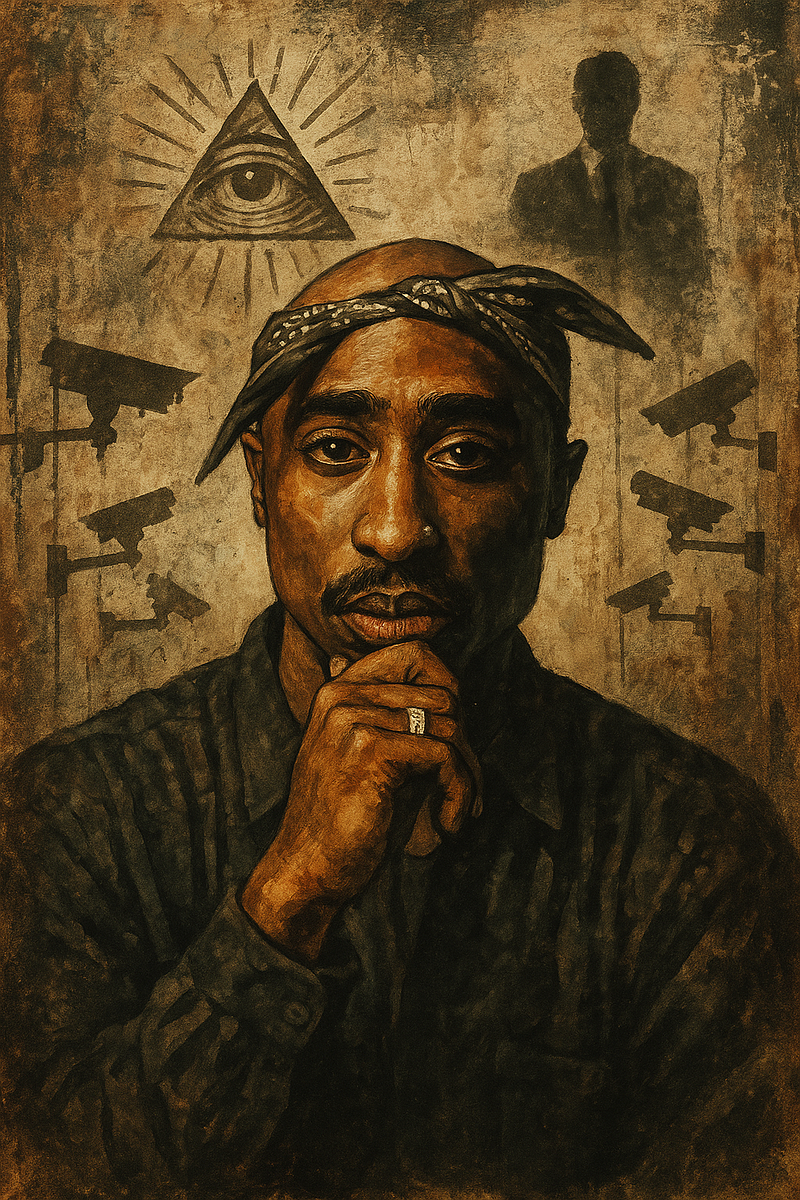
Hold that sentence, because it is the mechanism of the whole story, and it does not require a single conspiracy to operate. Tupac entered American consciousness carrying something the culture industry could not manufacture and the state had reason to fear: the fusion of a real political inheritance with a mass audience. He was the son of the Black Panther Party, raised inside its aftermath, and he had a voice that could reach millions of young people directly, across the lines of race and class, in a language the institutions did not control. That combination, inherited radical consciousness plus uncontrolled reach, is the most combustible thing a managed culture can encounter. It is the unowned voice, and it is dangerous not for what it says but for who it can move.
There is a reliable way to defang such a voice without ever banning a word of it, and it is older than Tupac and larger than him. You do not argue with the message, which only amplifies it. You define the man. You attach to him, early and relentlessly, a single flattening label, and you let that label do the work of dismissal in advance, so that by the time he says anything political, the audience has already been taught how to file him. For Tupac the label was ready and waiting. He was a thug. The word followed him through every news segment, attached to every story, repeated until it became the frame through which everything else about him was seen. The poetry, the political analysis, the inheritance, all of it was made to disappear behind a single syllable of dismissal.
This is the first and deepest stage of neutralization, and it is the one that requires no gunman. A leader painted as volatile becomes easier to ignore. A thinker branded as a criminal becomes easier to dismiss. A voice framed as chaos becomes easier to lose in the noise, and easier, when violence eventually finds him, to explain away. Before America had to deal with what Tupac was saying, it had already decided who he was, and the deciding was the neutralization.
Born into the file
To understand why he was treated as an inheritance rather than an individual, you have to start before he was born, in a Manhattan courtroom. His mother, Afeni Shakur, was a member of the Black Panther Party and one of the defendants in the case known as the Panther 21, a sweeping 1969 prosecution that charged a group of New York Panthers with a conspiracy to bomb public sites. The charges were vast and the bail was crushing, and the case was part of the broader federal and local campaign against the Party that ran through those years. Picture the scene that produced him. A young Black woman stands in a Manhattan courtroom, visibly pregnant, facing a list of charges that on paper could have buried her for the rest of her life, and she does not hide behind a lawyer. She questions witnesses herself, with no legal training, and dismantles the case the government has built. In May 1971 the jury acquits the defendants on every count. A few weeks later, still carrying the freedom she had argued for, she gives birth to a son and names him Tupac Amaru Shakur, after an Andean revolutionary who rose against an empire. He arrived, quite literally, as the child of a woman who had just beaten the state in open court, and the state does not forget being beaten.
That courtroom is the truest opening of his life, more than any stage or studio. He was not born into poverty alone, though he was poor. He was born into a file already open, into a family the government had spent years trying to break, carrying from his first breath a significance the country had assigned him before he could earn it.
He was, in other words, born to a woman the state had just tried and failed to imprison, into a family and a movement that the FBI's domestic counter-intelligence program had spent years working to destroy. That program, COINTELPRO, was real, is documented, and was not subtle about its purpose: its own memos set the goal of preventing the rise of a unifying Black leader who could electrify the young, and it pursued the Panthers above all other targets. The campaign against the Panthers was not gentle and is not in dispute. Its leaders were surveilled, infiltrated, and set against one another; one of them, the young Chicago organizer Fred Hampton, was killed in a 1969 police raid carried out with the help of an FBI informant who had supplied a floor plan of his apartment. The Party that Afeni Shakur belonged to was, within a few years, broken, its survivors imprisoned, exiled, or scattered, its momentum dispersed by exactly the kind of operation the Bureau had designed. Tupac was born into the wreckage of that defeat, to a mother who had stood in a courtroom against the same machinery and, against the odds, walked out free. This is the genuine history beneath Tupac's life, and it needs no embellishment. He grew up among people for whom surveillance was not paranoia but memory, who had watched the machinery work on their friends and families, and who raised him on the knowledge of how movements rise and how the system answers when they do. He did not inherit a grievance. He inherited a literacy, an early and unusual understanding of how power actually operates, and he would spend his short life putting it to music.
The boy raised in the aftermath
He was born Lesane Parish Crooks and renamed, while still a child, Tupac Amaru Shakur, after an eighteenth-century Andean leader who rose against the Spanish empire. The name was a statement of intent before he could read it. His family was not a single household but a network that ran through the arteries of Panther history: an aunt, Assata Shakur, who would become one of the most wanted women in America and flee to Cuba; a stepfather and others bearing the same chosen surname, figures who appeared in federal files as markers of where the next tremor might come from. To be a Shakur was to be born already cross-referenced.
His childhood was poor and itinerant, moving between cities, often hungry, frequently uprooted, and shaped throughout by the knowledge of what had been done to the people who raised him. The adults around him discussed surveillance not as fear but as routine, analyzed the news for strategy rather than bias, and passed on, as ordinary household knowledge, the history of how movements rise and how the state responds when they do. Where most children absorb a vague sense that the world is unfair, Tupac absorbed something far more specific and far more dangerous: a working model of how American power operates on people like him.
The one stable gift of those unstable years was a place at the Baltimore School for the Arts, where he studied acting, poetry, ballet, and the canon, Shakespeare and Ibsen among them. It was not a refuge so much as an accelerant. It gave a precociously political mind the formal tools to move people, and it is where the two halves of him fused: the inherited consciousness of the movement and the trained capacity of the artist. He left Baltimore able to do the most dangerous thing an inheritor of that tradition could do, which was not to argue but to make millions feel.
The making of a persuader
What made him a problem was not anger, which the culture knows how to sell, but persuasion, which it does not. By his teens, trained at a performing-arts school in Baltimore on Shakespeare and Ibsen and Baldwin, he had turned the analysis he absorbed at home into craft. He could move a room. Not by force, by resonance, by the specific gift of making a listener feel that what he was describing was true. The most difficult figure for a system to manage is not an extremist, who can be marginalized, but a persuader who is also beloved, because his reach is real and his credibility cannot be revoked from outside.
When he entered the music industry, he brought an authenticity that no label could fabricate and none could fully steer. In his early interviews he spoke about the conditions of young Black men not as a performer reaching for a theme but as someone describing a structure he had lived inside, with a clarity that occasionally frightened the people around him. That was the asset, and it was also the threat. A voice that can make a generation feel understood is a voice that can, in principle, make them act, and a voice that answers to no party, no church, and no established leadership cannot be bargained with the way an organization can. He was, at his height, a direct line to millions of people that no institution owned, which is the single most uncontrollable thing a person can be.
The narrative war
So the war over Tupac was fought, first and last, over his image, and it is the part of his story that the documented record supports most fully. The media foregrounded the aggression in his work and passed over the politics. News anchors reached for the word thug with the ease of a script. The industry, for its part, found that controversy sold, and nudged him toward the version of himself that moved units, because a volatile star is profitable and, not coincidentally, easy to dismiss. What began as misrepresentation hardened into a kind of mutual production: the press got a villain, the labels got a product, and the political content that made him genuinely threatening was steadily edited out of the public Tupac, until the man who had been raised in the analysis of American power was known mainly as a symbol of disorder.
The deepest irony sits inside the label itself. The phrase the press used to dismiss him, thug, was one he had taken up and rebuilt into a piece of social analysis. He explained Thug Life as an acronym, The Hate U Give Little Infants effs Everybody, an argument, however crude, that the violence the culture condemned in young Black men was the downstream consequence of what the society had done to them as children. It was a thesis about cause and effect, about how neglect and contempt aimed at the powerless return, a generation later, as the disorder the powerful then point to as proof of their inferiority. In other words, the very word weaponized to flatten him contained, for anyone who bothered to ask what he meant by it, exactly the structural critique the flattening was designed to bury. The media kept the word and threw away the argument inside it, which is the narrative mechanism in a single gesture: take the most political thing the man made, strip its meaning, and hand it back to the public as a synonym for senseless menace.
This is what sets Tupac apart from the others whose stories rhyme with his. They did not author the labels that buried them; the brand was attached from outside. Tupac handed the culture the very word it would use against him, with a thesis folded inside it, and watched the thesis get discarded and the word kept. He collaborated, half-knowingly, in his own flattening, which is exactly why his case is the clearest place to watch the mechanism work. You can see the meaning being drained from a thing the man himself made and offered, in good faith, as an explanation.
This is narrative as an instrument, and its effect is real whether or not anyone coordinated it. A society taught to see a man as dangerous will not examine why he was feared, will not parse his actual arguments, and will, crucially, know exactly how to interpret his eventual death. The framing did not need a conspiracy to function. It needed only a media that profits from villains and an industry that profits from controversy, both pulling in the same direction, and the result was a public figure pre-discredited, his legitimacy spent before he could fully spend it himself. By the time he was killed, the story that would explain his killing, just another violent man meeting a violent end, had been written years in advance and rehearsed nightly.
The documented confrontations
None of this means Tupac was a passive victim of pure invention, and the honest record includes the real friction between him and the state, which was considerable. In October 1991, in Oakland, police stopped him for jaywalking, and the encounter ended with him, by his account and his suit, slammed to the pavement, choked, and arrested. He sued the department for ten million dollars and settled for a reported forty-two thousand. The sum is small; the act was not. Here was a young Black man with Panther lineage and a growing platform who responded to a street humiliation not with silence but with a lawsuit, publicly, on the record, against a police department. He was demonstrating exactly the trait that made him more than a performer: he would confront power directly, legally, and without apology, and he had an audience watching him do it.
The legal entanglements multiplied from there, some of his own making, some not, and they functioned the way such entanglements function for any figure the system finds inconvenient. They consumed time, drained credibility, and kept him perpetually on the defensive, fighting cases instead of building the thing the cases interrupted. This is a pattern seen across these lives, the way the courtroom becomes a kind of slow attrition that does not need to convict in order to cost, and Tupac spent years of his brief life inside it. The difference, in his case, is that the courtroom was only one front. The other, larger one was the narrative, and there he was losing ground even when he won the cases.
Quad Studios and the feud the industry fed
In November 1994, at Quad Recording Studios in Manhattan, Tupac was robbed and shot multiple times in the lobby, grazed in the head, and survived. He came to believe he had been set up by people he had trusted, and the suspicion curdled into the rivalry that would define his last years, the so-called East Coast versus West Coast feud between his camp and that of the Notorious B.I.G. and the New York label around him.
It would be an overreach to claim, as some do, that this feud was manufactured in a boardroom as a deliberate operation; the evidence does not show that, and this archive does not assert what it cannot document. What is documented, and is damning enough, is that everyone with a microphone or a balance sheet had an incentive to pour fuel on it. The media amplified every exchange because conflict drew audiences. The labels tolerated and at times encouraged it because rivalry sold records. The public consumed it as entertainment. Two of the most gifted and influential young Black artists in America were turned, with the eager assistance of the institutions around them, into rivals whose energy was aimed at each other rather than at anything outside the frame. Whether or not anyone designed it, the structure rewarded division and punished unity, and it got exactly what it rewarded. Both men were dead within a year of each other.
The voice that was turning political again
In the final stretch of his life, by several accounts, Tupac's public language was sharpening in a particular direction. The interviews grew more analytic, less about feuds and more about systems: about the architecture of poverty rather than only its pain, about economic self-sufficiency, about organizing young people rather than merely speaking to them. He was, in the telling of people around him, beginning to move from being a voice of the condition toward being an organizer against it, reaching back, perhaps not consciously, toward the Panther inheritance he had been raised in.
You can hear it in the interviews from his last year, where the subject keeps sliding from his feuds and his fame toward something larger: the observation that the poverty he came from was engineered rather than accidental, the insistence that the answer was ownership and organization rather than spectacle, the impatience with being treated as a symbol when he wanted to be an actor on the conditions themselves. He spoke of building something for the young people who listened to him, of turning an audience into a constituency. The phrasing was loose and the man was unfinished, but the trajectory pointed unmistakably back toward the tradition he had been born into, the one that ended with people in prison and exile and graves.
It is important not to inflate this into a finished program he never completed; he was twenty-five, contradictory, and in the middle of becoming several things at once. But the direction is the relevant fact. The most dangerous version of Tupac was not the one selling records. It was the one beginning to articulate a structural critique to an audience of millions who trusted him, the one in whom the inherited consciousness and the mass platform were starting to fuse into something like leadership. That version was the newest, the least controlled, and the one the existing narrative was least prepared to absorb. It was also the version that did not get to develop, because the street vendetta from the casino floor reached him first.
What actually killed the threat
The documented chain of that night is squalid and clear. After a Mike Tyson fight at the MGM Grand, members of Tupac's entourage spotted Orlando Anderson, a young man from a rival California gang who had been involved in an earlier altercation with Death Row associates, and Tupac and several others beat him in the casino lobby, the assault captured on the hotel's surveillance cameras. A few hours later, at the traffic light on Flamingo Road, the Cadillac pulled up and the shots came. The 2023 arrest charged Duane Davis, Anderson's uncle, who for years had openly placed himself in that Cadillac, even publishing an account of the night, and whom prosecutors described as having organized the retaliation from the front seat. Anderson himself was never charged and was killed in an unrelated shooting two years later. This is the killing: a beating answered by a shooting, a gang reprisal that ran its course in a few hours on a Saturday night, with names, a motive, and a vehicle.
Here the reverse-pressure of the case becomes the whole argument. Grant, as the evidence now strongly suggests, that no agency planned his death, that it was a gang retaliation for a beating, an ugly and entirely human killing with a named suspect and a documented motive. The structural account does not weaken. It sharpens, because it no longer depends on a conspiracy at all.
The threat Tupac posed had already been managed before he died, by the narrative that turned a political inheritor into a thug, and it was completed after he died by the same mechanism running in reverse. The moment he was gone, the country performed the ritual it knows well. The political lineage vanished from the coverage. The structural analysis evaporated. What remained was the story that had been prepared for years: a violent life, a violent end, a cautionary tale about a culture rather than a question about a country. The man who had been raised in the study of American power was eulogized as a symbol of disorder, and the framing that had made him easy to dismiss in life made him easy to bury in death. If the story is chaos, the system has no questions to answer. The thug narrative was not only how he was diminished while alive. It was the explanation waiting to receive his death.
Death is the perfect contract
What came next is the second neutralization, and it is the one that runs to this day. In death Tupac became one of the most lucrative figures in the history of the music business, his catalogue and his image generating fortunes across decades, posthumous albums, films, holograms, a relentless merchandising of the face and the bandana and the defiant pose. The radical was rendered into product, the analysis into attitude, the inheritance into a brand of rebellion sold mostly to people who will never read a COINTELPRO memo.
The scale of the afterlife dwarfs the career. He released a handful of albums while alive; he has released far more dead, a steady stream of posthumous records assembled from vault recordings, outselling much of what he managed in life. In 2012, sixteen years after his death, a digital projection of him performed at a California music festival, a literal apparition of the man summoned to play to a living crowd, the image quite separate now from any person, owned and operated by an estate and the companies licensed through it. His face sells clothing, posters, and accessories around the world, much of it to people born after he died, for whom the bandana and the defiant stare are a style rather than a stance.
This is not a separate story from the narrative war. It is its completion. A living Tupac was an unowned and developing voice that no one could fully control and that was, in his last months, turning toward something more dangerous. A dead Tupac is a fixed and infinitely licensable image, the political content safely drained, the danger replaced by an aesthetic. The market did to his memory what the media had done to his life, kept the surface and discarded the substance, and it did so all the more thoroughly because a dead artist cannot object, cannot evolve, and cannot turn political again. Death, for a figure like this, is the perfect contract. No royalties owed to the meaning. No resistance from the man. Just the image, freed at last from the person, available forever.
The variable was the story
Strip the case to its mechanism and the determining variable is clear, and it is not the gun. It is the story, the control of the narrative through which a public understands a figure. Tupac's danger lay in an unowned voice that fused inherited political consciousness with mass reach; the system's most effective answer was never to silence that voice directly, which would have created a martyr, but to define it, to attach a flattening label early enough that the political content could never be heard cleanly and the eventual violence would be pre-explained. The murder, when it came, came from the street, not the state. But the neutralization of the threat had been accomplished long before, in the framing, and was perfected afterward, in the merchandising.
That is the portable law beneath the Tupac case, and it reaches far past hip-hop. Whoever controls the story controls the figure, more completely than any prison and more permanently than any bullet, because the story decides what the figure is allowed to mean. A voice that cannot be owned can still be defined, and a voice that has been defined as chaos has been disarmed without a word of it being censored. The deepest power over an unowned voice is not the power to end it. It is the power to narrate it, in life and in death, until the meaning is gone and only the image is left.
The pattern, not the exception
Tupac is not an isolated case, only the one in which the narrative machinery is most visible. The same structure recurs around figures whose influence the institutions could not own. An antiwar musician is surveilled and nearly deported while alive, then has his anthem stripped of meaning after his death. A unifying singer is shot and then sold back as a brand of peace. A champion who refuses a war is stripped and then, decades later, canonized once he is safe. Each is a different form of influence, reach, unity, legitimacy, voice, and each meets a version of the same two-part instrument: the management while living, the commodification after. It would be an error to flatten them into a single plot, and in Tupac's case the documented killer was a gang figure, not a government. What recurs is not a conspiracy but a structural response, the predictable way an order built on managed consent handles a person who generates the real thing outside its control, and the way the market completes the work once the person is gone.
The honest objection
The strongest case against this reading deserves full statement, because it is partly true. Tupac was not a pure victim of a narrative imposed entirely from outside. He participated in the image. He named the philosophy Thug Life himself, courted controversy, was convicted in a real and serious case, was genuinely involved in violence including the casino beating that appears to have gotten him killed, and built part of his persona on exactly the menace that the press then amplified. The thug label was not simply invented and pinned on an innocent; he picked it up and wore it, for reasons of art and commerce and survival. And his death, on the best current evidence, was a gang retaliation with a named suspect, not a system operation, which means reading it through the lens of state power risks importing a drama the facts do not contain.
That objection is right about the particulars and wrong only about what they prove, and conceding it sharpens the argument rather than dissolving it. The claim here is not that Tupac was an innocent destroyed by a plot, nor that the state killed him; both would be exactly the overreach this archive exists to refuse, and the second is contradicted by the evidence. The claim is narrower and survives every concession: that he carried a genuinely dangerous fusion of inherited political consciousness and unowned mass reach; that the dominant response to it, whoever intended it, was the narrative reduction of a complex political figure to a single dismissive label; and that this reduction, which he partly collaborated in, did the work of neutralization that no bullet had to, and was completed by a market that sold the image once the man was safely gone. The story did not need a conspiracy to be true. It needed only the ordinary machinery of media and money, doing what it does, to a voice that frightened them by belonging to no one.
The question he leaves
So the question Tupac leaves is not who fired into the BMW; that, at last, appears to have an answer, and it is a human and squalid one. The question is the one his whole life poses to a country built on managed consent: what happens to a voice that cannot be owned, that fuses a real political inheritance with a reach no institution controls, and refuses to be only a product. The answer his case gives is not reassuring. Such a voice is rarely silenced by force, which makes martyrs. It is defined into harmlessness while it lives and licensed into nostalgia once it dies, and the meaning is removed so gradually that most of the people wearing the face have no idea there was ever an argument behind it.
And the mechanism did not end with him. It runs now on every figure who builds a direct, unowned audience and starts to say something the institutions would rather not have said at scale, the independent voices and platforms and channels that reach millions without a license from anyone. The names and the formats change. The machine that turns a dangerous voice into a safe image, first by defining it and finally by selling it, does not. Tupac is quoted on murals and in classrooms and in courtrooms now, his words carrying a charge his merchandise has been carefully drained of, and the gap between the two, between the voice that frightened a country and the image that country learned to sell, is the exact measure of how the mechanism works. There is a line of his that survives on a thousand walls, that a system can kill a man but cannot kill the question he leaves behind. It is true, and it is also incomplete, because the system never needed to kill the man. It killed the question a different way, by answering it in advance, by deciding what Tupac meant before he could finish meaning it, and then by selling the leftover image at a profit. The body was buried in 1996. The question was buried more slowly, under merchandise, and it is being answered, right now, the same way, about someone else whose name we have not yet learned to drain.
Evidence Map
Facts, interpretations, forecasts, and disconfirming signals.
Core claim. Tupac Shakur carried a dangerous fusion of inherited political consciousness (the son of a Black Panther) and unowned mass reach, and the primary instrument that neutralized that threat was not violence but narrative: the reduction of a complex political figure to a single dismissive label ("thug") that pre-discredited his content while he lived and pre-explained his death, completed by the commodification of his image after he was gone. The determining variable is control of the story, not the gun.
Evidence level. Facts (high): Afeni Shakur was a Panther 21 defendant acquitted in 1971, shortly before Tupac's birth; COINTELPRO was a documented FBI program targeting the Black Panther Party; Tupac sued the Oakland police after a 1991 beating and settled for a reported ~$42,000; he was shot at Quad Studios in November 1994; he was killed in a Las Vegas drive-by on September 7, 1996, dying September 13; in 2023 Duane Davis was arrested and charged in the killing, with the documented motive being gang retaliation for the MGM Grand beating of Orlando Anderson hours earlier; Tupac's image and catalogue have generated enormous posthumous revenue. Interpretation (marked): reading the "thug" framing as a neutralization mechanism, and the commodification as its completion, is analytical interpretation grounded in those facts. Excluded as unsupported (marked): the claim that the state planned or carried out his murder; the documented evidence points to a gang killing, and this essay treats it as such.
What would confirm this. The persistent gap between the commercialized Tupac and his actual political content; the recurrence of the label-and-dismiss pattern around other unowned voices.
What would disprove this. Evidence that his political content reached the public undistorted by the "thug" framing; evidence that the state directed his killing (which would change the case from narrative neutralization to direct suppression); an account in which his posthumous image carried his politics forward rather than draining them.
Watchlist. The Davis prosecution and what it establishes about the killing; how Tupac is taught and sold, and whether the political content travels with the image.
Jerry van der Laan writes The Manifest Archive, where he examines power, culture, and institutions. He traces the structures beneath them.