How many wars are happening right now? (Updated July 2026.) The count depends on the definition. Humanitarian trackers led by the International Committee of the Red Cross count roughly 130 armed conflicts worldwide. By the stricter standard of a war, an armed conflict with at least 1,000 combat deaths in a single year, thirteen reached that threshold in 2025, the most since 1992. The Uppsala Conflict Data Program recorded 65 active state-based conflicts across 35 countries that year, the highest number since systematic tracking began in 1946, and the third record year in a row.
The major active wars in 2026:
- Ukraine. The largest conventional war in Europe since 1945, now in its fifth year, dominated by long-range drone and deep-strike warfare.
- Sudan. The army-versus-RSF war in its fourth year, with more than 12 million people displaced and famine conditions, among the deadliest in the world.
- Gaza and the Middle East front. Devastation across Gaza under a fragile ceasefire, alongside the 2026 war on Iran by Israel and the United States, where a ceasefire in April and a memorandum in June were followed by renewed strikes in July.
- Eastern Democratic Republic of Congo. Fighting continues over mineral-rich territory despite repeated peace agreements.
- Myanmar. A fragmented civil war running since the 2021 coup.
The wider belt of escalation zones includes the Sahel, the state collapse in Haiti, the Taiwan Strait and the South China Sea, and shipping chokepoints such as the Red Sea. These are not all full wars, but zones whose danger is how quickly they could widen.
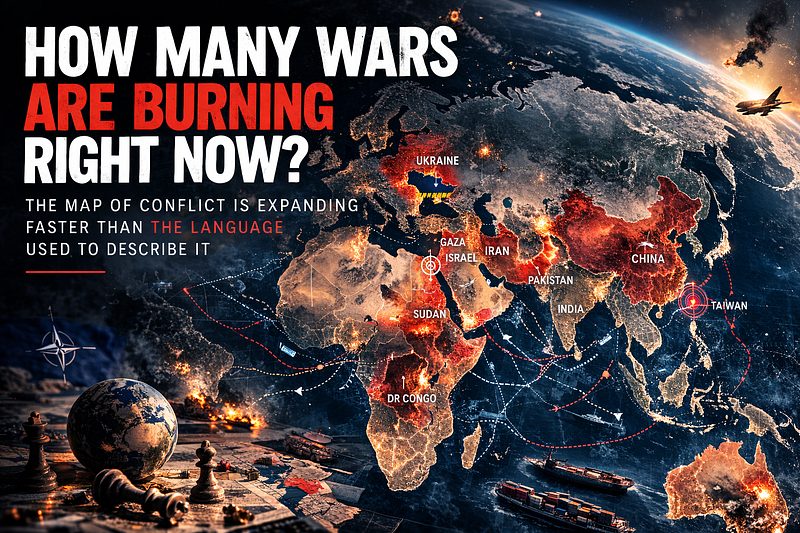
Those are the numbers. Here is what they already cost you: a surcharge on the world's wars, folded into bread, fuel, and everything imported, with the line item the only part hidden from you. The map below shows where that surcharge is written, and where each fire connects to the system you live in.
The largest war in Europe since 1945; about three-fifths of the world's battle-related deaths in 2024 and 2025.
Strains: grain, energy, NATO industry
The War That Left the Map →About 12 million displaced, the largest displacement crisis on earth; famine confirmed.
Strains: humanitarian capacity, the hierarchy of visibility
Below: the war the West underreads →First IPC famine determination in the Middle East; a fragile ceasefire.
Strains: Red Sea shipping, alliance legitimacy, Iran escalation
What the Iran War Is Breaking →Goma seized by Rwanda-backed M23 in January 2025; hundreds of thousands displaced.
Strains: coltan and cobalt, the supply lines of modern electronics
Below: the violence beneath extraction →A fragmented civil war running since the coup.
Strains: chronic invisibility
Below: the wider belt →Cape of Good Hope rerouting adds about 10 to 14 days per voyage; insurance repriced.
Strains: the modern siege: a cost, not a wall
Hormuz & Suez: Chokepoints of Global Power →The jihadist insurgency across Burkina Faso, Mali, and Niger, by the Global Terrorism Index the world's deadliest region for terrorism.
Strains: state survival, the coup belt, migration corridors
Below: the wider belt and what the map leaves out →Not yet a war, but the most dangerous non-war on the map.
Strains: semiconductors, deterrence credibility
The Chokepoint That Breaks Everything →Jump to: Why the map is expanding · Ukraine · Gaza · Sudan · Congo · The human ledger · What it costs you
The numbers are the entry point. Most lists of current wars stop there, at naming them; this chapter asks a different question: what happens when they all begin pulling on the same global system at once? That is the part the headlines miss, and it is why these are not separate emergencies but a single system running along the same few arteries.
A cargo ship reroutes through the Red Sea. A family in Kyiv wakes to the sound of drones. A school in Sudan is hit. In eastern Congo, armed groups move again through mineral ground the rest of the world depends on but rarely sees. On another screen, analysts watch Taiwan, the South China Sea, Haiti, Myanmar, and the Sahel. None of it arrives as one story. It comes broken apart, one alert from Europe, one headline from Gaza, one brief mention of Sudan, a passing update from Congo, and presented that way, war looks scattered, almost accidental, a run of unrelated crises that happen to overlap in time.
That is no longer what the map shows. This is not only a world with many wars. It is a world in which multiple wars, insurgencies, and escalation zones are burning at once across the same arteries of dependence: shipping routes, food systems, mineral belts, energy corridors, capital flows, and alliance structures. Read one headline at a time and the pattern disappears. Step back, and it becomes hard to ignore.
This chapter of The Manifest does not treat 2026 as a list of separate wars but as a widening conflict map, one in which the major battlefields of Ukraine, Gaza, Sudan, and eastern Congo sit inside a much broader belt of instability stretching across Africa, the Middle East, and Asia. The point is not to flatten these wars into one thing. It is to show how much pressure is now accumulating inside the same world system.
The modern information order prefers compartments. Ukraine is filed as European security, Gaza as a Middle Eastern crisis, Sudan as a humanitarian disaster, Congo as a chronic African emergency, Myanmar as a distant civil war, the Taiwan Strait as deterrence theater. Each gets its own language, its own experts, its own shelf. That separation is politically useful, because it keeps the public from seeing how many fires burn at once and how often they gather around the same strategic terrain. It keeps wars looking local even when their effects travel globally, and turns one connected body into a sequence of isolated emergencies. But the sequence is the illusion.
A World of Simultaneous Wars
Humanitarian agencies, conflict trackers, and strategic assessments all point to the same underlying reality, even in different language. The ICRC has said it is working across more than one hundred armed conflicts and put the number near 130 in 2025. The Council on Foreign Relations tracks nearly thirty conflicts of concern to the United States. ACLED records hundreds of violent incidents per day across an even broader landscape of political violence.
The numbers matter, but the shape they make matters more. Violence is no longer concentrated in one dominant theater; it is dispersed, layered, and cumulative. Some of these are large interstate wars, some civil wars, some fragmented insurgencies, and some are not full wars yet but escalation zones whose danger lies in how quickly they could widen. Together they form something more consequential than a count of crises. They behave less like separate emergencies than like one body under strain, its arteries running through Europe, the Middle East, Africa, and Asia at once, pulling on alliance systems, humanitarian capacity, food security, weapons production, maritime movement, diplomatic attention, and public perception all at the same time. A war in one place does not stay in one place when supply chains, sanctions, shipping lanes, aid budgets, fuel costs, and military inventories are already stretched by wars elsewhere.
This is why a serious map cannot stop at the most familiar fronts. Ukraine, Gaza, Sudan, and eastern Congo are the heaviest pressure points, but around them lies a wider belt including Myanmar, Yemen, the Sahel, Haiti, and the tense maritime zones of East Asia. Seen separately, these are regional emergencies. Seen together, they look more like the shape of the age.
The world is no longer defined by one dominant war. It is defined by simultaneity.
Why the Map Is Expanding Now
It is tempting to read a record number of wars as coincidence, a run of bad luck across unrelated regions. The data suggests something more structural. The count of 65 state-based conflicts is not a one-year spike but the peak of a steady climb that has roughly doubled the figure of two decades ago, and the question worth asking is what changed in the system to permit so many fires at once.
One interpretation fits that pattern better than coincidence, and it points not to a villain but to a vacuum. For a generation after the Cold War, a single dominant power and the institutions around it set an outer limit on how far regional disputes could run, less by resolving them than by making escalation expensive and uncertain. That enforcement capacity has thinned. As the unipolar moment passed into a contested, multipolar one, the outer limit blurred, and more actors, states and armed movements alike, began testing how much they could now get away with, in more places, at once. No central decision produced this; it is the ordinary behaviour of many actors recalculating risk once the referee's reach is in doubt.
This is a marked interpretation, not a documented fact, and it should be held as one. But it fits the pattern the numbers show better than the alternative, which is that the simultaneity is random, and random distributions do not cluster on the same arteries, repeat the same year-on-year rise, and concentrate exactly where great-power backing meets local grievance. Two features follow, and they recur across every front below. The first is proxy depth: most of these are not isolated local quarrels but local quarrels with outside backing, which lengthens them and raises the ceiling on how violent they can become. The second is attention scarcity: a system that can focus on one or two wars cannot focus on six, and the conflicts that fall outside the spotlight, Sudan above all, are not less severe but less seen, which itself changes how long they are permitted to run. Ukraine alone accounted for close to three-fifths of the world's state-based conflict deaths in 2024, a concentration that shows how unevenly the strain is distributed.
The Heaviest Pressure Points
Not every conflict weighs equally on the international system. Some are catastrophic mainly for the populations trapped inside them; others radiate outward through food prices, migration, mineral supply, alliance cohesion, rearmament, shipping risk, energy anxiety, and the credibility of states far beyond the battlefield. The heaviest pressure points in 2026 are therefore not simply the wars with the loudest headlines, but the wars whose effects travel furthest through the system: Ukraine as the defining military war in Europe, Gaza as one of the most politically explosive conflicts in the Middle East, Sudan as one of the most devastating wars on earth and the least watched at its scale, and eastern Congo as the most strategically consequential and persistently underestimated, sitting where violence, foreign backing, and extraction meet. A complete view needs both breadth and hierarchy. Without breadth, the reader mistakes the world for a small set of televised wars; without hierarchy, the reader sees only clutter. Only with both does the map begin to explain the year.
Ukraine: Europe's Defining War
Ukraine remains the largest ongoing war in Europe and the central military conflict shaping the continent in 2026. It is not only a war of territory and attrition; it is a war that has restructured Europe's political imagination. Rearmament, procurement, artillery production, sanctions policy, grain corridors, air defense, alliance discipline, and industrial capacity now all move under the shadow of this battlefield. For decades Europe preferred to treat large-scale war on the continent as a memory rather than a possibility. Ukraine returned not just war but industrial war, trench logic, drone saturation, ammunition dependency, and strategic exhaustion to the center of European life.
This matters beyond the battlefield. Ukraine is a test of European endurance and of Western bandwidth, and every new crisis elsewhere raises the same question in Kyiv and in European capitals: what happens when attention fragments, inventories thin out, and multiple theaters compete for the same resources? A battlefield in Europe is no longer only a European matter when it intersects with Middle East escalation, Red Sea instability, energy anxiety, and the limits of global military production. Ukraine is the battlefield through which Europe is discovering what kind of continent it has become.
Gaza and the Expanding Middle East Front
Gaza remains one of the most politically explosive wars of 2026, not only because of the devastation inside the Strip but because of how the conflict radiates outward. Aid access, border closures, medical evacuation, food supply, public legitimacy, alliance cohesion, and maritime security all become entangled with a territory so small it should, in theory, be containable. That is precisely what makes it revealing. The violence does not stay in Gaza; it spills into shipping risk, Red Sea insecurity, unrest across capitals, diplomatic fracture, and the pressure surrounding Iran, Lebanon, and U.S. posture in the region. A war can now remain geographically narrow while becoming systemically wide, spreading not by territorial expansion but through infrastructure, fuel anxiety, aid collapse, insurance costs, shipping rerouting, and the strain placed on alliances already carrying other burdens.
Gaza also reveals the limits of official language. Words like containment, de-escalation, and humanitarian concern survive in public statements long after the underlying structure has moved into something more volatile. The fragile ceasefire is the clearest case: the word survives while the structure beneath it moves, and it is inside that delay that escalation grows.
The map changes before the language does.
Sudan: The War the West Still Underreads
Sudan is one of the largest and most devastating wars unfolding on earth, yet it receives far less sustained international attention than conflicts closer to Western strategic centers, and that mismatch between suffering and visibility tells its own story. A war does not become important because Western media says so; it becomes important because of its scale, its devastation, and the patterns it reveals. Sudan matters on all three. What is unfolding there is not a temporary breakdown at the edges of state authority but a profound institutional fracture that consumes schools, clinics, civilian life, local economies, and the basic conditions of survival. When those foundations collapse, the battlefield is no longer only where armed groups confront one another; it becomes the terms on which society is forced to continue existing. That is why a phrase such as humanitarian crisis can become too soft: it suggests the destruction of civilian life orbits the war, when in Sudan civilian collapse is one of the central mechanisms through which the war is lived.
By late 2025 the toll had become staggering and still largely unwatched. Sudan was the largest displacement crisis on earth, with roughly twelve million people uprooted, and famine had been formally identified in parts of the country, even as the war sat near the bottom of the international agenda. The prolonged siege of el-Fasher in Darfur, where vast numbers of civilians were trapped, drew a fraction of the coverage given to far smaller events closer to Western capitals. Sudan is therefore the clearest single proof of the hierarchy this map exposes, a catastrophe whose scale and whose obscurity have risen together. Visibility, it turns out, is not distributed according to suffering. It is distributed according to power, and a war can be massive, prolonged, and catastrophic and still be treated as peripheral if it sits too far from the centers that decide what counts as urgent.
Eastern Congo and the Violence Beneath Extraction
Eastern Congo belongs on any serious map because it combines regional warfare, foreign backing, armed groups, mass displacement, state weakness, and proximity to one of the most strategically significant mineral zones on earth. The pattern turned concrete in January 2025, when the Rwanda-backed M23 movement seized Goma, the largest city in the east, over terrain rich in the coltan and cobalt that modern electronics cannot do without. Congo is often framed as a tragic but distant conflict, a chronic zone of violence that somehow belongs only to itself, but that framing conceals the deeper relationship. The extraction zones sit near the supply lines of modern industry. Minerals move outward, components move outward, devices move outward, value moves outward, and the insecurity surrounding the ground from which the value is drawn is left conceptually behind, as though the violence and the wealth belonged to different stories. They belong to the same story. Congo stays underestimated precisely because the global system prefers to treat extraction as clean and violence as local, when the two are deeply entangled: the modern economy depends on regions whose instability is tolerated, managed, or ignored so long as the outward flow of strategic material continues. That does not make Congo a secondary conflict. It makes it one of the clearest windows into how the world system actually works.
The Human Ledger: Displacement and Hunger
Behind the strategic map is a human one, and it is the part the count of conflicts hides most completely. By the end of 2024 the number of people forcibly displaced worldwide had reached 123.2 million, the highest figure ever recorded, which means roughly one person in every sixty-seven on earth had been driven from home by war, persecution, or violence. That is not a metaphor for strain. It is the strain, measured in people. The documented image of the Sudan war makes the abstraction concrete: at the Adre crossing on the line between Sudan and Chad, hundreds of thousands of people, the majority of them women and children, have walked out of the country on foot, carrying what they could lift, into a desert region that could barely feed those already there. The number is the abstraction. The line at the border is the thing the number is made of.
The distribution maps almost exactly onto the pressure points. Sudan has become the largest displacement crisis in the world: by the end of 2025 nearly thirteen million people had been uprooted, some nine million displaced inside the country and more than three and a half million driven across the borders into Chad, Egypt, South Sudan, and beyond, exporting the war as a humanitarian shock to every neighbour. In eastern Congo the Rwanda-backed M23, which a United Nations group of experts reported was reinforced by several thousand Rwandan troops, captured Goma in January 2025, displacing hundreds of thousands more in a single offensive over the same mineral ground the global electronics economy depends on. And in Gaza, after roughly two years of war, the international Integrated Food Security Phase Classification confirmed famine, the first such determination ever issued in the Middle East, with hundreds of thousands in catastrophic conditions. These figures belong on the conflict map because they are how the war is actually lived, and because they travel: displacement on this scale is not contained by the border it begins at but presses on neighbouring states, aid budgets, migration politics, and the legitimacy of governments far away. The system does not only move oil and containers along its arteries. It moves people, in the opposite direction, away from the fires, and a map that counts battles but not the displaced records only half of what the year is doing.
The Wider Conflict Belt Beyond the Main Fronts
Once the four heaviest pressure points are clear, the outer ring comes into focus, and Myanmar, Yemen, the Sahel, Haiti, and East Asia are not a miscellaneous category or background noise but part of the same field of strain. Myanmar shows how a civil war can become chronic while slipping in and out of visibility. Yemen shows how a war can shape maritime insecurity long after it fades from the front page. The Sahel shows how insurgency, coups, militarization, and state erosion merge into a belt rather than a single contained crisis. Haiti shows how armed groups and institutional collapse fuse into chronic emergency close to the Western hemisphere's own centers of power. East Asia remains the most dangerous non-war zone on the map, because the Taiwan Strait and the South China Sea sit at the edge between deterrence and rupture.
A map that names the heaviest fronts is still a selection, and honesty requires saying what it leaves out. This chapter does not catalogue all of the roughly sixty-five active state-based conflicts, and several major, high-fatality wars sit just outside its focus. The largest is the central Sahel's jihadist insurgency across Burkina Faso, Mali, and Niger, by the Global Terrorism Index the world's deadliest region for terrorism. Mexico's cartel war is ranked by conflict trackers in their most extreme tier. Nigeria carries a twin crisis of jihadist insurgency in the northeast and mass-kidnapping banditry in the northwest. And a further ring of ongoing, lower-intensity wars runs through Somalia, Ethiopia, post-Assad Syria, and Mozambique. Naming them is part of the point, not an aside to it: the map is larger than any single frame can hold, and its edges are where the next heaviest fronts are most likely to form.
These are not identical cases, and no serious analysis should pretend otherwise. But they do not need to be identical to belong to the same picture. What unites them is not an ideology or an actor or a military form, but their participation in a world where pressure accumulates simultaneously across many critical theaters, and that simultaneity is what makes them consequential together. Without the outer ring, the reader sees only the brightest fires. With it, the reader sees the dry forest around them.
Shipping Routes, Energy Corridors, and Strategic Arteries
A map of conflict is never only a map of battlefields. It is also a map of routes: for oil and gas and grain, for containers and undersea cables, for military movement and aid and data, for the financial and material bloodstream of the international system. This is one reason the expanding map of 2026 matters so much, because the world's most consequential wars and escalation zones are not randomly distributed. They gather around or spill into the corridors that sustain wider systems of dependence. The Red Sea matters because it is a shipping artery, Ukraine because it affects grain and energy and European security, eastern Congo because of extraction, the South China Sea because it is one of the central spaces of world commerce and military signaling. A war does not need to shut a route completely to change the system around it. Sometimes rerouting is enough, or insurance, or risk pricing, or delay, or political uncertainty alone, to push governments, companies, and alliances into a different mode of behavior. This is why the map tells more truth than the headline: the headline reports the explosion, and the map shows what the explosion sits next to.
Violence becomes globally consequential when it gathers near the arteries the system cannot easily replace.
The Red Sea is the clearest case of a local war repricing a global system without closing anything outright. When attacks on shipping made the Bab-el-Mandeb strait too dangerous, much of the traffic that would have used the Suez Canal began routing instead around the Cape of Good Hope, adding thousands of miles and roughly ten to fourteen days to each voyage between Asia and Europe, while insurance for the remaining Red Sea transits rose sharply. No general closure of the strait was ever declared. The route was simply made expensive enough that the world's supply chains rearranged themselves around it, which is the modern form of a siege: not a wall, but a cost, imposed at a distance and paid by everyone.
This is the inversion that makes the moment distinctive, and most analysis misses it. The enforcer that used to cap escalation has thinned, but the wiring that binds the world together has only grown denser. The old order is gone; the old order's dependencies remain. Fewer brakes, more transmission lines, an ungoverned grid. That combination, not any single conflict, is what makes a map of many small wars more dangerous than the sum of them, because there is at once less to stop a war starting and more to carry its shock once it does. And the shock arrives, unannounced, at the ordinary person far from every front: as the price of bread and fuel a little higher than it should be, as insurance folded silently into everything imported, as a background instability that makes every market and government a little more brittle. You are already paying a surcharge on the world's wars. The only thing hidden from you is the line item.
Food and Fuel: How a Distant War Reaches Your Shelf
The most intimate artery is the one that ends at a kitchen table. Russia and Ukraine together supplied close to a third of the world's traded wheat before 2022, along with a large share of its sunflower oil, and Russia and Belarus rank among the largest exporters of the fertiliser that grows everyone else's crops. When the invasion closed the Black Sea, the price of food did not rise only in the war zone. The United Nations food price index reached an all-time high in March 2022, and the places that felt it worst were not the combatants but the import-dependent states of North Africa, the Middle East, and the Sahel, where bread is political and a price shock is a stability shock.
The mechanism is the whole thesis in miniature. A war in one place raised the cost of survival in dozens of others that had no part in it, through a corridor, the Black Sea grain route, that the system could not easily replace. A diplomatic arrangement reopened part of that corridor in 2022, and its collapse the following year tightened the screw again. No shot was fired at the countries that paid the price; they simply sat downstream of an artery a distant war had pinched, and paid in the currency of hunger. Some of the very states now appearing on the map as fragile or coup-prone sit exactly where those food shocks landed hardest, which is the system completing a circuit: a war feeds a price, a price feeds instability, and instability feeds the next war. Energy runs the same way and needs less explaining, because everyone has watched it happen. A conflict near a producing region or a chokepoint moves the price of fuel worldwide, and the fuel price moves the cost of everything fuel touches. The point is not that any single war steers the global economy, but that a world carrying many wars at once is a world in which several of these transmission lines are being pulled at the same time, so that an ordinary person far from every front pays a little more for food and fuel and is never told that the surcharge is the distant map arriving, quietly, at the till.
The Capital Artery
There is a fifth artery, less visible than the others because it has no physical route on any map, and it may be the fastest of them all: money. A war reprices risk before it reroutes a single ship. War-risk insurance and the reinsurance behind it move within hours of a strike, and that repricing is what actually closes a strait or empties a corridor, long before any cargo is turned back. Sanctions travel the same way, switching a country on or off the payment-messaging systems, chiefly SWIFT, through which trade is settled, so that a conflict can sever a rival's commerce without a shot crossing a border. Underneath both sits the dollar: the currency most of this trade is priced and financed in, whose liquidity every importer depends on and whose cost is set far from any front. And the fighting itself runs on sovereign borrowing, war loans, and central-bank backstops, so that the price of the war is booked as debt long before it is paid in taxes.
This is the artery that carries the surcharge itself. When a distant war lifts an insurance premium, tightens dollar funding, or freezes a payment channel, the shock reaches a borrowing cost, a currency, or a central-bank decision faster than it reaches a shelf, and it lands on economies that never sent a soldier anywhere. The physical arteries move oil and grain and minerals. The capital artery moves the price of all of them, instantly, and it is the one along which the modern war is most quietly financed and most widely felt.
The Body Beneath the Wars
This is the point where counting conflicts stops being the main task. The real task is to see what happens when separate wars begin interacting inside the same structure. Ukraine stresses weapons production and alliance attention. Gaza stresses legitimacy, diplomacy, and regional stability. Sudan strains humanitarian capacity and exposes the hierarchy of visibility. Congo reveals the violence built into extraction. Yemen threatens maritime security, the Sahel stretches the geography of instability, Myanmar deepens the picture of chronic civil war, Haiti sharpens the question of state failure, and East Asia hovers at the edge of great-power escalation. None of these is reducible to another, and yet they accumulate inside the same world, straining shipping routes, aid budgets, food systems, diplomatic bandwidth, industrial production, and military planning all at once. They create overlap without formal merger, remaining geographically separate while behaving strategically like components of a broader system of strain.
This is where the language of isolated crisis begins to fail. A world with one major war can still behave as though the rest of the system is stable. A world with many simultaneous wars behaves differently: shocks become harder to contain, priorities harder to set, attention harder to hold, and the line between temporary emergency and structural condition harder to draw. The wars remain formally separate. The strain does not. And the vocabulary lags behind the map, because speaking of separate regions and separate crises lets governments respond in files and publics imagine that instability stays manageable so long as each case is treated on its own. The map of conflict is expanding faster than the language used to describe it, and once that becomes visible, it is harder to pretend the world is merely passing through another ordinary year.
What Would Show This Reading Wrong
The connected-system claim is testable, and it should be stated as such. If the count of simultaneous conflicts fell back sharply while no single power reasserted an enforcing role, the structural explanation would weaken, and the simultaneity would look more like a passing cluster than a condition. If the major fronts resolved independently of one another, with no transfer of strain between them, the idea of one connected body would not hold. The map is the claim. Watch whether the fires keep gathering on the same arteries, or scatter.
Closing Reflection
The world does not enter dangerous periods only when one war becomes global. It also enters them when many wars burn at once, across the same arteries of dependence, while institutions keep speaking as if each crisis can still be understood alone. That is the deeper reality of 2026: not one battlefield, not one rupture, not one center of gravity, but a widening map, a tightening system, and a language already lagging behind the pressure it is trying to describe. The question is no longer how many wars are active. It is how much strain a single connected body can carry at once before it stops behaving like a collection of crises and becomes a condition. The twentieth century was defined by world wars. The twenty-first is being defined by simultaneous ones, travelling the same few arteries the whole world depends on.
Evidence Map
Facts, interpretations, forecasts, and disconfirming signals.
Figures reflect UCDP data through 2025, the ICRC count of 2025 and UNHCR data through 2024; conflict status current to July 2026 and updated as the map changes.
Core claim. The wars of 2026 are best read not as a list of separate emergencies but as one connected body of shared arteries under strain: a record number of simultaneous conflicts, gathered around the same shipping routes, food and mineral corridors, capital and insurance markets, fragile states, and alliance structures at once.
Evidence level. Facts (high): 65 active state-based conflicts in 2025 across 35 countries, the most since 1946 (UCDP); thirteen conflicts at the 1,000-death war threshold, the most since 1992; roughly 130 armed conflicts by the broad ICRC count; 123.2 million forcibly displaced by end-2024 (UNHCR); Ukraine responsible for about three-fifths of battle-related deaths in 2024 and 2025; the documented rerouting of shipping around the Cape after Red Sea attacks. Interpretation (marked): reading the simultaneity as a structural condition driven by a thinned enforcement capacity in a multipolar transition, rather than coincidence, is an analytical interpretation, not a documented cause, and is marked as such.
What would confirm this. Continued clustering of conflict on the same strategic corridors; the year-on-year rise in simultaneous conflicts persisting; strain visibly transferring between theaters.
What would disprove this. A sharp fall in simultaneous conflicts with no single power reasserting an enforcing role; major fronts resolving independently with no transfer of strain between them.
Watchlist. The UCDP and ICRC annual counts; Red Sea and Hormuz routing and insurance costs; whether Sudan and eastern Congo gain or lose visibility relative to their scale.
Jerry van der Laan writes The Manifest Archive, where he examines power, history, and institutions. He traces the structures beneath them.
Frequently asked: current wars in 2026
How many wars are going on right now in 2026? Around 130 armed conflicts by the broadest humanitarian count (ICRC), and thirteen that met the stricter threshold of a war with 1,000 or more annual combat deaths in 2025, the most since 1992, inside a record 65 active state-based conflicts.
What are the current wars happening right now? The largest are Ukraine, Sudan, Gaza, the 2026 war on Iran, eastern DR Congo, and Myanmar, set inside a broader belt of conflict across the Sahel, Haiti, and the Taiwan Strait.
Related from The Manifest Archive