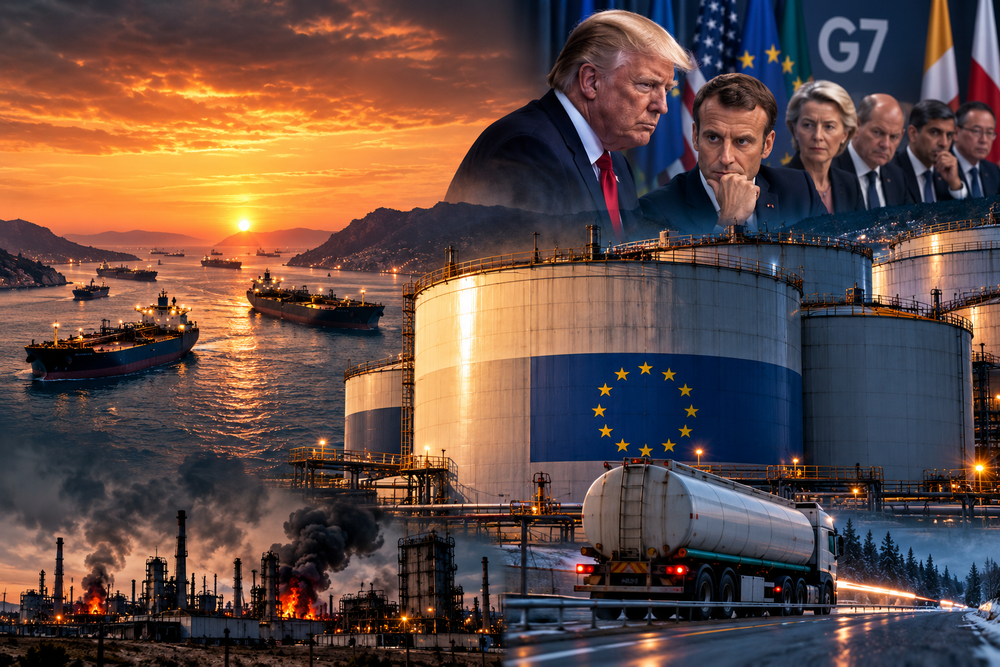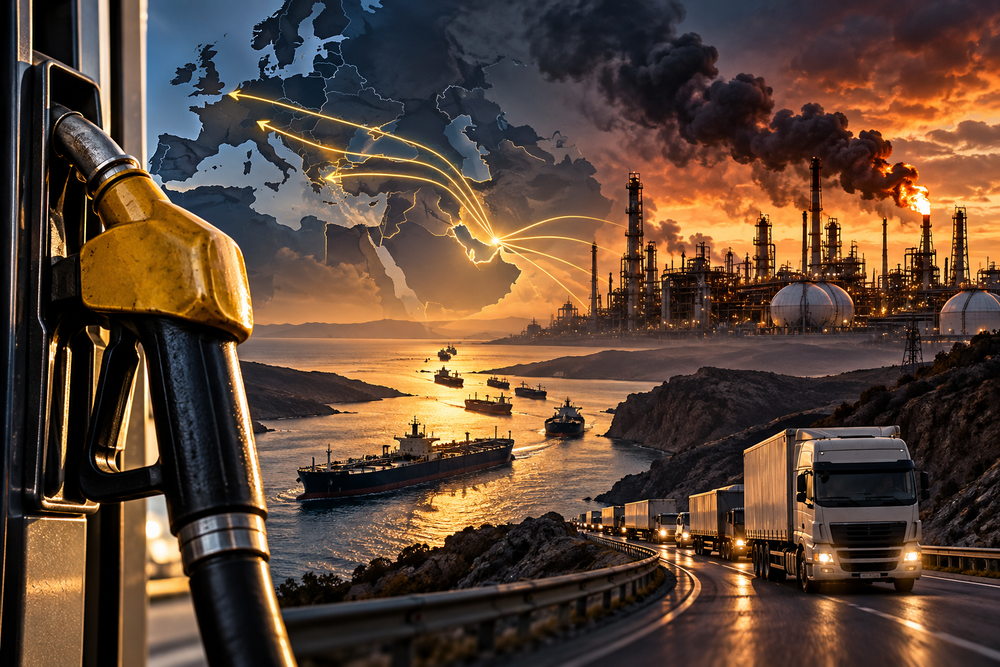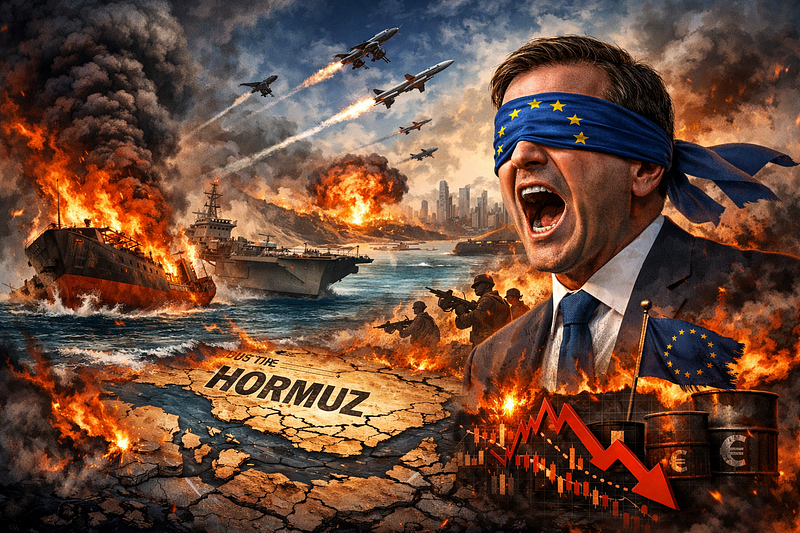
As the Hormuz crisis deepens, Europe is not restoring control but moving closer to a wider war through selective diplomacy, weak strategy, and growing political exposure.
A narrow waterway. Tankers under threat. Insurance costs rising. Energy markets tightening. Governments speaking in the language of stability while the structure beneath them shifts toward something far more dangerous.
This is how large geopolitical failures often begin.
Not with one final decision, but with a sequence of smaller choices wrapped in careful language. Maritime security. Freedom of navigation. Necessary steps. Responsible coordination. Each phrase sounds measured. Each phrase sounds temporary. Each phrase sounds as if it belongs to order rather than escalation.
But that is precisely what makes this moment so dangerous.
Europe is responding to the Strait of Hormuz crisis as though presence can substitute for control, and as though narrow crisis management can replace real diplomacy. In official statements issued in early March, the European Union warned that disruption of critical waterways such as the Strait of Hormuz must be avoided, while a later GCC-EU statement strongly condemned recent Iranian attacks on commercial shipping and infrastructure. What is striking is not only what is present in that language, but what is missing. Comparable condemnation of Israel or the United States is absent. The chain of escalation is narrowed before the strategic debate has even properly begun.
That asymmetry matters.
Because once the political framing is fixed, the range of acceptable policy begins to narrow with it.
Why The Strait Of Hormuz Changes Everything
The Strait of Hormuz is not simply another flashpoint on the map. It is one of the most important strategic chokepoints in the world, a narrow maritime corridor through which vast volumes of oil and gas must pass. When that corridor comes under pressure, the effects do not remain local. They move into fuel prices, insurance costs, industrial planning, political pressure, market fear, and alliance calculations.
This is what makes so much of the current European discussion feel detached from reality.
Hormuz is often spoken about as if it were a shipping lane that merely needs to be protected. But it is far more than that. It is a narrow economic artery running alongside Iranian territory, in one of the most militarized maritime environments on earth. Geography compresses everything. Distance is short. Reaction times are small. Civilian traffic is dense. Missile range matters. Drone range matters. Coastal proximity matters. A route does not need to be permanently sealed to become strategically dysfunctional.
That is the first blind spot.
Iran does not need to create a perfect blockade to impose strategic pain. It only needs to make transit dangerous enough, uncertain enough, and expensive enough that shipping companies, insurers, and energy markets start behaving as if normal passage no longer exists. In practice, that alone can be enough to trigger the kind of wider disruption Europe says it wants to avoid.
Presence Is Not Control
This is the point at which European policy begins to look weak.
Europe can send ships. It can contribute escorts. It can increase surveillance. It can coordinate politically and symbolically with allies. None of that is impossible.
But none of that is the same as restoring control.
The central strategic question is not whether Europe can add military assets to the region. Of course it can. The real question is whether Europe can restore normality in the Strait of Hormuz against the will of a state that has geographic advantage, escalation leverage, and multiple tools for disruption.
The answer remains deeply unconvincing.
Europe cannot change the geography of the Gulf. It cannot remove the political logic driving Iranian pressure. It cannot force commercial confidence back into existence simply by appearing present. And it cannot independently determine where the escalation ladder ends once it attaches itself to a mission shaped largely by others.
A tanker captain does not care about official rhetoric. An insurer does not price risk according to diplomatic wording. An energy market does not respond to declarations of resolve. They respond to danger, unpredictability, and exposure.
That is why the strategic distinction matters so much.
Whoever believes that additional European involvement can make the Strait of Hormuz safe and normal against Iran’s will is confusing maritime presence with strategic control.
The Escalation Trap
Once that distinction is ignored, Europe moves into a far more dangerous space.
The public is told that the objective is limited. Defensive. Temporary. Responsible. The language remains careful because careful language makes involvement politically easier to sell.
But the trap lies in what follows.
If attacks continue, pressure grows for stronger maritime protection. If stronger protection fails, pressure grows for harder measures. If harder measures still do not restore normal passage, the mission begins to change in character. What started as protection becomes deterrence. What started as deterrence becomes participation. What started as a shipping issue becomes political ownership of a wider conflict.
This is not dramatic exaggeration. It is the ordinary logic of creeping involvement.
And that is exactly why the current European line is more dangerous than it appears. It is not dangerous because Europe has already decided on total war. It is dangerous because it is building the policy language through which deeper involvement can later be presented as unavoidable.
Why Europe Is Choosing Narrow Diplomacy Instead Of Real Diplomacy
The obvious question is the one Europe seems least willing to confront honestly.
If this path is strategically weak, why is Europe not putting its full weight behind real diplomacy? Why is it not trying to address the entire chain of escalation in a constructive way?
The answer is uncomfortable.
Europe is not avoiding diplomacy. It is choosing a narrower, safer version of diplomacy, one that manages consequences without seriously confronting causes.
That distinction is crucial.
There are meetings. Statements. Calls for restraint. Coordination with regional actors. Concern about shipping routes. Concern about energy security. Concern about regional stability. All of that counts as diplomacy in the narrow procedural sense.
But it is not the same as diplomacy directed at the full structure of escalation.
Real diplomacy in this situation would require confronting all the actors pushing the crisis forward. It would require pressure on Iran, certainly. But it would also require clear political willingness to confront the role of Israel and the United States in setting the present chain of escalation in motion. That is exactly the step Europe is refusing to take.
Why?
Because that kind of diplomacy is politically expensive.
It creates friction with Washington. It risks splitting European capitals. It complicates alliance management. It threatens the appearance of unity. It forces Europe to act less like a supporting bloc and more like an independent strategic actor. And that is precisely what much of Europe still seems unwilling to become.
So instead, Europe chooses the manageable version. The safer version. The version that sounds constructive while remaining structurally narrow. The version that addresses shipping, fallout, and short-term stability while leaving the deeper architecture of escalation largely untouched.
That is why the current diplomatic posture is not merely inadequate. It is self-limiting by design.
This will come back to Europe in a terrible way, and almost nobody is trying to stop it: Europe is not avoiding diplomacy. It is choosing a narrower, safer version of diplomacy that manages consequences without seriously confronting the chain of escalation set in motion by Israel and the United States.
What Europe’s Current Response Actually Produces
European leaders may present this course as responsibility.
But the strategic reading is far less flattering.
This response does not open a meaningful path to de-escalation. It does not resolve the underlying conflict. It does not reduce Europe’s long-term vulnerability to Hormuz. It does not create a new diplomatic framework capable of addressing the full chain of escalation.
And it does not give Europe control.
The only real result of this step is that Europe becomes more deeply involved in a war over which it has little strategic control and which it does not politically want to enter.
That is the real substance beneath the language.
Not more control.
Not more peace.
Not more clarity.
More exposure.
More responsibility without command.
More risk without real strategic authorship.
The Blind Spots Are Becoming Catastrophic
At a certain point, careful language stops sounding responsible and starts sounding detached.
Europe may still tell itself that it is acting cautiously, proportionally, and with restraint. But there comes a point when the speed of events makes that self-description hard to take seriously.
Has everyone lost their mind? Everyone can see that this is escalating in a terrifyingly short span of time. And yet almost nobody seems willing to confront the full chain of causes, the strategic weakness of the current path, or the sheer speed with which this could break back against Europe itself.
That is what makes this moment so alarming.
Not only the danger of the crisis, but the narrowing of vision inside it.
What we are witnessing is not merely miscalculation. It is the deliberate narrowing of political vision at the very moment when clarity is most urgently needed. Massive geopolitical blind spots are being constructed in real time, and if this continues, the consequences will not be abstract. They will be economic, military, political, and potentially catastrophic.
That is the real warning.
Not that Europe is doing nothing.
But that Europe is doing the wrong kind of something while persuading itself that this still counts as strategy.
Europe is moving closer to the fire while still pretending it is merely managing the smoke.
Related Chapters of The Manifest
- Europe and the Strait of Hormuz: Drifting Into a War It Cannot Control
- Strait of Hormuz: The Chokepoint That Could Break the World Economy
- The Iran Escalation Is Bigger Than the Headlines
- Europe’s Last Strategic Choice: Peace with Russia or Permanent Dependency
- The Growing Condemnation of the US-Israeli Attack on Iran
The Manifest is an ongoing investigation into power, history, finance, and the structures that continue beneath the surface of modern events.
If this chapter spoke to you, you can follow the publication here.
Related from The Manifest Archive