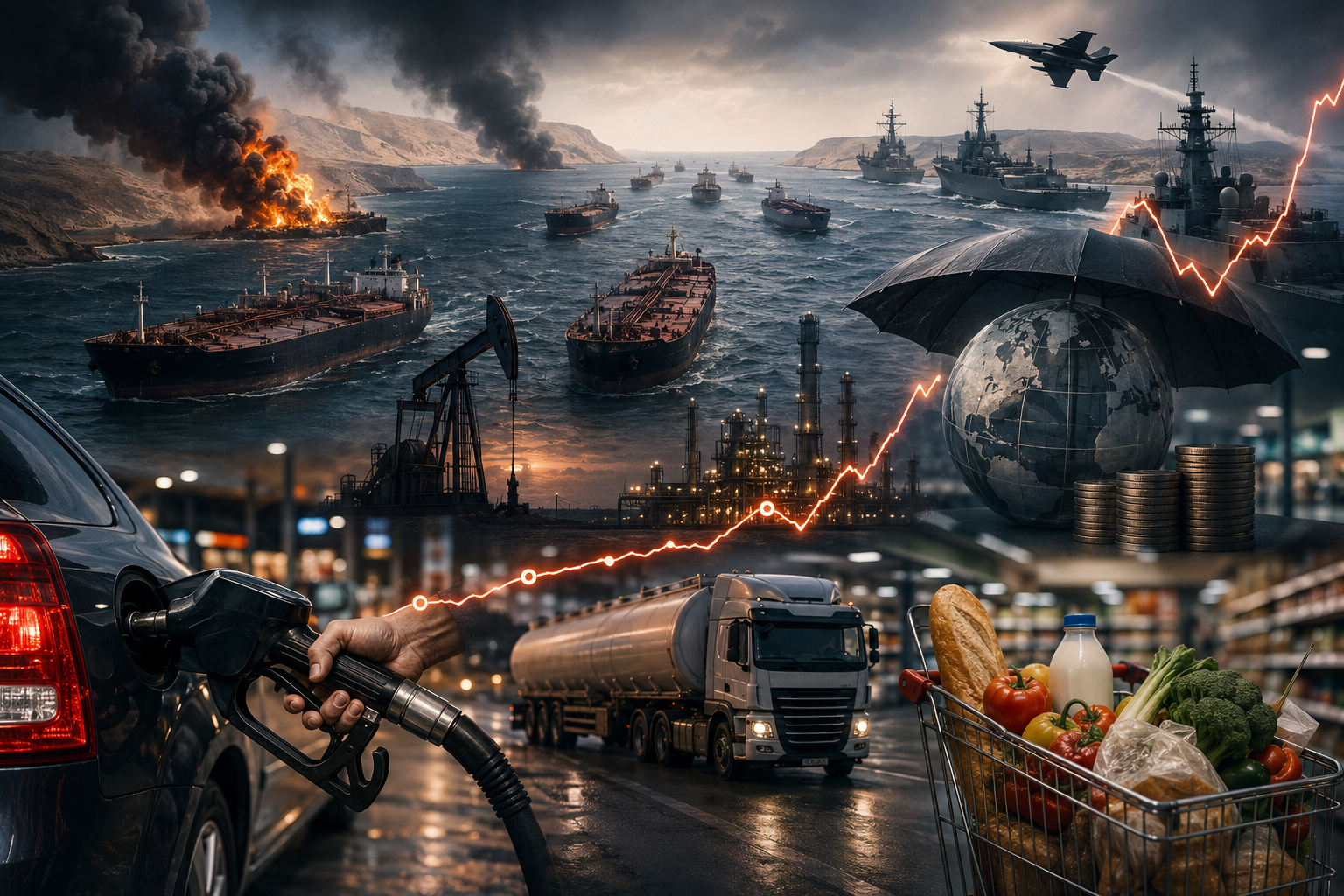
The advice from the Dutch motoring press on the thirteenth of July was practical, almost cheerful. Go fill up today. Tomorrow the board above the forecourt will show a higher number, and the day after that a higher one still. The reporters were not wrong, and they were not being dramatic. They were describing the last meter of a pipeline that begins eleven thousand kilometers away, in a strip of water most drivers will never see, and that ends at the nozzle in your hand.
Notice what did not happen. The price at the pump is not rising because oil got scarce. Tankers are full. Storage is full. The wells pump what they pumped last month. The price is rising because a set of decisions was taken over a distant strait, and decisions of that kind are now settled in liters, by people who were never asked. That gap, between where the decision is made and where the bill arrives, is the whole subject of this piece. It is also, read correctly, a forecast.
Because the pump is only the most visible collection point of a machine that has been assembling itself, in plain sight, across the last six months. The individual pieces have all been reported. The wars, the strikes, the shipping, the chip shortage, the insurance spikes. What has not been reported is that they are one machine, and that the machine has a direction. This is an attempt to name it while it is still being built.
The Story That Gets Told, and the One That Does Not
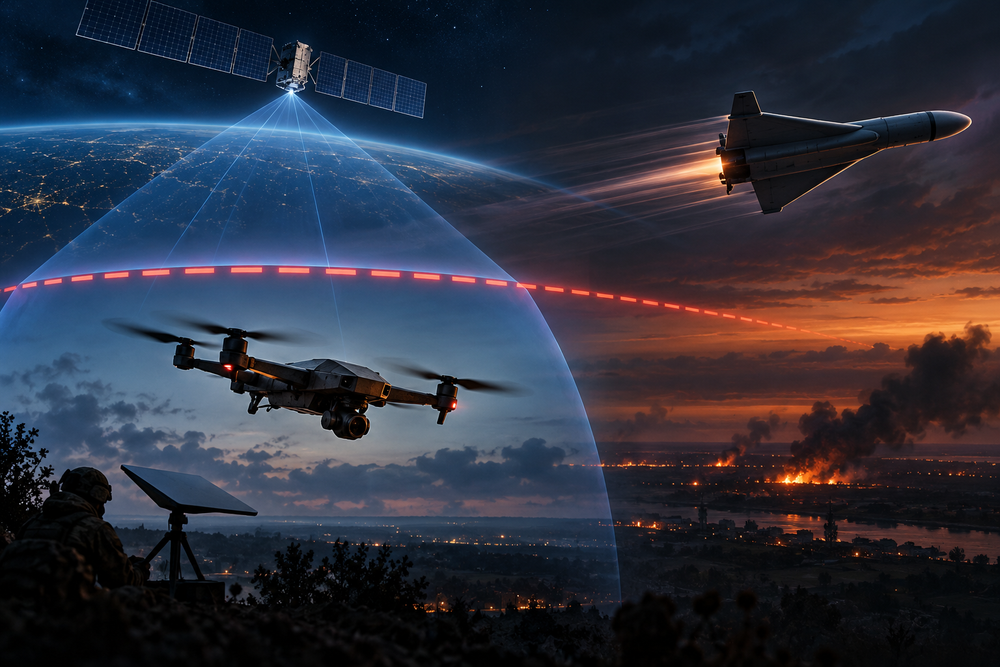
Open any newspaper and the coverage is there. Iran and the United States trading strikes across the Gulf. The Strait of Hormuz throttled to a fraction of its traffic. A chip industry that turns out to depend on a few factories on a geopolitical fault line. A war in Ukraine grinding through its third year. Each is covered thoroughly, as an event, in its own section of the paper, by its own correspondent.
What no section covers is the line that runs from those events to you. Not the connection between the wars, which commentators draw every day, but the one that leads from a decision taken over that distant strait to the number on your local forecourt, and from there into the price of everything a truck delivers. That line is real, it is surprisingly short, and it is the actual subject here. The events are loud and separate. The thing that quietly joins them to your week is what determines where this goes, and it is worth following one link at a time, because the shape it makes only appears at the end.
This is not a claim that someone is running the machine from a control room. There is no room. The pattern is emergent, which is exactly why it is dangerous. A conspiracy can be exposed and stopped. A structure that assembles itself out of the ordinary incentives of navies, underwriters, refiners, and finance ministries has no switch to throw, and no one who can be voted out of it. It is built by everyone acting normally, and it is paid for by everyone driving to work.
From Public Good to Toll Booth
Start with the clearest case, because it is the one now sitting on the table with a number attached.
For eighty years the Strait of Hormuz was kept open as a public good. The United States funded a navy, the navy kept the world's most important oil artery flowing for everyone, friend and rival alike, and the payoff came back indirectly: the dollar as the currency of oil, the cohesion of alliances, the right to write the rules of trade. The service was given away at the point of use precisely because giving it away was what made the order American. In 1987, when the Iran-Iraq war spilled into the Gulf and Kuwait asked for protection, Washington reflagged eleven Kuwaiti tankers under American colors and escorted them through the strait in the largest convoy operation since the Second World War. No ally received an invoice. The cost was real, and sometimes it was paid in lives rather than budget. Thirty-seven American sailors died aboard the USS Stark in those same waters in 1987, killed by a missile, and no beneficiary was billed afterward.
Measure the distance to this July. On the thirteenth, the American president announced that the United States would act as the guardian of the Strait of Hormuz and be, in his words, reimbursed at the rate of twenty percent on all cargo shipped through it, in exchange for protection. The next afternoon a naval blockade of ships moving to and from Iranian ports came into force. The International Maritime Organization responded that a transit charge of that kind has no basis in law. Tehran, which has spent months insisting that it alone is the guardian of the strait and has floated its own separate fee of a million or two per vessel through a newly created strait authority, rejected the American claim within hours. Two powers now assert custody over the same water, and each assertion arrives with a price tag.
Hold the two arrangements side by side, because the water is the same and the threat is the same and only one thing has changed. The public good became a product. The order became a subscription. What Washington once financed as the price of being the system, it now bills to the very economies whose dependence on the chokepoint eighty years of that protection helped to build. The escort did not change. The invoice did. And once one chokepoint has a rate card, the rate card is the news, not the strait.
The Oldest Name for This
The arrangement is not new. Only its disguise is. Empires used to be honest about it and published the rates. Rome called it tributum and wrote it into law. The Ottomans called it kharaj and sent assessors to measure what was owed. In the decades around the year 1000, the English crown paid Danegeld, silver handed to Viking fleets in exchange for not being raided. The payments began at ten thousand pounds in 991 and had reached seventy-two thousand by 1018, because paying had proved that paying worked. The fleet did not need to raid. It needed to remain visibly capable of raiding, nearby, forever. The Danish crews understood something that translates without a word of change into modern security economics: the product is not violence. The product is the standing possibility of violence, maintained at the customer's expense.
Those older systems shared one feature the modern one has quietly engineered away, and it is the feature that matters most. The payer could see the payment. A Saxon farmer knew the silver had left the village, counted out in front of the men who would otherwise burn the harbor. He knew what he paid, to whom, and for what. The modern version needs none of that apparatus. It needs a chokepoint, an index, and a fleet, and the tribute collects itself through the price mechanism, continuously, from everyone who drives, heats, ships, or eats. There is no assessor at the door because the assessor is the forecourt board, and it never says the word.
That invisibility is the whole innovation, not a side effect. A tribute this size, levied openly and itemized on a bill, would fall governments within a season. Dissolved into a fuel price, an insurance premium, and a refinery margin, it falls instead on households one tank and one shopping basket at a time, and produces no revolt, only a low and constant grievance that attaches to no one in particular. The Saxon could at least refuse, or rebel, or negotiate. The modern payer cannot refuse a price, cannot find the line item, and is told, when the number climbs, that it is simply the market. A payment you cannot see is a payment you cannot contest, and a payment you cannot contest is the most durable kind there is.
The Machine That Carries a Strike to a Forecourt
The reason this reaches your fuel tank so fast, and the reason it is so hard to see, is that it travels through four private mechanisms that each look reasonable on their own and only become a single transmission line when you stack them.
The first is the war-risk premium. When strikes hit the Gulf, marine insurers in London reprice the water within hours. War-risk cover for a Hormuz transit that ran a fraction of a percent of a ship's value in peacetime spikes many times over, and a committee of underwriters redesignates the sea as a war zone. That premium enters the freight rate of every tanker still willing to sail. The second is the oil benchmark. Brent is a global price, so a barrel lifted in the North Sea or Texas that will never go near the strait reprices upward the same morning, because benchmarks transmit risk, not routing. This July, Brent jumped more than nine percent in a single day after Iranian forces struck two tankers in Omani waters. One of them, the Mombasa, lost a crew member, an Indian merchant sailor working a war that was not his, on a ship whose flag was not his country's, in the waters of a state that was not a party to the fight. The market recorded his death as a nine percent move and went on quoting. Europe, for its part, pays the war premium without receiving a drop of the oil the war is nominally about.
The third mechanism is the one the Dutch competition authority has already caught red-handed, and it is the most important for whether this becomes a lasting problem or a passing spike. The ACM, in its fuel-price monitor, documented what economists call rockets and feathers: pump prices shoot up like a rocket when crude rises and drift down like a feather when it falls. Its finding was blunt. After the previous spike, pump prices never returned to their old level, and the reason lay not with the crude producers but with the refining and wholesale layer, where the margin quietly kept the difference. The analysts quoted this week expect the pattern to repeat, and their two stated reasons are worth reading closely. The refineries cannot lower prices, they say, because their own costs are the highest they have ever been. And with demand still enormous, nothing in the market gives anyone a reason to push wholesale prices down. Read the second reason again. That is not an inability but a choice with no penalty attached.
The fourth mechanism sits closer to home than any strait. More than half of a Dutch liter is tax, and the value-added tax is charged on top of the full price, excise included. Every cent of war premium and refinery margin that reaches the forecourt is therefore taxed again on arrival. The finance ministry collects a commission on the increase. No one designed that, and no one refuses it either.
Four mechanisms, each legal, each defensible in isolation, stacking into a single line that ends at the nozzle. No single link can be blamed for the total, and that is precisely what makes the total durable. By the time the money leaves a wallet in Utrecht, it is called a market price, and no line item says war.
Why It Is a Problem With a Memory, Not a Spike
Here is the distinction that matters, and the reason the honest forecast is not "prices will rise" but something more specific and harder to shake.
A spike goes up and comes back down. A problem goes up and stays. The rockets-and-feathers ratchet is what turns the first into the second. When the crude price eventually eases, and it will, the pump price does not follow it all the way back, because the margin absorbs the gap and there is no competitive pressure forcing it to give the gain back. Each crisis therefore does not just raise the price. It raises the floor. The war premium is temporary. The higher baseline it leaves behind is not. That is why the ACM found prices that never returned, and it is why filling up today is, this once, genuinely rational advice: you are not dodging a bad week, you are getting in under a level that is about to be reset upward and is unlikely to reset back.
This is the piece the coverage misses when it treats each fuel-price story as weather. Underneath the weather sits a ratchet with a memory, and the memory is the problem. The strikes light the premium, the premium lifts the price, the ratchet locks the gain, the tax multiplies it, and when the shooting pauses the floor stays where the fear put it. A household does not experience this as a war. It experiences it as a winter that costs more than the last one, for reasons no one on the news quite connects.
The Basket, Not Just the Tank
The pump is the meter everyone can read, which is exactly why it hides how small a part of the bill it is. Diesel does not only move commuters. It moves almost everything physical: the truck to the distribution center, the container ship across the ocean, the tractor across the field, the refrigerated trailer keeping food cold on the last leg. Freight is a line in the cost of every object that has ever been in a warehouse. A fuel premium, then, is an input cost to the entire economy of things, not merely a commuting expense, and it arrives a second time, laundered one layer further, in the price of the weekly shop. The citizen who does not drive still pays it, in the transport built silently into a bag of groceries.
The Fertilizer Nobody Prices
The pump and the freight are the fast half of the story. The slow half is food, and it is where the machine compounds most quietly and cuts deepest. Modern agriculture runs on synthetic nitrogen fertilizer, and synthetic fertilizer runs on natural gas, fixed into ammonia in a handful of enormous plants through a century-old process. It is another chokepoint, hiding in the same logic as the strait: concentrated, energy-dependent, and taken for granted until it is not. When energy prices rise, fertilizer rises with them. When fertilizer rises, the next harvest costs more to plant, and that cost lands months later at the same checkout, in bread and meat and milk. Roughly half the food the world eats exists because of that gas-fed nitrogen. The same shock that lifts the number on the forecourt board is, on a slower clock, lifting the cost of growing everything.
So the household pays three times over, from one distant war, on three different timers. Once at the pump, immediately and visibly. Once in the freight folded into every good on the shelf, a few weeks later. And once in the food whose growing was made more expensive by the same energy spike, a few months after that. The cruelty is the lag. The fuel jump you can see and blame. The grocery increase three weeks on and the food increase three months on arrive looking like separate stories, filed under inflation or bad luck, and nothing on the news connects them back to a strip of water in the Gulf. That disconnection is the design working as intended, not a failure of attention.
This Was Never About Oil
Step back from the pump now, because everything so far has been one example, and the example was never the point. Look again at what happened to the strait and it stops being a war story, or even an oil story. It is a toll road. A narrow place the whole world must pass through was quietly converted from something kept open for everyone into something priced, closed, or charged for at will, with the bill handed to people who were never asked and cannot route around it. A public road became a private gate.
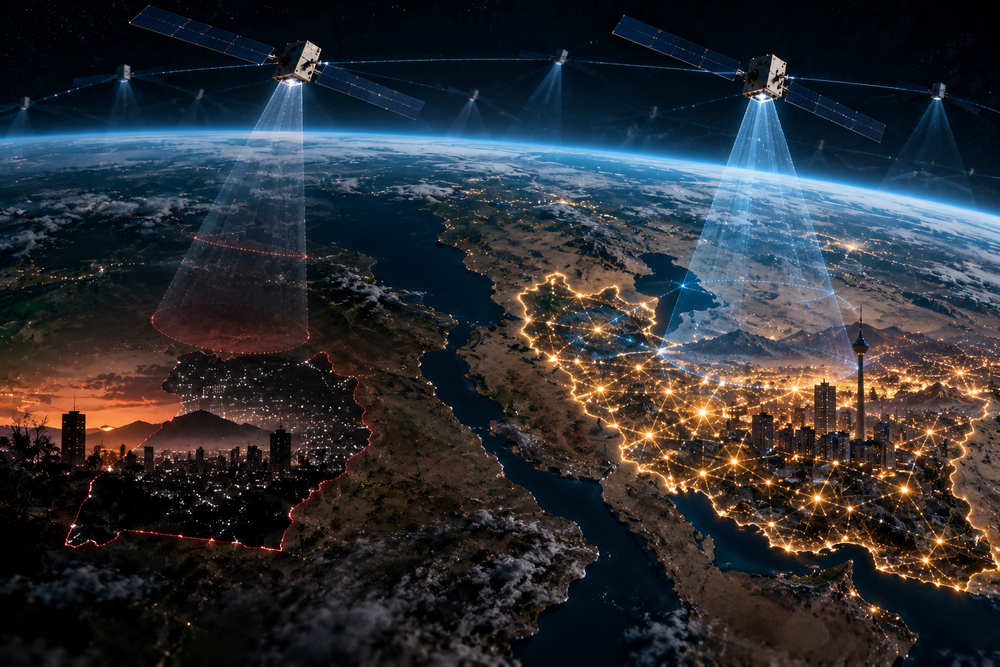
That is a priced chokepoint, and once you can name the shape you cannot stop seeing it. The modern world runs through a handful of them, each concentrated into a few hands, taken for granted until it is not, and convertible from a passage into a checkpoint by whoever controls it. The chips the whole economy runs on come from a couple of factories on the most dangerous fault line in Asia. The fertilizer that grows half the world's food is fixed from gas in a handful of plants. The cables and the payment rails are the same story, still untold. The Hormuz charge is the first live demonstration of the business model, and a demonstration is the thing that travels.
The Four Variables That Decide the Rest
If this is a machine and not an accident, then forecasting where it goes is not prophecy. It is a matter of naming the variables that govern it and watching them. Four decide almost everything that follows.
The first is whether Hormuz de-escalates or stays hot. The entire oil premium rests on the probability that ships get attacked, and that probability is set by one thing: whether the governments involved credibly declare the fighting over. As long as the strait is contested, the premium is a standing tax on energy. The day a credible declaration reopens it, the premium can unwind in weeks, as it did when the Iran-Iraq tanker war ended in 1988. Watch the war-risk quotes and the shipping traffic, not the front page. They will move first.
The second is whether the toll becomes a template. A twenty percent charge on the cargo through one strait is, by itself, a contested announcement. But it is also a demonstration. If it is enforced and copied, then every chokepoint on earth acquires a business model: prove you can close it, then price the promise not to. Malacca, Suez, Gibraltar, Panama, the undersea cables, the pipelines. Washington has already used the language of ownership about Panama once this decade. The question is not whether the idea is tempting. It is whether the first live example is allowed to stand, because rivals are watching the same demonstration.
The third is whether the concentrated supply chains hold. The same fragility that runs through Hormuz runs through the other narrow places named above: the chips, the fertilizer, the payment rails, the cables. Each is a chokepoint that has not yet been priced or broken. The risk is not that any one of them is doomed but that they share a geography and a logic, so a shock to one is a rehearsal for the rest.
The fourth is the quietest and the most decisive: whether the cost stays invisible enough to be uncontestable. Everything the earlier chapters described is engineered to keep it there, and so far it works, which is why no political limit has formed against it. Visibility is the only variable on this list that ordinary readers can actually change, and that is the entire reason for writing this down.
Three Ways This Can Go
Set those variables spinning and the future is not one line. It is three branches, and which one arrives depends on the variables above, not on anyone's confidence.
In the de-escalation branch, a credible declaration reopens Hormuz. The premium falls, the shipping returns, the oil benchmark relaxes, and the immediate fuel spike subsides within weeks. This is the good case, and it is a real one. But it is not a reset. The ratchet and the toll leave the floor higher than they found it, and the demonstration that a chokepoint can be priced does not un-happen. The world exhales, pays a little more than before, and forgets, which is how the baseline creeps upward one crisis at a time.
In the persistence branch, the base case if nothing decisive changes, the strait stays contested without exploding. The premium stops being an emergency and becomes furniture: a permanent surcharge built into the price of energy and therefore into the price of everything energy touches, which is everything. The toll template spreads to a second chokepoint. Inflation stays stickier than the models expect, and no one can quite say why, because the cause is distributed across four legal mechanisms and one distant war. Households absorb a standing tribute they were never asked to approve. That is not a catastrophe so much as something quieter and more corrosive: a slow, deniable transfer that never triggers the backlash a visible tax would, precisely because it is invisible.
In the escalation branch, a second chokepoint goes while the first is still hot. A blockade or accident around Taiwan severs the chip supply. A cable is cut. A fertilizer shock hits the food chain. Because these systems share the same fault-line geography and the same just-in-time fragility, the shocks do not add, they compound: an energy, food, and technology squeeze at once, each amplifying the others through the same price mechanisms already described. This is the tail, not the center of the distribution, and naming it is not predicting it. But a forecast that refuses to name its tail is not being careful, only comforting, which is a different thing.
A Toll With No End Date
Follow the twenty percent forward and ask what the payer actually receives that can be verified. A tax, however resented, buys an auditable state: roads, courts, a budget argued over in public and revised at elections. The toll buys a presence whose measure of success is unstated, whose targeting decisions no payer reviews, and whose revenue has no published destination. Nobody has said which fund receives the money, or which body audits it. The rate has been announced. The ledger has not. That asymmetry, a precise price and an invisible recipient, is the signature of tribute rather than taxation.
And there is no end condition written anywhere, because the honest end condition would be embarrassing to state: the toll ends when the danger ends, and the danger is co-produced by the party collecting the toll. Every strike raises the premium. Every premium raises the value of the escort. Every escort is now billed against the cargo it guards. The service and the threat share a return address, and a service that profits from the persistence of its own threat has no internal reason to end it. An emergency measure with no defined end is not an emergency measure. It is a business line, and business lines are not wound down for the crime of succeeding. Nothing inside the arrangement rewards its own resolution, and that, not malice, is why it belongs in a forecast rather than a news bulletin: left alone, a machine paid to keep a danger alive will keep it alive because every incentive in the chain points the same way and none points toward the exit.
The Case Against This Reading
The strongest objection deserves its full weight, because a piece that connects everything to one mechanism can talk itself into seeing that mechanism everywhere.
An intelligent critic would say two things. First, that this is ordinary geopolitics dressed as a system. Wars have always moved oil prices; the Gulf has spiked and settled many times; the ACM ratchet is a known feature of fuel retail, not a new machine; and reading a single tribute-architecture across Hormuz, Taiwan, and a Dutch forecourt is pattern-matching, the human brain's favorite error. Second, that the American position is not tribute but overdue burden-sharing. Washington has kept these sea lanes open at enormous cost, in money and in lives, for economies that spend a fraction of American levels on defense, and a charge for that service is a crude invoice for a public good the world has consumed free for eighty years. Both points are serious, and the second correctly names the free-rider problem that has distorted alliance politics for decades.
The reading offered here does not need to deny either. It makes a narrower claim. Whatever the origin of each fire, the current architecture routes the revenue toward whoever has the most control over whether the fire keeps burning, and nothing in that architecture rewards putting it out. Burden-sharing agreed between allies is a treaty: rates set jointly, destinations audited, an end condition written down. A charge set unilaterally, priced against a danger the collector helps to sustain, and harvested through the pump without any payer's consent, is a different instrument wearing the same word. And the pattern claim survives the accusation of pattern-matching for one reason: it is falsifiable, and it names in advance what would prove it wrong. That is not something a conspiracy theory can do.
What Would Prove This Wrong
Name the disconfirming signals plainly, because a forecast you cannot lose is worthless.
If Hormuz reopens on a credible declaration and pump prices, after a lag, return to their pre-crisis level rather than settling above it, then the ratchet is weaker than claimed and this is a spike, not a problem with a memory. If the twenty percent toll is quietly dropped, unenforced and uncopied, then it was a bluff, not a template, and the priced-chokepoint thesis loses its keystone. If a crude price that falls is followed, within a normal lag, by a wholesale price that falls just as fast, then the ACM finding has been overtaken and the transmission line does not ratchet. And if the concentrated supply chains absorb a real shock over the coming year with no cascade, then the shared-fault-line claim was overstated. Each of these is measurable. Watch for them. If they appear, this reading was wrong, and you will have lost nothing by having watched the right instruments.
Why the Biggest Story Is the One Nobody Tells
The strangest thing here is not the machine but the silence around it. The largest quiet change in the world economy is also the one story no section of the paper runs, and that absence is so consistent it demands its own explanation. The explanation is not a cover-up, which would at least be a thing you could expose. It is four ordinary forces acting together, which is worse, because there is nothing to expose.
The first is that the press is organized by desk, and this story has no desk. Hormuz is filed under foreign affairs, the pump under consumer news, the chips under technology, the fertilizer under agriculture, the inflation under economics. The mechanism lives in the seams between those desks, and no desk owns a seam. A story that belongs to everyone is written by no one. The second is that the machine is invisible by design, and invisibility gives a newsroom nothing to point a camera at: no document, no leak, no press release. Real structural power is boring in exactly this way. A queue and a margin do not trend, and a newsroom runs on what trends.
The third is that a story whose honest ending is "and there is very little you can individually do" gets tuned out by readers and therefore avoided by editors, until the avoidance becomes its own quiet filter on what gets covered. And the fourth is that almost everyone positioned to explain the machine is also positioned inside it. The refiner, the insurer, the finance ministry collecting its share of the increase, the government selling the protection. None of them is lying. Each simply has no reason to stand up and connect the dots in public, and a pattern that no participant is paid to name tends to stay unnamed.
So the instinct is right, and it is worth stating plainly against the reflex to call it far-fetched. This is no distant scenario waiting over the horizon. It is already running, now, in this month's headlines, read separately. The fact that it is not discussed as a whole is not evidence that it is small or unreal. It is a property of how changes of this size always arrive. Not with an announcement, but as a slow reclassification of what counts as normal, until one day the abnormal is simply the price of things. Naming the seam before it closes over is the entire reason a record like this one exists.
The Number on the Board
Back to the forecourt, because that is where all of this clears. The board flips its digits tonight and again tomorrow, and the advice to fill up today will be repeated next week against a higher baseline. Somewhere in that number is a strike on a Gulf port, a dead sailor in Omani waters, a war-risk premium set in London, a refinery margin that rises like a rocket and falls like a feather, a tax collected in The Hague, and a twenty percent toll announced by a man who called it protection. There will be no invoice, no vote, no treaty submitted for ratification, no line in any budget where the payment can be found and argued over. The insurer has its premium. The refiner has its margin. The ministry has its commission. The fleet has its toll. The architecture has a place for every actor in the chain except the one holding the nozzle.
That is the thing nobody is saying, and the reason it needs saying. Not that the world is ending, which is easy to write and impossible to act on, but that a specific, buildable machine is quietly installing a permanent premium on the narrow points the modern world runs through, and routing the bill to households in a form designed not to be noticed. You cannot vote against a price. You can only see it for what it is. The forecast is not that fuel will get more expensive, though it will. The forecast is that the way it gets more expensive is being normalized, chokepoint by chokepoint, until passage itself is a subscription and the tribute collects itself at the pump.
The goal here was never certainty. It was visibility. The war has a business model. The pump is where it clears. And the invoice, this time and increasingly, arrives in liters.
Evidence Map
Facts, interpretations, forecasts, and disconfirming signals.
Core claim. The world's strategic chokepoints are being converted from public goods kept open into weapons that can be priced or closed, and the cost is transmitted to households invisibly, through price levels, insurance premiums, refinery margins, and tax, rather than through treaties or votes. The July 2026 Hormuz toll and blockade are the clearest live example; the fuel pump is the clearest collection point.
Evidence level. Facts (high, documented): the load-bearing fact of this essay, the US president's public, on-the-record announcement on 13 July 2026 of a 20 percent Hormuz transit charge in exchange for protection, together with a naval blockade effective 14 July, is widely reported (CNBC, CNN, Axios, Al Jazeera) and was publicly rejected by the IMO as having no basis in law. It is a stated presidential position, not a leak or a rumor, and it is distinct from Iran's separate per-vessel "service fee." Also documented: the mid-July strikes and the two UAE-owned tankers struck in Omani waters with one crew member killed; Brent up more than 9 percent in a day; the collapse of the 60-day Islamabad Memorandum; the Dutch ACM fuel-price monitor documenting rockets-and-feathers stickiness at the refining/wholesale layer; the 1987 Operation Earnest Will reflagging and the USS Stark loss of 37 sailors. Interpretation (marked): that these events form a single emergent mechanism rather than separate incidents; that the toll functions as tribute rather than burden-sharing. Forecast (speculative, conditional): the three branches (de-escalation, persistence, escalation) and the claim that the price floor ratchets upward crisis by crisis.
What would confirm this. The toll being enforced and copied at a second chokepoint; pump prices settling above their pre-crisis level after any de-escalation; inflation staying stickier than energy fundamentals explain.
What would disprove this. Hormuz reopening and pump prices returning fully to pre-crisis levels; the toll dropped, unenforced and uncopied; wholesale prices falling as fast as crude after a decline; concentrated supply chains absorbing a real shock with no cascade.
Watchlist. Gulf war-risk insurance quotes and Hormuz shipping traffic; whether the 20 percent toll is enforced and whether any other state prices a chokepoint; the ACM fuel monitor and the Dutch pump-vs-crude gap; chip, fertilizer, and cable supply signals.
Related from The Manifest Archive
- Everyone Is Watching the Strikes. Nobody Is Watching the Sentence.
- The War of Two Blockades: How the Strait of Hormuz Became a War Over the Tanker
- No Warship Closed Hormuz. An Insurance Committee in London Did.
- The Memory Wall: Why the AI Boom Is Decided by Three Factories, Not the Models
Jerry van der Laan writes The Manifest Archive, where he examines power, history, and institutions. He traces the structures beneath them.