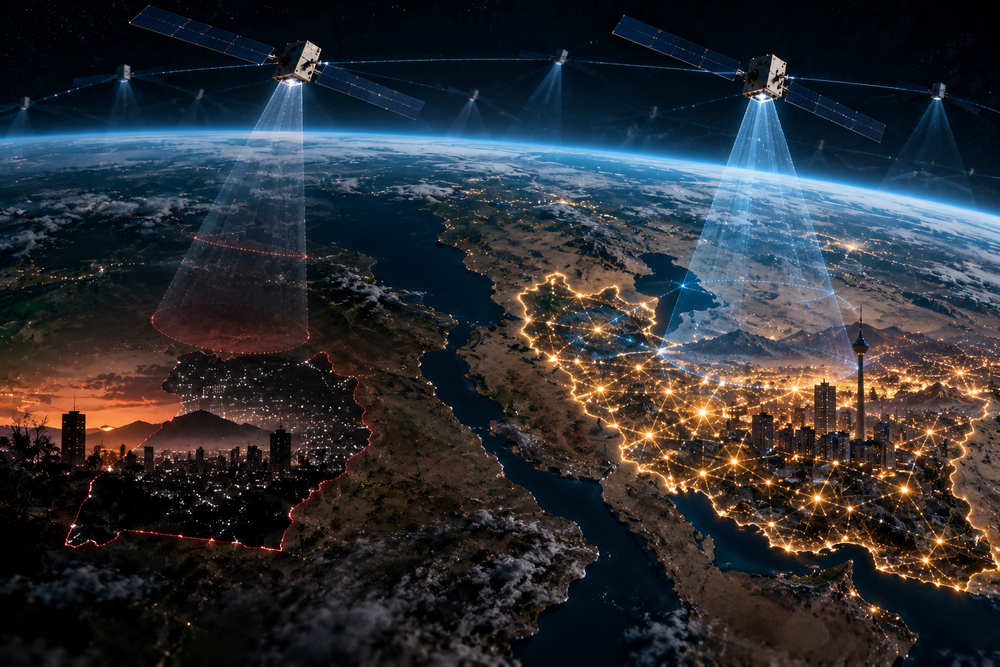
On a single trading day in late June, a rumor about one factory erased roughly a trillion dollars.
The story did not come from a war, a bankruptcy, or a central bank. It came from a whisper in the semiconductor supply chain that a single South Korean memory maker might slow the expansion of one specific product line. Within hours the KOSPI, Seoul's main index, suffered the largest single-day fall in its history, tripping its circuit breakers twice. SK Hynix and Samsung each dropped around twelve percent; Micron, on the other side of the world, fell about thirteen. Nvidia had already shed close to six hundred billion dollars of market value that month. The most valuable buildout in the history of capitalism, the trillions being poured into artificial intelligence, shuddered on its foundations because of a supply signal about high-bandwidth memory.
That reaction is the whole argument of this essay compressed into forty-eight hours. Everyone is watching the AI bubble: the capital expenditure that now runs into the hundreds of billions a year, the circular deals, the question on every front page of whether it is all about to pop. Almost no one is watching the thing that actually decides the answer. The fate of the AI boom is not set by the models, the valuations, or even the graphics chips everyone can name. It is set in three memory factories and one packaging plant, and the market proved it in a day.
The story everyone is telling
Start with the visible spectacle, because it is genuinely enormous and worth stating plainly before we go beneath it.
The four largest American cloud companies, Amazon, Google, Meta, and Microsoft, are on course to spend somewhere between roughly six hundred and thirty and seven hundred and twenty-five billion dollars on AI infrastructure in 2026, depending on which analyst's tally you take, up something like seventy percent from the year before. The figure is so large, and the divergence between estimates so wide, that no single number should be quoted without a source attached. What is not in dispute is the direction: by the summer of 2026 the free cash flow of those four companies had reportedly fallen to near zero, which means the buildout is now being bridged with debt.
The money has also begun to move in circles that make careful observers uneasy. Nvidia has committed up to a hundred billion dollars to OpenAI, the customer that then buys Nvidia's chips. OpenAI has signed compute commitments reported to total around one and a half trillion dollars, spread across Broadcom, Oracle, Microsoft, Nvidia, AMD, and others, against a revenue that is a small fraction of that and, by its own reset guidance, will remain so for years. More than a hundred and twenty billion dollars of data-center spending has been moved off the hyperscalers' balance sheets in under two years through special-purpose vehicles funded by private credit. And the productivity that is supposed to justify all of it remains stubbornly hard to find: study after study reports that the overwhelming majority of enterprise AI pilots show no measurable effect on profit.
The numbers behind the unease are specific. Analysts have mapped more than eight hundred billion dollars of interlocking commitments in which the industry's giants finance one another's demand: the leading chipmaker investing in the model company that then buys its chips, the model company signing cloud contracts with providers it has also invested in. One prominent investor has argued that the hyperscalers are understating the true cost of their hardware by stretching its assumed useful life from four years to six, on machines that in practice wear out faster, a claim he has backed with bets against the companies and which they dispute. And the revenue gap keeps widening: one venture firm's much-cited estimate puts the annual revenue the industry would need to justify its spending at around six hundred billion dollars, a figure that grows with every announcement, and by one measure the divergence between what is being spent and what is being earned has now exceeded the telecom bubble of 2001.
The scale of the commitments is its own warning. The best-known model company alone has signed compute deals reported to total around one and a half trillion dollars, against a revenue that is a small fraction of that and, by its own reset guidance, will stay so for years; when one cloud partner central to those deals was doubted on whether it could deliver, its shares fell roughly thirty percent in a single quarter. Meanwhile the productivity meant to redeem the spending stays hard to find: one widely cited study reported that ninety-five percent of enterprise AI pilots produced no measurable effect on profit, and a national-scale economic analysis found that ninety percent of firms reported no measurable productivity gain at all. This is the anxiety the market carries into every trading day, and it is why the sector is primed to reprice violently on almost any signal.
There is a quieter fragility in how the buildout is financed, too. More than a hundred and twenty billion dollars of data-center construction has been pushed off the tech giants' own balance sheets in under two years, into special-purpose vehicles funded by private-credit firms; one flagship structure of around thirty billion dollars keeps a single company's largest data-center complex off its books entirely. The lenders are the new titans of private credit, and the arrangement means that if the AI revenue never arrives, the loss lands not only on the famous technology companies but on a web of credit funds and their investors in structures most of the public has never heard of. It is the housing playbook of the 2000s in a new costume: real demand, real building, and a financing layer whose fragility stays invisible until it isn't.
This is the story the financial press has told a thousand times, and it is a real story. But it is the visible layer, and the visible layer is not where the outcome is decided. It is a story about money, and money is downstream of something physical.
What money cannot conjure
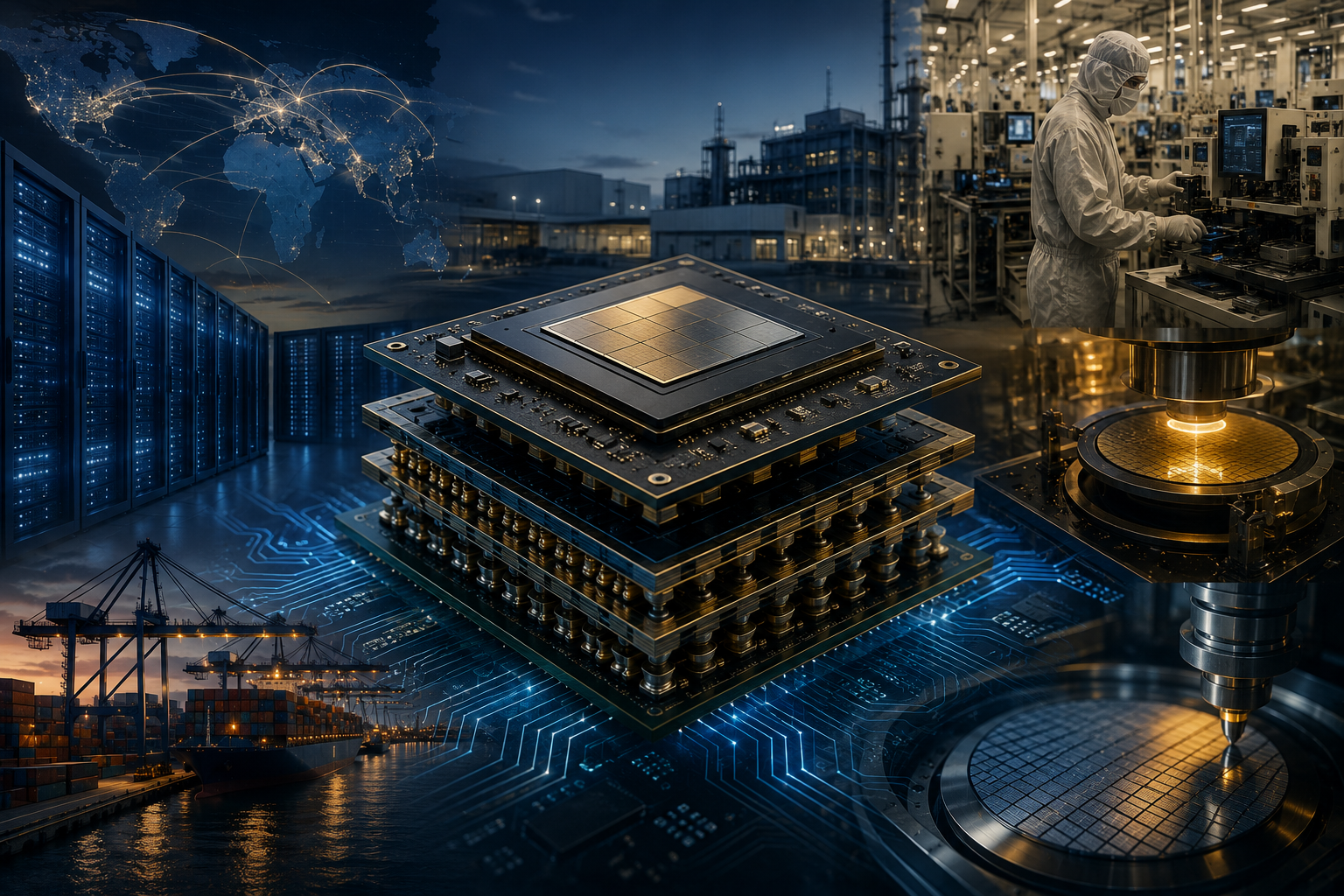
Here is the part almost no one outside the trade press is watching. A modern AI accelerator is not one chip. It is a logic die, the processor that gets all the attention, surrounded by stacks of high-bandwidth memory, all of it fused together on a silicon platform by a technique called advanced packaging. The processor is only the visible face. The memory and the packaging are the body, and the body is where the constraint lives.
High-bandwidth memory, or HBM, is the constraint that the phrase "AI chip" hides. It is not ordinary computer memory. It is memory stacked vertically, a dozen dies high, threaded with thousands of microscopic vertical connections, and it is fantastically hard to make. Producing a single bit of it consumes roughly three times the factory capacity of producing a bit of the ordinary memory in a laptop. By 2026 it had swollen to consume close to a quarter of the world's entire output of DRAM wafers, and the spillover was so severe that the price of ordinary consumer memory began to climb sharply as the industry diverted its lines to the AI product that paid more.
The reason it cannot simply be scaled on command is that the constraint sits at the back end, in the stacking rather than the wafer. Building a stack means threading a dozen memory dies with thousands of vertical connections and bonding them into a single tower without a flaw, a process gated by the throughput of specialized bonding machines and by how many finished stacks come out usable. You cannot buy that capacity in a quarter; it is tooling, cleanrooms, and years of yield learning. Nor is it cheap: a single next-generation stack runs around five hundred dollars, and even a current one costs perhaps sixty to a hundred dollars against five to ten for the ordinary memory it displaces. That gap is why the makers divert their lines to it, and the spillover reached the shelf: as capacity swung to the AI product that pays more, the price of ordinary computer memory climbed steeply over the year by trade estimates, so that a gamer upgrading a PC and a hyperscaler filling a data center found themselves, for the first time, bidding for the same scarce wafers.
And the supply is already gone. SK Hynix's own chief financial officer has said the company has sold out its entire 2026 HBM supply. Micron says the same of its capacity, booked under fixed-price contracts. By the end of the first quarter of 2026, industry trackers reported, essentially all of the year's HBM output from all three makers had already been claimed by Nvidia, AMD, and Google. When something is sold out a year in advance, the price is no longer the mechanism that clears the market. Allocation is. And allocation is decided by a very small number of firms.
How small is contested, and the contest itself is the point. Estimates of the HBM market put SK Hynix somewhere between fifty and sixty-two percent, Samsung somewhere between twenty and forty, and Micron in the single digits to low teens, with sources diverging so widely they cannot be reconciled; for the memory going into Nvidia's next platform specifically, analysts put SK Hynix as high as sixty to seventy percent. The demand side is a treadmill that makes the shortage self-renewing. Each new generation of AI accelerator wants more memory than the last, not less, because the models keep growing and the work stays memory-bound; a single top accelerator now carries more high-bandwidth memory than an entire high-end server did a few years ago. So even as the makers pour billions into new capacity, the memory demanded per chip climbs to meet it. This is not a one-time supply gap that will clear. It is a structural race in which the appetite grows with every model. And the industry is mid-transition to the next generation, HBM4, which roughly doubles the interface, is harder to make, commands a premium of about a third over the current generation, and concentrates the advantage further with whoever masters it first. In early June the chief executive of the dominant accelerator maker confirmed that all three memory firms had passed qualification to supply that next-generation memory for its coming platform, which widens the gate slightly. But qualification is not volume, and the volume remains concentrated where it has always been. Whatever the exact split, the shape is unmistakable. The memory that the entire trillion-dollar buildout depends on is made by three companies, one of them dominant, and there is no fourth.
The plant that everything passes through
Memory is only half of the hidden layer. The other half is the packaging, and here the concentration is starker still, because it is not three firms. It is effectively one.
The technique that fuses the logic die and the memory stacks into a single working accelerator is dominated, at the leading edge, by a single company: TSMC, and specifically its advanced-packaging process. Every high-end AI chip in the world, whoever designs it, passes through that process to become usable. And that process has been sold out. TSMC's own leadership told shareholders in mid-2026 that its packaging capacity remained effectively booked through the year, with lead times of roughly a year to a year and a half; industry analysts put its packaging lines as sold out into 2027. The company has been expanding furiously: from around thirty-five thousand specialized wafers a month at the end of 2024, to roughly seventy-five thousand a year later, toward a target of something like a hundred and twenty-five to a hundred and forty thousand by the end of 2026, with outsourced assembly partners adding perhaps another fifty to sixty thousand on top. And here honesty requires a caveat the alarmed version usually omits: the gap between supply and demand is projected to narrow, not widen, through 2026, from around twenty percent toward ten, easing further the year after. The chokepoint is acute and it is loosening at the same time. Both are true, and the essay that reports only the first has stopped doing forensics.
But loosening is not the same as gone. For the duration of the current buildout, the single most valuable industrial process on earth runs through the back-end lines of one company, and the second most valuable through three. That is the sentence the market read in June, and it is why a rumor about one of them moved a trillion dollars.
Why memory became the wall
None of this was always true. For most of computing's history the processor was the scarce, glamorous part and memory was the cheap commodity that fed it, and the whole industry optimized for making the processor faster. The trouble is that processors grew faster than the memory feeding them, decade after decade, until the gap itself became the defining constraint of the field: the point at which a chip spends most of its time waiting for data rather than computing. Engineers have a name for it, the memory wall, and they have been warning about it for thirty years.
Artificial intelligence walked straight into that wall and made it the whole game. A large language model is, mechanically, an enormous pile of numbers that must be hauled out of memory to the processor and back for every word it generates; the arithmetic itself is trivial next to the moving. Measurements of real inference put the work as memory-bound the substantial majority of the time, meaning the expensive processor sits idle, waiting for the memory, more often than not. That is why the industry's answer was to bolt the memory physically onto the processor and stack it as high as it will go, which is all that high-bandwidth memory is: a confession that the scarce step had moved from computing to feeding. And it is why, the moment AI became the center of gravity, the scarce resource moved with it, from the logic die everyone still watches to the memory stack and the package almost no one does. The famous part of the chip stopped being the constraint years ago. The coverage simply has not caught up.
Three names, and no fourth
Step back from the mechanics and look at who these facts actually name, because the Manifest's recurring question is not what is scarce but who holds the scarcity.
The memory that feeds the entire buildout is made, at the leading edge, by three companies: SK Hynix and Samsung in South Korea, Micron in the United States. The packaging that assembles the finished accelerator is dominated by one, TSMC in Taiwan. That is the real map of power in artificial intelligence, and it looks nothing like the map the public carries. The public map is a gallery of founders and chatbots and trillion-dollar valuations, American and loud. The real map is a short list of industrial firms on the Pacific rim whose names most investors in the boom could not reliably produce, whose factories decide how much of the ambition can actually be built, and against whom there is no near-term alternative. There is no fourth memory maker waiting in the wings, and no second company that can package at the leading edge at scale. The scarcity is not just real. It is held.
And a fourth is not going to appear on any timescale that matters. Building leading-edge memory or packaging is among the most capital- and knowledge-intensive undertakings on earth: a single advanced facility costs tens of billions of dollars, takes years to build, and then takes years more of yield learning before it produces reliably, learning that cannot be bought or copied because much of it lives in the tacit experience of the engineers who run the lines. Patents fence off the rest. This is why the incumbents have stayed the incumbents for a generation while everything downstream of them churned. The scarcity is not a temporary imbalance that high prices will summon new entrants to correct. It is structural, defended by physics, capital, and time, which is exactly what makes it a determining variable rather than a passing shortage.
The pecking order among the three is itself a live drama with real stakes. SK Hynix has led the high-bandwidth-memory era and, by most estimates, supplies the majority of the memory going into the leading accelerator platform; Samsung, which stumbled on qualification and lost ground, has been fighting to claw its share back; Micron, long the smallest of the three, is by some counts now overtaking Samsung. The exact figures are genuinely disputed across sources and should be read as a range rather than a scoreboard. But the direction is the point: whoever leads a given memory generation captures a disproportionate slice of the profit and the pricing power of the entire AI supply chain, which is why one of them merely adjusting its production plans can move a trillion dollars, as June proved.
This is the pattern the Manifest keeps finding beneath every visible power. The thing everyone watches, the model, the chip brand, the market cap, is the part that is abundant enough to become famous. The thing that decides the outcome is the part that is concentrated enough to stay quiet. When a capability becomes universal, as chip design and model training now have, power does not stay with the capability. It migrates to whatever remains a bottleneck, and it accrues to whoever owns that bottleneck. In this boom the bottleneck is a stacking line and a packaging plant, and the owners are a handful of firms on the far side of the world.
The counterfactual that settles it
The way to know whether a variable is decisive is to remove it and see what happens to the outcome. Run that test on the AI boom and the result is clean.
Remove the models, and the buildout continues; there are many models, and a new one arrives every month. The graphics processors are a harder case, because the leading maker's software ecosystem is a genuine moat and not easily substituted. But even there the point holds from the other direction: however many firms design capable accelerators, and whoever's software wins, every one of those designs still depends on the same memory and the same packaging. You can compete on the logic and the software. You cannot yet compete your way around the stack and the package. Remove the high-bandwidth memory, or remove the packaging capacity that turns a logic die into a finished accelerator, and the entire buildout stalls regardless of how many chips have been designed or how many billions have been raised to buy them. A processor with no memory to feed it is a space heater. A stack of memory and a logic die that cannot be packaged together is two piles of silicon. The determining variable is not the part with the trillion-dollar valuation. It is the part with the year-long lead time.
You can already see the counterfactual in the physical world. Data centers stand built and energized, their racks waiting, because the accelerators meant to fill them are held up behind memory and packaging rather than behind money, designs, or even electricity. The scarce step is visible as empty floor space in buildings that cost billions, waiting on components that cost a few hundred dollars each and cannot be had.
This is why a growing number of supply-chain analysts have stopped calling compute the constraint and started calling memory the constraint, noting that the actual work of running a large model is bound by memory bandwidth the substantial majority of the time, not by raw processing. The industry even has a name for it, the memory wall, and 2026 is the year the wall stopped being a technical footnote and became the thing that prices the whole sector.
A chokepoint in the worst place on the map
There is one more fact about this layer that should keep strategists awake, and it follows straight from the concentration. The scarce step in the most important technology of the age does not sit in some neutral, redundant, well-defended location. It sits in two of the most dangerous places on earth.
The single company that packages nearly every leading-edge accelerator is in Taiwan, the island a nuclear-armed China claims as its own and has never renounced taking by force. Two of the three memory makers are in South Korea, within artillery range of a hostile, nuclear-armed North. The entire trillion-dollar Western AI buildout runs through a supply chain concentrated on the front line of the two most volatile standoffs in Asia. A blockade of Taiwan would not merely raise chip prices; it would sever the step that turns silicon into a usable accelerator, and there is no substitute that could be stood up in less than years. The scarce thing is not only held in a few hands. It is held in a few hands sitting on a fault line, which is the thread that ties this quiet industrial story to every loud geopolitical one.
The concentration is also being actively weaponized. The same governments that depend on this supply chain are restricting parts of it to keep rivals out: export controls on the most advanced memory, chips, and the tools that make them are now a permanent feature of the contest between the United States and China. That both hardens the chokepoint, by discouraging the redundancy that competition would otherwise build, and turns it into an instrument of statecraft. A resource this concentrated does not stay purely commercial for long. It becomes leverage, and every power that can reach it will try to.
The stakes of all this are not abstract. If the memory or packaging supply genuinely tightened for a sustained stretch, or if the Taiwan chokepoint were disrupted, the result would not be a slower AI news cycle. It would be a hard ceiling on how much artificial intelligence the world can physically build, felt first as cancelled data-center plans and repriced valuations, and eventually as a strategic gap between the powers that secured their supply and those that did not. The buildout that everyone treats as inevitable is, at its foundation, contingent on a production schedule in a handful of plants. That is not a caveat to the AI story. It is the load-bearing fact beneath it.
The day the market admitted it
Which returns us to late June, because that episode is not color. It is the proof.
For two years the financial story and the physical story ran on separate tracks. The press debated the bubble, the valuations, the circular deals, the revenue gap; the trade publications quietly tracked stacking yields and packaging lead times. Then, for forty-eight hours, the two tracks touched. A single rumor that one memory maker might favor its high-margin ordinary-memory business, where margins were said to approach ninety percent, and slow the ramp of its next-generation HBM was enough to convince the market that the supply feeding the entire buildout might tighten, and the whole AI complex repriced at once. The record fall in Seoul, the circuit breakers tripping twice, the twelve-percent drops in the memory makers, the contagion to Micron a hemisphere away: all of it triggered by a capacity signal from one firm's back-end line. It did not stop there. A related chip selloff weeks later took more than a fifth off Intel in a single day, and a closely watched Wall Street bubble gauge climbed toward the top of its range. The pattern was unmistakable: the most expensive story in the world had discovered that its floor was a stacking schedule.
Mark the claim carefully, because markets are never moved by one thing alone and the rumor was the reported trigger, not a proven sole cause. But the sensitivity it revealed is undeniable and it is the finding. The confidence of a seven-hundred-billion-dollar annual spending cycle turned out to rest on the production decisions of a handful of factories that most of the people funding the boom could not name. The bubble everyone watches and the bottleneck almost no one watches are not two stories. They are one story, and June was the day the market admitted it.
Why nobody is watching
If this layer is so decisive, why is the coverage almost all about the money? Because the money is legible and the physics is not. Anyone can grasp a trillion dollars, a circular deal, a revenue gap; almost no one outside the industry can hold in their head what a through-silicon via is, or why a stacking line's throughput caps the whole supply. The bubble story is written in a language everyone speaks; the physical one is written in a language spoken in Hsinchu, in Icheon, and at a few analyst desks. And it is boring in exactly the way real power usually is: no villain, no drama, nothing to photograph, just a queue and a yield curve. A queue does not trend. But the queue is where the outcome is set, and the drama on the front page is a lagging indicator of what a few thousand engineers can physically stack and bond this year.
The strongest objection
The best case against this whole framing deserves to be put at full strength, because a memory-bottleneck thesis can curdle into its own kind of hype.
An intelligent critic would say two things. First, that the chokepoint is easing, not tightening: all three memory makers are now qualified to supply the next-generation HBM, the packaging supply-demand gap is projected to close through 2026, and capacity is expanding faster than at any time in the industry's history. A bottleneck that is being relieved on a known schedule is a temporary margin story, not a structural determining variable. Second, that the revenue beneath the boom is not fictional the way a bubble's is: the chipmakers at the center are posting real, enormous, growing sales, with the leading accelerator maker's data-center revenue up more than ninety percent year on year. If the money is real at the chip layer and the physical constraint is loosening, then calling memory the thing that decides whether the boom pops is just the bearish narrative wearing an engineer's coat.
That objection is serious, and the honest reply concedes its facts and narrows the claim to what survives them. The chokepoint is indeed loosening, and the essay says so; the revenue at the chip layer is indeed real, and the essay says that too. What neither of those facts touches is the core point: for the window that matters, the near-term years in which these trillions are actually committed and spent, the outcome is gated by memory and packaging capacity rather than by models or money, and the market has demonstrated, with a record crash, that it knows this even when the coverage does not. The claim is not that memory makes the boom a fraud. It is that memory, not the model or the valuation, is the variable that sets the ceiling, and that a story told only about the money is watching the scoreboard instead of the game.
What would falsify the reading is concrete and worth naming. If the AI buildout continued to accelerate through a genuine, sustained HBM or packaging shortage without its pace or its valuations being affected, then memory would not be the binding constraint after all. If the next violent repricing of the AI complex were triggered by something with no connection to the physical supply chain, a pure demand or financing shock, the June pattern would look like coincidence rather than mechanism. Watch what moves the sector next. If it is a factory again, the case is made.
The factory, not the model
Strip the boom of its noise and the question that decides its outcome is whether the memory can be stacked and the die can be packaged fast enough to fill the data centers that a trillion dollars has already paid for. The answer sits with three memory makers and one packaging plant, not with any founder or any fund.
Read this way, the AI economy has three layers, and only the top two are ever discussed. There is the visible layer, the models and founders and valuations that fill the news. There is the layer beneath it, the memory and packaging that actually gate how much can be built. And there is a governing layer beneath that: the physics, the geography, and the handful of firms that decide the middle layer's capacity. The market spends its days trading the top layer, glimpses the middle one on a day like June's, and almost never looks at the bottom at all. Yet the causation runs upward, from the governing layer to the visible, not the other way around. The valuation is the shadow. The stacking line is the object casting it.
There is a portable lesson here that reaches well past this boom. When the exciting part of a technology becomes abundant, the design of the chip, the training of the model, the raising of the money, power does not stay with the exciting part. It migrates to whatever remains scarce, and the scarce thing is almost always physical, unglamorous, and concentrated in a few hands: a stacking line, a packaging plant, a queue with a year-long lead time. The breakthrough gets the valuation. The bottleneck sets the ceiling. So the next time the AI complex lurches and the headlines reach for a bubble or a genius or a crash, look past all three, to a handful of factories in Korea and Taiwan whose production schedules quietly decide how far the most expensive story in the world is allowed to go.
Evidence Map
Facts, interpretations, forecasts, and disconfirming signals.
Core claim. The outcome of the AI boom is gated not by models, valuations, or GPUs but by high-bandwidth-memory and advanced-packaging capacity, concentrated in three memory makers and effectively one packager. The June 2026 crash demonstrated the sensitivity: a rumor about one memory maker's capacity repriced the entire AI complex.
Evidence level. Facts (high): the record KOSPI single-day fall of 23-24 June 2026 with twin circuit-breaker halts and ~12% drops in SK Hynix/Samsung; SK Hynix and Micron statements that 2026 HBM is sold out; TSMC advanced-packaging lead times of roughly 52-78 weeks and sold-out status; HBM consuming ~3x the wafer of standard DRAM and ~a quarter of DRAM output; big-four 2026 capex in the ~$630-725B range. Contested estimates (attributed, ranges only): HBM market shares (SK Hynix ~50-62%, Samsung ~20-40%, Micron single digits-teens; Rubin-specific SK Hynix ~60-70%); the exact capex total; consumer DDR5 price spikes (trade-press). Interpretation (marked): that memory/packaging is the determining variable and the financing bubble its downstream consequence; that the June rumor was the reported trigger, not a proven sole cause. Forecast (speculative): the next major repricing of the AI complex will again originate in the physical supply chain.
What would confirm this. The AI buildout's pace and valuations continuing to track HBM and packaging capacity signals; the next sector-wide move again originating in a memory or packaging event.
What would disprove this. The buildout accelerating through a sustained HBM/packaging shortage with no effect on pace or valuation (memory not binding); or the next violent repricing triggered by a pure demand/financing shock unconnected to the supply chain (June was coincidence, not mechanism).
Watchlist. SK Hynix / Samsung / Micron HBM4 ramp decisions and pricing; TSMC advanced-packaging lead times and the supply-demand gap; HBM share of DRAM wafer output; hyperscaler capex versus free cash flow; the concentration of memory and packaging supply.
Related from The Manifest Archive
- Everyone Is Watching the AI Boom. Nobody Is Watching the Transformer That Can't Be Built in Time.
- The Architecture of Power: Why Empires Redistribute Instead of Fall
- The War of Two Blockades: How the Strait of Hormuz Became a War Over the Tanker
- The Financial Architecture of Power: How Debt Defines the Limits of Modern States