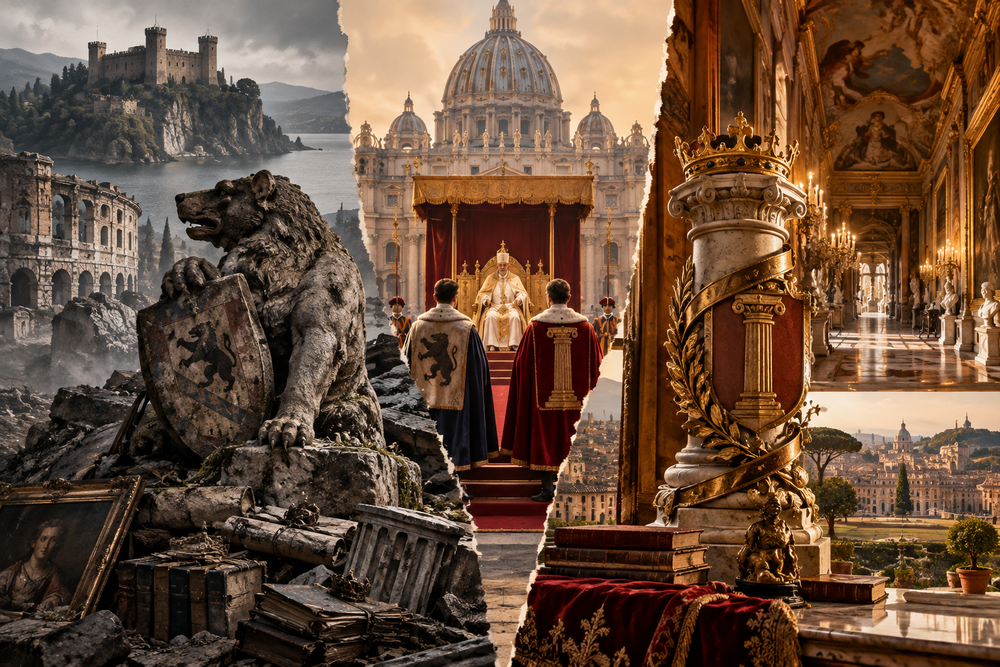
In the months after Rome fell to Italy in 1870, the heads of the city's great families faced a small social question that turned out to be an enormous strategic one. There were now two courts in Rome. One belonged to the new king, installed in the Quirinal Palace, the very building that had until weeks earlier been a papal residence. The other belonged to the pope, withdrawn behind the walls of the Vatican, sovereign of nothing but a palace, refusing to recognize that anything had changed. To which court should a family send its sons, pay its respects, marry its daughters? The question looked like etiquette. It was in fact a wager on which of two institutions would still be standing in a hundred years, and the families that answered it split into two camps whose fates would diverge in a way almost no one in 1870 could have predicted.
The families that chose the king became known as the White Nobility. They took positions at the royal court, accepted the new order, and aligned themselves with what was plainly the rising power, a young, ambitious, unified Italian kingdom with an army, a parliament, and the future apparently in its hands. The families that chose the pope became the Black Nobility, named for the mourning they wore. They refused the king's court, withdrew from the public life of the new state, and tied themselves to a sovereign who had just lost his entire country and looked, to any sober observer, like a man presiding over the end of something. At the moment of the choice, the white families had clearly chosen well and the black families had clearly chosen sentiment over sense. They had bet on the loser.
This chapter is about how the bet on the loser turned out to be the winning one, and about the mechanism underneath that reversal, because the mechanism is not really about Rome or aristocrats at all. It is about the difference between two kinds of power, the kind you hold and the kind you outlast with, and about a rule that governs the survival of elites far beyond this one city: that you do not endure by defending the form your power currently takes. You endure by being willing to trade that form, the moment it becomes a liability, for one that lasts.
The Two Bets
To feel the strangeness of what happened, you have to take the 1870 situation seriously on its own terms, without the benefit of hindsight.
In 1870 the smart money was unmistakably with the king. The Kingdom of Italy was the new fact of European politics, the culmination of a unification movement that had swept the peninsula, backed by a modern army and recognized by the powers. It held Rome. It held the future. The House of Savoy sat at the head of it, and a family that attached itself to that court was attaching itself to the winning side of history, to growth, to access, to the ordinary rewards that flow to those who back the victor. The white nobility were not fools or opportunists in any contemptible sense. They were doing the rational, prudent thing, the thing almost everyone does, which is to make peace with the power that has actually won and to position themselves inside it.
The pope, by contrast, was a spectacularly bad bet. He had lost his state. He governed no territory. He had shut himself inside a palace and declared himself a prisoner, and he was demanding that the world pretend the Kingdom of Italy did not legitimately exist, a demand the world was visibly not going to honor for long. To bind a family's fortunes to this dispossessed and apparently obsolete figure, to refuse the king's court out of loyalty to a sovereign with no country, looked like the choice of families too proud or too sentimental to read the writing on the wall. They were mortgaging their future to the past.
And yet. The whole story turns on that and yet, because the obvious reading of 1870 contained a hidden error, and the error was about time. The white nobility had bet on which institution was winning. The black nobility, whether they understood it in these terms or not, had bet on which institution would last. Those are different questions, and in the long run the second one is the only one that matters, because winning is a snapshot and lasting is the whole film.
How the Bets Resolved
Now run the film forward, and watch the apparently safe bet come apart.
The Italian monarchy that the white nobility had so prudently joined lasted seventy-six years. In 1946, in the wake of the catastrophe of fascism and a lost world war, Italy held a referendum on whether to remain a kingdom or become a republic. The people chose the republic. The monarchy was abolished. The king, Umberto the Second, who had reigned for barely a month, went into exile, and the male heirs of the House of Savoy were formally barred from even setting foot on Italian soil, a prohibition that would stand until the twenty-first century. The royal court simply ceased to exist. The Quirinal Palace, the seat of that court, the place where the white nobility had gone to pay its respects to the winning side of history, became the residence of the president of a republic that had no use for a nobility at all. Everything the white families had attached themselves to, the crown, the court, the royal honors, the whole apparatus of monarchical prestige, was gone, and gone not slowly but in a single constitutional stroke.
The institution the black nobility had bet on was, at that same moment, still there. The papacy that had looked finished in 1870 had by 1946 long since recovered its footing. The quarrel with Italy had been settled in 1929, the pope restored to a small but real sovereignty, and the Church went on, as it had gone on through every previous catastrophe, indifferent in its slow way to which governments rose and fell around it. The families that had tied themselves to it were tied to something that was still standing when the rival institution had vanished. The dispossessed sovereign of 1870 outlasted the triumphant kingdom that had dispossessed him, and the families that had mourned with him outlasted the families that had celebrated with the king.
This is the reversal at the heart of the story, and it is worth stating in its full paradoxical force. The families that bet on the winner lost. The families that bet on the loser won. Not because they were wiser or better, but because they had, by loyalty or instinct or calculation, attached themselves to the more durable of the two institutions, and over a long enough span durability beats victory every time. The white nobility backed the power that was winning in 1870. The black nobility backed the power that would still exist in 1970. Only one of those bets pays out, and it is never the one that looks smart at the time.
The Mechanism Underneath
Step back from the particular families and the mechanism becomes visible, because what the black nobility did has a general structure that recurs wherever an elite survives a change of regime.
When the Papal States fell, the Roman families loyal to the pope lost a specific and visible form of power. They had been the aristocracy of an actual sovereign state, holders of office, administrators, the governing class of papal territory. That form of power, territorial and political and embedded in a state, was precisely the form that 1870 destroyed and could not be recovered. The families had a choice about how to respond to that loss, and the choice is the mechanism. They could cling to the form, insisting on a political and territorial role that no longer existed, and go down defending it. Or they could let that form go and convert what remained of their standing into other forms, less visible, less obviously powerful, but attached to an institution that would endure.
They chose conversion. The power that had been territorial became ceremonial, expressed in the honorific roles of the papal court. The power that had been political became institutional, embedded in the lay orders and foundations and chivalric bodies that orbit the Church, in positions like membership of the ancient Order of Malta, in the slow machinery of ecclesiastical and charitable institutions. The power that had been public became social and matrimonial, carried in marriage networks and inherited name and the quiet continuity of families that knew how to wait. None of these converted forms looked like the power they had lost. A ceremonial office is not a governorship. A seat in a chivalric order is not a ministry. And that unimpressiveness was exactly the point, because forms of standing that do not look like power are not contested as power, are not stripped away when regimes change, and can be carried, almost invisibly, across the very upheavals that destroy more conspicuous kinds of authority. The families traded the visible for the durable, and the durable, by definition, is what survives.
This is the rule the whole story exists to illustrate. An elite dies when it defends the form of its power. It survives when it abandons the form to keep the substance. The substance, in this case, was continuity itself, the persistence of the family as a recognized entity attached to an enduring institution, and that substance could be preserved only by giving up the specific shape, territorial and political, that everyone in 1870 would have identified as the family's power. To keep what mattered, they had to let go of what looked like it mattered. The families that could not perform that trade, that insisted on being what they had always been, did not make it through. The families that could, did.
What Conversion Looked Like, Concretely
The trade from visible power to durable form was not an abstraction. It had specific institutional channels, and naming them shows how the mechanism actually ran.
The clearest example is also the most telling, because the institution mirrors the families' own predicament. The Sovereign Military Order of Malta, the ancient Catholic chivalric order recognized by the papacy for the better part of a thousand years, is a sovereign entity under international law that holds no territory, a state without a country, headquartered extraterritorially in a palace on the Via Condotti and a villa on the Aventine hill in Rome. An order that is sovereign yet stateless was the natural home for families who had themselves just become, in effect, sovereign in dignity yet stateless in fact, and the Roman aristocracy was historically prominent in its ranks, where noble lineage was for certain grades a formal requirement. To hold rank in such an order was to retain a recognized, even sovereign, standing that depended on no government and could survive the fall of any state, which is precisely the kind of power the moment called for.
Around this ran the rest of the converted apparatus. There were the honorific offices of the papal court itself, the ceremonial dignities that let a family stand, literally, near the center of the Church. There was the Noble Guard, the corps of aristocratic soldiers that attended the pope until it too was dissolved in the reforms of 1970. There were the lay confraternities, the charitable foundations, the patronages of churches and chapels, the slow institutional work that kept a family's name attached to the permanent body of the Church rather than to the transient body of the state. And underneath all of it ran the oldest instrument of aristocratic continuity, marriage, the careful weaving of the papal-loyalist families into one another and into the wider Catholic nobility of Europe, so that the network itself became a form of durable capital, reproducing across generations regardless of which regime held Rome.
None of these forms was power in the sense the families had lost. You could not govern a province from a seat in a chivalric order or a place in a marriage network. But each of them had the one property that mattered, the capacity to persist through political change, and together they constituted a way of being important that did not require a state to underwrite it. That was the whole art of the conversion: to relocate a family's standing out of the structures that regimes can destroy and into the structures that outlive regimes.
Exit, and the Loyalty That Goes With It
There is a sharper way to name the move, and it comes from the economist Albert Hirschman, who observed that anyone inside a declining organization has three possible responses: exit, voice, or loyalty. You can leave. You can stay and try to change things. Or you can stay and remain faithful. Most people and most families choose one of the three. What the black nobility did was rarer and more interesting, because it combined two of them across two different institutions at once.
Toward the Kingdom of Italy, the black families chose exit. They withdrew. They refused the king's court, declined to participate in the new state's public life, absented themselves from its politics, a withdrawal formalized for Italian Catholics generally in the Church's instruction that the faithful should be neither candidates nor voters in the kingdom's elections. This was not mere sulking. Exit is a real strategic act. By refusing to invest themselves in the new state, the black families avoided binding their fortunes to it, which meant that when that state convulsed and transformed and eventually discarded its monarchy, they had nothing staked on the outcome. The white nobility, having chosen loyalty to the monarchy, went down with it. The black nobility, having exited the monarchy early, were not aboard when it sank.
Toward the Church, the same families chose loyalty, and it was the loyalty that made the exit pay. Exit alone is just departure; it leaves you with nothing. The black nobility exited the dying institution and simultaneously bound themselves more tightly to the enduring one, transferring the whole weight of their loyalty from the state that was rising to the institution that would last. That combination, exit from the regime that looks like the future, loyalty to the institution that has the longer past, is the precise mechanism of their survival. It is also profoundly counterintuitive, which is why so few manage it. Every instinct says to stay loyal to the winner and exit the loser. The black nobility did the opposite, exited the winner and stayed loyal to the loser, and over the span of a century it was the only move that worked.
The Institution That Does Not Die
Why was the Church the right thing to bet on? Not because of faith, or not only, but because of a property the historian would call its time horizon. The Church operates on a different clock from states.
Kingdoms and republics are fast institutions. They rise, govern for a few generations, and are replaced, and the Italian monarchy that looked so permanent in 1870 was, in the long view, just another of these fast structures, with a lifespan of less than a century. The Church is a slow institution. By 1870 it had already survived the fall of the Roman Empire that gave it its capital, the collapse of medieval Christendom, the rupture of the Reformation, and the armies of Napoleon, who had also, within living memory, made a pope a prisoner and seized the Papal States, only to vanish himself while the papacy resumed. A family with any historical memory could look at the Church and see an institution that had outlasted every power that had ever tried to end it, including ones far more formidable than the Kingdom of Italy. To bet on the Church in 1870 was not, on this reading, sentimental at all. It was the coldest possible calculation: in a contest of endurance between a fifty-year-old kingdom and a fifteen-hundred-year-old church, bet on the church.
This is the deep logic the black nobility had access to, whether or not any individual family articulated it. The families that surrounded the papacy had spent centuries inside an institution built for the long run, and they had absorbed its time sense, its assumption that regimes are weather and the institution is climate. The white nobility, attaching to the new monarchy, were thinking in the time horizon of the state, in decades. The black nobility, attaching to the Church, were thinking, in effect, in the time horizon of the institution, in centuries. And when the two horizons were laid against each other by the events of the twentieth century, the longer one simply contained the shorter. The monarchy's whole existence fit inside a single chapter of the Church's ongoing life.
Why the Smart Money Is Usually Wrong
The deepest question the story raises is not about Rome but about judgment: why did the prudent, rational choice turn out to be the losing one, and why does that keep happening? The answer is that the way power presents itself to observers is systematically misleading, and the misleading is not random but biased in one direction.
Power that is winning is loud, visible, and present. It has armies and parliaments and newspapers and the unmistakable momentum of the moment, and it rewards those who join it immediately and conspicuously. Power that merely endures is quiet, often unimpressive, sometimes apparently obsolete. It does not announce itself, because its strength is not in any present victory but in its capacity to still be there after the present victors have gone. When a family, or an investor, or anyone with something to protect surveys the field and asks where to attach, the winning power shouts its case and the enduring power says nothing, and so the rational survey, weighing the visible evidence, almost always points toward the winner. The present overweights the institution that is rising and underweights the institution that is merely permanent, because rising is visible and permanence is not.
This is the trap the white nobility fell into, and it is not a stupid trap. It is the default error of prudent people, the systematic tilt that comes from judging durability by present strength when present strength is exactly the thing that does not predict durability. The Italian monarchy was strong in 1870 and gone by 1946. The Church was weak in 1870 and standing in 1946. Anyone scoring the two institutions on visible strength in 1870 would have ranked them backward, and most observers did. The black nobility, for whatever mixture of reasons, scored them on a different axis, on how long each had already lasted and what each was built to survive, and that axis is the one that turned out to predict the outcome. The lesson is not that you should always bet on the apparent loser. It is that present strength and future endurance are different measurements, that the eye is drawn to the first and the second is what actually decides survival, and that the discipline of looking past the winning power to the lasting one is rare precisely because everything visible argues against it.
The Limit of the Mechanism
It would be a false ending to suggest the mechanism worked perfectly or forever, and the honest account has to mark its limit, because the conversion bought endurance, not immortality.
The bet was vindicated in 1929, when the long quarrel between the pope and Italy was finally settled, the Roman Question resolved, and the pope restored to a real if tiny sovereignty. That vindication is the subject of its own chapter and need not be retold here; what matters for the families is that the institution they had bet on had not only survived but recovered its standing, and their loyalty across the lean decades was redeemed. But the very forms into which they had converted their power were themselves subject to time. In 1968 the Church reorganized its own household and abolished most of the hereditary court offices that had been the families' last formal foothold, retaining only the husk of the grandest title, which then fell into disuse. The ceremonial power that had absorbed the political power was, in its turn, quietly retired by the institution itself.
So the mechanism did not produce eternal power. It produced something more modest and more real: a soft landing across a century that destroyed harder forms of authority, and a continuity of name and status and social position that persists, in attenuated form, into the present. The families that made the conversion are, today, prominent and often wealthy and historically resonant, but they are not a governing class and hold no formal power, and the category that named them has, by the strict historical reckoning, dissolved. The conversion preserved the substance long after the form was gone, but substance, too, thins across enough generations. What the mechanism guarantees is not permanence. It is survival through the specific transition that kills those who cannot perform it, which is a great deal, but it is not forever.
The Steelman
The strongest objection to this whole reading is that it credits the families with a strategy they may never have had, and it deserves a full hearing.
On this objection, there was no clever mechanism at all. The black nobility did not calculate institutional time horizons or shrewdly convert visible power into durable forms. They were simply conservative, pious families who stayed loyal to the pope out of genuine faith and old habit, and who happened, by sheer luck, to have backed the institution that turned out to last. To describe their survival as a sophisticated act of strategic conversion is to read cleverness backward into what was really sentiment and good fortune. The white nobility were not punished for a strategic error; they made the reasonable choice and were unlucky that the monarchy fell. History could easily have gone the other way, with the Church declining and the Italian state consolidating, in which case the white families would look prescient and the black ones like stubborn romantics who clung to a corpse. To build a law of elite survival on a single case whose outcome turned on contingent twentieth-century events is to mistake hindsight for mechanism.
This objection is serious, and the honest response does not defeat it so much as locate the mechanism in a different place. The claim here is not that each family consciously calculated, and it does not need to be. The mechanism is structural, not psychological. Whatever the families intended, the ones attached to the durable institution survived the transition and the ones attached to the fast institution did not, and that differential outcome is the mechanism regardless of anyone's intent, exactly as a population can become adapted to a climate without any individual organism deciding to adapt. Loyalty and faith were the proximate motives; attachment to the longer-lasting institution was the structural cause, and the two simply happened to point the same way for the black families and opposite ways for the white. As for contingency, the objection is right that the outcome was not guaranteed, and that is precisely what the falsification condition records. If the Church had declined and the Italian state had proved the more durable, the white nobility would have been the survivors and this analysis would be telling their story instead. The thesis is not that betting on the pope was certain to win. It is that survival went to whichever families had attached to the more durable institution, and that this, not victory in 1870, was the variable that decided their fates. That claim is testable, and the twentieth century happened to test it in the black families' favor.
The Same Trade Elsewhere
If this were only a story about Roman families it would be a curiosity. It is worth telling because the same trade appears wherever elites face the loss of the form their power has taken, and the pattern of who survives is remarkably consistent.
The clearest parallel is the one sitting right beside the Italian case. Across the same period in which the Italian monarchy was abolished, most of Europe's other monarchies were also put to the test, and they divided along exactly the line this chapter has drawn. The crowns that survived into the present, in Britain, in the Low Countries, in Scandinavia, are without exception the ones that surrendered real political power and converted themselves into ceremonial and symbolic institutions. They gave up governing in order to keep existing. The crowns that insisted on retaining actual political authority, that defended the form of monarchical power rather than trading it for a durable symbolic role, are the ones that were swept away, in Russia, in Germany, in Austria, in Italy itself. The surviving monarchies made the black nobility's trade at the scale of a whole institution: they let go of the visible substance of power, the governing, and kept the durable shell, the throne, and the shell outlasted the substance precisely because it had stopped being worth overthrowing. The deposed monarchies did the white nobility's move, held on to the form, and lost everything.
The same logic runs through the long history of aristocracies more broadly. The European nobilities that endured into the modern world are the ones that converted feudal and territorial power into other kinds of capital, into finance, into the professions, into industry and culture and the quiet ownership of things, as their political monopoly dissolved beneath them. The ones that defended their feudal privileges to the end, that staked everything on remaining what they had been, met revolutions that erased them. And the same shape recurs far outside aristocracy altogether, in institutions whose original purpose dies and which survive only by reattaching their accumulated standing to some new and more durable function, becoming something other than what they were in order to go on being at all. In every version the rule holds. The entity that defends the form of its power against change is destroyed by the change. The entity that can let the form go and carry its substance into a more durable vessel survives.
What makes the black nobility the cleanest case is the matched pair. Most of history gives you only the survivors or only the casualties, and you have to imagine the counterfactual. Rome in 1870 ran the experiment with a control group. The same city, the same class, the same moment, split into two sets of families making opposite bets on the same question, and a century later the result was legible: the ones who traded the form survived, the ones who defended it did not. You rarely get the experiment that clean.
What the Black Cloth Was Really For
Return, at the end, to the cloth on the balconies in 1870, because it can now be read as something more than grief.
The black was mourning, genuinely. But mourning is also a letting go, a formal acknowledgment that something is over and will not return, and in that sense the black cloth was the first move of the whole mechanism. The families that hung it were not only grieving the lost state. They were, in effect, divesting from it, declaring that they would not chase the vanished form of their power into the new order, would not compete for position in the king's Rome, would not stake themselves on the winning side. The mourning was the visible beginning of the trade, the surrender of the old form that made room for the conversion to the durable one. The white nobility, who hung no black and went instead to the king's court, were making the opposite move, investing where the black families were divesting, and a century later the ledger came due.
The portable lesson reaches well past Rome. It is the rule for any elite, any institution, any holder of power facing the loss of the form that power has taken: deposed dynasties, displaced establishments, even companies whose original business is dying under them. The ones that perish are the ones that defend the form, that insist on being what they were, that stake everything on the structure that is visibly winning today. The ones that endure are the ones that can mourn a lost form without chasing it, let go of the visible shape of their power, and attach what remains to whatever is built to last. Bet on the institution that outlives states, not the state that is winning this year. The black nobility, by loyalty or by cunning or by both, made that trade, and it carried them across the century that buried the rivals who would not.
They surrendered what looked like power and kept what was. Their rivals kept what looked like power and lost it. That inversion is the whole of the lesson, and it was written, before anyone could have read it, in the color of cloth a few families chose to hang from their windows in the autumn the old world ended.
It is worth holding the strangeness of it one last time. At the moment of choosing, everything visible said the black families were wrong. They were turning their backs on the future and binding themselves to a man without a country. It took the better part of a century for the choice to be vindicated, and by then most of the people who had made it were long dead, which is the final feature of this kind of survival: its payoff arrives on a timescale longer than a life, so that the families who make the durable bet rarely live to see it rewarded, and the families who make the visible bet are usually praised for their good sense right up until the institution they joined disappears beneath their grandchildren. Endurance is a wager whose winnings are collected by descendants. That is why so few are willing to make it, and why the ones who do are so often mistaken, at the time, for fools.
Frequently Asked Questions: The Black Nobility After 1870
What happened to the Black Nobility after 1870?
After Italy annexed Rome in 1870, the families loyal to the pope refused to recognize the new state and went into a public mourning that lasted nearly sixty years, until the Lateran Treaty of 1929 settled the dispute. They lost the Papal States but kept their proximity to the papacy through hereditary court offices and marriage, until those offices were reformed in 1968.
How did the Black Nobility survive the loss of the Papal States?
Not through secrecy but through continuity of position. The families held hereditary offices in the papal court, such as Prince Assistant to the Papal Throne, intermarried, and stayed close to the one institution that outlasted the Papal States: the Church itself. They traded visible political rule for durable influence around it.
What was the Roman Question, and how did 1929 resolve it?
The Roman Question was the standoff between the papacy and the Kingdom of Italy after 1870, with the pope calling himself a prisoner in the Vatican. The Lateran Treaty of 1929 resolved it by creating the sovereign Vatican City State, which ended the families' posture of mourning.
Do the Black Nobility still exist today?
The families still exist, but the Black Nobility as a live political category effectively ended with the 1929 settlement and the 1968 reform of the papal court. Most serious scholarship treats it as a bounded phenomenon of 1870 to 1929, not a present-day power bloc.
Evidence Map
Facts, interpretations, forecasts, and disconfirming signals.
Core claim. The Black Nobility survived the loss of the Papal States in 1870 not by defending their position but by trading it. The families that bound themselves to the dispossessed pope, the apparent loser, outlasted those that attached to the victorious Kingdom of Italy, because they shifted from a form of power they held, territory and court rank, to one they could outlast with: proximity to an institution that endures.
Evidence level. Facts: high. Documented: the fall of Rome in 1870 and the split of the Roman aristocracy into White and Black; the Black families' mourning and withdrawal from the royal court; the resolution of the Roman Question by the Lateran Treaty of 1929; the persistence of the great Roman houses and the hereditary offices tying them to the papacy. Interpretation: medium, and marked as such. The reading of this as a transferable rule of elite survival, that you endure by trading the form of your power rather than defending it, is an analytical conclusion drawn from the documented reversal.
What would confirm this. Further cases in which elites that surrendered a visible form of power for a durable attachment outlasted those who defended the visible form; the continued social persistence of the Black families relative to the White.
What would disprove this. Evidence that the Black families' later standing derived from retained political power rather than institutional attachment, or that the White families fared equally well, which would dissolve the contrast the claim rests on.
Watchlist. Historiographical rather than predictive: whether the survival-by-transformation pattern holds across other dispossessed elites, or whether the Roman case is singular.