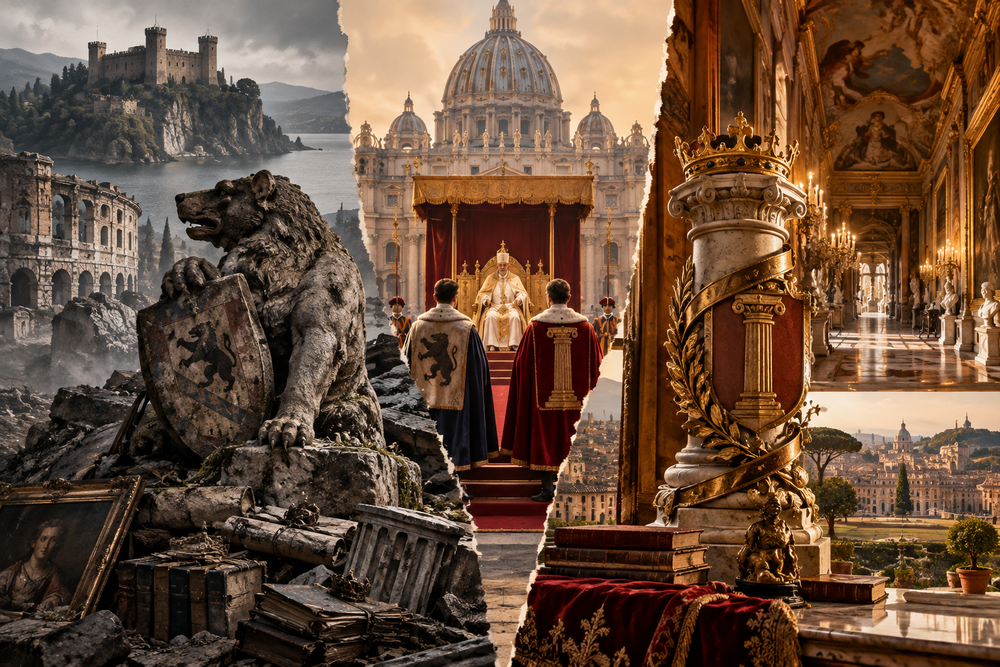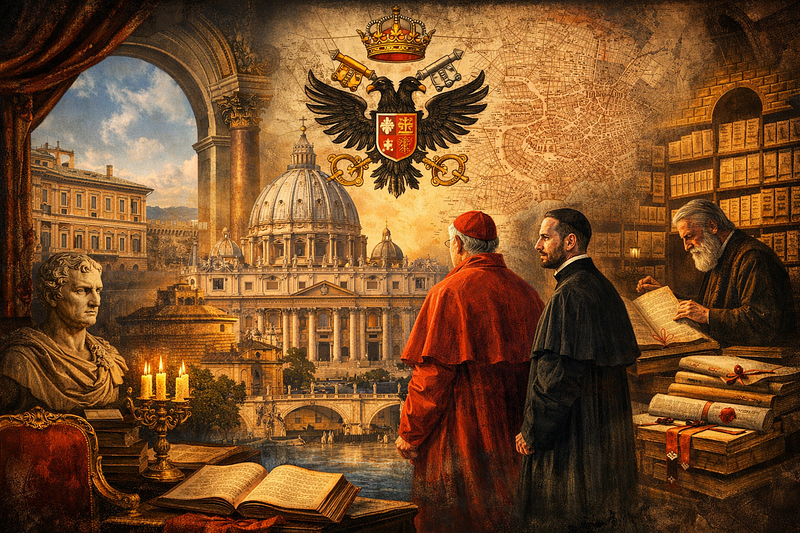
You can read it off the stone. Above a doorway on a Roman street there is a carved crest, and the family whose arms those are is still, centuries later, a name in the city, while the governments that were supposed to have dissolved such families into irrelevance have themselves come and gone. Colonna. Orsini. Pamphilj. Farnese. Aldobrandini. The names survive the way old roots survive under new pavement, quietly, without shouting, folded so deeply into the fabric of the place that a whole civilization walks past them without noticing they are still there. But look again at where the names survived, and the more interesting fact appears. They did not survive standing alone in the open. They survived attached to something, woven into the world of the Church, their crests on chapels, their sons in its offices, their daughters married into its orbit. And the Church, in turn, survived attached to them, staffed by them, hosted by them, given a body and a city by them.
This is the observation that the usual accounts of both miss, because they tell the two stories separately. One story is about the papacy, the institution that outlived empires, and how it kept its sovereignty and its diplomacy through every upheaval. Another is about the families, the Roman aristocracy and how it endured the loss of its political world. But the families and the institution were not two separate survivors who happened to share a city. They were a single system. Each had a fatal weakness that the other repaired, and what actually survived the centuries was neither the institution by itself nor the families by themselves, but the bond between them, the coupling of a class and an institution into a structure more durable than either could have been alone.
That coupling is the subject of this chapter. The determining variable in the long survival of Vatican power was not the institution's resilience and not the families' tenacity, taken separately. It was the join between them, the way a mortal class and a disembodied institution were locked together so that each carried the other across the ruptures that should have ended them both.
Two Things That Needed Each Other
Start with the weaknesses, because the coupling is best understood as two different kinds of fragility canceling each other out.
An institution and a family fail in opposite ways. An institution like the papacy has a remarkable kind of permanence: it is a structure of offices, rules, and continuity that does not age or die, that can replace any individual who fills it, that persists in principle forever. But that very abstraction is its weakness. An institution has no body. It cannot, by itself, marry or inherit or host a banquet or be a neighbor or hold a fortune in land. It is a set of positions waiting to be filled, and if no one fills them, if it has no human carriers embedded in the social world, it becomes a rulebook with no life, a doctrine without a presence. The institution is immortal and disembodied, and its danger is that immortality without a body is a kind of ghost.
A noble family is the mirror image. It has everything the institution lacks and lacks everything the institution has. It is intensely embodied: it has people, palaces, marriages, fortunes, a place in the life of a city, a web of relations and obligations and memory. But it has no permanence it can guarantee itself. A bloodline can fail to produce an heir. A fortune can collapse. A regime can confiscate the land and scatter the family in a single generation. The family is embodied and mortal, and its danger is that a body without permanence is, sooner or later, a corpse.
Now couple them, and watch each danger dissolve. The institution, which has no body, acquires one in the families that staff it, host it, and give it a social existence. The families, which have no guaranteed permanence, acquire it by attaching themselves to an institution that has already proven it can outlive anything. The ghost gets a body. The body gets a soul that will outlast it. Neither has solved its own problem; each has solved the other's, which is why the bond between them is sturdier than either party, and why, when the storms came, it was the bond that held.
What the Institution Could Not Do for Itself
Look more closely at the institution's side of the bargain, because it is the side most often overlooked, since we are used to thinking of the Church as self-sufficient.
A papacy is, in the abstract, a thing made of offices and doctrines. But a papacy that exists only as offices and doctrines is not a worldly power; it is a theology. To be a worldly power, to have weight in the affairs of Rome and Europe, the institution needed to be lived in, and it could not live in itself. It needed families to fill its court and its administration, to provide the cardinals and on occasion the popes, to fund and maintain its chapels and its art, to host the social life through which influence actually moves, to give it, in short, a human presence in the world. The great Roman houses supplied exactly this. They produced popes across the centuries, gave the Church a governing personnel, married into its networks, and made the institution not a remote abstraction but a living presence woven through the first families of the city. The families were, quite literally, part of the institution's body. Strip them away and what remains is a creed and a bureaucracy, which can endure but cannot dominate, because domination in the human world is done by people embedded in society, and the institution had no people of its own. It borrowed them, generation after generation, from the families.
This is why the relationship was never charity in either direction. The institution did not tolerate the families out of sentiment, and the families did not serve the institution out of piety alone. The institution needed the families the way a mind needs a body, to act in the world at all. The dependence ran upward as much as downward, and an account that treats the families as mere ornaments around a self-sufficient Church has the architecture backward. The Church was self-sufficient as a faith. As a worldly power it was not, and the families were a large part of what made up the difference.
What the Class Could Not Do for Itself
Now the families' side, which is the more obvious half but has a twist worth drawing out.
What a noble family cannot manufacture, by any amount of wealth or cunning, is permanence beyond its own luck. Every aristocratic house lives under the same shadow: the line may end, the fortune may fail, the political world that gives it standing may be swept away. History is a graveyard of families that were powerful for a few centuries and then simply stopped, their palaces sold, their names extinguished, because the one thing they could not secure was a guarantee of continuation. A family is always one failed generation, one confiscation, one revolution away from disappearing.
Attachment to the Church was the closest thing to a solution this problem has ever had. The Church was an institution that had, demonstrably, outlived every power that had ever tried to end it: the Roman Empire that gave it its city, the medieval orders, the Reformation, the armies of Napoleon. A family that wove itself into that institution gained access to a kind of permanence it could never generate on its own. Its standing was no longer staked only on its own bloodline and fortune, both fragile, but anchored to a structure built for the long run. The hereditary court offices, the ecclesiastical careers, the chapels and foundations bearing the family name inside churches that would be maintained for centuries, all of these were ways of converting the family's mortal standing into a share of the institution's immortality. The family lent the Church a body; in return the Church lent the family a measure of its own deathlessness. That was the trade, and for the families that made it well, it worked across spans of time that defeated nearly everyone who tried to endure by family means alone.
The Joints of the Coupling
The bond was not abstract. It was maintained through specific mechanisms, and naming them shows the coupling as a working machine rather than a metaphor, because each is a point where the class and the institution physically interlock.
There were the hereditary court offices, the dignities that gave particular families a permanent, inherited place in the ceremonial life of the papacy, binding a bloodline to the institution by formal right. There was the supply of personnel: the families produced the popes, the cardinals, the senior administrators, so that the institution's leadership and the city's aristocracy were drawn, again and again, from the same pool, fused into a single elite. There were the marriage networks, which wove the families to one another and to the wider Catholic nobility of Europe, turning the whole into a connected fabric that the Church sat at the center of. There were the chapels, the patronages, the foundations, the family names carved into ecclesiastical stone and tied to endowments the institution would maintain in perpetuity, so that a family's memory became something the Church itself was committed to preserving. And there were the lay institutions in the Church's orbit, the chivalric orders and confraternities of traditionally noble character, which gave the families a recognized standing that depended on the institution rather than on any state. Each of these is a joint, a place where the family and the institution are bolted together, and the sum of the joints is the coupling: not a vague affinity but a dense, redundant, load-bearing set of connections through which a class and an institution had made themselves into parts of a single structure.
The Family That Was Both
The coupling is easiest to see at the moments when it collapsed into a single act, when a family and the institution fused so completely that you could not say where one ended and the other began. The clearest of these is the practice that gave the modern world a word.
When a man from one of the great families was elected pope, he frequently raised his own relatives, above all his nephews, to the cardinalate and to the senior offices of the Church. The relative so elevated was known as the cardinal-nephew, in Italian the cardinale nipote, and from that nipote the word nepotism descends. It is worth pausing on the fact that our general term for the corrupt favoring of relatives was coined specifically to describe this Roman fusion of family and institution, because the etymology records the mechanism. In the cardinal-nephew the coupling is not a slow weaving of marriage and patronage across generations. It is instantaneous and total. A family supplies the institution its head, and the institution's head immediately converts members of his family into officers of the institution. The bloodline becomes the hierarchy; the hierarchy becomes an extension of the bloodline. For the duration of such a papacy, the two were not coupled, they were briefly the same thing.
This was the coupling at its most concentrated, and it built some of the most famous of the Roman houses. Families produced a pope, and the pope in turn elevated and enriched the family, raising relatives to red hats and great offices, endowing them with palaces and titles and the accumulated standing that would outlast his reign. The Barberini rose around Urban the Eighth, the Borghese around Paul the Fifth, the Pamphilj around Innocent the Tenth, and in each case a single papacy converted a family's temporary hold on the institution's summit into permanent aristocratic standing that the family would carry for centuries afterward. The family lent the institution a pope; the pope lent the family a piece of the institution's permanence; and what looks at first like simple corruption is, structurally, the coupling firing at full power, a bloodline and an institution trading their respective strengths in the most direct way the system allowed.
When the Coupling Was Banned
That the practice eventually had to be curbed is itself part of the story, and it reveals the institution recognizing the coupling as a thing with costs as well as uses.
The fusion of family and institution that the cardinal-nephew represented was efficient for the family and dangerous for the institution, because a Church repeatedly converted into the property of whichever family currently held the papacy was a Church being steadily privatized by its own leaders. By the late seventeenth century the cost had become impossible to ignore, and in 1692 Pope Innocent the Twelfth issued the bull Romanum decet Pontificem, which sharply restricted the practice, limiting what a pope could grant to his relatives and curbing the institution of the cardinal-nephew. The institution, in other words, moved to police its own coupling with the families, to set a limit on how far the bloodlines could convert the Church into family property.
This is a revealing moment, because it shows that the coupling was never simply a comfortable symbiosis. It was a relationship with a built-in tension, in which the families' interest in absorbing the institution ran against the institution's interest in not being absorbed. The reform of nepotism is the institution asserting that the coupling must have a boundary, that the families could be part of its body but must not be allowed to become its owners. And the fact that such a reform was necessary, and that it took until the end of the seventeenth century to impose, is the measure of how deep the coupling had run. You do not need to pass a law against a marginal practice. You pass it against a central one that has grown dangerous, and the law against nepotism is the institution's own admission of how thoroughly it and the families had become entangled.
The Ledger of the Coupling
There is one more component that made the coupling durable across the centuries, and it is the least visible: the records that remembered it.
A coupling that depends on memory needs somewhere to keep the memory, and the Church kept it. The genealogies, the registers of offices and honors, the deeds of chapels and foundations, the documentation of which family held which dignity and which endowment, all of this was preserved in the institution's archives, which is to say that the institution itself became the keeper of the families' standing. This matters more than it seems. A family's claim to its position is fragile if it lives only in the family's own assertion of it, but it becomes durable when it is recorded and maintained by an institution built to last. By preserving the documentation of the coupling, the Church made itself the guarantor of the families' continuity, the place where their standing was written down in a form that would survive their own lapses of memory and fortune. The archive was the ledger of the coupling, the running account of what each family had given and held, kept by the institution that the families had given themselves to. And because the institution preserved that account across centuries, a family's place in the system did not have to be re-won each generation; it was on the books, in the keeping of a body that did not forget. Memory, held institutionally, is one of the strongest forms of permanence there is, and the families had lodged their memory in the one institution most likely to keep it.
The City as the Third Party
There is a place where the coupling became physical, where you can still walk through it, and that place is Rome itself, which is less the backdrop to the bond than its body.
The coupling between the families and the institution did not happen in the abstract. It happened in a particular city, and it built that city, so that the fabric of Rome is the coupling rendered in stone. The family palaces and the great churches do not occupy separate quarters; they interleave, often on the same streets, frequently joined, a noble palazzo here and a basilica there and between them a chapel that one family funded inside a church the institution maintained. The families left their arms on the chapels they endowed in the Church's basilicas, their tombs in its sanctuaries, their patronage carved into the institution's most sacred buildings, so that to walk through the great churches of Rome is to read, in marble, the record of which family was bound to which part of the institution. The city is a single fabric woven from both threads, and you cannot pull them apart, because the chapel is the family's and the church is the institution's and they are the same building.
This shared body is one more reason the coupling proved so durable, because it externalized the bond into something neither party could easily abandon. A family could in principle drift from the Church, and an institution could in principle do without a given family, but neither could walk away from the city they had jointly built, in which their fortunes were quite literally cemented together. The palaces needed the prestige of proximity to the institution; the institution's grandeur was partly the grandeur the families had funded. Rome is the physical guarantee of the coupling, the place where the abstract bond between a class and an institution was poured into stone and made into a city, and a bond you have built a city around is not a bond you can quietly dissolve. The families and the Church were joined not only in offices and marriages and archives but in the streets themselves, and the streets are still there.
The Coupling Under Stress
The strength of a join is revealed not in calm but in rupture, and the great rupture came in 1870, when the Papal States fell and the institution lost the territory it had ruled for a thousand years. This is the moment that tested whether the coupling was real or decorative, and the test is instructive precisely because both parties were wounded at once.
The institution lost its state. The families loyal to it lost the political world in which their power had operated. By the older logic each might have gone its separate way, the Church retreating into pure spirituality, the families making peace with the new Italian order. Some families did exactly that, and detached. But the families bound most tightly into the coupling did not detach, and the bond carried both parties through the wound. The families that stayed kept the institution socially alive during the decades when it had no country, surrounding it, sustaining its presence in Rome, giving the stateless papacy a living world to exist within. And the institution gave those families a reason and a structure to endure when their own political role had been stripped away, a vessel to carry their standing now that the state that had housed it was gone. Neither rescued the other out of generosity. Each, in holding to the other, was also saving itself, because by 1870 the two had been coupled for so long that the survival of one ran through the survival of the other. The detail of how the institution managed its stateless decades, and of how the families converted their standing, belongs to other chapters. The point here is narrower and prior to both: that what made either survival possible was the coupling that preceded it, the fact that institution and class had long since become load-bearing for each other.
Why the Bond Outlasts Either Part
Step back and the principle generalizes, which is what makes it worth the name of a mechanism rather than a description of one city.
A structure built from two components that fail in opposite ways is more durable than either component, provided the two are coupled tightly enough that each covers the other's weakness. The institution's failure mode is to become a bloodless abstraction; the embodied family prevents that. The family's failure mode is to run out of luck and end; the permanent institution prevents that. Coupled, the system has no single failure mode that kills it, because the danger that would destroy one party is the danger the other party is built to absorb. This is why the pairing of a hereditary aristocracy with a permanent institution recurs across history wherever power has lasted unusually long. Monarchies that fused a royal line to a permanent church or state apparatus outlasted those that relied on the bloodline alone. The combination is sturdier than its parts because its parts are complementary, each strong exactly where the other is weak.
There is a precise way to state why this works, borrowed from how engineers think about reliability. A system fails at its weakest single point, and a system with only one component fails when that component fails. Couple two components whose weaknesses do not overlap, and you remove the single point of failure, because the event that would destroy the first is exactly the event the second is built to withstand. The disembodiment that would hollow out the institution is answered by the family's body; the extinction that would end the family is answered by the institution's permanence. Neither failure can take down the pair, because each party's fatal weakness lands on the party that does not share it. That is not luck and it is not conspiracy. It is the simple arithmetic of complementary fragility, and it is why a coupled structure routinely outlasts, by centuries, the lifespan of either thing it is made of.
It also tells you where to look when you want to understand how any long-lived power actually persists. The temptation is to credit the visible survivor, the institution that is still standing or the family whose name is still on the palace. But the visible survivor is rarely the whole answer. Behind it there is usually a coupling, a partnership with something that supplied what the survivor lacked, and the coupling is the thing that did the surviving. The names on the Roman doorways did not endure because the families were strong. The papacy did not endure because the institution was resilient. Both endured because they had become, over centuries, parts of each other, and a part of something larger is harder to kill than a thing standing on its own.
The Same Marriage Elsewhere
The pattern is not unique to Rome, and seeing it elsewhere is what turns it from an anecdote about the papacy into a mechanism worth knowing.
Wherever power has lasted unusually long, you tend to find the same marriage of a permanent institution to a hereditary class. The European monarchies that endured longest were the ones that fused a royal bloodline to a permanent state apparatus or an established church, so that when a given king proved weak or a line faltered, the institution carried the crown across the gap, and when the institution drifted toward abstraction, the living dynasty gave it a face and a body. The great merchant and banking houses that outlasted their founders did so by coupling the family to a durable institutional form, a firm, a charter, a partnership that could survive the death of any individual while the family supplied the continuity of name and trust. In each case the logic is identical to the Roman one: a mortal, embodied lineage and an impersonal, permanent structure, bound together so that each repairs the other's characteristic failure.
And the same logic predicts the failures. Dynasties that refused the coupling, that staked everything on the bloodline alone without anchoring themselves to a durable institution, tend to end when the bloodline ends, which is to say relatively soon. Institutions that had no embodied class to give them social life tended to remain administrative rather than commanding, present on paper but thin in the world. The pairings that lasted are the ones that achieved the coupling, and the Roman case is simply the most spectacular and longest-running example of a structure that appears wherever durability does. It is, in the end, a general answer to a general question. How does anything last far longer than its natural span? Usually by not trying to last alone, by binding itself to something with the opposite weakness, so that the combination has no single point at which it can be killed.
The Honest Limit
The strongest objection to this is that it overstates the families' importance, and it deserves a hearing, because the Church plainly has resources of survival that owe nothing to the Roman aristocracy.
The institution, the objection runs, survived the Reformation and Napoleon and a dozen other catastrophes by institutional means, by doctrine, organization, diplomacy, and the sheer inertia of a global faith, not by the loyalty of a few hundred noble families. The families were the social color of a particular time and place, the aristocratic furniture of the old Roman regime, and to elevate them into a load-bearing pillar of the Church's survival is to mistake decoration for structure. The proof, the objection adds, is in the present: the modern Church runs almost entirely without the old families, their court offices abolished, their political role gone, and it persists perfectly well as a global institution. If the coupling were truly load-bearing, its dissolution should have weakened the Church, and it did not.
This objection is largely right, and the honest response is to narrow the claim to the size the evidence supports. The Church as a global faith and a doctrinal institution did not and does not depend on the Roman nobility; it has always had other and deeper means of survival, and the modern Church proves it can stand without the old coupling. The claim here is narrower and bounded in time. For the long era in which the Church was not only a faith but a worldly Roman power embedded in the society of a particular city, the coupling with the aristocracy was a real and load-bearing part of how that worldly power lived and persisted, supplying the institution with the body and the social presence that doctrine alone could not provide. That era is largely over, closed by the loss of the Papal States and the later dismantling of the old court, and with it the coupling has loosened into something closer to historical residue. So the boundary is clear and worth stating plainly: the coupling explains a great deal about how Vatican power survived as a worldly Roman institution across the centuries up to the modern age, and very little about how the Church survives as a global faith today. Within those limits the mechanism holds. Beyond them it does not, and saying so is what keeps it an analysis rather than a mystique.
What Actually Survived
Return one last time to the crest above the doorway, and read it correctly now. The name endured, but not on its own strength; it endured because it had married itself to an institution built to outlast everything. The institution endured, but not on its own strength either; it endured, as a worldly Roman power, because it had given itself a body in the families that filled and surrounded it. Each is a survivor, and each is only half the story, because the real survivor is the thing between them, the coupling, the long marriage of a mortal class to a deathless institution in which each became the other's insurance against its own particular way of dying.
That is the lesson worth carrying past Rome. When something has lasted far longer than it should have, do not look only at the thing itself. Look for what it is coupled to, what supplies the strength it lacks, what it has made itself a part of. Pure institutions tend toward bloodless abstraction; pure dynasties tend toward extinction; and the powers that last the longest are usually the ones that found a way to be both at once, by binding a body to a permanence and a permanence to a body, until neither could die without the other and so, for a very long time, neither did.
This is also why the coupling is so easy to misread from either end, and why the two halves of Rome's story are usually told apart. Look only at the institution and you see a miracle of self-sufficient endurance, a Church that simply refuses to die, and you miss that for most of its history it lived in borrowed bodies. Look only at the families and you see a remarkable run of aristocratic luck, names that somehow outlasted the governments around them, and you miss that the luck was an anchorage, a deliberate mooring to the one institution built to outlast everything. Each half, told alone, becomes a mystery, because the explanation for each is the other. The institution lasted because it had bodies; the families lasted because they had a vessel; and the only way to see why either lasted is to look at the join, which is precisely the thing that falls out of view when you tell the two stories separately. The coupling hides in the gap between the two accounts that omit it.
The family could not last. The institution could not live. Bound together, each gave the other exactly what it lacked, and the bond outlasted them both.
Frequently Asked Questions: Vatican Power and the Roman Families
How did Vatican power survive the loss of the Papal States?
Through the coupling of the institution with the Roman families. The Church supplied permanence, a structure of offices that outlives any individual; the families supplied a body, fortunes, palaces, and a social presence. Neither would have lasted as well alone.
Why is the papacy so durable?
Because it is a structure of offices rather than a person, it can replace anyone who fills it and persist in principle forever. Its weakness is that it has no body of its own, which is exactly what embedded aristocratic carriers provided.
What did the Black Nobility families give the Church?
People for its offices, palaces and hospitality, fortunes, and marriages that wove the institution into the life of a city. In return the families gained the one thing they could not guarantee themselves: permanence, by attaching to an institution that endures.
Did the families control the Church?
No. The relationship was interdependence, not control. The record shows a mortal class and a disembodied institution repairing each other's weaknesses, not a family running the papacy from behind a curtain.
Evidence Map
Facts, interpretations, forecasts, and disconfirming signals.
Core claim. The determining variable in the centuries-long survival of Vatican power was not the papacy's institutional resilience or the Roman families' tenacity taken separately, but the coupling between them: an immortal yet disembodied institution and embodied yet mortal families locked together so that each repaired the other's fatal weakness.
Evidence level. Facts: high. Documented: the persistence of the great Roman houses, the Colonna, Orsini, Pamphilj, Farnese and Aldobrandini, woven into the offices, chapels and marriages of the Church; the papacy's continuity of office across successive regimes. Interpretation: medium, and marked as such. The framing of the two as a single coupled system, rather than two separate survivors who shared a city, is an analytical conclusion.
What would confirm this. Cases where an institution lacking embedded social carriers failed to persist, or where families detached from an enduring institution dissolved into irrelevance; documentation of the offices and marriages that bound the families to the Church.
What would disprove this. Evidence that the papacy persisted independently of any aristocratic carriers, or that the families' survival owed nothing to their institutional attachment, which would break the interdependence the claim asserts.
Watchlist. Whether the class-institution coupling weakens as the hereditary papal-court offices recede, largely abolished in the 1968 reform, and the families' role becomes purely social.