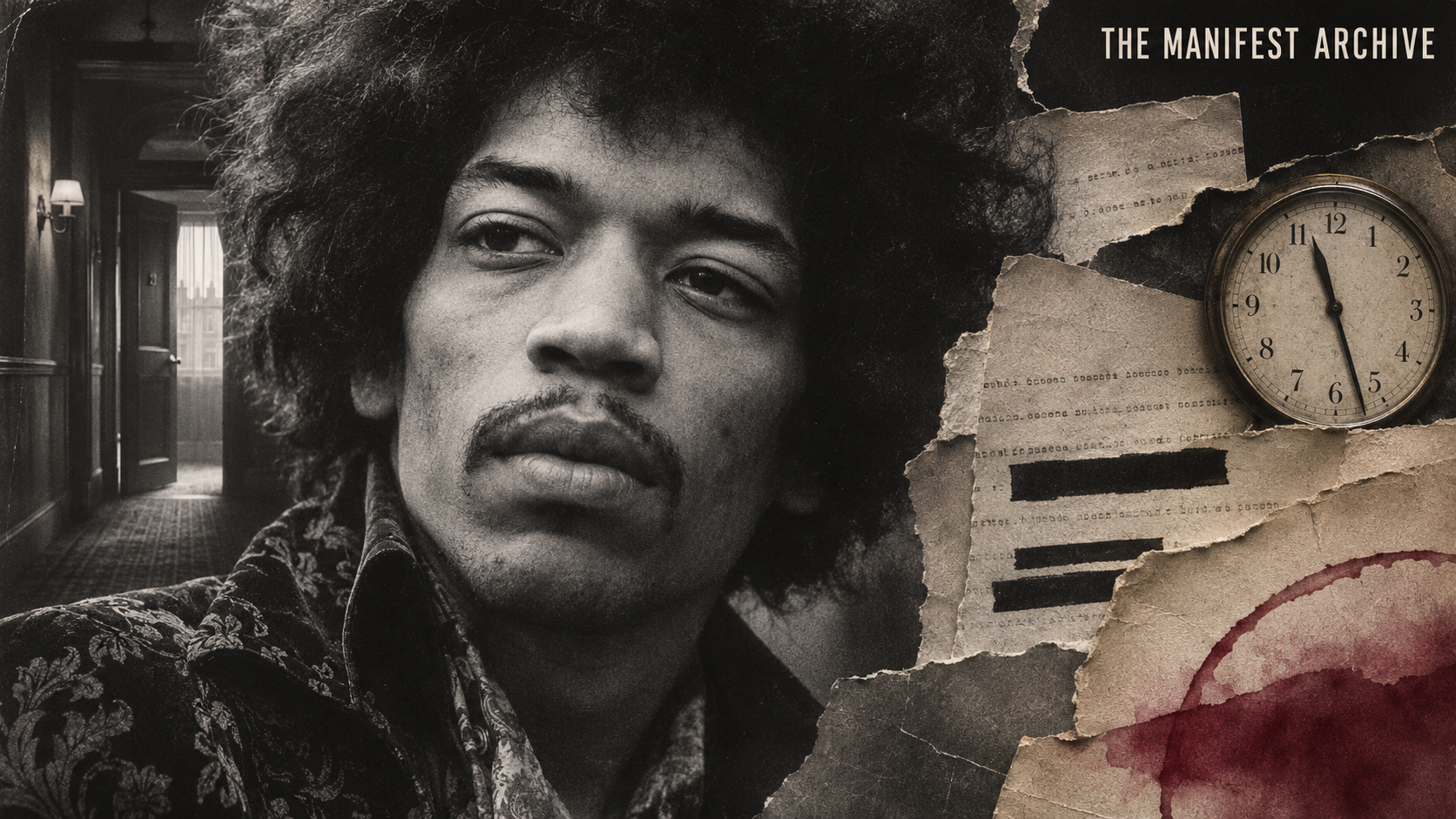
At 11:27 on the morning of 18 September 1970, two paramedics walked into a flat in the Samarkand Hotel in Notting Hill and, by their later accounts, found a famous man alone in a dark room.
The door stood open. The gas fire was on. The curtains were drawn. Jimi Hendrix lay in bed, covered in vomit, and his airway was blocked solid. One paramedic later said the vomit was already dry. The suction device did nothing.
Nobody else was there, by the paramedics’ account. The rest of the morning is less empty.
That detail matters, because the account told afterwards by the one person who should have been there kept changing. And because at least one other man says he stood in that room before the ambulance arrived, and left with things in his hands.
The official ending is short. Asphyxia, caused by inhaling vomit, after barbiturate intoxication. The coroner found no evidence of suicide, said there was not enough evidence of the circumstances, and recorded an open verdict. The inquest opened on 23 September and was over on 28 September.
The cause of death was recorded within days. The circumstances have stayed open for fifty-six years.
This piece keeps three kinds of statements apart. A documented fact is something a record or independent sources support, and a statement recorded in a document is a recorded statement, not proof that the events happened. A claim is something a named person says, even if many repeat it. A rumor is something that travels without a traceable source. Several publications can depend on one source, so counting them does not add evidence. Where I could not tell which was which, I say so.
The Clock Nobody Can Settle
The ambulance was called at 11:18. Monika Dannemann, the woman Hendrix was staying with, says she found him unresponsive after coming back from buying cigarettes.
Her wake-up time moves. She said 9:00. In another account, 10:00. At the inquest, 10:20. In her first statements to police, 11:00. If the earliest version is true, more than two hours passed between waking and the call. Waking up is not the same as finding him, and she says she went out in between, so the gap is a question, not a finding.
Those hours were not necessarily silent. By Eric Burdon’s account, she phoned him around dawn. He says he told her to wake Hendrix, and later to call an ambulance. She did not mention that call to the police or to the coroner. She also phoned a friend, Alvenia Bridges, who advised turning Hendrix onto his side so he would not choke. There is no record that this happened.
In a phone call that Hendrix’s ex-girlfriend Kathy Etchingham recorded in 1991, Burdon said he had told Dannemann to pour some coffee down his face.
There is also a rumored second clock. A story in circulation has a roadie, Terry Slater, phoning Stickells about a problem with Jimi around 8:00 or 9:00. I could not trace it to a document or a recorded statement, so I do not build on it.
Then there is the clock inside the body. The 1970 post-mortem gave no time of death. In the 1990s a pathologist named Rufus Crompton is cited as having used the rice in the stomach to put the time of death at about 5:30 a.m., and other accounts say no later than 4:00. A letter from Dannemann in the June 1996 issue of Musician describes him as the man Etchingham’s side brought forward in 1993 and 1994. An editor’s note under that letter says he has since said the exact time of death cannot be fixed. I read this in an indexed copy and could not check it against Crompton himself. So the early estimate was one reviewer’s, and by that note he later stepped back from precision.
He was pronounced dead at 12:45. Nobody has put a reliable time on when he died.
Reportedly, a hospital statement that day already said he had died of an overdose, before any autopsy had been performed. I could not confirm that statement from a record.
The Woman Who Told the Story
Dannemann was the key witness, the only known person with him in his last hours, and parts of her account do not fit with other records.
She said Hendrix was alive in the ambulance and that she rode with him. The ambulance crew say nobody else was in the vehicle. Burdon says she did not leave in it at all, because she was with him. When the London Ambulance Service looked again in 1992, it still found nobody else at the flat or in the ambulance.
She also gave different counts of missing sleeping tablets: ten, then nine. Nine of those pills, a German barbiturate called Vesparax, would be eighteen times the recommended dose. The difference between ten and nine is not proof of anything by itself. The count matters because it rests almost entirely on her word.
The biographer Tony Brown spoke to her from 1980 until she died in 1996. He wrote that her account changed from one call to the next.
In 1996 she was found dead in her car, reported as a suicide, two days after a High Court judge convicted her of contempt of court for repeating an allegation about Etchingham that she had promised, in settling an earlier libel action, not to repeat. The version she carried can never be tested again.
Who Got There First
Here is the detail that makes the room feel crowded, for a flat that was supposed to hold one dead man.
Burdon says he reached the flat before the ambulance, found Hendrix dead, took away what he considered incriminating items, and found a poem Hendrix had written the night before. He first told the press it looked like a suicide note. Then he said he had misread it.
Dannemann gave a different list. She said Hendrix’s tour manager, Gerry Stickells, and another man, Eric Barrett, took some of Hendrix’s possessions, including recent messages, before the ambulance came.
Then there is Slater, whom I do not count among the three men in the title, because no source I found dates his clean-up. By his own account to Etchingham, he and Dannemann cleared the flat and buried drugs in gardens nearby, and he threw a block of hashish into the bushes. When this happened is disputed. Some versions put the clean-up before the ambulance, others in the afternoon, before police interviewed Dannemann. I found no source for the often repeated story that police filmed him burying drugs, so I have left it out.
These may be different events or different versions of one. Burdon’s items were removed, on his own account, before the paramedics. Dannemann’s account has the same timing, but she says other men did it. The sources I found do not let me tell which, and Slater’s clean-up cannot be dated from them. Nothing I found says when the police began treating the flat as anything but the home of a man who had died.
Some witnesses are said to have changed their accounts over the years, but I could not tie those reports to a primary record, so I leave the details out. Burdon’s own versions of the poem shifted, as he has said himself. Witnesses revising their accounts proves nothing about a crime. It does mean the later record is unstable.
I found no record that anyone was ever formally asked to account for what left that room.
The Wine
This is the detail that most people remember, and it is the one that needs the most care.
The wine story runs through five separate claims, and each does not prove the next:
- There was wine on the body or clothing.
- There was wine in the stomach or airway.
- Someone gave it to him.
- That caused his death.
- It was done to kill him.
The sources I found support none of these five with a contemporaneous record, and the story depends on whom you ask.
The sentence people repeat, that he drowned in red wine, comes from John Bannister, the surgical registrar who pronounced Hendrix dead. In January 1992 he told the Hendrix researcher Harry Shapiro that Hendrix had died mostly from asphyxiation on red wine. In 2009 he told a newspaper the murder theory sounded plausible.
Here is the problem. I have not seen the autopsy report. In the accounts of it that I could read, vomited matter is in the airways and wine is not mentioned, and in the sources I could consult no doctor, paramedic or police officer at the time is recorded as mentioning wine in the airway. According to the source I could check, the first mention of wine in the airway that I could trace came from Dannemann, in the first edition of Electric Gypsy, in 1990, and Bannister had read that edition before he spoke to Shapiro. The same book carried her accusation that Bannister should have performed a tracheotomy. That is context for his later account, not proof of what drove it.
The blood alcohol reading is disputed, and I could not see the autopsy report, so I give no figures. Some accounts say the reading was low next to the wine described at the hospital. That comparison is only as good as the report behind it, and a blood reading does not measure how much wine someone drank or show what was in the airway. Barbiturates can also suppress the cough reflex, which is how a man chokes without drinking much.
The most mundane source for the wine is also on record: Hendrix reportedly drank wine with Dannemann and friends the evening before, and accounts mention two bottles of French red brought around 7 p.m. That makes wine in the room ordinary. It does not make wine in the airway, and in the sources I could consult no one at the time wrote down seeing any.
A claim adds a twist. The writer Sharon Lawrence says in a 2005 book that Dannemann admitted in 1996 that she had poured wine down Hendrix’s throat. Lawrence herself believed the death was a suicide. The claim sits on one person’s recollection of a conversation with a woman who is no longer alive.
The wine is a claim, not a finding. But it did not come out of nowhere either: it has a traceable author, and it has a date.
The Manager
Every version of the murder story needs a man with a motive, and for fifty years the name has been Michael Jeffery.
Documented: Jeffery was born in 1933, did national service from 1951 and worked in the Intelligence Corps. He opened clubs in Newcastle, managed The Animals, and then co-managed Hendrix with Chas Chandler. Money from the Hendrix tours flowed to an offshore company in the Bahamas. Eric Burdon called it a Bermuda Triangle for their earnings.
Rumor: that Jeffery was a British spy. The Intelligence Corps is an army unit, not MI6, and Burdon says Jeffery liked to brag. The service record, as reported, shows him vetted in March 1953, a private in the Intelligence Corps, later an acting corporal in the Field Security Service, and posted to Trieste. That is real intelligence-adjacent work. It is not proof of anything after he left the army.
Reported by Dannemann: that Hendrix phoned his lawyer on 17 September to find a way out of his contract with Jeffery. Alan Douglas tells it differently: that he phoned Hendrix’s New York lawyers that morning to say Jeffery was being relieved of his duties. Both versions put a break with Jeffery on the table the day before Hendrix died. They disagree on who made the call, and nothing independent that I found confirms either.
Reported: that Hendrix left a message that night saying he needed help. Accounts disagree on whom he called and whose answering machine it was: Chas Chandler’s, Jeffery’s, the engineer Eddie Kramer’s, or a call to Burdon. Hendrix had reportedly been looking to bring Chandler back, according to Kramer, and Burdon says Hendrix told him a week earlier that he would get new management. Burdon was then suing Jeffery himself, which gives his account its own interest.
Claimed: in 2009 James “Tappy” Wright, described in some accounts as a former Animals roadie and by Barrett as an associate of Jeffery, said in a book that Jeffery confessed to him in 1971 that he had Hendrix killed, with a gang forcing pills and wine into him. The story included a mob debt and a two million dollar life insurance policy.
Disputed: in 2011, Hendrix’s one-time associate Bob Levine said Wright admitted making it up to sell books. Levine added that the insurance policy was taken out by Warner Brothers, and that Jeffery never collected. Another biographer says the policy never existed. One author notes that Jeffery kept earning from Hendrix’s royalties after 1970. That argues neither way: it shows the money did not stop, not why it came.
A motive is not an opportunity, and neither is a deed. A man who stood to lose his client had a reason to be unhappy. Nothing I found puts him in the room, or shows him acting.
Rumor: that Jeffery worked for or with MI6, the FBI and the Mafia, and that nobody dared cross him. The evidence offered is his sudden wealth, his Bahamian accounts and his bragging. Anecdote: Hendrix told people in 1969 that he had been kidnapped and held for days, then rescued by Jeffery, and believed it was staged to remind him who he depended on. Reported: that the producer Alan Douglas thought he heard Jeffery say things that amounted to an admission, and that days after the death Jeffery was traced to Majorca, saying he had not heard the news.
After the death, the money trail is documented. The Hendrix estate was entangled in litigation for years. Redding and Mitchell settled their claims in 1973 and 1974. Hendrix’s father regained the rights to his son’s recordings in July 1995, after suing the estate’s longtime lawyer, Leo Branton Jr., for mismanagement and fraud in April 1993, which Branton denied. His legal costs, about $6 million, were covered by a loan from Paul Allen, according to UPI. That lawsuit was not against Jeffery. Who gained is on record. Whether anyone gained by killing him is not.
Counterweight: Eric Barrett, one of the two men Dannemann named, calls Hendrix’s death a stupid, tragic accident in a published interview with Gary James. He rejects the claim that Jeffery was behind it and says he believes Wright invented his story to sell books. The interview does not address what happened in the flat that morning.
The Manager’s Last Flight
Documented: on 5 March 1973, two and a half years after Hendrix, Jeffery was on an Iberia DC-9 from Palma de Mallorca to London. Over Nantes it collided with a Spantax airliner. All 68 people on the Iberia plane died, 47 of them British. The French investigators put it down to air traffic control error, on a day when military controllers had taken over from striking civilian ones. The village of La Planche set up a memorial where the bodies and remains were first laid out.
Rumor: that Jeffery’s remains were never found, and that he checked his luggage but did not board. Burdon and Noel Redding are named as holders of this theory. Eric Barrett, in a published interview with Gary James, says he does not believe it.
I found no passenger-list gap, no sighting and no document that supports it. A crash with 68 dead makes recovery and identification hard, which may explain such a story but does not prove it, and I could not check the list of identified victims, so that question stays open. Devon Wilson, a woman in Hendrix’s circle, died after a fall from a window at the Chelsea Hotel in 1971. These are separate events, and I found no evidence of a shared cause.
The File
Hendrix’s politics are the part of the story that reaches furthest, and the part with the least to hold onto. Start with scale: by 1969 Hendrix was famous enough, and close enough to radical politics, that official interest in him is a fair question to ask.
Documented: by 1969 Hendrix was one of the best-paid rock performers in the world, and in August of that year he closed Woodstock with his version of the American national anthem. Whoever kept watch on the counterculture had a reason to know his name. The FBI file does contain a report on Woodstock, but it describes the festival as a spectacle, not Hendrix as a threat. The scale is documented. What the state made of it is not.
Documented: the FBI opened a file on him in June 1969, after his arrest at Toronto airport. Canadian immigration asked the bureau for help finding grounds to deport him, and the FBI came back with an old Seattle arrest from 1961. The file is short and heavily redacted. According to Rolling Stone it was not made available to the public until 2011. The FBI had by then run COINTELPRO against the Panthers for years.
Documented, but only as public statements and testimony: he spoke warmly of the Panthers in print and told a reporter in 1969 that he was writing a song for them. Two Seattle Panthers say he was receptive. Accounts say he gave money to the Seattle chapter, and Panthers worked security at his 26 July 1970 concert at Sicks’ Stadium. In a 1969 interview he said his music was not for guerrilla warfare. Other accounts say he distrusted the group as too violent and wanted to lead a peace movement instead, and that Jeffery did damage control when the link surfaced.
Reported: that Toronto in 1969 looked like a setup. Redding and Mitchell both say Hendrix was warned of a bust a day earlier, and Jeffery could not be reached in Hawaii. Drugs planted on him is a theory, not a finding.
Claimed, with no primary document found: that he sat on the FBI’s Security Index, the list of people to be detained in a national emergency, supposedly spotted by Santa Barbara students in 1979. That the CIA tracked him under its MHCHAOS program. The one CIA reading-room document that carries his name is a researcher’s request for files on rock stars, not a file on him. That he agreed to play a Panther benefit in Oakland, and gave the party money, which some tellings turn into extortion.
Claimed, by Alex Constantine: that a remark about the Panthers invading Washington marked him, and that a stranger on a New York street once showed off his pistol skills to deliver the message. Leon Hendrix says his brother was on a government list.
Anecdote: Hendrix felt followed in New York, and so did people around him, according to Dannemann. No document backs that, and it was also the mood of the time.
Rumor: that the FBI or CIA killed him, with Jeffery as the instrument. A reviewer of one documentary that makes this case called its evidence hearsay and gossip, much of it from people who did know him.
The case for that rumor rests on capability, and the capability is real. COINTELPRO was the FBI’s program of disruption, and the Panthers were its main target. In 1969 FBI informant William O’Neal was involved in the killing of the Chicago Panther leader Fred Hampton. What the program had done to Hampton it could in theory have done to someone else. But the documents that show this are about the Panthers, not about Hendrix. Capability, and hostility toward the Panthers, are documented. A motive to act against Hendrix is not, and neither is an operation against him.
No declassified record that I found connects any agency to his death. What the file shows is that the bureau collected and exchanged information about him with Canada in 1969. It does not show that anyone followed him afterwards. Whether anything else exists, redacted or not released, is a question the documents leave open.
The Reviews That Went Nowhere
The formal story did not end in 1970.
In 1992, Etchingham, who had paid for a private investigation, gave her results to the authorities and asked for the inquest to be reopened. The same year, the London Ambulance Service looked again and said nobody else was at the flat or in the ambulance. The Attorney General, Sir Nicholas Lyell, asked Scotland Yard to make new inquiries.
Lyell rejected a new inquest. A UPI report dated 9 March 1994 reports the decision, while some sources give 1993. According to that report, the police review had found insufficient evidence. Another account says he judged that reopening would not serve the public interest, partly because so much time had passed. Dannemann said she wanted the findings published to stop the rumors for good.
I could not find the Scotland Yard findings themselves. That matters for a piece like this one: a review was done, and a decision was made, but I could not find what it was based on in anything I was able to read.
Among the primary sources I have not seen is the inquest file. I have not confirmed where it is held or whether it can be requested: inquest records in London are normally kept by the coroner’s district or the London Archives, and files under 75 years old can be restricted.
The Strongest Counterargument
The strongest argument against this whole reading does not need to defeat any single item above. It says the items are weak where it matters and ordinary where they are strong.
Panic can explain confusion, delay and self-protection. Friends and roadies of a rock star might well clear drugs from a flat before the police arrived, out of loyalty and fear, without any link to the death. Barbiturates and alcohol can kill, and the pathologist’s later reviewer found a barbiturate level above the toxic threshold. A 27-year-old man who by several accounts had not slept properly for days, and who reportedly told a friend he was almost gone, could simply have died of a drug mix.
It can also attack the sources. Most of the strangest details come from people recalling events decades later: Burdon, Bannister, Lawrence, Wright. Several of them depend on one another, or on Dannemann, whose account was not stable. The one time estimate comes from a single reviewer. Philip Norman, writing in 2020, called it a totally avoidable accident. The open verdict says what it says: not enough evidence about the circumstances, and no finding of murder.
It explains most of what is on the table.
The claim here is narrower. It does not say Hendrix was murdered. It says the usual explanation covers the death but not the handling of it: the hours before the call, the items that left the room, the witness whose story never settled, and the formal reviews whose reasoning I could not find. The cause was recorded in days. For fifty-six years, the circumstances have stayed open.
The Room
Dannemann has an account. Burdon has an account. Slater has an account. Bannister has an account. They do not agree on the order of that morning.
The one man in the bed never got to answer any of them.
If it was not a tragic accident, who had a motive? And who had the opportunity? In everything I found, those are two different lists, and no name appears on both. Which list would you start with?
Research Appendix
Separate from the narrative above. For each claim: the level, what it supports, the source as I used it, what stays uncertain, and what I still want to check. Links go to the pages I read, not to primary records unless stated.
| Claim | Level | What it supports | Source as I used it | What stays uncertain | To check |
|---|---|---|---|---|---|
| Ambulance 11:18, arrival 11:27, pronounced dead 12:45 | Documented | The official timeline | Wikipedia | Whether times come from original records | Inquest file |
| Cause: asphyxia from inhaled vomit, barbiturate intoxication; open verdict | Documented | The formal outcome | Wikipedia | Exact wording | Death certificate scan, which I could not open |
| Burdon reached the flat before the ambulance and took items | Claimed (his own account) | One man placed in the flat before the ambulance arrived, by his own account | Burdon’s accounts as relayed in secondary sources | His versions shifted | Primary interviews |
| Stickells and Barrett took items before the ambulance | Claimed (Dannemann) | Two more men placed there, by her | Dannemann as relayed | Her account was unstable | Her police statement |
| Slater helped clear the flat | Claimed (his own account to Etchingham) | That he says he took part in a clean-up. Not when, and not what was removed | Etchingham, as relayed | When it happened | Etchingham’s own account |
| Slater phoned Stickells around 8 to 9 a.m. | Reported, untraced | Nothing; not used as a basis | No source located | Whether any document exists | Shapiro/Doerschuk text |
| Crompton’s time-of-death estimate, later softened | Claimed | One reviewer’s estimate, later described as not fixable | Musician, June 1996, a Dannemann letter and editor’s note; Wikipedia talk page | Second-hand; I did not see Crompton’s own words | Crompton’s letter |
| Blood alcohol level | Disputed; no figures used | Nothing | Competing online accounts | I could not see the report | The autopsy report |
| Wine in lungs, stomach and hair | Claimed (Bannister) | A claim with a traceable author and date | The Quietus; Far Out | No contemporaneous record in the sources I could consult | 1970 papers; first edition of Electric Gypsy |
| Lawrence: Dannemann admitted pouring wine, 1996 | Claimed | One recollection of a conversation | Lawrence, 2005, as relayed | Dannemann cannot answer | The book |
| Jeffery’s Intelligence Corps service | Reported | Intelligence-adjacent army work | Service record as relayed | Record not seen | National Archives |
| A break with Jeffery on 17 September | Reported | Two versions of a contract break | Dannemann; Alan Douglas, as relayed | They disagree on who called | Primary interviews |
| Douglas thought Jeffery’s words amounted to an admission | Reported | A suspicion, not a finding | As relayed in secondary sources | No record of the words | Douglas’s own statements |
| Wright’s claim that Jeffery confessed; Levine says Wright admitted it was invented | Claimed / disputed | A contested confession | Wright 2009; Levine 2011, as relayed | Both second-hand | The book; Levine’s letter |
| Barrett rejects the murder theory | Documented as his statement | A counterview from a man Dannemann named | Classic Bands interview | It does not cover the morning of 18 September | Barrett’s memoir |
| The rumor that Jeffery staged his own death in 1973 | Rumor, no support | Nothing | ATC error finding; Barrett on the rumor | Victim list not checked | 1973 press, victim list |
| FBI file opened June 1969 after Toronto; public 2011 | Documented | A file exists and what it concerns | Rolling Stone; UNL record | I could not open the file | FBI Vault, which did not load |
| Security Index and CIA tracking | Claimed only | Nothing documented | Soundwave overview calls extensive CIA spying largely unverified | No primary document | Original documents |
Related from The Manifest Archive
Jerry van der Laan writes The Manifest Archive, Forensic Narrative Intelligence Writing on the systems beneath power, money, and history. He traces the structures beneath them.
The questions, the editorial judgments and the responsibility for every published claim are mine. AI assists with the research, the drafting and the source checks.