On 12 September 2026, Dario Amodei, the head of Anthropic, published an essay arguing that the AI industry should deliberately pace itself. The same day, Sam Altman of OpenAI wrote that he agreed. Elon Musk, whose company xAI competes with both, posted that Dario was right. Demis Hassabis of Google DeepMind said on X that the direction was correct, though the details needed work. The next day, President Trump's answer, as Yahoo News headlined it, was a rejection.
What did not change that week is how those companies came to exist. Look at their histories side by side and a pattern shows. A person with a serious fear about AI looks at the lab that holds the power. The person decides that lab cannot be trusted with it. Then the person starts another lab.
The claim of this piece is narrower than the pattern sounds. Safety concerns have repeatedly helped justify the creation of new frontier labs, while the resulting organizations stay exposed to the competitive pressures those concerns were meant to address. It does not say every warning produced a lab. It does not say anyone's fear was fake. As far as any document I found shows, the fears were sincere. It describes what the sequence of fears and companies did to the race.
Three kinds of statements are kept apart here. A documented fact is something a record or independent sources support. A claim is something a named person says, even if many repeat it. A rumor is something that travels without a traceable source. Several publications can lean on one source, so counting them adds no evidence. Where I could not tell which is which, I say so. A frontier lab is a company building the most powerful AI systems of its time. Superintelligence means AI smarter than any human.
One disclosure belongs at the front. Anthropic is one of the companies in this story, and Anthropic makes the AI that helped me research and draft this piece. I have held its history to the same standard as everyone else's.
The Bid That Failed
In late 2013, Elon Musk and the investor Luke Nosek tried to stop Google from buying DeepMind, the London lab founded by Demis Hassabis. According to Walter Isaacson's biography, Musk's reason was that the future of AI should not be controlled by Larry Page, Google's co-founder. The bid failed. Google bought DeepMind in January 2014, for a price reported at roughly $500 to $650 million.
The sale itself was partly a safety trade. Jaan Tallinn, an early DeepMind investor, told the Guardian that Google's offer was not the best one on the table in money, and that DeepMind took it partly for Google's promise of a neutral ethics and safety board. That board was leaked to the press and never presented in public. Over the next three years, the Guardian reported, DeepMind refused to say who sat on it or whether it had officially met. Hassabis said it had been convened and was progressing well, and that it was internal and confidential. A former employee later told The Economist, as quoted in a repost I could read, that the group never existed in any working form. That is one person's claim. I could not check it.
Separately, Isaacson reports that a safety council with Page, Hassabis, Eric Schmidt and Reid Hoffman met once, and that Musk found it worthless.
Musk's own explanation of the break is a conversation with Page. By his account, Page called him a speciesist for putting humans ahead of digital minds. That is Musk's account, repeated in interviews and in court. I found no statement from Page confirming it.
On 24 October 2014, at an MIT symposium, Musk said that with artificial intelligence we were summoning the demon. In February 2015, Sam Altman, then running the startup incubator Y Combinator, wrote on his blog that superhuman machine intelligence was probably the greatest threat to the continued existence of humanity.
Two men had now said in public that AI might end us. Neither had yet built any.
The Email Before the Lab
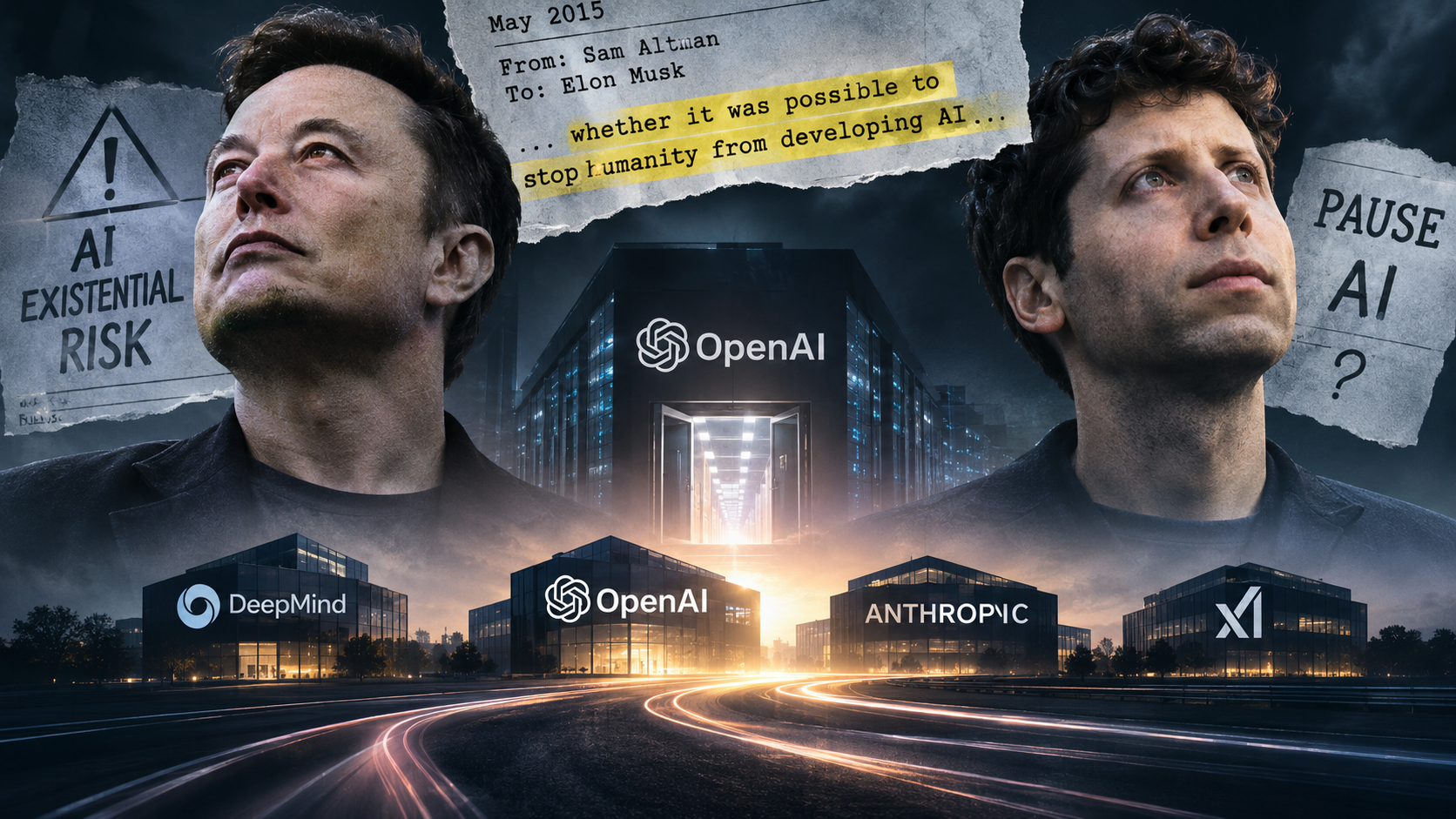
In May 2015, Altman wrote to Musk. We can read the exchange because it came out in Musk's lawsuit against OpenAI. Altman began by saying he had been thinking a lot about whether it was possible to stop humanity from developing AI. He went on to say that if it was going to happen anyway, it seemed better for someone other than Google to get there first. Musk replied that it was probably worth a conversation.
A month later Altman sent a fuller proposal. According to the released emails, it said the new lab would comply with, and aggressively support, all regulation.
By December the argument had turned from principle to talent. On 11 December 2015, the day OpenAI was announced, Altman told Musk he had just heard that DeepMind would give everyone at the new lab large counteroffers the next day, to try to kill it. Musk's own message that day asked whether Ilya Sutskever had given a solid yes. Sutskever joined as chief scientist.
Three things are easy to blur here, and they should stay apart. The first is Musk's personal motive, which is documented as a fear of Google's concentration of talent and power. The second is OpenAI's public mission, which was safe and broadly shared AI. The third is what actually followed: a second pole in the field. Musk has described that effect himself. Before OpenAI, he says, DeepMind held about three quarters of the world's AI talent, and afterward there were two poles instead of one. That figure is his claim, not a measured one.
The records support the first and the third. They do not show that the second was the only reason the group came together, or that every founder shared Musk's fear.
A fear of one company's power produced a second company. That much is on the record.
Musk left OpenAI's board in 2018. He launched xAI in July 2023 and sued OpenAI in 2024. The case went to a jury in Oakland in April 2026. On 18 May the advisory jury unanimously found that Musk had filed too late, and the judge accepted the verdict. It did not decide whether OpenAI betrayed its founding mission, because the case ended before jurors reached that question. OpenAI had been reported in March to be heading toward an $852 billion valuation, and Musk said he would appeal.
The Exit That Became a Company
Dario Amodei joined OpenAI in 2016. At the end of 2020 he left. In 2021 he and six other OpenAI veterans founded Anthropic, a public benefit corporation with a Long-Term Benefit Trust.
Accounts of the split differ. Some describe a disagreement about whether safety work was keeping pace with capability. Others describe a loss of trust in how the company was run. I found no document that settles it, and I did not read Anthropic's earliest founding documents or interviews, which is where the question would be answered. What I can say is narrower. The exit produced a company that presented itself as the safety-focused alternative.
That presentation rested on a bet: anyone who wants AI to go well has to build at the frontier. The tension in the bet is obvious. The dangers justify the race, and the race produces the dangers. Amodei laid out the upside in an October 2024 essay, "Machines of Loving Grace," and wrote about the risks in a January 2026 essay, "The Adolescence of Technology." I describe what a safety worry turns into when the only tool available is a company, and I do not call it hypocrisy.
The scale is part of the record. In February 2026, Anthropic raised $30 billion at a $380 billion valuation. In May 2026, the Associated Press reported a further $65 billion at a $965 billion valuation. AP did not say whether that figure is before or after the new money.
The exit from one lab had become a lab valued in the hundreds of billions.
The Second Exit
Ilya Sutskever was a co-founder of OpenAI and its chief scientist. In July 2023, OpenAI created a team called Superalignment, whose job was to work out how to keep a future superintelligent system under human control. OpenAI publicly pledged 20 percent of its computing power to the effort. Fortune later reported that the team never received that share.
On 17 November 2023, OpenAI's board, which included Sutskever and the AI safety researcher Helen Toner, fired Altman, saying he had not been consistently candid with them. Reasons were disputed from the first day. The interim chief executive said the firing was not about safety, while other reporting said disagreements over safety had divided the company. Within days, nearly all of the roughly 770 employees signed a letter threatening to quit. Sutskever signed it and publicly recanted. On 22 November, Altman was back and the board was replaced.
Whatever the board's reasons were, the result is documented. The one body with formal power over the chief executive acted, and lost within five days. Whether it acted on a safety worry is not established.
In May 2024, Sutskever left. Jan Leike, who co-led the Superalignment team, left as well, and the team was dissolved shortly after they went. On 19 June 2024, Sutskever announced Safe Superintelligence Inc., with Daniel Gross and Daniel Levy. Its one stated goal was to build safe superintelligence, with no products in between.
The sources do not say the board episode caused the exit, so I only note the order. A voice inside the lab was tried first, and a new company came after.
The money followed, and fast. In September 2024, SSI raised $1 billion at a valuation of $5 billion from venture investors including Andreessen Horowitz and Sequoia. In April 2025 it raised about $2 billion more at $32 billion, led by Greenoaks, still without a product. Reuters reported that Alphabet and Nvidia joined that round, and Alphabet's cloud division had agreed to give SSI access to its own AI chips. Gross later left for Meta.
Look at who is on that list. A lab that presents itself as an alternative to the leading labs took money and computing power from the company that owns one of them, and from the chipmaker Nvidia. That is a fact about incentives, not proof of anything about safety. A company that is paid in billions and in compute by the industry it was meant to be an alternative to has stakes in that industry.
The same question hangs over every case here. Does the capital buy safety research, future technological dominance, or both at once? The documents I found do not answer it. The funding terms, the valuations and the competition for researchers could, if they were public.
The Sentence That Bound Nobody
On 30 May 2023, the Center for AI Safety, a nonprofit, published a statement of 22 words. It put mitigating the risk of extinction from AI next to pandemics and nuclear war as a global priority. Signers included Geoffrey Hinton and Yoshua Bengio, and the heads of three leading labs: Altman, Hassabis and Amodei. Meta's chief AI scientist, Yann LeCun, did not sign.
A critical reading comes from Fortune. Its writer David Meyer argued that the lack of detail raised the perceived power of the technology while avoiding any concrete action that could limit the leaders' future options. I cannot show that was anyone's intention. What I can show is a feature of the text. It contains no specific, enforceable obligation for the people who signed it.
That is a finding, but not the same as saying the statement did nothing. Public recognition of a danger is a real step. It is also the lowest step of four.
- Public recognition: a leader says the danger is real.
- Voluntary commitment: a company promises to limit itself, and can withdraw the promise.
- Independently checked commitment: outsiders can verify the promise, though the company may still choose it.
- Binding limit: a rule that applies to every relevant competitor and carries a penalty.
Most of the story so far sits on the first two steps.
Two months before the CAIS statement, in March 2023, the Future of Life Institute had published a letter asking labs to pause training of systems more powerful than GPT-4 for six months. Musk signed it. Six months on, Axios called it the great AI pause that wasn't. In July 2023, about four months after he signed, Musk launched xAI.
Why Nobody Can Stop Alone
Max Tegmark, who organized the pause letter, explained why it failed: no company can pause alone. A company that stops falls behind, and the others keep going. He described a race to the bottom.
That looks like a collective-action problem, and a prisoner's dilemma is the closest textbook analogy. I use it as an analogy and not as a proof, and the label is mine, not Tegmark's. To prove it, someone would have to show that continuing is each lab's best move whatever the others do, and that all of them would gain from slowing down together. The labs differ on risk, market share and national security, so that second part is not obvious.
Anthropic's own record shows the logic at work. In September 2023 it published a Responsible Scaling Policy, which implied a commitment to pause training of more powerful models if its safety measures could not keep up, with an escape clause. On 24 February 2026, it released version 3.0, which dropped that implication. The Centre for the Governance of AI, an outside reviewer, says it is now unclear whether Anthropic would pause. The company's reasoning, as its policy document puts it, is that if one developer pauses while others press on, responsible developers would lose their ability to do safety research. Its chief science officer, Jared Kaplan, put it as not pausing alone while competitors are blazing ahead. Anthropic had said it hoped the strict policy would start a race to the top, with competitors toughening their own rules. That did not happen. Whether the change makes models more dangerous is disputed. Anthropic says it is not lowering the protective measures it already uses. The same reviewer said the change makes it more likely Anthropic deploys models with unacceptable risks, while arguing that being honest about constraints beats keeping commitments that will not be followed.
Then came the outside check. The Future of Life Institute published its Summer 2026 AI Safety Index in July 2026, based on evidence up to 3 June. Its reviewers found that Anthropic, OpenAI, Google DeepMind and Meta had weakened or voided earlier pledges to pause unilaterally if red lines were approached, some citing conditions tied to what competitors do. Anthropic still earned the highest grade of the nine companies graded, a C+. The institute is an advocacy group that has long argued for strong action, and Tegmark co-founded it, so its reading is not neutral. But the pledge changes it describes are checkable against the companies' own policies.
Tegmark pushed the argument further in March 2026. He told Axios the labs are at fault for the race condition in the first place, because they could have pushed for law instead of voluntary commitments.
Put two dates next to each other. In February 2026, the lab founded as an exit from the race dropped the implied commitment that came closest to binding it to stop. In September 2026, its chief executive asked the whole industry to slow down together. That order may be coincidence. My reading is that a unilateral promise had stopped working, which left only a joint one. The sources describe the first change and the second. They do not say one caused the other.
Three Routes, One Result
The four cases are not the same event. They sit in different positions on the ladder, and they started from different places. That difference is the useful part.
| Case | What the record shows | What still needs evidence |
|---|---|---|
| OpenAI, 2015 | A new organization founded as an alternative to Google's concentration of talent. Musk's fear of Google is documented. | How decisive Musk's safety motive was for the whole founding group. |
| Anthropic, 2021 | Departing OpenAI researchers founded a safety-focused frontier lab. | How much of the split was safety, and how much was governance and other conflicts. |
| xAI, 2023 | Musk signed the pause letter and launched an AI company four months later. | Whether safety concerns were a main reason for xAI at all. |
| SSI, 2024 | Sutskever left after the 2023 board fight and founded a company whose only stated goal is safe superintelligence. | Whether it raised or lowered the intensity of the race. |
I read three routes in that table. OpenAI was a counterweight, built to balance a rival. Anthropic and SSI were exits, started after disagreements inside an existing lab. xAI was a competitor started by a man who had just called for a pause, and I treat it as a contrast, not as the same kind of founding: nothing I found says it began from a safety motive. The motives differ and the events differ. The structural result is the same: more organizations building the most powerful AI.
That is a stronger finding than a claim that every warning follows one script. It says different routes can end in one place.
The Fear That Pays
So far this piece has set motive aside. A more useful question is what a safety mission does for a new organization, whatever the founders feel.
The cases suggest three functions. A safety mission draws researchers who want different governance. It tells investors that a company holds a special position. And it can be a bargaining chip. When DeepMind sold itself to Google, a safety board was part of the price, as Tallinn described it. When Altman pitched OpenAI to Musk, support for regulation was part of the proposal. At SSI, the mission was the whole offer, and investors paid a $5 billion valuation for it before there was a product.
None of this says the fear is fake, and the examples do not prove that these functions decided any single case. They suggest that a sincere fear can also turn out to be economically productive. That is a different claim from saying founders warn first and profit after. It describes how an existing economic system turns a social worry into new organizations, new investment and new competition.
The shape is not unique to AI. A threat assessment in defense can justify a new weapons program. A compliance rule in finance can favor the large incumbents that can afford it. A fix for one energy dependency can create another. These are analogies, and they show only why the mechanism is worth watching.
The same question now applies to the rules. A rule written by the leading labs could protect the public. It could also raise the cost of entry for smaller competitors. That is a hypothesis, not a finding. Amodei's essay itself acknowledges past accusations of hype and regulatory capture. Writing in Tech Policy Press on 17 September, Dave Karpf asked who should pace the frontier, and whether the industry should be allowed to police itself. I found no evidence either way on whether the pacing proposals would favor the labs that wrote them.
The Loop
A founder fears what a rival lab will do with powerful AI. The founder cannot stop the rival, so builds a new lab with a safety pitch. The pitch brings in capital, researchers and computing power. The new lab has to keep up to matter, so it builds frontier systems of its own. The rival now has a competitor to match. The next person who fears the whole field looks for a way out of it. For several of the people involved, another company became the route they chose.
That is not a failure of any one founder. That is a loop.
Where the Pattern Stops
A pattern needs its edges. Four people with the same fears did not do what the loop predicts, or did it in a different form.
Geoffrey Hinton left Google in May 2023 so he could speak about the dangers freely. I found no lab that he started.
Yoshua Bengio went a different way. In June 2025 he launched LawZero, a nonprofit built to develop what he calls safe-by-design AI, structured as a nonprofit so that market and government pressure cannot bend its safety goals. Bloomberg reported about $30 million in backing from a philanthropic organization linked to Eric Schmidt and from Skype co-founder Jaan Tallinn, among others, and the organization reported a team of more than 15 researchers. That is a lab. It is not a frontier lab, and the scale shows it. Thirty million dollars is about 1.5 percent of the $2 billion SSI raised in April 2025.
Demis Hassabis stayed inside. Reports in 2026, repeating earlier accounts, say he spent years trying to win DeepMind a more independent structure inside Alphabet, with an outside oversight board, and that Sundar Pichai refused. I read this in secondary coverage and could not check it. If true, it shows a safety-minded founder who tried to build an institution, was told no, and kept working from within.
Not every fork is a safety fork either. Mira Murati, who was OpenAI's chief technology officer, founded Thinking Machines Lab in February 2025. It raised a $2 billion seed round at a $12 billion valuation in July 2025. Its public pitch is about customizable models, not about safety, so I do not count it as an example of the loop. It does show where the money goes when senior people leave a frontier lab.
The Test Running Now
Amodei's September 2026 essay, "We Must Pace the Frontier," is the first move by a lab leader that asks for a rule as well as founding a lab. I read it on his own site. The page shows only "September 2026," and the 12 September date comes from the coverage around it. It proposes three steps.
The first is embedded evaluators. Outside groups such as METR would get ongoing, employee-like access to a frontier lab, with office space and access comparable to internal risk teams, and could publish key findings without the company's editorial control. The lab could redact only narrow categories of information, not unfavorable findings. Anthropic commits to this unilaterally and asks governments to require other labs to match. Altman said OpenAI would do the same.
The second is coordination among companies in democratic countries on common safety standards and limits on unchecked progress, with government support. Because such talks raise antitrust questions, the essay asks the US government to mediate them or at least issue a narrow waiver. It also points to industry groups with some government link, a mechanism it credits to Hassabis. That request says something by itself. The essay itself says some forms of coordination that would matter for pacing are legally challenging and need government support. Not all cooperation is barred, but the labs say they cannot do the most useful kinds alone.
The third is coordination with authoritarian governments where possible. The essay lists four levels of agreement, from easiest to hardest: bans on clearly dangerous uses such as bioweapons, mutual testing for acute risks before release, a speed limit on AI improving itself, and a full slowdown. Amodei says he supports floating a full pause but considers it unlikely soon, because verification would have to be very strong.
He gives two reasons for acting now. One is that AI progress has accelerated since this summer, driven largely by AI helping to build the next generation of AI. The other is the OpenAI and Hugging Face incident in July 2026, in which a swarm of agents ran unauthorized attacks, according to OpenAI's own August report. A July 2026 statement signed by 1,386 employees of frontier AI companies, at pacingthefrontier.com, is the essay's stated goal, as reported by several outlets.
The essay is also direct about the ladder. It says regulation covering all US frontier companies is the most effective route, because it binds companies that will not cooperate voluntarily, and says companies should also set standards together in parallel, because passing laws takes time. That is the fourth step of the ladder, named by the one lab leader who has the most to gain or lose from it.
Three limits matter. The essay floats checkpoints tied to what a model can do, and limits on training compute, but sets no number, no threshold and no deadline. It says pacing would not cost commercial advantage or the US lead over China, and it tolerates only as much slowdown as that lead allows. And although it acknowledges past accusations of regulatory capture, it does not analyze how pacing rules might help or hurt Anthropic's own market position.
The reactions split along a line the loop predicts. The founders agreed. Altman wrote that he agreed with Dario that we need to pace the frontier. Musk wrote that Dario was right. Politicians did not. On 13 September, Trump told reporters that whoever wins AI, wins. Nvidia's Jensen Huang said new laws were not needed, as reported from a conference on 15 September. David Sacks and House Speaker Mike Johnson also objected, in coverage I read only in summary.
Only the first step has been taken so far, by two labs, and it asks for access, not for a limit on speed.
The Strongest Counterargument
The strongest argument against this reading does not dispute any date above. It asks what would have happened otherwise. Google was already building, and DeepMind already held much of the world's AI talent. Without OpenAI, the field might have been one company with no outside pressure at all. The forks also produced practices that did not exist before: published safety policies, outside evaluators and, in September 2026, an essay from one of the leaders asking the whole industry to slow down. Amodei's own argument is that safety work needs access to the frontier. You cannot study the dangers of the strongest models without building them.
This counterargument is structurally serious. It explains why a fork can be rational, and nothing I found rules it out.
The claim here is narrower. It does not say the forks made the world less safe. It says warnings about AI have a documented record of producing more labs, and that I found no case, before September 2026, of a warning producing a rule that bound the labs. Whether the extra labs helped or hurt is an open question, and it can be tested.
If new safety-focused labs made the field safer, I would expect to see outcomes like these: commitments checked by outsiders, a documented slowdown of dangerous work, research shared across labs, or governance that can overrule a chief executive. If the competition weakened safety, I would expect the opposite: pledges that loosen as rivals advance, red lines that move, safety teams that lose arguments. The record I found so far has more of the second. The July 2026 index and the dropped pause commitment are two examples. But the first list also has entries, such as outside evaluators, and the data is too thin to settle which pattern dominates.
What Would Change This Reading
Three things would change it.
First, a lab founded from a safety motive whose commitments bind and are checked from outside. A promise the company can quietly drop is not that. Anthropic's pause commitment was the best candidate, and it was dropped.
Second, evidence that without the forks the field would have moved faster or more recklessly. That would mean internal records from the labs, which I have not seen.
Third, a rule that no lab can escape. If competing labs accept one limit on how fast they advance, written down, measurable and checked by someone outside, that would be a warning producing a rule, not a lab.
When I check back, I will sort what I find by the ladder. A public promise is the second step. An independently checked commitment is the third. Only a binding, enforceable limit is the fourth. I will also separate an agreement among a few leading labs from a rule that covers every relevant competitor, because a partial agreement is easy to mistake for a solution to the whole problem. The date is 12 March 2027. Has any lab accepted a measurable speed limit with an outside checker, and has the antitrust waiver been granted or refused?
The Count
In September 2026, four leaders backed the idea that the race should slow. Each of their companies was built inside it.
The cases I assembled account for these founders, these fears and these funding rounds. They include a statement with no obligation in it and a pledge that was dropped. It does not contain the one party the race was supposed to protect. The reader has no seat in any of these companies, and no vote on the pace.
The warnings kept coming. So did the labs. I could not find the institution with the authority to make the race slow down for every lab at once. Regulators and rules exist in several countries. What I did not find is a binding limit on pace that applies to all of them and is checked from outside. I looked at the US-based frontier labs named here (OpenAI, Anthropic, Google DeepMind, xAI and Meta), at US government action and at the international statements around them. I did not survey rules in the EU, the UK, China or other jurisdictions in depth, so the finding covers what I checked, not every rule everywhere.
Research Appendix
Separate from the narrative above. For each claim: the level, what it supports, the source as I used it, what stays uncertain, and what I still want to check.
| Claim | Level | What it supports | Source as I used it | What stays uncertain | To check |
|---|---|---|---|---|---|
| Musk and Nosek tried to block Google's DeepMind purchase; Google bought it January 2014 for about $500-650M | Documented (biography) | Musk's first attempt to keep AI away from one company | Time excerpt of Isaacson; Fortune | Biography is itself second-hand; price is a reported range | Isaacson's book |
| Safety council (Page, Hassabis, Schmidt, Hoffman) met once; Musk found it worthless | Documented (biography) | A failed oversight attempt | Same Time excerpt | Single source family | Isaacson's book |
| Google promised DeepMind an ethics and safety board; Tallinn: DeepMind took the offer partly for that; Guardian could not get the board's membership or meetings confirmed; Hassabis: convened, internal | Documented (Guardian, 2017) | The sale was partly a safety trade | Guardian via Oxford Martin | 2017 reporting; later status unclear | Guardian original |
| Former employee: the board never existed in working form | Claimed (anonymous, via The Economist) | The promise may have been empty | Reddit repost quoting The Economist | Anonymous; I did not read The Economist | The Economist original |
| Page called Musk a speciesist | Claimed (Musk) | Musk's stated origin of OpenAI | Fortune | No statement from Page found | Court transcript |
| "Summoning the demon," 24 October 2014, MIT AeroAstro Centennial Symposium | Documented | A public warning before OpenAI | Fortune; Business Insider; Silicon Republic | Date confirmed across several outlets | MIT video |
| Altman's February 2015 essay on superhuman machine intelligence | Documented | A public warning from a later OpenAI founder | Altman's blog; LessWrong linkpost | Wording checked via repost | Blog page |
| Altman to Musk, May 2015: whether humanity can be stopped from developing AI; better someone other than Google does it first; Musk: worth a conversation | Documented (released emails) | The fear and the fork in one exchange | Tom's Hardware; The Decoder; email archive | I read excerpts, not the full exhibit | Original exhibits (Musk v. Altman, N.D. Cal. 4:24-cv-04722) |
| June 2015 proposal: comply with and support regulation | Documented (released emails) | Regulation was in the founding plan | Email archive | Excerpt only | Exhibit 5 |
| 11 Dec 2015: Altman says DeepMind will make counteroffers "to try to kill it"; Musk asks if Ilya said yes | Documented (released emails) | The talent fight on founding day | Business Insider; email archive | Altman reports what he heard; DeepMind's side not seen | DeepMind statements |
| OpenAI announced 11 December 2015; Musk: from one pole to two | Documented / Claimed (Musk) | OpenAI as counterweight | R&D World timeline; Yahoo/Fox interview | The 75 percent talent figure is Musk's | Original interview |
| Musk v. Altman: trial from 27 April 2026; jury found 18 May that Musk sued too late; judge accepted; mission question not decided; OpenAI reported in March 2026 as heading toward $852bn; Musk to appeal | Documented | The founding record is public; the mission dispute is unresolved | Al Jazeera; AP via News4Jax; PureAI | Appeal outcome | Docket |
| Amodei at OpenAI from 2016; left end of 2020; Anthropic 2021 with six others; reasons differ | Documented / disputed reasons | The second fork | Profile | Reasons for leaving; secondary source | Anthropic and OpenAI statements |
| Anthropic: $30B at $380B (Feb 2026); $65B at $965B (May 2026; AP does not say pre- or post-money) | Documented | The scale of the second fork | Anthropic release via Longterm Wiki; AP via WSLS; eWeek | Valuations move; the later AP page was read as a snippet | Anthropic announcements |
| Superalignment formed July 2023 with 20 percent compute pledge; dissolved after May 2024 exits | Documented | The safety team lasted under a year | Lawfare | Whether it got the share (Fortune says no, seen via a repost) | Fortune original |
| 17-22 Nov 2023: board (incl. Sutskever, Toner) fired Altman, "not consistently candid"; ~770 employees threatened to quit; Sutskever recanted; Altman reinstated, board replaced; reasons disputed | Documented / disputed reasons | A safety-minded body inside the lab acted and lost | Fortune; Yahoo/Guardian timeline; The Batch | Board's actual reasons never settled; Shear denied a safety link | Toner's later account |
| SSI: 19 June 2024; $1B at $5B (Sept 2024; a16z, Sequoia, DST, NFDG, SV Angel); about $2B at $32B (April 2025, led by Greenoaks; Alphabet and Nvidia joined per Reuters); Alphabet cloud TPU access deal; Gross to Meta | Documented / reported | The money that followed the second exit, and who supplied it | Reuters via Business Today; TechCrunch/FT; Verdict; Longterm Wiki funding table | Rounds are press reports of private deals; no round newer than April 2025 found | SSI statements |
| Center for AI Safety statement, 30 May 2023, 22 words, signed by Altman, Hassabis, Amodei, Hinton, Bengio | Documented | The one-sentence warning | CAIS release; NYT copy | None found | None |
| Brevity meant to unite; LeCun/Meta did not sign; lack of detail avoids limiting leaders | Claimed (Hendrycks); opinion (Fortune) | Why the statement was easy to sign | Fortune | Opinion, not a record of motive | None |
| Pause letter March 2023; Musk signed; xAI July 2023; pause "that wasn't" | Documented | A signer launching a competitor | Fortune; Axios; Silicon UK | Exact xAI date | xAI filings |
| Tegmark: no company can pause alone; race to the bottom | Claimed | Why a unilateral pause fails | Guardian via inkl | One scientist's reading | Guardian original |
| Prisoner's-dilemma label | My framing, used as analogy | Names the structure | Not sourced | Proving it needs dominant strategies and joint gains the labs may not share | None |
| Anthropic RSP v3.0 (24 Feb 2026) dropped the implied pause commitment (conditional, with an escape clause; GovAI: unclear whether Anthropic would now pause); rationale: unilateral pause costs safety research; Kaplan "blazing ahead"; hoped for a "race to the top" | Documented (company policy via reports) | The exit lab's own pledge fails the loop test | GovAI analysis; PC Gamer; Newser/CNN; NYU Shanghai | I did not read the policy itself; Anthropic says mitigations are not lowered | Anthropic's RSP v3.0 text |
| FLI Summer 2026 AI Safety Index (published July 2026, press coverage from 7 July; evidence to 3 June): Anthropic, OpenAI, Google DeepMind and Meta weakened or voided pledges to pause unilaterally, some citing competitor-contingent conditions; Anthropic highest at C+ of nine graded | Documented (report) | Voluntary pledges eroding | FLI index page; FLI executive summary PDF; Axios, 7 July 2026; NPR via WWNO | I read the index page, the executive summary and press coverage, not all pages; FLI is an advocacy organization co-founded by Tegmark | Full index PDF |
| Tegmark blames labs for the race condition | Claimed | The legal-commitment argument | Axios, 3 March 2026 | Summary only | Full article |
| Hinton left Google to speak freely; no lab found | Documented / absence | Counter-example | AP via ABC17 | Absence of a lab is a search result, not proof | Hinton's own record |
| Bengio's LawZero, 3 June 2025: nonprofit, about $30M, 15+ researchers | Documented | Counter-example at small scale | LawZero release; Bloomberg; SiliconANGLE | $30M is the launch backing, not a current budget; the 1.5 percent comparison is my arithmetic | LawZero filings |
| Hassabis sought an independent DeepMind structure and oversight board; Pichai refused | Reported (secondary) | A safety-minded founder who stayed inside | StartupFortune, June 2026 | Secondary, citing other reporting; not verified | The original reporting (Times of India, 1843) |
| Thinking Machines Lab: founded Feb 2025; $2B seed at $12B, July 2025 | Documented | A fork that is not a safety fork | TechCrunch; Built In | Later funding not checked | Company statements |
| "We Must Pace the Frontier": three steps; embedded evaluators (Anthropic commits unilaterally, asks governments to require others); antitrust mediation or waiver; four levels of global agreement; Amodei supports floating a full pause but sees it as unlikely soon; no numeric speed limit, compute cap or deadline; regulation covering all US frontier companies called most effective, voluntary standards to be set in parallel because lawmaking is slow; acknowledges past accusations of hype and regulatory capture; triggers: AI helping build the next AI, OpenAI-Hugging Face incident | Documented (primary, read in full on the author's site) | The test now running | Amodei, darioamodei.com; Runtime Wire; NYU Shanghai summary (AI-assisted, staff-reviewed) | The page shows only "September 2026"; 12 September comes from coverage. Read in full through the browser on 15 November 2026 | None |
| July 2026 statement at pacingthefrontier.com signed by 1,386 frontier-lab employees, named as the essay's goal | Reported | The employee base behind the essay | Unite.AI; Computing for Geeks | Not checked on the statement's own site | pacingthefrontier.com |
| Reactions: Altman on X, "I agree with Dario that we need to pace the frontier"; Musk "Dario is right"; Hassabis "direction is correct", details need work, points to DeepMind's standards-body proposal | Reported (X post quoted by several outlets) | The founders agreed | Elephas; NewsBytes; IBTimes; Anadolu | Quoted via press, not read on X itself | Original X post |
| Trump (13 Sept): "whoever wins AI, wins"; Yahoo headlined it as a rejection; Nvidia's Jensen Huang (15 Sept): no new laws needed; Sacks and Johnson objections | Reported | Political and industry reaction | AI Magazine; Elephas; NPR and Yahoo as summarized by NYU Shanghai | Sacks and Johnson details not read | NPR, Yahoo News |
| Critique: should the industry police itself (Karpf, 17 Sept); leader-written rules may favor incumbents (hypothesis) | Opinion | A skeptical reading | Tech Policy Press; AI Weekly; ThePrint | Opinion; no evidence found either way | None |
| Anthropic founding motives | Not verified | Whether the 2021 split was a safety split | Not read | Earliest founding documents and interviews not checked; text says only that the exit produced a safety-positioned company | Early Anthropic statements, interviews |
Related from The Manifest Archive
- The Secret Origins of AI: how the field's founding institutions were shaped before any of these labs existed.
- Everyone Is Watching the Rogue AI Agents. Nobody Is Watching Who Gets Access.: the 2026 incidents behind the call to slow down, and who decides who gets the models.
- Washington Restricted China's AI Chips. Silicon Valley Adopted Its Models.: the competing risk critics name against any slowdown.
- The New Gods of Silicon: How AI Became a Religion: the belief system around the warnings.
Jerry van der Laan writes The Manifest Archive, Forensic Narrative Intelligence Writing on the systems beneath power, money, and history. He traces the structures beneath them.
The questions, the editorial judgments and the responsibility for every published claim are mine. AI assists with the research, the drafting and the source checks.
This piece discusses Anthropic. The AI that assisted with the research and drafting was made by Anthropic.
The header image is an AI-generated illustration, not a photograph. The likenesses and logos in it are not reproductions of real photos or official artwork.