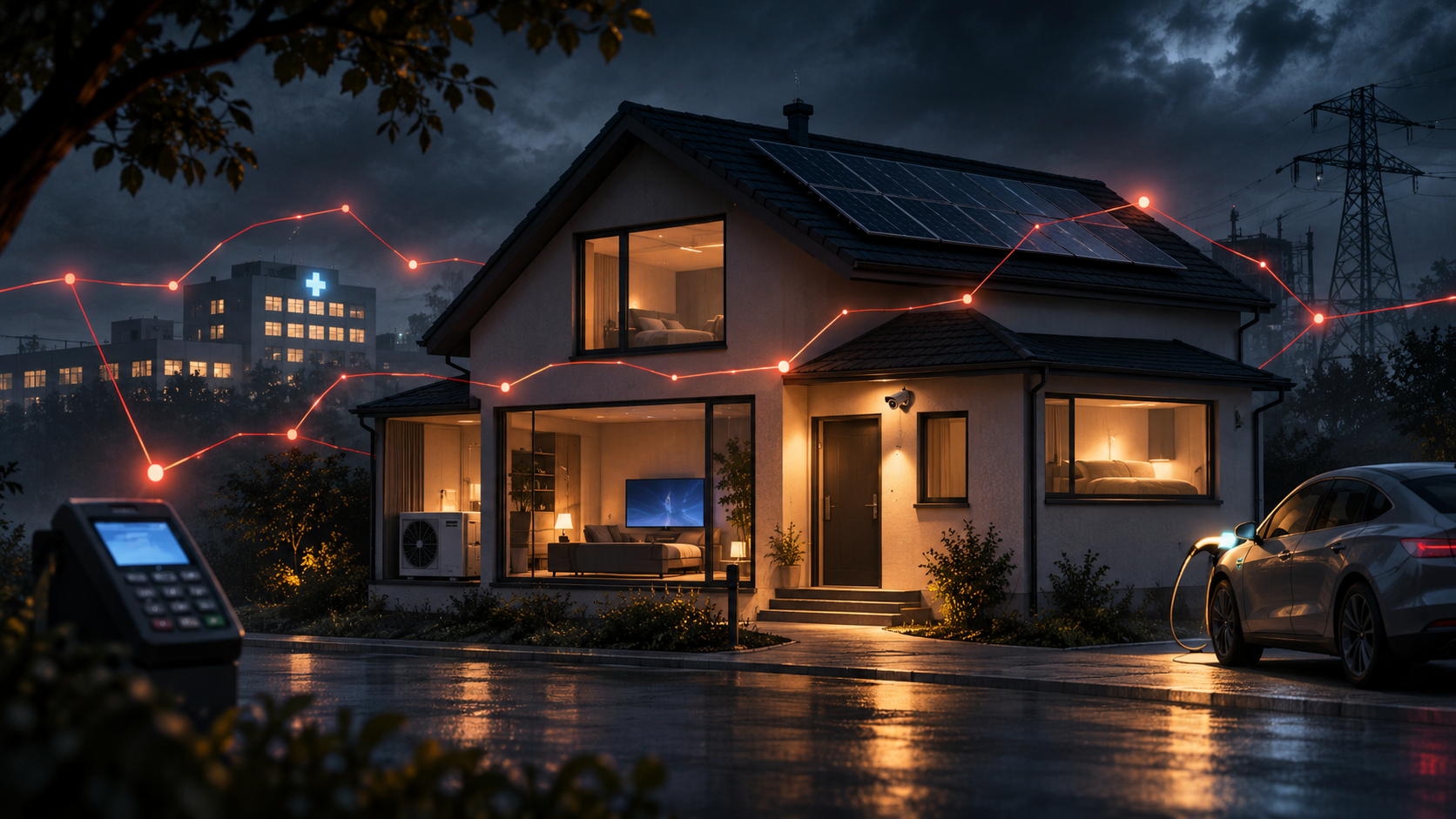
Imagine an ordinary Tuesday evening in your house.
You come home in the dark. The camera by the front door notices you, and the hallway light comes on. The router in the hallway blinks its small green lights, as it has since the day the technician left. In the living room the streaming box wakes up with the television. On the shelf the photo frame turns to a picture of the children at the beach. Outside, the car is charging on the drive. On the roof the inverter turns the last of the daylight into electricity, and in the utility room the heat pump decides, by itself, that it is time to heat the water.
Nothing in this scene is unusual. In a typical connected home, each of these objects can connect to the internet, and you own every one of them. But owning an object is not the same as being able to keep it working. Ask who sets up its updates, who runs the server it talks to and who could stop it, and you would probably say that nobody in the house knows.
The question of this piece is not whether someone can hack your home. It is how much of your home still works when the systems outside it stop working, or are influenced from outside. Some of the objects above would keep doing their job without a connection, and some would not. A connection does not prove that an object stops without it, so the piece goes through the evidence and asks, case by case, what failed, what kept working and why.
The same question reaches beyond the house, to the shop where you pay, the hospital that treats you and the grid that powers all of them. It does not depend on who the outsider is or why they act. A failing provider, a criminal, a maker and a state are different actors with different access and different responsibilities. What connects them is the dependency they can reach. The dependency exists before the failure, and the event reveals it.
Two distinctions carry the argument. A dependency is a condition in which a function relies on another system. A vulnerability is a weakness that lets someone misuse it. A dependency can disrupt without any vulnerability, and a vulnerability can exist without any outage. And residual autonomy, my word for what keeps working when the connection, the controller or the service disappears, is a lens for reading the cases, not a measured metric. Every possibility is marked as a documented event, a demonstrated capability, an official scenario, a reasoned scenario or a probability. The last would need separate evidence, and where I found none I say so.
What You Own, and What Keeps It Running
Start with the objects in that evening. For each, the documents show what it depends on and who can interrupt that dependency. I sort each into three states: a documented event that has happened to ordinary households ("Happened"), a capability researchers have demonstrated ("Demonstrated"), or an official scenario written by a regulator ("A scenario"). A fourth state, the reasoned scenario, comes later. Nothing below says how likely any of it is.
- The bed and the thermostat. Stopped by a provider outage, as when Eight Sleep's bed lost its cloud on 20 October 2025 and one owner said the other side of the bed "set itself to 110 f and won't turn down." I found no documented hijacking, so these two are outage only. Happened.
- The photo frame and the box behind the television. Infected before purchase or through an unlocked developer port, as in BADBOX 2.0 and Kimwolf, and used to attack others and to carry strangers' traffic through the owner's address. Happened.
- The router in the hallway. Taken over through unpatched flaws: about 369,000 routers and cameras by AVrecon, according to the FBI's warning of 12 March 2026. Happened.
- The camera by the door. Stopped by a provider outage when many Ring and Blink cameras went unresponsive on 20 October 2025, and taken over by criminals when hacked cameras and recorders powered the Mirai attack of 21 October 2016. Both happened.
- The music and the family photos. A streaming library is access, not ownership: Spotify's support page says downloads are kept only if you go online at least once every 30 days. Photos held only in a provider's cloud depend on the same kind of access, but I found no documented loss, so that is a dependency, not an event.
- The money on your phone. Cut off for hours by outages at ING on 1 February 2023 and ABN AMRO on 17 May 2026. Happened. Attacks on the phone itself I did not research.
- The car. Taken over wirelessly and stopped on a highway in the 2015 Jeep demonstration, and described in the Norwegian bus tests as stoppable by its maker, in theory. Demonstrated, with no criminal case at scale documented.
- The charging pole. Interrupted by radio interference from up to 47 metres in the Brokenwire research. Demonstrated, DC fast charging only.
- The inverter, battery, charger and heat pump. Switched off together, in the Dutch regulator's scenario of 16 October 2026, because many of them answer to the same digital backend. A scenario, with no documented Dutch incident.
The first group is documented in court papers, regulator warnings and company statements. The second was shown to work in a laboratory or a test. The third is a worry written by an official body whose job is to worry. The outsiders behind them come in four kinds, and they differ in motive and in almost nothing else that matters here. The provider that fails wants nothing: Amazon's outage was nobody's attack. The criminal wants your address or your device. The maker already has the access it needs to update or diagnose your product. Depending on how the product is built, that access may also be able to disable it. And a state can be an attacker, a regulator worried about other states, or itself the one that reaches into private devices.
A home is a small network that nobody administers. What an outsider can switch off does not depend on why they want to.
Switch the Connection Off
There is a simple way to find out which objects keep working, and it needs no attacker. Switch the connection off and walk through the rooms.
The cleanest documented case is a bed. When Amazon Web Services failed on 20 October 2025, according to BNN Bloomberg, Eight Sleep owners could not open the app, change alarms or adjust their beds, and the next day the company began shipping an outage mode that reaches the bed over Bluetooth. At the front door, PCWorld reported that many Ring and Blink cameras became unresponsive that morning, and one Blink owner said the cameras missed an attempted arson. What kept working: Philips Hue lights, Tapo and Wyze cameras that store video on the device, and robot vacuums on schedule. Connected objects, in other words, differ enormously in how much autonomy they keep, and the difference was decided in a design meeting, not in your living room. Many connected objects keep their basic physical function offline and lose only the remote control, the schedule or the monitoring, while Eight Sleep's bed shows that some do not, so the useful question is which of those a household actually relies on.
Then the things you may believe you own. A music collection on a streaming service is a right to listen, not a shelf of records: Spotify says you need to go online at least once every 30 days to keep your downloads, because it records play data so artists can be compensated. A short outage leaves downloads playable and streams silent, and a closed account leaves nothing. Photos work the same way when the cloud holds the only copy, and where families once had prints in a box, many now have a library at a provider. I found no documented case of a household losing its photos through an outage. For the television, the computer and the smart refrigerator I found no documented outage case either, so I make no claim about them.
What still works offline was decided in a design meeting, not in your living room.
At the Till
The house is the part of this dependency you can walk through. Step outside and the question changes scale: what happens when a service you use, and do not own, stops while everything you do own stays intact?
On the evening of 16 May 2024, according to a blog by the Dutch central bank DNB, card terminals in shops across the Netherlands stopped working for about two hours, after a technical problem at a major supplier. People queued at cash machines, and retailers reported millions of euros of damage the next day. The author called payment "the gas, water and electricity of our economy." Nothing in the source points to an attacker. The customer's money, the bank and the terminal were all intact. What failed was the link between them, and neither side could do anything about it. What remained was cash, for those who carried it.
The banking cases show a related pattern. On 1 February 2023, according to the NOS, online banking for nearly nine million ING customers was down for about fifteen hours, while card payments in shops kept working. On Sunday 17 May 2026, Hart van Nederland reported, ABN AMRO customers got error codes in the app and on the website, with more than 7,400 complaints at the peak. No cause was named. In both cases the function that failed was the one that ran through the phone and the bank's servers, and the one built differently kept working. I did not research digital identity systems, so I make no claim about them.
In the Hospital
From payments the question moves to a place where interruption has physical consequences. The record offers two examples that look alike from the bed and are different underneath.
On 3 June 2024 a ransomware attack hit Synnovis, a pathology partnership that runs blood tests for hospitals in south east London, and NHS England described significant disruption, with appointments and operations cancelled. I did not retrieve official figures for how many, so I give none. Six weeks later, on 19 July 2024, one faulty update from CrowdStrike, a security company most patients have never heard of, crashed computers around the world. Microsoft estimated that 8.5 million Windows devices, less than one percent of all Windows machines, were affected. According to OPB, non-emergency operations were cancelled at hospitals in Germany, doctors in England had trouble reaching basic medical records, and Delta, United and American Airlines grounded their flights. CrowdStrike said it was a software defect, not a cyberattack.
One of these events was a crime and the other was a mistake, and the mechanisms differ: one hit a supplier that a hospital relies on for tests, the other reached the hospital through a security product its own computers ran. A patient waiting for a result could not tell them apart. The connection between them is the one this piece follows. A hospital can own its equipment and still depend on a third party for the software or the service that makes it useful.
On the Grid
The next scale is the electricity system that every example so far runs on. The honest starting point is a blackout with no connection to any of the actors above. On 28 April 2025 at 12:33 CEST the power system of mainland Spain and Portugal collapsed. The expert panel's final report, published on 20 March 2026 and summarised by ENTSO-E, the association of European grid operators, attributes it to many interacting technical factors, among them gaps in voltage control and cascading generator disconnections. I found no cyber cause in the summary I read and claim none, and I did not verify the blackout's effects on homes and services here. It shows what one shared dependency looks like at the scale of a country, and what a cascade is.
The Dutch case is different in kind, because nobody has attacked it. The criminal botnet and the legitimate energy network have different purposes, and different permissions. But both show what happens when many privately owned machines answer to one central controller, and the evidence changes with the move from a documented event to an official scenario. Imagine a sunny noon in May, with hundreds of thousands of rooftops feeding electricity into the grid and home batteries and heat pumps waiting for instructions. On 16 October 2026 the RDI, the Dutch digital infrastructure inspectorate, published a position paper, as reported by Solar Magazine, saying that many such devices connect to the same digital backend, a manufacturer's cloud, an energy management system or an aggregator, so that large numbers of them can be switched on or off at once by a targeted cyberattack or a faulty software update. A sudden loss or gain of 3 gigawatts or more, the paper says, could push the grid frequency outside its safe band, with disruption or outages as a result. That is a scale I would compare to a few large power stations, though the comparison is mine and not the RDI's. The noon is the regulator's scenario, not an event, and I found no documented Dutch incident.
Lithuania wrote part of the question into law on 12 November 2024, as the European Solar Manufacturing Council reported, barring entities from countries seen as a threat to national security, China among them, from the control systems of installations above 100 kilowatts. A household system is far below that, so a rule written for power plants does not reach the roof.
The question is the same in a living room and in a utility room: who else can reach the controller?
A Dependency Is Not a Weakness
Before the outsiders, one distinction. The payment outage, the CrowdStrike update and the Iberian blackout were dependencies that disrupted without any weakness being exploited by an attacker. A device relaying a stranger's traffic can be compromised for years without any outage at all, which is a weakness without disruption. And a maker's legitimate right to push updates is a dependency that is a feature, not a flaw. Reading the three together matters because the usual alarm about hackers describes only one of them.
The documents also let us separate kinds of concentration. A shared commercial supplier is documented: one supplier's problem stopped card payments nationwide. A correlated failure across many devices is documented: one update reached 8.5 million machines, and one cloud outage reached beds and cameras. A cascading failure is documented in the grid, from technical causes. A single manufacturer controlling consumer energy devices at once remains the regulator's scenario. These are related but not interchangeable, and the strongest systemic argument is the one that says which are documented and which are not.
When Someone Does Want the Devices
So far nobody wanted anything. The other case is outsiders who want the devices themselves, and it is the best documented part of this piece.
On 19 March 2026 the United States Justice Department announced that it had taken down the control servers of four botnets, which are networks of hijacked devices that criminals steer from a distance. It put the devices at more than three million: digital video recorders, web cameras, wifi routers. Krebs on Security, the investigative site that followed the case from the start, reported that in Kimwolf, one of the four, two thirds of the infections were unofficial Android TV boxes, the kind that third-party merchants sell on large retail sites for between $40 and $400. Cloudflare, which defends websites against attacks, attributed to the Aisuru and Kimwolf network a flood of traffic of 31.4 terabits per second, a unit for how much data arrives every second. The department's word for the devices was "enslaved." Put the box behind your television into that sentence.
The way in started with a business model. Some companies rent out ordinary home internet connections, so that their customers can visit websites as if they were a family on a quiet street. A researcher named Benjamin Brundage, who runs a firm called Synthient, found that Kimwolf spread through these companies. Each had a rule against requests to the private side of a home network, and on 17 December 2025, ninety-two days before the announcement, he warned eleven of them that the rule could be bypassed. A request disguised with an address record pointing to 192.168.0.1, the usual address of a home router, or to 0.0.0.0, got through. In his words, as Krebs reported: "It is possible to circumvent existing domain restrictions by using DNS records that point to 192.168.0.1 or 0.0.0.0." Behind that door sat Android Debug Bridge, a developer tool that listens on a numbered entrance to the device, port 5555, and hands administrative control to anyone who reaches it, without a password. On virtually all the TV box models Brundage tested it was switched on by default. A device nobody had hacked, in a home nobody had targeted, could still be taken.
Why would anyone want a TV box in someone else's living room? Because of the address. Websites trust visitors who look like homes, and residential proxy services sell exactly that: the ability to send traffic out through real homes. Some of those homes agreed, in a settings screen they probably did not read. Many others, as the botnet cases show, agreed to nothing. The Justice Department calls it cybercrime as a service, and says Kimwolf and JackSkid reportedly also targeted devices that are normally firewalled from the internet, which means the attackers used a connection inside one home as a doorway into the next. To a website on the receiving end, the traffic comes from your address. I found no symptom that the sources give to the household, and my reading is that a device relaying other people's traffic has every reason to leave its owner's experience unchanged. This is the weakness without disruption: the owner's autonomy is intact, and the owner's address works for someone else.
Three routes put devices in reach, and none needs the owner to make a mistake. The first is the factory: in June 2025 the FBI said that BADBOX 2.0 consists of millions of infected devices, some infected before purchase with malware installed during manufacturing, including digital projectors and aftermarket car infotainment systems. Quokka, cited by Krebs, found that the bestselling digital photo frame on Amazon in March 2025 was among them, and on 17 July 2025 Google sued the operators and said more than 10 million uncertified devices were compromised.
The second is a setting, the open developer port. The counts come from different parties using different methods and should not be added together: Synthient counted more than two million infected devices, XLab at least 1.8 million, and XLab warned that its larger figure of 2.7 million cumulative addresses counts addresses over time, not that many devices at once.
The third is age: on 12 March 2026 the FBI and the US cyber agency CISA warned that AVrecon had taken over about 369,000 routers and cameras since 2020, in about 163 countries, through flaws that makers had published and owners had not patched, and on some devices installed firmware that switches off updates.
Together the three cover a device's whole life: before the sale, on the day of setup and over the years after.
For scale, go back to 21 October 2016, when a botnet called Mirai, built from hacked recorders and cameras, took down access to sites that Krebs listed as Twitter, Amazon, Reddit, Spotify and Netflix. A month earlier a Mirai-linked attack of 620 gigabits per second had hit Krebs's own site, and 31.4 terabits is about fifty times larger. The weakness changed shape, from a default password to a default open port, and stayed in the same place: a cheap connected box that nobody administers. Now ask who paid. The victims did. I found no reporting that measures what the owners of the devices lost, in electricity, in bandwidth or in the standing of their own internet address. To everyone who prosecutes, defends or regulates, the owner is not a party to the case.
The router faces the street. This route arrives from another house.
When the Maker or the State Holds the Key
Criminals break in. Makers and states have other ways, because they are already inside the relationship or can reach the connection. The distinction matters because the first is a weakness, and the other two are an access that exists by design or by authority.
The maker's access is documented in two forms. In autumn 2025 the Norwegian transport company Ruter tested new Chinese Yutong buses and older Dutch VDL buses and reported that the Yutong buses could receive software updates over the air while the VDL buses could not. Ruter said the manufacturer has direct digital access to each bus for updates and diagnostics, that it can reach the battery and power-control system over the mobile network, and that in theory the buses could be stopped or rendered inoperable by the manufacturer. Ruter also said the buses cannot be operated remotely, and its response was to plan tougher security requirements and firewalls that keep control local. The second form is a demonstration. In 2015 the researchers Charlie Miller and Chris Valasek took over a Jeep Cherokee wirelessly while a Wired reporter drove it on the highway, slowing it from 70 mph to a stop. Fiat Chrysler recalled about 1.4 million vehicles. That shows that certain vehicle architectures can contain such risks, not that every modern car can be stopped in the same way. On 14 January 2025 the US Commerce Department announced a rule barring Chinese and Russian software from connected cars from model year 2027, naming the risk of remote manipulation, and researchers from Oxford and Armasuisse described Brokenwire, a radio signal that interrupts DC fast charging from 47 metres away. I found no documented case in which criminals stopped ordinary cars at scale, and I did not research any specific model. What the record shows is that the capability exists.
What a device can be made to do is part of the device, whether or not anyone has done it yet.
The third kind of outsider moves the story to the international level, and it belongs here because it uses the same doors: the connections already running into your house. The record shows a state in two roles. The first is the attacker. On 24 February 2022, at the start of Russia's invasion, an attack on the satellite network KA-SAT, run by Viasat, made thousands of modems in Ukraine inoperable, at least 27,000 devices according to the EU cybersecurity agency, and cut the remote monitoring and control of about 5,800 Enercon wind turbines in Germany for several weeks. On 10 May 2022 the UK, the US and the Council of the EU attributed the attack to Russia, which denies conducting offensive cyber operations. Nobody in Germany was the target. In January 2024 the Justice Department confirmed an operation against the KV botnet, privately owned small-office and home routers that had reached end of life, which a China-linked group called Volt Typhoon used to hide intrusions into American and allied critical infrastructure.
The second role is the state that reaches into private devices on purpose, to protect them. The KV operation ran under a court authorisation that let the FBI delete the botnet malware from the owners' routers, and on 14 January 2025 the Justice Department and the FBI said that, with French law enforcement, they had deleted the PlugX malware from about 4,258 American computers under nine warrants. In the Netherlands, since 1 March 2019 specially appointed police officers may secretly and remotely break into a suspect's device, within limits. I did not research how often it is used. None of this is far-fetched, because it is in the record: governments, friendly and hostile, can reach private devices through the same connection that serves the owner. I found no documented case in which a Western government used such access to disable ordinary households' devices for harm, and this section does not claim one.
The mechanisms differ: a fault, a break-in, a built-in access, an order. What they share is the connection that makes the house convenient.
Who Is Responsible?
If the dependencies are documented, the next question is who looks after them. Five questions help: who owns the asset, who controls the critical software or connection, who is responsible for maintenance and recovery, who bears the consequences of failure, and who has the authority to intervene. Apply them to the TV box that Kimwolf infected. The household owns it. An often unnamed brand controls the software, and Krebs reports the boxes were sold by third-party merchants on large retail platforms. I found no obligation on anyone to keep it updated. The household and, in the botnet cases, the victims of the traffic bear the consequences. Police can disrupt the botnet that uses it. The household owns the box and the maker owns the code. The household pays for the failure, and the maker answers for none of it. The ownership, the control, the maintenance and the consequences sit with different parties, and that gap is the institutional finding. It does not hold equally for every example: a hospital that buys a service by contract, or a bank that runs its own systems, has a different arrangement.
The response to the botnets was large. The FBI warned about BADBOX 2.0 on 5 June 2025, and Google sued the operators and tightened Play Protect. After Brundage's warnings, IPIDEA says it blocked access to internal addresses, and Oxylabs said on 31 December that it had begun rolling out changes. On 12 March 2026 the FBI announced a takedown of the SocksEscort proxy service with Europol and police in France, the Netherlands and Austria, and on 19 March the Justice Department, with the German Bundeskriminalamt, the Royal Canadian Mounted Police and the Dutch police among its partners, seized domains and servers belonging to the four botnets. That is more than most consumer-technology problems ever receive. Look at what each action reaches. Arrests reach the people who steer the machines, seizures the servers that give the orders, warnings whoever reads a public alert. None of them walks into a living room and changes a box. Krebs reports that after the Kimwolf method was disclosed on 2 January, several other botnets emerged that copy it. The FBI says a reboot or factory reset can disrupt an infection, but neither prevents reinfection unless the flaw is fixed, and on a device whose maker no longer issues fixes, nobody can fix it. Police cannot, and in democratic countries should not, rewrite a device that belongs to its owner. And none of this touches the other cases in this piece: no seizure prevents a faulty update or a supplier outage.
That leaves the rules about what gets sold, and they begin on dates. Three jurisdictions have written down what a connected product must do, in the order they begin:
- United Kingdom, 29 April 2024: no guessable default passwords, a contact point for reporting flaws, a stated period of security updates, and fines up to £10 million or 4% of global revenue.
- European Union, 1 August 2025: wireless devices must meet basic security requirements, including an update mechanism, to carry the CE mark.
- European Union, 11 September 2026: under the Cyber Resilience Act (CRA), the EU's law on the security of products with digital elements, makers must report actively exploited vulnerabilities.
- European Union, 11 December 2027: the Act's main duties apply, with security updates over a support period that defaults to five years.
- United States: the voluntary Cyber Trust Mark is not yet on shelves, according to Nextgov on 28 October 2026.
The UK and radio-equipment dates come from secondary sources and should be checked against the official texts. I checked the CRA provisions below, Articles 14 and 69, against the official text of Regulation (EU) 2024/2847 on EUR-Lex.
The botnet reports describe devices sold before most of these dates, so the question is whether any rule reaches back to them. Under Article 69 of the CRA, products placed on the market before 11 December 2027 fall under the Act's requirements only if they are substantially modified afterwards.
There is one exception. Under Article 69(3), the reporting duties of Article 14, which apply from 11 September 2026, cover all in-scope products, including those already on the market: a manufacturer that learns of an actively exploited vulnerability must report it to the authorities within 24 hours and must also inform the affected users. So within the CRA, the one rule that reaches back to devices already in homes is a duty to tell, not a duty to fix. That is a finding about one regulation, checked against the official text of Articles 14 and 69. I did not research consumer-protection and product-safety duties, such as recalls and corrective measures, that may apply to installed products, so I do not claim that no legal duty exists anywhere. My reading is that an unnamed brand that sold a box and moved on leaves even the duty to tell with no one to carry it.
The Dutch regulator points to a gap of its own. As Solar Magazine reports, the RDI says the CRA currently sets only general cybersecurity requirements for high-power internet-connected devices and leaves the check with the manufacturer, that the NIS2 directive applies in principle to organisations above a certain size, and that the Dutch cybersecurity grid code gives limited attention to such devices. Those are the regulator's statements, and I have not verified them against the texts.
Every design rule on the calendar begins on a date. The devices in the botnet reports were sold before most of them. The one rule in the CRA that reaches back is a duty to tell, not a duty to fix.
What Follows If You Take the Record Seriously
Everything so far is reporting: documented events, demonstrated capabilities and official scenarios. This section changes the kind of evidence. It is reasoning, and it is labelled as that. Each scenario states a documented premise, the assumptions it adds, the event it imagines, the consequence it would have, what would limit it and what would make it more plausible. None of them is an event, and combining documented capabilities yields a plausible scenario, not a probability. Where I say a connection is lost, the consequence is usually loss of remote access, monitoring or convenience, not a physical shutdown, and I name the difference.
One door, the whole house. The premise is the Kimwolf route: the Justice Department says the botnet reportedly targeted devices normally firewalled from the internet, and the attackers reached them from inside the home network by way of a rented connection. The assumption is that the router, camera, television, charger and phone sit on one network. I found no survey of how many homes separate them, so this is my reading. Whoever controls one device may be able to look for the next, if a further flaw or access right allows it, and the next may be the camera, which shows when the house is empty. The consequence is a loss of privacy and monitoring, not a shutdown. A split network limits it, and a documented case of lateral movement into cameras or chargers would make it more plausible.
One update, every house. The premise is that makers hold the access to push software to what they sold, as Ruter described for its Chinese buses, while its Dutch buses could not receive updates over the air. And on 19 July 2024 a single faulty CrowdStrike update affected about 8.5 million Windows devices, according to Microsoft. The assumption is that the same architecture sits in inverters, chargers, heat pumps and cars, and that updates arrive to many devices at once. A faulty or malicious update goes out on a Tuesday night, and on Wednesday morning the chargers, heat pumps and doorbells on your street do not answer. The consequence is temporary unavailability, up to loss of essential function if heating is involved. Staged rollouts limit how many devices a faulty update reaches, and signing protects against unauthorised changes but not against a faulty update from the legitimate maker, and the RDI's own scenario is a version of it, written by a regulator.
Days, not hours. The premise is the length of the outages in the record. Software failures lasted hours: ING's fifteen, the card terminals' two, Amazon's cloud in one October morning. An outage that destroys hardware lasts longer: the Viasat attack disabled modems that had to be replaced and left Enercon's turbines without remote monitoring for several weeks. The assumption is that a failure could hit a connection layer, not only a service. If your connection goes away for days, you find out what still opens the door, heats the rooms, pays at the till and reaches the people you need. Offline modes, such as Eight Sleep added within a day, limit it.
One phone, many keys. The premise is that the money lives on the phone, as the ABN AMRO outage of 17 May 2026 showed, when iDEAL ran through the bank app. The assumption is that a household has also hung the car, the front door and the heating on the same phone, which I did not research for any specific product. A locked account, a lost phone or a quiet mobile network would then shut all of them at once, which is a loss of authentication, not of the devices. Spreading the keys across devices limits it.
A house that is both tool and target. The premise is Volt Typhoon, which used end-of-life routers owned by ordinary people to hide its intrusions, and the Viasat attack, timed for the first morning of an invasion. The assumption is that connectivity is the first thing attacked in a conflict and that the home connection is the cheapest way to reach it. In a tense year between states, your router is at once a place to hide in and a thing to be switched off. Replacing old routers limits it, and a documented case of a Western or hostile state disabling households' devices would make it more plausible.
Reasoning from documented capabilities is not a prediction. It is a way to expose dependencies before they fail.
The Strongest Case for Dependence
The strongest counterargument does not dispute any fact above. It accepts that devices were infected, that takedowns do not clean them, that outages happened and that the rules begin on future dates. It then says this is how a young field normally develops, and that external connectivity makes systems more reliable, secure and recoverable than the alternative. The case has real weight. The takedowns were large, international and fast, the proxy providers fixed the hole within weeks, the United Kingdom has had a binding law since April 2024, the EU's radio rules have applied since August 2025 and the CRA's reporting duties began in September 2026. Each generation of botnet since Mirai has met a larger response.
A second argument may be stronger, and it is the paradox at the centre of this piece. A remotely updated device can be more secure than one maintained by hand. A central update channel lets a maker fix a flaw in millions of devices at once, which no household would manage by hand. Professional operators may run systems better than individual owners, and a centrally managed system may recover faster than a decentralised one. The architecture that creates the shared point of failure also creates the shared point of repair. This piece does not argue that remote access is only a weakness, or that connectivity is dangerous in itself. It argues that the owner depends on it either way, and rarely knows on whom.
A third objection goes to the heart of the piece: possibility is not probability. A bed that could be hijacked is not a bed that has been. That is correct, and it shows what is claimed. Because the reason an outsider acts does not matter here, this piece makes no claim about how likely any attacker is. The claim is narrower than a warning. Each capability sits inside the product as sold, the party that holds it is usually not the owner, and the owner is rarely told which of the states applies to the thing in the hallway. The reading would be wrong if the support periods from December 2027 and the FBI's replacement advice retire the old devices within a few years, or if the number of infected consumer devices falls sharply at the next independent measurement.
So the question becomes when dependence turns dangerous, not whether it is acceptable. The factors visible in the cases are how critical the function is, whether a local alternative exists, how concentrated the control is, how transparent the arrangement is, how much redundancy exists, how fast recovery is, whether the user can switch provider, and who is accountable for failure. A streaming playlist and a heating system score very differently on those factors, and the interesting systems are the ones that score badly on several at once.
What Autonomy Remains?
Treat the cases as a way to ask, about your own house, which functions need a connection. Which devices work locally? Do the controls remain available without a smartphone? Do the door, the heating and the car have another way in? Is the information you need available offline? Is there a second payment method? Do the devices still receive security updates, and does recovery depend entirely on a maker or provider? The answers differ by model and configuration, so there is no universal answer here, and a minute with the router switched off will tell you more than a catalogue.
Then the plainest question about the TV box: who was supposed to look after it? Krebs says to remove any box that matches the models on Synthient's published list, in his words "rip it out of your network". He also advises a separate guest network, buying from known brands and care with installed apps, and points to a checker on Synthient's site that tells you whether your home address appears among infected systems. The FBI adds a list:
- Change default passwords.
- Switch off remote administration, or restrict it.
- Turn on automatic updates.
- Replace routers and other devices that no longer receive security updates.
- Keep devices that cannot run security software on a separate part of the network.
All of it is sound, and all of it asks the least informed party to do the one job nobody else can do from outside. This is not a reason to blame households. The default setting that opened the door was a manufacturer's choice, the pre-installed software was installed in a factory, and the price of a forty-dollar box does not include a team that patches it. A household can take reasonable precautions. It cannot redesign a maker's update system, a national payment network, a hospital's software supply chain or a grid, and those need institutional answers. Start with the router and the box behind the television. Find the model on the label, then look on the maker's own support page for how long it still receives updates. If the page does not say, you have your first answer.
Tuesday Evening Again
Go back to the hallway. The camera notices you, the light comes on, the router blinks. The evening looks exactly as ordinary as it did before, and the objects in it are the same. What has changed is what you can see in it. Each of those objects depends on something outside the room, and the same is true of the till, the hospital and the grid behind them.
In every case, someone owned the thing and someone else kept it running. The cause of the failure changed from one case to the next. The owner's position did not.
Look at what survived. When Amazon's cloud failed, the lights, the cameras that store video on the device and the vacuums on schedule kept going. When ING's online banking was down for fifteen hours, card payments in shops kept working. When the terminals stopped for two hours in May 2024, cash still worked, for those who had it. In each case what survived had a local path: a copy on the device, a schedule in the unit, a second route to the money. None of it was luck, and none of it was chosen by the owner. Each of those paths was built in by someone, in a design meeting, long before the evening.
So the plainest finding is a short list. Your life keeps working to the extent that somebody left something running in the room. Look in the hallway, then in the wallet, then on the shelf, and count what is still there.
Evidence Map
Facts, interpretations, forecasts, and disconfirming signals.
Claim A. Dependency is documented across domains. Evidence level: documented events. Payments (DNB, 16 May 2024), banking (ING, 1 February 2023; ABN AMRO, 17 May 2026), hospitals (Synnovis, 3 June 2024; CrowdStrike, 19 July 2024), cloud-dependent home devices (AWS, 20 October 2025) and the grid (Iberia, 28 April 2025, technical causes). The cause varies; the structure does not. Confirm: further independent incident reports of the same pattern. Disprove: evidence that these functions kept working through the failures without the shared dependency.
Claim B. Capability to reach devices from outside is demonstrated. Evidence level: documented events and demonstrated capabilities. Botnets of consumer devices (DoJ, 19 March 2026; FBI, 12 March 2026 and 5 June 2025; Krebs), the Jeep demonstration of 2015, Brokenwire, Ruter's report on manufacturer access, state operations (Viasat KA-SAT, KV botnet, PlugX). Confirm: independent testing finds the same paths, an open debugging port, unpatched firmware or a manufacturer update channel, in newly sold devices of the named classes. Disprove: independent testing of those classes finds the paths closed and updatable. A fall in the number of infected devices would show less prevalence, not less capability, and is a separate indicator (Synthient, XLab and Cloudflare counts).
Claim C. Under the CRA, only Article 14's duties to report and inform reach devices already on the market. Beyond that, ownership, control, maintenance and consequence sit with different parties. Evidence level: the first sentence is a legal reading checked against the official text (Article 69(2) and 69(3)), and it can be tested against that text. The second is interpretation from documented rules and responses, and it is limited to the botnet-affected device classes in this piece. It makes no claim about other law: consumer-protection and product-safety duties for installed products were not researched, so the absence of a duty elsewhere is untested, not established. Confirm: the official text and later guidance keep the Article 14 reach as read here, and no binding duty to patch, replace or withdraw those devices is found in other law. Disprove: a duty of that kind is found in consumer-protection or product-safety law, or an Article 69 reading from the Commission or a court that extends the main requirements to installed devices. A duty found elsewhere would narrow the second sentence, not the CRA reading.
Claim D. A shared backend could switch off many energy devices at once. Evidence level: official scenario. The RDI position paper of 16 October 2026, as reported by Solar Magazine (shared backend or central entry point; 3 GW or more; safe band 49.99 to 50.01 Hz, as given in the press report, which gives no calculation for the 3 GW threshold). No documented Dutch incident. Confirm: a documented event in which a shared backend switched off many such devices. Disprove: the regulator's own analysis, or the grid operator's, showing that staged updates and local fallbacks make the scenario infeasible.
Claim E. Combining documented capabilities yields plausible scenarios, not probabilities. Evidence level: reasoned scenarios, five, in 'What Follows If You Take the Record Seriously'. Probability is not claimed and would need separate evidence. Confirm: one of the five reported as occurring against ordinary households in Europe. Disprove: evidence that the premises do not hold together, for example that home networks are routinely segmented, or that signed, staged updates are standard in inverters, chargers and heat pumps.
Watchlist. Cloudflare's quarterly attack reports; Synthient and Black Lotus Labs on botnet size; the FCC's Cyber Trust Mark proceeding; the NEN standards for energy devices; the RDI's next publication; enforcement of the CRA's Article 14 reporting duty from 11 September 2026; manufacturers shipping offline modes as standard.
Sources. Krebs on Security, 2 January 2026 and 19 March 2026; Justice Department release, District of Alaska, 19 March 2026; FBI FLASH 20260312-001, 12 March 2026; FBI public service announcement I-060525-PSA, 5 June 2025; Google blog, 17 July 2025; Cloudflare explainer on Aisuru-Kimwolf; The Hacker News, 20 March 2026 and on the UK law, April 2024; Krebs on Security, 21 October 2016; Cloud Security Alliance research note, August 2026; heise online on the Radio Equipment Directive; independent guide to Regulation (EU) 2024/2847; Nextgov, 28 October 2026; Solar & Storage Magazine, 15 September and 16 October 2026; European Solar Manufacturing Council on Lithuania; CCDCOE cyber law wiki on the Viasat KA-SAT attack; Nextgov, 31 January 2024 (KV botnet); US Attorney's Office, Eastern District of Pennsylvania, 14 January 2025 (PlugX); bijzonderstrafrecht.nl on the hacking power of 2019; BNN Bloomberg, 23 October 2025 (Eight Sleep); PCWorld, 20 October 2025 (Ring, Blink); How-To Geek, 2018; NOS, 2 February 2023 (ING); Hart van Nederland, 17 May 2026 (ABN AMRO); Dark Reading, July 2015 (Jeep recall); Euronews, 6 November 2025 (Ruter); US Commerce Department BIS release, 14 January 2025; SecurityWeek (Brokenwire). ACM and RDI study of smart devices, 4 March 2024; Consumentenbond smart home campaign page; DNB blog on the nationwide card payment outage of 16 May 2024; NHS England page on the Synnovis ransomware attack, June 2024; OPB, 19 July 2024 (CrowdStrike outage); ENTSO-E page on the 28 April 2025 Iberian blackout and the expert panel's final report of 20 March 2026; Spotify support, "Listen offline". Ruter via Fortune; Microsoft blog on the CrowdStrike impact; Solar Magazine, 16 October 2026 (RDI).
Related from The Manifest Archive
- Why You Should Drive an Old Mercedes Diesel, Not a Tesla
- Everyone Is Watching Chinese Cars Win Europe. Nobody Is Asking What Any Maker Can Still Switch Off.
Jerry van der Laan writes The Manifest Archive, Forensic Narrative Intelligence Writing on the systems beneath power, money, and history. He traces the structures beneath them.
The questions, the editorial judgments and the responsibility for every published claim are mine. AI assists with the research, the drafting and the source checks.