The European Quarter of Brussels looks different after midnight. What daylight presents as glass and geometry, night reveals as something stranger: a soft, humming constellation of lit windows suspended above the city, held in orbit by the gravity of bureaucracy. From a distance the Berlaymont building resembles a diagram more than an address, a luminous grid that seems to float rather than stand. Up close it feels less like an office than like a chamber inside a larger organism, a place where decisions take shape before the nations they govern realise the shape has already been chosen.
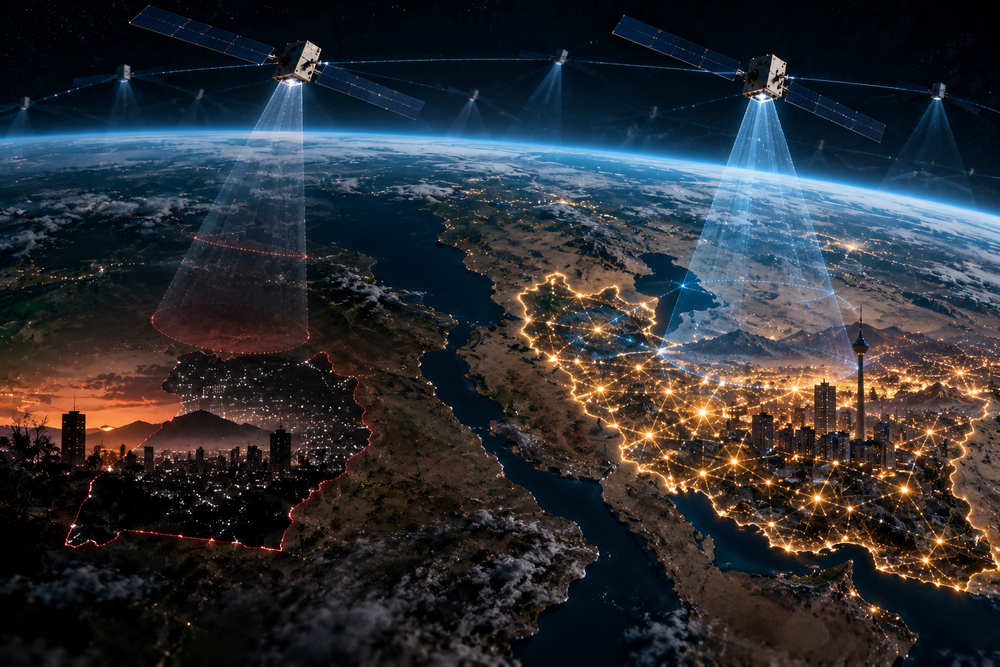
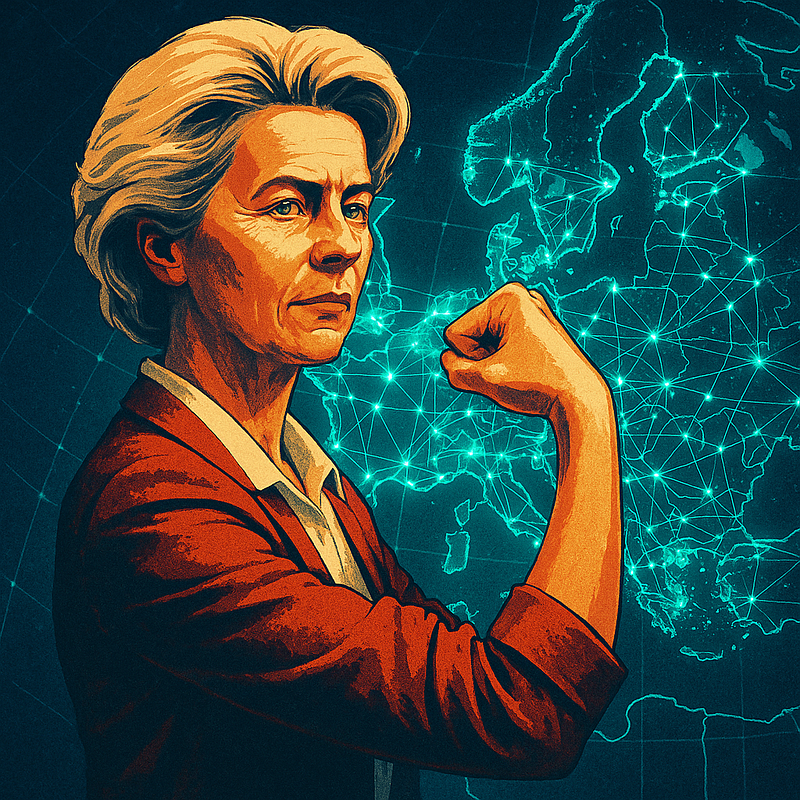
Picture one window still burning, and behind it a figure studying not a political map but a different kind of chart entirely. No borders, no flags, no capitals. A map of flows: energy currents, data streams, shipping corridors, procurement routes, pharmaceutical supply lines, digital identity networks. Europe rendered not as a collection of states but as a circulatory system, lines pulsing like veins, nodes blinking like nerve clusters. This is the correct image to hold while reading what follows, because it is the image that explains the power of Ursula von der Leyen better than any account of her speeches or her votes. Most Europeans cannot describe her victories. Fewer can recall voting for her. None did, in any direct sense. And yet her shadow falls across vaccine contracts, digital identity frameworks, energy realignments, military coordination, industrial policy, and crisis governance alike.
This is not the story of a woman who seized power. It is the story of a system that needed someone who understood how to move through it without friction, and of what that system became once it found her. The seizing-power story is the one we know how to tell, complete with a villain and a moment of capture, and it is the wrong story here, because nothing was seized and there was no moment. There was only a slow settling, the way water finds the lowest channel, until the channel looked like the only place the water had ever meant to go. The determining variable is not her ambition. It is a quiet relocation of power itself, from the place where votes are cast to the place where frameworks are written, and the whole point of this piece is to make that relocation visible, because it is the kind of change that is designed never to be seen happening.
The ascent that ran on deadlock
Her rise did not follow the usual trajectory of political ambition. There were no sweeping victories, no roaring crowds, no defining speeches lodged in public memory. It began, instead, precisely because nothing about her career suggested she was destined for the top.
In Berlin she was known less for vision than for entropy. As Germany's defence minister she had presided over a portfolio so beset by decay that some believed the ministry itself resisted her: aircraft grounded, ships immobilised, procurement tangled in consultants and contradictions, parliamentary inquiries circling her office. Her tenure was marked less by scandal than by a slow institutional running-down. But systems do not fear entropy in the way careers do. Where ordinary politicians falter, bureaucratic structures compensate; where reputations dim, procedural authority quietly expands to fill the space. She was not, in the end, hindered by her failures. In a specific structural sense she was freed by them, because a politician weakened at home becomes the ideal candidate for a supranational role: dependent on networks rather than a base, loyal to procedure rather than a programme, immune to national tribalism, fluent in the language of continuity.
The mechanics of 2019 confirm it. She was not a Spitzenkandidat under the Union's own lead-candidate system. She had not campaigned across member states. Her name surfaced only after the May elections produced weeks of deadlock and the official candidates each accumulated enough vetoes to be impossible. Europe did not choose von der Leyen. Europe ran out of everyone else, and discovered that the residue suited it. She was confirmed on 16 July 2019 by 383 votes to 327, nine above the threshold, thin enough to look accidental and firm enough to be irreversible. She entered the presidency without a mandate, a movement, or a constituency, and entered it carrying something the system valued more than any of those: a demonstrated willingness not to resist its pull.
There was a deeper fit, too. Her father, Ernst Albrecht, had been among the early senior officials of the Commission in the 1950s. She had grown up inside the grammar of supranational administration. She did not enter Brussels as an outsider to be absorbed. She returned to a native terrain, and the machinery recognised one of its own.
The pandemic pivot: power through tempo
Crises reveal the architecture beneath institutions. They expose what is hidden, accelerate what is latent, and elevate those who grasp that legitimacy in an emergency is granted not by law but by tempo. Von der Leyen entered the pandemic with no popular mandate. She left it as the most powerful unelected figure in modern European history, and the transformation came not through rhetoric but through velocity.
Governments hesitated. Committees debated. Parliaments froze in procedural amber. She moved, and the Union that had been mocked for decades as slow suddenly behaved like a single organism, taking in hours decisions that had once taken years. The Commission assumed centralised responsibility for vaccine procurement, an unprecedented concentration of health authority at the European level. And the way it did so is the tell. The contractual terms were classified. National parliaments were excluded from full oversight. The decisive negotiations ran through informal channels, including direct exchanges between von der Leyen and the chief executive of Pfizer, Albert Bourla, in 2021.
The largest pharmaceutical contract in European history began, in part, in a text conversation that the Commission would later say it could not produce. When a New York Times journalist requested those messages under transparency rules, the answer was that they had not been retained. The European Ombudsman found maladministration. And on 14 May 2025 the General Court of the European Union annulled the Commission's refusal of access, ruling that it had failed to plausibly explain why it did not hold the messages and had breached the Union's transparency law. The point here is not the scandal. It is the method made structural: authority exercised at continental scale through channels that leave the thinnest possible trail, in a venue where responsibility has twenty-seven directions to disperse and no single body positioned to gather it back.
From a certificate to a citizenship
It is easy to read the pandemic response as a one-off emergency. The more important reading is that it became a precedent, and the clearest proof is what grew out of it.
The EU Digital COVID Certificate was Europe's first universal digital identity instrument: more than fifty countries connected, over two billion certificates issued, a model copied around the world. It was presented, reasonably, as a health tool. But its real significance was that it normalised an act. Verification became routine, the routine became expected, the expected edged toward required, and a population learned, without quite noticing, to present a credential in order to move. The certificate was, in that sense, a civilisational test of whether a billion people would accept continental, interoperable verification of their status as a condition of ordinary life. Europe passed the test, and the architecture stayed after the emergency that justified it had gone.
It did not merely stay. It evolved, into eIDAS2 and the European Digital Identity Wallet, no longer framed as emergency but as convenience: your identity document, your driving licence, your health data, your educational records, your banking, your access, gathered into one interoperable system spanning the continent. Its supporters describe enhanced security and seamless services, and they are not wrong. Its critics warn of programmable rights, of a substrate on which permissions could one day be granted and revoked at scale, and they are not wrong either. Both are describing the same fact from different ends.
The word that does the work here is programmable, and it is worth being exact about what it means, because the exactness is the whole argument and the vagueness is where both the reassurance and the panic hide. A paper passport is dumb in the technical sense: it states a fact and cannot be made conditional. A credential in a digital wallet is, by design, a small piece of software, and software can carry conditions. It can be set to verify only within a date range, to be checked against a live registry at the moment of use, to resolve differently depending on what the verifying system is permitted to ask. None of that is misuse; it is simply what the technology is. But it means the difference between a right you hold and a permission you are granted has narrowed to a setting. The wallet was not built in order to control people. It was built in a way that makes control, should anyone ever want it, a matter of configuration rather than construction, and the gap between those two is the only thing standing between a convenience and an instrument. That is the quiet danger of infrastructure: it does not decide how it will be used, it only decides what becomes possible, and it tends to outlive every assurance given at its launch by the people who happened to be in charge when it was poured.
Picture the smallest version of it, because the smallest version is where the change is actually felt. A woman stands at a turnstile, a counter, a border, and holds up a phone. A code is read. Somewhere a system is asked a question about her and answers in a fraction of a second, and the gate opens, or it does not. She has done this a thousand times now and thinks nothing of it; the gesture has become as ordinary as showing a face. What she does not see, because it is designed not to be seen, is that the question being asked about her, and who is permitted to ask it, and what counts as an acceptable answer, are all set elsewhere, by no one she can name and no one she elected. The turnstile is the visible part. The architecture that decides what the turnstile does is the part that matters, and it is invisible by construction.
Making a continent legible
To understand why an identity layer is the centre of gravity rather than a side project, it helps to borrow an idea from the study of how states see. Power at scale depends on legibility: before a territory can be governed from above, it must first be made readable, its people counted, named, registered, rendered into categories an administrator can act on without leaving the office. The map of flows in the Berlaymont window is exactly that, a continent made readable, and an identity wallet is the instrument that completes the reading by attaching every individual to the grid.
This is not sinister in intent and that is precisely why it is powerful. Legibility is also genuinely useful; it is how pensions get paid, borders get crossed, and services reach the people entitled to them. But legibility is never neutral, because whoever defines the categories defines the reality the categories describe, and whoever controls the register controls the conditions of belonging to it. A person who exists on the grid can be served at the speed of software. A person who falls off it, whose document does not verify, whose status does not resolve, discovers that the same efficiency which served them can exclude them just as fast, and with the same air of impersonal correctness. The wallet does not announce this. It simply makes the continent readable enough that acting on the reading becomes a matter of configuration.
Von der Leyen's significance, in this frame, is not that she designed the reading. It is that she presided over the moment the reading became continental and the instrument to act on it became standard. The pandemic supplied the occasion; the architecture supplied the permanence. What began as a way to verify a vaccination became a way to verify a person, and a continent that can verify a person at scale has acquired a capability that no election created and no election can easily withdraw.
Markets become arsenals
War changes the geometry of institutions. Horizontal arrangements tilt vertical, debate compresses into tempo, and authority flows to whoever speaks first with conviction. Von der Leyen did not seek wartime leadership so much as fit its requirements when it arrived. When Russia invaded Ukraine she moved before ministers convened and before capitals fully aligned, and her voice became, for a period, the rhythm to which the Union marched.
Under that rhythm Europe's very identity shifted. A bloc that had defined itself for half a century as a market and a regulatory power began to describe itself in the vocabulary of security. Semiconductors became strategic assets, pipelines became critical infrastructure, supply chains became defence vectors. Regulation became strategy; the economy became, in the official framing, a theatre of confrontation. None of this was merely rhetorical. Joint procurement, ammunition acts, military mobility corridors, and strategic-autonomy frameworks gave the redefinition institutional form.
It is worth being careful and concrete here, because this is exactly the kind of claim that tips into overstatement if left loose. The European Union and NATO remain, legally and constitutionally, separate organisations with separate memberships and separate command. Nothing described here fuses them, and saying that it does would be false. What can be said, on the documented record, is narrower and still significant: the instruments the Commission built under the security framing, the joint defence procurement, the schemes to move troops and materiel across the continent more quickly, the industrial-capacity acts aimed at sustaining a war economy, operate in the same domain, toward the same ends, and increasingly on the same timetable as the alliance. The bloc did not become NATO. It tuned itself to NATO's frequency, in the sense that its economic and industrial machinery began to move in time with a military posture it does not formally control. That is a real and consequential alignment, and it was driven from an office that no European votes on, which is the only point this piece needs and the most it can honestly assert.
The sanctions that followed the invasion were unprecedented in speed and scale, and they reshaped Europe as much as their target: energy upheaval, industrial contraction, waves of inflation, fractured supply chains. These were not, in the main, failures. They were the consequences of acceleration without pause, and once the spiral had begun, reversal became structurally difficult, because each measure created dependencies and political commitments that the next measure assumed. Europe had entered a path it could extend far more easily than it could leave.
Path dependency is the dry name for it, and it deserves a moment, because it is the mechanism that converts a series of emergency choices into a permanent condition. Each sanction package was justified as a response to the moment, but each also built infrastructure, new supply routes, new industrial commitments, new bureaucracies of enforcement, that only made sense if the confrontation continued. To unwind one package late in the sequence was no longer to reverse a single decision; it was to strand everything that had been built on the assumption that the decision would hold. So the cost of stopping rose with every step, until stopping became, in practical terms, more disruptive than continuing. This is how a continent ends up locked into a posture no one ever chose as a destination: not through a decision to make it permanent, but through a sequence of reversible steps each of which quietly removed the option of taking it back. The acceleration that looked like decisiveness was also the closing of exits, and the figure who supplied the tempo was, in the same motion, the figure under whom the exits closed. When the Nord Stream pipelines were destroyed in September 2022, the response from Brussels was a calibrated quiet, an instinct that some questions are too structural to ask out loud, because asking them would disturb the alignment the moment required. Accountability gave way to adaptation, and the continent adjusted, as it always does.
The administrative crown
Some leaders rule through charisma, some through ideology. Von der Leyen rules through structure, and that is what makes her power so easy to underestimate and so hard to remove. Her authority is not emotional or performative. It is procedural gravity, the kind that governs the way a platform governs its users: not by issuing commands but by defining the parameters within which everyone else must move. Her influence lies less in what she says than in what the system becomes once she has spoken.
The clearest measure of this is what happens to her in moments that would end an ordinary political career. The vanished texts, the court ruling, the controversies that in a national system would force a resignation, reach her and slide off, not because she is uniquely protected as a person but because procedural gravity does not respond to scandal the way electoral gravity does. A leader who depends on popularity is vulnerable to losing it. A leader whose authority descends from the architecture is vulnerable only to the architecture changing, and the architecture has no reason to change something that is working for it. That is why she emerged from each storm not weaker but more firmly installed, and why 2024 returned her by a wider margin than 2019: the things that looked like wounds were, to the structure, irrelevant.
She is, in this sense, Europe's first genuinely post-political leader, the politician without a people. She has no electorate, no popular base, no national mandate, no mass movement, and more practical influence than any elected leader on the continent, because her power does not rise from below. It descends from the architecture. She negotiates not with voters but with frameworks, and she survives not through popularity but through continuity. The European top job has long been understood, by those who study it, as a kind of sovereignty by procedure, a crown without a coronation worn by whoever can navigate the machinery without breaking it. She wears it as a second skin, and the machinery, asked in July 2024 whether it wished to keep her, answered yes by a wider margin than in 2019: 401 votes to 284. The record had only lengthened in the intervening five years. The mandate grew anyway. A system does not return a figure more confidently the second time unless what it is selecting for is precisely the thing that figure supplies.
The network nobody voted for
Power of this kind does not reside in a person. It circulates through a network, and the network is not conspiratorial but infrastructural, which is why it is so much harder to see and so much harder to oppose. Consultancies, corporations, committees, alliances, digital ecosystems, regulatory engines: von der Leyen did not create this web. She became its most fluent operator, and fluency in a network is a more durable form of power than command of an organisation, because a network has no single point at which it can be voted out.
Consider the strategy-consulting firms whose templates shape European policy from inside, the McKinseys and the rest, which bring not ideology but frameworks, diagrams, and documents, and frameworks quietly determine what is thinkable. Consider the pharmaceutical orbit, in which executives drift in and out of advisory roles, regulators negotiate with those they regulate, and public-private task forces blur the line between the governed and the governing, until the industry is less an object of European governance than a component of it. Consider the consortium behind the digital identity wallet, the payment networks and cloud providers and biometric firms and interoperability councils that share no ideology but share an incentive: an identity layer that is portable, programmable, and routed through their systems. eIDAS2 is not merely a tool the Commission built; it is an ecosystem the Commission activated, and von der Leyen is its political face rather than its sole author. None of this is corruption in the ordinary sense. It is dependence, and dependence is more stable than corruption because it requires no wrongdoing to sustain it, only the ordinary operation of everyone's incentives at once.
Who writes the framework the deciders use
There is a layer beneath even the network, and it is the one most worth reaching, because it is where the real authority sits. Most analysis of power asks who decides. The harder question is who writes the framework within which the deciders decide, because the framework quietly fixes the answer before the decision is ever made. A minister who chooses between options does not control the menu of options; whoever drew up the menu has already done most of the governing, and has done it invisibly, because a menu does not look like a decision. It looks like reality.
This is the form of power von der Leyen's Commission most fully embodies. Its defining instrument is not the dramatic order but the framework, the regulation, the standard, the interoperability specification, the procurement template, the directive that defines the terms in which a whole sector must subsequently operate. These documents are written far from any election, often with heavy input from the consultancies and corporate bodies that will live under them, and once written they are nearly impossible to reverse, because reversing a standard means unwinding everything that has since been built on top of it. The vote, when it eventually arrives, is a vote on options the framework has already narrowed. The public argues about the dishes while someone else owns the kitchen.
It is tempting to call this a conspiracy, and it is important not to, because the conspiracy reading is both wrong and weaker than the truth. No secret meeting is required. The firms that shape the frameworks are simply the ones with the expertise and the proximity; the officials who adopt them are genuinely trying to govern complex systems they cannot master alone; the result emerges from everyone's ordinary incentives pulling the same way at once. That is what makes it durable. A conspiracy can be exposed and broken. An emergent alignment of incentives cannot, because there is nothing to expose, only a thousand reasonable decisions that add up to a continent whose terms of operation are written by people no one chose and felt by people who never saw them drafted.
The system that outlives its makers
Power built on popularity is fragile, and power built on ideology is cyclical. Power built on infrastructure is permanent, and that is the real legacy. Von der Leyen's lasting mark is not any single decision. It is the set of systems that now operate without her: crisis centralisation as a method, digitised citizenship as a default, regulatory sovereignty as a reflex, public-private governance as a norm, and the operational synchronisation of the Union with NATO. These are not policies that a future election can reverse. They are parameters within which future elections will be held.
This is the inversion that matters, and it should be stated without melodrama. The gravitational centre of European decision-making has drifted upward and inward: from health to health governance during the pandemic, from foreign policy to a single coordinating voice during the war, from energy markets to industrial-security policy during the shock, from migration to border-management systems, from the open internet to digital identity. Europe did not lose its democracy in any dramatic sense. It did something subtler and harder to contest. It outpaced it. Democracy does not lose its edge only when it is opposed; it loses it when the consequential decisions migrate to layers that move faster than any electoral cycle can follow, so that by the time a public forms a view, the framework has already set, the contract is already signed, the architecture is already poured.
And the figure best suited to that drift is not the visionary or the strongman. It is the custodian who governs through voids and intervals, whose power is strongest where she is least visible, who is replaceable as a person and irreplaceable as a function. The Commission can change its faces. What it has shown it cannot easily change is its trajectory, and a trajectory that survives the replacement of its occupant is no longer a matter of who governs. It is a matter of how the governing now works.
The strongest case for the defence
The objection to all of this is serious, and in its best form it is not a defence of von der Leyen but a defence of the choices Europe actually faced. It runs like this. The pandemic was a genuine emergency in which fragmented national procurement would have produced bidding wars, profound inequity between rich and poor member states, and deadly delay; centralisation was not a power grab but the only humane option, and it worked. The war was a genuine emergency in which European disunity would have emboldened aggression; a single coordinating voice was a strategic necessity, not a usurpation. Digital identity is a sensible modernisation that most citizens welcome for the convenience it brings, and treating it as a control grid is the paranoid reading of an ordinary administrative upgrade. On this account, the "relocation of power" described here is simply what competent governance looks like in an age of continental-scale problems that no single nation can address, and calling it post-democratic is to mistake effective coordination for a coup.
This objection has real force, and the honest response concedes a great deal of it. Centralised procurement probably did prevent a worse outcome in the pandemic. Unity probably did matter in the war. The digital wallet probably will be, for most people, mostly a convenience. If the claim of this piece were that these specific decisions were wrong, the objection would frequently win. But that is not the claim. The claim concerns what each emergency decision became after the emergency passed. The test is not whether acceleration was justified in the moment; it is whether the powers acquired under emergency framing were returned when the emergency ended, or retained as the new baseline. On the evidence, they were retained. The certificate became the wallet. The crisis procurement became a precedent for centralised authority. The wartime coordination hardened into permanent industrial-security structures. A power exercised once under genuine necessity and then quietly kept is no longer explained by the necessity. It is explained by the architecture's preference for keeping what it has gained, and that preference, not any single emergency, is the subject.
What would falsify the reading? If the emergency powers had visibly sunset, if the centralised competences had reverted to member states once the crises eased, if the digital identity framework had remained the narrow health tool it began as, then the claim of a one-way upward drift would collapse and the competent-coordination account would win. The mechanism predicts the opposite: that each competence gained in crisis will be retained in calm, and renamed as normal. Watch what is returned. The theory lives or dies on the ratchet.
The machine and the mirror
When historians look back, they may be tempted to read Ursula von der Leyen as an anomaly, a uniquely skilled operator who concentrated unusual power. That reading will be wrong, and the error matters, because it points the attention at the person when the story is about the structure. She is better understood as a forecast: the first fully post-political executive of a system drifting toward what can only be called infrastructural sovereignty, in which interoperability gradually replaces ideology, coordination replaces debate, credentials replace citizenship, architecture replaces policy, management replaces leadership, and momentum replaces the slow, frustrating, accountable work of democracy.
She did not cause that evolution. She revealed it, the way a strong current is revealed by the one swimmer who stops fighting it and simply moves with the flow. Europe had already begun transforming itself into a place where power is procedural, authority is increasingly algorithmic, identity is credentialed, sovereignty is distributed across networks, and legitimacy is supplied by continuity rather than consent. She was the figure fluent enough to move through that Europe without friction, and frictionlessness, in a system like this, is indistinguishable from rule.
There is a reason this is so hard to oppose, and naming it is the last necessary step. You cannot vote out a framework. You cannot hold a referendum on an interoperability standard. You cannot campaign against a procurement template, and by the time its effects are felt the standard has already been built into a thousand systems that now depend on it. The instruments of democratic correction, the vote, the campaign, the change of government, are all designed to operate on people and policies, on things that present themselves as choices. They have no purchase on architecture, which presents itself as plumbing. That mismatch is not von der Leyen's invention and it is not her fault. It is the condition she revealed, and the condition will persist long after her name has left the building, because the architecture she presided over was specifically the kind that outlives the people who occupy it.
Now that the architecture is at least partly visible, the question is not whether one election can reclaim it, because one election cannot reach the layer where it lives. The question is whether a continent that governs itself increasingly through frameworks still remembers that it was once supposed to govern itself through choice, and whether it can find a way to make the framework answer to the vote again before it forgets that the vote was ever supposed to be in charge. That is not a question about one woman at a window with a map. It is a question about whether democracy can learn to act on the layer where power has quietly gone to live, and the unsettling part of the answer is that it has not learned yet, and the architecture is not waiting for it to.
Evidence Map
Facts, interpretations, forecasts, and disconfirming signals.
Core claim. Under von der Leyen the consequential power in Europe relocated from electoral mandate to administrative architecture, frameworks, crisis-acceleration, digital-identity infrastructure, public-private networks, and EU-NATO operational synchronisation, so that she functions less as a chosen leader than as the fluent operator of a self-perpetuating system. The claim is about a structural drift, not a proven plan, and the test is the retention of emergency powers after the emergency.
Evidence level. Facts (high): nomination outside the Spitzenkandidat process and 2019 confirmation 383-327; 2024 re-election 401-284; centralised COVID procurement with classified terms; the von der Leyen-Bourla 2021 texts, the Ombudsman maladministration finding, and the General Court ruling of 14 May 2025; the EU Digital COVID Certificate and its evolution into eIDAS2 / the Digital Identity Wallet; unprecedented sanctions and the EU-NATO operational alignment; the legal distinctness of the EU and NATO. Interpretation (medium, marked): the reading of these as a one-way upward relocation of power and of von der Leyen as a "post-political function" is an analytical conclusion, not a documented intention.
What would confirm this. Emergency competences retained and renamed as normal after crises ease; the digital identity framework widening beyond its original purpose; trajectory persisting across changes of personnel.
What would disprove this. Emergency powers visibly sunsetting, competences reverting to member states in calm, the identity framework staying narrow. A genuine ratchet-reversal would defeat the upward-drift reading.
Watchlist. The scope creep or containment of eIDAS2; whether second-term centralisation is rolled back or extended; the durability of EU-NATO industrial structures in peacetime.
Jerry van der Laan writes The Manifest Archive, where he traces the structures beneath the headlines. He traces the structures beneath them.