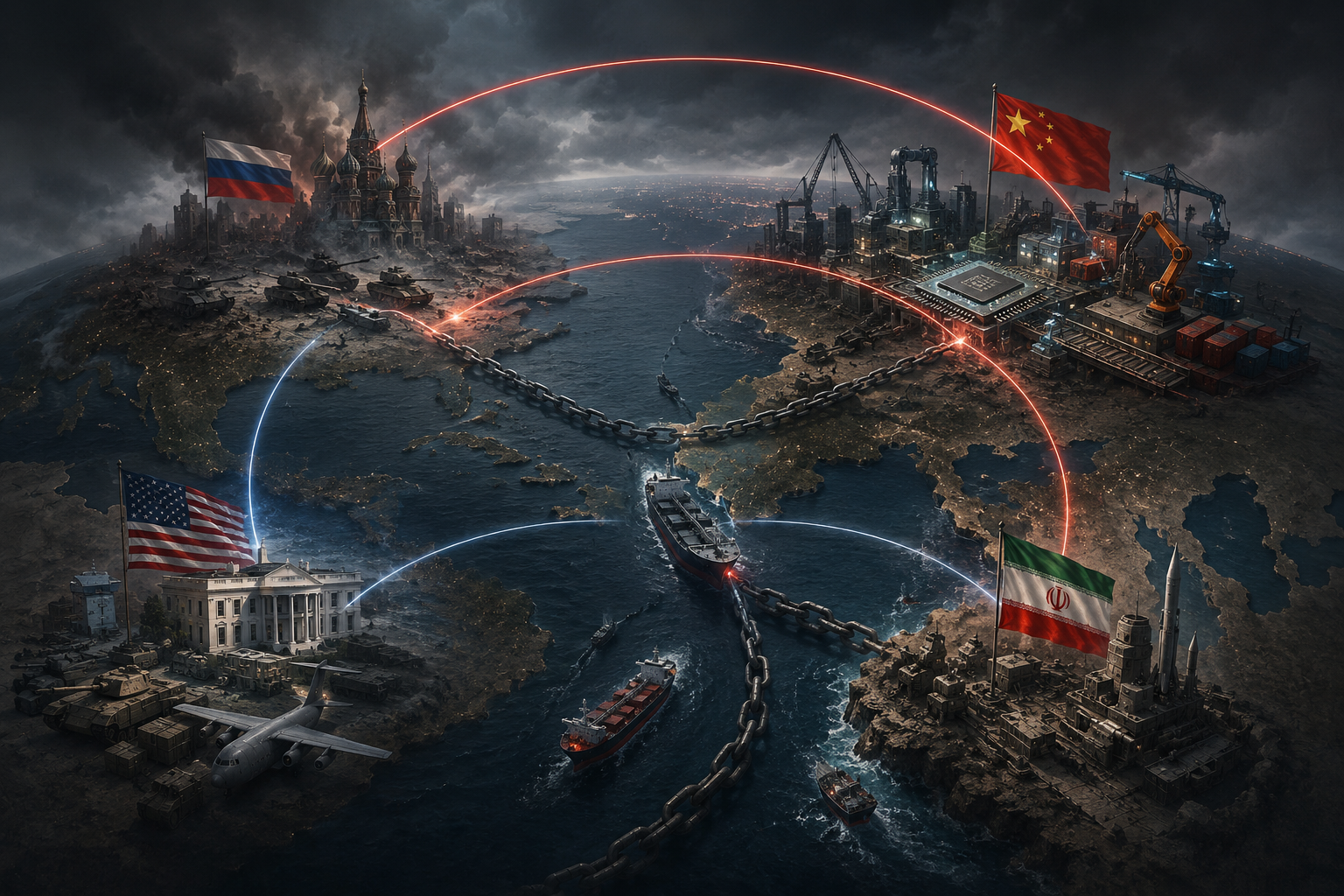
Russia can stop fighting only by risking regime instability and exposing the mobilisation narrative that has justified four years of sacrifice. China can reduce support only by risking the strategic division that has become advantageous to Beijing. America can abandon Ukraine only by repricing every security guarantee in Europe and Asia. Iran can close the Strait of Hormuz only as a renewable threat. The moment it is fully used, leverage converts into an existential military confrontation. Europe can escalate sanctions on China only by damaging the economic base required to sustain them.
This is not paralysis. This is not a conspiracy. This is what happens when each actor makes rational decisions in sequence, and each decision eliminates the alternatives available to the next actor.
The conflicts are not converging around a shared goal. They are converging around the progressive disappearance of alternatives. Strategic freedom has become the scarcest resource in geopolitics.
The Supply Lock: How Dependence Becomes Architecture
In February 2022, when Russia invaded Ukraine, Chinese exports of semiconductors and machine tools to Russia were marginal. By July 2026, they had become structural. This is not merely trade. This is the replacement of one economy's production capacity with another's.
By 2023, China accounted for 89 percent of Russia's imports across the high-priority product categories tracked by Western export-control authorities, including semiconductors, telecommunications equipment, and machine tools. That dependence has since become embedded in Russia's war economy. Machine tool exports increased tenfold: from $6.5 million monthly to $68 million monthly. These are the components required to sustain weapons production at the rate needed to offset Ukrainian losses and maintain territorial position.
The scale is instructive. Russia is not importing consumer goods. It is importing the means of production itself. A CNC machine tool is not a finished weapon. It is the apparatus that manufactures weapons. Without it, Russian production capacity collapses not incrementally but precipitously. The moment Chinese supply halts, Russian factories begin to stall within weeks. Ammunition production falls. Drone manufacturing halts. The ability to replace battle losses disappears.
Russia can reduce dependence on Chinese supply only by building domestic semiconductor and machine tool manufacturing -- a process requiring years, imported technology, specialised equipment, and capabilities that sanctions have made far harder to acquire at scale. This is not simply an economic problem. It is a technological transfer problem, a capital accumulation problem, and a time problem, all simultaneously. Russia cannot solve it under the conditions it faces.
But here is the asymmetry that creates the true lock-in: China is not locked into Russian victory. It is locked into preventing Russian failure without becoming responsible for Russian success.
A Russian military victory would provoke a more unified and mobilized Western response. NATO would militarize more comprehensively. American resources would concentrate on Europe rather than disperse across two theaters. This outcome damages China's strategic position.
A Russian military collapse would be equally costly. It would release Western strategic capacity from Europe and redirect it entirely to the Indo-Pacific. American attention would concentrate on Taiwan. Japanese security commitment would harden. The distraction that China requires would vanish.
Beijing's preferred position lies between these extremes: Russia must remain viable enough that the West cannot afford to ignore Europe, costly enough for the West to contain through Ukraine support, and sufficiently dependent that Chinese leverage over Russian behavior persists. Russia must not collapse. Russia must not win decisively. China must maintain the supply relationship. China must avoid becoming the visible owner of the war.
China is locked into maintaining supply, not out of loyalty but out of necessity.
This is the first lock-in: neither actor can reverse course without triggering consequences more severe than continuation. Russia cannot survive without Chinese components. China cannot afford to let Russia fail. Both are trapped by their own logic.
The Commitment Lock: How Weapons Build Institutions
The moment America committed military aid to Ukraine at scale, it created a second mechanism that operates by a different logic entirely. This lock-in is not about material dependence. It is about institutional reproduction.
Every weapon system delivered creates an ecosystem that must be trained, supplied, maintained, replaced, and politically defended. Every training mission conducted raises the expectation that support continues. Every public commitment restricts future politicians' ability to withdraw without appearing weak to allies and inviting opportunism from adversaries.
The lock-in is not the weapon already delivered. It is the institution built around keeping it operational. Training academies in Poland, the UK, and Germany now exist for Ukrainian troops. Maintenance facilities have been established. Supply chains have been built. Defense industrial production has been reorganized around Ukrainian requirements. Political careers have been staked on Ukrainian success. Congressional votes have been cast. European budget cycles have been disrupted. Military doctrines have been rewritten. Intelligence sharing has become permanent infrastructure.
By July 2026, NATO had committed at least 70 billion euros for 2026 and stated that equivalent levels would continue in 2027. This is not episodic aid. This is institutionalized commitment. The moment a government began to reduce that commitment, it would face not just military questions but political questions about its entire alliance posture.
America can reduce Ukraine support only by forcing every ally -- Poland, the Baltics, Romania, NATO -- to recalculate how long American commitments actually last. That recalculation would cascade. Japan, South Korea, the Philippines, Taiwan would all be forced to contemplate whether American security guarantees are truly binding or merely conditional on the absence of competing demands.
The commitment lock operates not through physical force but through institutional and political logic.
Europe faces a parallel trap. Having committed military, financial and political resources to Ukrainian survival, Europe can reduce that commitment only by accepting that the reputational damage will be measured in weakened deterrence, emboldened adversaries, and the need to rebuild military capacity from a position of reduced credibility. A European withdrawal would not simply end the war in Ukraine. It would restructure the entire European security architecture.
The Timing Lock: Why Acceleration Is Riskier Than Waiting
China cannot wait indefinitely to prepare Taiwan contingency operations. Every year that passes strengthens Taiwan's military, deepens American weapons integration, and hardens Japanese security commitment. Each year of delay means that a future invasion would face stronger defenses than today.
But China also cannot accelerate the timeline. A Taiwan invasion attempt while the West is fully focused on the Indo-Pacific would face concentrated American force -- carriers, Japanese air defense, Taiwanese defenses, and regional alliance structure, all coordinated, all prepared for precisely this contingency. The military calculation would be catastrophic for Beijing.
China's optimal position is therefore to keep American strategic capacity divided. Ukraine provides that division. As long as the war persists, American resources flow to Europe. As long as American resources flow to Europe, less strategic capacity can be concentrated in the Indo-Pacific. Budgets are zero-sum, military leadership bandwidth is finite, and strategic attention is the most scarce commodity.
But China cannot visibly own Russia's war or orchestrate its escalation. That would trigger direct confrontation with the United States. It would unify Western strategy. It would accelerate the very concentration on China that Beijing wishes to prevent.
China is thus locked into a paradox: it benefits from Ukraine persisting, but cannot be seen to be causing that persistence.
Time is not China's ally. It is not China's enemy. It is structurally ambiguous. Every year that passes is a year closer to capability, but also a year closer to meeting stronger defenses. This ambiguity creates the trap.
The Escalation Lock: The Weapon That Destroys Its Owner
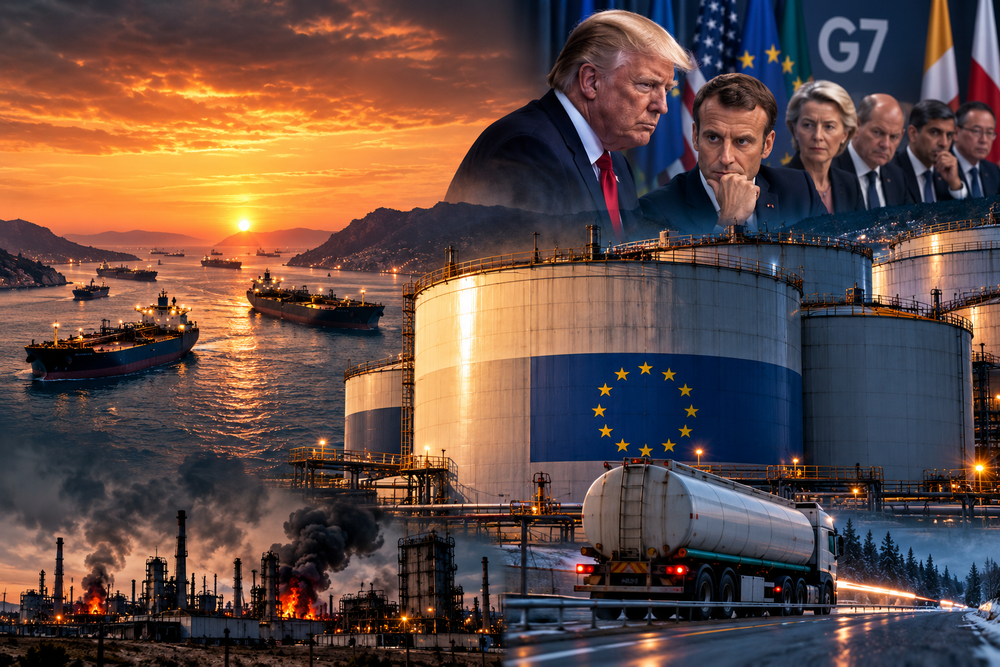
Iran can close the Strait of Hormuz only as a renewable threat. Full use would convert leverage into an existential military confrontation that could threaten the regime. This is Iran's central dilemma.
Approximately 20 percent of global oil trade and 25 percent of global liquefied natural gas pass through the Strait's narrow waters. An Iranian blockade would disrupt global energy markets. Oil prices would spike. Gas prices would spike. European manufacturing would contract. Economic pressure would mount on every actor in the system.
But Iran cannot stand down either. To withdraw the blockade threat is to lose the one instrument capable of imposing immediate global costs disproportionate to its conventional power. Without the Hormuz card, Iran becomes strategically marginal.
Iran is therefore locked into maintaining perpetual threat without crossing the threshold that would trigger response. Every escalation must stop just short of the point where the West has no choice but to act. Every de-escalation must preserve the credibility that Iran can escalate if necessary.
The value of the weapon increases only as long as it is not used.
The moment Iran uses the weapon fully, it converts a renewable threat into an existential military confrontation. The regime faces direct retaliation. So Iran is locked into the paradox of the perfect weapon: its disproportionate value depends entirely on maintaining the threat without using it.
The Cross-Theater Lock: How Choices in One Theater Reprice Choices in All Others
This is where the system begins to reproduce itself.
When Ukraine becomes harder to support due to energy costs, Europe's appetite for Chinese sanctions declines. Europe cannot afford simultaneous security burdens: military commitment to Ukraine plus economic conflict with China. It must choose. It chooses Ukraine. This means it cannot confront China on semiconductors or machine tools, which means Chinese supply to Russia continues unimpeded.
When American resources remain committed to Europe, Taiwan's defense must accelerate independently. Taiwan cannot wait for American concentration. Taiwan must assume that American military capacity will arrive late or at reduced strength. This acceleration itself sends a signal that accelerates Chinese planning, which tightens the Taiwan timeline.
When Taiwan's defense accelerates, the strategic value to China of keeping Western capacity divided increases. So China's interest in maintaining Russian supply, which sustains that division, persists.
Each theater makes the others less escapable.
Ukraine does not merely consume weapons. It changes the cost of defending Taiwan by absorbing the resources that would otherwise concentrate there. Taiwan does not merely occupy Chinese planning. It changes the value of keeping Russia viable by requiring American attention to remain divided. Hormuz does not merely threaten energy flows. It changes the domestic price Europe pays for sustaining Ukraine through the prospect of inflation and manufacturing contraction.
This is constraint transmission: a decision in one theater produces costs that migrate into another theater, where they reshape what actors consider rational. The transmission is not visible as a conspiracy. It operates through the mathematics of scarcity. Spend bandwidth on one crisis, and you have less for another. That arithmetic is what converts three separate wars into one system.
The conflicts are not one war. They are one constraint transmission system. A choice that seems locally rational propagates constraints into other theaters where other actors must adapt to costs they did not create. No actor can improve its position in one theater without transmitting constraints into another.
The Steelman: Is This Really One System?
The strongest objection is not about coordination. It is about whether the connections are real or retrospectively constructed.
Three geopolitical confrontations unfold simultaneously. Each imposes costs. Do those costs genuinely create a unified system, or does this analysis simply place three separate crises in one frame? A cross-theater lock exists only when four conditions are present: a decision in one theater changes the cost structure in another; actors anticipate that change; their response reinforces the original theater; and the transmission persists without central coordination. Without transmission, there is no system -- only simultaneity.
Ukraine's cost to America's Indo-Pacific capacity is not hypothetical. The broader US Ukraine response had received more than $180 billion in appropriations by the end of 2024, spanning direct assistance, stock replenishment, and related support. The NATO commitment of 70 billion euros for 2026 demonstrates the scale and institutional character of the commitment. That attention and budget could have been concentrated elsewhere.
Taiwan's timeline is not independent of Ukraine. American defense planning explicitly considers two-theater scenarios. American concentration in the Indo-Pacific can only proceed by shifting a larger share of Europe's burden onto European allies. That redistribution is itself evidence of the constraint: concentration in one theater requires institutional substitution in another.
China's strategy is not detached from Ukraine's duration. Beijing sustains the industrial supply categories Russia requires while avoiding the overt military ownership that could consolidate Western retaliation. Hormuz is not isolated from Europe's energy calculus. European energy prices affect the economic and electoral conditions under which long-term Ukraine support must be sustained.
The reading offered here does not claim that actors designed this system or prefer it. It claims something narrower: each actor, pursuing rational self-interest, transmits constraints into other theaters where other actors must adapt to costs they did not create. The system is one not because anyone designed it, but because each actor's rational self-interest now flows in a direction that reinforces the others' constraints. The connections are material, not constructed.
How the System Reproduces Itself
Russia continues because stopping would mean military collapse. China continues because stopping would release Western strategic capacity to concentrate on Taiwan. America continues because stopping would transmit a signal of unreliability to every ally in the world. Iran continues threatening the Strait because stopping would transmit irrelevance. Europe continues because stopping would transmit weakness into NATO's deterrence posture.
None of these actors coordinated this outcome. None of them chose this system. But each actor, behaving rationally according to its own interests, transmits constraints into other theaters where other actors must respond. Each response reinforces the original constraint.
The system enforces itself because the moment any actor tries to break free, the constraints they encounter are more severe than the cost of staying locked in.
What makes this system durable is not merely the decisions of individual actors. It is the institutional infrastructure that has grown up around those decisions. Defense industries in Poland, the UK, and Germany have retooled production for Ukrainian compatibility. Chinese manufacturers have developed specialized production lines for Russian needs. These institutions now have their own incentive to perpetuate the arrangement. Reversal would require dismantling architecture that has become profitable.
The documented supply dependencies and commitment figures establish conditions, not the system itself. The claim that these constitute a unified constraint transmission system is a structural hypothesis: it would require revision if a major actor successfully exited its constraint without generating observable costs in the connected theaters, and if that pattern repeated across multiple actors.
What It Would Take to Break the System
No single decision can dissolve the lock-in. A shock large enough to break it would have to be structural, not marginal.
If Russia achieved decisive military victory in Ukraine, the constraint would shift but not dissolve. European alarm would spike. NATO would militarize more comprehensively. But the fundamental dilemma would remain: American capacity is finite. Attention is finite. The choices would be reordered, not expanded.
If Taiwan fell to Chinese invasion, the constraint would reconfigure around India and the South China Sea. The lock-in would not vanish. It would relocate.
If the Strait of Hormuz closed permanently, the constraint would intensify through energy crisis and recession. Political pressure would mount on governments to end the commitments consuming resources. But the fundamental pressure would persist: actors still cannot simply choose. They can only choose which cost to accept.
The only genuine exits are catastrophic: a collapse so severe that the system cannot reproduce itself, or a breakthrough so sudden that the constraint structure becomes irrelevant. These are shocks, not policies. Policies work within the constraint. Shocks are survivable at best.
The Last Word
At what point do states stop choosing within this system and begin reproducing it through every choice they make? That point has arrived.
Russia still has options. It can negotiate, accept ceasefire, trade territory for stability. But each option carries the cost of exposing the mobilization narrative as fiction. So Russia continues.
America still has options. It can reduce Ukraine support, concentrate on Taiwan. But each option reprices the credibility on which every other commitment rests. So America continues.
China still has options. It can accelerate Taiwan preparation, cut off Russian supply. But each option triggers cascades through the other theaters. So China maintains its current path.
The system does not lock actors through coercion. It locks them through the structure of their own choices. Every previous decision has made the next one more expensive. The wars are no longer resolving the conflicts that produced them. They are narrowing the range of futures still available.
No state designed this system. No state controls it. Yet every state now reproduces it through the choices it makes.
The defining characteristic of modern geopolitical constraint is not that states lack choices. It is that every strategically important choice now comes with costs that return through different theaters. Pull one lever, and something else moves that you did not intend to move.
This is not a prison. It is more precise to say it is an architecture. Prisons are built to hold people against their will. This system is built from the decisions of actors pursuing their own interests. The prisoners built it themselves.
Choice has not disappeared. Independent choice has.
Evidence Map
Core claim. Five geopolitical actors (Russia, China, America, Europe, Iran) have entered a constraint system in which each actor's rational choices transmit costs into other theaters, eliminating alternatives for other actors and reproducing the system without central coordination.
Observed conditions (high confidence, directly documented). China accounted for 89 percent of Russia's imports across high-priority export-control categories (Carnegie Endowment, 2024). Chinese CNC machine tool exports to Russia increased from $6.5 million monthly to $68 million monthly since February 2022. NATO committed minimum 70 billion euros for Ukraine support in 2026. US Ukraine-related appropriations exceeded $180 billion by end of 2024 (Congressional Research Service). Western intelligence services acknowledge Iran-Houthi liaison channels. Houthi operations displaced Red Sea commercial traffic to Cape of Good Hope routing.
Documented structural dependencies (medium-high confidence). Russian weapons production rate depends on Chinese CNC machine tool supply for ammunition and drone manufacturing. American alliance credibility with Japan, South Korea, and Taiwan depends on sustained Ukraine commitment. European security architecture depends on American commitment remaining operational. China's optimal Taiwan timeline depends on American strategic attention remaining divided between theaters.
Analytical inferences (medium confidence). The four individual lock-ins interact to create a unified constraint transmission system rather than four independent crises. Institutional infrastructure -- training academies, retooled production lines, retooled supply chains -- has added inertia that makes policy reversal more expensive than continuation. Each actor's attempt to break the system in their theater transmits costs into other theaters, making the system self-reinforcing without requiring coordination.
What would confirm this. Observable cross-theater behavioral adjustment when one theater changes -- measured reduction in US Indo-Pacific force deployment following Ukraine escalation peaks. Chinese reduction of Russian supply correlated with documented Indo-Pacific capability gap. European sanctions relaxation on China correlated with measured increase in Ukraine support costs.
What would disprove this. A successful exit by one actor from their constraint without observable cost increase in other theaters. China cutting Russian supply without measurable deterioration in Chinese Indo-Pacific deterrence capacity. American Ukraine withdrawal without documented recalibration announcements from Japan, South Korea, or Taiwan. Statistical demonstration that cross-theater cost correlations are timing coincidences rather than causal transmission.
Watchlist. Monthly Chinese machine tool export data to Russia (CSIS, Silverado Policy Accelerator). NATO 2027 commitment levels, to be announced Q4 2026. Taiwan defense budget trajectory and US weapons delivery schedule. Iran Hormuz signaling cadence relative to diplomatic contact windows. European energy price index correlation with Ukraine support approval ratings.
The deadlock documented here has structural predecessors and real-time parallels. Everyone Is Watching the Iran War. Nobody Sees Why It Cannot End. maps the four mechanisms producing the Iranian stalemate — the same structural logic operating at the level of one theater. Epic Fury Ended May 5. Hormuz Was Still Closed May 6. establishes what the military operation could touch and what the escalation lock structurally prevented it from resolving.
The Iran War Has No Off Switch tracks the IEA buffer arithmetic and the specific timeline in which the cross-theater energy constraint becomes irreversible. Angela Merkel Helped Broker a Peace Agreement in 2015. In December 2022, She Said It Was Never Designed to Bring Peace. is the commitment lock's historical precedent: a diplomatic framework built to outlast its stated purpose.
The structural logic of a system that reproduces without central direction has an earlier institutional iteration. David Rockefeller's Architecture of Private Policy documents a coordination architecture that persisted across administrations because each actor within it had rational incentives to maintain their position — not through conspiracy, but through institutional logic that made continuation cheaper than reversal.
Jerry writes The Manifest Archive, forensic analysis of the institutional structures that shape geopolitics, history, and power. Published at themanifestarchive.com.