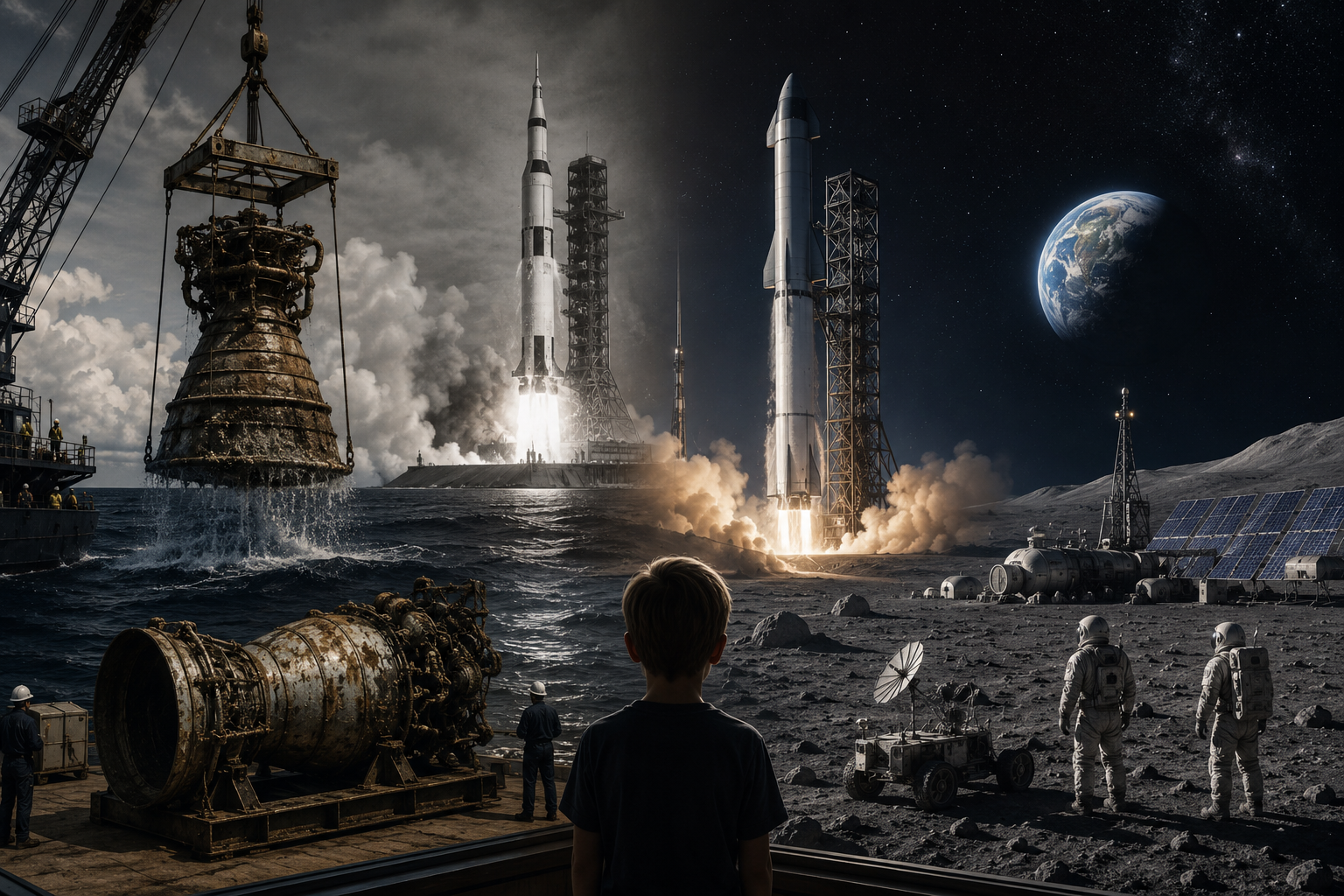
In December 1972, a geologist named Harrison Schmitt climbed a ladder up the side of a lunar module, pulled himself inside, and closed the hatch. No human being has stood on the Moon since. He was the last man down the ladder and the last man up it, the only trained scientist ever to walk there, and when the engine lit and lifted him off the surface he became, without anyone deciding it, the end of something. He is still alive. Remember him; we will come back to him, because the story bends around to where he is now, and where he is now explains the whole thing.
Forty years after Schmitt left, in the spring of 2013, a fleet of robots descended four thousand metres into the black of the Atlantic and began lifting pieces of the most powerful machine human beings have ever built. They were the F-1 engines of a Saturn V, the first stage that had thrown Apollo crews toward the Moon and then fallen back into the sea. The expedition was privately funded, by Jeff Bezos. The engines came up corroded and scarred, serial numbers still legible under the rust, and they were sent to museums. The centrepiece today is an engine from Apollo 12, displayed exactly as the ocean returned it.
Sit with what that scene actually is, because it is the whole story in one image. The single most capable rocket ever flown was recoverable from the seabed as a relic, and not reproducible on land as a machine. We could raise the engine. We could not build it. In the decades after Apollo, NASA and outside experts said it plainly: recreating a Saturn V today would be almost impossible, not because the physics is beyond us but because the factories are gone, the tooling was scrapped, the suppliers dissolved, the engineers retired, and nobody now alive fully understands how the real vehicle differed from the drawings. The blueprints survived. The capability did not.
So when you hear that we are "going back to the Moon," set that scene beside it. We are not picking up where we left off. We left the engines on the seabed and the tooling in the breakers' yard, and we are now trying to build, from almost nothing, the ability to do again what we last did in 1972. The question worth asking is not whether we can return. We went, once, with slide rules. The question is why returning is so much harder than going the first time, and what, this time, is actually pulling us back.
We did not lose the Moon. We stopped paying for it.
There is a comfortable myth that the Apollo capability was somehow lost, as if a civilisation could misplace the Moon the way a person misplaces a key. It is worth dismantling, because the truth is less mysterious and more damning.
The ambition never left. Every American president after Apollo proposed a return. In 1989, on the twentieth anniversary of Apollo 11, George H. W. Bush stood at the National Air and Space Museum and announced the Space Exploration Initiative: back to the Moon, this time to stay, then on to Mars. NASA priced it in what became known as the Ninety-Day Study, and the number came back near five hundred billion dollars, spread across two or three decades. The reaction in Washington was not debate but recoil. Congress refused to fund it, and the initiative was quietly ended by the next administration in favour of cheaper things. The figure itself was the whole message. It said that going back would cost something close to what going the first time had cost, and that nobody could any longer name a reason worth that price. In 2004 George W. Bush tried again, with the Vision for Space Exploration and the Constellation programme, built explicitly to rebuild the capability to reach the Moon. Independent reviewers judged its costs and schedule unreal, Congress never funded it fully, and in 2010 it was cancelled.
Read those two failures together and the pattern is unmistakable. The ambition was continuous. It was declared, costed, and killed, declared again, costed again, and killed again, every time on the same ground: the price. We did not forget how to go. We were told, repeatedly, what it would cost to go, and repeatedly we decided not to pay.
That decision looks stranger until you remember what going once had cost. At its peak, in 1966, NASA consumed 4.41 percent of the entire federal budget, a share no agency outside the military has approached before or since. Apollo was not expensive the way a programme is expensive. It was expensive the way a war is expensive. And a country will fund a war only as long as it believes it is fighting one.
A demonstration has no reason to last.
Here is the part the myth hides. The reason no one would pay again is that Apollo was never built to last. It was built to win.
And notice what "going" even meant the first time, because the word "return" quietly hides it. Apollo never established a presence on the Moon. It visited, six times across three and a half years, and the entire human history of standing on another world adds up to roughly three days of boots on the surface, divided among twelve men, none of whom stayed longer than about seventy-five hours. Then it stopped, and no one has been back since 1972. That was never a foothold being held. It was a sprint, run to its finish line and walked away from. So "returning to the Moon" is the wrong picture in the first place. We are not going back to something we kept. We are trying, for the first time, to do the thing Apollo deliberately skipped: not to visit, but to stay. And staying is a different order of problem, because a visit needs only a reason to go, while a presence needs a reason to remain.
Apollo was a demonstration, a Cold War argument made in metal: that a free society could out-engineer a closed one, that the United States could reach the Moon before the Soviet Union. It worked. The point was made on live television to the largest audience in human history, and once a point is made, repeating it is merely expensive. The moment the political reason dissolved, so did the will to maintain the apparatus. The factories were repurposed, the tooling sold for scrap, the workforce dispersed into other industries. None of this was an accident or a tragedy. It was the rational fate of a machine built to prove something rather than to do something.
This had a human face, and it is worth seeing it, because "a dispersed workforce" is an abstraction and what happened was not. As Apollo wound down, the aerospace towns emptied. Tens of thousands of engineers and technicians around Cape Canaveral and across the country were let go within a few years. Around Seattle, where Boeing was cutting its own workforce savagely in the same period, two real-estate agents rented a billboard near the airport that read: "Will the last person leaving SEATTLE turn out the lights." The men and women who knew how to build a Saturn V did not deposit their knowledge in a vault on the way out the door. They went and did other things, and grew old, and the specific, unwritten understanding of how the most powerful machine ever made actually behaved left the world with them, one retirement at a time. A capability is not a document. It is a population, and populations disperse.
And this is the part that should change how you read the whole story. The capability did not die because the knowledge was lost. The knowledge was lost because the capability had no reason to live. A skill a civilisation stops using is not filed away intact, waiting to be reopened. It decays in a specific and irreversible way, because most of what makes an industry work is not written down. It lives in the hands of the machinist who knows how the alloy behaves when it is cut, in the supervisor who remembers why a tolerance was changed in 1967, in the supplier three states away who made one obscure valve and no longer exists.
You can keep the drawings. You cannot keep the tacit knowledge, and the tacit knowledge is most of the machine. That is why the F-1 engine could be raised from the sea but not reproduced on the land. We had the relic and had lost the recipe.
The proof of this is not rhetorical, and it is worth standing inside it for a moment. When NASA began designing its new heavy rocket in the 2010s, a team of young engineers at the Marshall Space Flight Center did something that should not have been necessary. They went to the surviving F-1 engines, the museum pieces and the parts hauled from the sea, and took one apart to learn how it worked. They lifted out its gas generator, the component that had driven the turbopump, carried it to a test stand, wired it with instruments their predecessors never had, and lit it. Grown engineers stood and watched a piece of hardware built by hands now dead roar back to life, recording with modern sensors what the original builders had known in their fingers and never fully written down. When they needed parts the drawings no longer fully described, they did not remake the old ones; they printed them with a digital technique that did not exist in 1969. A space agency had to reverse-engineer its own most powerful machine, in a room, from a relic, because the knowledge had not been filed anywhere. It had lived in people, and the people were gone. That is what a lapsed capability looks like from the inside. Not a locked door, but a language with no living speakers.
This yields a law that reaches far past rockets, and it is worth stating cleanly, because the rest of this depends on it. A capability built to be demonstrated will not survive the reason it was demonstrated. Only a capability built to be used persists.
What changed was not the rocket.
If the obstacle were technological, the fifty-year gap would be inexplicable, because the technology to reach the Moon existed in 1969 and has only improved since. The obstacle was never the rocket. It was the price, and the absence of a reason to pay it. So the honest question about the current return is not what we finally invented. It is what finally made the price bearable.
Two things did, and neither is a Moon rocket. The first is the collapse of the cost of leaving Earth. By NASA's own later accounting, the Saturn V put mass into orbit at roughly five thousand four hundred dollars a kilogram, and the Space Shuttle, sold as the reusable future, turned out to cost around fifty-four thousand a kilogram, ten times worse. Then reusable boosters arrived, and a Falcon 9 now delivers to low orbit at under three thousand a kilogram by most estimates, a reduction of ninety percent or more from the Shuttle, with the next vehicle aiming, at least on paper, at a few hundred. The mechanism behind the fall is mundane and decisive. For sixty years a rocket was thrown away after a single flight, the equivalent of scrapping an airliner at the end of its first journey, and the moment a booster could land itself and fly again, the largest single cost in spaceflight began to collapse. That is not a better Moon rocket. It is a cheaper road to orbit, and a cheaper road is what turns an unaffordable destination into a thinkable one.
The second is a new reason to go, which is the subject of everything that follows. Because a cheaper road only matters if there is a reason to travel it, and the reason determines whether anything built at the far end will last. This is the hinge of the whole question. The fifty-year gap was not a technology gap. It was a motive gap, and the motive has returned in a form that is worth examining very closely, because it decides whether this time we stay.
The motive is the variable.
When a state explains why it is returning to the Moon, it reaches for the Apollo vocabulary: exploration, science, inspiration, the human urge to push the frontier. Treat that vocabulary with suspicion, not because it is insincere but because it is exactly the kind of reason that did not last the first time. Inspiration built the relics now resting in museums. If inspiration were a durable motive, the engines would not have spent forty years on the seabed.
So set the stated reasons aside and look for the load-bearing one, the motive that actually moves money and sets deadlines. Three candidates present themselves, and the discipline is to weigh them honestly, including the unglamorous possibility that one of them is not a motive at all.
The first is the race with China, and it sets the clock. Beijing has committed to landing astronauts on the Moon by around 2030, is sending its Chang'e 7 and Chang'e 8 probes to prospect the south pole for ice, and intends, with Russia and a dozen other partners, to begin building a permanent base there from 2031. The American urgency is openly framed against this: do not let China arrive first and set the terms. This is real, and it explains the timing. But it is, by its nature, a disposable motive. A race ends. One side wins, or both lose interest, and when the rivalry cools the reason to maintain the apparatus cools with it, exactly as it did when the first race was won. A motive that is a race is a motive with a built-in expiry date.
The second is not a motive at all, and saying so plainly is what separates analysis from suspicion. A great deal of the programme persists because it is an industrial and political organism that feeds a base. The contracts flow to a handful of giant firms. The jobs are spread, deliberately, across as many congressional districts as possible. The flagship rocket at the centre of it costs billions per launch and flies rarely, and has proved nearly impossible to cancel for exactly that reason: the spending is the point, because the spending is distributed where it buys votes. That keeps the machine running, year after year, regardless of whether anyone is going anywhere. But it is inertia, not intention. It explains why a programme refuses to die. It cannot explain why it would ever land a human being on another world. An organism that exists to sustain itself will happily sustain itself in low Earth orbit forever.
Which leaves the third, the only candidate that points to a capability built to be used rather than shown. And it has been hiding in plain sight, behind a question almost no one asks: what, specifically, is up there worth the journey.
There is almost nothing on the Moon worth bringing home.
Ask what the Moon is for, and the popular answer is a vault of riches: rare metals, fusion fuel, a new gold rush. The forensic answer is colder, and it is the part that is almost never said out loud. For nearly everything the Moon contains, there is no economic case for bringing it back to Earth at all.
The Moon does hold real materials. Its KREEP terrains are enriched in rare-earth elements, thorium, and phosphorus. Its soil is heavy with titanium and aluminium. But the consensus among the people who actually model this is blunt: it is hard to name a single lunar resource valuable enough, by itself, to justify the cost of extraction and return. The reason is freight. Lifting and landing and returning mass across that distance imposes a cost measured in many thousands of dollars per kilogram, and almost nothing survives that math. Even platinum does not clear it; if you wanted platinum-group metals, you would mine an asteroid, not climb in and out of the Moon's gravity well to fetch them.
So the prize was never a substance you carry home. It is a position. The genuinely scarce thing at the lunar south pole is a few square kilometres of specific ground: the permanently shadowed crater floors that hold water ice, and beside them the so-called peaks of eternal light, ridges so positioned that the sun almost never sets on them. Two points along a single ridge near Shackleton crater are lit, between them, about ninety-four percent of the lunar year. Continuous power next to accessible ice, in a place where almost everywhere else swings through two weeks of darkness and lethal cold, is the only real estate on the Moon that matters, and there is very little of it. The race is not for the Moon. It is for a handful of ridgelines, and for the right to write the rules of who may own them, a right two rival rulebooks are already contesting, the American-led Artemis Accords on one side and the China-Russia lunar station on the other.
It is worth seeing what that contest is actually about, because it is stranger than a land grab. The Outer Space Treaty of 1967 forbids any nation from claiming sovereignty over the Moon; no border can be drawn there. But the Artemis Accords, now signed by more than sixty countries, introduce the idea of "safety zones" around operations, areas that others are asked to keep clear of. A safety zone is not ownership in name. A perimeter you control around a resource you are using is ownership in everything but the word.
China and Russia, building their rival base, are advancing their own version of the same manoeuvre. So the true prize at the south pole is neither the ice nor the light. It is the precedent. Whoever stands first on the few ridges that matter gets to define what "use" means and what a "safety zone" may quietly enclose, and that definition becomes the working property law of everything beyond Earth for the century that follows. The Moon is where the rules of off-world ownership are being written, and they are being written not on paper but by the act of arriving.
That is the steelman of the sceptical view, and it is strong: the Moon is a place to plant a flag and a legal claim, not a place to get rich. If that were the whole truth, the current return would be Apollo again, a demonstration with a longer lease, and the law above would predict its eventual decay. But it is not quite the whole truth. There is one exception, and the identity of its first buyers tells you what is really happening.
The exception, and the buyer is the Air Force.
There is exactly one material on the Moon for which a real, paying market to bring it back to Earth already exists. It is not a metal and not fusion fuel. It is an isotope of helium, helium-3, and the demand has nothing to do with the energy fantasies usually attached to it.
Helium-3 is vanishingly rare on Earth, a fraction of a part per million of all helium. The reason is grim and specific: almost all of it is a decay product of tritium, the heavy hydrogen used to boost the yield of nuclear warheads. The United States largely stopped producing tritium in 1988, and as the existing stockpile decayed, the helium-3 supply began to run dry. By 2008 the shortage was a recognised crisis, with annual demand far outpacing what the government could supply, because helium-3 is also the best material for the neutron detectors that scan for smuggled plutonium at borders and ports. The fuel of the bomb, decaying into the gas that detects the bomb, running short because the bombs stopped being made.
Now a second demand has arrived, and it is the one that changes the calculation. Quantum computers must be cooled to within a hair of absolute zero to hold their fragile states, and the machines that reach those temperatures, dilution refrigerators, run on helium-3. As the industry scales, its appetite for the isotope threatens to outrun anything Earth can supply. One precision matters here, because the error would unravel everything: this is not the water-cooling problem of ordinary AI data centres. Removing heat from hot processors and reaching near absolute zero are different problems in different physics. What the Moon offers is not a fix for the heat of today's computing, but a supply of the scarce coolant the next computing frontier runs on.
And the proof that this is taken seriously is in the order book. A startup called Interlune has been founded for the single purpose of mining helium-3 on the Moon and returning it to Earth, where it now trades around twenty million dollars a kilogram. The company reports nearly half a billion dollars in binding purchase orders already signed. Its customers are quantum-computing firms and, tellingly, the United States Department of Energy and the Department of the Air Force.
Note who built this company. It was founded by the former president and the former chief architect of Blue Origin, and its executive chairman is Harrison Schmitt, the geologist who closed the hatch in 1972 and has argued since 1986 that helium-3 was the reason to go back that no one had priced. The last man off the Moon is now selling the one motive that might bring people back to stay. That is the signature of a motive built to be used, not shown. When the Air Force is a named buyer of a substance before the supply chain to deliver it exists, the Moon has stopped being a place to demonstrate national greatness and become a place to source a strategic input.
And the reason a defence ministry, specifically, is a buyer reaches past cooling. Quantum computing is itself treated as a strategic technology, the machine that may one day break the encryption the world's secrets rest on, and helium-3 is one of its physical inputs. A government buying it is not buying a coolant. It is buying a position in a race it believes it cannot afford to lose, the same logic that built the bomb whose decaying fuel is now the supply. This is the first reason on the list with the structure of an infrastructure rather than a demonstration. It need not be the only thing a lasting presence could ever rest on, and it may yet prove disposable like the others. But it is the first plausible economic candidate to appear in fifty years, and that alone is what separates this return from the ones before it.
The state that won the Moon now rents the ride.
There is a final turn, and it changes who is actually deciding whether America returns. The country that reached the Moon in 1969 with its own rocket, built in its own government-directed factories, cannot reach it now without a private company.
In the current architecture, NASA keeps the parts that resemble the old model. It owns the heavy rocket and the crew capsule that carry astronauts to lunar orbit. But the vehicle that actually descends to the surface, the one that touches the Moon, is private. The lander for the first crewed Artemis landings is a version of SpaceX's Starship; the lander for the mission after that belongs to Blue Origin. Which means the question of when, or whether, American astronauts stand on the Moon again no longer turns on NASA's budget or will. It turns on a private engineering milestone: whether SpaceX can demonstrate the transfer of propellant between two Starships in orbit, a test that has already slipped a full year and, as of early 2026, had not been done. You can watch the consequence in the schedule. In February 2026, NASA redesignated the next crewed flight, Artemis III, from a Moon landing into a demonstration in low Earth orbit, where the crew would rendezvous with the landers rather than ride one down, and pushed the first crewed landing to the mission after it, Artemis IV, targeted for around early 2028. The astronauts have been named; the landing keeps receding. NASA's own inspector general has criticised the lander delays in plain terms, and neither private lander has yet been certified to carry a human being. Everyone watches the astronauts and the launch dates. The actual gatekeeper is a refuelling experiment owned by a company, on a schedule the government does not control.
And the rented vehicle is built for a different planet. SpaceX states openly that Starship is designed to land crews on Mars; the lunar lander is a configuration of that Mars-driven core vehicle, whose development SpaceX largely self-funds. The keystone technology is the same for both destinations: the in-orbit transfer of propellant, which is the single hardest enabling step toward Mars and which NASA's lunar contract gates its payments on.
So the milestone that decides whether America returns to the Moon is the same milestone a private company needs to reach Mars, and the public money paying for the Moon lander is quietly buying down the cost of a private interplanetary programme aimed somewhere else. Whether that crossing of public mission and private ambition is the intent or merely the structure is a question to mark rather than to assert; the alignment itself is on the record. The national timeline is hostage to a private engineering test, and the private test advances a goal that was never the Moon.
This is the same pattern that runs through so much of modern power, arriving now in the one domain that was once the purest expression of the state. A sovereign achievement has become a service contract. The capability to reach the Moon does not live in the nation any more. It lives in a firm, and the nation rents it, on a vehicle pointed past the Moon entirely.
The honest case against all of this.
The strongest version of the opposing argument deserves to be put at full strength, because the analysis only earns its keep if it survives it.
The first objection is that capability is not really lost, only mothballed, and returns whenever a society genuinely needs it; the fifty-year gap reflects priorities, not decay. There is truth in it, but the record cuts the other way. Three separate, expensive, serious attempts to rebuild the capability were launched and abandoned over those decades, which is not what mothballing looks like. It is what repeated, costly reconstruction from a cold start looks like.
The second objection is sharper, and it is aimed at the helium-3 motive that this argument leans on. That motive may be as disposable as the others. Quantum computing is still a promise more than an industry, and if it stalls, the demand evaporates. Helium-3 can also be produced on Earth, by restarting tritium production, which would undercut any case for fetching it from space. Both are real risks, and they are exactly why this motive must be marked as a hypothesis rather than asserted as fact. If quantum computing fails to scale, or if terrestrial helium-3 becomes cheap again, the one durable-looking reason to stay on the Moon becomes another disposable one, and the law predicts another slow abandonment.
The third objection is the most concessive, and it should be conceded fully. Reusable rockets genuinely changed the economics, so perhaps the talk of lost capability is beside the point: we did not need to rebuild the Saturn V, because we built something better instead. That is correct, and it does not weaken the argument; it completes it. We did not restore the old capability. We paid, across decades and many billions, to build a new one from scratch. That is precisely the cost of letting a capability lapse. You do not reopen it. You repurchase it, at full price, in a new form, which is the most expensive way a civilisation can choose to remember something.
What the Moon is really teaching.
Go back to the engines on the seabed, raised into the light after forty years, legible and useless. They are the clearest object lesson a civilisation has ever left itself. We kept the relic and scrapped the recipe, because the recipe was built to win an argument, and once the argument was won there was no reason to keep paying the people who held it in their hands.
That is the law, and it does not stay on the Moon. It is the same mechanism that grounded supersonic passenger flight, a capability demonstrated by Concorde and then allowed to lapse, because it never found a reason to exist beyond the demonstration. It is the reason the United States, which once turned out warships and the cores of its own nuclear weapons as a matter of routine, has spent years and fortunes struggling to restart capabilities it allowed to lapse, because the workforce that held them retired and carried the unwritten part away. It is why a country that stops building a thing for a generation does not find the skill waiting where it left it, but learns it must be repurchased, slowly, from a cold start. It is why an institution that lets its memory walk out the door cannot rehire that memory, only rebuild it at full price. A society does not keep what it makes only to prove that it can. It keeps what it makes only to use.
Which brings us back to Harrison Schmitt, the last man up the ladder. He never spent the fifty years since believing the Moon had simply been lost. He spent them, from 1986 onward, insisting there was a reason to return that no one had bothered to price, and today, at ninety, he is the executive chairman of the company built to mine it. The man who ended the age of demonstration is trying to begin the age of use, because he understood, perhaps earlier than anyone, that a flag is not a reason, and that what is built only to be shown will not be kept. There is a kind of unbearable honesty in that arrangement: the last bootprint, selling the one motive that might earn the next one.
So the question hanging over the return was never the one everyone is asking. It is not whether we can go back; we answered that, with slide rules, before most people alive were born. It is whether this time we are building something to use rather than something to show. The flags are the old, disposable reason. The race with China is the old, disposable reason wearing a new flag. The first reason with even the shape of permanence is the least romantic of them all, a scarce coolant for machines that do not yet quite work, bought in advance by the Air Force, championed by the last man to leave. Whether it is enough to keep us there is the only open question that matters. Watch the motive, not the rocket. The rocket only tells you that we can leave. The motive tells you whether we will stay.
Evidence Map
Facts, interpretations, forecasts, and disconfirming signals.
Core claim. The fifty-year absence from the Moon was not a loss of technical capability but a repeated refusal to fund one, because Apollo was built as a Cold War demonstration with no self-sustaining use, and a capability built to be demonstrated decays once its reason ends. The current return is enabled not by a new rocket but by the collapse of launch costs plus a new motive, and whether it lasts depends on whether that motive is durable (an infrastructure) or disposable (another race). The one motive with the structure of permanence is helium-3 as a strategic input to quantum computing, signalled by defence agencies buying it in advance.
Evidence level. Facts (high confidence, documented): Apollo peaked at 4.41% of the US federal budget (1966); the Saturn V F-1 engines were recovered from the Atlantic seabed in 2013 and are museum pieces, while experts state a Saturn V could not now be reproduced; the Space Exploration Initiative (1989) and Constellation (2004) were both cancelled on cost; launch costs fell from ~$5,400/kg (Saturn V) and ~$54,500/kg (Shuttle) to under ~$3,000/kg (reusable Falcon 9); the lunar south pole holds water ice and "peaks of eternal light" (~94% illumination near Shackleton); the economic consensus is that almost no lunar material is worth returning to Earth; helium-3 is a tritium decay product, US tritium output largely stopped in 1988, and a shortage was recognised by 2008; Interlune reports ~$500M in binding helium-3 orders at ~$20M/kg with quantum firms, the DOE, and the Air Force among buyers, and was founded by former Blue Origin leadership with Apollo 17's Harrison Schmitt as executive chairman; the Artemis landers are private (SpaceX, Blue Origin) and the SpaceX orbital propellant-transfer test had slipped and was not yet completed as of early 2026; China targets a crewed landing around 2030. Interpretation (medium, marked): the framing of the gap as a motive problem rather than a capability problem; the ranking of motives; the claim that helium-3/quantum is the load-bearing durable motive. Forecast (speculative): that without a durable economic motive the presence decays again.
What would confirm this. A sustained lunar presence organised around resource use (ice-to-propellant, helium-3 extraction) rather than flags; defence and industrial procurement of lunar helium-3 growing as quantum computing scales; the Artemis timeline continuing to hinge on private lander milestones rather than NASA funding.
What would disprove this. A decades-long, well-funded lunar presence sustained on prestige or security alone, with no economic engine (which would break the demonstration-decay law); quantum computing stalling while the Moon programme continues regardless (which would show helium-3 was not load-bearing); cheap terrestrial helium-3 from restarted tritium production making lunar supply pointless; a return to the Moon that revives rather than rebuilds Apollo-era capability.
Watchlist. The SpaceX in-orbit propellant-transfer demonstration; the Artemis III/IV schedule; Interlune's first lunar mission (planned ~2028) and its order book; China's Chang'e 8 in-situ resource test (2028) and the ILRS build from 2031.
Frequently Asked Questions
Why did it take 50 years to return to the Moon?
Not because the technology was lost. It existed in 1969. Every proposed return, the Space Exploration Initiative in 1989 and Constellation in 2004, was cancelled on cost, because Apollo was a Cold War demonstration with no economic engine, so its tooling and workforce were scrapped and no one would re-fund the price. What finally changed is the collapse of launch costs and the arrival of a new motive, not a technical breakthrough.
Did NASA really lose the ability to build the Saturn V?
The blueprints survived, but the tacit knowledge did not. The tooling was scrapped, the suppliers dissolved, and the engineers retired. To design its new rocket, NASA had to take a museum F-1 engine apart, re-fire a component, and 3D-print new parts to understand how its own engine had worked. A capability is not a document. It is a population, and populations disperse.
What is actually worth getting on the Moon?
For almost everything, nothing is worth bringing back to Earth, because freight costs run to thousands of dollars per kilogram. The real prize is position: the few permanently sunlit 'peaks of eternal light' beside the south-pole ice, and the legal precedent of who writes the rules of ownership. The one material with a genuine return market is helium-3.
Why is the US Air Force buying lunar helium-3?
Helium-3 cools quantum computers (in dilution refrigerators) and detects smuggled plutonium, and Earth's supply is a dwindling by-product of nuclear-weapon tritium. The startup Interlune reports around half a billion dollars in binding orders at roughly twenty million dollars a kilogram, with the Department of Energy and the Air Force among its buyers. It is treated as a strategic input, not a science curiosity.
Is the return to the Moon a NASA or a SpaceX programme?
Both. NASA runs Artemis and owns the rocket and crew capsule, but the lander that touches the Moon is private: SpaceX's Starship for the first landings, then Blue Origin. Starship is designed for Mars, and the milestone that gates America's return, in-orbit propellant transfer, is the same one SpaceX needs to reach Mars. The capability now lives in a company, and the nation rents it.
Related from The Manifest Archive
- ASML: The Company Behind the World's Most Powerful Chips
- The Architecture of Scarcity: How the Chip Shortage Became a System of Global Control
- Everyone Is Watching the Front in Ukraine. Nobody Is Watching the Factories in Europe.
- The Empire of Code: How AI, Digital Identity and Compute Power Are Rewriting Sovereignty


