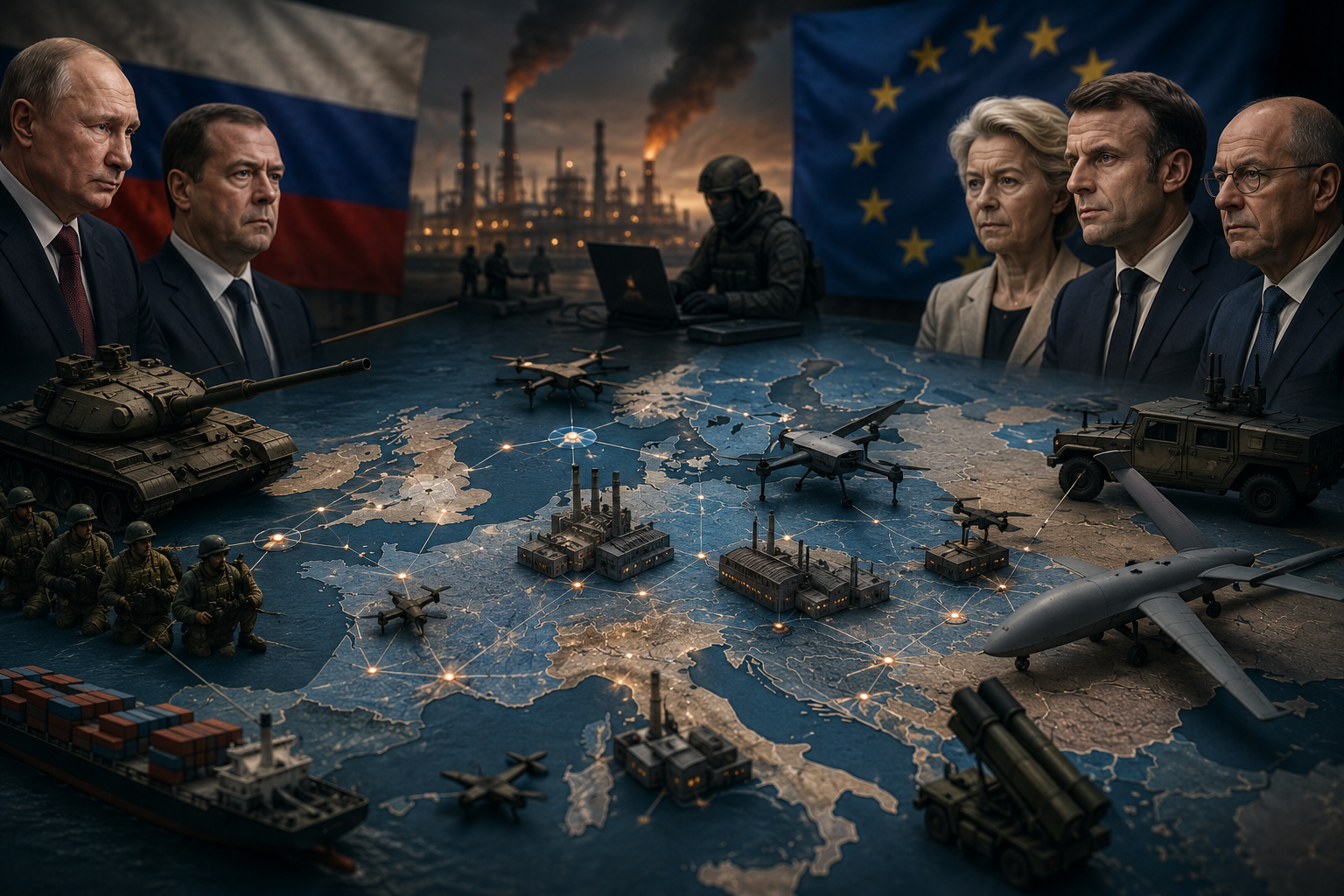
In April 2026 the Russian Ministry of Defence did something a state does not usually bother to do. It published a list of addresses. Not military bases, not government buildings, but factories and workshops in ordinary European cities, in the United Kingdom, Germany, the Netherlands, Denmark, Latvia, Poland, Czechia, Spain, Italy. Beside the list a senior official, Dmitry Medvedev, added a sentence that turned a spreadsheet into a threat. The published sites, he said, were "a register of potential legitimate targets for the Russian armed forces." Sleep well.
The reason given was almost clerical. European citizens, the ministry said, ought to know the true causes of the threats to their own security, and ought to know the addresses of the enterprises in their countries that build drones for Ukraine. The message underneath was harder. These are not your neighbours' businesses anymore. They are part of a war, and we know where they are.
Most coverage read the list as intimidation, and it is. But intimidation works by pointing at something real, and the thing it points at is worth looking at directly, because it has changed while almost no one was watching it change. For three years the question about Europe and the war was how much it would pay. Some time in the last few months the question quietly became something else, and Russia's list is the first official acknowledgement of the shift. Europe is no longer only funding the war. It has begun, on its own soil, to build it.
From writing cheques to building weapons
Follow the money and the change is unmistakable, because it is written into the European Union's own announcements.
The headline figure is a Ukraine Support Loan worth ninety billion euros, of which the first instalment, three and a fifth billion, was paid out in the last days of June 2026. Of that programme, some twenty-eight billion is earmarked specifically for Ukraine's defence-industrial capacity, the machinery of making weapons rather than the weapons themselves. The European Commission president confirmed that six billion euros of it, in a single quarter, would go to drones. And underneath sits a larger instrument still, called SAFE, offering up to a hundred and fifty billion euros in loans to member states to invest in defence.
These are not the numbers of a sponsor. They are the numbers of a producer. And the producing has already started to take a physical address. Under SAFE, two hundred million euros has been committed to joint drone manufacturing run by Ukraine and Romania, localised on Romanian soil, with the technology and the combat experience flowing west from Kyiv and the factory floor sitting inside the European Union. Ukraine has said it intends to stand up around ten such drone production sites across Europe, joint ventures in which European partners supply the buildings and the financing and Ukraine supplies the design and the know-how forged in three years of war. There is a formal name for the arrangement now, the EU-Ukraine Drone Alliance, and there are bilateral versions of it: agreements signed for joint drone production with Germany, struck in Berlin, and with Norway.
Read that sequence slowly, because the steps are small and the destination is not. A country that sends another country money is a financier. A country that sends finished weapons is an armourer. A country that hosts the factory where the weapon is built, that puts the production line on its own territory and pays for the building it sits in, is something for which the old vocabulary has only one word, and it is not a comfortable one. The drone that crosses into Russian airspace and strikes a refinery near Moscow was, increasingly, not merely bought with European money. It was made in Europe.
Why Europe is building the war, not just paying for it
The shift from buying to building was not an accident of accounting. It is a strategy, and understanding the strategy explains why it will be hard to reverse.
Three pressures pushed the production west. The first is that Ukraine has become, by necessity, the most advanced drone manufacturer in the world, iterating designs in weeks under combat conditions in a way no peacetime European arms firm can match, and turning out cheap machines by the million. Europe does not want to rebuild that capability from scratch; it wants to graft onto it, which is why the joint ventures run as they do, Ukrainian know-how poured into European buildings. The second is survivability. Drone plants inside Ukraine are themselves targets, hit regularly by Russian missiles; moving production to Romania, Germany, or further west places it, for now, beyond the range Russia has been willing to reach, which is precisely the assumption this whole situation is testing. The third is that Europe has decided it needs the industrial base regardless. After three years of watching its own stockpiles empty into Ukraine, the continent has launched a rearmament it calls overdue, and Ukrainian drone production on European soil doubles as the seed of a European drone industry. SAFE itself is not a Ukraine fund. It is a European defence-industrial fund that Ukraine's war happens to be accelerating.
Put those together and the production stops looking like a favour to Kyiv that could be switched off if it turned dangerous. It is woven into Europe's own security plans, its industrial policy, its answer to its own hollowed arsenals. That is what makes the off-ramp so hard to build from this side: the factories are not only helping Ukraine strike Russia, they are rebuilding Europe's capacity to defend itself, and no government dismantles its own rearmament because an adversary published a list. The same decision is, at once, support for a war and the foundation of a defence industry, which means the pressure to keep building runs deeper than any week's headlines. The machine has acquired its own reasons to grow.
The line the lawyers draw, and the one the missiles draw
Here the story splits into two readings that do not touch, and the gap between them is the whole danger.
In the Western legal reading, none of this makes Europe a party to the war. Supplying a belligerent with weapons, even manufacturing them, is the conduct of a neutral that has chosen a side, and international law has long tolerated exactly this without treating the supplier as a combatant. By this account the factories in Bavaria and Romania are no more legitimate targets than a steel mill that sells to an army. Europe supports a country that was invaded; it does not itself fight. The line between supplying a war and waging one is real, and Europe stands, comfortably, on the safe side of it.
This is not the first time the threshold has been argued over a factory. In 1940 and 1941 the United States called itself neutral while it became, in Roosevelt's phrase, the arsenal of democracy, shipping arms to Britain under Lend-Lease. Germany treated that industrial support as a hostile act in all but name, and the dispute over whether arming a belligerent makes you one is as old as the practice itself. What is new in 2026 is not the dilemma but the distance. The arsenal is no longer an ocean away from the war. It sits a drone's flight from the border, in countries that share a frontier, an alliance, and an air-defence map with the fighting. The old question is being asked at point-blank range.
In the other reading, the one Russia has now put in writing, that line was crossed the moment the production moved. The classical doctrine of co-belligerency does not ask whether you fired the shot. It asks whether you are materially part of the war effort, and a state that designs, finances, and physically houses the manufacture of the weapons used to strike the enemy's capital is, by that older logic, participating in the war rather than observing it. Medvedev's register of "legitimate targets" is that doctrine stated as policy. The ministry's phrase, the "creeping transformation" of these countries into Ukraine's "strategic rear," is the same idea in the language of a general staff: the place where a war is supplied and rebuilt is not neutral ground. It is the rear of the front, and rears get hit.
The reader does not need a verdict on which doctrine is correct under international law, because the point is colder than that. The threshold of "an act of war" is not set by the side that crosses it. It is set by the side that has to answer it.
Europe is making a legal argument. Russia is making a targeting decision. When a supplier's lawyers and a target's missiles disagree about where the line is, the lawyers do not get the last word. The factory does not become safe because Brussels has a good case. It becomes safe, or not, depending on what Moscow decides the factory is.
Why the room is getting smaller
There is a second force pressing on this, and it runs the other way, from the front toward the rear.
Through the spring of 2026, Ukraine turned its drones into a strategic weapon rather than a battlefield one. Swarms of long-range machines began reaching deep into Russia: an oil refinery near Moscow, infrastructure in St. Petersburg struck overnight hours before Russia's flagship economic forum opened, a sustained campaign that forced the occupation authorities in Crimea to halt fuel sales and ration ordinary life. These are not pinpricks. They reach the capital, they hit the oil that funds the state, and they are growing in range and number, fed by precisely the European production capacity described above.
By June the campaign had a measurable bite. A strike on the Gazprom Neft refinery near Moscow was reported likely to keep it offline into 2027, and the number of refineries hit had roughly doubled over the year, forcing Moscow to restrict fuel exports to steady domestic shortages. The drones were no longer harassing the front line; they were reaching into the revenue and the fuel that keep the war running, launched from sites increasingly stocked by European factories. And each such strike does something specific to Russia's position: it raises the cost of absorbing the war quietly, and shortens the list of answers that do not involve hitting back at the source.
What that does to Russia's options is the part worth stating carefully, because it is interpretation and not fact, and it is the hinge of the whole question. As the strikes deepen and Russia's conventional answers inside Ukraine yield diminishing returns, the menu of responses that do not involve crossing into NATO territory grows shorter. Each escalation by the drones narrows the set of replies that stay below the threshold. This is the mechanism a reader should hold onto, not because it guarantees anything, but because it is the variable that everything else turns on: the size of the room Russia has left to answer in without hitting Europe. The smaller that room becomes, the more the question shifts from whether Russia would strike a European factory to whether it will judge it has any cheaper way left to make the production stop.
It would be easy, and wrong, to call the outcome inevitable. Inevitability is the one claim the evidence does not support, and the evidence against it is large and sitting in plain view: for three years Russia has absorbed extraordinary strikes, including on Moscow itself, and has consistently chosen not to cross the line into NATO, because the thing on the far side of that line, Article Five, is the single outcome it has worked hardest to avoid. The deterrent has held through worse than this. A reader who concludes that a strike on Europe is certain has stopped reading the evidence and started reading their fears. The honest shape of it is not certainty but a narrowing: a probability that rises as the room shrinks, against a deterrent that has not yet broken.
The off-ramp no one is building
If the room is shrinking, the obvious question is who is working to make it larger again, and here the imbalance is stark.
Set the two tracks side by side. On the military-industrial side: ninety billion euros in loans, factories rising across the continent, six billion for drones in a single quarter, an entire alliance built to scale the production. On the diplomatic side: a sequence of stalled meetings. US-mediated talks in Geneva and Abu Dhabi through early 2026 produced no breakthrough. A European plan presented in London in June, five principles for ending the war, was rejected by Moscow within hours. Putin has refused to accept Europe as a mediator at all, and the core demands have not moved: Russia insists on the whole of the Donbas, Ukraine will not cede it, and the question of Western security guarantees stays open. The European Council issues its calls for a ceasefire. The factories, meanwhile, get built.
It is not that diplomacy is absent. It is that it is stalled and, more tellingly, dwarfed: there is no peace track of remotely comparable weight, urgency, or money to the war track. A continent that can move ninety billion euros and stand up ten factories in a year has built no de-escalation effort on anything like the same scale. That asymmetry is what turns a narrowing into a danger rather than a strain. A room shrinking on one side can be held open if something widens it on the other; here the escalation has industrial backing and the de-escalation has communiqués, so the only direction with real momentum is toward the threshold. What is missing is not talk. It is a second track heavy enough to matter.
The first bills have already arrived
None of this is hypothetical at the edges, because the war has already begun to touch European soil, and it has already cost European governments.
The clearest case is Latvia. In early May 2026 two drones, suspected to be Ukrainian and likely pushed off course, crossed into Latvian airspace; one came down at a fuel storage facility. The military detection system did not catch them, and the public alert reached people's phones about an hour after the drone had already crashed. The political consequence was swift and total. The defence minister resigned over the handling of it. Days later the prime minister resigned as her coalition collapsed. A government fell, months before its election, over drones that no one had aimed at it.
Latvia is not alone in feeling the spillover, only the most dramatic. Romania has logged more than two dozen drone incursions since the war began, at a sharply rising rate, with 2026 already on course to be its worst year. The war's geography is no longer the map of Ukraine. It is creeping outward along the eastern edge of the alliance, one stray machine and one fallen minister at a time, and it is doing so before Russia has chosen to do anything deliberate at all. This is what the spillover costs when it is still an accident.
And the alliance has already fired. In September 2025, between nineteen and twenty-three Russian drones crossed into Poland in a single night. NATO scrambled jets and shot several of them down, the first time the alliance had fired its weapons in the war. Within days it launched Operation Eastern Sentry to harden the eastern flank, pulling in fighters and air defence from a dozen members. That episode matters because it moved the question from theory to record: NATO aircraft have already engaged Russian machines in NATO skies and the alliance did not tip into war. The threshold bent without breaking. But each incident teaches both sides exactly where it sits, and a line that everyone has now seen tested is a line closer to being crossed in earnest. The list Medvedev published is a description of what the next step costs when it is a choice rather than a stray.
The loop closed at Omsk
On the sixth of July, a Ukrainian drone struck the Omsk refinery in western Siberia, roughly two and a half thousand kilometers from Ukraine, along a reported flight path of more than three thousand. It was the deepest strike of the war, and the target was not incidental. Omsk is Russia's largest refinery, and by Ukrainian accounts it was the last of the country's eleven biggest gasoline plants that had not yet been hit. The aircraft was an FP-1 in its extended-range version, built by the Ukrainian firm Fire Point, whose designer puts the type's reach at up to three thousand four hundred kilometers. The economics are the point: a machine reported to cost on the order of fifty thousand dollars crossed a continent and disabled a primary crude unit rated in millions of tonnes a year. Nor did Omsk stand alone. In the same two weeks, drones reached the Slavneft refinery at Yaroslavl, oil and military facilities near St Petersburg, and the Gazprom petrochemical complex at Salavat in Bashkortostan, fifteen hundred kilometers out.
Now place that beside a quieter fact from the other end of the supply chain. Fire Point, the company behind the drone, is the same company whose rocket-fuel plant Denmark is fast-tracking at Vojens, beside the F-35 base at Skrydstrup; to get it built on schedule, the Danish government set aside more than twenty of its own laws. The drones that struck Omsk were built in Ukraine. But the company's production is migrating into Europe piece by piece, fuel and engines first, and the migration is being accelerated by European governments willing to bend their own rulebooks to make room for it.
Read the two facts together and the abstract question of this chapter turns concrete. The factory layer in Europe and the deep-strike layer inside Russia are no longer separate stories; they are the two ends of one documented supply chain. Every kilometer of added range makes the production end more valuable, and everything that makes the production end more valuable makes it more interesting to the state being struck. The list of addresses published in April was written for exactly this world.
Europe cannot yet stop the drones
Underneath every one of these incidents sits an uncomfortable fact: Europe does not yet have a reliable way to stop a drone.
The incursions kept getting through not because the alliance is indifferent but because it is not built for this threat. Latvia's detection system missed the machines that crossed it and warned the public an hour too late. Poland needed scrambled fighters and allied jets to bring down a handful of cheap drones, using missiles that cost orders of magnitude more than the things they destroyed. That cost asymmetry is the heart of the problem. A drone can be built for hundreds or a few thousand euros; the interceptors and fighter sorties flown against it run to hundreds of thousands. An air-defence system designed for a small number of expensive enemy aircraft is the wrong shape for a large number of cheap ones, and everyone now knows it.
Operation Eastern Sentry and the talk of a European drone wall are both the admission of the gap and the scramble to close it, but they are years and many billions away from a dependable shield. Until then Europe sits in the worst possible position for a threshold: it hosts the production that provokes, while lacking the defence that would make the provocation safe to sustain. It can build the factory. It cannot yet protect the town the factory sits in. That gap is what makes a deliberate strike, deniable or not, both tempting and hard to answer: the target is exposed, the weapon is cheap, and the response is expensive, slow, and politically explosive. The narrowing room has thin walls.
The deniable war is already here
There is a reason to think the first deliberate blow, if it comes, will not announce itself, and the reason is that this kind of war is already running across Europe, and has been for two years.
While the public watched the front in Ukraine, a quieter campaign spread west. Western intelligence services attribute to Russia a wave of sabotage on European soil: arson, attacks on railways, damage to pipelines and undersea cables, incendiary parcels in cargo networks. One tally counted thirty-four incidents of arson or serious sabotage in 2024, against twelve the year before and two the year before that. The cases are concrete. A shopping centre in Warsaw burned to the ground in 2024 in a fire investigators later said had been ordered by a Russian military-intelligence officer. An IKEA store in Vilnius was set alight in what Lithuanian prosecutors called an act of terrorism directed by the GRU. Two undersea cables in the Baltic were severed within a day of each other; a power link between Finland and Estonia went dark on Christmas Day, and a shadow-fleet tanker was detained over it. Incendiary parcels caught fire in DHL depots in Britain and Germany.
The method is the tell, and the reason for it is the whole point. Sabotage is attractive precisely because it preserves political ambiguity: it lets the attacker act without owning the act, doing real damage while staying below the threshold that would force a collective response. These operations are run at arm's length, intelligence handlers recruiting petty criminals and drifters over encrypted apps and paying in cryptocurrency, so that every act sits behind a layer of deniability and the state can shrug at each one. This is the existing toolkit, already pointed at the countries that support Ukraine, already operating below the threshold that would trigger a collective response. It is not a capability Russia would need to invent in order to reach the drone factories. It is a capability it is already using, on the same soil, against the same states, for the same reason.
That changes what the forecast even is. The question is not whether Russia might one day open a deniable front inside Europe. The deniable front is open. The question is narrower, and more uncomfortable: whether the production sites get moved onto a target set that already includes shopping centres, cables, and cargo hubs. The factory Medvedev named does not need a missile to be in danger. It needs only to slide from the political list to the operational one, in a campaign that is already running and already deniable.
Three weeks in July: the deal, the budget, and the nameless factory
In the weeks after this chapter was first published, the pattern it describes stopped being a trend and became policy, on both sides at once.
On the fifteenth of July, in Kyiv, Ursula von der Leyen and Volodymyr Zelensky signed a letter of intent that the press immediately called the Drone Deal: joint European-Ukrainian drone and counter-drone production by the end of 2026, joint anti-ballistic-missile production by 2028, nineteen founding companies from Indra and Fincantieri to Quantum Systems, and another billion euros for drone production drawn from the ninety-billion-euro EU loan. The Commission president promised, in language that mattered more than the money, that the production would be given safe and secure sites inside the European Union. Within hours, Russian state media had repurposed the promise: TASS headlined it as Europe building production sites for drones to attack Russia, and the foreign ministry restated that the war ends when the weapons stop. The same sentence that reassures a factory manager reads, in Moscow, as a map reference.
Meanwhile the map itself keeps gaining addresses. Near Munich, the joint venture of Quantum Systems and Frontline Robotics is building toward a production line of more than ten thousand drones a year for the Ukrainian forces. Ukrainian manufacturers plan to open some ten factories across Europe over the course of 2026, a dispersal of the industry away from the reach of Russian missiles and into the cities of the alliance. In the second week of July, Rheinmetall announced a joint venture in Croatia for unmanned ground vehicles. Each announcement is, in commercial terms, ordinary industrial policy. Each is also, in the April list’s terms, a new entry, and the two readings are being written simultaneously, by different capitals, onto the same buildings.
A week earlier, at the Ankara summit, NATO had put a number on the other side of the ledger: more than forty billion dollars over five years for counter-drone and unmanned systems, the first alliance-level budget line whose implicit object includes defending the factory layer and not just the front. What the package did not include is as telling as what it did. No program, as of this writing, assigns air defense to named plants. The protection of the production layer exists at the level of money and language, not yet of interceptors.
And beneath the policy, the deniable layer kept moving exactly as the earlier sections describe. In Toulouse, in an incident reported in mid-June, someone threw Molotov cocktails at the plant of Delair, a drone supplier to Ukraine; the mixture failed to ignite, and three days later police arrested a Belarusian national filming a prototype outside the same plant, with French investigators naming foreign interference as their leading theory. In early July the International Institute for Strategic Studies counted 144 suspected Russian drone sightings over NATO countries, many likely launched from ships of the shadow fleet, with more than a thousand suspicious sightings over Germany alone in a single year, defense companies among the overflown. And in southern Germany, New York Times reporting found Europe's most valuable defense startup, Helsing, building its AI-guided HX-2 drones in an unmarked industrial building with no sign on the door, designed, by its own account, to be relocated within twenty-four hours if threatened.
That is the quiet answer to the question this chapter opened with. The threshold is no longer being debated; it is being furnished. Europe is writing the factories into policy, Russia is writing them into targeting language, NATO is pricing their defense, and the industry is camouflaging itself. Every actor is behaving as though the war over the factory layer has already begun. The only thing missing is the formal admission, which, as the rest of this chapter argues, is precisely the thing nobody has an incentive to supply.
What the steelman has to concede, and what it does not
The strongest case against alarm deserves to be made at full strength, because it is largely right.
Russia invaded Ukraine; Europe is responding to an act of aggression, not committing one, and a continent that helps a neighbour resist invasion is doing something defensible and arguably necessary. The legal argument that arming, even manufacturing, does not make a state a combatant is the mainstream reading and has decades of practice behind it. And the deterrent, as noted, has held through three years of provocation far past what most analysts predicted it could survive. Russia's answer to the deep strikes has been to pour escalation back into Ukraine, with record barrages on Ukrainian cities and the power grid, rather than across the NATO line, which is itself a map of where Moscow has so far chosen to keep the war. Put those together and the responsible conclusion is not panic. Russia's list may be exactly what a former US envoy called it: intimidation, designed to frighten European publics into pressuring their governments to stop, precisely because the production is hurting.
What the steelman cannot do is make the threshold disappear. It can argue that crossing it is unwise for Russia, that the deterrent should hold, that the legal case for the factories is sound. It cannot guarantee that Moscow shares the same map of where the line is, and it is Moscow's map that decides where the missiles land. The defence of Europe's position is strong on everything except the one thing that matters at the threshold, which is that the other party gets a vote, and has just published, in writing, where it thinks the line already is.
What would tell us which way it breaks
A claim like this earns its keep only if it can be proven wrong, so here is the test.
If the European production keeps expanding, the factories multiplying across the alliance, the swarms reaching ever deeper into Russia, and Russia continues to leave those sites untouched, then the room was never as small as the threat implied, the list was theatre, and the deterrent is stronger than the pressure. That is the outcome the steelman predicts, and it is entirely possible. If instead the first deliberate strike comes, it will most likely not arrive as an open attack with a flag on it, because that is the one form Russia has most reason to avoid. It will arrive deniable: a fire at a plant, an "accident" at a substation feeding a factory, a drone no one will claim, damage that sits carefully below the line that triggers Article Five while making the production sites understand they are no longer safe. Watch the deniable edge, not the open one, the same edge already cutting Baltic cables and burning European warehouses. That is where a narrowing room spends its last options first.
The facts that are not in dispute are these. Europe has moved from paying for the war to manufacturing it, on its own territory, with its own money, and has said so in its own press releases. Russia has answered by publishing the addresses and calling them targets. Two governments' worth of European ministers have already fallen to drones that were merely lost. And the question of whether any of this amounts to an act of war is not being decided in the parliaments that voted for the funding. It is being decided, quietly and continuously, in the one capital that never gets a say in those votes and holds the only opinion that, at the threshold, counts.
Evidence Map
Facts, interpretations, forecasts, and disconfirming signals.
Core claim. Europe has shifted from financing Ukraine's war to manufacturing weapons for it on European soil (drone production localised in Romania and other member states, EU-funded), which moves it toward the contested threshold of co-belligerency. Whether this constitutes an "act of war" is not settled by European law but by Russia's response, and Russia has formally designated the European production sites as legitimate targets. Meanwhile the diplomatic track is stalled and far outweighed by the war track, so as military pressure rises there is no de-escalation mechanism of comparable scale to lower it.
Evidence level. Facts (high, documented): the EU's 90-billion-euro Ukraine Support Loan with 28.3 billion for defence-industrial capacity and a 6-billion-euro drone package (first instalments mid-2026); the 150-billion-euro SAFE instrument and 200 million euros for Ukraine-Romania joint drone production on EU soil; the EU-Ukraine Drone Alliance and joint-production deals with Germany and Norway; Russia's Ministry of Defence list (April 2026) naming European drone firms across the UK, Germany, the Netherlands, Denmark, Latvia and others, with Medvedev calling them a "register of legitimate targets"; Ukraine's deep-strike drone campaign reaching Moscow, St. Petersburg and Crimea; the May 2026 Latvian drone incident and the resignations of the defence minister and prime minister; ~16 Romanian incursions in early 2026; the stalled US-mediated talks in Geneva and Abu Dhabi, the London five-point plan rejected by Moscow in June 2026, and Putin's refusal of Europe as a mediator, with the cores (Donbas, security guarantees) unmoved. Interpretation (medium, marked): that Russia's option space narrows as the strikes deepen, raising the probability of a strike on European production. Forecast (speculative, marked): that any first deliberate strike would most likely come in deniable, sub-Article-Five form.
What would confirm this. Continued expansion of EU-soil drone production accompanied by Russian sabotage, "accidents," or deniable strikes against those sites or their power supply; further escalation rhetoric tied to specific facilities.
What would disprove this. European production multiplies and Russia leaves the sites untouched, indicating the list was intimidation and the deterrent holds; or a negotiated settlement removes the pressure before the threshold is tested.
Watchlist. The pace of new EU-soil drone factories; the deniable edge (unexplained fires, substation failures, unclaimed drones near production sites); the durability of the Article-Five deterrent under deepening strikes.
Frequently Asked Questions
Is supplying or making weapons for Ukraine an act of war?
Under the mainstream Western legal reading, no: supplying or even manufacturing weapons for a belligerent does not by itself make a state a combatant. Under the older doctrine of co-belligerency, and under Russia's stated position, materially producing the weapons used to strike the enemy can count as participation. The two readings disagree, and the dispute itself is the danger, because the threshold is judged by the side that decides how to respond.
Is Europe becoming a co-belligerent in the Russia-Ukraine war?
That is the contested question. By moving drone production onto its own soil with EU funding, Europe has moved closer to the classical definition of a co-belligerent, while maintaining that arming a victim of aggression keeps it a supporter rather than a party. Russia has signalled it regards the production states as part of Ukraine's "strategic rear."
What did Russia's "target list" of European companies actually say?
In April 2026 Russia's Ministry of Defence published locations of European firms it says make drones for Ukraine, across countries including the UK, Germany, the Netherlands, Denmark and Latvia. A senior official, Dmitry Medvedev, called the published sites a "register of potential legitimate targets for the Russian armed forces." Analysts widely read it as intimidation, but intimidation backed by a real and growing production base.
Will Russia attack European drone factories?
It is not inevitable. Russia has absorbed years of strikes, including on Moscow, without crossing into NATO territory, because that risks Article Five, the outcome it most avoids. The risk rises as its non-escalatory options narrow, and any first move would most likely be deniable rather than an open attack. Whether the threshold breaks is an open question, not a certainty.


