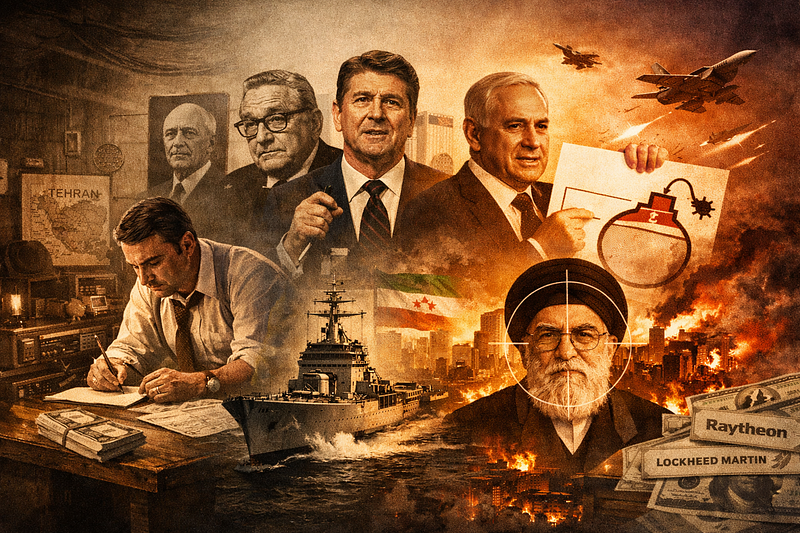
August 19, 1953. Tehran. The summer heat has not left the city by midnight. In a basement safe house near the Majlis, a CIA officer named Kermit Roosevelt Jr. coordinates the final payments to street gangs, army officers, and newspaper editors recruited to manufacture the appearance of popular unrest. The operation is called Ajax. Its objective: remove the elected Prime Minister Mohammad Mosaddegh, restore the Shah, and return Anglo-American access to Iranian oil.
Roosevelt will later write a book about it. He will call it ‘Countercoup.’ He will call it a success.
He was right. It was. That is the problem.
Seventy-three years later, on February 28, 2026, nine hundred American and Israeli strikes hit targets across Iran, killed Supreme Leader Ali Khamenei, and closed the Strait of Hormuz within forty-eight hours. The question every newsroom asked: who ordered this? The question that matters: when was this built?
The answer is 1953.
What the Narrative Says
The official account presents a last resort: Iran crossed a nuclear threshold, diplomacy was exhausted, the strikes were surgical. Each statement is technically defensible. None of them is the story.
What “Iran chose war” replaced was simpler and harder to say: the infrastructure completed its function. The nation-state framing substituted agency for mechanism, obscuring seventy years of accumulated architecture behind a single morning’s headline.
The story is the infrastructure. The infrastructure is older than any of the actors who authorized the strikes, older than the Islamic Republic itself.
The First Stone: Dependency by Design
Operation Ajax cost approximately one million dollars. For that investment, the United States removed a democratically elected government and restored a dependent monarchy. Henry Kissinger institutionalized the relationship: between 1950 and 1979, the United States sold Iran more than twenty billion dollars in military equipment, calibrating Iran’s military to American systems, its intelligence services to CIA training, and its political stability to continued American support. The Islamic Revolution of 1979 was not an irrational rupture. It was the structural consequence of a dependency that had become visible to those it was designed to contain.
What was built in 1953 was not a policy toward Iran. It was the creation of a dependency. Dependency requires continuous management, which is another word for control.
The Reagan Calculation: Controlled Instability
The 1980s produced controlled instability as deliberate condition. The Reagan administration provided Iraq with military intelligence and chemical weapons precursors while simultaneously selling weapons to Iran through Israeli intermediaries. Both sides bled. Neither won. On July 3, 1988, the USS Vincennes shot down Iran Air Flight 655. All 290 passengers and crew were killed. The ship’s commander received the Legion of Merit. The citation does not mention Flight 655.
What the official record does not contain: an inquiry into why the Vincennes was inside Iranian territorial waters. The absence is not a gap. It is a decision, and it established permanently what Iran could expect: that American actions in Iranian airspace carried no consequence for Americans.
The Planning Documents: Doctrine in Writing
In 1997, the Project for the New American Century was founded by Dick Cheney, Donald Rumsfeld, Paul Wolfowitz, and Jeb Bush, among others. In September 2000, they published “Rebuilding America’s Defenses.” The document is still publicly available. It called for permanent Gulf forces “even should Saddam Hussein pass from the scene.” The geography was the objective. Iraq was the entry point. In 2010, Stuxnet was deployed against Iranian centrifuges at Natanz: the first state cyberattack on critical infrastructure, without declaration of war.
Iraq was a pretext. The Gulf presence was the objective. The planning documents had said so in advance.
Thirty Years, One Claim: Perceptual Infrastructure
Benjamin Netanyahu told Congress in 1996 that Iran was eighteen months from a nuclear weapon. He said the same in 2002, 2006, 2009. In 2012 he drew a “red line” on a bomb diagram at the United Nations. Over thirty years, a claim does not accumulate evidence. It accumulates authority, the kind that comes not from being proven right but from being persistent enough that the claim becomes the background against which all subsequent events are interpreted.
What Netanyahu constructed was not a political position. It was perceptual conditioning: a conclusion planted, repeated, and normalized until authorization required no deliberation, only a signature.
Maximum Pressure and the Financial Layer
The JCPOA of 2015 was a structural pause. Iran complied. The IAEA confirmed compliance fourteen times. On May 8, 2018, the United States withdrew under a policy named “maximum pressure.” Between 2018 and 2025, the Iranian rial lost more than ninety percent of its value. The price of a kilogram of bread tripled in a month in 2022. The government did not capitulate. The enrichment program accelerated.
Lockheed Martin’s annual revenue grew from $53.8 billion in 2018 to over $71 billion. RTX reported $80 billion in 2024, a record. James Mattis joined the General Dynamics board four months after leaving the Pentagon; General Dynamics received $8.5 billion in contracts that year. John Bolton received speaking fees from the Mojahedin-e Khalq before and after serving as National Security Advisor.
The infrastructure of profit and the infrastructure of policy are not identical. In the Gulf between 2018 and 2026, the adjacency became indistinguishable from alignment.
A Ceremony, Not a Choice
By February 2026, everything was in place. Seven decades of sanctions had isolated Iran’s financial system at every layer. American assets at Al Udeid Air Base in Qatar and on Arabian Sea carrier groups had been positioned and updated for decades. Israeli-American intelligence integration had produced a unified operational picture. Nothing required improvisation.
Systems do not determine outcomes with the precision of physics. They establish gradients of likelihood, foreclose alternatives, and prepare certain paths so thoroughly that resistance requires an extraordinary convergence of political will, institutional courage, and public pressure , none of which the architecture had left space for.
The nine hundred strikes did not require a decision. They required a final signature on infrastructure accumulating since 1953.
The Language of Inevitability
“Maximum pressure” implies a gauge with a release valve. None of those properties were present. “Nuclear threat” requires no evidence, only repetition. “Red line” presents a threshold as neutral measurement while concealing that it was drawn by the party that would benefit from its crossing.
None of the three phrases describe conditions. They describe conclusions, drawn in advance, sustained by repetition, and available for use when the moment arrived.
August 19, 1953. Tehran. The summer heat is still in the room.
Kermit Roosevelt Jr. is at a desk near the Majlis. He calls his operation “Countercoup” because he needs a Soviet threat to make it legible as defense. The Soviet threat was not the reason. It was the language that made the reason disappear.
The nine hundred strikes were not a choice made on February 28, 2026. They were what the system produced when the final condition was met: patient, layered, self-reproducing, requiring no single conspirator because the incentive structure rebuilt itself through institutions that each acted rationally within their own terms.
Kermit Roosevelt Jr. died in 2000. By then, the heat had moved: from Tehran to Washington, from Washington to the targeting screens at Al Udeid, where the coordinates had been maintained for decades, waiting.
He built it anyway.
The architecture accounts for every actor except one. The CIA officer, the defense contractor, the policy planner, the politician, the journalist who covers the event without covering the infrastructure that produced it: each has a designed role. The architecture does not account for the reader who traces the construction backward from 2026 to 1953 and names what runs through it. Every architecture of this kind has always known that gap exists. Managed resistance is, in part, the mechanism built to ensure it stays small.
This is the condensed Medium version. The full analysis, including the financial layer, semantic architecture, and extended closing, is available on Substack.
This is part of The Architecture of the Decision series. The next installment traces the seventy years themselves: coup, Shah, Revolution, hostage crisis, and the architecture of a relationship reconstructed at each rupture to make the next one more likely.
The Architecture of 70 Years publishes next. The Manifest Archive publishes daily on Medium and Substack.
Related from The Manifest Archive
- Everyone Is Watching the Iran War. Nobody Is Watching What It Is Breaking.
- In 1990, James Baker Promised Russia NATO Would Not Move One Inch Eastward.
- The Iran Talks Failed. The Language Failed First.
- Angela Merkel Helped Broker a Peace Agreement in 2015. In December 2022, She Said It Was Never Designed to Bring Peace.