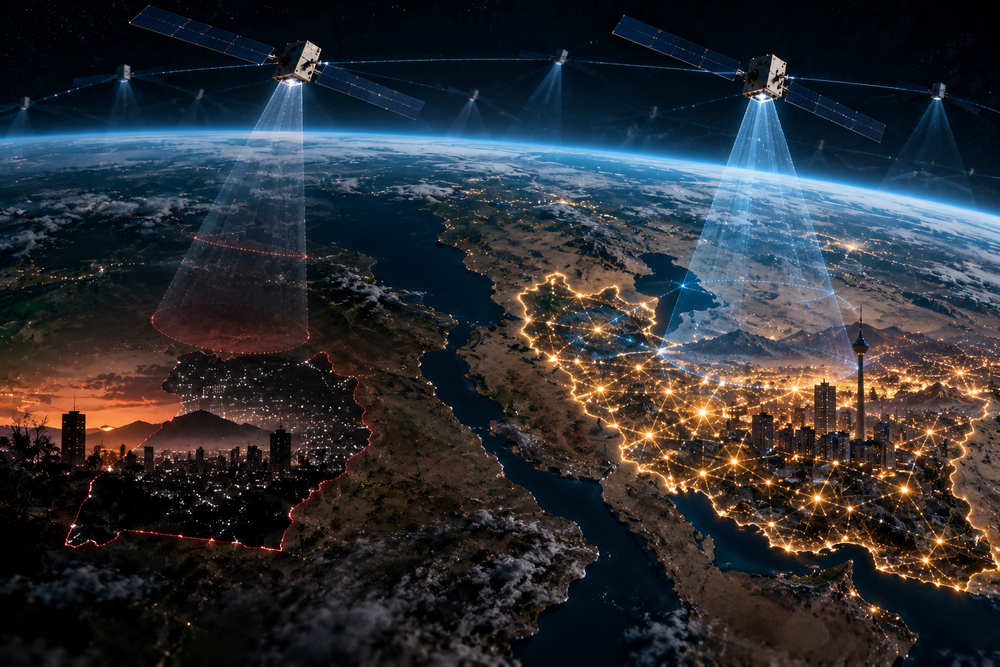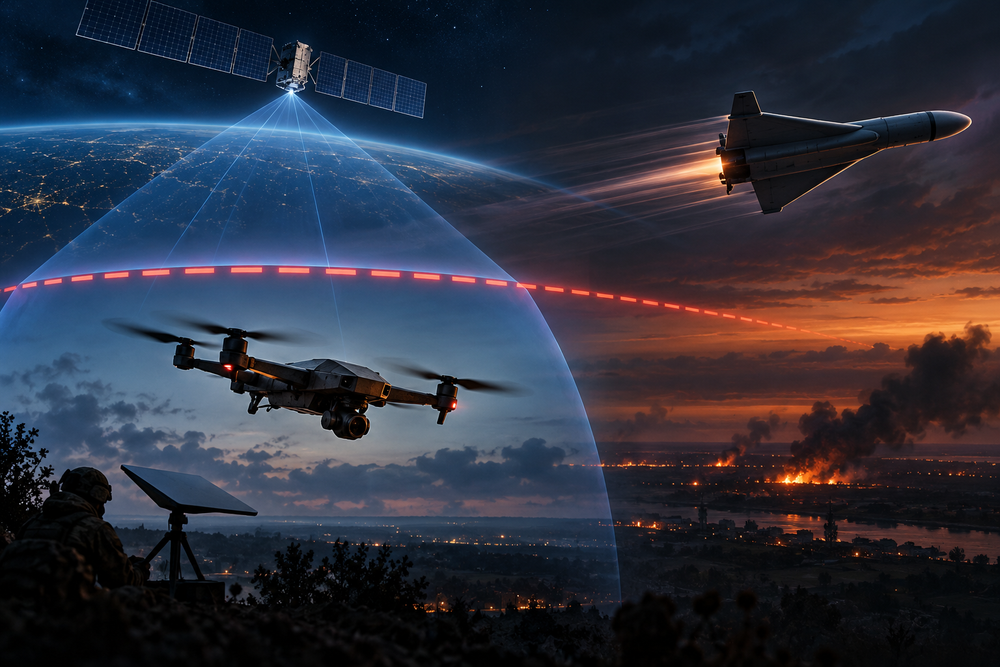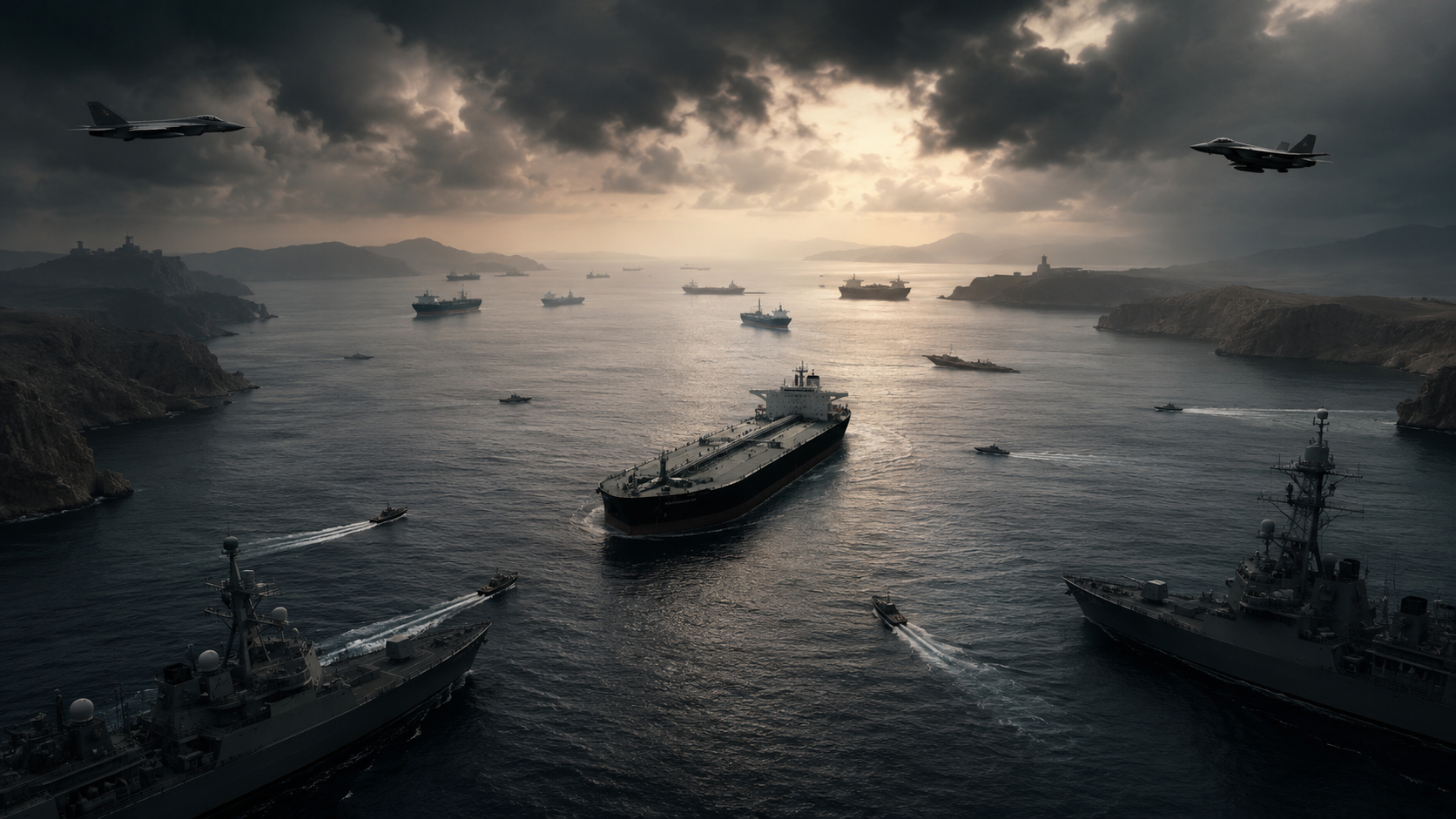
How constitutional limits, asymmetric naval warfare, and Chinese diplomacy outlasted American airpower.
The operation ended on May 5. The Strait of Hormuz was still closed on May 6. Between those two dates sits a gap of twenty-four hours and zero reopened commercial lanes. That gap is the entire argument. Everything else is the record of how it was made.
The Lloyd's Joint War Committee redesignated the Strait of Hormuz as a war risk zone within 48 hours of the first strikes on February 28. War risk premiums on a single Very Large Crude Carrier transit climbed from their pre-war baseline of roughly $500,000 to between $10 million and $14 million, according to Lloyd's List. By day 67, more than 22,500 mariners were waiting in anchorages across the Arabian Sea and the Gulf of Oman. Ships burn fuel at anchor. Crews rotate off contracts that have run past their legal limit. The mariners waiting on May 6 were not waiting for diplomacy in the abstract. They were waiting for a specific waterway to reopen, and it had not reopened on the day the operation that was supposed to reopen it officially ended.
For 67 days, from February 28 through May 5, 2026, the United States and Israel conducted joint airstrikes against Iranian military and nuclear infrastructure. More than 100 targets were struck. Thousands of sorties were flown. The USS Gerald R. Ford completed its longest carrier deployment since the Vietnam War. No NATO ally contributed military force. The stated objective was unambiguous: compel Tehran to reopen the Strait of Hormuz to commercial shipping.
The mechanism that produced the gap between May 5 and May 6 was not classified. Parts of it were written into federal law in 1973. Parts of it were built underground in Qom province before 2012. Parts of it were formalized in a treaty signed in Beijing in 2021. The sequence ran in full view.
The Tactical Record
Operation Epic Fury was, by the metrics that airpower generates, a real success against the targets it could reach. Surface-to-air missile batteries were struck and destroyed. Radar installations were taken offline. Iranian air defense command nodes were hit. The damage to above-ground conventional military capacity was documented by the Department of Defense and by independent satellite imagery analysis. By the first week of March, Iranian air defense coverage over the northern Strait had measurable gaps.
Washington's response to the premium spike in the Lloyd's war risk market was structural: a $40 billion insurance backstop announced through the US Development Finance Corporation, underwritten by a consortium that included Chubb, AIG, Berkshire Hathaway, Travelers, Liberty Mutual, and Starr International. The program was designed to make transit economically feasible by removing the financial barrier. It produced zero policies. The Lloyd's Market Association surveyed its marine war market in March and found that 88 percent of underwriters retained appetite for war risk coverage in principle. The capacity was there. The problem was not the premium.
Ships that transited the Strait were being struck. The DFC guarantee covered financial loss. It did not cover a hull in pieces or a crew in the water. Washington had designed an insurance solution for what turned out to be a physical-war-risk problem. The distinction runs all the way through the operation's logic: the assumption was that once the financial barrier was lowered, transit would resume, economic pressure on Iran would build, and Tehran's threshold would eventually be crossed. Each step in that chain required the prior step to function. The prior step did not function.
Between February 28 and May 5, an estimated 21 commercial tanker transits of the Strait were recorded, against a pre-war baseline of more than 100 daily. Approximately 5 percent of normal commercial traffic. The remainder rerouted around the Cape of Good Hope, adding 10 to 14 days and $1.5 million in additional fuel costs per voyage, or waited at anchor across the Gulf of Oman.
Iran's Hormuz interdiction capability does not depend on fixed positions. The IRGC Navy operates through a dispersed system: fast-attack craft launching from sheltered coastal points along the northern shore, naval mines seeded across the shipping lanes, underwater drones, and shore-based anti-ship missiles distributed across the Musandam Peninsula approach. Airstrikes destroy what has a fixed address. They cannot permanently neutralize a mobile minefield or a fleet of fast boats operating from dozens of positions. The dispersal was the design. It was engineered specifically around the assumption that Iran would face US air dominance and had to function within it, not against it.
Sixty-seven days of sustained airstrikes documented what that design produces when it meets a sustained air campaign. Tactical attrition. No strategic closure.
The objective was to translate documented damage into capitulation on the Strait. The damage was real. The translation did not follow.
The Underground Architecture
Iran's nuclear infrastructure presents a constraint that conventional munitions, as currently deployed, cannot resolve. The Fordow Fuel Enrichment Plant in Qom province is buried under a mountain at depths estimated between 80 and 90 meters. The US Air Force B-2 Spirit carries the GBU-57 Massive Ordnance Penetrator, the largest conventional bunker-busting weapon in the US inventory. It is rated to penetrate approximately 60 meters of reinforced concrete before detonating. The gap between those two numbers is not marginal. It is a specification.
Iran constructed Fordow knowing the GBU-57 existed. The plant became operational in 2012. The weapon entered US service in 2011. The timing was not coincidental. The depth of Fordow was an engineering response to a known weapons ceiling, built into the construction before the first centrifuge was installed.
The same logic governed the IRGC's broader hardening program. Since the 2015 JCPOA negotiations made clear to Iranian military planners that any agreement with Washington would be reversible, command and communications infrastructure for Strait operations was progressively hardened and geographically distributed. This was documented in US intelligence assessments between 2016 and 2022. It was not a response to Epic Fury. It was the prior condition that Epic Fury encountered.
What the strikes destroyed was built to be reachable. What holds the Strait was built for the opposite purpose.
Airpower destroys above-ground infrastructure. The Strait is held from below and from the water.
The depth was the answer.
The Constitutional Ceiling
The War Powers Resolution, codified at 50 U.S.C. sections 1541 through 1548, was enacted by Congress in November 1973 over President Nixon's veto. Its operative core: the President has 60 days to obtain congressional authorization for military hostilities, or must begin withdrawing forces. A 30-day withdrawal window follows. Total outer limit without authorization: 90 days. Every administration since Nixon has contested the law's constitutionality. None has repealed it. It remains the governing framework.
Operation Epic Fury began on February 28, 2026. The 60-day clock expired on April 28. On April 30, the Senate voted on a War Powers Resolution authorization for continued operations. The vote failed, 53 to 47. Secretary of State Marco Rubio declared the operation's conclusion on May 5. The Strait was still closed on May 6.
Fifty-three senators voted against authorization after 60 days of airstrikes had not reopened the waterway. The arithmetic of the vote reflected the arithmetic of the operational record. A majority of the Senate looked at 60 days of strikes against a still-closed strait and declined to fund more time on that basis. The vote was not procedural. It was a reading of the evidence.
The War Powers Resolution was not an obstacle that materialized unexpectedly in April. From February 28, the ceiling was in the statute. Any operation designed to force the reopening of a major international waterway had, absent authorization, a maximum of 90 days to deliver that outcome. The Strait had been effectively closed since February. It was still closed when the withdrawal window ran out.
A version of this analysis attributes the outcome primarily to the Senate vote: authorization would have extended the campaign, and the campaign might eventually have produced a different result. That reading is possible. It also accepts that the stated objective required more than 90 days of sustained airstrikes to achieve, which is itself a significant claim about the relationship between the tool applied and the outcome sought.
The 60-day ceiling was not an obstacle that appeared in April. It was the outer boundary of the operation from day one, written in federal law fifty-three years earlier.
The Leverage Transfer
On May 5, 2026, the party with the most direct and functional channel to Tehran was not Washington. It was Beijing. That position was built in documented steps between 2015 and 2021, while US Iran policy cycled through the JCPOA, withdrawal from the JCPOA, maximum pressure, and back toward negotiation.
China's position in the Hormuz standoff has foundations that predate Epic Fury by years. China receives approximately 44 percent of its crude oil imports through the Strait. It is the largest foreign purchaser of Iranian oil, buying under a discounted framework that survived both the collapse of the JCPOA and the reimposition of US sanctions. In March 2021, China and Iran signed a 25-year Comprehensive Strategic Partnership covering economic cooperation, energy infrastructure, and security coordination. Wang Yi attended the signing in Tehran.
Oman has historically served as a back-channel between Washington and Tehran. It signed no 25-year energy partnership with Iran, holds no crude purchasing arrangement that survived sanctions, and has no structural interest in Iranian oil revenue comparable to China's. The difference between Oman's channel and China's is not geography. It is investment.
The leverage is recorded in tanker data as much as in diplomatic cables. Kharg Island handles approximately 90 percent of Iran's crude oil exports. Since May 6-7, no crude loading has been documented at Kharg Island. Bloomberg and TankerTrackers, drawing on satellite imagery, reported 18 Very Large Crude Carriers anchored east of Kharg Island with no loading in progress. Twenty-eight days without a crude export from Iran's primary export terminal. The oil is on the island. The ships are at anchor. The loadings have not commenced. That is not a diplomatic signal. It is a balance sheet.
China did not cause the Hormuz blockade. China did not design Epic Fury. What China did was spend five years building, through publicly recorded agreements, the diplomatic channel that made it the only external actor with both a functional route toward and an operational interest in resolving the situation. When the operation ended on May 5 without reopening the Strait, the party holding the next move was the one that had been building the relationship with Tehran through each round of US policy reversal.
The interest alignment runs across three parties. Iran needs the Strait open for revenue. China needs it open for energy supply. The United States and its allies need it open because an estimated fourteen trillion dollars in annual global trade depends on unimpeded transit. The difference is not the interest. It is who has the channel to act on it. Al Jazeera, Reuters, and the Financial Times each reported in May 2026 that Chinese diplomatic engagement with Tehran had increased ahead of a scheduled Trump-Xi summit. The price of an arrangement Washington cannot negotiate for itself has not been published. It will be invoiced.
Washington launched the operation. Beijing is positioned to negotiate the exit.
China did not win the war. It was still there when the war ended.
The Strongest Counterargument
The most serious case against this analysis does not dispute the tactical record or the War Powers Resolution timeline. It accepts both and argues that what happened between February 28 and May 5 produced durable conditions that a brief timeline cannot measure.
The argument runs as follows. Epic Fury substantially degraded Iran's long-term conventional military capacity. Air defense networks will take years to rebuild. The IRGC suffered command-level casualties that disrupted operational continuity. The cumulative damage created the conditions for a negotiated reopening that would not have been achievable without the campaign. Negotiated resolution under military pressure produces more stable outcomes than a forced reopening would have, because a forced reopening creates no durable incentive for Iran not to close the Strait again the next time leverage is needed. The operation did not fail to achieve its objective. It shifted the mechanism from forced compliance to diplomatic settlement. May 5 is a handoff date, not a conclusion.
This counterargument is structurally serious and should not be treated as rationalization. Military campaigns that generate conditions for subsequent settlements are a documented historical category. The 1973 Yom Kippur War created the military stalemate that the 1978 Camp David Accords required. The argument from accumulated pressure to negotiated outcome has real instances behind it.
The claim here is narrower. The stated objective was reopening the Strait. The Strait did not reopen before the operation ended. The party with the functional channel to facilitate reopening is Beijing, not Washington. Whether Chinese mediation produces a durable agreement, and at what cost to Washington, is a question May 5 cannot answer. What the record through May 6 establishes is the location of the leverage, how it was built, and which party did not build it.
The operation may have created conditions for an agreement. It did not build the channel through which that agreement will be negotiated.
What the Record Establishes
The mechanism runs in seven steps. A 67-day air campaign was launched on the premise that airpower could raise the cost of Hormuz interdiction above Tehran's threshold. Iran's underground nuclear and command infrastructure survived the strikes. The IRGC Navy's dispersed Strait interdiction capability survived the strikes. The War Powers Resolution set a 60-day ceiling. The Senate declined to extend it. The operation ended on May 5. The Strait was still closed on May 6. That is not a miscalculation. That is a sequence.
Each element followed its own logic without coordination between them. The underground infrastructure was built before February 28 to a depth that reflected a known munitions specification. The constitutional ceiling was written in 1973 and has governed every US military deployment since. The Senate vote reflected sixty days of strikes against a still-closed waterway. The Chinese diplomatic position was formalized through a signed partnership agreement in 2021. None of these elements needed to know about the others for the sequence to produce the result it produced.
On May 10, 2026, Windward Maritime Intelligence reported 21 commercial vessels without active AIS transponders operating in Iranian-controlled anchorages in and around the Strait. Twelve were VLCC-class. Combined cargo capacity: an estimated 24 million barrels. They were invisible to the commercial tracking systems that insurers, charterers, and port authorities use to monitor Strait traffic. They were not invisible to the calculations of whoever holds the channel to negotiate their movement. The shadow fleet has a price. The price has not yet been named.
By May 6, Brent crude was near $100 per barrel. US retail gasoline averaged $4.52. The IEA's emergency petroleum release, the largest in the institution's history, was approaching exhaustion on a timeline the institution had published. The economics of a closed strait do not pause for diplomatic processes.
The 22,500 mariners waiting in anchorage on May 6 were not a statistic in the gap between May 5 and May 6. They were the gap made human. They were waiting because the operation ended, because the Strait stayed closed, and because the actor with a functional channel to change that was not Washington. Their position in the situation was determined by a sequence of decisions none of them made, and a set of constraints none of them designed. That is not a verdict on any particular actor's intentions. It is a description of how constitutional ceilings, engineering decisions made before 2012, an insurance program that wrote zero policies, and diplomatic relationships built over five years interact to produce a specific outcome.
The operation ended on May 5. The Strait was still closed on May 6. The gap between those two dates does not explain everything. It explains the location of the leverage, and who will name the price for closing it.
The operation ended. The accounting began.
The Hormuz closure has structural predecessors this article connects to. The Iran War Triggered the Largest IEA Reserve Release in History documents the cascade arithmetic of the emergency petroleum buffer that runs out before any diplomatic resolution can take effect. BlackRock Does Not Own the War. It Owns Everything Around It. documents the financial ownership layer that assigns a profit interest in the duration of the closure.
Jerry writes The Manifest Archive, forensic analysis of the institutional structures that shape geopolitics, history, and power.
Related from The Manifest Archive
- The Iran War Triggered the Largest IEA Reserve Release in History. The Buffer Runs Out in July. Nobody Published the Date.
- Everyone Is Watching the Iran War. Nobody Is Watching What Keeps the World Moving.
- China's Iran Leverage: The Exit No One Else Controls
- Everyone Is Watching the Iran War. Nobody Sees the Complete Picture