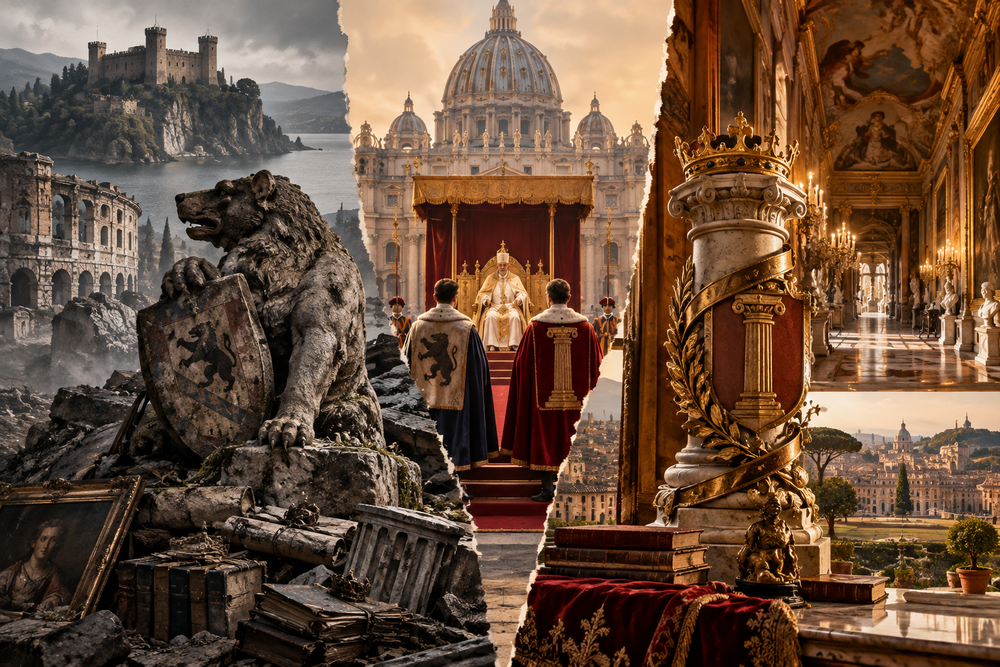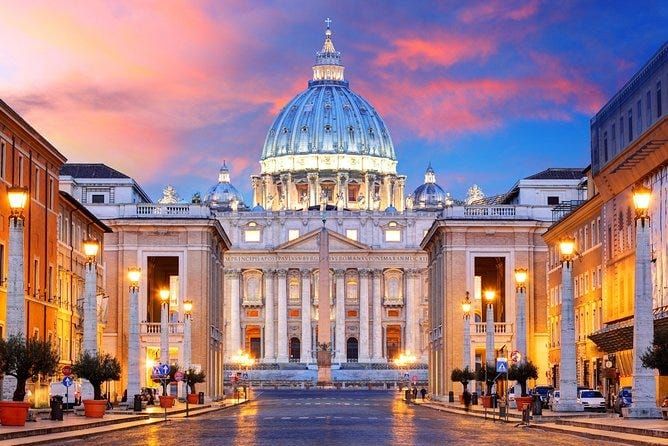
The visible story is a tiny city-state with no army and no economy. The determining variable is that its power was never stored in territory at all; it lives in an office, and an office cannot be conquered the way land can.
People who go looking for hidden power usually look for a hidden room. A table somewhere behind the visible world, a small group deciding the large questions, a secret that, if only it were exposed, would explain everything. The search is old and the names rotate through it: secret societies, banking dynasties, private clubs where the powerful talk off the record. The assumption underneath all of them is that real power must be concealed, and that to find it you must find what is being hidden.
The Vatican is the standing refutation of that assumption. It is one of the most durable concentrations of authority in the history of the world, and almost nothing about it is hidden. Its head of state is photographed daily. Its constitution is published. Its diplomatic relations are listed. Its sovereignty is recognized in open treaties and seated, by name, in the chambers of the United Nations. There is no secret to expose, because the power was never in a secret. It is in a form, a particular legal and institutional shape that the world has agreed to treat as a sovereign, and that shape has outlasted every empire that ever owned more land, more soldiers, and more money than the popes. To understand the hidden throne you do not need to find a hidden room. You need to look very carefully at the thing sitting in plain sight and ask why it has never fallen.
The sovereignty that needs no country
Begin with a distinction almost everyone collapses and that explains nearly everything. There are two entities on the small hill across the Tiber, not one. There is Vatican City, a territory of about forty-four hectares, the smallest state in the world by both area and population. And there is the Holy See, the central government of the Catholic Church, the office of the bishop of Rome and the institutions that act in his name. In everyday speech the two are used interchangeably. In law they are not the same kind of thing at all, and the difference is the whole secret that is not a secret.
It is the Holy See, not Vatican City, that conducts diplomacy, signs treaties, and is recognized as a sovereign subject of international law. The territory exists to serve the office; the office does not derive its standing from the territory. This is why the Holy See exchanges ambassadors and the city-state does not, why concordats are signed with the Holy See and not with Vatican City, why the entity seated at the United Nations is the Holy See. International lawyers have a slightly awkward time with it, because the Holy See is a sovereign that is not a state in the ordinary sense, a sovereignty attached to an office and a function rather than to a country and a population. That awkwardness is not a flaw in the arrangement. It is the arrangement. The Vatican is sovereign the way few things in the modern world are sovereign: not because it holds ground, but because it holds an office that the system of states recognizes as a peer.
Once that distinction is in view, the famous durability of Rome stops being a mystery of wealth or secrecy and becomes a property of design. A power that is stored in territory can be taken by taking the territory. A power that is stored in an office can only be ended by destroying the office, and an office is far harder to destroy than a province, because it has no borders to cross and no capital to burn. You cannot lay siege to a function.
How the throne acquired its country
The territory the Vatican lost in 1870 was itself a medieval acquisition, which is worth dwelling on, because it shows that even the land was a late addition to an office that had existed for centuries before it. The popes did not begin as temporal rulers. The Papal States were created in the middle of the eighth century, when the Frankish king Pepin the Short defeated the Lombards and, in 756, handed the conquered territories of central Italy to the papacy. The bishop of Rome, already an ancient office, thereby became a secular prince as well, and ruled a substantial Italian state for the better part of eleven centuries, from the 750s until 1870.
So the timeline runs in a revealing order. First there was the office, the bishopric of Rome, reaching back into late antiquity. Only centuries later did the office acquire a kingdom, by the gift of a Frankish king. And then, after eleven hundred years, the kingdom was taken away, and the office continued. The temporal state was something the papacy gained and lost; the office was the constant on either side of it. A reader who treats the Papal States as the essence of papal power has the relationship inverted. The kingdom was the variable. The office was the spine that acquired the kingdom, carried it, and outlived it.
There is a useful irony in how the kingdom was first justified. For centuries the papacy's claim to temporal rule leaned partly on the Donation of Constantine, a document purporting to record the emperor Constantine granting the popes dominion over the western empire. The document was a forgery, exposed definitively in the fifteenth century by the scholar Lorenzo Valla. The temporal kingdom, in other words, rested for a long time on a fabricated title, while the office that held the kingdom needed no such prop. Strip away the forged donation and the temporal claim wobbles; the office stands exactly where it always stood. Even at the level of its own paperwork, the Vatican's durable part and its perishable part were never the same thing.
Losing the country and keeping the crown
The strongest proof that the Vatican's sovereignty was never in its land is that, for an entire human lifetime, it had no land, and lost nothing essential.
For more than a thousand years the popes had ruled the Papal States, a substantial territory across central Italy. Then, in 1870, the army of the newly unified Kingdom of Italy entered Rome, completed the unification of the peninsula, and absorbed the Papal States, including the city of Rome itself. The temporal kingdom of the popes, built up over centuries, was gone. Pope Pius IX retreated into the Vatican palace and refused to recognize the loss, casting himself as a prisoner; his successors held the same posture for decades. By every measure the textbook uses to define a state, the papacy had just ceased to be one. It had no territory it controlled, no army, no border.
And for the next fifty-nine years it went on being a sovereign anyway. Through the whole stateless span from 1870 to 1929, the Holy See continued to send and receive ambassadors. Foreign governments continued to maintain diplomatic missions to it. It continued to negotiate and sign concordats with states as a sovereign equal. It was treated, in the practice of nations, as what it claimed to be, a sovereign subject, even though it had been stripped of the one thing the modern definition of sovereignty is supposed to require, which is territory. The half-century of statelessness is the cleanest natural experiment in the whole history of sovereignty, and its result is unambiguous. Take away all the land, and the throne is still there, still recognized, still functioning. Whatever the Vatican's sovereignty was made of, it was demonstrably not made of ground.
The office that outlived its own rivals
If 1870 proved the office could survive losing its territory, an older crisis proved something stranger: that it could survive losing agreement about who held it. In 1309 the papacy decamped to Avignon in southern France and stayed for most of the century, a period later called the Avignon Papacy. When the popes finally returned to Rome, the strain broke open. In 1378 a disputed election produced two claimants, one in Rome and one back in Avignon, each insisting he was the true pope, each backed by a different bloc of European kingdoms. This was the Western Schism, and it lasted nearly forty years. An attempt to resolve it at the Council of Pisa in 1409 only made it worse, producing a third claimant, so that for a time there were three men, each calling himself pope, each with cardinals, revenues, and obedient nations.
By the test that defines most institutions, this should have been fatal. The single most important fact about the office, who actually holds it, was in open dispute for four decades, with rival armies of clergy and the crowned heads of Europe lined up behind incompatible answers. And yet the institution did not dissolve into its rival claimants. It was finally reunified at the Council of Constance, which between 1414 and 1418 secured one resignation, deposed the other two claimants, and elected a single pope, Martin V, in 1417. The schism ended; the papacy went on.
The lesson cuts deeper than the territorial one. In 1870 the Vatican kept the office while losing the land. In the Western Schism it kept the office while losing all agreement about the man. Through forty years in which no one could say with certainty who the pope was, no one doubted that there was a papacy, an office real enough to be worth fighting over by three men at once. The office was more solid than any of its claimants, which is only possible if the office is the actual unit of power and the man is its temporary occupant. An institution that can be contested by three rivals and emerge as one has located its permanence somewhere other than in the person who happens to wear it.
A state handed back by treaty
The episode that supposedly restored the Vatican is, read carefully, the strongest confirmation that it never needed restoring.
In 1929 the Holy See and Mussolini's Italian government signed the Lateran Treaty, which settled the long standoff and created the State of Vatican City as a sovereign territory under the pope. The conventional telling treats this as the moment the Vatican became a state again. But notice what actually happened. A sovereignty that had survived fifty-nine years with no territory was provided with a small territory, deliberately tiny, expressly so that the office would have a patch of ground it indisputably controlled and could never again be made a prisoner inside someone else's country. The territory was created to serve the pre-existing sovereignty, not to constitute it. The Holy See did not become a sovereign in 1929. It was already a sovereign, and had been throughout the years it owned nothing. What 1929 added was a floor under its feet, forty-four hectares chosen for sufficiency, not for power.
This is why the smallness is not a curiosity but a statement. Every other sovereignty in the world correlates its standing with its size, its resources, its capacity to project force. The Vatican deliberately holds the least territory that sovereignty can sit on, because in its case the territory was never the source of the sovereignty in the first place. The state exists to anchor the office. The office is the thing.
The last absolute monarchy
Inside that tiny state sits a form of government that has otherwise vanished from the earth. Vatican City is an absolute monarchy. The pope holds full legislative, executive, and judicial power in a single person; there is no separation of powers, no parliament that can overrule him, no constitution he did not ultimately authorize and cannot revise. In a world that spent the last three centuries dismantling absolute monarchy almost everywhere it existed, one absolute monarchy remains, and it is the one the modern democracies treat as a respected diplomatic partner rather than an anachronism to be reformed.
But the decisive feature is not that the monarchy is absolute. It is that the monarchy is elective, and that single design choice is what has carried it across two thousand years while hereditary dynasties decayed and fell around it. A hereditary throne is hostage to biology. It passes to whoever is born next in line, which means it passes, sooner or later, to a child, an incompetent, a madman, or no one at all, and dynasties die of exactly these accidents. The papacy escaped the trap. Its monarch is chosen, late in life, by an electorate of cardinals, from a pool selected over decades for the purpose. The crown never passes to an infant. It never sits empty waiting for an heir to come of age. When a pope dies, the office does not weaken; it enters a defined vacancy, the sede vacante, and is filled by deliberate selection rather than by the lottery of birth.
The result is an absolute monarchy immune to the one disease that kills absolute monarchies. It concentrates power as completely as any Bourbon or Romanov ever did, and then renews its holder by choosing the next one, which means it never has to gamble the whole structure on the genetic luck of a single bloodline. The throne cannot be inherited badly because it is not inherited at all. It is the oldest trick in the institutional book, the separation of the office from the man, executed more completely and for longer than any other institution on earth has managed.
The renewal mechanism is worth seeing in detail, because its precision is the point. When a pope dies or resigns, the office enters the sede vacante, the vacant seat, and authority passes temporarily to the College of Cardinals, with day-to-day affairs in the hands of an official called the camerlengo. Within a set period the cardinal electors gather in a conclave, sealed off from the outside world, and vote in repeated rounds until one candidate reaches a two-thirds majority. The electorate is itself the product of design: only cardinals under the age of eighty may vote, a rule fixed in 1970 to keep the choosing body from aging into incapacity alongside the men it once elected. The procedure has been refined over centuries precisely to guarantee that the vacancy is always brief, the choice always deliberate, and the succession never left to chance or to birth. Where a dynasty waits for nature to deliver its next ruler, the papacy manufactures its next ruler on a schedule, by election, from a vetted field. The whole apparatus exists to make sure that the death of the man is never the death of the office, and it is written down, published, and rehearsed, so that the most vulnerable moment in the life of any monarchy, the empty throne, is for this one a routine administrative procedure with a known end.
The absolute power itself is not informal or merely traditional; it is constituted in writing. Vatican City has a Fundamental Law, a short written constitution promulgated by the pope on his own authority, which vests full legislative, executive, and judicial power in him and delegates the running of the territory to a governing commission and a governorate that act in his name. The document can be revised by the pope alone, which is itself the signature of an absolute monarchy: the constitution exists at the sovereign's pleasure rather than above him. What makes this absolutism survivable, where every other modern absolutism became intolerable and was overthrown, is that it governs almost no one. An absolute monarch over a great population is a tyrant; an absolute monarch over a few hundred officials and a square kilometer of offices and basilicas is a constitutional curiosity that the world is content to leave alone. The form keeps the total concentration of power and sheds the population that would make such concentration unbearable, which is one more way the institution has arranged to keep the durable part and let the dangerous part go.
The diplomatic body older than the states it speaks to
The office does not merely persist; it operates, and its main instrument is the oldest continuously functioning diplomatic service in the world. The Holy See maintains formal diplomatic relations with more than 180 states, a network of nuncios, the papal ambassadors, that predates the foreign ministries of almost every country it deals with. When the modern system of resident embassies was taking shape in Renaissance Italy, the papacy was already a practiced player at it. The states it now exchanges ambassadors with are, almost without exception, younger than the institution receiving their envoys.
That diplomatic apparatus is a sovereign instrument, not a religious courtesy. The Holy See sits at the United Nations as a Permanent Observer, a standing it took up in 1964 and saw enlarged in 2004 to include nearly all the participation rights of a full member short of the vote, which gives it a voice and a seat in the deliberations of the society of states, a position it has used to shape debate on exactly the questions where it has a doctrinal stake. It is, notably, not a member state and has generally declined to become one, which fits the logic of the whole institution: full membership would tie its standing to the machinery of the state system, while observer sovereignty keeps it adjacent to that system and dependent on none of it. The same instinct that holds the smallest possible territory holds the lightest possible attachment to the club of nations, present in every room, bound by none of the obligations that could be used as leverage against it. It negotiates concordats, bilateral treaties that fix the legal position of the Church inside a given country, and the striking feature of concordats is their durability. Governments that sign them fall; the constitutions that surrounded them are rewritten; the concordats frequently remain, because they were made with a sovereign that outlasts the government on the other side of the table. The Holy See has signed agreements with monarchies that became republics, with democracies that became dictatorships, and with dictatorships that became democracies again, and across those transformations its treaties have a way of surviving the regimes that signed them.
The pattern is visible in specific cases. In 1801 Pius VII signed a concordat with Napoleon that re-established the Church in France after the Revolution had tried to dismantle it; the revolutionary state that had de-Christianized France negotiated, within a decade, with the institution it had tried to abolish. In 1933 the Holy See signed the Reichskonkordat with the German government months after Hitler took power, fixing the Church's legal rights in the Reich; the Nazi state that signed it was annihilated in 1945, and yet the Reichskonkordat was held to remain in force for the Federal Republic that succeeded it, a treaty that outlived by decades the regime that put its name to it. In 1929 the Lateran accords made Roman Catholicism the state religion of Italy; in 1984 a revised concordat between the Holy See and the Italian republic quietly ended that establishment, the same sovereign adjusting its terms with a transformed Italy fifty-five years on. In each case one party to the agreement passed through revolution, defeat, or refounding, and the other party was still there, the same continuous sovereign, ready to sign the next version. The concordat is a treaty between an institution that thinks in electoral cycles and one that thinks in centuries, and the asymmetry tells in which signatures survive.
There is a recognition function in all of this that is easy to miss. For a very long time, to be received by the pope, to exchange ambassadors with the Holy See, to sign a concordat, was to be acknowledged as a legitimate member of the society of sovereigns by the oldest sovereign in it. The Lateran Treaty itself did double work in 1929: it gave the Holy See its territory, and it gave Mussolini's regime the prestige of having settled the Roman question that liberal Italy never could. Recognition flowed in both directions. The throne that wants nothing from you materially can still give you something you cannot get elsewhere, which is the acknowledgment of an institution that was conferring and withholding legitimacy centuries before your state existed.
The power to confer legitimacy
The modern recognition function, the quiet prestige of being received at the Vatican, is the worn-down remnant of something that was once enforced with the full weight of the medieval order. For centuries the papacy did not merely acknowledge rulers; it claimed the authority to make and unmake them. In the year 800 the pope crowned Charlemagne emperor in Rome, an act that announced that imperial legitimacy in the West passed through the papal hand. The Holy Roman Emperors who followed sought papal coronation because the title was understood to be incomplete without it. The office in Rome had become the place where temporal authority went to be validated.
The high-water mark of the claim is captured in a single image. In the Investiture Controversy of the eleventh century, Pope Gregory VII and the emperor Henry IV fought over who controlled the appointment of bishops, and the pope excommunicated the emperor, releasing his subjects from their allegiance. In 1077, to have the sentence lifted, Henry came to the castle of Canossa and, by the chronicles, waited in the snow as a penitent before the pope would receive him. Whatever the scene's exact details, its meaning rang across Europe: the most powerful secular ruler of the age had to seek the validation of the office in Rome. Two centuries later the claim was stated at its most absolute, when Boniface VIII's bull Unam Sanctam of 1302 declared that submission to the Roman pontiff was necessary for every human creature, the boldest assertion of papal supremacy over temporal power ever put on parchment.
The medieval claim to depose kings did not survive the rise of the nation-state, and the papacy lost the contest for supremacy over secular rulers; that much the realist gets right. But the residue did not vanish. What remained, once the power to command obedience was gone, was the older and quieter power to confer legitimacy, to recognize, to receive, to treat with as a peer or to decline to. The pope no longer crowns emperors, but the society of states still seats his envoy, still signs his treaties, still counts an audience in the Apostolic Palace as a thing worth having. The coercive claim burned away. The recognition function it was built on is still alight, which is exactly what one expects of an institution whose durable layer was never the part that gave orders.
The office as the unit of power
Lay these features side by side and the pattern resolves into a single principle. The Vatican's power is not stored where power is usually stored. It is not in a large territory, because the territory is the smallest in the world. It is not in an army, because there is none to speak of. It is not in an economy of scale, because the population could fit in a village. It is not even, despite the rumors that cling to it, primarily in hidden wealth, because wealth is seizable and contingent and the Vatican's endurance has survived periods of genuine poverty and crisis. The power is in the form: a sovereignty lodged in an office rather than a place, an absolute authority renewed by election rather than birth, a diplomatic personality older than its counterparts, recognized openly by the very system of states that has dissolved nearly every comparable institution.
This is why the Vatican belongs in the same study as the fall of Rome and the survival of empires, and why it is, in a sense, the purest case of all of them. The recurring finding across those histories is that a regime is the part of power built to be seen and an apparatus is the part built to last, and that when the visible regime ends the apparatus is quietly inherited and goes on. The Vatican took that principle to its conclusion. It made the apparatus the whole of the thing. There is almost no perishable regime left to fall away, no large territory to lose, no dynasty to die out, no economy to collapse; there is mostly just the office, which is the part designed to survive, operating in the open. The hidden throne is hidden only in the sense that a load-bearing wall is hidden. It is in plain sight, holding everything up, and we look past it precisely because it is too obvious and too permanent to read as power.
The strongest objection
The strongest objection is that this confuses durability with power, and that what the Vatican actually has is not power at all but its echo. A serious realist would say: power is the capacity to make others do what they otherwise would not, and it rests, in the end, on force or money. The Vatican has neither. It cannot tax, conscript, sanction, or invade. Its sovereignty is a convenience the international system extends to it and could withdraw; its diplomacy is influence at most, not command; its absolute monarchy governs a few hundred people on a few hectares. To call this one of the great powers of history is to mistake longevity and ceremony for the real thing. A institution can persist for two thousand years precisely because it threatens no one and asks for nothing it could be denied.
This objection is correct about what the Vatican is not, and it sharpens rather than refutes the claim. The Vatican is plainly not a coercive power; it commands no one through force, and the essay does not pretend otherwise. But the realist definition smuggles in an assumption, that the only power worth the name is the power to compel, and the long record argues against it. The forms that could compel, the empires with the armies and the treasuries, are gone, every one of them, and the form that could compel nothing is still here, still sovereign, still recognized, still receiving the representatives of the states that replaced those empires. What the Vatican demonstrates is a different quantity from coercive power, and arguably a scarcer one: the capacity to endure as a recognized sovereign across the rise and fall of every coercive power around it. If power is only the ability to force an outcome this year, the Vatican has little of it. If it includes the ability to still be standing, sovereign and acknowledged, when the forcers have all fallen, then the Vatican may have more of it than anyone, and it got there by storing its authority in the one vessel that armies cannot reach.
What remains
To be exact about the claim, this is documented structure carrying a marked reading, and the two are kept apart on purpose. The documented part is not in dispute. The Holy See and Vatican City are legally distinct, and it is the Holy See, a sovereign subject of international law, that conducts the Vatican's external affairs. The Papal States were absorbed by Italy in 1870, and the Holy See nonetheless functioned as a recognized sovereign, exchanging ambassadors and signing concordats, throughout the territory-less decades until the Lateran Treaty of 1929 created the State of Vatican City. That state is an absolute monarchy with an elected monarch. The Holy See maintains diplomatic relations with more than 180 states and holds Permanent Observer status at the United Nations. None of this is hidden or contested.
The marked, interpretive part is the reading offered here: that these documented facts are best understood as a single mechanism, sovereignty lodged in an office rather than a territory, which is what has made the institution uniquely resistant to the kinds of collapse that ended its rivals. That reading is an interpretation, not a documented intention, and it would weaken if the Vatican's survival turned out to be better explained by ordinary factors, by accumulated wealth, by the protection of larger powers, or by simple historical luck, than by the structural feature emphasized here. The essay names that condition rather than hiding from it. And it makes no claim of a secret directing hand, no hidden room behind the visible Church; the argument is precisely that the power is in the visible form and needs no secret to work.
What the hidden throne finally teaches is a correction to the instinct it begins with. We look for power in what is concealed, and we miss the power that is sitting in the open in a shape we have stopped seeing. The most enduring sovereign in the world publishes its constitution, lists its ambassadors, and seats itself under its own name at the United Nations, and we read past it because we are still looking for the secret table. There is no secret table. There is an office that learned, longer ago and more completely than anything else in the modern world, to keep its power in the one place that neither armies nor centuries have ever been able to take.
Evidence Map
Facts, interpretations, forecasts, and disconfirming signals.
Core claim. The Vatican's durability comes not from territory, wealth, or secrecy but from a sovereignty lodged in an office, the Holy See, rather than a place; it is the world's last absolute monarchy, and an elective one, which is why it survived losing all its territory between 1870 and 1929 and even survived losing agreement over who held the office during the Western Schism.
Evidence level. Facts: high (the legal distinction between the Holy See, a sovereign subject of international law, and Vatican City; the 1870 absorption of the Papal States and the stateless 1870-1929 span of continued recognized diplomacy and concordats; the 1929 Lateran Treaty creating Vatican City; the absolute elective monarchy and conclave mechanics; the Donation of Pepin of 756 and the Donation of Constantine forgery exposed by Valla; the Western Schism of 1378-1417; the 1801, 1933 and 1984 concordats; Permanent Observer status at the UN since 1964). Interpretation: medium (reading these documented facts as one mechanism, sovereignty lodged in an office rather than a territory). No hidden directing hand is claimed; the argument is that the power sits in the visible form.
What would confirm this. The office continuing to be recognized as sovereign through the losses that end territorial states (the 1870-1929 statelessness, the contested succession of the Schism); and the same office-survives-the-regime pattern recurring across the series' other cases.
What would disprove this. The Vatican's survival proving better explained by accumulated wealth, the protection of larger powers, or simple historical luck than by the office-not-territory structure emphasized here; or the Holy See's sovereignty proving to rest, after all, on its territory rather than its office.
Watchlist. Evergreen and historical: the documented spine is fixed, and the mechanism is reviewed against the series' other office-and-apparatus-survival cases, Rome Never Fell, The Archive of Power, and The Soviet Illusion.
Jerry van der Laan writes The Manifest Archive, a continuous investigation into how institutions, language, and systems shape what people are permitted to see as reality. He does not report events. He traces the structures beneath them.
Related from The Manifest Archive