The visible story is a dramatic ending in the year 476. The determining variable is which parts of Rome were ever load-bearing, because the part that broke was the western state, and the part that lasted was the apparatus that outlived it.
A child is taught the fall of Rome as a single picture. Barbarians at the gate, a city in flames, the last emperor deposed, and then the lights going out across Europe for a thousand years. The picture is vivid, datable, and easy to carry, which is exactly why it survives. It is also, in the specific form the classroom teaches it, closer to a story than to the record. Something did break in the fifth-century West, and it broke hard. But the thing that broke was not the thing the story names, and the thing that lasted was never in the picture at all.
The honest version begins with a smaller event than the myth. In 476 the Germanic commander Odoacer deposed Romulus Augustulus, a teenage emperor who had reigned in the West for less than a year, and declined to appoint a successor. He did not declare Rome abolished. He sent the imperial regalia east to Constantinople, to the emperor Zeno, with the message that the West no longer needed a separate emperor of its own, and asked to govern Italy in Zeno's name. The man who is supposed to have ended the Roman Empire announced himself as its administrator. That gesture is the whole subject of this essay in miniature: a visible end that is, on closer reading, a transfer.
The year that did less than it seems
Treat 476 as a hinge and the date dissolves. There had been no emperor worth the name in the West for decades before it; real power sat with Germanic generals who made and unmade figureheads. There continued to be a Roman emperor after it, in Constantinople, ruling an unbroken Roman state that called itself Roman until 1453. The Senate of Rome went on meeting and corresponding into the sixth century; its last securely attested act is dated to around 603, when it acclaimed statues of the emperor Phocas and his consort. Consuls were still being named. Roman law still ran in the courts of the men who had supposedly destroyed Rome, because the Ostrogothic and other successor kings governed their Roman subjects by Roman law and kept the Roman administrative class in place to do it.
What 476 marks, read precisely, is the moment the western half stopped maintaining a separate imperial office. It is a real event and a real fracture. It is not the disappearance of an empire, a body of law, a language, a church, or a ruling culture. Those things did not vote to end in 476. Most of them did not notice the year at all.
What actually broke
The Manifest's discipline is to concede the strongest version of the opposing case before making its own, and here the opposing case is strong and must be stated at full weight. The historian Bryan Ward-Perkins has argued, against the gentler academic fashion, that the fall of the western empire was a genuine catastrophe and not a polite handover. In the western provinces after the fifth century, the archaeology shows a steep material decline: long-distance trade contracted, mass-produced fine pottery vanished from ordinary sites, coinage thinned, monumental building in stone largely stopped, and even something as basic as standardized roof tile became rare. Literacy narrowed. Population fell. For most people in Britain, Gaul, Spain, and Italy, the centuries after Rome's western government dissolved were poorer, more local, more dangerous, and shorter-lived. To call that a mere costume change would be a lie told from a library.
So this is the boundary, drawn honestly. The western Roman state fell. The western Roman economy fell with it. The integrated Mediterranean world that the empire had run as a single market broke into fragments, and the fragments were worse off. None of that is in dispute here. The claim is narrower and harder to see, and it sits underneath the rubble: while the state and the economy broke, the institutional apparatus of Rome, its law, its language, its administrative forms, and above all its central religious office, did not break. It was inherited. And over the long run it was the inherited apparatus, not the lost legions, that decided the shape of the world that followed.
What did not break: the law
Begin with the most concrete carrier, the one that requires no interpretation. Between 529 and 534, the eastern emperor Justinian had the entire inheritance of Roman law gathered, edited, and codified into what later ages called the Corpus Juris Civilis, the body of civil law. It was a Roman act performed in a Roman state a half-century after the West's supposed fall. For centuries it sat mostly dormant in the West. Then, in the late eleventh and twelfth centuries, scholars at Bologna recovered it, and it became the foundation text of legal study across Europe.
The consequence is still load-bearing today. The civil-law systems of continental Europe, and through them the legal systems of most of Latin America and much of Africa and Asia, descend in their categories and reasoning from that codified Roman law. When a French or German or Brazilian court reasons about contracts, property, or obligations, it is working inside a structure a Roman jurist would recognize. The empire that is supposed to have died in 476 still writes the rules in roughly half the courtrooms on earth. This is not metaphor and not lineage-as-flattery; it is the documented descent of a working system.
What did not break: the office
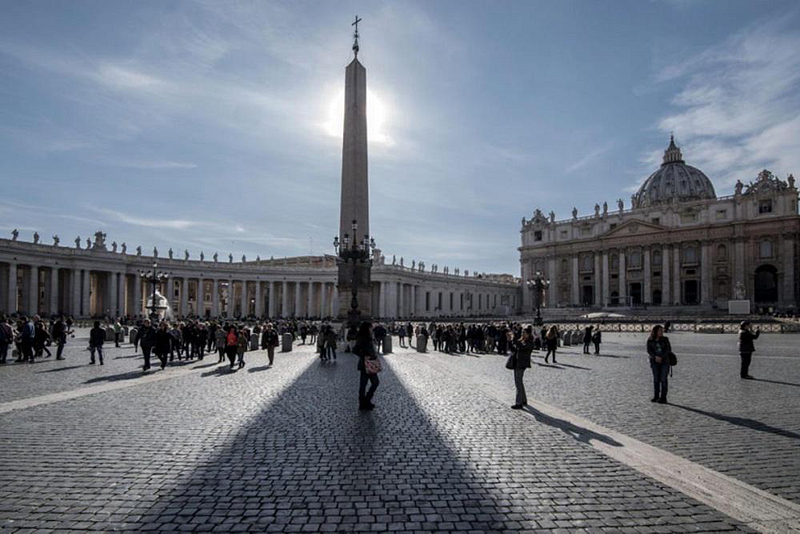
The second carrier is institutional, and its survival is the plainest of all because it required no title to be inherited at all. As the western imperial administration thinned through the fifth and sixth centuries, the Church in Rome absorbed its forms. It kept Latin as its working language when Latin had stopped being anyone's mother tongue. It governed through a chancery and a body of canon law modeled on Roman administrative and legal practice. It conducted what amounted to foreign policy. Leo the Great met Attila in 452; Gregory the Great, around the year 600, was effectively administering Rome and feeding its population while the imperial apparatus that once did so had withered. Into the vacuum left by the vanished western state stepped an institution that spoke its language, used its law, and sat in its capital. The visible empire had no emperor in the West. The institution that took over its functions in Rome was the Church.
The famous title is a subtler case, and an honest reading makes it more interesting, not less. The chief priest of pagan Rome held the style Pontifex Maximus, supreme bridge-builder, head of the state religion; the emperors absorbed it from Augustus onward, and the popes carry it today. But the line between is not unbroken. The emperors let the pagan high-priesthood go late in the fourth century, when Gratian renounced the office, and for roughly a thousand years afterward the bishops of Rome did not routinely use the title. It was the Renaissance papacy, from the middle of the fifteenth century, that deliberately revived Pontifex Maximus and inscribed it on coins and monuments, consciously reaching back across the gap to clothe the papal office in the dignity of imperial Rome. Read as unbroken succession, the title is a myth. Read accurately, it is something the Manifest finds more telling: a documented case of an institution reaching back over a millennium to reclaim Rome's central office on purpose, because the prestige of continuity was worth manufacturing. The interval is real. So is the deliberate decision to close it.
What did not break: the administrative skeleton
There is a further carrier, and it is the most physical of them: the map. When the emperor Diocletian reorganized the empire around the turn of the fourth century, he grouped its provinces into larger administrative units called dioceses, each the responsibility of an official who answered upward through a chain of command. When the western administration dissolved, the Church kept the name. To this day the basic territorial division of the Catholic Church is the diocese, governed by a bishop, carrying the name of a Roman administrative district drawn seventeen centuries ago and, across much of the old empire, the boundaries of the smaller Roman city territory, the civitas. The Church did not invent a structure to govern itself. It inherited the empire's filing system and never gave it back.
The diplomatic apparatus survived the same way, and it is the carrier the original telling of this story rightly emphasized. Having lost its legions, Rome kept its negotiating table. The Holy See conducts foreign relations as a sovereign actor and maintains formal diplomatic ties with more than 180 states, a reach older and wider than almost any government now in existence. It negotiated with the powers that were supposed to have buried it, signing agreements with Napoleon, with Mussolini, with a long line of states that persecuted Catholics and bargained with the papacy anyway. In 1929 the Lateran Treaty with Mussolini's Italy re-established the Vatican as a sovereign state with its own territory, passports, and standing, formally resurrecting on paper a sovereignty the popes had lost in 1870. An institution that can lose its state in one century and be handed a new one by treaty in the next is not living on memory. It is operating an apparatus that the modern system still treats as a state.
The empire that kept the name
Another carrier is the simplest and the most often forgotten: a Roman empire continued to exist, under that name, for another thousand years. The state ruled from Constantinople never called itself Byzantine. That word is a later coinage of historians who wanted a clean break. Its own people called themselves Romaioi, Romans, and called their state the Empire of the Romans, without interruption, from the foundation of Constantinople until the city fell to the Ottomans in 1453. For most of the period the western classroom files under the fall of Rome, there was a living, self-described Roman emperor on a throne, issuing Roman law in Greek, ruling a Roman state.
The word Byzantine, which makes the eastern state sound like a separate thing, did not become the standard name for the eastern state until 1557, when the German scholar Hieronymus Wolf applied it to the medieval Roman sources he was editing, more than a century after the empire he was labelling had already fallen. Its own people never heard the word. They called themselves Rhomaioi, Romans, and their country Romania, the land of the Romans, to the end. And the eastern state was not a passive survivor. From the 530s the emperor Justinian sent his general Belisarius west and reconquered North Africa from the Vandals and, in a war that ran into the 550s, Italy itself from the Ostrogoths, so that for a generation Rome and Ravenna were again governed from a Roman capital, one that happened to sit on the Bosphorus. The empire the classroom buries in 476 retook the city of Rome in the sixth century. It is difficult to fall and then recapture your own capital.
And the West, having lost its emperor, kept trying to reconstitute one. In 800 the Pope crowned Charlemagne emperor in Rome, an act whose entire meaning was the claim that the Roman imperial dignity could be revived and transferred. From 962 that claim hardened into the Holy Roman Empire, a central European polity that insisted, in its very name, on being the continuation of Rome, and that lasted until Napoleon dissolved it in 1806. Medieval thinkers had a phrase for this machinery of continuation, translatio imperii, the transfer of empire, the idea that imperial authority did not die but passed from holder to holder. They were not describing a conspiracy. They were describing, in the language of their time, the mechanism this essay is about: the empire as a transferable office rather than a perishable place.
The third Rome
The transfer did not stop at the Latin West. When Constantinople finally fell to the Ottomans in 1453, the claim to be Rome’s heir migrated again, north and east. Within a few decades the grand princes of Moscow had taken it up explicitly. A Russian monk, Philotheus of Pskov, wrote to the ruler that two Romes had fallen, the old Rome and Constantinople, that Moscow was the third, and that a fourth there would not be. The Muscovite rulers married into the last Byzantine dynasty, adopted the double-headed eagle of the eastern empire, and took a title that was simply the Latin word for emperor worn down by Slavic mouths: tsar, from caesar, the same word the German emperors carried west as kaiser. By the time the doctrine hardened, three different states, the papacy in Rome, the Holy Roman Empire in central Europe, and the tsardom in Moscow, were each claiming, in their titles and their symbols, to be the continuation of the same empire that a textbook says ended in a single year. That is not what the death of an institution looks like. It is what a contested inheritance looks like, with more than one heir reaching for the same name.
The families as one carrier, not the whole story
There is a final thread, and it must be handled with more care than the popular version allows, because it is where a documented pattern shades quickly into fantasy. A cluster of Roman aristocratic families, later nicknamed the Black Nobility, supplied the personnel of papal Rome across many centuries. This part is record, not rumor. The Orsini and Colonna feuded as warlords and produced cardinals and popes; families such as the Aldobrandini, Borghese, Barberini, Pamphilj, Chigi and Boncompagni gave the Church popes and curial officials across the early-modern period; one hereditary court office attached to the papal throne was held by the Orsini and Colonna until it was reformed in the twentieth century. The continuity of named families inside a single institution, across the centuries that the textbook calls Rome's absence, is genuine and documented.
What is not documented, and what this essay declines to assert, is the further claim that these families constitute a hidden government steering European events from behind every throne. That version is unfalsifiable by design and is exactly the kind of story the apparatus thesis does not need. The families matter here only as one carrier among four, and the weakest-standing of the four, because the law, the office, the administrative skeleton, and the surviving eastern state carry the argument on documented ground without any appeal to secret control. The honest statement is the modest one: a set of families stayed fused to a durable institution and outlasted the regimes around them, which is what institutional power looks like, not what a cabal looks like.
The mechanism beneath the ruins
Lay the carriers beside the conceded collapse and the real shape appears. Rome as a western state and economy did fall, and the people who lived through it paid for the fall in poverty and danger. But a state is the part of power built to be seen, and an apparatus is the part built to last. Rome's apparatus, the codified law, the administrative Latin, the religious office, the very idea of a transferable empire, did not fall, because none of it depended on the western emperor whose deposition the story dates. It depended on institutions, and institutions can change owners without changing function.
This is the oldest case of a pattern the Manifest traces through later centuries under one name, the illusion of collapse. A regime ends visibly and on a date, and everyone marks the date. The apparatus the regime ran is quietly inherited by whoever is positioned to use it, and almost no one marks the inheritance, because an inheritance has no dramatic year. The determining variable is never the year of the fall. It is the question the year distracts from: which parts of this thing were ever load-bearing, and who picked them up. In 476 the load-bearing parts were the law, the language, the office, and the name, and the institution positioned to pick them up was the Church of Rome. The empire did not learn to hide through cunning. It hid the way all durable power hides, by being mistaken for the building that fell off the front of it.
The strongest objection
The strongest objection is not that any of this is false but that it proves less than the title promises. A serious historian of late antiquity would say: continuity of law, language, and religious office is real, but calling it the survival of the Roman Empire stretches the word empire past the breaking point. An empire is a political and military state with the power to tax, conscript, and command. That state did end in the West in the fifth century, and what continued was something genuinely new, the medieval Church and the kingdoms around it, wearing Roman clothes. To say Rome never fell, on this view, is to mistake influence for identity, the way one might say the Latin language never died because its words live on in French. The descendant is not the ancestor.
This objection lands, and the title concedes to it in one direction. If empire is defined strictly as a unitary tax-and-army state, then yes, the western one fell, and the essay has said so plainly. But the objection also reveals what it leaves out. It treats the apparatus as mere inheritance, decoration carried into a new building, when the apparatus was the thing that decided what the new building could be. Roman law did not flavor medieval Europe; it structured its courts. The papacy did not echo the empire; it governed as one, with the empire's office, capital, and language, for longer than the western empire had existed. The disagreement is finally about where to point the word Rome, at the dead state or at the living apparatus, and the Manifest points it, with the interpretation marked as interpretation, at the part that was still issuing rules a thousand years later.
What remains
To be exact about its claim, this is documented spine and marked reading, held apart on purpose. The documented part is not in serious dispute: the western imperial office ended in 476 while the eastern Roman state continued to 1453; Roman law was codified under Justinian and became the base of European civil law; the Church in Rome inherited the empire's administrative Latin, its canon-law forms, and its territorial unit the diocese, and the Renaissance papacy later reclaimed the imperial title Pontifex Maximus across a thousand-year gap; the Holy Roman Empire claimed Roman continuity into 1806; named Roman families supplied papal personnel for centuries. The marked, interpretive part is the sentence on the cover, that these inheritances are best read as one empire surviving the visible end of its state rather than as a set of separate borrowings. That reading would weaken if the carriers turned out to be disconnected coincidences rather than one continuous transfer, and the essay names that condition rather than hiding from it.
What the date teaches, then, is less a fact than a habit, the habit of believing that power ends when it stops being visible. Rome is where the habit was first installed, because Rome is where the gap between the dramatic ending and the quiet continuation is widest and easiest to measure. The empire did not need to conspire to survive its own funeral. It only needed an heir standing in the same room, speaking the same language, holding the same office, and a world content to read the funeral and skip the will.
Evidence Map
Facts, interpretations, forecasts, and disconfirming signals.
Core claim. The fall of Rome in 476 ended the western imperial state, but the load-bearing parts of Rome, its codified law, its administrative Latin and territorial units, the surviving eastern Roman state, and a later deliberately reclaimed imperial office, did not depend on that emperor and were inherited; an apparatus outlived the regime.
Evidence level. Facts: high (Odoacer deposing Romulus Augustulus in 476 and returning the regalia to Constantinople; the eastern Roman state self-identifying as Roman to 1453; Justinian's Corpus Juris Civilis of 529-534 and its Bologna revival as the base of European civil law; the diocese as a Roman administrative unit kept by the Church; the Holy Roman Empire to 1806; the Lateran Treaty of 1929; named families supplying papal personnel). Interpretation: medium (reading these inheritances as one empire surviving the visible end of its state). The popular claim that the title Pontifex Maximus passed unbroken is rejected in the text as a Renaissance reclamation across a thousand-year gap; no hidden government is claimed.
What would confirm this. The carriers proving to be one continuous inheritance rather than coincidences (documented institutional descent of Roman law, administration, and the eastern state into medieval and modern Europe); and the same apparatus-survival pattern recurring in the series' later collapses.
What would disprove this. The carriers turning out to be disconnected borrowings rather than a continuous transfer; or evidence that the post-Roman institutions (the Church, civil law, the eastern empire) were genuinely new constructions rather than inherited Roman apparatus.
Watchlist. Evergreen and historical: the documented spine is fixed, and the general mechanism is reviewed against the series' other apparatus-survival cases, the Soviet Illusion, the Reich, and the Black Nobility.
Jerry van der Laan writes The Manifest Archive, a continuous investigation into how institutions, language, and systems shape what people are permitted to see as reality. He does not report events. He traces the structures beneath them.
Related from The Manifest Archive