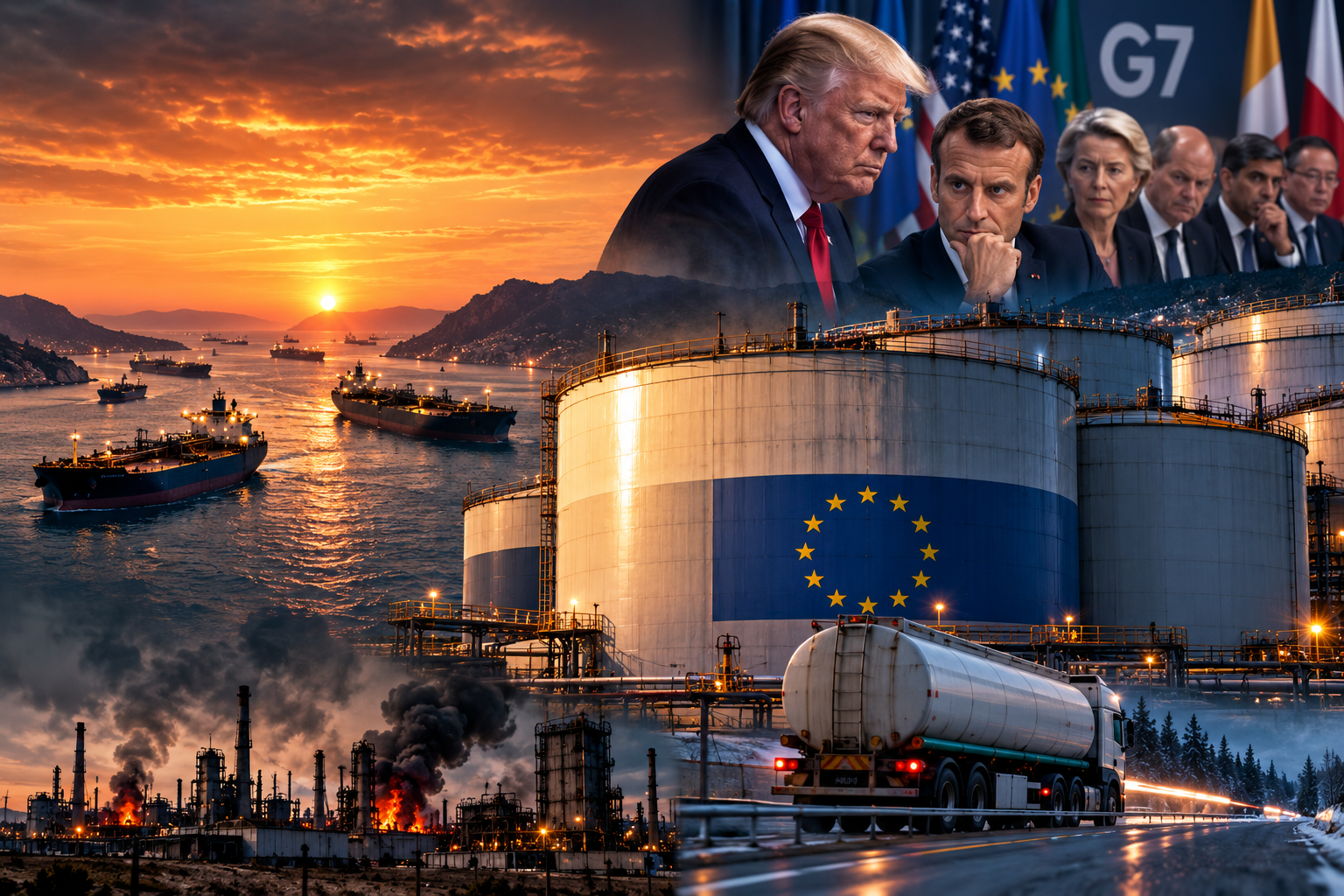
On Friday 2 October, at one minute past ten in the morning in Washington, Donald Trump typed a sentence about European storage tanks. "Europe has just agreed to release a massive amount of their heavily stocked Diesel Oil," he wrote on Truth Social. "The process will begin immediately." In Paris it was just after four in the afternoon. Emmanuel Macron, who holds the G7 presidency this year, had opened a video call of the seven leaders about an hour and a half earlier, and the number that came out of it was 100 million barrels, to be released over four months, with the diesel first.
Two words in the president's post stayed with me. Heavily stocked. For most of this year the standard line on emergency reserves, including in this archive, has been that they hold the wrong thing. Reserves are crude oil, the shortage is diesel, and crude is of little use when the refineries that would process it are full, damaged or cut off. If that were the whole story, there would be nothing in Europe for an American president to demand.
So I went to look at what is in the tanks. The answer changed how I read the release, and it changed a sentence I published here a week ago.
Ninety-eight percent, and fifty-eight
Start with the pair of numbers that made the question urgent, and take both from the same source on the same day.
At the end of September, analysts at JPMorgan led by Natasha Kaneva estimated that crude oil was leaving the Middle East at about 17.5 million barrels a day, roughly 98 percent of its pre-war volume. After seven months of war, a strait closed to most traffic for much of that time, and pipelines under attack, the raw material was almost all the way back. In the same note they put exports of refined products such as diesel, gasoline and jet fuel at about 3 million barrels a day. That is 58 percent of the pre-war level.
Other measures put the fuel further behind, though none of them can be laid directly beside JPMorgan's crude figure. Goldman Sachs, comparing against the 2025 average and not the eve of the war, had shipments of the main products at about half. The International Energy Agency's September report, which looks at diesel and gasoil alone and at August, put the Gulf's net exports at about 390,000 barrels a day, just over a quarter of pre-war levels. That is the narrowest of the measures and the oldest. A figure of "25 percent" has been set against the 98 in some coverage this week as if the two were a matched pair. They are not: one is crude in late September, the other is one product in August.
The matched pair is enough. The same region, behind the same disrupted waterway, has produced two recoveries forty points apart, and the gap is not mainly about shipping lanes. JPMorgan's analysts put the result in one line: the crude market "has largely normalized even as refined product supplies remain constrained."
The pipeline to Yanbu, and the plant that cannot move
The reason sits in the difference between moving something and making something.
A barrel of crude has options. It can leave Saudi Arabia through the Gulf or cross the country by pipeline and leave from Yanbu on the Red Sea. When one exit closes, some of the flow can be sent to another, at a cost in freight and insurance that this archive has described before. That is how the headline figure recovered. Richard Meade, the chief editor of Lloyd's List, was careful about what the recovery means: higher exports, he said, "do not necessarily mean that the Strait of Hormuz has become safe. They simply show that the oil industry has become accustomed to working around that danger."
A barrel of diesel has to be manufactured before it can be shipped, and the manufacturing happens in a fixed plant. Goldman Sachs estimates that refinery outages in the region are running about 2.0 million barrels a day above the seasonal norm, while the fields and terminals that produce crude, in the bank's words, "have largely avoided attacks." A distillation column hit by a drone in March cannot be rerouted through Yanbu. It has to be repaired, inspected, insured and restarted, and those steps run on a timetable of months. Goldman gives a second reason as well. Refined products are more flammable than crude, which makes them a greater physical risk for a tanker crossing the strait under fire.
The crude went around the war. The war went through the refineries.
For Europe this matters more than for most, for reasons I set out in an earlier chapter: the continent replaced Russian diesel with Gulf diesel after 2023 and closed refineries of its own while it did so. I will not repeat that argument here. What matters for this one is its consequence. The product Europe most needs in winter is the product whose supply chain has the least give in it, and when the chain broke, the question became what Europe had put aside.
What a directive from 2009 allows
The familiar answer is: crude. For the United States that is close to true. The Strategic Petroleum Reserve holds only crude oil, and America's one government stock of diesel, the Northeast Home Heating Oil Reserve, holds about a million barrels, less than a day of national demand.
For Europe the familiar answer is wrong, and the published figures say so.
European stockholding is governed by Council Directive 2009/119/EC. It requires each member state to hold emergency stocks equal to 90 days of net imports or 61 days of inland consumption, whichever is greater. It does not require those stocks to be crude. A member state may hold its obligation as crude oil or as finished petroleum products, and the product categories the directive names include gas and diesel oil. Many states do exactly that, through agencies whose only job is to keep fuel in tanks.
Eurostat publishes the result. In May 2025, the most recent month covered by its explanatory article, the European Union held 108.6 million tonnes of emergency oil stocks. Crude oil was 43.5 million tonnes of that, about 40 percent. Gas and diesel oil was 39.0 million tonnes, about 36 percent. Motor gasoline was 10.4 million tonnes. The remainder, by subtraction about 15.7 million tonnes, was kerosene, fuel oil and other products.
Put those together and something close to three fifths of Europe's emergency stock is not raw material at all. It is finished fuel. And more than a third of the whole is the specific fuel that is now short.
This is the fact the "reserves are crude" argument misses, and I should be precise about my own part in it. A week ago, writing about the refinery crisis, I described the world's emergency system as one built for the last crisis: hundreds of millions of barrels of crude and almost no product. I noted that Europe was the exception. I did not put a number on the exception. The number is 39 million tonnes, which at the usual conversion for gas oil, about 7.45 barrels to the tonne, is roughly 290 million barrels. A reserve of that size is large enough to matter.
Where it sits matters too. France held about 8.2 million tonnes of the gas and diesel oil stock and Germany about 5.6 million, according to the same Eurostat table. Between them that is roughly 35 percent of the Union's total. The buffer is a set of national tanks under national control, each government deciding for itself whether to open them, with the European Commission in the role of coordinator.
2 October: what the G7 statement says, and what it leaves out
The release announced on Friday did not begin as a European idea.
In the last week of September the Trump administration, facing American diesel at a record of about $6.50 a gallon and midterm elections in November, turned on Europe. The United States exports a great deal of diesel, and by August it was supplying about half of the European Union's diesel imports. The president had spent about ten days floating a ban on those exports. Washington's price for not imposing one, as reported by several outlets, was a European release of 120 million barrels over 180 days. The Treasury secretary, Scott Bessent, said European partners "should accelerate delivery on their existing commitments and make additional supplies immediately available." The Commission's reply was that a ban on diesel exports "would undermine our trust in the United States as a reliable partner."
What came out of Macron's call was smaller than the American demand and less exact than the headlines. The G7 statement, as quoted by Reuters, said the members would act "with a coordinated release through the IEA of 100 million barrels," to begin immediately and run for four months. Other outlets quote the statement as promising a "front-loaded substantial diesel release within the first 20 days." The leaders also reaffirmed a commitment not to place export restrictions on energy between G7 members. Macron described the bargain in two halves: "We all committed to releasing strategic reserves," he said, and "we all pledged that there would be no export bans."
Read the statement again and notice what is absent, and one thing that is present. The sentence Reuters quotes begins with a qualifier: "Taking into account commitments that have already been fulfilled, we will implement our commitments." Bloomberg described the figure as "as much as" 100 million barrels and reported that it may include barrels pledged in March that have not yet been made available. About a third of the March release was still undelivered last week. So some of the hundred million may be old promises under a new date, and how much is new the statement does not say.
There is no breakdown by country. There is no breakdown by product. The figure that has travelled furthest since Friday, 50 million barrels of European diesel, does not appear in it. That figure comes from a French proposal discussed among EU governments before the call: 50 million barrels of diesel from European reserves, and a further 50 million barrels of crude from members of the International Energy Agency. Reuters reported it from sources. It may well be what happens. As of this writing it is a proposal that fits inside the G7 number, and "50 million barrels in 20 days" is a compression of two separate phrases that the statement does not join.
Analysts at the consultancy Energy Aspects, quoted in the same Reuters report, called the announcement "a political statement rather than a specific and binding commitment," with a large headline number "intended to persuade President Trump not to impose a diesel export ban."
That reading is theirs, and I think the evidence supports a narrower version of it. I cannot show what any government intended. What the sequence shows is an effect: the release and the no-export-ban pledge arrived in the same statement, on the same day, after a week in which one had been made the condition of the other. Whatever else the European barrels do, part of their function this month is to keep American barrels crossing the Atlantic. A buffer built against a shortage of supply is being drawn, in part, to settle a dispute with a supplier.
Seventeen percent of what
Suppose the French proposal is what Europe delivers. That is a supposition, and everything in this section and the next is built on it: a figure from unnamed sources, not a commitment. If Europe's share turns out to be 30 million barrels or 70, the sums below scale with it and the mechanism does not change. How much of the buffer is 50 million?
Reuters gave the answer as approximately 17 percent of the EU's emergency stocks of diesel and gasoil, citing Eurostat data, or about 3 percent of the bloc's annual consumption. A share like that deserves to be checked before it is repeated, and it can be. Thirty-nine million tonnes is about 290 million barrels. Fifty million barrels against 290 million is 17.2 percent. The reported share and the Eurostat aggregate agree. That does not give the figure a second independent source, since both rest on the same table. It shows that the arithmetic is sound.
It also shows which table. The 39.0 million tonnes is the stock in May 2025. That is nine months before the war began and ten months before the first emergency release of this crisis.
On 11 March the IEA's members agreed the largest stock release in the agency's history. The agency's table for that decision, as it stood on 15 March, gives Europe's share as 107.5 million barrels, and it gives the composition: 32 percent crude, 68 percent oil products. For the IEA as a whole the proportions were the other way round, 72 percent crude and 28 percent products. When the contributions were confirmed on 19 March the total had risen to 426 million barrels, 301 million of crude and 125 million of products, with Germany pledging 19.5 million barrels, France 14.6 million and Spain 11.6 million. On the 11 March table, Europe's product pledge works out at about 73 million barrels. So Europe has been committing finished fuel since the spring, and a share calculated on the 2025 stock is a share of a buffer that has since been drawn on.
So the question is no longer whether Europe has the fuel. It is how much is left, and that depends on which month you ask.
The monthly data can answer it, up to a point. Eurostat's monthly oil stock series carries a line for gas oil and diesel oil held as EU emergency stock. It excludes the biofuel portion, so it runs about a million tonnes below the figure in the explanatory article: 38.0 million tonnes in May 2025 against the article's 39.0. What matters is how it moves. In February 2026, the last month before the war, it stood at 37.3 million tonnes. In June, the latest month published for the Union as a whole, it stood at 35.8 million tonnes.
That is a fall of 1.5 million tonnes, about 11 million barrels, or 4 percent. On the June figure the buffer is roughly 267 million barrels.
Two tables should not be mixed in one comparison, so here is the share on this series alone. Against the May 2025 stock, 283 million barrels, 50 million is 17.7 percent. Against the June 2026 stock it is 18.7 percent. The proposal would take nearly a fifth of what was in the tanks in June.
Last week I wrote that Europe faced the winter with thinner tanks, and that I could not establish how much thinner. Now I can, through June. The tanks are thinner by about a twenty-fifth. I had expected more, and so, I think, would anyone who set a pledge of some 73 million barrels of product beside a drawdown of 11 million barrels of gas oil.
The Netherlands, Portugal, Sweden, Hungary: where the four percent went
To find out where the difference went, I stopped reading about the series and downloaded it: every member state, every month since January 2025, split by who holds the stock, and the same again for every oil product. The national figures add up to the Union total to the last tonne, which is the only check a table like this can run on itself. The file is published with this piece.
It shows that Europe did not draw its reserve down by 4 percent. A handful of countries did. Seven states account for almost the whole fall, and four of them are small holders. The Netherlands, Portugal, Sweden and Hungary held 9 percent of the Union's emergency gas oil in February and supplied 58 percent of the decline. Each lost about a quarter of its stock. The Dutch figure went from 1.18 million tonnes to 0.86 million, most of it in the single month of June and all of it from the national stockholding agency. France lost 339,000 tonnes, 4.6 percent, almost entirely from stocks held by companies. Germany lost 2.6 percent. Spain, Belgium and Poland ended June with more than they had before the war.
The four percent is an average of countries that emptied a quarter of their tanks and countries that added to theirs.
The split by holder matches the IEA's table of pledges. Of Europe's 107.5 million barrels, 32.7 million were to come from government stocks and 74.8 million from stocks that industry is obliged to hold, made available by lowering the obligation. In the Eurostat file, gas oil held by companies under obligation fell by 994,000 tonnes between February and June. Gas oil held by the national agencies fell by 506,000. Gas oil held directly by governments did not move. Lowering an obligation permits a company to sell fuel it was required to keep. It does not compel a sale on any date, which may be why the fall is so uneven.
Then there is the summer. Twenty-five of the twenty-seven states have reported July; Greece and Romania have not. Their combined stock fell by a further 0.7 percent. Inside that small number the two largest holders were moving the other way. France rebuilt from 7.09 to 7.27 million tonnes in July. Germany, one of the few to have reported August, was back at 5.73 million tonnes, within half a percent of its level before the war. Italy, Sweden, Denmark, Croatia and Lithuania kept falling. So in the summer before Washington demanded a release, Europe's two biggest reserves were being refilled.
Widen the lens from one fuel to all of them and the puzzle gets larger. The Union's whole emergency stock, crude and every product together, fell by 2.6 million tonnes between February and June, or 2.4 percent. Gas and diesel oil was a little over half of that and motor gasoline most of the rest. The emergency stock of crude oil went up. Two and a half million tonnes of products is on the order of 20 million barrels. The European pledge in the IEA's table, which also counts Britain, Norway and Turkey, was 107.5 million. Fatih Birol, the IEA's executive director, said on 29 September that members had released about two thirds of what they agreed, and the United States has accused European governments of delivering less than they pledged. I cannot make the pledge and the stock data meet, and I do not think the public record allows anyone to. Barrels may have been delivered after June. Stocks freed from an obligation may still be sitting in the same tanks under a different label. The data shows the size of the gap and does not explain it.
The file settles two smaller questions. The first is scope. Eurostat's headline category is gas and diesel oil together, which includes heating oil, but the monthly series separates them. Of the 36.9 million tonnes held in June, counting the biofuel portion, 32.2 million was road diesel and 4.7 million was heating and other gas oil. Road diesel alone comes to about 240 million barrels, and 50 million barrels would be about 21 percent of it.
The second is the trend before the war. The reserve was already shrinking. It stood at 39.46 million tonnes in January 2025 and 37.31 million in February 2026, a fall of 2.15 million tonnes in thirteen months of peace. The four months of war took 1.50 million. The pace more than doubled, but the direction was not new.
Eleven days, two months, or a month of the gap
Nearly a fifth of a reserve sounds like a great deal. Whether it is depends on what you hold it against, and there are three reasonable yardsticks. The sums that follow are mine, made from published figures, and I show them so they can be checked.
Hold it against consumption. If 50 million barrels is about 3 percent of the EU's annual use of diesel and gasoil, as Reuters reported, then it is about eleven days of that use: 3 percent of 365. Run the same sum on the 267 million barrels in the June series and the entire buffer comes to a little under sixty days of consumption.
Hold it against imports. The EU and the United Kingdom together brought in 24.25 million barrels of diesel from outside in September, according to Kpler figures reported by Euronews. Fifty million barrels is about two months of that.
Hold it against the hole in the world market. The IEA's September report put the combined diesel exports of the Gulf and Russia at 1.6 million barrels a day below their February level. Fifty million barrels divided by 1.6 million is 31 days.
Eleven days of what Europe burns, two months of what Europe imports, one month of what the world is missing. None of those is trivial, and all of them are measured in time.
That is the mechanism this whole episode turns on. A reserve is a stock. A shortage of refining is a missing flow. A stock can stand in for a flow, but only for as long as it lasts. The release puts real barrels of the right fuel into a market that is short of them, and for some weeks the market is less short. It does not repair the unit that burned at Mina Abdullah. It does not end Russia's ban on diesel exports. It does not restart the Chinese shipments that Beijing halted in March, allowed again over the summer and suspended once more for October. When the last released barrel has been burned, the daily gap between what the world's refineries make and what its engines use is whatever it was going to be anyway, and the tank that covered it is emptier.
Alan Gelder of Wood Mackenzie, who expects a major release to take $20 to $30 a barrel off wholesale diesel and perhaps 10 to 15 euro cents off a litre at the pump, put the limit in one sentence: any further release "only buys time, as global diesel supply is still below global diesel demand." Ed Hirs, an energy economist at the University of Houston, was blunter about what comes after. "Once these releases are done," he said, "we are, as some pundits say, scraping the bottom of the barrel for inventories." The IEA's own count is that observed global oil stocks have fallen by 507 million barrels since the war began, an average of 2.8 million barrels a day. Against that rate of draw, the whole 100 million barrels is about 36 days. The two rates are not rivals. The 1.6 million is one fuel from two regions. The 2.8 million is every kind of oil leaving every tank the agency can observe.
March 2022: the last time product left the tanks
None of this is new as practice, and it would be a mistake to treat the release as a novelty.
On 1 March 2022, five days after the invasion of Ukraine, IEA members agreed to release 60 million barrels. When the pledges were counted they came to nearly 62.7 million. The agency reported that over two thirds came from public stocks and nearly one third from lowering the stockholding obligations placed on industry. It added that the vast majority of the public stocks were crude oil, while the bulk of the oil made available by lowering obligations was refined product. A second, larger action followed in April. Across the two, the IEA said, nearly 50 million barrels of the 182.7 million were oil products.
So product has been released before, in tens of millions of barrels, through the same machinery. What the precedent also shows is the part that follows a release and gets no headline. Stocks that are drawn below the legal minimum have to be rebuilt. The directive leaves the timing to the Commission, which sets "a reasonable time frame within which Member States must bring their stocks back up to the minimum required levels."
Eurostat publishes each country's emergency stock as a number of days, the measure the 90-day rule is written in. In February, six of the twenty-seven member states stood below 90. In June, fourteen did. In July, fourteen of the twenty-five that reported. Eight states crossed the line downward in those months, among them Italy, which went from 90.1 days to 77.3, and the Netherlands, from 98.6 to 80.4. Being below 90 during an agreed emergency release is not a breach; drawing below the line is what a release is. It does identify who will have to buy fuel back when it ends, and before a single barrel of the October release has moved, that is already half the Union.
Rebuilding means buying. And this is where the present crisis differs from 2022 in a way that matters for the months ahead. Diesel futures have been in steep backwardation for months: fuel for delivery now costs far more than fuel for delivery next year. A stockholding agency that sells 2026 barrels and has to replace them is, on paper, well placed, because the replacement is priced lower. But it can only buy them when they physically exist to be bought, and the reason for the release is that they do not. The barrels that leave the tanks this month are borrowed from a later date, and the loan gets repaid in whatever market exists then.
Whether the March 2022 barrels were ever fully bought back before this crisis began is something I looked for and could not find in the public record. If they were not, part of the buffer Europe is now spending had already been spent once.
76.77 on 1 October: the test that is already running
One number will show which reading of this release is right, and it is a diesel number. European diesel futures trade at a premium over Brent crude. That premium is the market's running verdict on whether the fuel, as distinct from the oil it is made from, is scarce. On Thursday 1 October, the day before the announcement, it stood at $76.77 a barrel. On Friday it fell to as low as $69.
Here the argument has to face its strongest opponent, which is the European Commission. Its position through the last week has been that Europe is in "an affordability crisis: energy prices are extremely high, but Europe is not facing a physical supply crisis." That is a serious claim and it is not obviously wrong. European refineries are running at above 80 percent of capacity and processing around 11 million barrels a day. The emergency stock of gas oil was, in June, only 4 percent below where it stood before the war, and the largest holders spent the summer refilling. Diesel is painfully expensive, but it is at the pump. If the Commission is right, then what Europe has is a price spike driven by fear of a shortage that has not physically arrived, and a release of stock is the correct instrument for it: put barrels on the market, break the fear, let the premium fall.
It would be easy to answer that by calling the release theatre, a gesture made for an American election and paid for with a European winter. I do not think the evidence allows that either. The barrels are real, they are the right fuel, and the price moved on the day.
The two readings make different predictions, so the test can be given one instrument, one line and one date. The instrument is that premium of European diesel futures over Brent. The line is $60 a barrel, and it is my choice. The date is the last full week of January 2027, when the four months have almost run out, the front-loaded diesel is long since burned and winter demand is at its height.
If the premium averages below $60 in that week, the Commission was right and the winter claim in this piece is wrong, for the plainest of reasons: the buffer was never as tight as the price made it look. If it averages $60 or more, the release bought time and the flow is still missing. A first reading comes on 20 November, four weeks after the front-loaded release is due to be complete.
I do not know which it will be.
What I could not establish
Three things are still missing, and the argument stays provisional until they exist.
The first is the size and composition of the release itself. The G7 has not said how much of the 100 million barrels is diesel, how much is Europe's, or how much was already promised in March.
The second is why the March pledge and the stock data do not meet. I can show where the reserve fell and by how much. I cannot show what became of the rest of the pledge. A trade report I could not reconcile with the Eurostat file belongs here too: in May, Quantum Commodity Intelligence, citing OilX data, said middle distillate stocks in sixteen EU countries had fallen in April to their lowest in about eighteen years. I could read only the headline. Eurostat's figure for all gas oil stocks in the Union shows no such low in April and a sharp fall in June. The two may measure different countries or different tanks.
The third is the present. The Union total stops at June, the national figures mostly at July. August and September, the months in which diesel set its records, are not yet in the data, and neither is whether the 2022 releases were ever fully rebuilt.
What is about to be spent
Go back to the president's two words. Europe is, in fact, heavily stocked with diesel, far more so than the argument about crude reserves allowed, and more than I had put a number on. That part of the post was accurate.
What the post treats as a stockpile is, in law and in function, an insurance policy with a fixed size. It exists for the day supply is disrupted, and a winter in which deliveries falter is the case it matters most for. The file shows how little of it had been used before this month, and by whom. Through June the policy was drawn at the edges. Four small holders gave up a quarter of their stock each, while France and Germany, which hold a third of the reserve between them, ended the summer close to where they began it. Taken as a whole, the reserve was barely spent.
That cannot be how the next release works. The Netherlands, Portugal, Sweden and Hungary had about 2.5 million tonnes of emergency gas oil left in June, under 19 million barrels between them. A release of 50 million barrels is more than twice everything they hold. If the French proposal is delivered, it comes out of the large reserves or it does not come at all. France, Germany, Spain and Italy held 154 million barrels in June, 58 percent of the Union's total.
So the insurance has not yet been spent. On the proposal now on the table it is about to be, in October, before the winter it exists for, to bring down a price, and alongside a pledge that keeps an ally's exports flowing. I can show that the release and the pledge arrived together. I cannot show that one was paid for with the other. It may turn out to be exactly the right use. A buffer is still a quantity, and from this month the quantity in the large tanks gets smaller.
In June the reserve held about 267 million barrels of gas and diesel oil, some 240 million of it road diesel. The proposal on the table is 50 million. The G7 release runs for four months, and the first of them is October.
Evidence Map
Facts, interpretations, forecasts, and disconfirming signals.
Core claim. Europe's emergency reserve is about one third gas and diesel oil, so a release can put the short fuel on the market. A stock can replace a missing refining flow only for as long as it lasts. Through June the reserve was drawn mainly by four small holders; a release of the size proposed would have to come from the large ones, before winter.
Evidence level. Facts (high): stock composition from Eurostat (May 2025); the stockholding rules in Directive 2009/119/EC; the monthly stock series by country, holder and product from Eurostat (nrg_stk_oilm, nrg_stk_oem; Union total to June 2026, most states to July), compiled into the dataset published with this piece; the March 2026 release from the IEA (decision, contributions); the 2022 precedent from the IEA; Gulf and Russian export losses from the IEA Oil Market Report, September 2026. Reported (medium): the G7 statement, the French proposal and the 17 percent share, all as reported by Reuters; the crude and product recovery estimates from JPMorgan, reported by Bloomberg. Own arithmetic (shown in text): 283, 267 and 240 million barrels, the 17.7, 18.7 and 21 percent shares, the country and holder breakdown, eleven days, 31 days, 36 days. Interpretation (marked): that the release also functions as the price of the no-export-ban pledge.
What would confirm this. The premium of European diesel futures over Brent averaging $60 a barrel or more in the last full week of January 2027; Gulf diesel exports still well below crude in December; European gas oil stocks lower in spring than in June.
What would disprove this. The premium of European diesel futures over Brent averaging below $60 a barrel in the last full week of January 2027 (it was $76.77 on 1 October); European stocks rebuilding through the spring; data showing the buffer was refilled after March.
Watchlist. The European diesel premium on 20 November and in the week of 25 January; Eurostat's monthly emergency stock tables; the Oil Coordination Group meeting on 15 October; any country-by-country breakdown of the release; the IEA's October report.
Jerry van der Laan writes The Manifest Archive, Forensic Narrative Intelligence Writing on the systems beneath power, money, and history. He traces the structures beneath them.