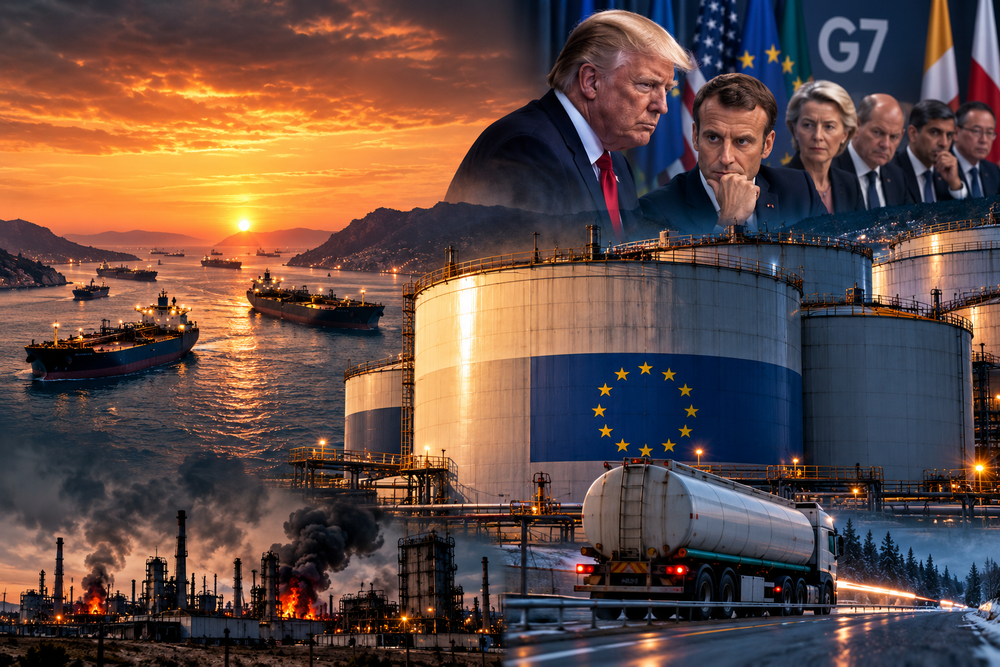
In February, the refinery's share of a litre of diesel in the euro area was about ten cents. That is the slice of the pump price that pays for turning crude oil into fuel: the distillation column, the hydrotreater, the energy to run them, and whatever margin the refiner can earn on top. Economists at the European Central Bank track it because it is normally the dullest line in the breakdown. It barely moves. In March it jumped to 26 cents. By July it was 35. In the third week of September, according to ECB staff estimates reported on 19 September 2026, it stood at 41 cents, about a fifth of what a European driver pays for a litre of diesel.
Over the same months, crude oil took a different path. Brent traded around $72 a barrel before the war with Iran began on 28 February, peaked in the spring, and by the first day of July had fallen back to about $72, its pre-war level. At that moment the oil was no more expensive than before the war. The refining slice of a litre of diesel was about three and a half times what it had been. Brent has since climbed back above $100, still below its June 2022 level, but the refinery's share never paused: it rose through the spring, through the July dip in crude, and through the summer.
That split is the story, and most coverage has missed it. On 4 September the average price of diesel in the United States broke its all-time record, set in June 2022. On 28 September the RAC reported that British diesel had done the same, at 199.18 pence a litre. In the Netherlands the advisory price for diesel reached €2.824 on 19 September, higher than petrol, higher than in 2022. Yet in June 2022 Brent averaged about $123 a barrel, and it is still below that level today. Diesel has set a new record on top of cheaper oil.
This piece asks why, and argues that the answer sits one layer below the oil: in the refineries that turn it into fuel, in the decisions Europe made about which refineries to rely on, and in the fact that almost nobody stockpiled the product that has now run short.
Ten cents in February, forty-one in September
Start with the part of the price that is not oil, because that is where the change is.
In the United States the gap between the price of a barrel of crude and a barrel of diesel, the number traders call the crack spread, normally sits somewhere between $15 and $30. In the second half of August it went above $100 a barrel in New York Harbor, reaching about $102 on 17 August, and it has hovered around that level since. By several measures that is a record, above the peaks of 2022, when by one analysis the same spread ran in the sixties and seventies. European diesel traded at a similar premium, with the European crack also above $100. S&P Global now expects global diesel cracks to average about $84 a barrel through the end of the year, $31 more than its previous forecast. In its September oil market report the International Energy Agency noted that American diesel had traded above $200 a barrel in early September, nearly double its pre-war level, and that refining margins in the Atlantic Basin had reached records in August, "led by sharply higher diesel cracks."
The ECB's decomposition shows what that means at the pump. Between February and April, the crude component of a litre of euro-area diesel rose by about 35 cents. The diesel price rose by about 55. The difference was the refinery. Petrol margins rose too, but far less: in September the ECB put the refining margin on a litre of petrol at about 17 cents, against 41 for diesel, and its staff judged that petrol margins had already peaked in August while diesel margins would peak only in October. Since January, the average price of diesel across the European Union has risen by about 40 percent, to €2.159 a litre in mid-September, the highest since the European Commission's price series began in 2005. Petrol rose 29 percent.
So the question is not simply why fuel is expensive. It is why the cost of turning oil into diesel has quadrupled, whether the oil itself was rising or falling.
The easy answer is "the war," and it is true as far as it goes. The war closed the Strait of Hormuz to most traffic, took refineries across the Gulf offline, and sent insurers and shipowners away from the region. But "the war" does not explain why diesel in particular, and why Europe in particular, is so exposed, or why the pressure on diesel kept building even in the weeks when crude fell back to its pre-war price. For that, you have to look at what a refinery makes, where Europe's diesel has been coming from, and what changed about that in the three years before the first drone hit a Gulf refinery.
Why the middle of the barrel
A refinery does not choose freely what it produces. When crude oil is heated in a distillation column it separates by boiling point: light gases and naphtha at the top, the stuff that becomes petrol; heavy residues at the bottom; and in the middle, the fraction that becomes diesel, jet fuel, heating oil and kerosene. The industry calls these middle distillates. They are the working fuels of the economy. Trucks, tractors, trains, ships, excavators, generators, military vehicles and a large share of home heating in the north-east of the United States and parts of Europe run on them. Jet fuel comes from the same cut.
The ratio can be adjusted, but only within limits set by the equipment a refinery already has and the crude it can buy. Heavier, sourer crudes, the kind produced in large quantities around the Persian Gulf, tend to yield more middle distillate. The very light crude that has made the United States the world's largest producer yields relatively more petrol and less diesel. A refinery built for one diet does not switch to another in a week. Converting a unit takes years and hundreds of millions of dollars, and nobody spends that on a war that could end next month.
This is why diesel behaves differently from petrol in a supply shock. Demand for diesel is less flexible, because much of it is freight and farming, activity that has to happen whether or not the price is high. Supply is also less flexible, because it depends on a particular kind of refining capacity, fed a particular kind of crude. When that capacity disappears somewhere in the world, it cannot be replaced by pumping more oil somewhere else. It can only be replaced by running other refineries harder, and in the autumn of 2026 the refineries that could run harder already were. American plants ran at close to 97 percent of their capacity in late summer, and still between about 94 and 97 percent in September. There is almost no headroom left in the system.
Crude oil is a commodity. Diesel is a manufactured product, and the factories are the constraint.
That sentence would be a truism if the factories were evenly spread around the world. They are not, and Europe spent the last three years reorganizing which factories it depends on.
February 2023: Europe changes suppliers
Before the invasion of Ukraine, Europe had a diesel problem it rarely talked about. Its fleet of cars and trucks had been pushed toward diesel for decades by tax policy, while its refineries, many of them old and built for a petrol-heavy world, could not make enough to meet demand. The gap was filled by imports, and the largest supplier by far was Russia. In 2022, according to the US Energy Information Administration, Russia supplied about half of Europe's diesel imports. Russia makes far more diesel than it uses, and much of the surplus went west by tanker.
On 5 February 2023, the European Union's ban on seaborne imports of Russian refined products came into force. It worked as a ban. By 2024, Russian diesel accounted for less than one percent of Europe's seaborne diesel imports from outside the region. What changed was the route, not the need. In the first half of 2025, Europe was still importing close to 850,000 barrels a day of diesel from outside the EU, the UK and Norway. The volumes that used to come from Primorsk and Novorossiysk now had to come from somewhere else, and the somewhere else was mostly the Middle East.
The Gulf was ready for them. In the years before the invasion, the region had built some of the largest and most modern export refineries in the world. Kuwait's Al Zour, with a capacity of more than 600,000 barrels a day, ramped up to full capacity around 2023. Oman's Duqm refinery was commissioned the same year. Saudi Arabia had Jubail on the Gulf coast and Yanbu and Jizan on the Red Sea. By the first half of 2025, the EIA calculated that the Middle East accounted for 43 percent of Europe's gasoil imports. An analysis in the Oil & Gas Journal put the Middle East's volume at around 340,000 barrels a day, the largest single source. India and Turkey together came next, at around 160,000 barrels a day. India's share came almost entirely from the giant Reliance refinery at Jamnagar, about a third of whose crude was Russian, and the Turkish refineries relied on Russian crude for about half of theirs.
That last detail closed the circle, and then the circle was closed from the other side. In July 2025 the EU's eighteenth sanctions package banned imports of refined products made from Russian crude in third countries, a measure that took effect in January 2026. It was aimed at the Indian and Turkish refineries that had been buying discounted Russian oil and selling the diesel to Europe. The policy logic was clear, and the effect was to narrow Europe's diesel supply further, toward the refineries least connected to Russia. In practice, that meant the Gulf.
Energy analysts saw the first link in this chain as soon as the war began: the Gulf diesel now at risk was largely the diesel that had replaced Russia's. What has been put together less often is how the rest of the chain connects.
Europe did not stop depending on refineries it could not control; it stopped controlling which refineries it depended on.
Nobody designed this as a strategy. Each step was a rational response to the step before. Sanctions removed Russia; the market found the nearest large, modern, non-Russian surplus; a second sanction removed the indirect Russian barrels; the remaining supply concentrated where the new capacity was. Each decision was taken in Brussels, or in a trading house in Geneva, or in a refinery's commercial office, for its own reasons. The sum of them was a continent whose marginal litre of diesel came, increasingly, from a handful of plants on the coasts of Saudi Arabia and Kuwait, several of them inside the Strait of Hormuz.
Grangemouth, April 2025
While its imports were being rerouted, Europe was also closing the refineries that might have covered the gap at home.
In April 2025, the Grangemouth refinery on the Firth of Forth stopped processing crude oil. Petroineos, its owner, had announced the decision more than a year earlier, and by July the site had been converted into an import terminal: tanks and jetties receiving fuel refined somewhere else. It had been Scotland's only refinery, and it ended more than a century of refining at the site. Two months later, in June 2025, the Lindsey refinery in Lincolnshire, owned by Prax, collapsed into administration; no buyer was found, and crude processing stopped for good in August 2025. The United Kingdom, which had eighteen refineries at its peak in the early 1970s, was down to four. In Germany, Shell ended crude processing at Wesseling, near Cologne, and BP cut capacity at Gelsenkirchen. According to an industry review published at the end of 2025, more than 400,000 barrels a day of European refining capacity was confirmed to close that year alone, on top of some thirty refineries that have closed or been converted across the region since 2009.
None of these closures was irrational. The refineries were old and small by global standards. They faced carbon costs their competitors in the Gulf and India did not. Their margins were thin in normal years, their domestic markets were expected to shrink as cars electrified, and the new export refineries in the Middle East could deliver diesel to Rotterdam more cheaply than many European plants could make it. An owner looking at a twenty-year investment horizon had every reason to stop. Governments, for their part, had climate targets that pointed in the same direction and little appetite to subsidize fossil fuel plants that the market no longer wanted. The logic ran all the way down.
What the logic did not price was the value of capacity that sits idle in normal times and matters only in a crisis. A refinery in Scotland that is marginally less efficient than one in Kuwait is a bad investment in a peaceful year. In a year when the Kuwaiti refinery is being hit by drones and the strait it exports through is closed, the Scottish refinery would be worth a great deal. But nobody is paid for keeping it open against that year, and so it closes. The same logic has emptied other kinds of spare capacity: the grid that runs at the edge of its reserve margin, the hospital running at full occupancy, the just-in-time supply chain. Refining is only the latest place it has shown up.
Efficiency is resilience converted into margin, and Europe converted a great deal of it.
This is not an argument that the closures were wrong. It is an argument that they moved a risk from the refinery's balance sheet to the public's, where it waited, unpriced, until someone else's war collected it.
Ras Tanura, Mina Abdullah, Satorp: the substitute is hit
The war that began on 28 February did not only close a strait. It hit the refineries that Europe had come to depend on.
In the first weeks, Saudi Arabia's Ras Tanura refinery, with a capacity of about 550,000 barrels a day, was halted after a drone attack; it was later restarted. Kuwait's Mina Abdullah refinery caught fire after an attack on 19 March, and Mina Al-Ahmadi, one of Kuwait's main refineries, was struck twice in March and again on 3 April. In Bahrain, Bapco Energies, with a refinery of around 400,000 barrels a day, declared force majeure. Units at Satorp, the 460,000 barrel-a-day joint venture of Saudi Aramco and TotalEnergies at Jubail, were halted after incidents on 7 and 8 April. In the United Arab Emirates, the vast Ruwais complex suffered fires from falling air-defense debris; it returned to full capacity only at the end of August. Even the Red Sea was not safe: Saudi Arabia's Samref refinery at Yanbu was struck on 19 March.
The effect on exports was larger than the damage to any one plant. Refineries that still worked could not easily ship what they made, because the strait they depended on was closed to most traffic and tanker owners would not risk the voyage. The ECB estimated that the closure cut global exports of refined products by about 4.5 million barrels a day in the second quarter. The IEA's September report put the Gulf's net exports of diesel and gasoil in August at about 390,000 barrels a day, "just over a quarter of pre-war levels." Together with Russia's losses, discussed below, the diesel exports of the Gulf and Russia were 1.6 million barrels a day below their February level, when the two together accounted for almost 45 percent of global seaborne trade in diesel and gasoil.
Precision matters here, because it would be easy to say that Europe's diesel "comes through Hormuz," and it would be wrong. Some of the Middle Eastern supply comes from Yanbu and Jizan on the Red Sea, and from Duqm on the Arabian Sea, outside the strait. But those routes have their own chokepoint, the Bab el-Mandeb at the southern end of the Red Sea, where attacks on shipping had already forced many tankers to take the long route around Africa. What Europe built after 2023 was not a dependency on one strait but on one region, served by two narrow waterways, both of which became dangerous in the same year. A continent that had diversified away from one supplier had concentrated into one neighborhood.
Recovery will be slower than the headlines about the strait suggest. Even if tankers move freely tomorrow, damaged units have to be repaired, inspected and restarted, and some of the equipment involved has long lead times. S&P Global has said it does not expect Middle Eastern crude production to return to pre-war levels before the end of 2027. Refining output is unlikely to recover faster than the crude that feeds it, and refineries come back on the schedule of engineers and insurers, which is far slower than the single day of good news that can move the oil price.
Russia's ban of 8 July
By the summer, a second source of supply was going offline, and this one Europe had stopped buying three years earlier.
Through 2025 and 2026, Ukrainian drones had been striking Russian refineries systematically, aiming at the facilities that earn Russia export revenue and fuel its army. By July 2026, according to Bloomberg and Reuters, Russia's refining throughput had fallen to about 3.6 million barrels a day, the lowest since May 2002. On 8 July, Moscow banned diesel exports by producers to protect its domestic market. The ban was meant to run to the end of the month. It was extended to the end of August, then to the end of September, and traders now expect it to last at least into late October. By one industry estimate, the ban removes roughly 10 percent of the diesel traded by sea worldwide.
It is tempting to say that this should not matter to Europe, which already refuses Russian diesel. It matters a great deal. Before the ban, Russian diesel went to Turkey, Brazil, North Africa and other markets that had not joined the sanctions. When it stopped, those buyers did not stop needing diesel. They turned to the same Gulf, Indian and American refineries that supply Europe, and bid against European buyers for the same cargoes. Sanctions decide which tankers sail where, but every one of those tankers still loads from the same global pool of diesel, and when that pool shrinks anywhere, every buyer pays.
This is the mechanism that connects a drone over Ryazan to a pump in Rotterdam, and it runs through a market Europe thought it had left. Global diesel exports in August were about 5.85 million barrels a day, a quarter lower than a year earlier. The Gulf, Russia and, as we will see, perhaps the United States: three of the largest sources of traded diesel were constrained at the same time, for three different reasons, none of them coordinated.
426 million barrels, 11 March
The response to the crisis was built mostly for a different one.
On 11 March 2026, eleven days into the war, Fatih Birol, the executive director of the International Energy Agency, announced that its member governments had agreed to the largest emergency release of oil stocks in the agency's history, initially put at 400 million barrels. It was only the sixth coordinated release since the IEA was founded, after 1991, 2005, 2011 and two in 2022. Flows through Hormuz had fallen below ten percent of their pre-war level. "Oil markets are global," Birol said, "so the response to major disruptions needs to be global too." When the member contributions were confirmed on 19 March, they came to 426 million barrels. The release did what it was aimed at. Over the spring it became one of the buffers that kept the oil price from following the strait all the way up.
Look at what those barrels were. Of the 426 million, the IEA reported, 301 million were crude oil and 125 million refined products. The agency said the release "will largely consist of crude oil, while in Europe the contributions will primarily take the form of refined oil products." The split follows the design of the reserves themselves. The largest single contribution came from the United States, 172 million barrels, and the American Strategic Petroleum Reserve holds only crude oil. By late September, according to Energy Department data, it held about 284 million barrels, its lowest level since October 1982. The United States does keep a reserve of diesel. It is called the Northeast Home Heating Oil Reserve, it holds about one million barrels of ultra-low sulfur diesel in tanks in Maine, Massachusetts, Connecticut and New York Harbor, and it is equal to less than one day of American distillate consumption. On one side, a crude reserve of hundreds of millions of barrels; on the other, a diesel reserve of one million. That ratio is not an accident of this crisis. It reflects a system built after the 1973 embargo on the assumption that the scarce thing in an oil emergency is oil.
Europe is the exception, and it is an instructive one. Its governments and obligated companies do hold a real share of their emergency stocks as finished fuel, and in March they released it. That softened the first shock. But a buffer spent in March is not available in October. What I cannot establish from public data is how much of the product Europe released in the spring has since been replaced, at a time when the futures market, as the next section shows, makes rebuilding stocks a losing trade. My reading, and it is an interpretation, is that Europe met the crisis with the right molecule at the wrong moment: it had diesel in the tanks for the opening of the war, and faces the winter with thinner ones.
For the rest of the world, the problem is simpler. A reserve of crude helps only if there is spare refining capacity to turn it into fuel, and in 2026 there was very little. The oil could be released, but someone still had to refine it, and the refineries were already full, or on fire, or on the far side of a closed strait. Seven in every ten barrels released were raw material for a factory that was the bottleneck.
Most of the world kept its emergency reserves in the form of the last crisis. Governments stored the thing they expected to run out of. They stored it in the form it takes before the refinery. They stored it on the assumption that refining capacity would be there when needed. And when the shortage arrived, it arrived after the refinery, in the product that fewer of them had kept.
A futures curve that pays you not to store
If there is so little diesel, why does the market not build up stocks for the winter? Because the futures curve makes that a losing trade. Diesel is in steep backwardation: in September, heating oil for delivery in 2027 traded more than a dollar a gallon, about $42 a barrel, below the prompt price. Anyone who buys today to store and sell later locks in a loss, so inventories are drawn down rather than rebuilt, which keeps the prompt price high. The price that signals the shortage also discourages the buffer against it.
Stocks are already thin. American distillate inventories stood at about 107 million barrels in mid-September, some 12 to 13 percent below their five-year average for the time of year. The IEA reported that observed global oil inventories fell by 95 million barrels in August alone. Harvest and heating season are starting, and so is the autumn round of planned refinery maintenance. As one S&P Global analyst put it in September, seasonal demand "is about to strengthen at exactly the wrong moment."
Then there is Washington. The United States exports a large share of the diesel it makes, by recent estimates a volume equal to close to half of its own consumption, much of it to Europe and Latin America. With pump prices above $6.50 a gallon and midterm elections weeks away, the pressure to keep that diesel at home has become intense. On 22 September Donald Trump said: "I've said let's not send out the diesel. We make a lot of diesel." Around the same time his energy secretary, Chris Wright, said no one was considering a flat ban and described the discussion as being about "the most efficient way to get more diesel into the United States." On 27 September the president said he was looking "very seriously" at a ban. Reports of a plan for a 90-day restriction, which the White House denied, had already moved the market. Refiners warned that a ban would backfire, because plants that cannot export would cut runs and make less petrol along with less diesel, and Wright said any fix should avoid "blunt instruments that would reduce refining throughput." For Europe the consequence is simpler. Wood Mackenzie and other analysts expect that removing American cargoes would force European buyers to bid harder for the remaining supply, widening the European crack further.
Peskov, late September: the circle closes
Follow the substitution one step further and it bends back on itself.
When the Gulf's diesel stopped flowing, Europe leaned on the Atlantic. According to data from the analytics firm Kpler cited by Euronews, the United States supplied about 17 percent of the EU's diesel imports from outside the bloc in 2025, and roughly 32 percent in 2026. For Northwest Europe, the Netherlands included, the American share rose from about 37 to about 57 percent. That is the supply Washington is now debating whether to keep at home. By one count of 2025 trade, the United States is the world's largest diesel exporter, at about 1.26 million barrels a day. The second largest, at around 780,000 barrels a day, was Russia.
In the last week of September the Kremlin said so out loud. Dmitry Peskov, Vladimir Putin's spokesman, said that for Russian diesel to saturate international markets it would have to reach them "without any sanctions, without any restrictions." It was an offer with conditions attached, and it came from a country that has banned its own diesel exports since July because its refineries are being hit. But the arithmetic behind it is real. Take the Gulf and Russia out of the traded market at the same time, put the American share under political review, and the list of large refining surpluses that could loosen the market becomes very short. One of the names on it is the supplier Europe spent three years removing from its system.
The distinction here has to be stated plainly. Nothing in this piece argues that Europe should buy Russian diesel again. That is a political choice with consequences far beyond the pump, and the sanctions exist for reasons this piece does not examine. The claim is structural. Europe reduced its political dependence on Russia, but it could not remove the world market's dependence on Russian refining capacity, because that capacity sits in the same pool every buyer draws from, whether or not European tankers load there. What the sanctions changed was where Europe stood in the queue for that pool.
The circle has a second turn that nobody designed. The capacity the Kremlin now offers is the same capacity Ukrainian drones have spent more than a year degrading, for the purposes of their own war. Russia, then the Gulf, then the United States, then Russia again: each substitution answered the one before it, and the last link in the chain is both politically excluded and physically damaged. Europe discovered that leaving Russian diesel did not mean the diesel market had left Russia.
What €2.78 at a Dutch pump is made of
For a Dutch driver, the whole chain arrives in one number. On 29 September the national advisory price for diesel was about €2.78 a litre (€2.785 by one tracker). Of that, about €0.55 is excise, fixed by law and unchanged by the market. €0.483 is VAT, charged at 21 percent on everything else. The remaining €1.75 or so, nearly two-thirds, goes to the oil company, and covers the crude, the refining, the transport and the margins of the supplier and the station.
Because the excise is fixed, every cent of change in the oil company's cost reaches the pump as 1.21 cents. And because the refinery's slice sits inside that €1.75, the pump price can rise even in weeks when crude falls, which is what the ECB's numbers show happened this summer.
On current evidence, my own reading is that a sustained fall in the Dutch diesel price is unlikely before winter unless the strait reopens credibly and stays open for weeks, not days. The useful signals are three numbers, not the headlines about talks: whether the ECB's expectation that diesel margins peak in October holds; whether American distillate inventories start to rebuild for several weeks in a row; and whether the crack spread falls back toward $60 a barrel, a level analysts at TOPONE Markets have proposed as the line below which the squeeze would be ending. If one of those moves without the others, it is likely to be noise. The risks point the other way: an American export restriction, a hard winter, or another round of damage to Gulf or Russian refineries. These are my estimates, not forecasts I can document, and they could be wrong in either direction.
There is one more number, and it is political. Germany has decided to cut taxes on diesel and petrol by 17 cents a litre, 14 cents of excise and the VAT on it, from 1 October until the end of the year, and is preparing a price cap for early 2027. The Netherlands, so far, has announced no plans to do anything similar. For drivers and hauliers near the German border, the gap at the pump is about to widen, and the refinery crisis will turn into a fuel-tourism problem that the Dutch treasury will measure in lost excise.
The strongest objection
The strongest counterargument to this reading does not dispute the numbers. It accepts that crude is below its 2022 peak and that diesel is at a record, that Europe replaced Russian diesel with Gulf diesel, and that most of the emergency release outside Europe was crude. It says none of this is structural. Diesel cracks spike in every serious supply shock: in 2008, in 2022, and now. Middle distillates are always the tightest part of the barrel, because demand for them is the least flexible. On this view, what we are seeing is simply the normal behavior of a refined-products market under a very large disruption, one that combined a war in the Gulf with a drone campaign in Russia. When the war ends and the refineries are repaired, cracks will fall back, as they did after 2022, and the pattern described here will look like an ordinary cycle that a writer mistook for a system.
That objection is serious, and part of it is right. The diesel premium is a recurring feature of supply shocks, and it will narrow when the shock passes. If the claim here were that diesel will stay at these prices, or that the refining system has permanently broken, the objection would win. The claim is narrower. It is that the size of this spike, and Europe's exposure to it, were shaped by choices made before the war: the decision to replace one concentrated supplier with another concentrated region, the closure of domestic capacity that had no market value in peaceful years, and an emergency system that stores the raw material rather than the product. Those choices are still in place. The cycle will turn, but the architecture that made this cycle so sharp will remain after the prices fall, ready for the next shock to find it.
Back to the forty-one cents
Return to the ECB's breakdown. Ten cents in February, forty-one in September: that is the part of a litre of diesel that few governments stored, no sanctions regime counted and no crude release could reach. It is the price of a refinery that exists somewhere else, run by someone else, shipping through water that someone else controls.
Every institution in this story did its job. The EU sanctioned Russia. The refiners closed plants that lost money. The Gulf built new capacity and sold what it made. The IEA released oil. The central bank measured the result. Each of them acted on a narrow and defensible mandate, and none of them was responsible for the whole.
The whole is what reached the pump: a fuel that rose while its raw material fell, and a difference, now about a fifth of the price, that is the cost of a dependency that moved rather than disappeared.
The oil can be released from a tank. The diesel is still waiting for its refinery.
Evidence Map
Facts, interpretations, forecasts, and disconfirming signals.
Core claim. The 2026 diesel crisis is mainly a refining crisis: crude is below its 2022 peak, while the refining margin on diesel has roughly quadrupled since February. Europe's exposure was built before the war, when it replaced Russian diesel with Gulf diesel and closed refineries at home.
Evidence level. Facts (high): refining-margin estimates from the European Central Bank and its September staff estimates (reported by Euronews); Europe's shift from Russian to Middle Eastern diesel (EIA, Oil & Gas Journal); Gulf and Russian export losses (IEA Oil Market Report, September 2026); the composition of the emergency release (IEA, 19 March); the US diesel reserve (Department of Energy); Germany's tax cut (Bundesregierung). Market data (high, measures differ): crack spreads, retail price records, the US share of European diesel imports (Kpler). Interpretation (medium, marked): that sanctions concentrated Europe's dependency in one region, and that Europe spent its product buffer early. Estimate (speculative, marked): the Dutch pump-price outlook.
What would confirm this. Diesel margins staying high after crude stabilizes; Gulf product exports recovering more slowly than Gulf crude; governments shifting emergency stocks toward finished fuel.
What would disprove this. Diesel cracks back to $15 to $30 within weeks of a Hormuz reopening while Gulf refineries are still impaired; Europe replacing Gulf diesel quickly and cheaply from elsewhere; evidence that Europe's product stocks were fully rebuilt after the spring.
Watchlist. ECB margin estimates in October and November; EIA weekly distillate stocks; diesel forward curves; any US export restriction; the length of Russia's export ban; Gulf refinery restarts.
Jerry van der Laan writes The Manifest Archive, forensic journalism on the systems beneath power, money, and history. He traces the structures beneath them.