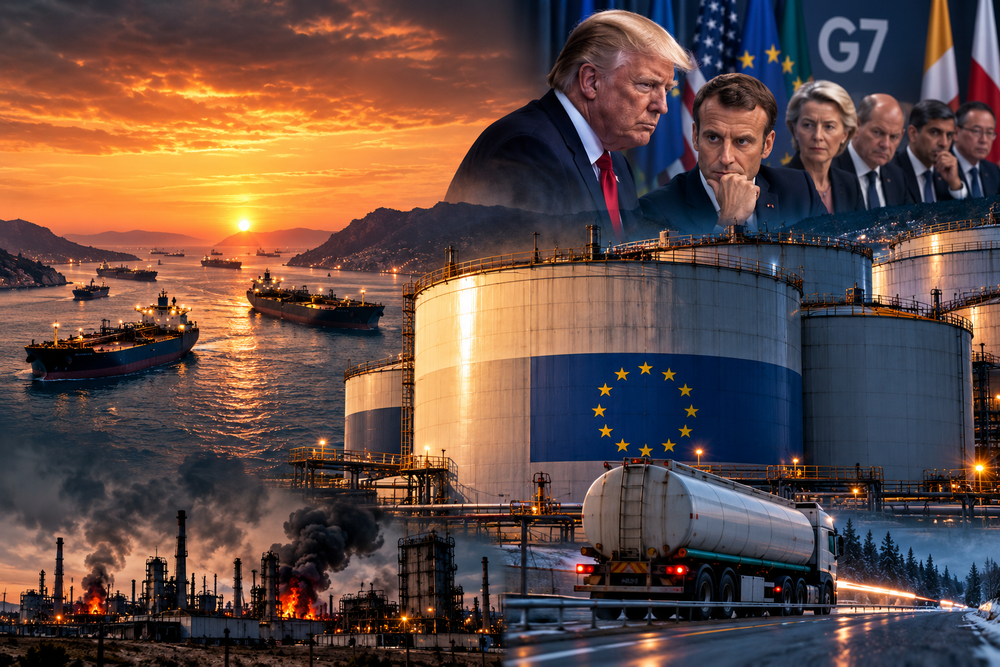
In the Persian Gulf, nothing moves without consequence.
Tankers slow before they stop. Markets react before the first strike. Insurance prices shift before a missile is launched. And somewhere beneath the surface of every headline sits a quieter reality: entire cities depend on systems that cannot fail, even briefly.
Water must keep flowing. Power must remain stable. Heat must be held back.
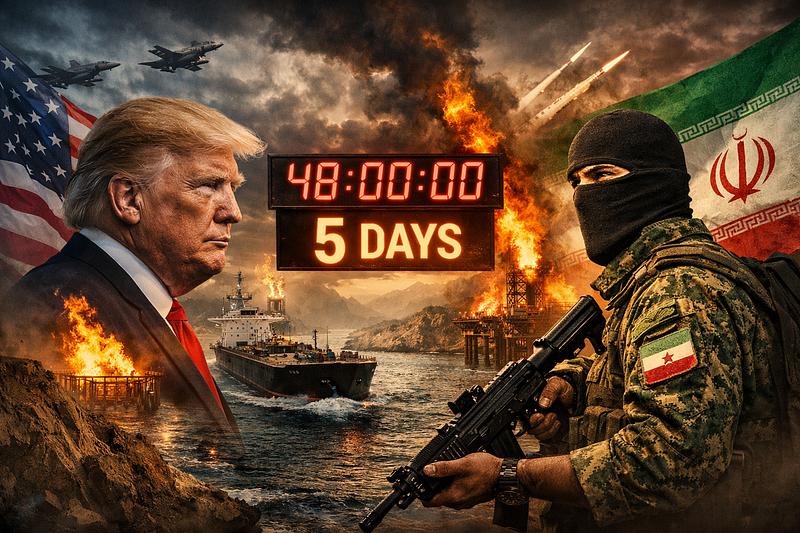
That is the environment in which the United States issued its ultimatum.
Forty eight hours.
Reopen the Strait of Hormuz or face the destruction of your energy infrastructure.
It sounded decisive. Clean. Controlled. The kind of language that signals hierarchy. A superpower setting the clock, expecting the world to move accordingly.
And then the clock changed.
Forty eight hours became five days. The justification was framed as “productive talks.” Iran denied that such talks existed. The threat remained, but something else had shifted. Not the words themselves, but the space behind them. What had been presented as immediate compellence became delayed calculation.
That shift is where the real story begins.
Power announces itself in deadlines.
Leverage reveals itself when those deadlines begin to move.
The Illusion of Compression
An ultimatum compresses time. That is its purpose.
It tells the other side: you do not have space to maneuver. Your options are narrowed. Your response is expected to be immediate.
But compression only works if the system around it can absorb the consequences of action.
In the Gulf, that assumption is fragile.
The Strait of Hormuz is not just a passage. It is a pressure valve for the global economy. A significant share of the world’s oil and liquefied natural gas flows through it. When tension rises there, prices move instantly. Shipping reroutes. Governments react. The effects are not contained to the region. They ripple outward in real time.
So when Washington threatens action in that environment, the question is no longer simply whether it can strike.
The question becomes:
what happens when it does?
And more importantly:
who absorbs the shock?
Because in Hormuz, no action is isolated.
Iran Did Not Answer With Symmetry
Tehran’s response did not mirror American power. It did something more precise.
It pointed at dependence.
Energy infrastructure. Electricity grids. Water systems.
Not as abstract threats, but as targets embedded in daily life across the Gulf. The message was simple and deeply uncomfortable: escalation will not stay contained within military boundaries.
It will move into the systems that make the region livable.
This is where the equation changes.
Because the United States does not need to be matched militarily to be constrained strategically. It only needs to face an opponent capable of touching the systems that surround its allies.
You do not need equal force to reshape leverage.
You only need access to what the system cannot afford to lose.
The Infrastructure Beneath Power
Oil is always the visible layer.
It is traded, priced, and understood. It dominates headlines because its disruption is immediate and measurable.
But beneath oil sits a deeper vulnerability.
Water.
Much of the Gulf survives on desalination. Cities that project permanence depend on continuous technical conversion of seawater into something drinkable. That process is not optional. It is not easily replaceable. And it does not tolerate disruption.
If desalination plants fail, reserves do not last indefinitely. Hospitals, housing, industry, and basic urban life begin to strain quickly. The margin between stability and crisis is thinner than the skyline suggests.
This is what makes Iran’s warning structurally significant.
It shifts the battlefield from visible assets to invisible dependencies.
From ships to systems.
From deterrence to exposure.
And once that shift happens, the meaning of leverage changes completely.
Why the Deadline Had to Move
The move from 48 hours to five days should not be read as a simple delay.
It should be read as friction becoming visible.
Because once the cost tree is fully considered, immediate action becomes harder to execute cleanly. A strike on Iranian infrastructure is not just a strike. It is a trigger.
Shipping risk expands.
Insurance premiums spike.
Energy markets react.
Allies calculate their exposure.
Civilian systems become potential targets.
And suddenly, the timeline that looked simple begins to stretch.
Not because power disappeared.
But because its consequences multiplied.
A deadline expands when the cost of enforcing it becomes harder to control than the language used to announce it.
Power Inside the System It Tries to Control
There is a deeper pattern here.
For decades, Western power has been described as if it exists above the systems it manages. It sanctions, pressures, intervenes, stabilizes. The language suggests distance. Control. Oversight.
But in reality, it operates inside the same networks.
Inside the same energy flows.
Inside the same supply chains.
Inside the same financial reactions.
Inside the same infrastructural dependencies.
Hormuz exposes that reality.
It shows that modern power cannot isolate its actions from their systemic effects. It cannot strike cleanly without triggering broader reactions. It cannot apply pressure without feeling it reverberate back through the same networks that sustain it.
That is not weakness.
It is entanglement.
And entanglement narrows leverage.
The Moment Leverage Becomes Visible
This is why the story is not about whether the United States is strong or weak.
That is the wrong frame.
The United States remains the most powerful military actor in the system. That has not changed.
What has changed is something more subtle and more consequential.
The relationship between power and outcome is no longer linear.
Threat does not automatically produce compliance.
Escalation does not guarantee control.
Dominance does not eliminate risk.
Instead, each move interacts with a system that is connected, fragile, reactive, and globally exposed.
In such a system, leverage becomes conditional.
And once leverage becomes conditional, certainty disappears.
What This Moment Actually Reveals
The extension from 48 hours to five days is not just a scheduling detail.
It is a signal.
A signal that the system did not bend as easily as expected.
A signal that the consequences of action required recalculation.
A signal that the language of control ran ahead of the reality of constraint.
And that is where the deeper insight sits.
Power is loudest when it speaks.
Leverage is revealed when it hesitates.
The most dangerous misunderstanding would be to read this as simple decline.
This is not a story about collapse.
It is a story about limits.
About what happens when a system built on projection encounters a reality shaped by interdependence.
About what happens when threats extend beyond battlefields into the infrastructure of daily life.
About what happens when the clock is no longer fully yours to control.
A superpower is easiest to recognize when it speaks in hours.
But it becomes most legible when those hours begin to stretch.
The old image was simple: power threatens, and the world bends.
The newer reality is harder to ignore: power threatens, and the system moves with it.
Continue reading in The Manifest
This chapter does not stand alone. It belongs to a larger pattern of pressure, chokepoints, hidden dependency, and the language of power. For that wider map, continue with:
- Strait of Hormuz: The Chokepoint That Could Break the World Economy
- US and Iran: This Is Not De-Escalation. It Is Repositioning.
- Iran and the Architecture of Permanent Pressure
- Operation Ajax: How the CIA, BP and MI6 Took Iran’s Oil
- Architecture of Power: How Modern Empires Hide in Plain Sight
Follow The Manifest if you want to see the structure before it becomes visible.
Related from The Manifest Archive