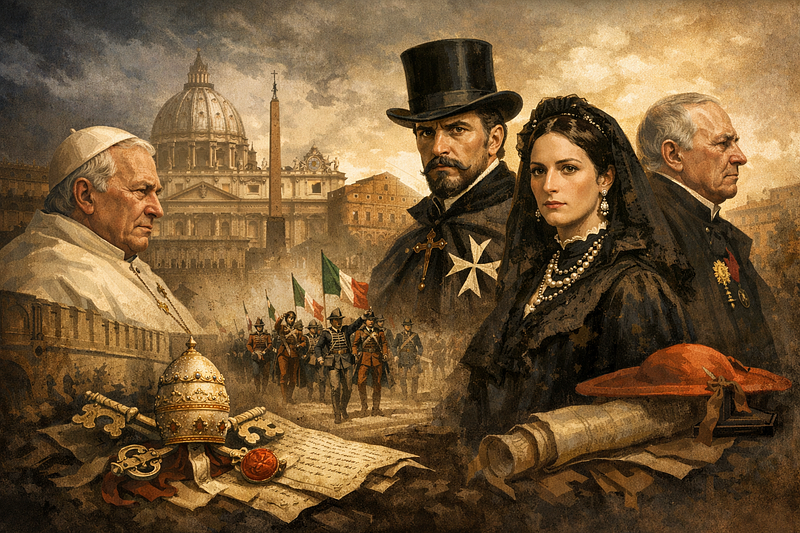
In the autumn of 1870, in a city that had just changed hands, a number of the oldest families in Rome did something that looks, at this distance, almost theatrical. They hung black cloth from their balconies, closed the great doors of their palaces to the street, and refused to attend the court of the new king. The mourning was for a state that had ended a few weeks earlier, when Italian troops came through a breach in the Aurelian Wall and the pope they had served for centuries withdrew behind the walls of the Vatican and declared himself a prisoner. The black cloth gave the families their name. They became known, collectively, as the Black Nobility.
That is the whole of it, at the root. A color of cloth, a political loyalty, a particular autumn. Almost everything else that now attaches to the phrase, the talk of satanic bloodlines and secret world-government and an occult cabal stretching back to ancient Rome or Venice, was added later, by people who had never seen the cloth and did not know what it was for. The strange thing about the Black Nobility is not that it is a secret. It is that it is not a secret at all, and has been turned into one anyway. The documented thing is open, named, and bounded. The myth is hidden, eternal, and total. They are not two versions of the same story. They are a real history and a fantasy that grew over it like ivy, and the fantasy has become so much louder than the history that the first task of anyone trying to understand the term is simply to pull the ivy off and look at the wall.
This chapter does that. It is not an exposé, because there is nothing concealed to expose. It is the opposite of an exposé. It is an attempt to say, plainly and with sources, what the Black Nobility actually was, which turns out to be more interesting than the legend, and to show how a label for grief became, in the retelling, a name for a conspiracy that never existed.
In this chapter: what the term actually means · why “black” · the three facts that break the legend · how a color became a cabal · the honest limit. Looking for the family-by-family reference? Read The Black Nobility Explained. For what survived after the mourning ended: Europe’s Families Who Never Left Power.
What the Term Actually Means
Begin with the definition, because the definition is precise and most accounts never reach it.
The Black Nobility, the nobiltà nera, were the Roman aristocratic families who, after the Kingdom of Italy seized Rome in September 1870, refused to recognize the new state and kept their loyalty to the pope. That is the entire content of the term. It is a statement about political alignment at a specific moment, not about blood, not about ritual, not about race, and not about any organization the families belonged to. There was no Black Nobility society. There was no membership. There was a choice, made family by family in the months after the city fell, between two courts and two loyalties, and the families that chose the pope acquired the name.
The choice had a visible counterpart, which is the clearest proof that this was a political stance and not a secret order. The families that made the opposite choice, that accepted the House of Savoy and took positions at the new royal court in the Quirinal Palace, became known as the White Nobility. Black and white were not ancient categories. They were the two halves of a single fracture that ran through the Roman aristocracy in 1870, the families sorting themselves by which side of the new Italy they would stand on. A category that comes in matched political colors, openly, with families publicly choosing one or the other, is the least secret thing imaginable. It is a faction, and factions are visible by definition.
The term also conventionally swept in a wider group: anyone the pope ennobled between 1870 and the settlement of 1929 that finally resolved his quarrel with Italy. This too points away from the conspiracy reading. The Black Nobility was not a closed bloodline admitting no newcomers. It was a status that the pope himself could and did confer, which means its boundaries were administrative and public, recorded in papal acts, not sealed in some genealogical vault.
Why Black
The color is worth pausing on, because it is the single fact that most cleanly separates the history from the myth.
Black was the color of mourning, and the mourning was specific and dated. When the Papal States fell and the pope retreated into the Vatican, the families loyal to him went into a kind of permanent public grief. They draped their palaces in black, shut their formal doors, withdrew from the festivities of the new monarchy, and wore mourning to the papal court functions that continued inside the Vatican. The black was a protest rendered in fabric, a way of saying that as far as these families were concerned, something had died in 1870 and they would not pretend otherwise. It was sustained, as a posture, for the better part of sixty years, until the quarrel between the pope and Italy was finally settled.
Read that and notice what it does to the occult story. The conspiracy literature treats the word black as if it were a confession, a hint of darkness, of the satanic, of hidden evil dressed in shadow. The actual black is a widow's black. It is the black of a funeral, hung from a balcony in 1870 by people who felt they had lost their world. There is nothing hidden in it and nothing dark in the sinister sense. It is the most human thing in the whole story, a gesture of loss, and the conspiracy reading can only sustain itself by not knowing, or not saying, what the color was for. The myth needs the word black to mean menace. The record says it meant grief. Everything else follows from that first substitution.
The Three Facts That Break the Legend
If the Black Nobility were what the myth claims, an ancient, unified, secret bloodline that has steered the world for a thousand years, then three things would have to be true of it. Its families would have to be ancient. They would have to be united. And they would have to be hidden. The documented history contradicts all three, and it does so not with speculation but with specific, checkable facts. Take them in turn, because each one alone is fatal to the legend, and together they leave nothing standing.
Consider first the claim of ancient blood, and set against it the Torlonia. The Torlonia are routinely listed among the great Black Nobility families, and they were genuinely powerful, princes with one of the largest fortunes in nineteenth-century Rome. But they were not ancient. The family was founded by Marino Torlonia, a man of humble origins whose people had come from the Auvergne in France, and the fortune was built in the most modern way imaginable, by banking and by administering the finances of the Vatican. The titles, Duke of Bracciano and Prince of Civitella-Cesi, were acquired around the turn of the nineteenth century, not inherited from the mists of time. The Torlonia were, in plain terms, new money, eighteenth-century financiers who bought their way into the aristocracy a few generations before the black cloth went up. A myth about an eternal bloodline cannot survive the fact that one of its flagship families was, by the standards of Roman nobility, nouveau riche.
Consider next the claim of unity, and set against it the oldest rivalry in Rome. The two houses most central to any list of the Black Nobility are the Orsini and the Colonna, and far from being partners in some coordinated bloc, they were enemies for centuries, the two poles of a feud that ran through the whole history of the medieval city. The Orsini stood, broadly, with the popes, in the Guelph interest. The Colonna stood, often, with the popes' enemies, in the imperial Ghibelline camp, and on occasion went much further than disagreement. In 1303 Sciarra Colonna led an armed assault on Pope Boniface the Eighth at Anagni and is said to have struck or threatened the pope to his face. A family that produced a man who laid hands on a pope is not a charter member of a pro-papal conspiracy. The consistent loyalty to the papacy that the term Black Nobility implies was not an ancient trait of these families at all. It was a stance adopted in 1870, by families whose longer history was one of rivalry, and at least once of violence against the very office they later mourned.
Consider last the claim of secrecy, and set against it the simple openness of the whole thing. These families were not hidden. Their names were carved above their palace doors, where they remain. Their genealogies were published. Their court offices were matters of public record. The pope conferred their status in documented acts. Even the most exclusive of their hereditary dignities, the office of Prince Assistant to the Papal Throne, the right to stand beside the pope on solemn occasions, was a known and recorded position, instituted in 1511 and shared, by formal arrangement, between the Colonna and the Orsini. A secret society does not advertise its hierarchy in liturgical handbooks. The Black Nobility did exactly that. Everything about it that the myth treats as concealed was, and is, written down in places anyone can read.
Ancient, the Torlonia were not. United, the Orsini and Colonna were not. Hidden, none of them were. The legend requires all three and the record supplies none.
What the Papal States Were
To understand why the families mourned, you have to understand what they had lost, and what they had lost was genuinely unusual.
For more than a thousand years, from the eighth century until 1870, the pope was not only the head of a church. He was the sovereign of a state. The Papal States were a broad band of territory across central Italy, governed directly from Rome, and the pope ruled them the way any monarch ruled a kingdom, with administrators, tax collectors, courts, and soldiers. This is the fact that modern readers most often forget, and it changes everything about the Black Nobility. The Roman aristocratic families were not hangers-on at a religious institution. They were the nobility of an actual state, embedded in its administration, its diplomacy, and its church offices, the way the nobility of France or Austria was embedded in those kingdoms. They governed, they administered, they represented, they held office. Their power was the ordinary power of an aristocracy inside the state it serves.
When that state vanished in 1870, the families lost what any nobility loses when its kingdom is annexed: the public structure through which their power had operated. The mourning was not abstract. It was the grief of a governing class watching the government it belonged to disappear, and choosing, rather than transfer its loyalty to the conqueror, to stand with the sovereign who had been dispossessed. Seen this way, the Black Nobility is not exotic at all. It is what happens to the aristocracy of any conquered state that refuses to recognize the conquest, a phenomenon as old as conquest itself. The only thing that made the Roman case distinctive is that the dispossessed sovereign was the pope, and the pope, unlike a deposed king, headed an institution that would outlast the kingdom that had displaced him.
The Barons Who Made Popes
The families that mourned in 1870 were old, and their age is the grain of truth the myth inflates, so it is worth seeing the real medieval story, which is dramatic enough without embellishment.
For long stretches of the Middle Ages, Rome was governed less by the pope than by its great baronial families, who held fortified palaces and towers across the city and treated the papacy as a prize to be contested. By the twelfth and thirteenth centuries two houses had risen above the rest, the Orsini and the Colonna, and their rivalry became one of the organizing facts of Roman life. They fought over land, over offices, over the city itself, and above all over the papacy, because to place a kinsman or an ally on the papal throne was to command the greatest institution in the Western world. Popes were made and opposed with the backing of these families, and a papal election could turn as much on the balance between Orsini and Colonna as on any question of doctrine.
This is the period the conspiracy theory dimly senses and wildly distorts. There was, genuinely, a time when a handful of Roman families exercised enormous influence over the papacy. But that influence was not secret, not unified, and not eternal. It was the open, violent, factional politics of a medieval city, in which the families were rivals far more often than partners, and in which their power rested on towers and soldiers and marriages, not on hidden ritual. The single most famous episode captures the truth of it. In 1303 Sciarra Colonna, in alliance with the king of France, led an armed party against Pope Boniface the Eighth at Anagni and seized him, an outrage that shocked Christendom and is remembered as the slap of Anagni. The Colonna at that moment were not the pope's secret masters. They were his enemies, with their hands on his person. A family capable of that is not a charter member of any pro-papal brotherhood. It is one pole of a rivalry old enough and bitter enough to have produced, at least once, the manhandling of a pope.
That medieval grandeur is what the families carried into the modern age, and it is why their names still resonate. But resonance is not conspiracy. The Orsini and Colonna were powerful for the most ordinary of reasons, land, arms, marriage, and proximity to the one office that mattered, and their power waxed and waned with the fortunes of any aristocratic house. By the time the black cloth went up in 1870, these were ancient families indeed, but ancient in the way of all surviving nobility, through luck, alliance, and adaptation, not through the unbroken transmission of a secret across a thousand years.
The Posture of Mourning
The black cloth was the visible sign of a stance that was also organized and political, and understanding the stance further dissolves the air of secrecy around it.
When Pius the Ninth withdrew into the Vatican in 1870, he adopted a posture that the world came to call the prisoner in the Vatican. The phrase needs care, because it was not literal. The pope was not confined by anyone. He was free to leave the Vatican at any time, and chose not to, because to step out into the Kingdom of Italy's Rome and move about freely would have looked like acceptance of the new order. The imprisonment was self-imposed and symbolic, a refusal expressed as a withdrawal, and it lasted through his reign and those of his successors until 1929. The Black Nobility's mourning was the aristocratic echo of that papal posture. As the pope withheld himself from the new Italy, so the families withheld themselves, draping the black, shutting the doors, declining the king's invitations.
This refusal was given a formal shape that reached far beyond the few hundred aristocratic families, and the wider policy is the clearest evidence that the families' stance was politics, not conspiracy. The Holy See issued an instruction, known by its Latin tag non expedit, meaning it is not expedient, advising Italian Catholics not to participate in the national elections of the Kingdom, neither as candidates nor as voters. Formalized in 1868 and reinforced thereafter, it was a Church-wide directive aimed at all Italian Catholics, not a secret signal to a noble cabal, and it was relaxed in the early twentieth century and formally ended in 1919 as the political situation changed. The Black Nobility's withdrawal from public life under the monarchy was simply the most visible, palatial expression of this far broader Catholic abstention. The families were not following hidden orders. They were doing, conspicuously and in fine clothes, what millions of ordinary Italian Catholics were being asked to do quietly.
A Tour of the Real Families
The surest cure for the myth is simply to look at the families it names, because their documented histories are specific, public, and entirely unmysterious.
The Orsini and the Colonna, the two great medieval houses, between them produced several popes across the centuries. From the Orsini came Celestine the Third in the twelfth century, Nicholas the Third in the thirteenth, and Benedict the Thirteenth in the eighteenth. From the Colonna came Martin the Fifth, elected in 1417, the pope who finally ended the long schism that had left the Church with rival claimants to the papacy. These were not shadow figures. They were among the most public men in Europe, their elections recorded, their reigns chronicled, their tombs still standing.
The pattern continues through the families that the term most often gathers. The Barberini gave the Church Urban the Eighth, the pope of the early seventeenth century whose patronage built much of baroque Rome and whose family bees still ornament its fountains. The Borghese gave it Paul the Fifth. The Chigi gave it Alexander the Seventh. The Boncompagni and Ludovisi lines gave it Gregory the Thirteenth, who reformed the calendar the world still uses, and Gregory the Fifteenth. The Massimo claimed a lineage older than most. And the Pacelli, the family of Pius the Twelfth, who reigned through the Second World War, illustrate the other route into this aristocracy, for the Pacelli were not ancient barons at all but a family of papal administrators, ennobled only in the 1850s, whose rise came through service to the Church rather than descent from medieval warlords. Pius the Twelfth's own grandfather had been a senior papal civil servant and a founder of the Vatican newspaper.
Look at that list and the conspiracy evaporates by sheer specificity. These are documented dynasties with documented popes, documented patronage, documented quarrels, and in the Pacelli case a documented recent ennoblement for bureaucratic service. There is no room in this much daylight for a secret. The families are among the best-recorded in European history, and the record describes an aristocracy doing what aristocracies do, holding office, building palaces, marrying well, producing the occasional pope, and feuding with one another, across centuries that left an enormous paper trail.
The Office Beside the Throne
There is one detail that sounds, more than any other, like the kind of thing a secret order would have, and precisely because it sounds that way it is the most useful to examine, because it turns out to be a matter of public liturgical record.
Among the dignities of the papal court was the office of Prince Assistant to the Papal Throne, the hereditary right to stand at the pope's side during the most solemn ceremonies, at the very top of the papal nobility. If anything in this story should be hidden, a permanent inherited place beside the pope is it. It was not hidden in the slightest. The office is traditionally dated to 1511, under Julius the Second. The right to it was shared between the Colonna and the Orsini, and when the two families predictably quarreled over which of them should take precedence, a pope, Benedict the Thirteenth, settled the dispute by formally fixing the arrangement between them. The Orsini held their portion from 1735 until 1958, when Pius XII removed the Orsini holder after a public scandal, and the seat then passed by papal appointment to the Torlonia. The office survived, technically, even the great reform of the papal household in 1968, which abolished most of the old hereditary court roles and took away this one's hereditary character; the two men then holding it kept the title for life, and after them it fell into disuse.
Every part of that is documented in the Church's own liturgical and administrative records. The date of institution, the families, the precedence dispute and its papal resolution, the transfer to the Torlonia, the eventual obsolescence, all of it is written down and published. A genuinely secret hierarchy does not record its precedence rules in handbooks of papal ceremony. The grandest, most exclusive, most ancient-sounding dignity the Black Nobility ever held was a public office with a known founding date and a known administrative history, which is the opposite of a secret in every respect that matters.
How a Color Became a Cabal
So how did a faction of mourning aristocrats become, in the popular imagination, the secret rulers of the world? The transformation is worth tracing, because it is a case study in how a documented thing gets buried under an invented one.
The raw materials were all suggestive in isolation. Here were old families, some genuinely ancient, with real historic ties to the papacy, a real concentration of wealth, and a real network of marriages and church offices. Here was a word, black, that the careless ear hears as sinister. Here was a Church that has always attracted suspicion about hidden power, and a city, Rome, layered with the symbolism of empire. Take those ingredients, remove the actual history that explains them, and you have the perfect substrate for a myth. The conspiracy version did exactly that. It kept the evocative surface, the old names, the wealth, the word black, the proximity to the Vatican, and discarded the boring explanatory core, the mourning, the politics of 1870, the open and recorded nature of it all. What remained was a set of resonant images with the explanation stripped out, and a resonant image with its explanation removed is precisely the shape a conspiracy theory needs.
The specific forms the myth takes give the game away. In its fullest version it speaks of thirteen bloodlines, sometimes called satanic, that supposedly rule the world from behind the Church, and it often grafts on a second story in which an ancient nobility migrated from Venice to seize control of global finance. The lists of the thirteen families do not even agree with one another, and they cheerfully include houses that spent centuries trying to destroy one another, the Orsini and the Colonna side by side as if their long war had never happened. The Venetian-finance story collapses against the plain fact that several of the supposedly eternal bloodlines, the Torlonia chief among them, were recent arrivals who made their money in ordinary banking. A theory whose own membership lists contradict each other, and which folds documented enemies into a single conspiracy and recent bankers into an ancient one, is not describing anything real. It is assembling a collage out of impressive-sounding names. None of this appears in any archive, any scholarly history, or any Church record. It lives entirely in a literature that cites only itself.
This is a general mechanism, not a quirk of this one subject. A documented account answers the question and closes it. The Black Nobility was a papal-loyalist faction named in 1870, and once you know that, there is nothing left to wonder about. A myth does the opposite. It keeps the question permanently open, because an eternal secret bloodline can never be confirmed or refuted, and an open question holds attention in a way a closed one cannot. The occult version of the Black Nobility is not popular because it is true. It is popular because it never ends, and because it flatters the listener with the sense of having seen behind a curtain that, in reality, was never drawn.
Why the Correction Matters
It would be easy to treat all this as harmless, a colorful legend that hurts no one. It is worth saying why the correction is worth making anyway, because the myth has costs, and they are not the ones people expect.
The shape of the Black Nobility conspiracy is not original to it. The template, a small number of hidden, ancient families secretly controlling the world's finance and institutions across the centuries, is one of the oldest and most portable in the conspiracy repertoire, and it has been fastened onto many different targets over time. It survives by being vague enough to attach anywhere and emotionally satisfying enough to resist correction. When it lands on the Black Nobility, it does what it always does: it takes a real and specific subject, drains out the documented detail that would let you actually understand it, and replaces that detail with a feeling of having glimpsed a hidden hand. The cost is not that people believe something silly. The cost is that the real subject, which is genuinely instructive, becomes unreachable, buried under a story that cannot be checked and therefore cannot teach.
And the real subject does teach. The Black Nobility is a clean case of something that matters far beyond Rome: how a governing class behaves when the ground is taken from under it, what loyalty costs and buys, how institutions and the families around them weather the loss of the states they were built on. Those are real questions with documented answers, and they are exactly the questions the conspiracy version makes it impossible to ask, because it has already supplied a false answer that explains everything and illuminates nothing. To insist on the documented Black Nobility over the invented one is not pedantry. It is the difference between a subject you can learn from and a subject that only flatters you with the sensation of secret knowledge. The discipline of pulling the ivy off the wall is not about protecting the families. It is about keeping the wall visible, because the wall, unlike the ivy, has something to say.
The Honest Limit
There is a serious objection to this whole subject that deserves stating at full strength, and it cuts against the alarmists and against any writer who would make too much of the families even in a debunking spirit.
The objection is that the Black Nobility, as a meaningful category, barely exists anymore, and arguably stopped existing a long time ago. The term named one specific situation: the families' refusal to recognize the Kingdom of Italy while the pope was dispossessed. That situation ended in 1929, when the pope and Italy finally settled their quarrel, the pope ceased to be a prisoner, and the entire political reason for the black mourning evaporated. There was no longer a conquest to refuse. Four decades after that, in 1968, the Church itself dismantled most of the hereditary court offices that had given the families their last formal role, retaining only the empty husk of the grandest title, which then fell into disuse. By any strict reading, the Black Nobility was a category with a birth date and a death date, roughly 1870 to 1929, with a long ceremonial afterlife that the Church closed out in 1968. What remains today is a set of socially prominent, intermarried, often wealthy families with deep historic ties to the Church, but no formal political power, no governing role, and no documented coordinated bloc. To speak of the Black Nobility as a present-tense ruling power is to mistake a dissolved nineteenth-century stance for a living institution.
This objection is correct, and it is worth noticing that it points in the opposite direction from the conspiracy theory while demolishing it just as thoroughly. The alarmist says the Black Nobility secretly rules the world. The honest historian says the Black Nobility was a bounded political alignment that lost its reason to exist almost a century ago. Both cannot be right, and the documented record is entirely on the side of the historian. The category was real. It was also temporary, and its temporariness is one more fact the myth cannot absorb, because a secret eternal bloodline is not supposed to have an expiry date written plainly in a 1929 treaty and a 1968 reform.
What Is Left When the Ivy Comes Off
Strip away the invented eternity and the invented secrecy and the invented darkness, and a real thing remains, and the real thing is worth knowing precisely because it is real.
The Black Nobility was the aristocracy of a vanished state, choosing loss over surrender. It was a faction that wore its grief in public for sixty years rather than recognize a conquest. It was old families and new ones, rivals as often as allies, bound together not by blood or ritual but by a shared political refusal at a single moment in history. It is a small and human story about what a governing class does when the government it served is taken away, and it is documented in papal acts and published genealogies and the black cloth that hung from the balconies in the autumn of 1870.
That story does not need the conspiracy, and it is diminished by it. The myth asks you to marvel at a darkness that was never there and to miss the actual thing, which is a defeated nobility mourning a lost state. The question the phrase Black Nobility really raises is not who secretly rules the world. It is a quieter and more interesting one: what happens to the powerful when their power's foundation is removed, and which of them know how to mourn one world while quietly preparing to endure in the next. That second question has an answer, and it is the subject of a different chapter. But it begins here, with the cloth on the balcony, and with the discipline to see the cloth for what it was.
Frequently Asked Questions About the Black Nobility
What is the Black Nobility?
The Black Nobility (Italian nobilta nera) were the Roman aristocratic families who, after the Kingdom of Italy annexed Rome in 1870, refused to recognize the new state and kept their loyalty to the pope. They hung black mourning cloth from their palaces, which gave them their name. The term describes a political loyalty at a specific moment, not a bloodline, a religion, or a secret society.
Why are they called "black"?
Black was the color of mourning. When the Papal States fell in 1870 and the pope withdrew into the Vatican, the families loyal to him draped their palaces in black and wore mourning to the papal court, a public grief they sustained until the dispute with Italy was settled in 1929. The name records loss, not menace.
What is the difference between the Black Nobility and the White Nobility?
The split happened in 1870. Families that stayed loyal to the pope became the Black Nobility; those that accepted the new royal House of Savoy and took positions at the Quirinal court became the White Nobility. That the two factions were openly named and publicly chosen is the clearest sign this was a visible political stance, not a secret order.
Are the Black Nobility a secret society that rules the world?
No. There was no Black Nobility society, no membership, and no documentary evidence of a unified secret organization. The occult claim of an ancient world-ruling bloodline is contradicted by the record: several of the supposedly ancient families are recent (the Torlonia were eighteenth-century financiers), the great houses of Orsini and Colonna were long and violently divided, and the category itself was public and conferred by the pope.
Evidence Map
Facts, interpretations, forecasts, and disconfirming signals.
Core claim. The Black Nobility is a precise, documented, and bounded historical category: the Roman aristocratic families who refused to recognize the Kingdom of Italy after 1870 and kept their loyalty to the dispossessed pope, named for the black mourning they displayed. The occult and conspiratorial readings of the term, an ancient unified secret bloodline ruling the world, have no documentary basis and are contradicted by the record itself.
Evidence level. Facts: high. Documented: the fall of the Papal States on 20 September 1870 and the pope's withdrawal into the Vatican; the black mourning that gave the families their name; the parallel White Nobility who served the House of Savoy; the recent and non-aristocratic origins of the Torlonia (eighteenth-century financiers from the Auvergne); the centuries-long Orsini-Colonna rivalry, including Sciarra Colonna's assault on Boniface VIII at Anagni in 1303; the hereditary office of Prince Assistant to the Papal Throne (instituted 1511, shared by Colonna and Orsini); the resolution of the Roman Question in 1929 and the 1968 reform of the papal court. Interpretation: low to medium. The reading of the conspiracy myth as a narrative substitution, an evocative surface with its explanation removed, is an analytical conclusion drawn from the documented facts.
What would confirm this. The continued absence, across archives and scholarship, of any documentary evidence for a unified secret organization; the persistence of the open, recorded, factional character of the historical category.
What would disprove this. Authenticated documentary evidence of a coordinated secret organization uniting these families across centuries, or of the occult and bloodline claims. No such evidence exists in the historical record.
Watchlist. Not applicable in the forecasting sense. The relevant standing question is historiographical: whether the term retains any analytical use as a present-tense category, or whether it is best treated, as the strongest scholarship suggests, as a bounded phenomenon of 1870 to 1929.